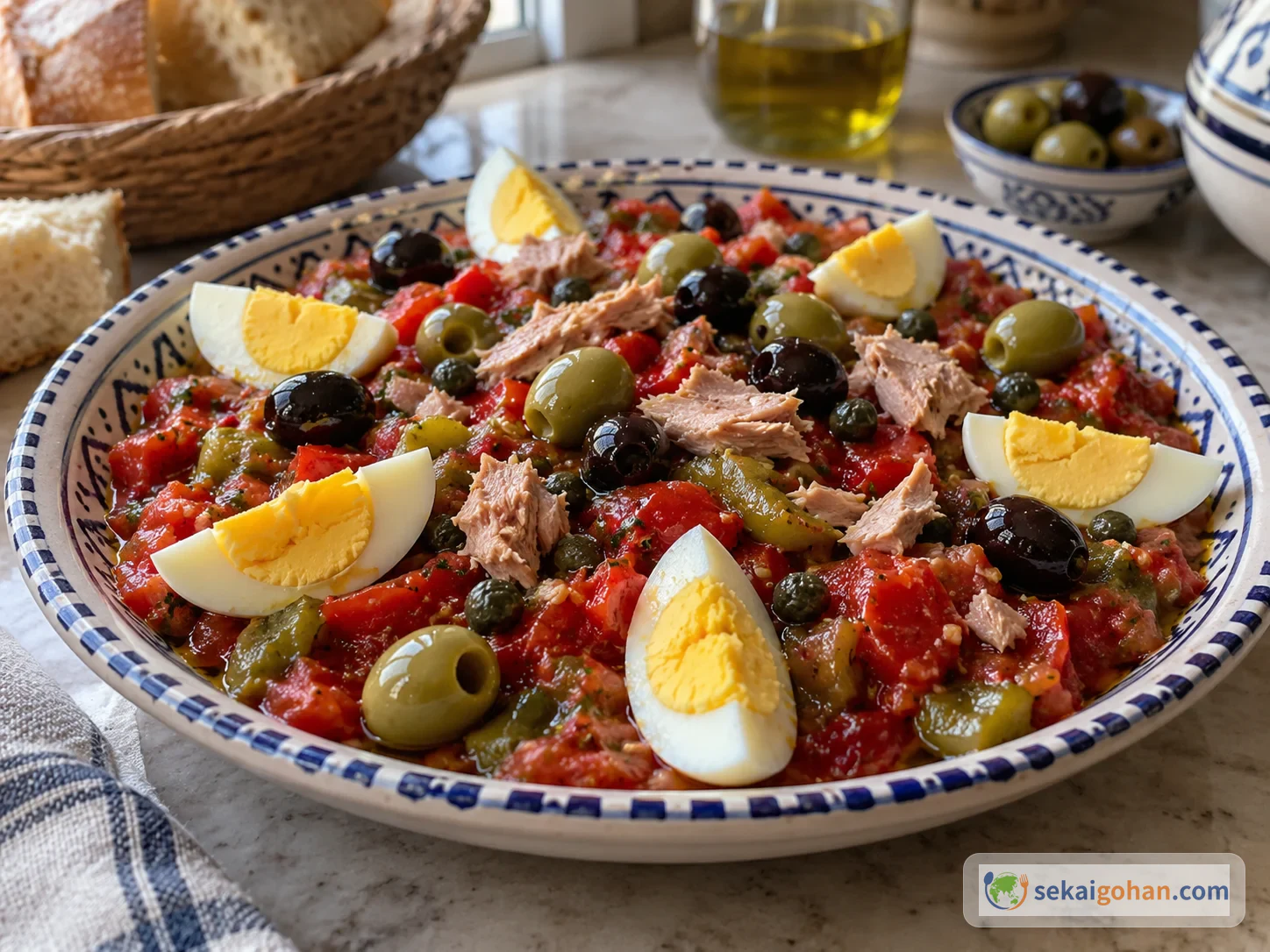
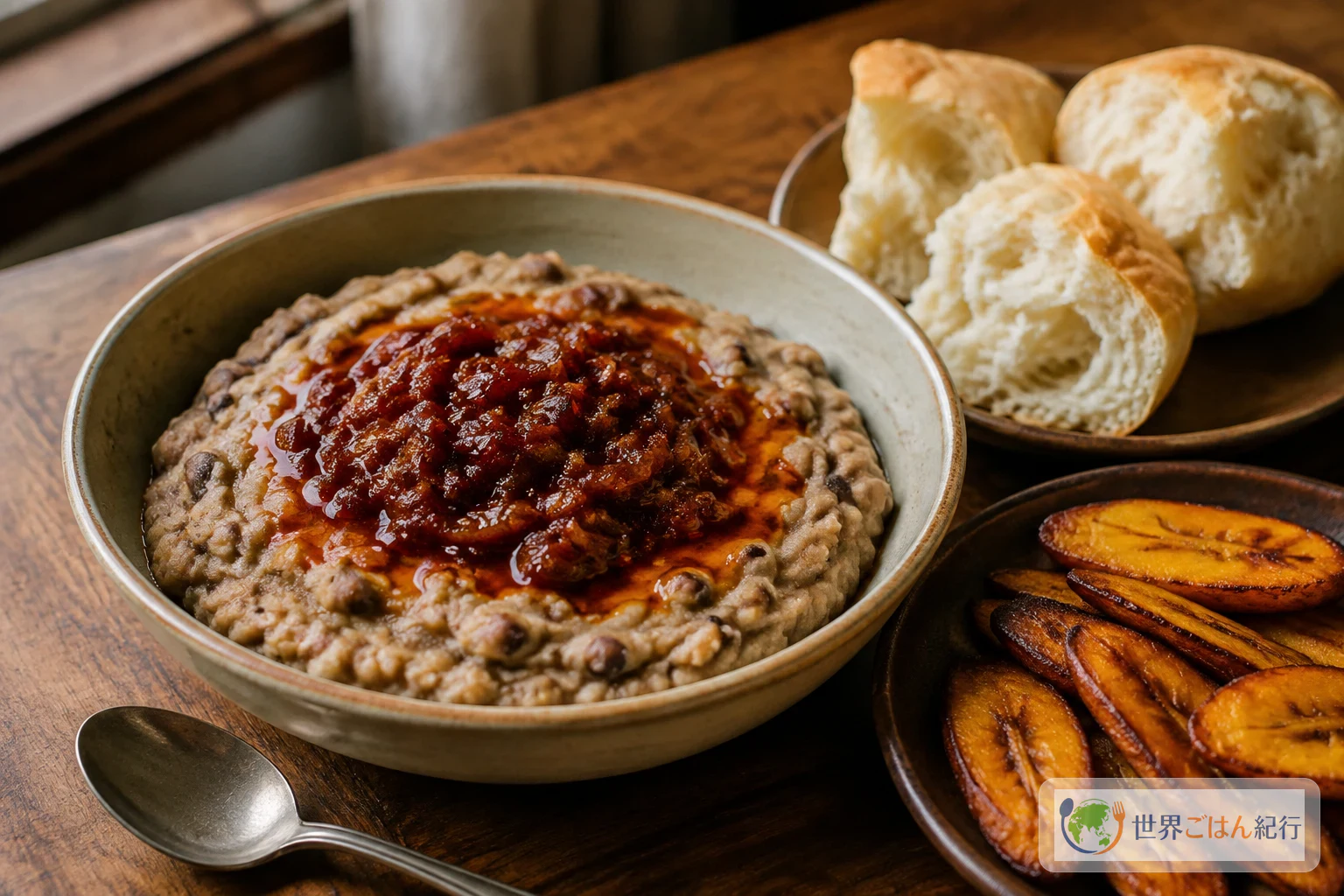
Hot sand and ash are brushed away as the fire dies down, and a round loaf comes out smelling of toasted wheat. It gets broken by hand at the table, then passed around with a tomato and onion sauce, a meat stew, and glasses of mint tea. Taguella is a thick, unleavened flatbread of the Tuareg of the Sahara, and its flavor comes from flour, water, and heat rather than any special spice. It isn't showy, and it sits at the center of the meal for good reason.

Taguella, the Sahara's Sand Bread
Taguella (also written Tagella) is tied to Mali, and it also belongs to the nomadic cultures of the Sahara, including Algeria, Libya, and Tunisia. It is known as a "sand bread": wheat flour or semolina, sometimes with millet, is kneaded with salt and water and baked as a thick disk, with no yeast or baking powder. Locally, a fire bed is made, and once the flames die down to embers, the dough is buried in hot sand and ash, which work as a natural oven.
The sand and ash are there to hold heat. Hot sand supports the underside of the bread, while ash and embers give dry heat from above. That dry heat wrapping the dough from above and below is what the home version recreates with a cast-iron pot, a tawa, or an oven. Once baked, the bread is broken into small pieces and dipped into sauces of tomato, onion, vegetables, or meat.
| What to look at | Local taguella | What the home version keeps |
|---|---|---|
| Flour | Wheat semolina, wheat flour, millet flour, and others | Some semolina and whole wheat for aroma and density |
| Leavening | Unleavened | No yeast or baking powder |
| How it is baked | Wrapped in hot sand, ash, and embers | Dry top-and-bottom heat from a cast-iron pot or tawa |
| How it is eaten | Broken and eaten with sauces, dairy, and tea | With tomato sauce, maafe, or harira |
| Result | Thick, dense, dry on the outside | Fragrant outside and a dense, not floury interior crumb |
Algerian kesra is also a semolina flatbread, but taguella is defined by being buried in sand and ash to bake. Among other staples that catch sauces, Sudanese kisra is a bread of thinly cooked fermented batter, and Tanzanian ugali is grain flour cooked and stirred. Similar names aside, look at how each one uses flour and heat, and the differences are clear.
Ingredients (one 8.5 inches (22 cm) round, serves 4)

Do not make this if anyone at the table has a wheat allergy, since it is a wheat dish. The character of taguella lies in density and browning, not in rise. Too much water makes it more like a heavy steamed dough than a bread, and too little leaves floury patches in the center. The first time, keep to the amounts in the table and limit extra water to 1.5 tbsp (20 ml).
Ingredients and Tools Worth Seeking Out

What is worth looking for in taguella is not meat or onions. It is flour that is hard to buy nearby, a tawa that bakes flat, and a cast-iron pot that stands in for the top-and-bottom heat of sand baking at home. All of them can be used in other dishes, so none is a tool you would use up on taguella alone.
Atta is a finely milled whole wheat flour sold for South Asian chapati. It is not a traditional taguella ingredient, but it is an easy way to add wheat aroma and avoid the monotony of white flour alone.
A tawa is a flat iron griddle for chapati and dosa. In a home version where the taguella is not buried in sand, it is useful as a tool for baking the underside broadly and evenly. Its edge is lower than a frying pan's, so it is also easier to flip a thick dough.
To approach the sand-baking sense of "heat from below and above," a cast-iron Dutch oven is convenient. The heat capacity of the preheated pot dries the surface of the dough while cooking it through to the center.
Choosing Equipment for Taguella at Home
Any heavy pan that holds steady, dry heat can stand in for the sand. Here is how the common options compare.
| Home equipment | Suitable way to bake | Cautions |
|---|---|---|
| Dutch oven | Preheat, use the lid, and build top-and-bottom heat in the oven | The pot is heavy and hot, so use thick oven mitts to move it |
| Tawa | Cover over medium-low heat and flip partway | The underside scorches first. Keep the heat down |
| Heavy frying pan | Use as a stand-in for a tawa | A pan with high sides is hard to flip, so use two spatulas |
| Oven sheet pan | Easy if you just set the dough on it | Top-and-bottom heat is weak, and it takes time for the surface to dry |
For hygiene, never cook in sand from a garden or a park. Use a cast-iron pot or an oven instead.
Common Taguella Problems and Fixes

| Problem | Cause | Fix |
|---|---|---|
| Only the surface is black and the center white | The heat after preheating is too high | Stay at or below 425°F (220°C). On a tawa, lower from medium-low to low |
| The cross-section is gummy and heavy | Too much water, or too little rest | Next time reduce water by 2 tsp (10 ml) and give it the full 25-minute rest |
| The edge splits badly | The dough is dry | Add 2 tsp (10 ml) extra water and rest 5 minutes before shaping |
| The bottom burns | The tawa or pot is thin, or the heat is high | Use a thicker tool and rotate 90 degrees partway through one side |
| A floury smell remains | Heat didn't reach the center | Add 5 minutes after flipping and aim for 199°F (93°C) or more at the center |
A few cracks or patchy browning are fine, since you'll be breaking the bread by hand and dipping it in sauce anyway. The real failures are white streaks of flour at the center, a strong bitter burnt taste, or a loaf so wet it collapses before it can take up the sauce.
Serving and Storing Taguella
Taguella belongs on the table in large pieces broken by hand, not cut with a knife. Dip it into a sauce of lightly simmered tomato, onion, and chili, and the dry outside soaks up the liquid while the dense crumb inside loosens.

With a meat stew, a rich sauce such as Malian maafe or Senegalese chicken yassa suits it well. Other grain staples, like Burkina Faso's tô and Ghanaian fufu, are served in a similar way.
Keep it at room temperature for the same day, in the refrigerator until the next day, or in the freezer for 2 weeks. Chilled bread firms up, so work about 1 tsp of water into the surface with your fingers and reheat 1 1/2 minutes per side in a frying pan over low heat. The microwave alone leaves the center heavy; finish with dry heat to bring the surface back.
FAQ
What if I have no semolina?
You can make it with 2 oz (60 g) more all-purpose flour, though the grainy density and yellowish tint from semolina will be weaker. For a reliable first try, the blend of 9 oz (260 g) all-purpose flour, 2.75 oz (80 g) atta, and 2 oz (60 g) semolina is easiest to handle.
Can I use ordinary whole wheat flour instead of atta?
Yes. Whole wheat flours vary in coarseness by brand, so with a coarse one, add 2 tsp (10 ml) more water and extend the rest by 5 minutes. If the dough splits easily, reduce the whole wheat to 2 oz (60 g) and increase the all-purpose flour by 20 g.
Can I bake it without an oven?
Yes. Preheat a tawa or heavy frying pan 5 minutes over medium-low heat, put the dough in, and cover. Aim for 10 minutes on one side and 8 minutes after flipping, lowering the heat if it looks about to burn. The top heat is weaker than in an oven, so cut it open to check that the center is cooked.
Is it easier to eat with yeast or baking powder?
It becomes easier to eat, but it drifts toward a different bread. Taguella's character is its density: unleavened, thick, and baked in dry heat. Letting the flour absorb water evenly and cooking it through to the center without hurrying gets you closer to the local texture than puffing it up.
Is tomato sauce required?
No. It is served with meat sauces, tomato and vegetable sauces, milk, and tea. A tomato stew, bean soup, lamb or chicken stew, or a mildly spicy vegetable sauce all pair well with it.
Summary
On ingredients alone, taguella is a wheat flatbread. But once you know the idea of burying it in hot sand and ash to bake, you see it is not just bread but a staple suited to the environment of the Sahara. In a home kitchen, skip the sand: let the flour absorb water thoroughly, shape it thick, and build dry top-and-bottom heat with a cast-iron pot or tawa. Keep that much, and you get a dense, fragrant taguella that catches tomato sauce and stews.
When you make it next, don't stop at taguella alone; set it beside maafe or harira. Break the finished bread and eat it while crumbling it a little in the sauce, and you will see that this bread is not just "a staple on the plate" but also a tool that completes the sauce.