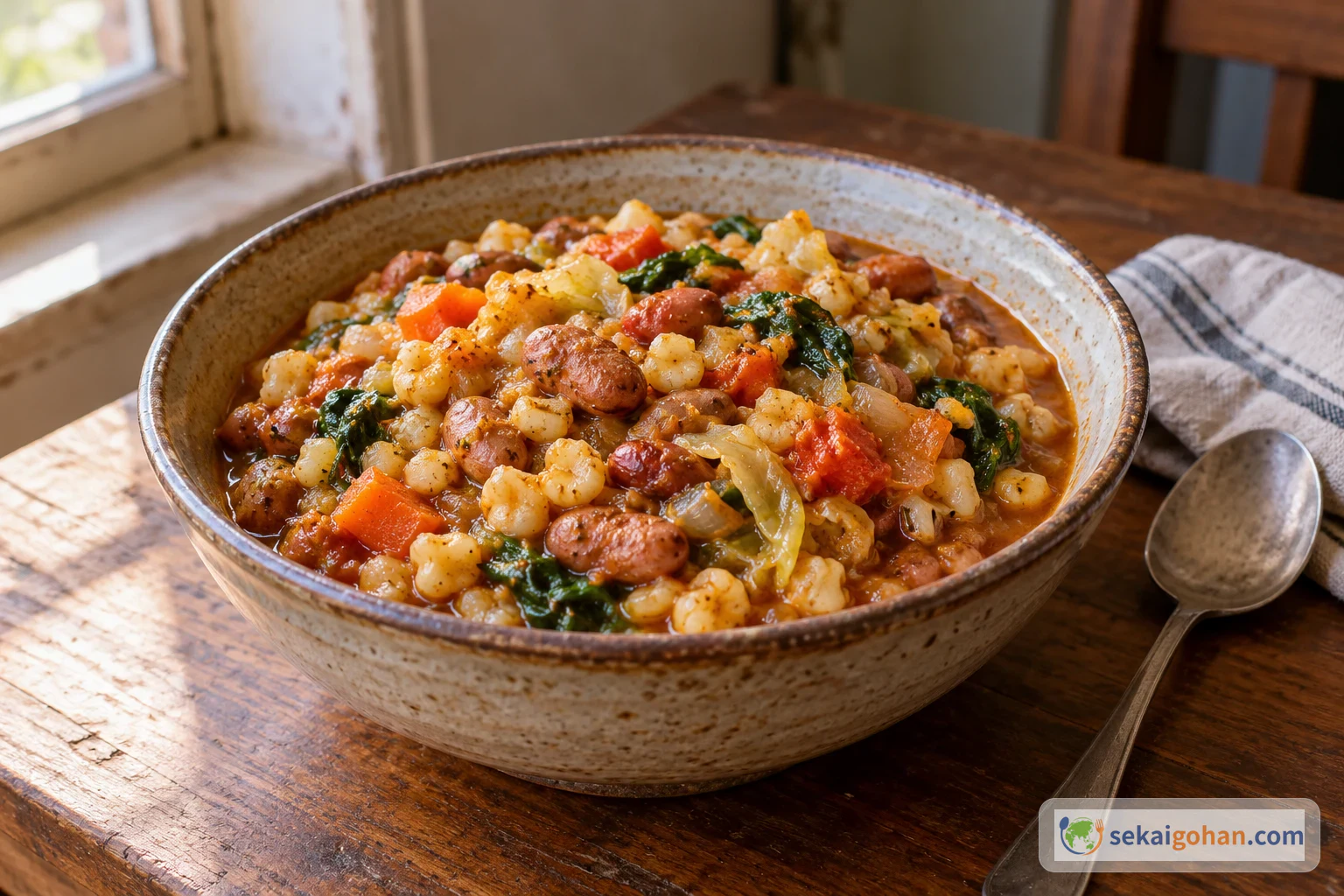
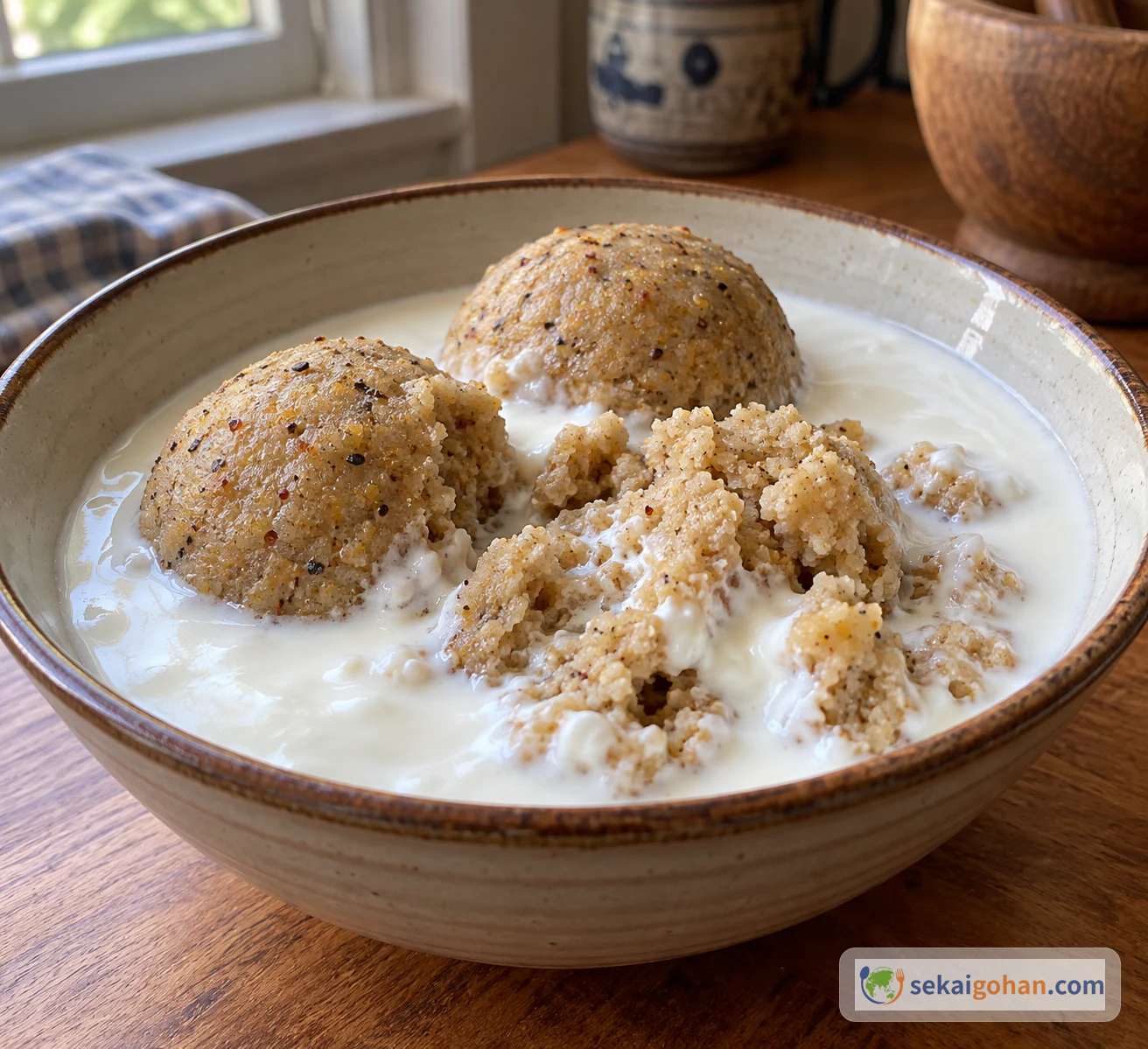
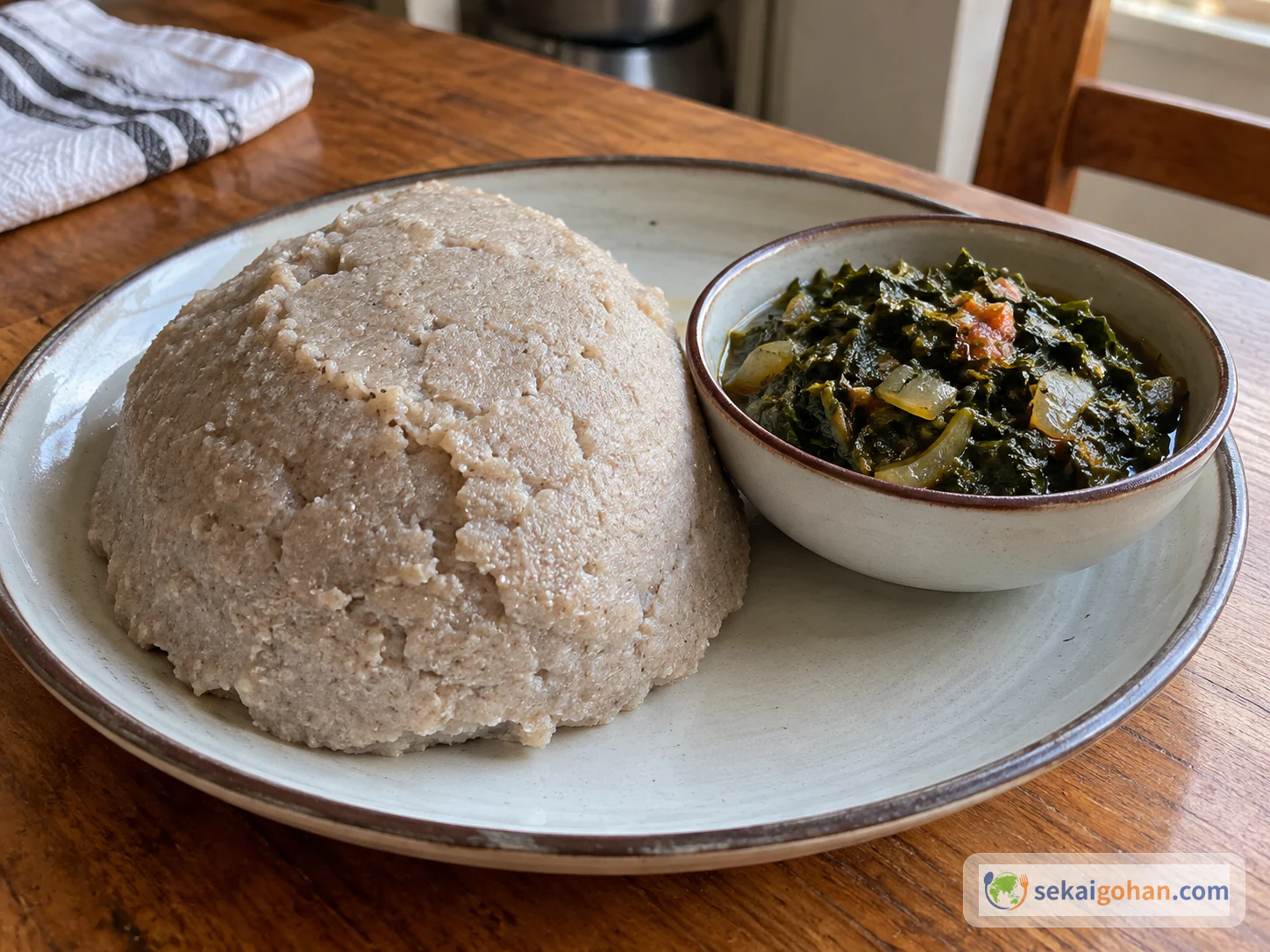
Slide the pot lid aside a little and, behind the sweet steam of the meat, the green aroma of fava beans, mint, and parsley rises. The broth is a greenish one where oil and herbs have mingled, with no tomato red in it. M'soki is a spring vegetable stew from Tunisian and Algerian Jewish households, and it fills a table with sheer quantity: lamb or beef, fava beans, green peas, artichokes, greens, herbs, and matzo, all layered in one pot. You can make it in an ordinary pot at home. The beans and meat simmer until tender, and the green vegetables go in at the end so they stay whole.
M'soki, a Passover Stew from Tunisia
M'soki (Msoki / M'soki) is served at the Passover table. It isn't a flashy street food. It's a home dish where seasonal vegetables go into one big pot and bread or matzo catches the broth. Even among Tunisian dishes, it comes to the table differently from the egg-and-tomato chakchouka or the fried-bread fricassé.
Put it next to North African stews like harira and tagine, or Libya's mafrum, a stuffed meat-and-vegetable dish, and you can see how m'soki makes beans, herbs, and broth work together.
Ingredients (serves 4)
M'soki looks like it has many ingredients, but the idea is simple. The meat makes the stock, the beans add body, and the greens and herbs bring back the aroma. The first time, focus on four items: fava beans, green peas, artichokes, and greens. Add zucchini or celery if you can get them.

Matzo and substitute crackers may contain wheat. Cook the meat all the way through. After stewing, break open a large piece and check that no red remains. Cook beef and lamb to an internal temperature of 145°F (about 63°C). In a stew, also keep cooking until the fibers are tender enough to fall apart.
Choosing Ingredients for M'soki
In Tunisian and Algerian Jewish homes, the pot is full of whatever spring vegetables are in season. Keeping those layers of vegetables matters more than gathering every ingredient. If you hold on to the core of beans, greens, herbs, and matzo to catch the broth, you'll get closer to the dish than by chasing imported ingredients.
Fresh fava beans and artichokes are hard to find year-round, so use what you can get: dried fava beans, frozen fava beans, frozen green peas, and canned artichokes. If you observe Passover strictly, check the certification on the matzo and seasonings separately.
| Element to keep | How to adapt it | What happens if you change it too much |
|---|---|---|
| Fava beans and green peas | Dried fava beans, frozen shelled fava beans, frozen green peas | If the beans are only chickpeas, the green spring aroma weakens |
| Bittersweet artichoke | Canned artichokes. Otherwise turnip plus zucchini | With root vegetables alone, it drifts toward an ordinary meat-and-vegetable stew |
| Greens and herbs | Spinach, chard, komatsuna, parsley, cilantro, mint | Adding the greens early turns them brown and the aroma does not remain |
| Meat stock | Brown beef chuck or lamb shoulder, then simmer | With ground or thinly sliced meat alone, the broth lacks body |
| Matzo to catch the broth | For a non-strict home version, thin crackers or flatbread | Thickening the pot with flour makes it a different stew |
Beans and Artichokes
Meat, onions, carrots, turnips, and spinach are easy to find nearby, so the fava beans are the real shopping job. Dried fava beans give m'soki its true bean flavor. Soaking and simmering them brings out a sweetness that ends up in the broth. Frozen shelled fava beans also work. Canned artichokes from an import store or online are fine.
When you start from dried beans, a pressure cooker saves a lot of time. In a regular pot you tend the beans and meat separately, while a pressure cooker shortens both the first boil and the stew.
Spices
It's tempting to reach for curry powder, but m'soki shouldn't taste like curry. Turmeric gives color, coriander adds roundness, and a little harissa brings heat. Mint and lemon go in at the finish. Buy spices one at a time: for a first try, turmeric and coriander plus a little cumin is enough. Go easy on the powders and bloom them briefly in oil so they stay in the background. Since you only use a little harissa, a substitute paste is fine the first time.
How to Make It: Soften the Beans First, Then Layer In the Spring Vegetables
If you add everything at once, the greens turn brown and the beans stay hard. Add the beans, meat, aromatics, and green vegetables in order, and the spring flavor holds even through a long stew.
For parboiling the beans, cook 15 minutes at high pressure, then let the pressure release naturally for 10 minutes. After browning the meat and blooming the spices, add the beans and 3 cups (750 ml) water and cook 18 minutes at high pressure, then let the pressure release naturally for 10 minutes. After releasing the pressure, add the root vegetables, artichokes, greens, and matzo in the same order as in a regular pot. The beans will be tender while the greens keep their color.
Common M'soki Mistakes and Fixes
Most problems with m'soki come from the order of steps rather than the seasoning. Three mistakes make the spring aroma heavy: adding greens while the beans are still hard, scorching the spices, and adding too much matzo.

| Problem | Cause | Fix |
|---|---|---|
| Hard beans | Too little soaking, too short a first boil, old beans | Before adding the greens, add ½ cup (150 ml) water and extend the low-heat simmer by 20 minutes |
| Brown greens | Added too early, or cooked over high heat | Next time, add them for the last 6 minutes. This time, add aroma with mint and lemon |
| Bitter spices | Scorched the powders over high heat | Fry the spices for 3 minutes over medium-low before adding water. Don't scrape the scorched pot bottom too hard |
| Watery | Lid closed too tightly, or too little matzo | Remove the lid and reduce for 5 minutes over medium heat, and add 1/2 sheet of crumbled matzo |
| Thick and heavy | Too much matzo | Add ½ cup (100 ml) hot water and 1 tsp lemon juice and thin over low heat for 3 minutes |
Matzo is there to catch the broth and make the stew easy to eat, more than to thicken it, and too much in the pot makes everything heavy at once. Crumble in 2 sheets, let it rest 5 minutes, and then decide. Break more over each plate at serving so everyone can set the thickness they like.
Serving and Storing M'soki
How to Eat It
At Passover, m'soki is eaten with matzo. At home, flatbread or lightly toasted baguette can also catch the broth. Spoon it over rice and it quickly turns into just another stew. To keep m'soki's character, put the bread or matzo on a separate plate and scoop up the broth with a spoon.
Leave the heat out of the pot. Put the harissa in a small dish so people taste the green aroma of the broth first and add heat afterward, which protects the sweetness of the beans and herbs. Lemon works the same way: squeeze a little over each plate rather than adding it all to the pot.
Menu Ideas
For a full Tunisian table, start with a small amount of chakchouka and add small pieces of fricassé as a light fried bread. You can taste how tomato, beans, and bread connect. For a wider North African menu, skip the couscous on m'soki days and let bread catch the broth directly. The meal stays lighter.
Storage and Reheating
On the day you make it, turn off the heat, let it cool slightly, and move it to shallow containers within 2 hours. It's a stew with meat and beans, so finish it within 2 days in the refrigerator. With a lot of matzo in it, it gets quite stiff by the next day. If you plan to make it ahead, put only half the matzo in the pot and break in the rest when you eat.
To reheat on the stove, move it to a pot, add 3 tbsp water or stock, cover, and warm over low heat for 6 minutes. When steam rises through the center, stir once from the bottom, then boil off excess liquid for 1 minute over medium heat. In a microwave, add 1 tbsp water per serving, heat at 600 W for 2 minutes, stir, and heat 1 more minute.
You can freeze it, though the greens and artichokes lose a little texture. Portion it out and leave out the matzo before freezing. Once it's thawed and warm, add the matzo, mint, and lemon. Another time-saver is to freeze just the beans and meat base. Next time, add the greens and the stew comes together much faster.
Frequently Asked Questions
Can I make it with frozen fava beans?
Yes. Use 9 oz (250 g) frozen shelled fava beans, skip the soaking and first boil, and add them in step 4 in place of the parboiled beans. Frozen fava beans are soft and fall apart if simmered for 45 minutes. Stew the meat for 45 minutes first, then add them with the root vegetables so they keep their shape.
Are chickpeas required?
No. A small amount keeps the bean body steady when you make it elsewhere. On days when you have plenty of spring fava beans, leave out the chickpeas and add more fava beans and green peas for a lighter result.
What if I cannot find artichokes?
If you can't find canned or frozen artichokes, add 1 more turnip and 1 zucchini cut into 1 inches (2 cm) half-moons for the last 18 minutes. You won't get artichoke's bittersweetness, but the volume of spring vegetables and the way the broth is caught come close. For more texture, add 2.75 oz (80 g) cooked bamboo shoots.
Is it not m'soki without matzo?
For a strict Passover meal, matzo matters. If you're making it at home to get to know the flavor, thin unsweetened crackers or flatbread also catch the broth. Keep the amount in the pot modest, and add more on the plate if needed.
Can I make it without meat?
You can, but the broth will be thinner. Leave out the meat, add 1 tbsp more olive oil, and cook the onion for 12 minutes over medium heat to bring out its sweetness. Use 3¾ cups (900 ml) vegetable stock in place of the water. Add a few more beans, and use more lemon and mint at the end so the broth still tastes full.
Is it good made the day before?
The bean and meat base gets better made the day before. Go as far as step 3, then stew the meat and beans. On the day, add the root vegetables, artichokes, and greens, then the mint, lemon, and matzo. You get the depth of a day-old stew and the fresh aroma of the spring vegetables.