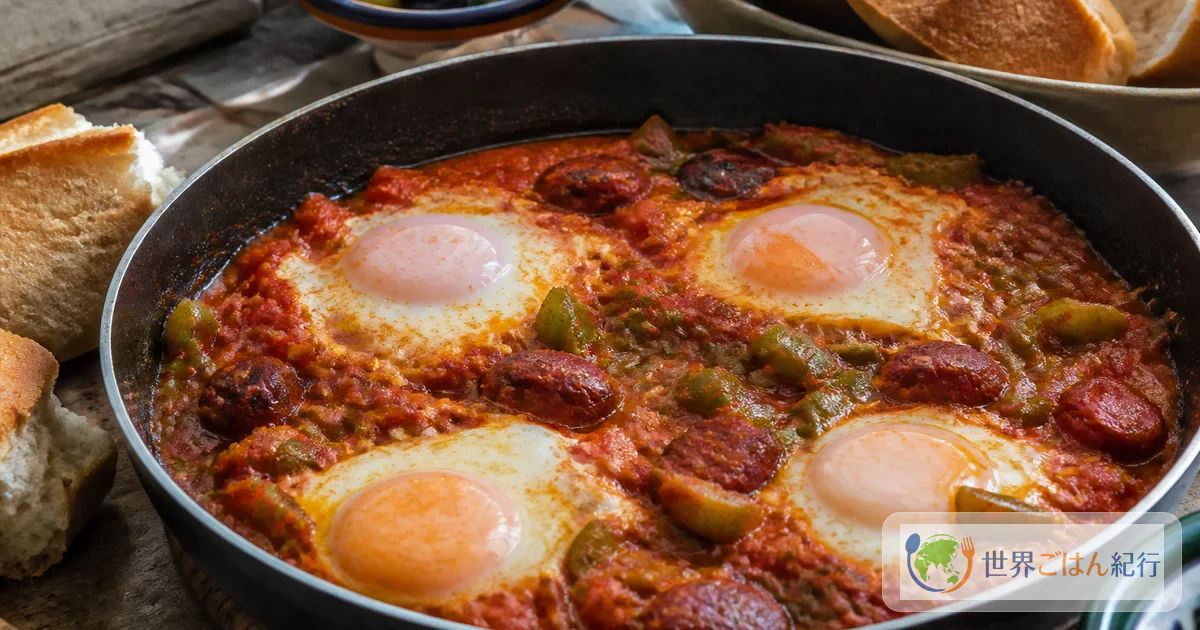
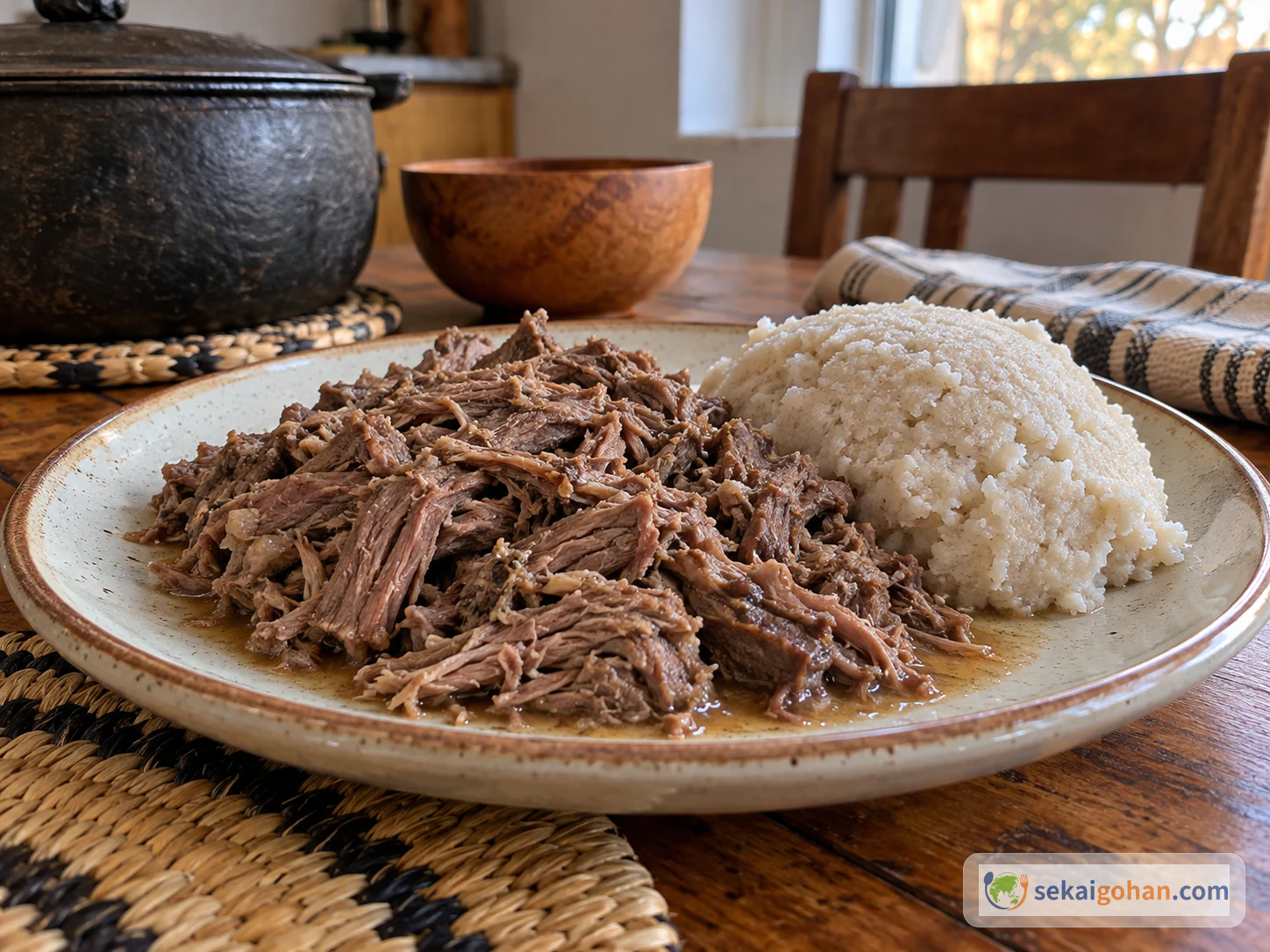
Lift the lid and the scent of tomato, cumin and sweet paprika rises in a wave. The surface looks like a red stew, but break it with a spoon and a meat filling comes out from inside the potato. That first-bite surprise is the fun of mafrum, a Libyan Jewish home dish of vegetables stuffed with herbed ground meat, coated, fried and simmered slowly in tomato sauce. Like Tunisian chakchouka and Moroccan tagine, it brings the smell of a North African kitchen, where tomato and spices cook for a long time, into your everyday pot.
About mafrum, the Libyan stuffed potato
Origin and names
Mafrum (مفروم / Mafrum, Mafroom) is well known in Libyan Jewish homes, and similar dishes are made in Tunisian and Israeli homes too. Libyan kitchens sit where Arab, Mediterranean, Jewish diaspora and Italian influences cross, and serving mafrum over couscous suits that crossroads. The couscous soaks up the sauce and becomes a bed of tiny grains under the potato.
Meat is the star, yet the dish doesn't rely on meat alone. The thickness of the potato, the tomato sauce and the couscous all catch the filling, so even a small amount of ground meat feels satisfying. That's the way of Maghrebi stuffed dishes, which stretch a plate with vegetables and grain rather than with lots of meat.
Why potatoes
The vegetable changes from home to home, and traditional recipes stuff eggplant, zucchini and cauliflower as well as potatoes. Potatoes are the easiest place to start. They hold their shape, support the filling well and are still substantial enough to anchor the table after simmering, while eggplant soaks up oil and zucchini releases water. Save those for when you're used to controlling the heat.
Four points that keep it together
Mafrum takes a little more care than ordinary stuffed vegetables. Cut the potato into a pocket rather than all the way through, stuff it without overfilling, firm up the surface by shallow-frying, then cook it slowly in tomato sauce over low heat. Follow that order and nothing falls apart in the pot, and each piece sits neatly on the couscous when you serve it.
| Authentic feature | Home adaptation | Can it be substituted? |
|---|---|---|
| Potatoes cut into pockets | Cut waxy potatoes thick and leave one side attached | Keep this |
| Herbed meat filling | Beef-and-pork ground meat with parsley, cilantro and onion | Lamb is closer to the traditional flavor |
| Fried in a red coating | A thin set coating of egg, tomato paste and flour | Keep the coating thin |
| Simmered in tomato sauce | Simmer gently for 35 minutes or more | Avoid short, high heat |
Ingredients (serves 4)

The list looks long, but the only genuinely special items are ras el hanout, couscous and, if you can find it, harissa. Potatoes, ground meat, onion and canned tomatoes are available at any ordinary supermarket.
This dish uses beef, pork, egg and wheat. Because it is a ground-meat dish, make sure the center reaches 167°F (75 °C) or higher after simmering, and holds there for at least 1 minute.
Choosing ingredients for mafrum
Ordinary ingredients get you quite close, but ras el hanout and couscous make the plate suddenly feel much more North African. Those two are what's truly worth buying the first time: the couscous catches the sauce, and you'll reach for the ras el hanout again and again. A thermometer earns its place as well, since it lets you check safely that the center of the ground meat is cooked.
Harissa is a heat adjuster here, not the star. Rather than putting it up front as in Tunisian cooking, dissolve just 1 teaspoon in the sauce and add more at the table if needed, which is easier for a family to eat. It's handy if you find it at a Middle Eastern or specialty grocer, but a small stand-in paste of chili flakes, sweet paprika, garlic and olive oil works fine for a first try.
Common mafrum problems and fixes
The most common failure is the potatoes opening in the pot and the filling escaping into the sauce. The cause is usually one of four things: the cut is too deep, the potatoes are overstuffed, the shallow-frying was too light, or the simmering heat is too high.
| Problem | Cause | Fix |
|---|---|---|
| Potatoes open | The joint on one side is too thin | Leave them alone in the pot and spoon sauce over to simmer |
| Filling is hard | Overmixed, too many breadcrumbs | Next time cut the breadcrumbs to 15 g and keep the onion's moisture |
| Coating peels off | Too much flour, egg coat too thick | Let the peeled coating dissolve into the sauce rather than putting it back |
| Sauce is watery | The lid was kept fully closed | Remove the lid and reduce for just 5 minutes over medium-low heat |
| About to scorch | Sauce at the bottom is too thick | Add 3.5 tbsp (50 ml) water along the side of the pot and scrape the bottom lightly with a wooden spoon |
Even if a few pieces lose their shape while frying, the flavor is still there. Put the broken ones at the edge of the pot instead of the center and simmer without touching them. A bed of couscous on the plate hides a little breakage, too.
Serving and storing mafrum
Storing and reheating
Mafrum tastes more blended the day after you make it. Once it has cooled a little, put it in a shallow container with its sauce and eat it within about 2 days from the refrigerator. You can freeze it, though the potato turns a little mealy; if you do, wrap each piece separately in plastic and keep the sauce in its own container.
A small pot reheats it better than the microwave alone. Put the sauce and 2 tbsp water in the pot and warm over low heat for 5 to 7 minutes, then once it's hot in the center, remove the lid for the last 30 seconds to cook off some moisture. In a microwave, heat at 600 W for 2 minutes, turn the pieces over, and heat for 1 1/2 minutes more.
What to serve with it
Mafrum with couscous, a chopped salad, and yogurt or tahini sauce makes an easy meal. For the same spice profile, try Moroccan couscous; for another tomato stew, chakchouka; and for a lighter fried dish to compare, Egyptian ta'ameya.
If you like rich meat-and-tomato dishes, Mali's mafe and Nigeria's suya are good next plates. Mafrum is stuffed and simmered, mafe is simmered with peanuts, and suya is grilled with ground spice, so each builds aroma from few ingredients in its own way.
Frequently asked questions
Q1. Can I use starchy potatoes instead of waxy ones?
You can, but they split more easily when simmered. Cut them 0.5 inches (1.5 cm) thick, shallow-fry a full 3 minutes per side before simmering, and avoid turning them over in the pot.
Q2. Does it not taste authentic without lamb?
Lamb brings the aroma closer, but a beef-and-pork blend makes a perfectly good version at home. If you use lamb, replace only 3.5 oz (100 g) of the 12.5 oz (350 g) ground meat so the smell doesn't get too strong.
Q3. What if I don't have harissa?
Mix 1/4 tsp chili flakes, 1 tsp paprika, a little garlic and 1 tsp olive oil, and put just 1 tsp into the pot. It won't smell identical, but it makes up for the heat and the red aroma.
Q4. Can I make it in the oven instead of frying?
Yes, though the toasty flavor of the coating is a little weaker. Arrange the potatoes on a lightly oiled baking sheet and bake at 200 °C (400 °F) for 10 minutes, turn, and bake 8 minutes more before simmering in the tomato sauce. If they're pale, searing the surface in a frying pan for just 30 seconds helps them hold together.
Q5. Does rice work in place of couscous?
It does. Over rice, loosen the sauce with 2 tbsp water over low heat rather than reducing it thicker; it's easier to eat that way. The dish then gets close to a Western-style meat-and-potato stew, so add plenty of lemon and parsley.
Q6. How much can I do the day before?
Only the tomato sauce; make it and refrigerate it. Mixing the filling and cutting the potatoes are safest on the day, so start by cutting, stuffing and shallow-frying, which keeps the aroma and texture from fading.