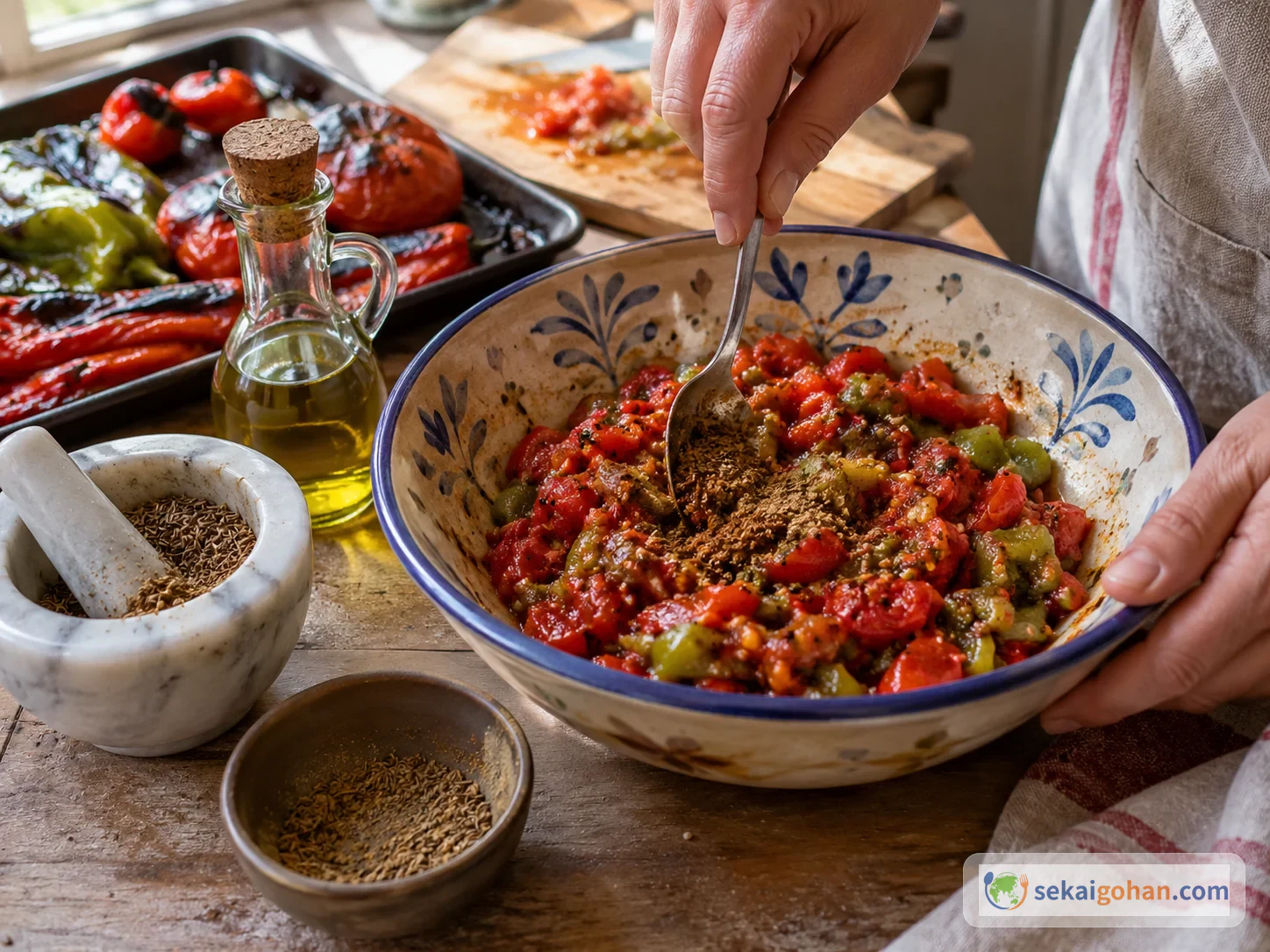
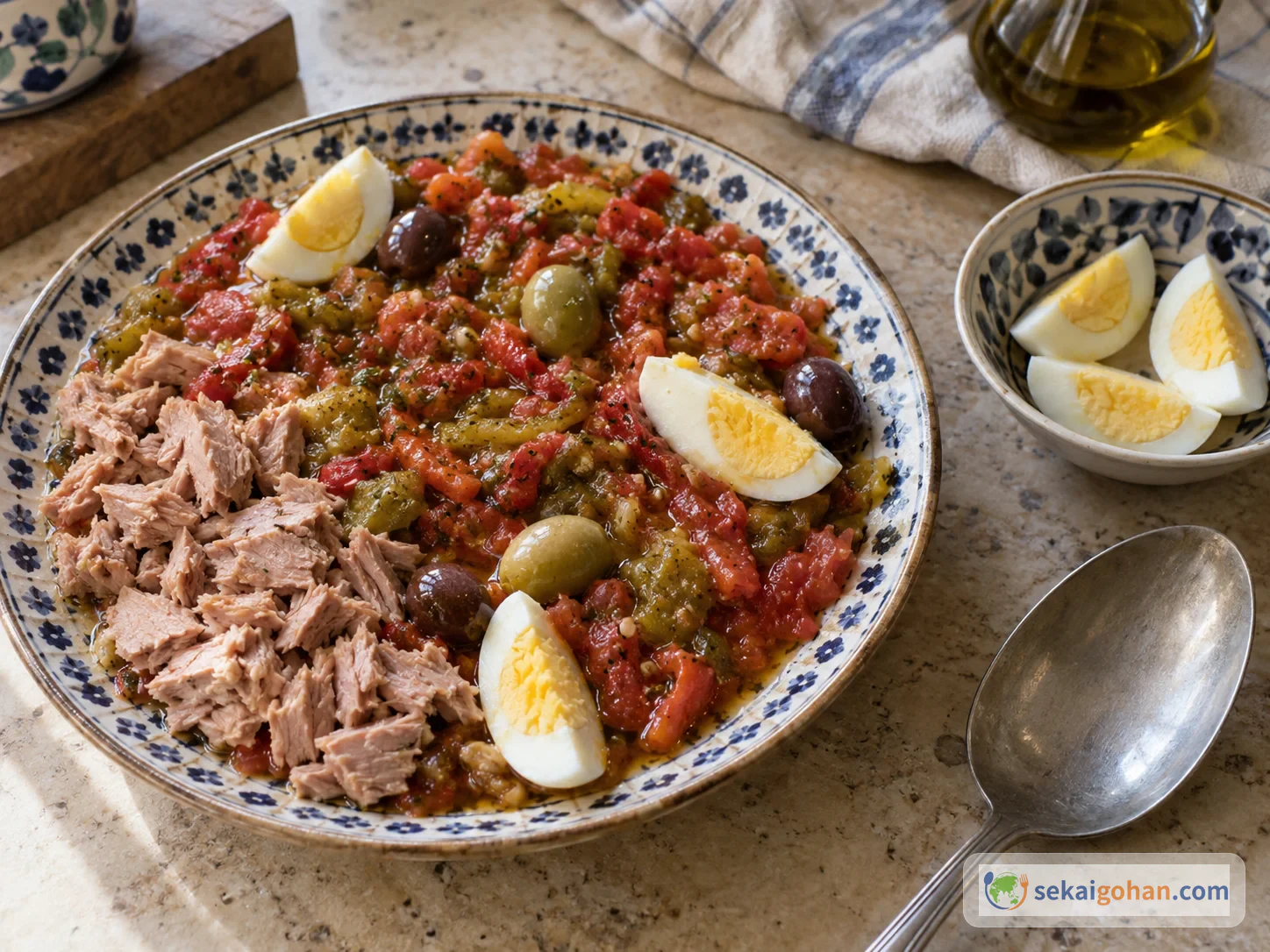
In Tunisian home kitchens, peppers go over an open flame or into the oven until their blackened skins slip off easily. The soft flesh is chopped with a knife, and eggs and tuna come to the table alongside. Slata mechouia (salade méchouia) is a salad you roast first and chop afterward, then serve cold, and the roasting gives it a toasty flavor. Peppers and tomatoes are easy to find in Japan; what trips people up is moisture and the spices. Peel and drain, crush the caraway finely, and you have most of it. For 4 servings, plan on 25 minutes of prep, 35 minutes of heat and about 60 minutes in all, plus oven preheating and chilling. The eggs can boil while the vegetables roast.
About slata mechouia
Méchouia means "grilled," so this salad starts from cooked vegetables rather than the raw plate you picture when you hear "salad." Salade méchouia and slata mechouia are two names for the same dish. You roast the vegetables, peel them, chop them and dress them with oil, in that order. The result has little in common with a salad of diced raw tomato and cucumber.
The roasting can happen over charcoal, over a stove flame, in the oven or on an outdoor grill, and the chopping with a knife or a food processor. Whatever the tool, the roasted vegetables are always peeled before use. Because it can be made in an oven, it works in a home kitchen anywhere.
Versions differ from cook to cook, especially in the heat of the peppers, the share of tomato and the spices. The next section covers how to handle each one at home.
Ingredients (serves 4)
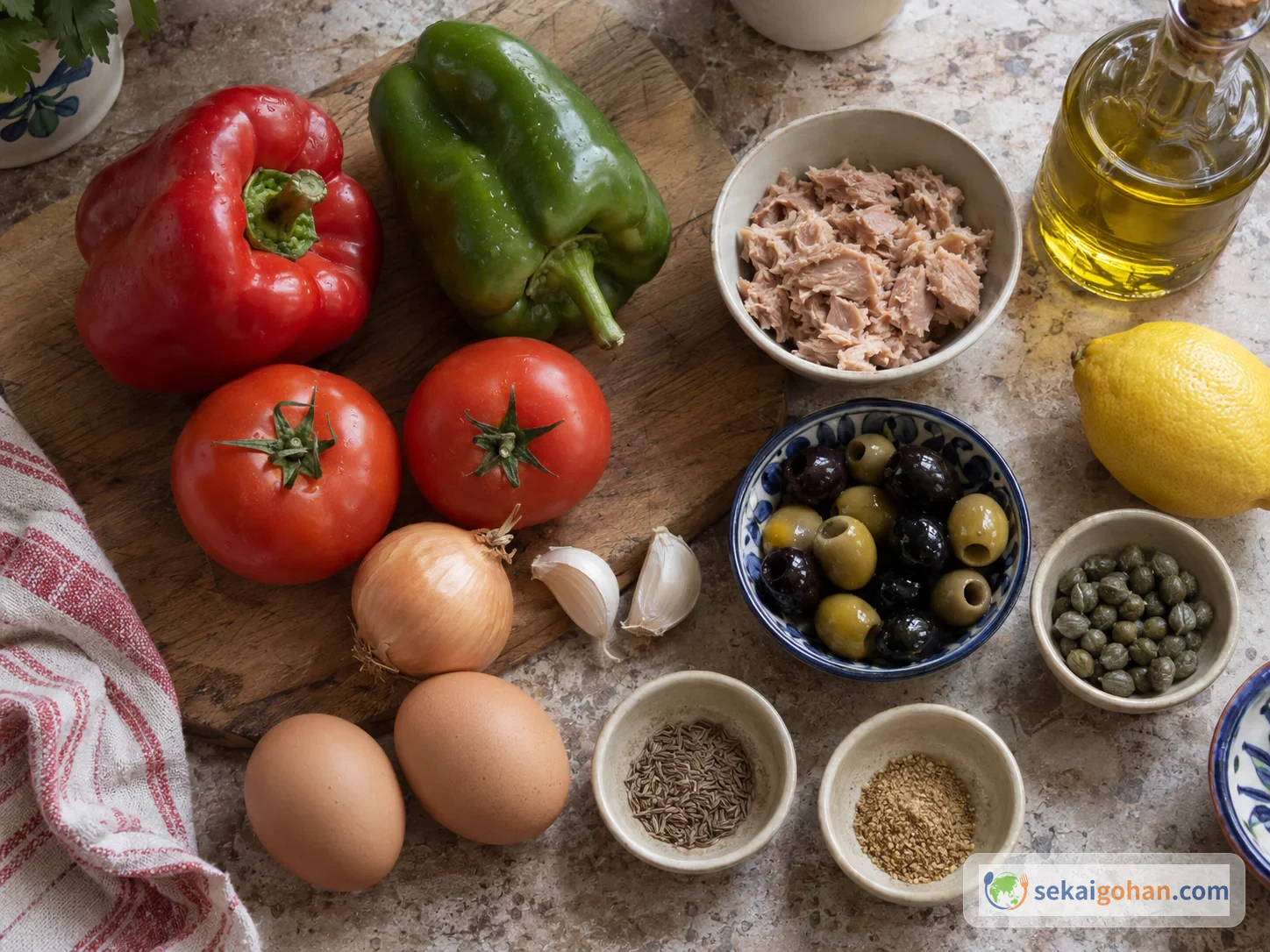
This proportion is adjusted for a home kitchen. The base is 1.25 lb (600 g) in total of red and green bell peppers, about 1–2 of each, and when you mix in small green peppers, match the total weight. Tomatoes are about 2 medium for 10.5 oz (300 g), and onion is 1/2–1 small for 3.5 oz (100 g). Bell pepper sizes in stores vary quite a lot, so match the vegetables by weight. The 4 servings is an amount for an appetizer or side dish, and the quantity of bread to serve with it as a staple is listed separately in the table. Bread is not included in the nutrition calculation.
Look for caraway seeds under their general name, and measure after crushing them. Whole seeds make the aroma uneven bite by bite, so crush them fine and mix them through. Ground coriander is powder from the dried seeds, not fresh cilantro. Don't swap the ground seed for the fresh leaf; using fresh leaves in the same amount gives a different flavor. If you skip the caraway, use 1 tsp coriander in total instead. The taste will be different.
Thick-fleshed peppers keep plenty of flesh even after peeling. Small green peppers dry out down to their thin flesh if roasted too long, so check them early. Red and green are not required together. Made with only red, the sweetness and color change; mixing in green adds the flavor of green vegetables.
Choosing peppers, tomatoes and spices
Some versions use sweet peppers, and others use hot chilies such as meski (the milder type) and ba9louti (the hot type). Neither is the same as Japanese green peppers. The salad can be made entirely with sweet vegetables. If you mainly use sweet Japanese bell peppers and add heat separately, everyone at the table can set their own level.
The amount of tomato varies, too: some cooks use 10 peppers to 2 tomatoes, others 4 to 3, and others 4 to 5. Vegetable sizes differ and Japanese bell peppers are large, so go by weight rather than counts. Here that means 1.25 lb (600 g) of peppers to 10.5 oz (300 g) of tomatoes. More pepper brings out the taste of the flesh. More tomato adds moisture and acidity.
Carvi is caraway and coriandre is coriander, two separate spices. Caraway and cumin are different things as well. Some versions pair caraway with coriander, others coriander with paprika. This recipe uses lightly crushed caraway seeds with ground coriander.
You can crush it in a mortar called a mehrass, or chop it finely with a knife or a manual or electric tool. Crush it smooth or leave some grains, depending on your taste. There is no single authentic texture.
Method
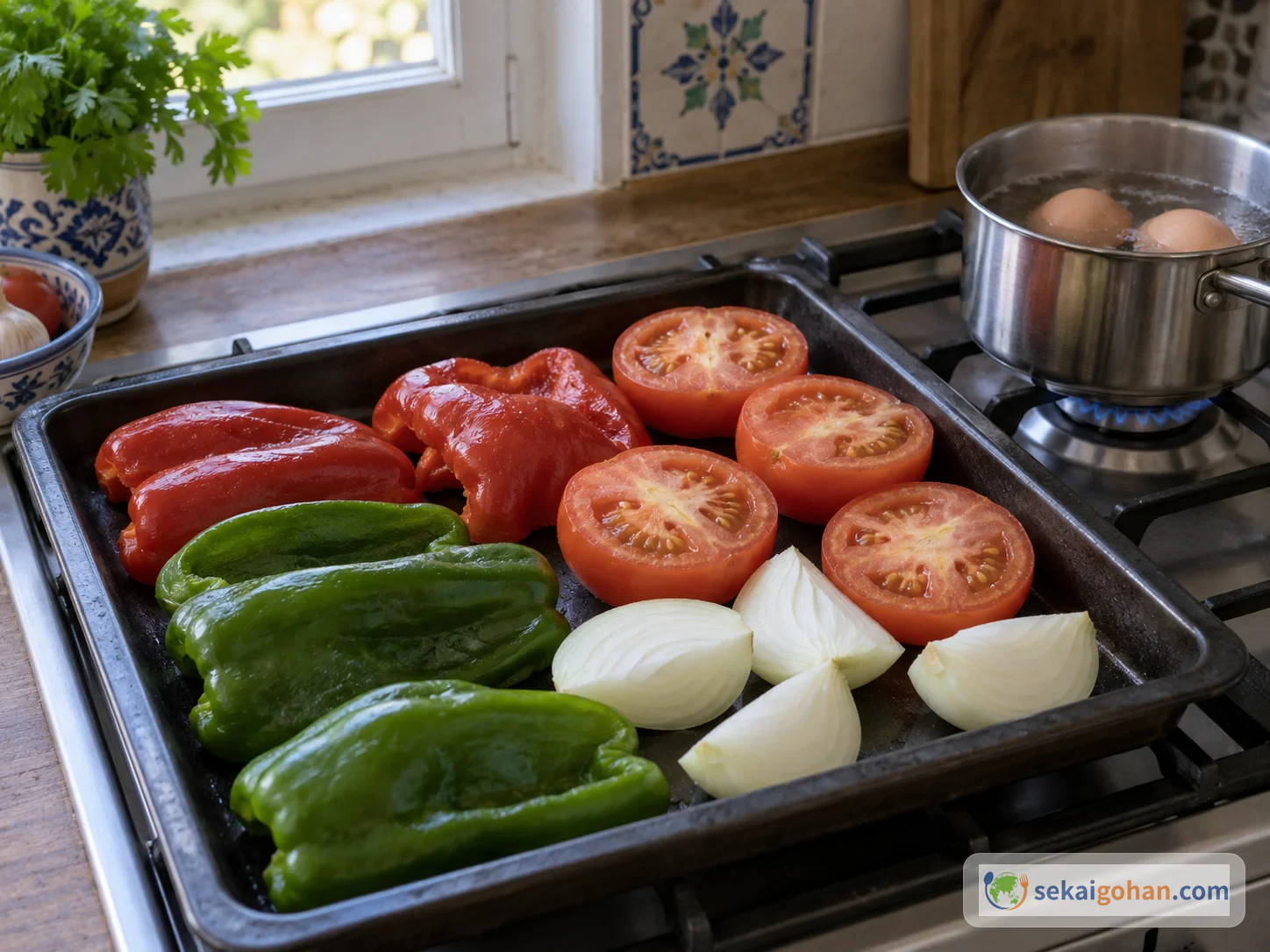
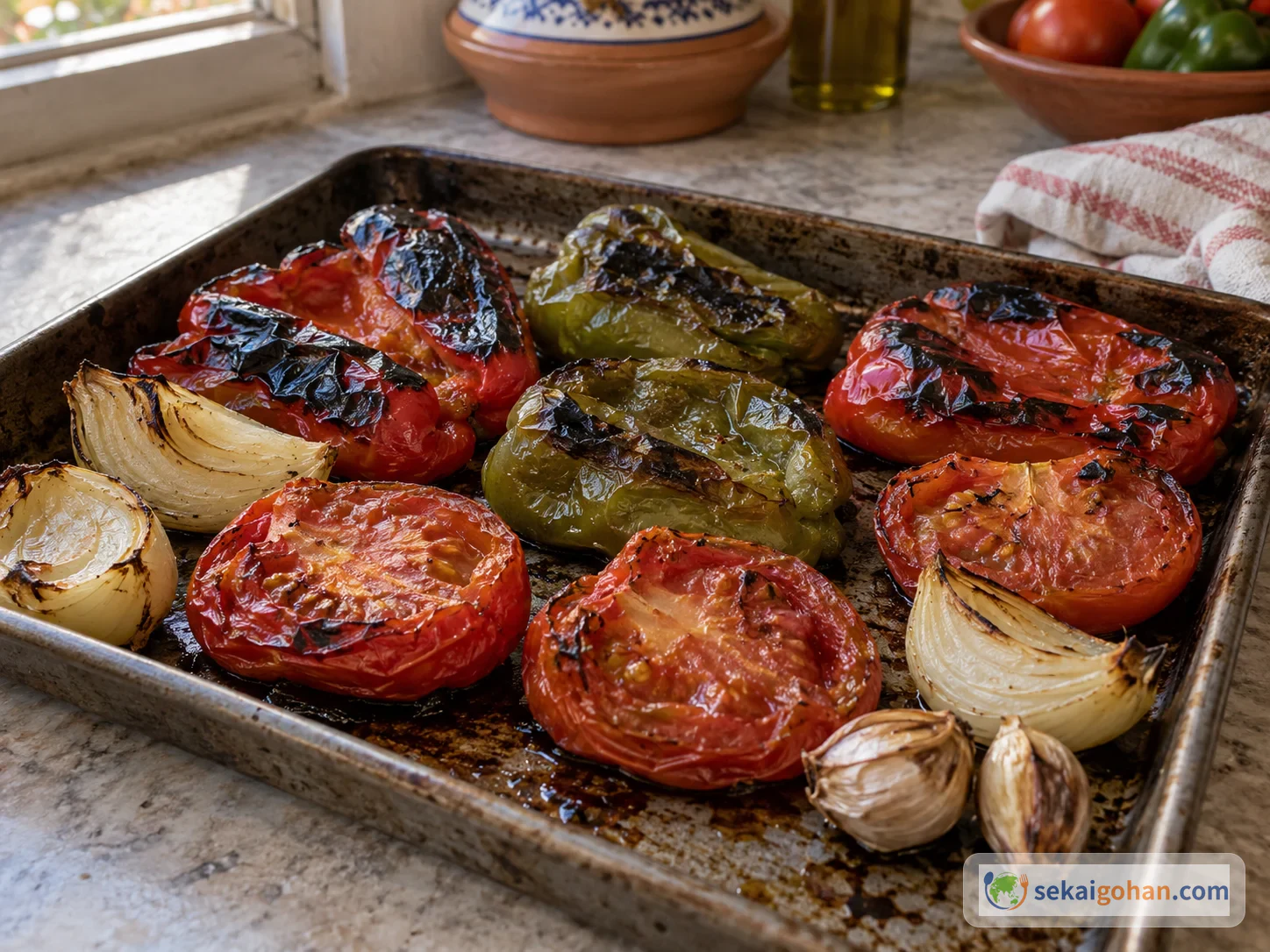
Preheat the oven to 220°C (430°F) and plan on 25–35 minutes of roasting, not counting preheating and chilling. Don't go by the clock alone; the appliance and the size of the vegetables change the timing. Look at the skin and flesh more than the roasting time. An overhead grill chars faster, so don't use the same time as an ordinary oven or it will burn. Follow the appliance's instructions. If you roast over charcoal, don't use the oven's time as is.
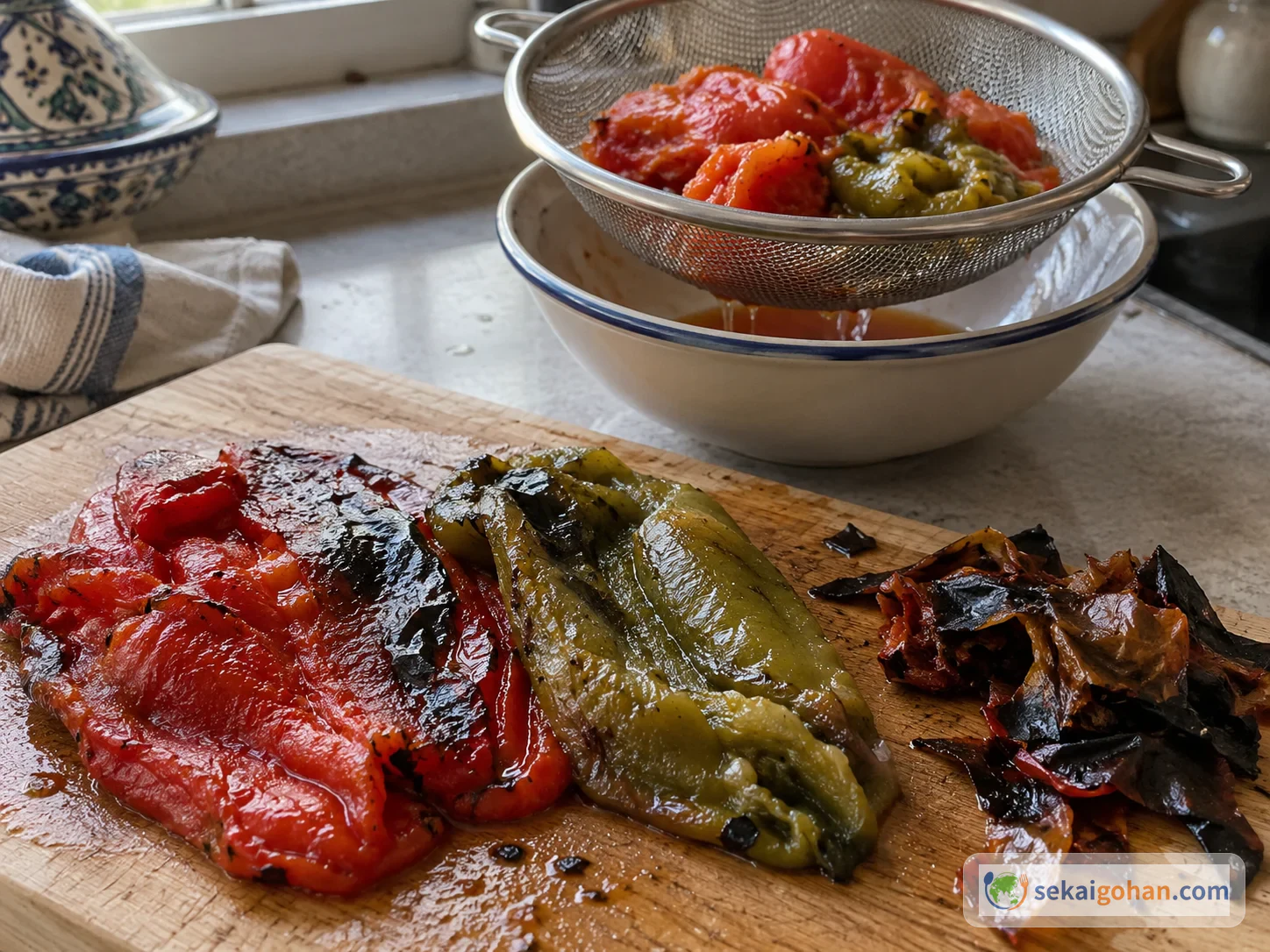
Drain before adding oil, so you don't pour away oil and liquid together later. If liquid builds up before you dress it, drain it again in the sieve for 2–3 minutes. After dressing, remove a little of the excess liquid with a spoon. Either way, don't squeeze the flesh in your fist.
If there are many bits of black skin, remove them before dressing. Cut away thinly any flesh that was roasted until burnt. Don't try to char underdone vegetables over high heat after chopping them. Think of roasting them soft and chopping and dressing them as separate steps.
Be careful not to burn yourself on the baking sheet, the vegetable juices or the steam when you open the bowl. Use oven mitts and tongs, and wait until the vegetables are cool enough to touch. Wash your hands, tools and counter that touched raw egg. Cook eggs until both white and yolk are set. Keep the clean tools you cut vegetables with separate from those that touched raw egg.
Slata mechouia problems and fixes
Most problems come from too much liquid, too much char or overprocessing. Peel off the blackened skin and use only the flesh inside, with no more than a trace of char mixed in.
| Problem | Likely cause | How to recover |
|---|---|---|
| Liquid pools on the plate | Mixed in too much tomato juice or baking sheet juice | Return it to the sieve before dressing. After dressing, remove the excess liquid with a spoon |
| Bitter | Too much black skin or burnt garlic | Remove before dressing. Once mixed in it can't be removed, so dilute it with more roasted vegetables |
| Salty | Added up the saltiness of the tuna, olives and capers | Add undressed roasted vegetables. Don't try to dilute with oil alone |
| No grains, watery | Ran the blender continuously | It won't return to grains. Add separately chopped roasted pepper |
| The vegetables are hard | Underheated for the size or the oven | Return to the oven before chopping and add 5 minutes at a time |
Overdone the spices? Add more roasted vegetables to dilute them, which works better than adding oil.
Serving and storing slata mechouia
How to serve it
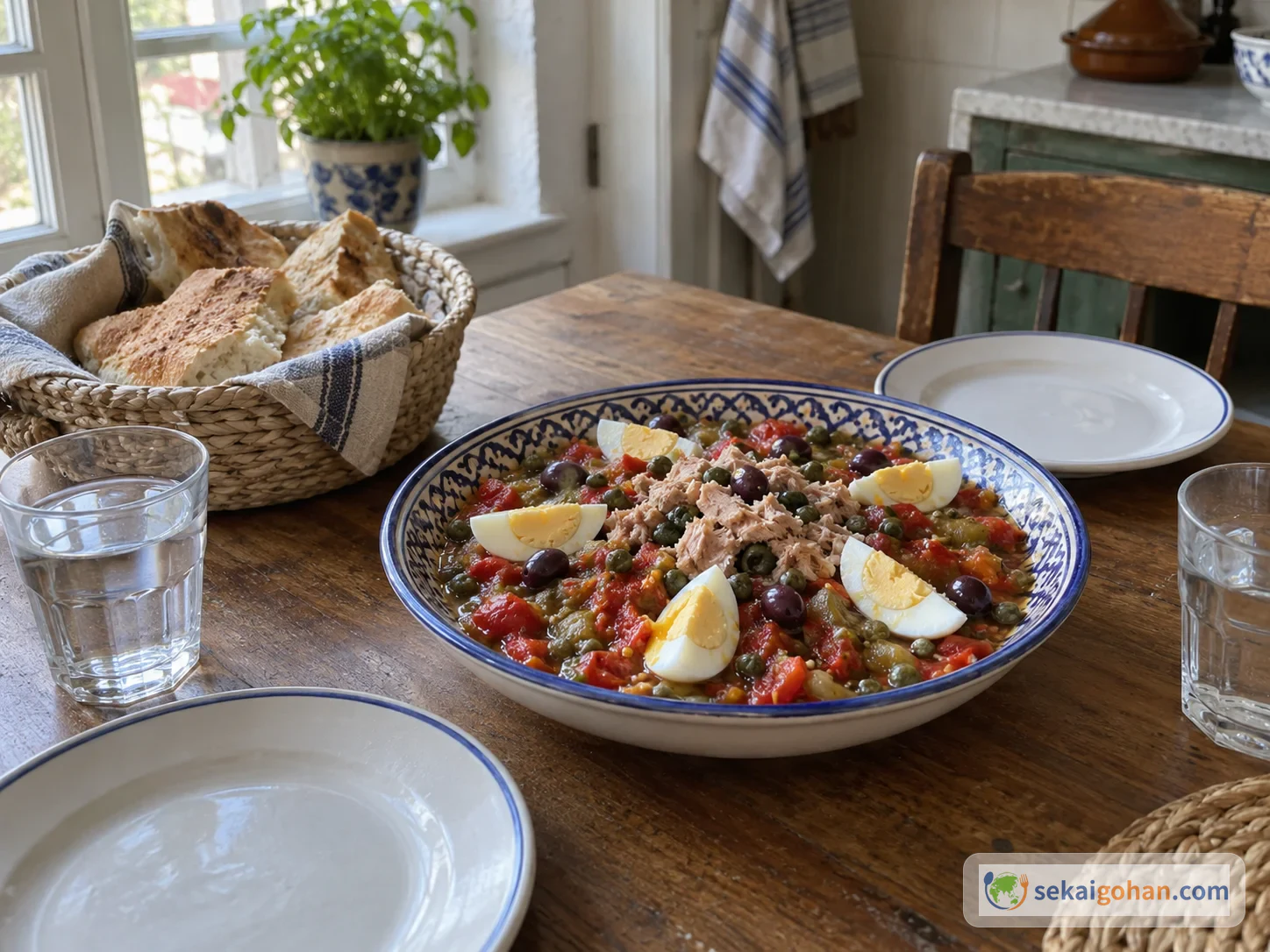
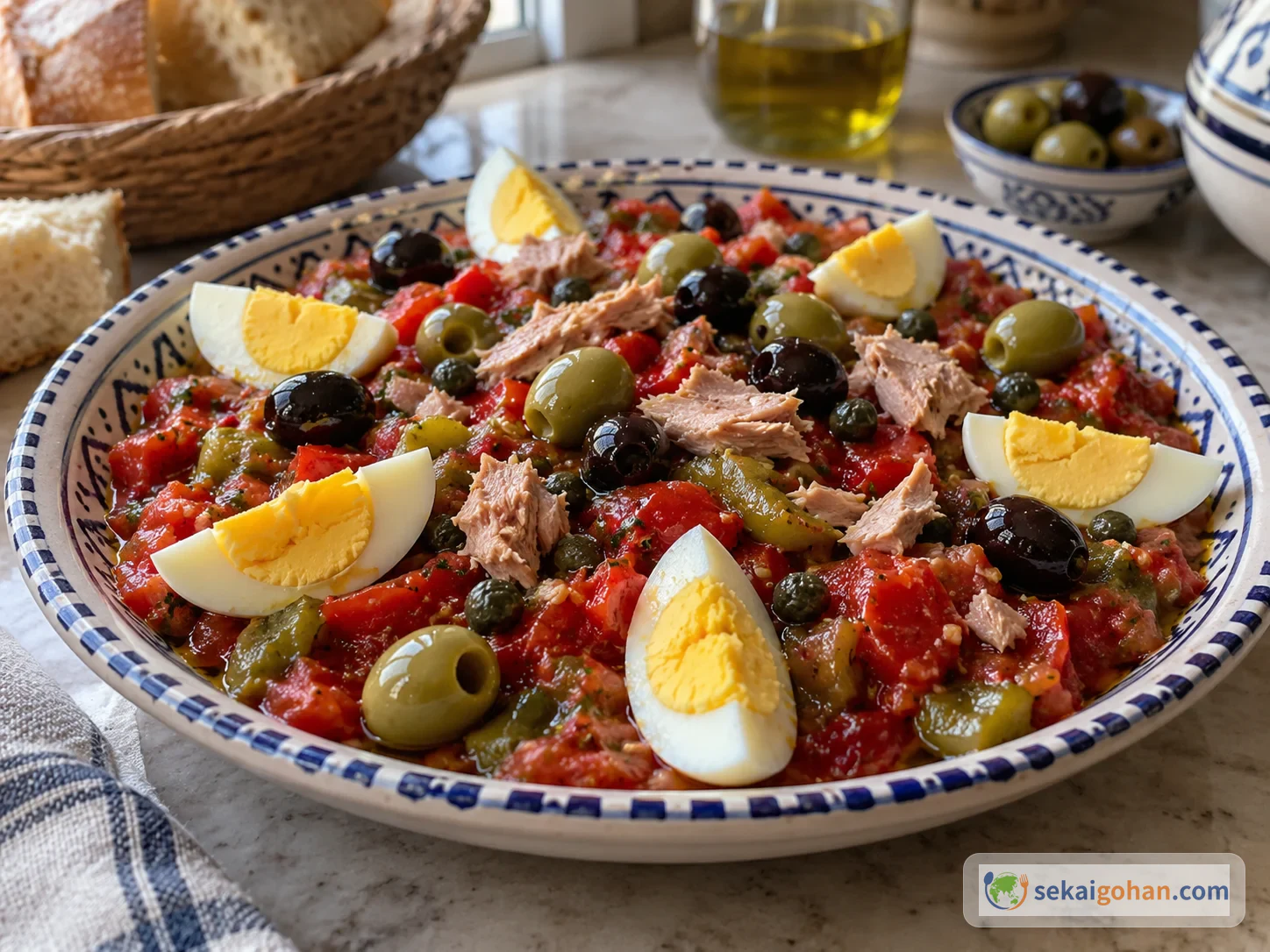
Spread the chopped vegetables on a plate and add tuna, hard-boiled egg, black or green olives and capers as you like; one or two toppings are enough. Each bite then gets a different ratio of vegetables to extras. For a big platter, portion it with clean serving tongs or a spoon.
Flatbread or bread goes alongside. In Japan, thin slices of baguette work well, warmed slightly. Spread the soft vegetables and oil onto the bread with a little egg, tuna and olive. Scoop up the vegetables with bread and a big platter becomes a meal. Add the bread right before eating so it doesn't go soggy.
As an appetizer or side dish, it goes well with grilled fish or meat. If you serve it with brik, the fried pastry with tuna and egg, cut back the tuna and egg on the salad so the two don't overlap. Moroccan taktouka uses similar vegetables but simmers the peppers and tomatoes instead of roasting them. It's fun to make the two side by side and compare.
Variations
| Change | Adjustment for 4 servings | Difference in taste and how to eat |
|---|---|---|
| Less heat | Skip hot chilies; use the sweet bell peppers of the base proportions | Centers on the taste of the roasted vegetables |
| Vegetables only | Omit the 5 oz (140 g) tuna and 2 eggs | Suits an appetizer or side. Nutrition differs from the base recipe |
| Made with red bell peppers | Make all 1.25 lb (600 g) of bell peppers red | Color and sweetness change |
| More tomato | Add 3.5 oz (100 g) tomato and reduce the peppers by 3.5 oz (100 g) | More acidity and moisture, so extend the draining |
| On bread | Slice 7 oz (200 g) bread thin and put the topping and salad on right before eating | Easy to pick up. Eat it soon after topping |
When you want heat, chop fresh chili on a separate dish and add a little to your own plate. Chilies vary in heat by variety, so taste a small amount first.
Storage and making ahead
Cover the finished salad in a clean shallow container and refrigerate it at 4°C (40°F) or below within 2 hours of cooking, or within 1 hour when the temperature is above about 32°C (90°F). Chill it quickly at 4°C or below. Egg and tuna salads can keep 3–4 days refrigerated, but home conditions vary, so finish it by the next day. Keep leftovers that sat out on the table for a long time apart from freshly chilled portions.
Freeze nothing that contains egg and tuna. Some cooks freeze the vegetables alone, though after thawing they can release liquid and change in texture. When you make it ahead, keep the vegetables plain. Add the egg and tuna right before eating, and only as much as you'll eat.
Don't eat anything that wasn't refrigerated as directed. Don't judge safety by taste or smell alone. Adding lemon or oil doesn't make food safe again once it has been left out. This salad contains egg and fish, and the bread contains wheat. Check the labels on processed items such as canned tuna, olives and capers too. If you have a relevant allergy, leave out those ingredients and watch for contact through tools and portioning spoons.
Nutrition
One serving (a quarter of the recipe) has about 270 kcal, 12 g protein, 20 g fat, 17 g carbohydrate and 4.5 g fiber. This estimate leaves out bread but includes the tuna, egg and olives. It is calculated from ingredient weights: 10.5 oz (300 g) each of red and green bell pepper, 27 g oil, 3.5 oz (100 g) of edible egg, 5 oz (140 g) of oil-packed white tuna and 1.75 oz (50 g) of green olives. Raw vegetable values are used, and trace spices and capers aren't counted. The numbers shift with oil- or water-packed tuna, how much liquid you drain and the saltiness of processed items.
More oil raises the calories. Leaving out the egg and tuna lowers the protein, too. To reduce salt, check the saltiness of the toppings: taste a bite with the tuna, olives and capers before adding the rest of the salt. If you are undergoing treatment or have dietary restrictions, follow your doctor's or registered dietitian's instructions first.
FAQ
Can I make it without caraway?
Yes. Use 1 tsp of ground coriander in total instead. The flavor will be different, because nothing else reproduces the aroma of caraway. Fresh cilantro and cumin aren't substitutes for it.
Can I make it without the oven?
You can roast over charcoal or a stove flame. If you use a Japanese fish grill, check the manual for whether vegetables, baking sheets and aluminum foil are allowed, and for the distance from the heat. The 25–35 minutes at 425°F (220°C) for the oven won't apply as is. An ordinary frying pan can cook them gently, but you'll lose the toasty aroma of the roasted skin.
Can I mix in raw tomato?
Raw tomato changes both the texture and the moisture, so it is no longer the basic "roast and peel" salad. Use cooked tomatoes, drain them, then dress.
How far can I prepare the day before?
Roast, peel and drain the vegetables, then refrigerate them quickly in a clean shallow container at 4°C (40°F) or below. The day before, prepare only up to the vegetables. Chop and dress them the next day, and add the tuna and egg right before eating. Nothing should sit at room temperature overnight.
Do I need a mortar or food processor?
A knife is enough to chop to 1/8–1/4 in (3–5 mm). Crush caraway seeds in a small mortar or with a bag and rolling pin. If you use an electric appliance, check it every few seconds; run it until the grains are gone and you've made a different dish.