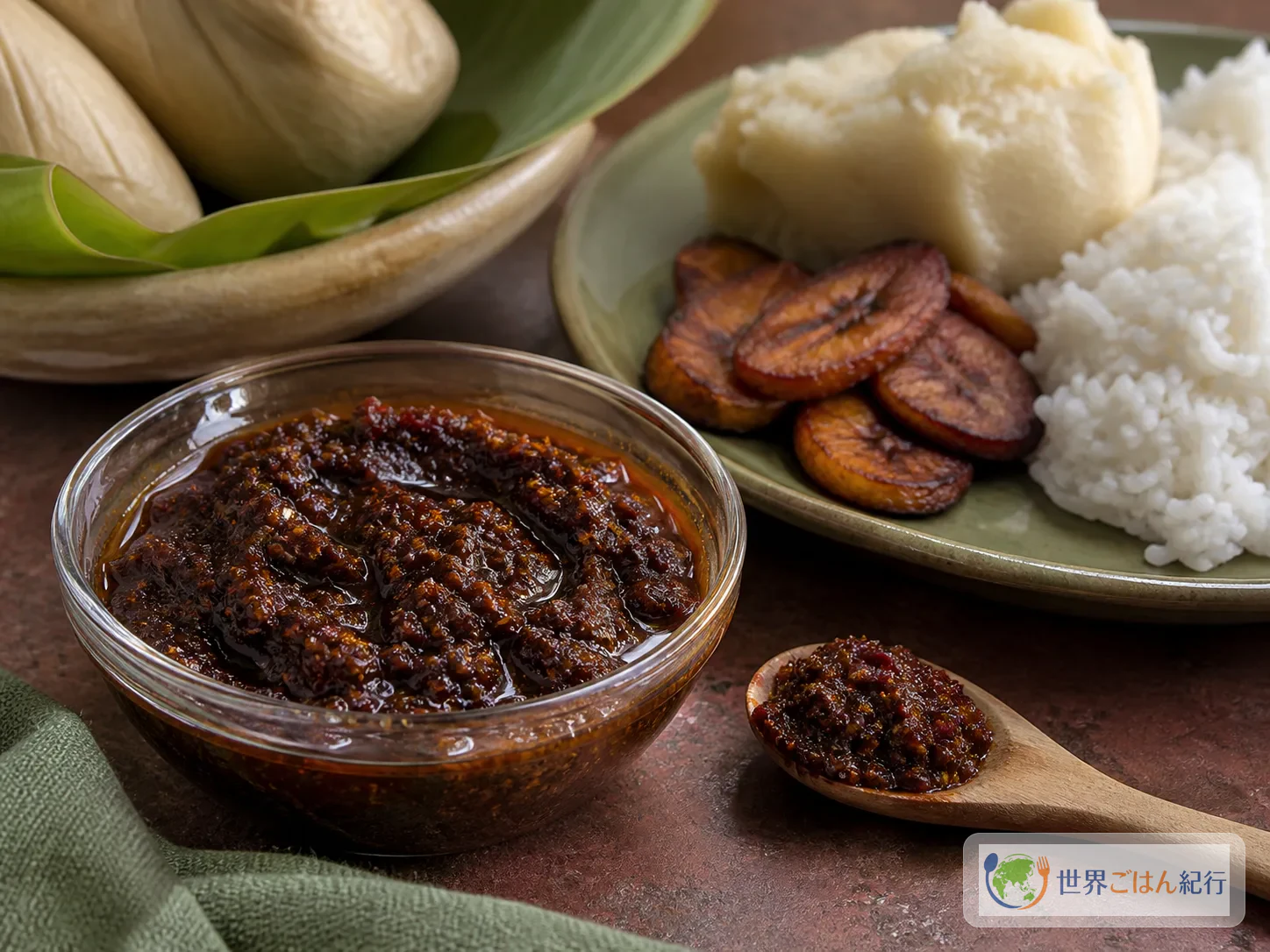
There is a moment when the white dough in the pot turns heavy and pushes back against the wooden spoon. It doesn't stretch the way wheat dough does; it smells of toasted corn and fermentation, and it pulls away from the side of the pot in one mass. That is banku, Ghana's staple of fermented corn and cassava dough, worked over heat into a round dumpling. It sits beside the main dish the way white rice does, but its sourness and stickiness come forward once it takes up the sauce.

What banku is and how it is eaten
On the coast, in places like Accra, banku is eaten with okra stew, pepper sauce, grilled fish and fish soup. It is a base for picking up sauce by hand. Take a small piece, dip it in the sauce, and swallow the sourness and heat together without chewing for long. Eaten this way, it won't feel heavy.
In Ghana, cooks use moist fermented corn and cassava doughs. Outside Ghana, start with shelf-stable corn flour and cassava flour, mix them with water and rest the batter for half a day to a day to build a light sourness, then cook it thoroughly in a pot. That fermentation and the water you add while stirring are what give banku its sourness and springiness instead of making it a plain corn dumpling.
Banku, fufu and kenkey
To an outsider, Ghana's staples can all look like "white, sticky things," but they differ considerably in texture and aroma. If fufu is a staple pounded and stretched, banku is a staple stirred in a pot. It also plays a different role from bean and rice dishes such as waakye or red red.

| Dish | Main ingredients | Method | Texture | Served with |
|---|---|---|---|---|
| Banku | Fermented corn dough, cassava dough | Stirred in a pot | Sour, chewy and heavy | Okra stew, fish, pepper |
| Fufu | Cassava, plantain, yam and others | Boiled and pounded | Stretchy and smooth | Light soup, groundnut soup |
| Kenkey | Fermented corn dough | Wrapped in leaves and steamed | Strongly sour, firm | Fish, pepper, soup |
| Akple | Cornmeal, cassava flour | Stirred in a pot | Close to banku, with a different regional name | Okra stew, fish soup |
Because of its fermented aroma, banku doesn't go beside just anything. It suits the slipperiness of okra, the sharpness of chili and the savor of fish far better than a sweet tomato stew. Outside Ghana, a spicy tomato stew, an okra fish soup or grilled fish with a seasoned relish is a more natural fit than miso soup.
Ingredients: the blend for a home kitchen
This recipe is for 4 servings and uses corn flour and cassava flour. Even if you want a stronger sourness, don't leave the batter at room temperature beyond 24 hours the first time. If it smells spoiled rather than fermented, discard it.

If you use fish stock or grilled fish, be careful of fish allergy. Mix the fermenting dough with a clean bowl and spoon, and do not use it if the smell is strong and leans toward rot, if colored mold appears on the surface, or if an abnormal stringy stickiness appears.
How to read the nutrition information
Per serving, the banku, okra stew and grilled fish come to about 495 kcal, 18 g protein, 12 g fat and around 3 oz (82 g) carbohydrate. Banku is a staple, so adding white rice separately would pile up carbohydrates. For dinner, a meal of banku, okra stew, fish and a stir-fried green fits well.
Choosing flours, red palm oil and substitutes for banku
Okra, onion, tomato and fish are easy to buy nearby. Corn flour, cassava flour and red palm oil take more looking, at specialty grocers or online. Ordinary wheat flour or potato starch in their place gives you a simple flour dumpling rather than banku.

On your first shop, buy the corn flour and cassava flour. Red palm oil changes the color and aroma of the okra stew, so you can skip it the first time. If you plan to keep cooking Ghanaian food, it earns its place in red red and West African stews.
| What to buy | Where to look nearby | When to order online |
|---|---|---|
| Corn flour | Baking supply stores, large supermarkets | When you cannot find a fine grind |
| Cassava flour | Import grocers, Brazilian grocers | When you do not want to substitute tapioca starch alone |
| Red palm oil | African or Brazilian grocers | When you want the okra stew closer to the local one |
Go easy on tapioca starch as a substitute. It gives strong springiness, but the cassava flavor and the weight of flour are weaker. If you cannot get cassava flour at all, use 9 oz (250 g) corn flour, 2.5 oz (70 g) regular rice flour and 1 oz (30 g) tapioca starch, and think of the result as a banku-style corn dumpling.
Method: separate the fermenting, stirring and shaping
Banku's dough suddenly turns heavy in the pot. Use a thick wooden spoon or a sturdy rice paddle, not a thin rubber spatula. Use a heavy pot that resists scorching. Add water along the way, and don't start with the dough too stiff.
Common banku problems: floury, cracked, too sour
Most failures come down to water and heat, not ingredients. Corn flour turns suddenly heavy once heated. Keep the heat too low for fear of scorching and a floury taste remains; rush it on high heat and only the bottom sets.
Dissolve the flours in water and let the batter rest. Once in the pot, smooth out lumps over medium heat, then stir over low heat until heavy. When shaping, wet your hands and settle the form while hot. Do these three things and you avoid a floury taste and cracking.

| State | Cause | How to restore |
|---|---|---|
| Floury | Undercooked, too little water | Add 3 tbsp water and work 5 minutes over low heat |
| Many lumps | Too little water at the start, started stirring late | Turn off the heat, stir in 3.5 tbsp (50 ml) water and resume over medium-low heat |
| Surface cracks | Worked too stiff, or dried out while shaping | Smooth with wet fingertips, cover and leave 2 minutes |
| Too sour | Fermented too long, room too warm | Use only half the dough and add fresh flour and water, then work it |
| Scorched bottom | High heat, thin pot, not stirred enough | Do not mix in the scorched part; move the rest to another pot |
Getting the sourness right
Fermentation shapes the whole dish. Skip the resting entirely and the corn flour aroma comes forward until it tastes like white polenta; for a light sourness, rest the batter 12 to 24 hours at 20°C to 26°C (79°F). If you dislike sourness, shorten the rest rather than dropping it.
Stronger sourness does not mean more authentic, and if you are serving banku to first-timers, a milder sourness is easier to keep eating. Above 77°F (25°C), check the smell at 12 hours. In winter, go by 18 to 20 hours.
Serving, pairing and storing banku
Pairing with other Ghanaian dishes
Banku day is a good excuse to branch out. Flour, beans, plantain and red palm oil each have more than one use, so you are less likely to end up with leftover ingredients.

Ghanaian fufu is another staple that takes sauce, but here you enjoy the stretch of pounded dough. If you like banku's sourness, make fufu next and the difference between cassava and plantain becomes easy to taste.
Waakye is street-food rice and beans, easier to place on an everyday table than banku, and fun to plate with gari, a boiled egg, fish and shito. If a stirred flour dish feels a little heavy, start there.
Red red is a stew of black-eyed peas and red palm oil, satisfying with plantain. It uses up the red palm oil you bought and practices the same rule as the okra stew: don't scorch the red oil. And when banku with spicy okra stew makes the table heavy, a small dish of kelewele, fried plantain coated in spices, brings a sweet-hot change of rhythm.
Storage and reheating
Banku is easiest to shape while hot, and the surface tightens as it cools. If you make it ahead, wrap it in single servings so it doesn't dry out. Refrigerated as one large lump, the heat struggles to reach the center and only the outside turns watery.

| How to store | How long | Reheating |
|---|---|---|
| Room temperature | The same day | Wrap to keep from drying and steam 3 minutes right before eating |
| Refrigerated | 2 days | Mist lightly with water and steam 8 minutes |
| Frozen | 2 weeks | Half-thaw in the refrigerator and steam 12–15 minutes |
In a microwave, sprinkle 2 tsp water on each piece, cover loosely with plastic wrap and heat at 600 W for 1 minute 30 seconds, adding 30 seconds at a time if the center is still cold. The microwave tends to dry the surface, so smooth it with wet hands before eating to keep it from cracking.
The okra stew keeps about 2 days refrigerated; if you added fish, finish it by the next day. A slippery sauce makes spoilage hard to notice, so don't leave it out long. Once the heat has eased, move it to a shallow container and refrigerate.
FAQ

Q1. Can I make it without fermenting?
You can, but the sourness typical of banku will be weaker. On a busy day, dissolve the flours in water, leave them for 30 minutes, and mix in 1 tsp lemon juice before cooking. The aroma differs from fermented dough, so treat it as a practice run.
Q2. Can I make it with cornmeal?
Coarse cornmeal alone tends to leave a gritty texture. If you use it, combine 5.5 oz (150 g) cornmeal, 2.5 oz (70 g) corn flour and 4.5 oz (130 g) cassava flour, and either grind it lightly in a blender before fermenting or soak it in water first. For a first attempt, fine corn flour is easier to handle.
Q3. Can I use tapioca starch instead of cassava flour?
A small amount works, but replacing all of it gives a wobbly, overly springy texture. Replace no more than 1.5 oz (40 g) of the 4.5 oz (130 g) cassava flour with tapioca starch.
Q4. Is it all right to eat if the sour smell is strong?
A light sourness like lactic fermentation is fine. If there is a rotten smell, an overly strong alcohol smell, colored mold or an abnormal slimy stickiness, do not use it. In warm seasons, check at 12 hours and switch to resting it in the refrigerator.
Q5. What can I serve it with at home?
Grilled mackerel, tomato-stewed okra and a chili relish are easy pairings. A plate with heat, acidity and fish savor suits banku's sourness better than miso soup or a sweet teriyaki.