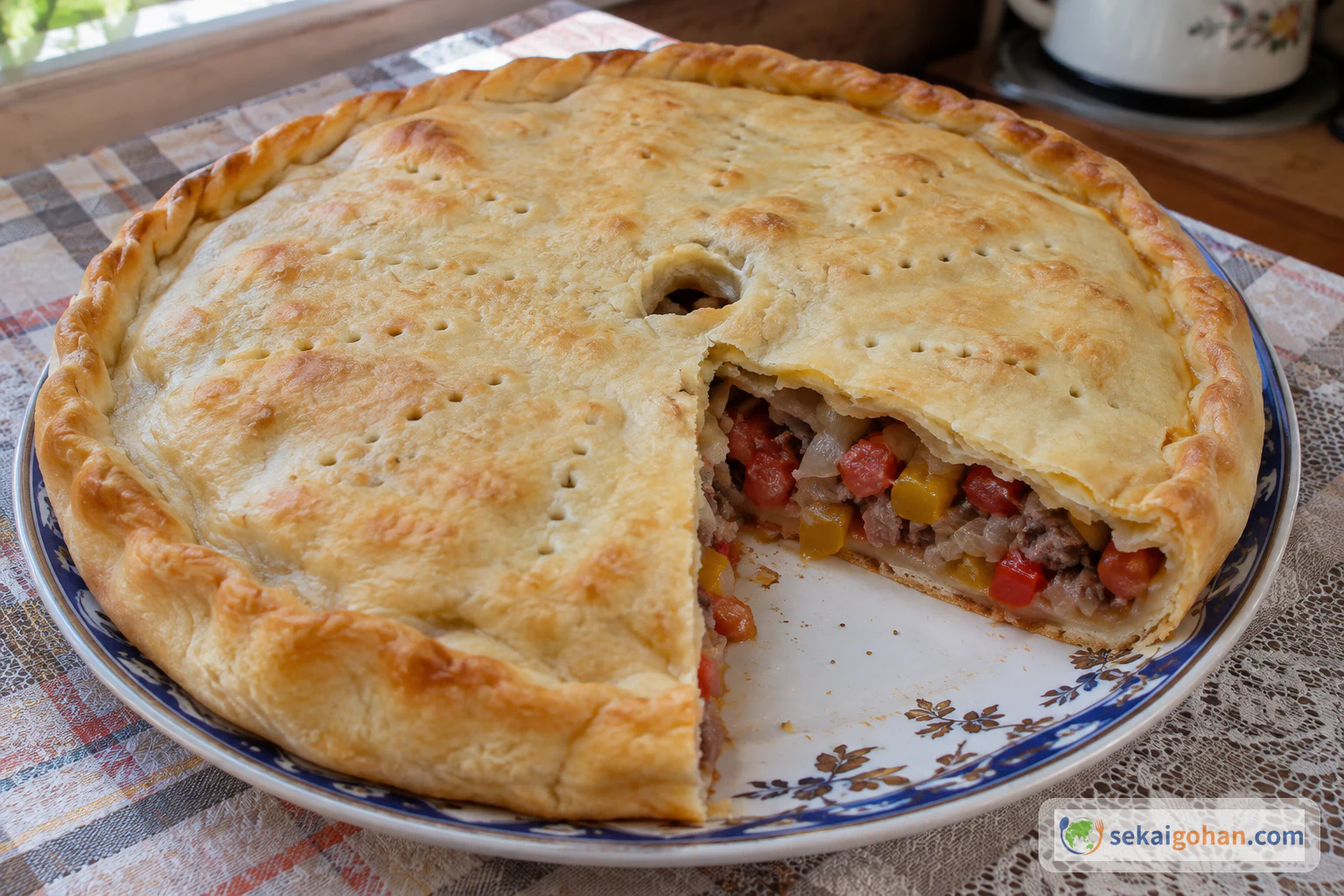
Early morning in Sarajevo. In the half-dark street, a lit shop window steams up, and behind the counter golden spiral pies are being cut from enormous round pans (tepsija) as wide as 23.5 inches (60 cm). The slice handed to you with a cold glass of yogurt drink (ayran) is burek (бурек): paper-thin filo dough (jufka) wrapped around spiced ground meat and onion, shaped into a spiral and baked in the oven. It comes out crisp on the outside and moist inside, rich with meat, and it is how much of Bosnia starts the day.
About Bosnian Burek
Burek is eaten across Bosnia and Herzegovina, Serbia, Croatia, Turkey, North Macedonia and beyond, but Bosnian burek holds a special place. The name comes from the Turkish burmak, "to twist," and it covers the thin-dough pies that spread across the Balkans under the Ottoman Empire.
Burek and the Bosnian pita family
In Bosnia, pies made from filo are collectively called "pita," and "burek" means meat, always. The cheese version is "sirnica," spinach is "zeljanica," and potato is "krompiruša." Elsewhere in the Balkans a cheese pie is also called burek. Say that in front of a Bosnian, though, and you will be corrected with a perfectly straight face: "That is not burek."

| Name | Filling | Notes |
|---|---|---|
| Burek | Ground meat + onion | The most popular. "Burek" means this |
| Sirnica | Fresh cheese (sir) | Creamy, good for breakfast |
| Zeljanica | Spinach + cheese | Beautifully green |
| Krompiruša | Potato | Hearty. A cold-season favorite |
| Tikvenica | Pumpkin | Sweet, dessert-like. Autumn only |
| Višnjača | Sour cherry | A dessert pita, sprinkled with sugar |
As a technique, of course, you can wrap almost anything. Like empanadas, dough plus filling has endless combinations.
How burek came to Bosnia
Thin-dough pies trace back to the food culture of Turkic nomads in Central Asia, the same culture that produced manti. Wrapping meat or dairy in thin, dried dough and baking it made a practical portable food for herders. Court cooks of the Ottoman Empire refined the technique, and it spread to Bosnia, Serbia, Greece and Albania with the conquest of the Balkans in the 15th century, along with meat dishes like kebab and köfte.
Bosnia came under Ottoman rule in 1463, and over more than 400 years of Ottoman administration burek became fully rooted in its food culture. It is closely tied to Bosnia's Islamic culture: for Bosniaks, who converted to Islam in the Ottoman period, it was a regular dish at iftar, the evening meal that breaks the Ramadan fast, and after Friday prayers. Today Serb Orthodox and Croat Catholic families eat burek every day too, and it has become a food shared across religion and ethnicity.
Buregdžinica culture
Every Bosnian city has a buregdžinica, a specialist shop that bakes burek, sirnica, zeljanica and more in large tepsija and sells them by weight or by the slice. They open early, around 4 or 5 a.m., to feed workers their breakfast, and the classic order is burek with ayran. Sarajevo, Mostar, Banja Luka: every major city has a place locals will proudly call "the best buregdžinica in our town."

Many buregdžinice are family-run, and the skill of stretching jufka passes from parent to child. Machines can make it evenly, but hand-stretched jufka gets its texture from slight unevenness in thickness, so many top shops still do it by hand.
The shops matter socially, too. In a society divided after the Bosnian war, they are neutral ground where everyone gathers regardless of ethnicity. Bosniaks, Serbs and Croats eating burek at the same counter is one of the most natural forms of coexistence in everyday Bosnia.
Börek, burek and spanakopita
In Turkey the pie is called börek, and it comes in many shapes: sigara böreği (cigar), su böreği (water börek), gül böreği (rose) and more. Turkish börek uses thinner dough and more butter, while Bosnian burek is shaped into a spiral and baked in a tepsija. They share an origin, but don't tell a Bosnian "that's Turkish food."
In Serbia the word often covers both the meat and the cheese versions, and the "what counts as burek" argument with Bosnians never ends. Serbian burek is usually cut into larger pieces and served as the centerpiece of a meal, much like pierogi. Greece's spanakopita (spinach pie) and tiropita (cheese pie) share the same ancestor; feta makes them saltier.
Ingredients (serves 4)

Bosnian burek filling is wrapped raw, not cooked first. Mix raw ground meat with raw onion and place it straight on the dough. As the oven slowly cooks it together with the pastry, the juices soak into the dough and create the burek's signature succulence. Pre-cooked meat gives a dry burek.
Burek Ingredients and Substitutes
Burek needs no special ingredients. With flour and ground meat you can make the basic version.
Frozen puff pastry (the butter kind) can also be used for burek, but the result is completely different. Puff pastry rises from layers of butter and gives a fluffy pie. To get burek's "crisp × moist" texture you need filo (thin, no butter). Spring roll wrappers are the easiest substitute, but less authentic.
| Ingredient | Substitute | Difference in the result |
|---|---|---|
| Homemade filo | Store-bought frozen filo | Easy, but too uniform. Taste is just as good |
| Filo | Spring roll wrappers | No layered texture, but easy and still delicious |
| Ground beef | Beef-pork mix | The fat comes partly from pork, but the texture is fine |
| Ayran | Lassi | Sweeter, so a weaker match for burek |
Method
Make the jufka (filo dough)
About 80% of burek's texture comes from how thin the jufka is. The ideal is thin enough to see through, but even a first attempt will taste very good.
Put the flour and salt in a bowl and knead while adding the lukewarm water a little at a time. Add the oil and knead for about 10 minutes, until the surface is smooth. Wrap the dough in plastic and rest it for 30 minutes. During this rest the gluten relaxes and the dough stretches thin more easily.
Divide the rested dough into 4 pieces and roll each into a ball. On a floured surface, roll each piece out with a rolling pin as thin as you can, to the limit before it tears. Skilled Bosnian cooks stretch it thin enough to read newsprint through it.
Baking points
The basic bake is 40–45 minutes at 350°F (180°C). The secret of Bosnian burek, though, is sprinkling water partway through the bake.
Twenty minutes in, open the oven and sprinkle 3.5 tbsp (50 ml) of water over the whole burek. This gives the signature texture, crisp on the surface and moist inside. Without the water the whole pie dries out and turns brittle.
When it comes out, cover it with a clean kitchen towel and let it steam for 5–10 minutes. The steam softens the layers further and makes the burek easier to cut.
The ideal color is deep golden brown. Pale yellow means underbaked and the dough tastes floury; too brown and the dough turns hard and the filling loses too much moisture. Ovens vary, so on the first try check the color at 35 minutes and adjust in 5-minute steps.
If you have no tepsija, a deep glass baking dish or a cast-iron skillet about 11 inches (26–28 cm) across is easy to work with. If you use a baking sheet instead, an S-shaped serpentine layout also works in place of the spiral.
Burek Troubleshooting
Dough that shrinks back when you stretch it hasn't rested long enough. Right after kneading, the gluten is tense; at least 30 minutes of rest relaxes it so the dough can be stretched thin, and an hour is even better if you have the time.
A pie that isn't crisp usually means too little oil. Brushing the whole surface of the stretched sheet leaves a film of oil between the layers, and in the oven that film turns into crisp, flaky layers. It works the way the béchamel builds layers in Greek moussaka.

Dry filling comes from leaving out the water. Adding water to raw ground meat seems contradictory, but it turns to steam during baking and keeps the filling juicy; without it, the meat dries out in the oven's heat.
Burst dough means the roll was too tight. The filling expands as it bakes, so roll with a little gap left inside, the same way the cheese in khachapuri needs room to expand. And if the pie comes out dry and brittle, don't skip the rest under a towel: the steam returns to the dough and gives you the ideal crisp outside, moist inside.
Serving Burek
In Bosnia, burek is always eaten with ayran, a cold drink of yogurt, water and salt that balances the rich pie perfectly. Cut into the golden spiral, take a sip, and you're a little closer to a Sarajevo buregdžinica at dawn.
Mix ¾ cup (200 ml) plain yogurt, ½ cup (100 ml) water and a pinch of salt well. Burek without ayran is incomplete, like laksa without lime.
FAQ
Q1. What if I have no oven?
You can cook it in a skillet. Use a deep skillet with plenty of oil, cover, and cook over low heat for 15 minutes per side. A folded half-moon shape, in the "sigara böreği (cigar börek)" style, suits a skillet better than a spiral.
Q2. Can I freeze it?
Yes, ideally before baking. Wrap the shaped rolls in plastic and freeze, then bake straight from frozen with no thawing, adding 10 minutes to the baking time. Baked burek can be frozen too, but it loses its crispness.
Q3. Is it OK for children?
Burek is a mild pie and suits children well; in Bosnia, schoolchildren stopping at a buregdžinica for a snack is an everyday sight. For a child-friendlier version, reduce the black pepper and add a little more water to keep it juicy. Sirnica, the cheese version, is especially popular with children.
Q4. What can I drink with burek besides ayran?
Bosnian coffee (bosanska kafa) is also popular: Turkish-style boiled coffee whose rich flavor stands up to the pie. Red wine and beer go well too, and for a fuller meal you can serve it with an Eastern European soup such as borscht.
More Dishes from Eastern Europe and Beyond
From the Caucasus, try khinkali, the region's dumpling. And for another dish from the eastern Mediterranean table, there's shakshuka.
Burek contains wheat (filo dough). Sirnica (the cheese version) also contains milk products, and ayran (the yogurt drink) contains milk as well. For a gluten-free version you can substitute a rice-flour dough, but it stretches poorly, so reproducing the thinness is difficult.
| Item | Value |
|---|---|
| Energy | 580 kcal |
| Protein | 24 g |
| Fat | 32 g |
| Carbohydrates | 48 g |
| Fiber | 2 g |
| Salt | 1.8 g |
Because it is a filo pie, fat is somewhat high. Pairing it with ayran (the yogurt drink) also adds probiotic bacteria.