Warm sugar and saffron in a small pot and the kitchen fills with an aroma like dried flowers. Add nuts, cardamom, and a lattice of rice-flour batter, and you have a sweet that feels like tea time on the road. Sheki halva (Şəki halvası) comes from Sheki in northwestern Azerbaijan. Thin lattice sheets are layered with nuts and spices, then soaked in saffron syrup. The top bakes red and golden, and every cut shows the layers of nuts inside.

Sheki halva and its lattice
In Sheki, craftsmen use special tools to bake a fine rice-flour batter into a net in a large round copper pan. Despite the name, it is quite different from the Middle Eastern sesame-paste halva or the halva made by frying flour. If you like sweet syrup pastries, compare it with Turkey's baklava to see how differently the layers are built.
In Azerbaijani it is written Şəki halvası. Şəki is the place name Sheki, and halvası means halva. In English it is written Sheki halva or Sheki pakhlava.
The texture is neither fluffy cake nor crisp pie. Fresh from the oven the lattice is light. Once it takes up the syrup it turns moist and heavy, and as it cools, the oil of the nuts and the sugar settle together. By the next day it cuts more cleanly and the aroma has mellowed.
A home kitchen can't reproduce the copper pan, but a squeeze bottle gets you surprisingly close. Pour a loose batter of rice flour and all-purpose flour into a frying pan in thin lines, layer the sheets with coarse nuts, and bake in an ordinary oven. Saffron goes into the syrup, and small amounts of freshly ground cardamom and coriander keep the sweetness in check.
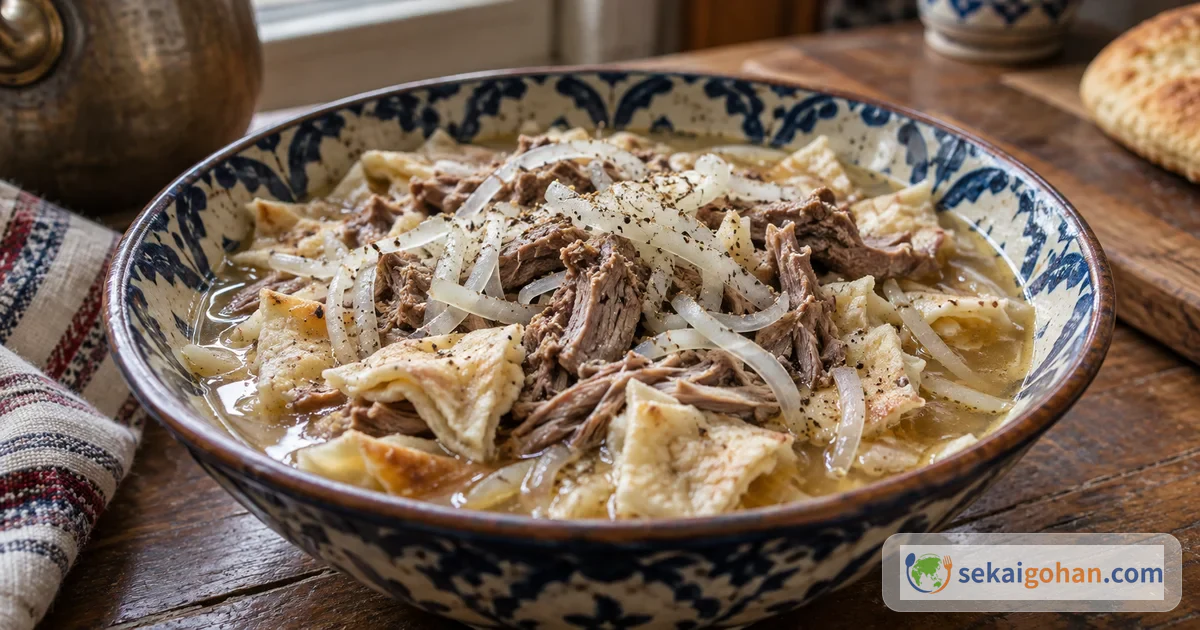
The pastry belongs to a cuisine with a wide range of flour, rice, stews, and sweets. Try piti, mutton stewed in a pot; qutab, a thin stuffed flatbread; or shah plov, rice wrapped in lavash.
Ingredients (one 7 inches (18 cm) round pan)
This makes one 7 inches (18 cm) round pan, 8 to 10 pieces. It is a very sweet pastry, so it is easier to eat if you cut each piece small. If you have no 7 inches (18 cm) round pan, you can use an 8 inches (20 cm) frying pan, but the layers will be thinner, so shorten the baking time by about 3 minutes.

This recipe uses wheat, egg, walnuts, and hazelnuts. If you have a nut allergy, do not substitute; choose a different sweet. Because it is a pastry that takes up syrup after baking, if you will keep it at room temperature for a long time, use a clean knife and an airtight container, and refrigerate it in summer.
Choosing ingredients for Sheki halva
Rice flour, all-purpose flour, sugar, and walnuts are easy to find at any grocery store. Spend your effort on what decides the aroma instead: saffron, whole cardamom, and a small mill that grinds spices fine. More nuts or more butter won't make up for those.
Locally, hazelnuts or walnuts are used coarsely chopped. Half walnuts and half hazelnuts works well at home, or simply more walnuts if you have no hazelnuts.
Saffron is the key to both color and aroma, and even 0.1 g makes a difference. Whatever is left can go into Iran's tahchin or other rice dishes.
Ground cardamom will do, but if you crack whole pods and grind only the seeds, the aroma holds up even inside the sweet syrup. Grind the cardamom and coriander just before using them so the pastry doesn't taste flat. Leftover cardamom is good in Basler Läckerli, and the same small mill handles salt-and-spice blends like Georgia's svanuri marili.
Method
If you rush the lattice sheets, the lines get thick and the layers shift when stacked. Prepare the syrup and the nuts first, mix and rest the batter, and bake the sheets in the frying pan one at a time. Add the syrup to the hot pastry after baking, but cut it only after it has cooled.
Common Sheki halva mistakes
| Problem | Likely cause | Fix |
|---|---|---|
| Lattice lines are thick | Batter is thick, or the bottle hole is large | Add 1 tbsp water, or switch to a bottle with a finer tip |
| Will not come off the pan | The pan is too cool, too much oil, or lumps | Heat to 325°F (160°C) or above, wipe off oil, and strain the batter |
| Layers are soggy | The syrup is undercooked, or added all at once | Cook to around 221°F (105°C) and add in 3 portions |
| Only sweetness is strong | Too little spice, nuts too fine | Regrind the cardamom and keep nuts at 0.125 inch (3 mm) or larger |
| Crumbles when cut | Not rested enough, or the knife is cold | Rest at least 1 hour (ideally overnight) and press through with a warmed knife |
The most common failure is trying to fill in the circle neatly and ending up with a thick lattice. What matters is thin lines with gaps between them. The gaps let the syrup in and show off the layers of nuts, while sheets as thick as pancakes soak up too much syrup and turn heavy.
Lines that are too thin, on the other hand, tear when you lift them, so treat the first two sheets as practice. A small tear won't show once everything is layered. Aim for thin and dry over picture-perfect.
Serving and storing Sheki halva
Cut Sheki halva into one- or two-bite pieces and serve it with strong black tea, unsweetened chai, or strong green tea, and the sweetness settles pleasantly. In Azerbaijani tea culture, sweets and jam turn up alongside tea on many occasions, and this pastry fits right in.
At room temperature it keeps 2 days in a cool season, or 4 days refrigerated. The fridge firms up the syrup, so take it out 15 minutes before eating. To freeze, sandwich each piece in parchment paper and keep it in an airtight bag for up to 2 weeks. After thawing, warm it in a toaster on low or in a 250°F (120°C) oven for 5 minutes and the surface of the lattice crisps up a little.
To make ahead, the easiest approach is to bake only the lattice sheets the day before. They dry out quickly, so once they are completely cool, seal them in a storage bag and layer them with the nuts the next day. A finished, syruped pastry grows more mellow over time but loses some of its light surface. For a gift, the morning after baking is when it handles best.
FAQ
Can I make it with only rice flour?
You can, but in a home frying pan it tears more easily. Adding 1.5 oz (40 g) all-purpose flour helps the lines join and keeps them from splitting when lifted. If you want to avoid wheat, try 5.5 oz (160 g) rice flour, 15 g potato starch, and 1¼ cups (280 ml) water, but make the lines thicker and use fewer layers.
Can I use turmeric in place of saffron?
A little turmeric gives the yellow color, but the aroma is quite different, and the dried-flower scent of saffron matters here. If you skip saffron entirely, add a little more cardamom and use an aromatic honey so the sweetness doesn't turn monotonous.
I have no hazelnuts.
It works with walnuts alone. Hazelnuts add toastiness and a round sweetness, so for a substitute, a combination of 2 oz (60 g) almonds and 5.5 oz (160 g) walnuts is easy to handle. Pistachios alone give a pretty color, but the oil and aroma shift it toward a different pastry.
Can I bake the lattice on a hot plate instead of a frying pan?
Yes. Set it to 325 to 350°F (160 to 170°C), wipe on a thin film of oil, and pour the lattice. A wide surface lets you bake 2 sheets at once, but batter that dries too much cracks, so lift each sheet one at a time and move it to a rack right away. If the plate gets too hot, switch it off, let the surface cool a little, and continue.
What dishes does it go with?
As an after-meal sweet, it follows salty dishes well. In an Azerbaijani menu, a small piece after piti or qutab makes a sweet finish. After a rice dish like shah plov it can feel heavy, so a sliver is enough.