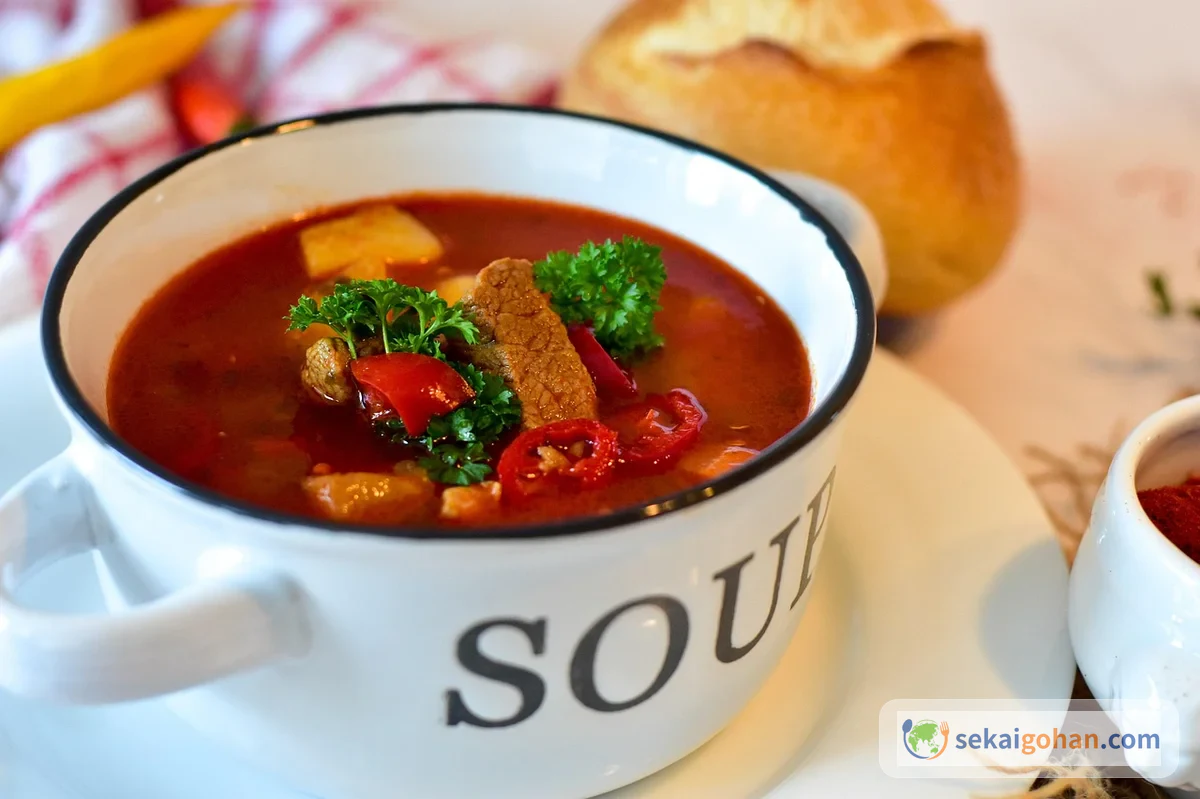
Bundles of red paprika hang in bright strings from the ceiling of Budapest's Central Market, and beneath them an older woman stirs a pot brimming with something red. The rich smell of paprika drifts across the vast two-story hall, and passing tourists stop in their tracks. That pot is gulyás (goulash), the dish you can't talk about Hungarian cooking without. Beef, onions and potatoes simmer in Hungarian paprika until the broth turns deep red, sweet from the onions and warm with spice.
What Hungarian gulyás is
Outside Hungary, goulash is often described as "beef stew," but the real thing is a soup: beef, onions and potatoes in a paprika broth, with the quality and quantity of the paprika deciding the flavor. The Hungarian word gulyás means "herdsman," and the dish began as a plain pot cooked at camp by cattle herders on the great plain (the puszta). Hungarians have their own names for the close relatives. A stew-like version with little liquid is pörkölt, and one finished with sour cream is paprikás.
Germany's Gulasch, Austria's Wiener Gulasch and the Czech guláš all derive from Hungarian gulyás, but they are different dishes. Much as borscht (in Japanese) differs between Ukraine and Russia, goulash looks completely different in Hungary and in its neighboring countries.
History of goulash
The story goes back to the nomadic life of the Magyars on the puszta in the 9th century. The herdsmen stewed dried meat and onions in a pot and carried it as portable food, and that original goulash contained no paprika at all.
Paprika came to Hungary in the 16th century, during Ottoman rule. At first it was grown as an ornamental plant, and it only found its way into cooking in the late 18th century. When large-scale cultivation began around Szeged in the 19th century, goulash became the red soup we know today. It later spread across Central Europe, and while other countries turned it into a stew, Hungary kept eating it as a soup.
Production still centers on two cities, Szeged and Kalocsa. Every autumn, bundles of paprika are hung up to dry all over town, an iconic seasonal sight in Hungary. At home, cooks often make goulash in a big pot for the weekend table.
Ingredients (serves 4)
Paprika and spices
| Spice | Amount | Notes |
|---|---|---|
| Hungarian sweet paprika | 3 tbsp | Don't skimp. It is the star |
| Caraway seeds | 1 tsp | Lightly crush in a mortar. Cumin can substitute |
| Black pepper | A little | — |
| Lard (or vegetable oil) | 2 tbsp | Lard is traditional. Butter also works |
In goulash, paprika matters more than curry powder does in curry. 3 tbsp is the minimum.
Ordinary supermarket paprika powder will work, but Hungarian édes (sweet) paprika is on another level for aroma and color. Look for it at import food shops or online.

Choosing beef and paprika for goulash
You don't need special equipment. If you get two things right, beef shank and Hungarian paprika, an ordinary pot can get you quite close to the real flavor.
Hungarian paprika is graded into eight levels, from sweet (édes) to hot (erős), and each grade has its uses. For goulash, the usual approach is to use sweet (édes) as the base and add a little hot (erős).
How to make csipetke (pinched dumplings)
Authentic goulash is traditionally served with small pinched dumplings called csipetke. They are nearly the same as Japanese suiton, and they add body and substance to the soup.
Ingredients
- 100 g cake flour or all-purpose flour
- 1 egg
- A pinch of salt
Method
- Put the flour, egg and salt in a bowl and knead for about 3 minutes into a dough firmer than an earlobe.
- Rest the dough for 5 minutes.
- Ten minutes before the goulash is done, pinch the dough with your fingertips into 0.5 inches (1 cm) pieces and drop them into the gently bubbling pot.
- Simmer on low heat for 4–5 minutes, until the csipetke float and no floury taste remains at the center.
If dumplings feel like too much work, you can substitute:
- Dried pasta (penne or fusilli): add it at the end of the simmering and boil it in the pot
- Extra potatoes: more potatoes give a similar satisfying feel
- Bread: serve Hungarian white bread alongside and dip it in the soup
Goulash mistakes and fixes
Because the steps are simple, how you handle the paprika changes the flavor enormously.
The paprika scorches and turns bitter
This is the most fatal mistake. Scorched paprika tastes bitter, the color goes dark, and there's no fixing it afterward. So this is the one rule to follow without exception: always add the paprika off the heat.
The flavor is flat
The usual cause is too little paprika. 3 tbsp is the minimum, and going up to 4 tbsp is fine if you like it stronger. Without enough salt the sweetness of the paprika doesn't come forward either, so taste as you season.
The soup is cloudy
Broken-down potatoes are the culprit. Use a waxy variety and add them for the last 20 minutes of simmering. A hard boil also clouds the soup, so keep it at a slow, gentle simmer on low heat.
The beef is tough
It simply wasn't simmered long enough. Shank needs at least 90 minutes, or use a pressure cooker (see the FAQ). As with tagine (in Japanese), low heat and patience win.

Serving and storing goulash
Serve goulash in deep soup bowls with chopped parsley scattered on top, and set out a few things alongside:
- Bread: Hungarian white bread (fehér kenyér) is the standard. A baguette can substitute
- Sour cream: put it on the table and let everyone add as much as they like. The tang sets off the sweetness of the paprika
- Pickled hot green peppers: an essential accompaniment in Hungarian cooking. Any tangy pickled pepper gives a similar feel

For lunch the next day or as a side, Rakott krumpli (in Japanese), a baked dish of layered potato, egg and sour cream, is another Hungarian home-style dish that fits right in. And if you want to keep cooking in this direction, Carbonnade (in Japanese), Waterzooi (in Japanese) and Pašticada (in Japanese) share many of the same ingredients and aromas. After a stew, Kūčiukai (in Japanese), a light baked sweet, shows you another side of an Eastern European winter table.
Storing goulash
Like zigni (in Japanese), goulash tastes better the next day. The paprika spreads through the whole pot, and the potatoes soak up the sauce.
| Storage | How long | Tips |
|---|---|---|
| Refrigerator | 2–3 days | Cool a little, store airtight. Reheat in a pot until it boils all the way through |
| Freezer | About 1 month | Deal with the potatoes first (see tip below) |
| Make-ahead uses | — | Pasta sauce, risotto stock or pie filling |
Potatoes tend to turn spongy when frozen. Either mash them with a masher and melt them into the sauce before freezing, or freeze the goulash without potatoes and add fresh ones when you reheat it.
Goulash variations
Paprikás csirke (chicken paprikash)
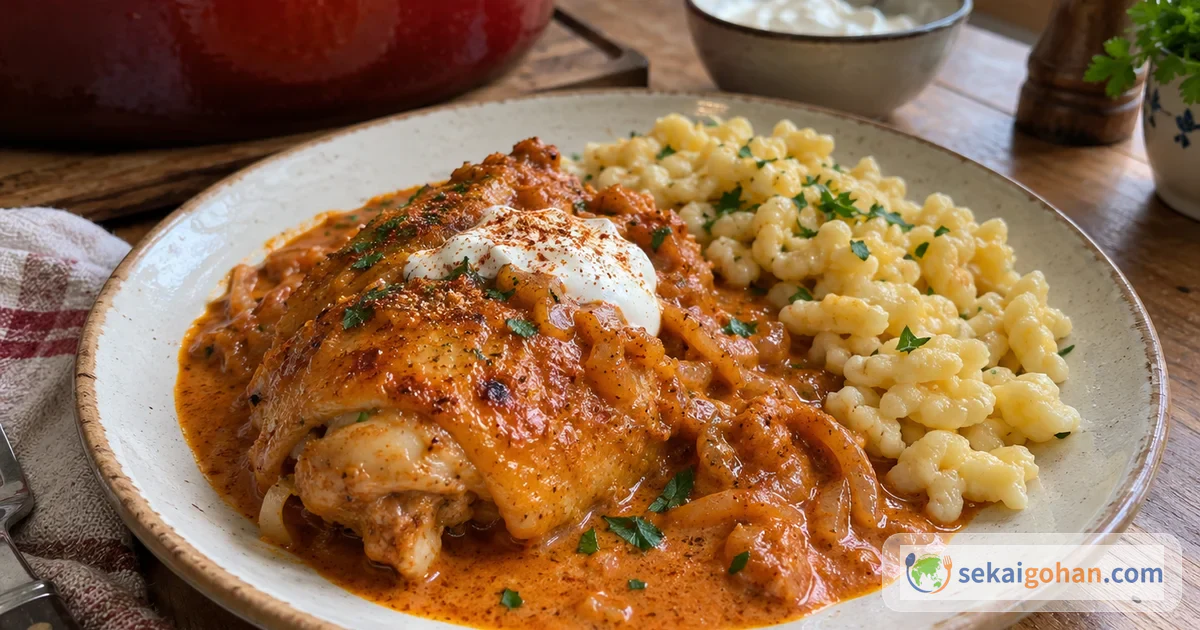
Use bone-in chicken thighs instead of beef and finish by stirring sour cream into the sauce. In Hungary "paprikás" usually means this chicken version, classically paired with small egg dumplings called nokedli. It's creamier than goulash and popular with children.
Pörkölt
In Hungarian, the soup in this recipe is called gulyásleves, "goulash soup." For something different, cut back the potatoes and water, use more onion and simmer until little liquid is left and you get something close to pörkölt. Serve it with nokedli or boiled potatoes.
Székely goulash (with sauerkraut)
This Transylvanian variation simmers pork with sauerkraut, and the sour cabbage plays against the sweetness of the paprika. Like burek (in Japanese), it shows how much Balkan and Central European dishes shift from region to region.
Goulash pasta
Reduce the sauce until thick and toss it with fusilli or penne, then pile on plenty of cheese for an Italian-Hungarian crossover. You can also chop the pasta and stir-fry it in goulash sauce, like kottu.

Japanese-style goulash (nikujaga-style)
"Paprika nikujaga" is seasoned with 2 tbsp paprika powder, 1 tbsp mirin and 1 tbsp soy sauce. Use more potatoes and carrots and cook off most of the liquid, and it sits naturally on a Japanese table.
Goulash nutrition (per serving, from the 4-serving recipe)
| Nutrient | Amount |
|---|---|
| Energy | About 440 kcal |
| Protein | About 1 oz (29 g) |
| Fat | About 14 g |
| Carbohydrate | About 1.5 oz (41 g) |
| Fiber | About 6 g |
| Salt equivalent | About 3.0 g |
One bowl gives you the protein and iron of beef and the potassium of potatoes and vegetables. The figures are estimates, and the salt equivalent depends on how much salt you use.
Frequently asked questions
Q1. What is the difference between goulash and beef stew?
Beef stew is thickened with roux or demi-glace. Goulash is a soup with paprika as the star, and Hungarian goulash contains no ketchup, flour or wine. Paprika, onions, meat and water: that simplicity is the whole point.
Q2. Which paprika powder should I buy?
Ideally Hungarian édes (sweet) paprika, from an import food shop or online. Ordinary supermarket paprika works too, but the color and aroma are weaker.
Q3. Can I leave out the caraway seeds?
You can, but you lose a lot of the characteristic Hungarian flavor. If you can't find them, substitute 1 tsp cumin seeds.
Q4. Is sour cream required?
It doesn't go into the goulash itself; in Hungary each person spoons some on at the table. Plain yogurt can substitute. As with moussaka (in Japanese), a little dairy lifts the finished dish.
Q5. Can I save time with a pressure cooker?
Yes. Do the onion and paprika steps as usual, then add the meat and water and cook for 25 minutes under pressure followed by a natural release. Release the pressure before adding the potatoes and vegetables, and simmer them without the lid for 20 minutes. It's ready in about 1 hour in total.
Q6. Can I serve it with pierogi (in Japanese)?
Pierogi are Polish, so it's not a standard pairing in Hungary. Still, potato-and-cheese pierogi on the side make a filling menu that doubles as the starch.