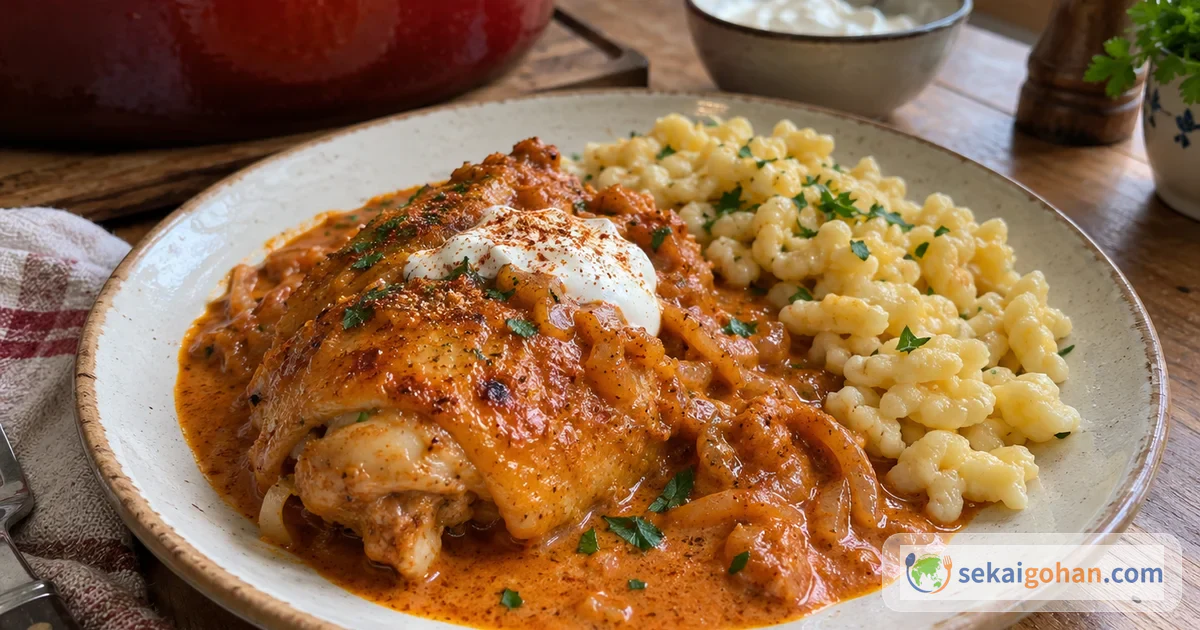
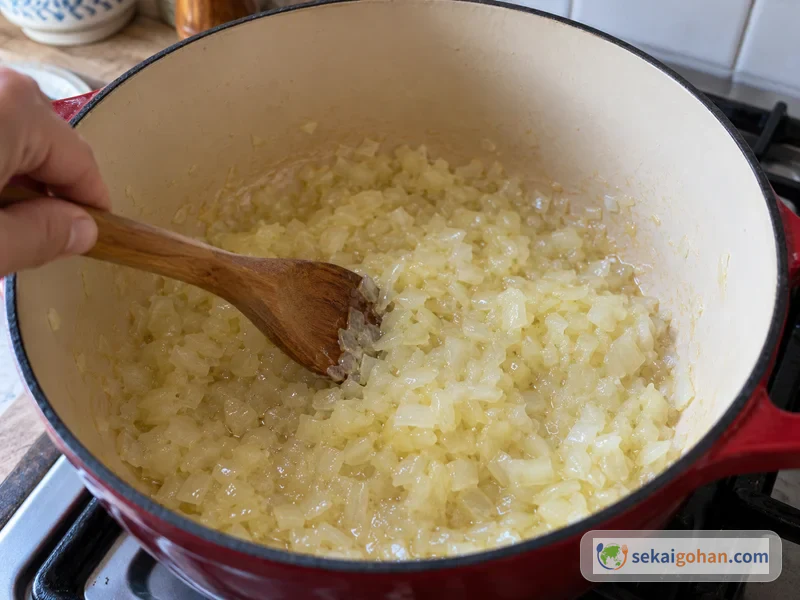
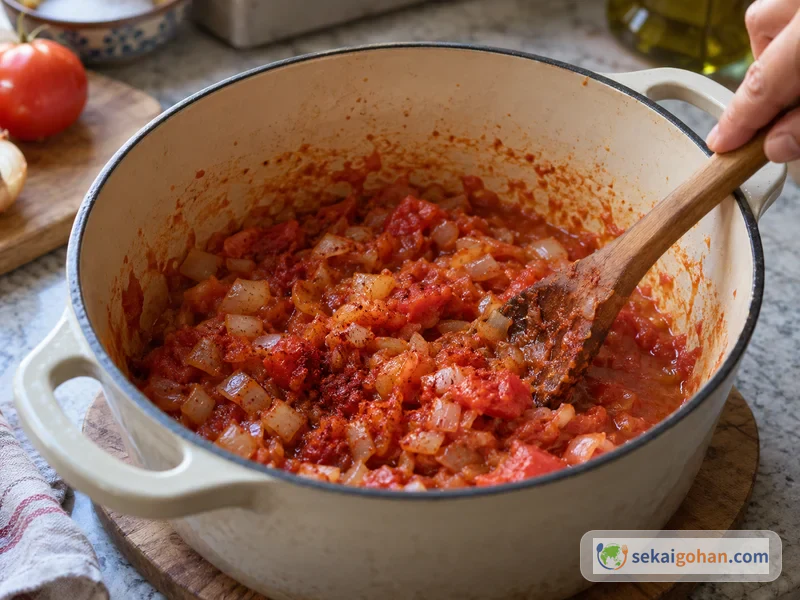
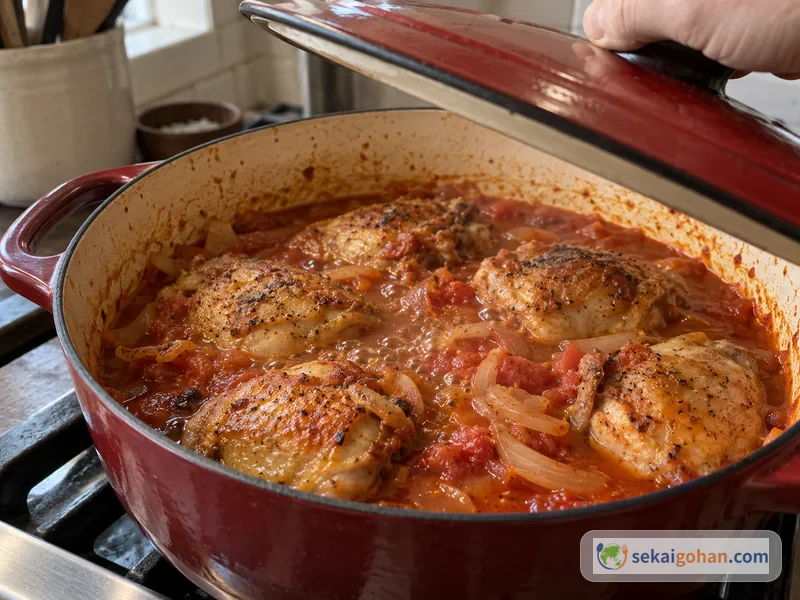
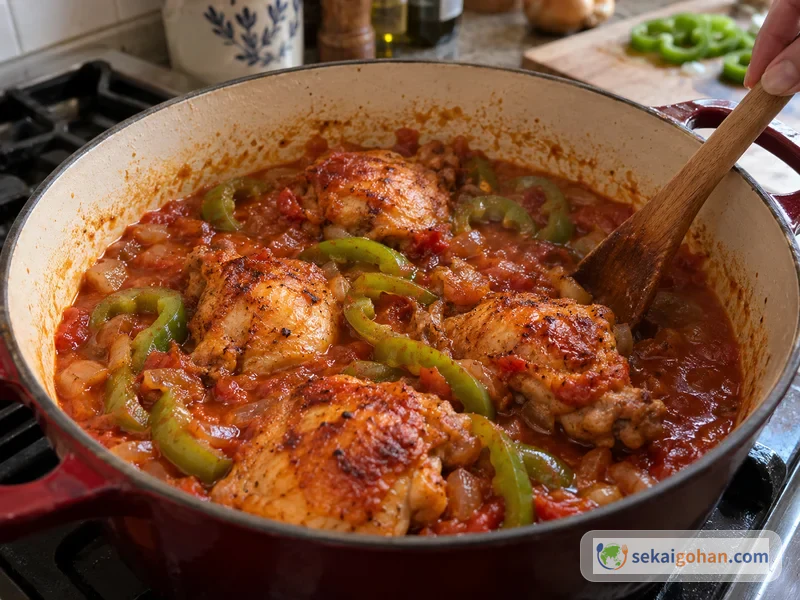
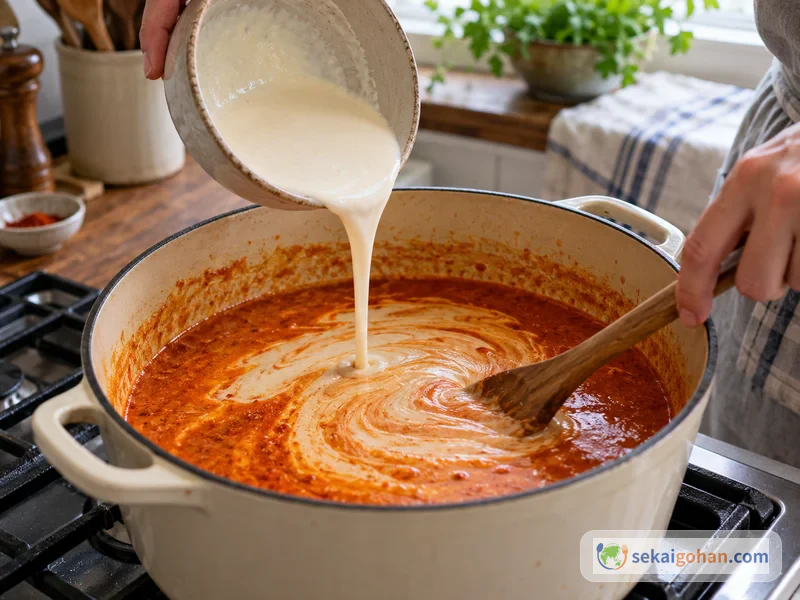
Midday in Budapest. On street corners you still find the old-fashioned canteens called étkezde, and one of their standard plates is chicken stewed in a red sauce: paprikás csirke, also called csirkepaprikás. Both names mean "chicken cooked with paprika." Onions sweat gently in lard, the pot comes off the heat so the paprika can melt into the fat, and the chicken simmers quietly. A spoonful of sour cream at the end turns the vivid red into a soft salmon color, and a red sauce brought together with cream is exactly what sets it apart from goulash, the other great dish of paprika country.
Everything you need is in an ordinary supermarket. There are only two tricky parts: don't scorch the paprika, and don't let the sour cream boil and split. Get those right and this is about an hour of simmering in a home pot.
The story of csirke paprikás
From the Great Plain to the town canteen
On the Alföld, the Great Plain that spreads across eastern Hungary, 19th-century farmers stewed beef and mutton with onions and paprika. Chicken gradually joined them, and poultry stews became widespread. In 1840s Hatvan, serf households ate "pörkölt hús" and "paprikás hús" made with beef, mutton, and chicken as everyday food.
The oldest written recipe dates from 1830, from the kitchen of Archduke Joseph's court. It fries onion, paprika, and allspice in butter or lard, adds the chicken, and thickens the sauce with flour, stock, and sour cream, which is almost exactly how it's made today. In 1834 an innkeeper in Nyíregyháza listed "Paprikás Tsirke" at 18 krajcár, a little more than the 15 krajcár he charged for the meat stew "paprikás hús."
Paprika has many old names: "Turkish pepper" (törökbors), "red pepper" (vörösbors), "Spanish pepper" (spanyol bors), and more. All of them mean "a pepper that came from somewhere else." The route by which New World chilies traveled around Europe and finally reached Hungary survives in the names.
Sour cream (tejföl in Hungarian) also said something about a dish's standing. A stew finished with it had risen from the peasant's pot to the kitchens of the town middle class, and from there it spread back to ordinary tables. By the end of the 19th century it was on restaurant menus and travelers to Hungary were recommending it. It even turns up in an 1897 novel: on his way to Transylvania, Jonathan Harker eats "paprika hendl," likes it, and jots down a note to get the recipe for his fiancée Mina.
Paprikás and pörkölt
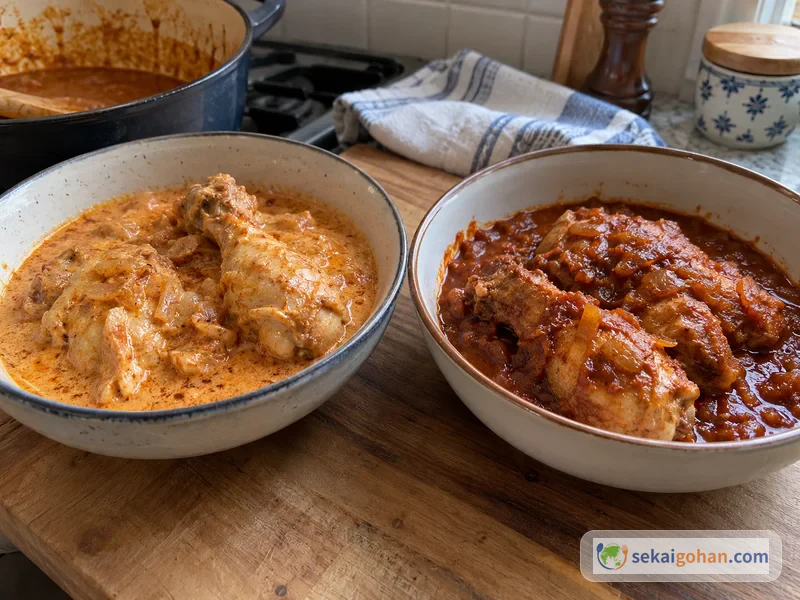
Hungarian cooking has four paprika-based stews: gulyás, pörkölt, tokány, and paprikás. Paprikás and pörkölt are very close, with one difference. Paprikás is finished with sweet cream or sour cream, while no cream of any kind goes into pörkölt (or gulyás).
The choice of meat follows from that. Veal and chicken suit paprikás, while beef, mutton, game, goose, duck, and pork usually go into pörkölt; the mildness of cream is paired with lean, delicate meats, and fattier or stronger-flavored ones are cooked without it. Mushrooms or fish are sometimes stewed the paprikás way too.
If you save the cooking liquid from a paprikás, the next day it can turn into Hortobágyi palacsinta. Crêpes are rolled around a meat filling and topped with the paprikás sauce with a little more sour cream added.
Paprikás beyond Hungary
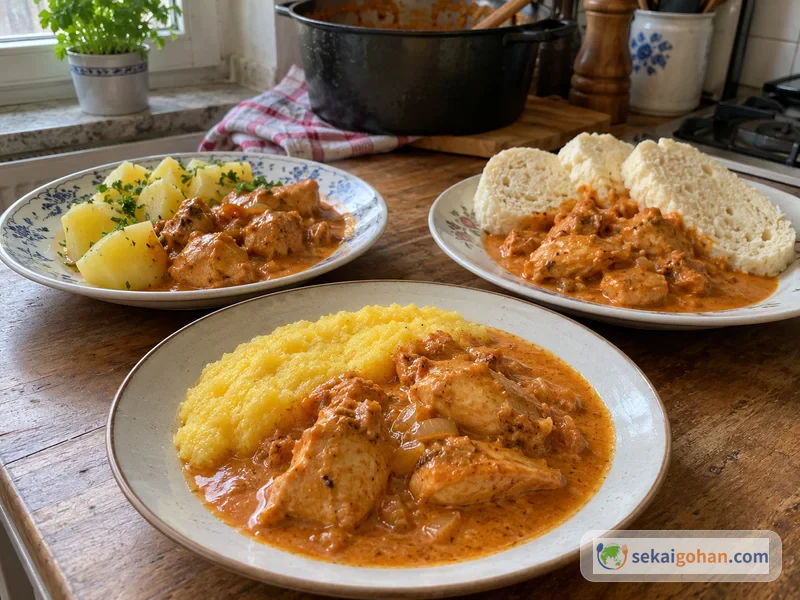
The dish has traveled, changing as it went. In Romania it is traditionally served with mămăligă, a cornmeal porridge, and in Czechia often with knedlíky, bread-style dumplings. It also became a home dish of the Danube Swabians, the German-speaking emigrants who lived along the Danube.
In Jewish households in Hungary and Czechoslovakia it was passed down as a Sabbath dish. Because dietary law forbids eating meat and dairy together, many cooks leave out the sour cream and bring the sauce together with tomato instead. Bulgarian paprikash (паприкаш) is a different dish altogether, with less paprika and diced sweet peppers in the lead.
To make it without dairy, use 2 tomatoes, skip the cream finish, and after adding the pepper simmer about 10 minutes longer, which thickens the sauce.
Ingredients (serves 4)
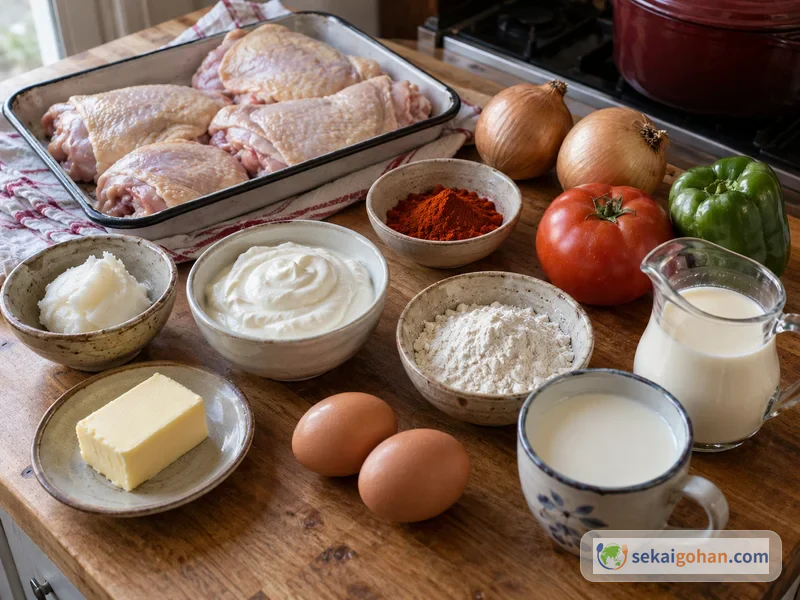
This sauce is made almost entirely of paprika flavor. Look for sweet paprika without heat; most ground paprika sold in supermarkets is sweet and can be used as is. If you can find Hungarian sweet paprika (édesnemes), the color and aroma go deeper still. Whether to mix in a little hot paprika (csípős) is up to you. One thing to watch: paprika loses its aroma once it has been open a while. If your jar has turned brownish at the back of the shelf, replacing it makes a clear difference in the result.
Cooking the chicken with the skin on gives the sauce depth and richness. If you dislike the skin, cook it on and remove it when serving. If you cannot find bone-in meat, use 1.75 lb (800 g) of boneless thigh and shorten the simmering time by about 5 minutes.
This dish contains milk (sour cream, heavy cream, butter, milk), wheat (flour, bread flour), and egg (the nokedli). If you are serving someone with an allergy, check the relevant ingredients.
How to make csirke paprikás
Prep takes about 15 minutes: chop the onions, cut the tomato and pepper, and mix the nokedli batter. The stew takes about 55 minutes counted from sweating the onions. Boil the nokedli while the chicken simmers and the whole meal is ready in about 1 hour 10 minutes.
Cook the chicken until the center has been held at 167°F (75°C) for at least 1 minute. This is what prevents Campylobacter food poisoning. The meat around the bone is the slowest to cook, so do not judge by color; check with a thermometer. Wash the cutting board and knife used for raw chicken before using them on other foods.
If the cream splits and the sauce turns speckled and grainy, take the pot off the heat, stir in 1 tbsp heavy cream, and mix quickly. Boiling is the main cause of splitting, so after adding the cream, go no further than a few small bubbles at the edge of the pot.
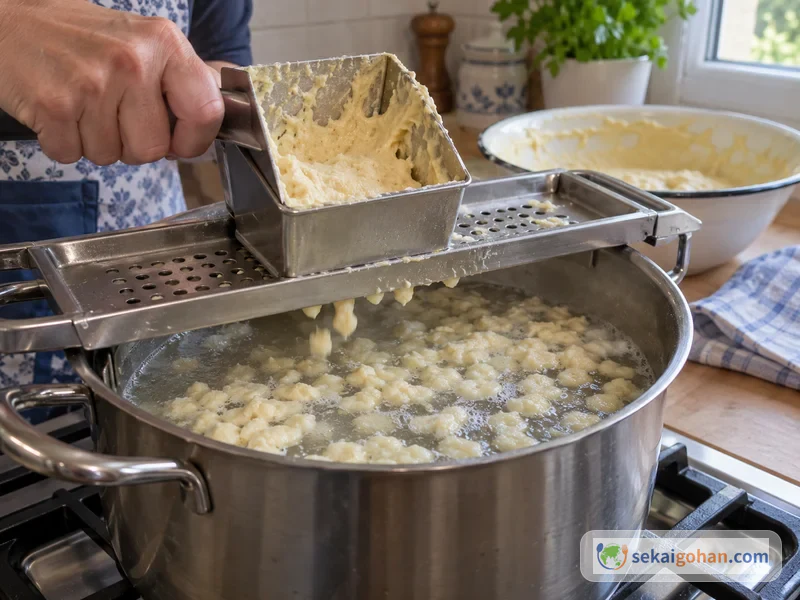
If the nokedli batter is too stiff, it will not pass through the holes of the grater. If it is too loose, it falls apart in the water, so do not add the milk all at once; add 1 tbsp at a time and check. You can also spread the batter on a wooden board and scrape it into the water bit by bit with a knife.
Serving csirke paprikás
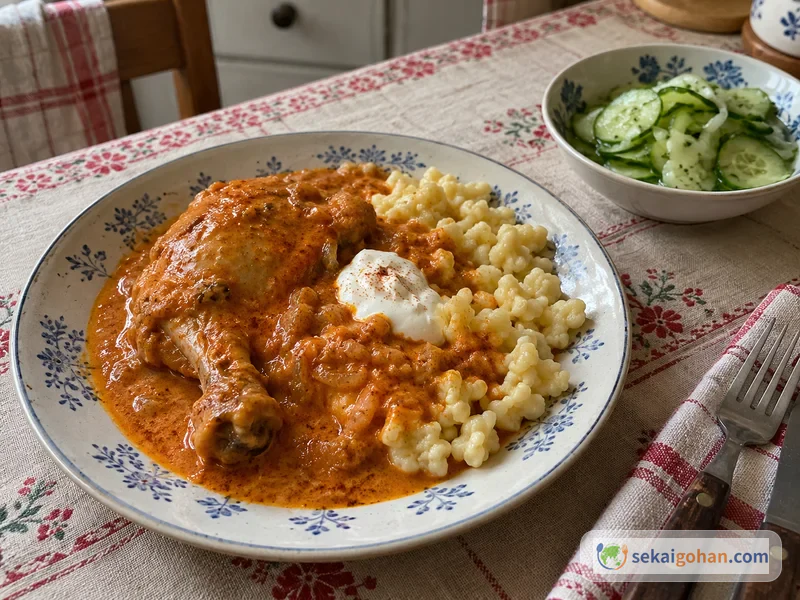
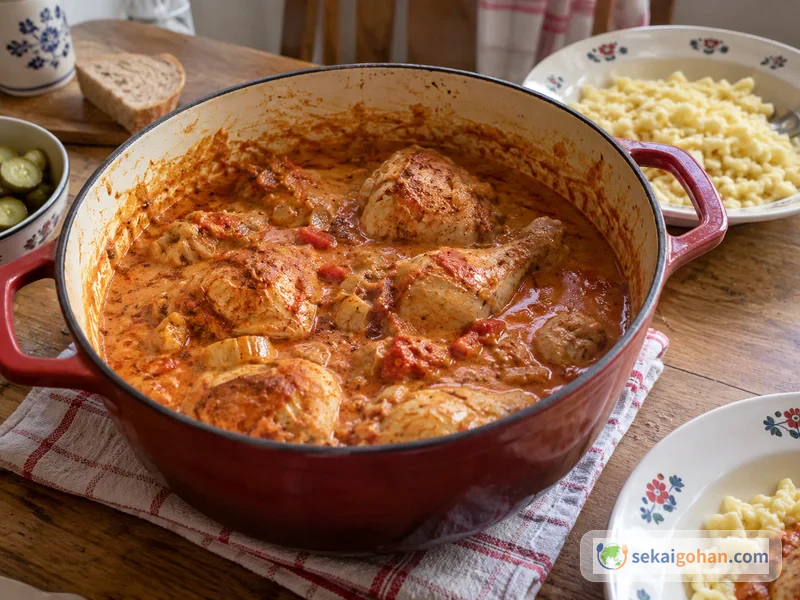
In Hungary, csirke paprikás almost always comes with nokedli. Also called galuska, these are small egg dumplings related to German spätzle, only shorter and stubbier, and they soak up sauce beautifully. Put the chicken on one half of the plate and the nokedli on the other, then ladle plenty of sauce over everything.
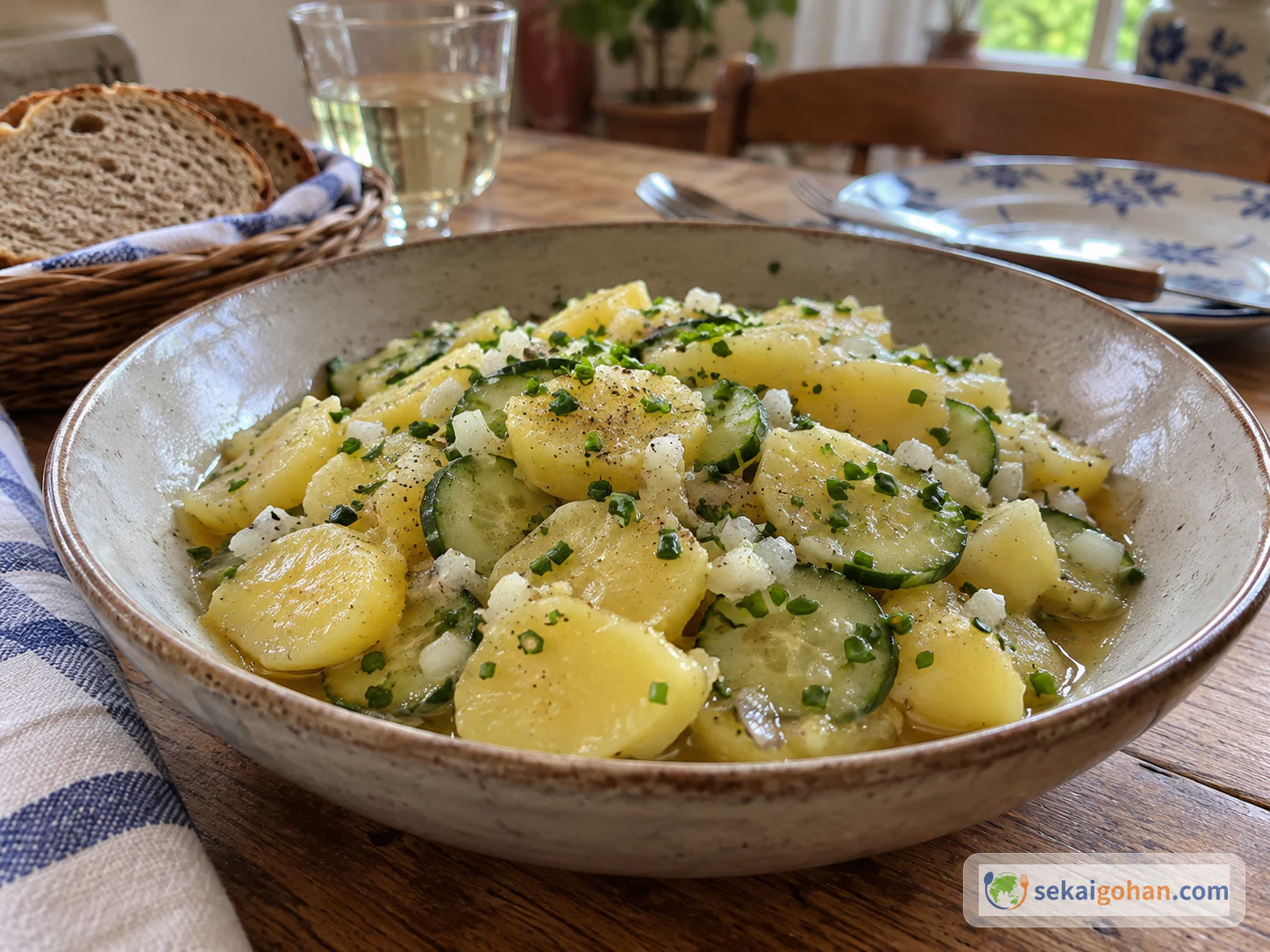
A sweet-and-sour cucumber salad is the classic side, its vinegar cleaning the palate after the rich sauce. On days when you don't have time for nokedli, boiled potatoes sprinkled with parsley, soft polenta, or store-bought egg-based short pasta carry the sauce just as well.
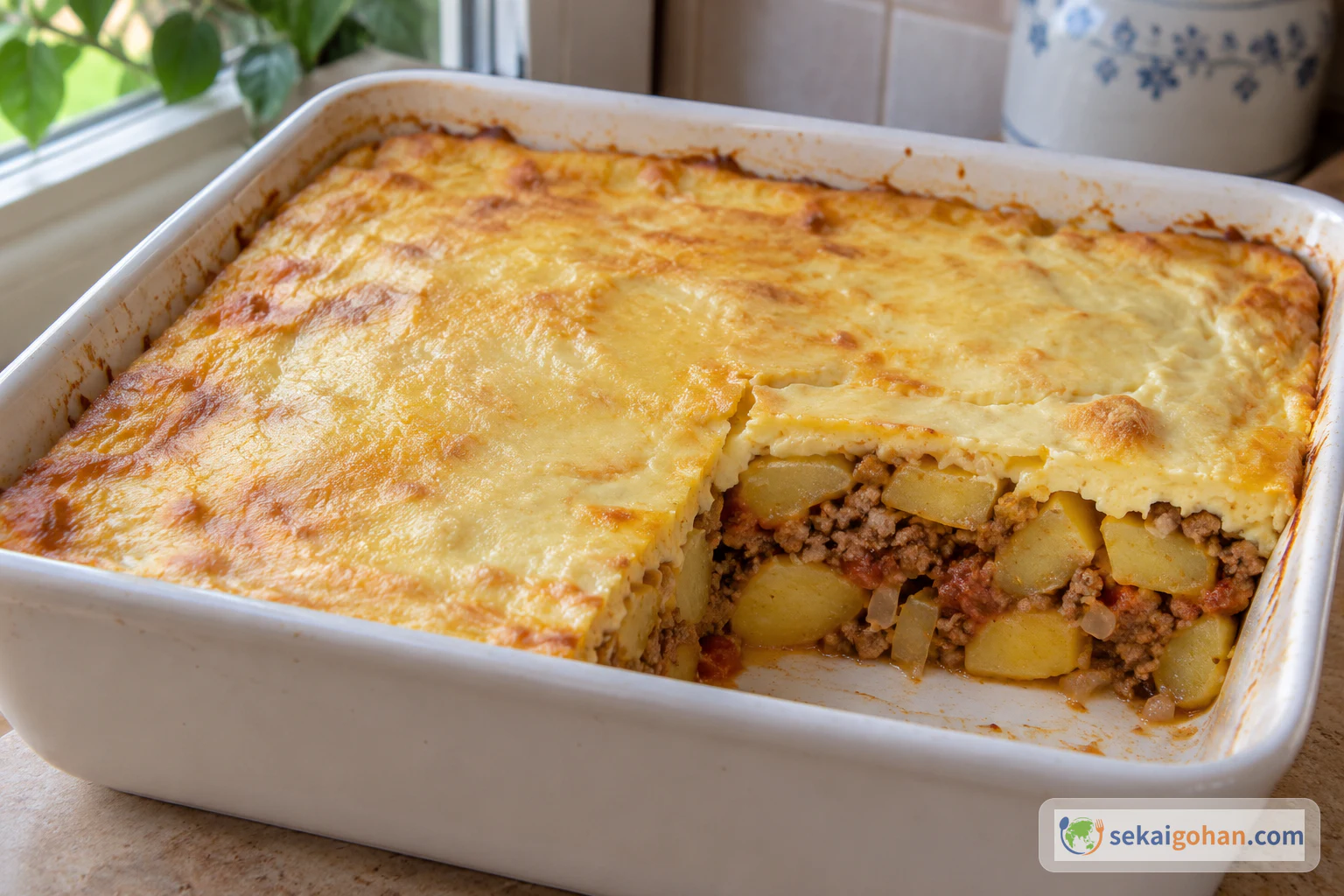
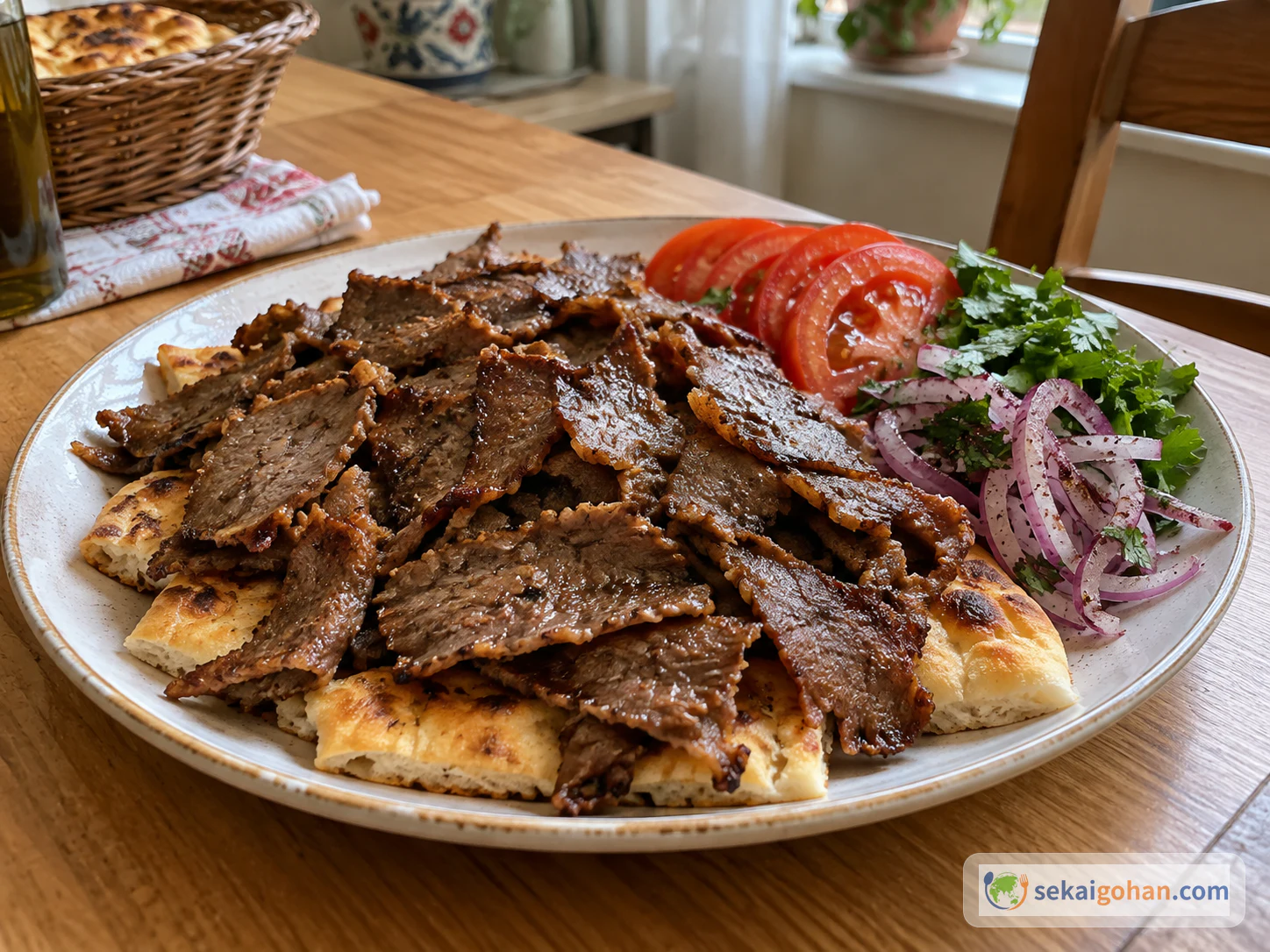
Leftover sauce can become Hortobágyi palacsinta, or you can toss it with nokedli for a light lunch. Try it alongside goulash, which stews beef with the same paprika, and you'll taste how much the sauce changes depending on whether or not there is cream. Rakott krumpli, baked layers of potatoes and sausage, is another Hungarian home dish built on the same sour cream.
Frequently asked questions
Can I make it with chicken breast?
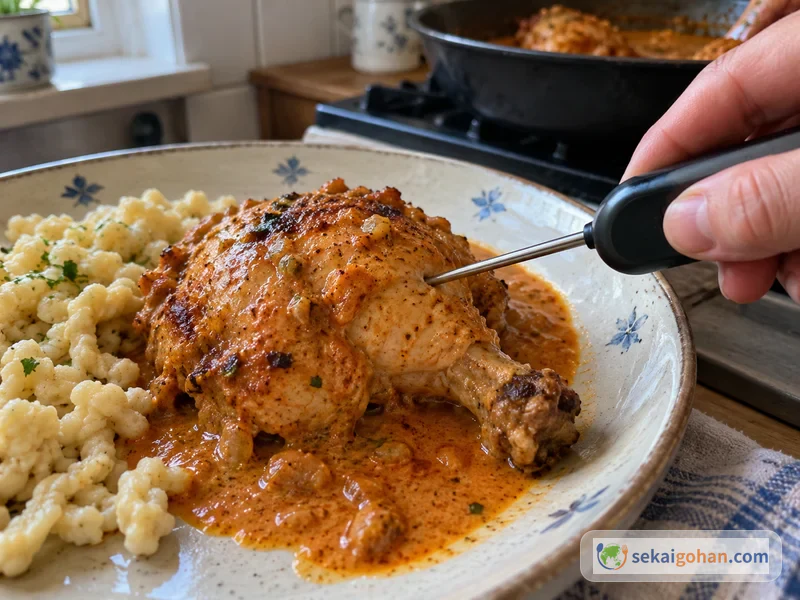
You can, but breast meat turns tough more easily than thigh. For boneless breast, cut it into bite-size slices and shorten the simmering in step 3 to about 15 minutes. With any cut, check with a thermometer that the center has been held at 167°F (75°C) for at least 1 minute.
Can I use hot paprika?
Yes. In Hungary it is made with both sweet and hot paprika. Hot paprika alone gives a strong heat, so start by swapping 1 teaspoon of the 2 tablespoons of sweet paprika for hot and see how you like it.
My sauce split. Can I fix it?
Take it off the heat, add 1 tbsp heavy cream, and mix quickly; sometimes the smoothness comes back. To prevent splitting, whisk the sour cream and flour together first, thin them with a little hot sauce before returning them to the pot, and keep it from boiling afterward.
Can I make it ahead?
Let the stew cool a little, then refrigerate it and eat it soon. Reheat slowly over low heat without letting the cream sauce boil hard, and make sure the chicken is thoroughly heated through to the center before eating.