Carbonnade Flamande: Belgian Beef Stew Braised in Beer

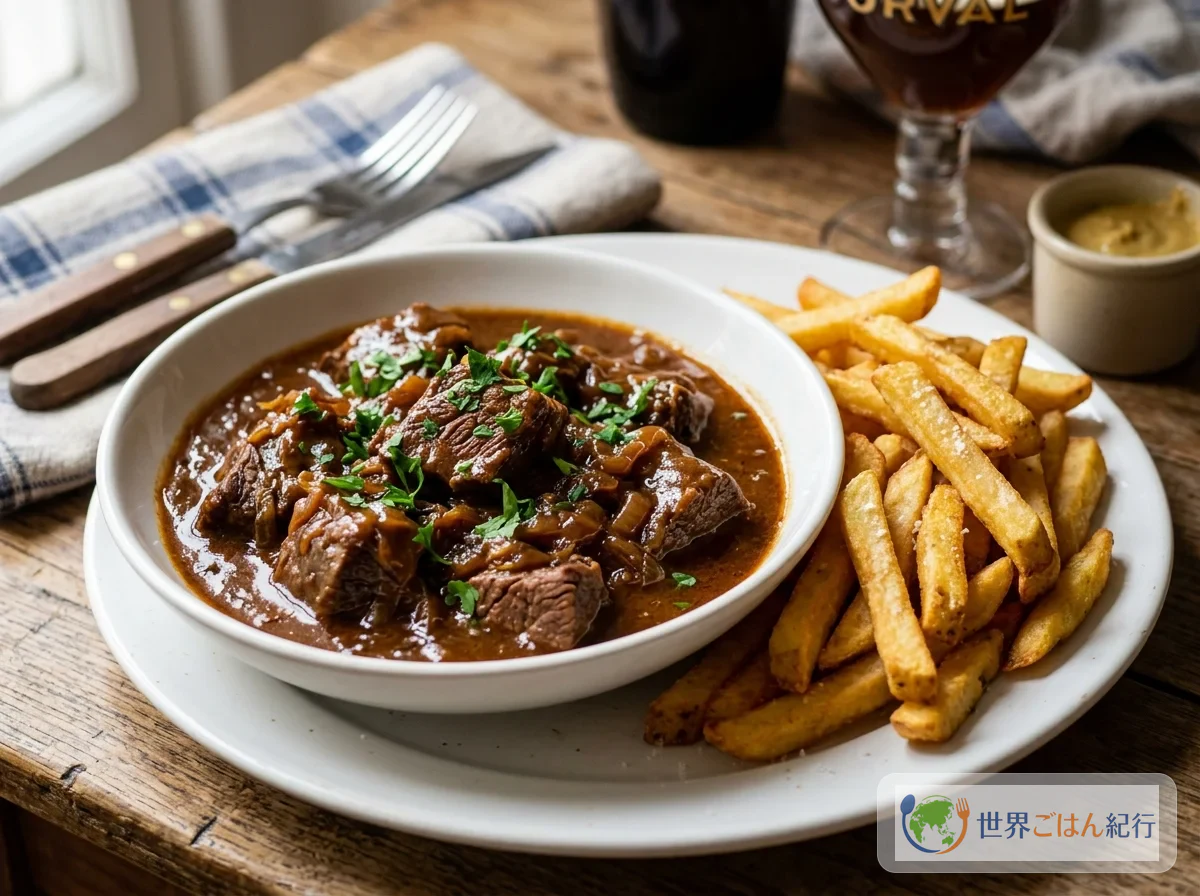
Belgian beer stew carbonnade flamande: tender beef in a deep amber sauce, served with frites
Prep
30 min
Cook
4 hr
Total
4 hr 30 min
Serves
6 servings
Level
Intermediate
Cuisine
Belgian

Carbonnade flamande is a Belgian beef stew braised for 4 hours in Belgian beer and brown sugar. Served with mustard bread and frites, with beer choices.

Cooking flow

Cooking steps

STEP11 / 6

Prepare and sear the beef

20 min

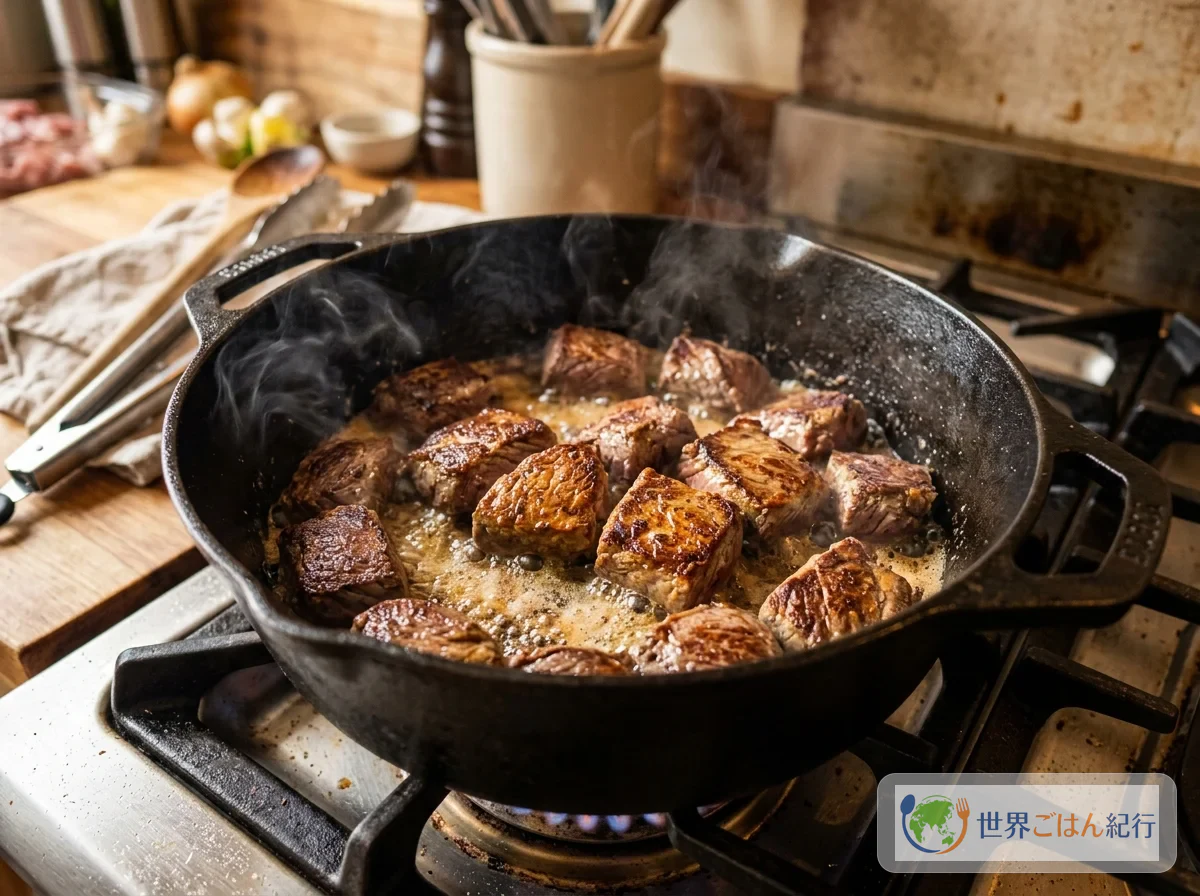
Searing chunks of beef in a cast-iron pot, with deeply browned pieces lined up
Searing the beef. Flouring helps browning and later thickens the sauce, a two-for-one technique

Cut the beef into large 2 inches (5 cm) chunks. Large cuts that resist falling apart are traditional for carbonnade. Coat all sides with 1 tsp salt and black pepper, then dust evenly with 2 tbsp flour. The flour absorbs moisture from the meat and forms a thin film that helps browning.

Put 15 g butter and 1 tbsp oil in a large pot and heat over high heat. Add the beef without crowding (searing in two batches is best) and sear 2–3 minutes per side until deeply browned. The browning decides the color and deep flavor of the sauce. Remove the seared meat to a plate.

STEP22 / 6

Cook the onions until golden-brown

25 min

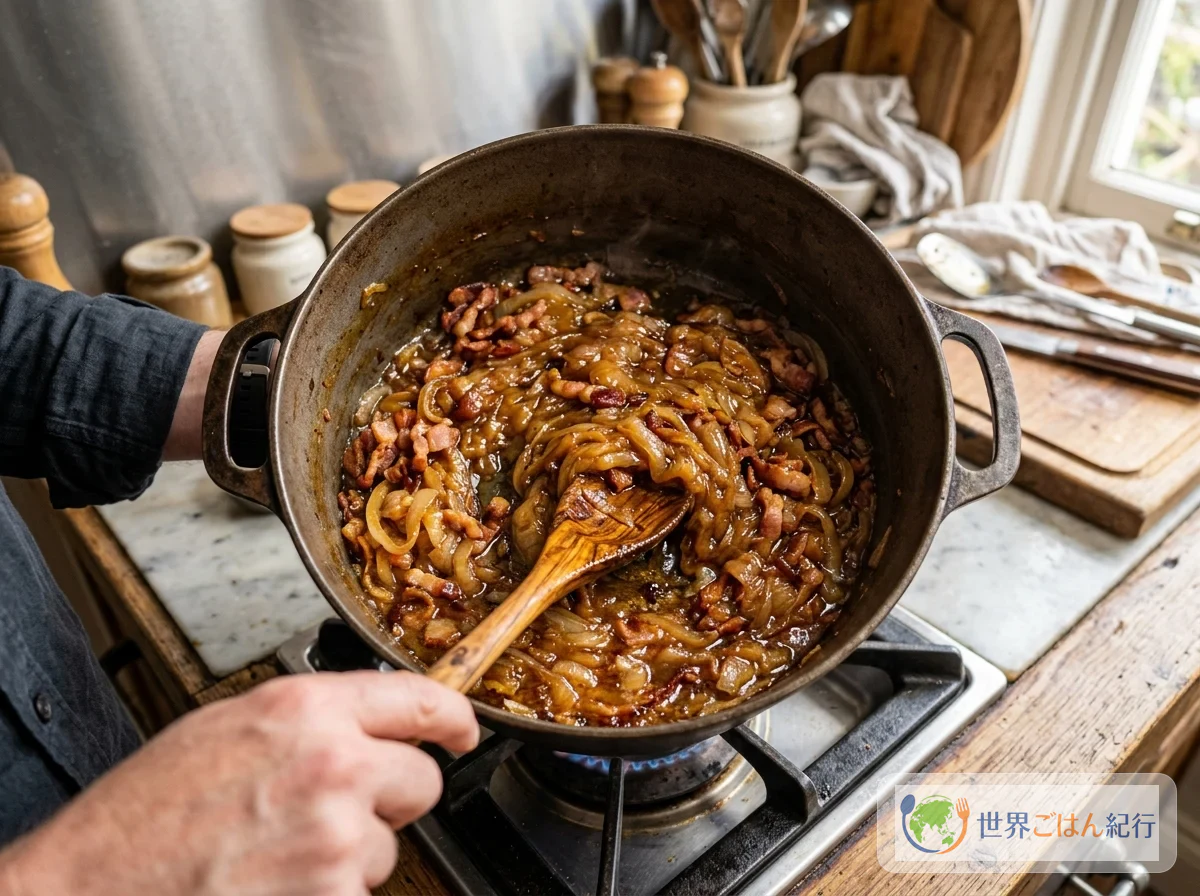
A pot of onions cooked down to amber, golden from the bacon fat
Onions cooked to amber. Four onions caramelize over 20 minutes and build the sweet base of the sauce

Add 15 g butter to the same pot and cook the bacon over medium heat for 5 minutes to render the fat. Add the 4 sliced onions and cook over medium-low heat for 20 minutes, until the volume has reduced by more than half, everything is a deep, glossy amber, and a thin light-brown film forms on the bottom of the pot.

This is the most important step for the flavor of carbonnade. As the water in all those onions slowly cooks off and the sugars caramelize, a deep sweetness develops. If the bottom threatens to burn, add 2 tbsp water and scrape it up; this deglazing layers on more flavor. Add the 3 cloves of garlic and cook 2 minutes to release the aroma.

STEP33 / 6

Start braising in the beer

10 min + 4 hours of simmering

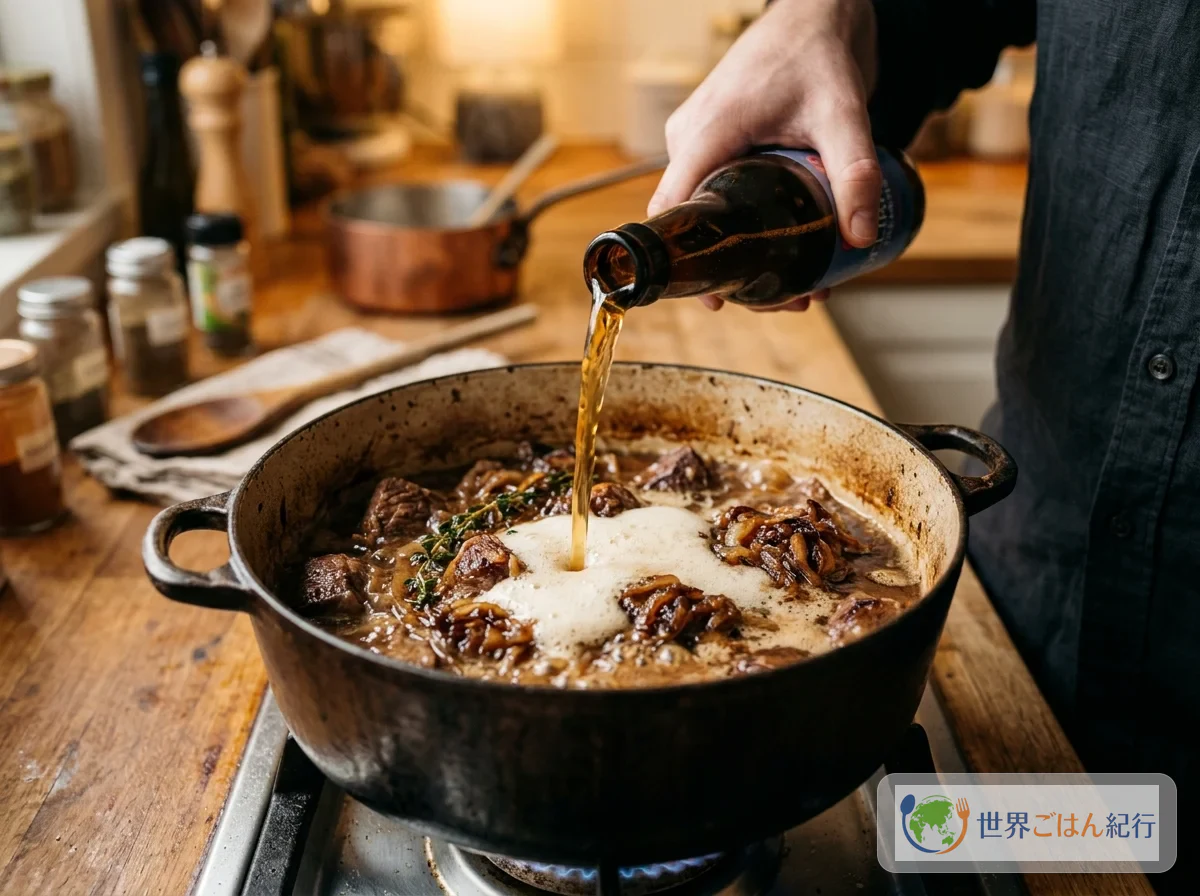
Pouring beer into the pot, amber beer covering the beef and onions
The moment of pouring the beer. Amber Belgian beer envelops the beef and golden onions. The 4-hour braise begins here

Return the beef to the pot and pour in 2 cups (500 ml) Belgian beer. The beer should about cover the meat and onions; if short, add ½–¾ cup (100–200 ml) water.

Add 2 tbsp brown sugar, 2 tbsp wine vinegar, 4 sprigs thyme and 2 bay leaves. Spread plenty of Dijon mustard on one side of 2 slices of bread and float them on the surface of the sauce, mustard side down.

Bring to a boil once over high heat, skim carefully, then cover and simmer over low heat for at least 3 hours, ideally 4. Every hour, lift the lid, check the liquid, and add ½ cup (100 ml) water at a time if needed.

Braising in the oven is steadier

If holding a low flame on the stove for 4 hours is difficult, braise in the oven at 325°F (160°C) for 3.5–4 hours. Put the whole pot in the oven. The temperature stays even, so there is no worry about scorching.

STEP44 / 6

Finish the sauce

15 min

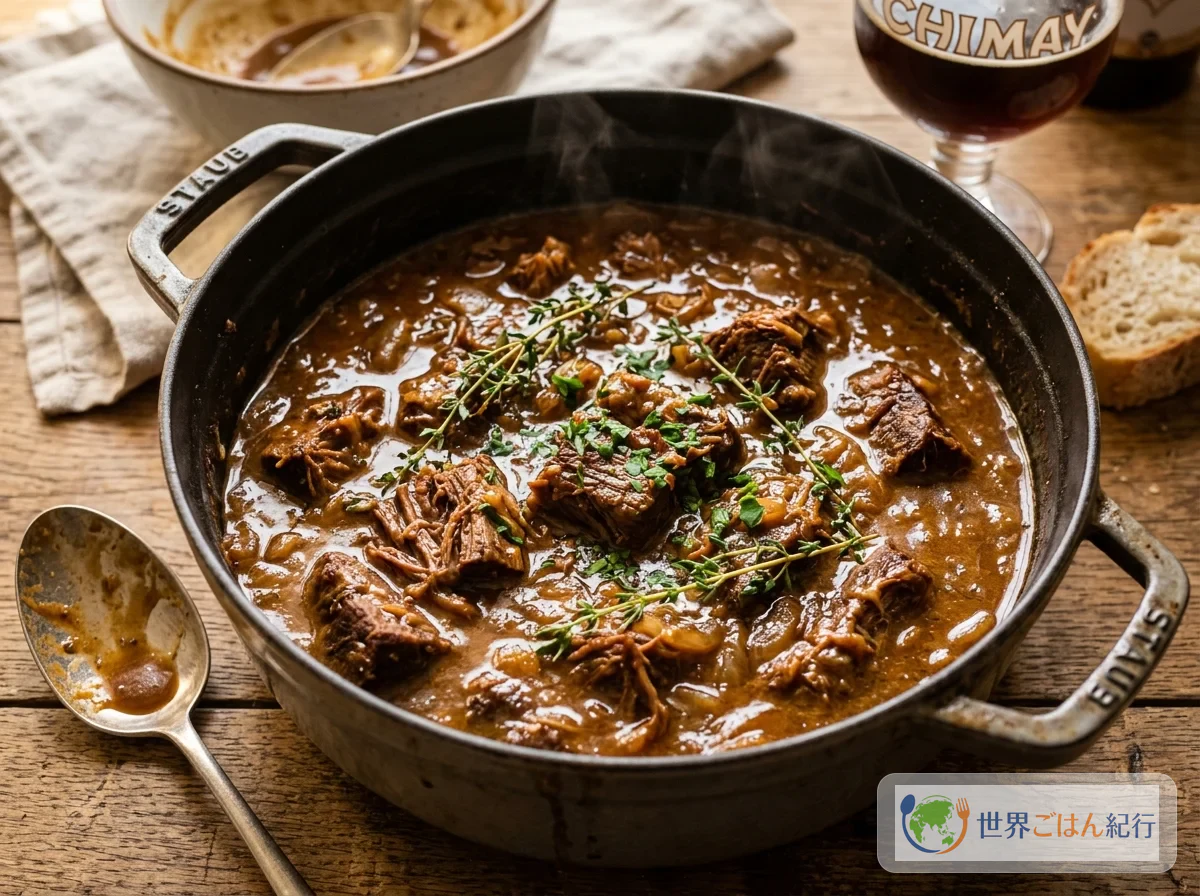
Finished carbonnade, tender meat in a deep amber sauce
Carbonnade after a 4-hour braise. The bread has dissolved into the sauce to thicken it, leaving a deep amber color

When the braise is done, the bread should have dissolved completely. Remove the thyme sprigs and bay leaves. Taste and adjust with salt and pepper. If it lacks sweetness, add 1 tsp brown sugar; if it lacks acidity, add 1 tsp vinegar.

If the sauce is thin, remove the lid and reduce over medium heat for 10–15 minutes. The ideal consistency "just coats the spoon." The meat should be tender enough to fall apart when touched with a fork.

STEP55 / 6

Make the frites (Belgian-style twice-fried potatoes)

30 min

Golden Belgian-style frites
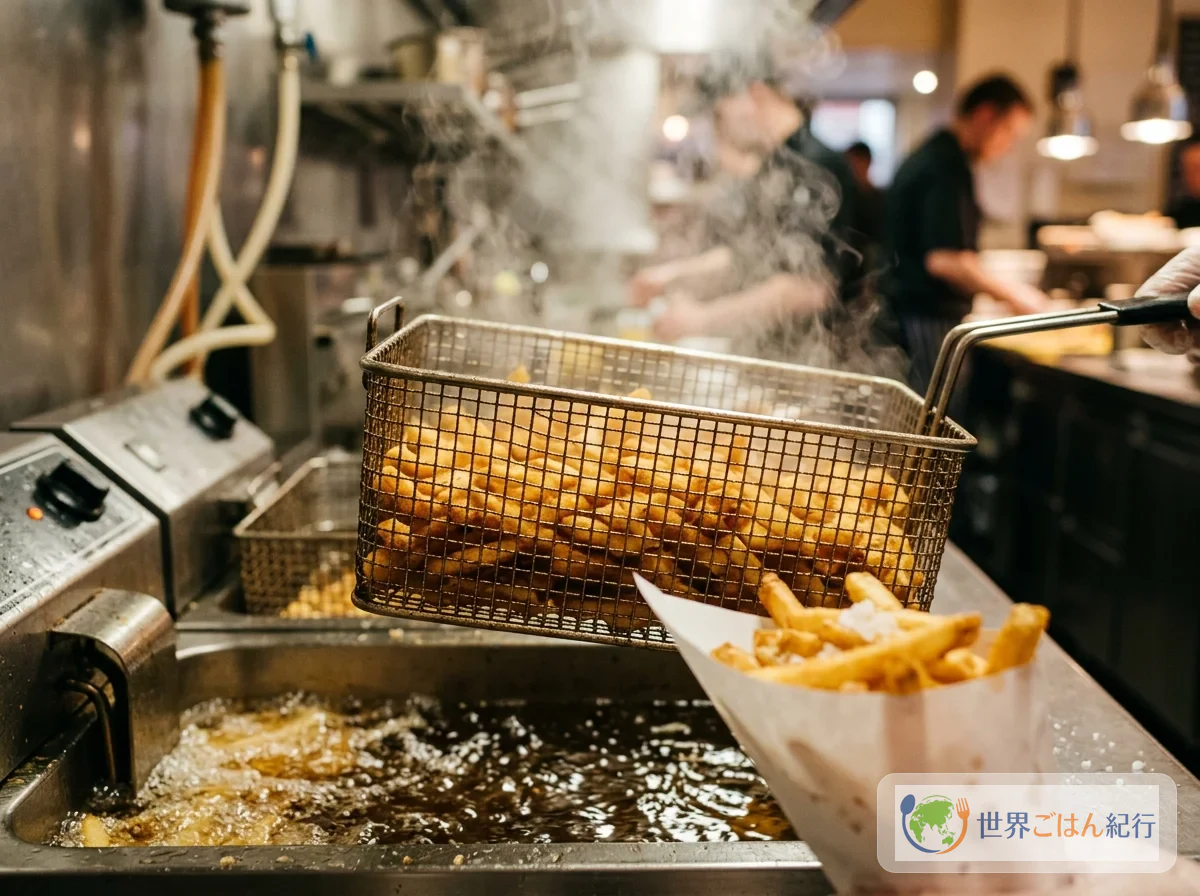
Belgian-style frites. Frying twice yields the ideal texture: crisp outside, fluffy inside

Cut the potatoes into 0.5 inches (1 cm) square sticks, soak in water for 10 minutes to remove starch, and pat dry.

Heat the oil to 325°F (160°C) and fry the potatoes for 6–7 minutes. They should not take on color yet but should be cooked through. Remove and rest 5 minutes.

Raise the oil to 375°F (190°C) and fry again for 2–3 minutes until crisp and golden. Sprinkle with salt and they are done. This double frying is the secret of Belgian frites, giving a crisp outside and fluffy inside.

STEP66 / 6

Plate

5 min

STEP 6

Ladle plenty of carbonnade into a deep plate and set the frites alongside. Chop the parsley to 2–3 mm and scatter it over the surface, and serve mayonnaise on the side. A plating that is easy to eat lets the sauce spread thinly across the bottom of the plate with the corners of the beef just showing. In Belgium, it goes without saying that frites are eaten with mayonnaise, not ketchup.

0 / 0
Ingredients

Ingredients

1 / 3

Main ingredients

Ingredient Amount Substitutes & notes
Beef chuck (in one piece) 2.25 lb (1 kg) Beef short rib or shank also works. A cut with a good balance of fat and lean
Belgian beer (brown ale) 2 cups (500 ml) A dark beer or stout can substitute (see below)
Onions 4 (thinly sliced) The large amount of onion is the base of the sauce's sweetness
Bacon 3.5 oz (100 g) Cut slab bacon into 0.5 inches (1 cm) cubes
Brown sugar 2 tbsp Light brown sugar works
Choosing the beer

The flavor of carbonnade is decided by the beer. Ideally use a Belgian brown ale (Leffe Brune, Chimay Red, Westmalle Dubbel and so on). Its sweetness and malt depth are ideal for a braise. If you can't get one, choose a dark, malty beer with gentle bitterness, such as a dark lager. A stout works too, though it is bitter and needs the brown sugar to balance.

Avoid lagers and pilsners. Their bitterness stands out and does not balance with sweetness even after braising.

2 / 3

Seasonings and spices

Ingredient Amount Substitutes & notes
Dijon mustard 2 tbsp Whole-grain mustard works
Red wine vinegar 2 tbsp Apple cider vinegar works
Thyme 4 sprigs 2 tsp dried thyme works
Bay leaves 2 —
Garlic 3 cloves (crushed) —
Soft (low-protein) flour 2 tbsp All-purpose flour is fine
Butter 1 oz (30 g) —
Salt 1.5 tsp Adjust to taste
Black pepper 1/2 tsp —
Parsley 2 tbsp Chopped to 2–3 mm. For finishing
Sandwich bread 2 slices Spread with mustard and sink into the sauce (see below)
The secret of the mustard bread

The hidden touch in carbonnade is bread spread with mustard. Spread plenty of Dijon on the bread and float it on the sauce, mustard side down. As the stew cooks, the bread dissolves and adds body and flavor to the sauce. It is a piece of Flemish home-cooking wisdom. Where Czech svíčková thickens with cream, carbonnade thickens with bread: both are beef braises, but the approach differs.

3 / 3

Side (frites)

Ingredient Amount Notes
Potatoes 1.75 lb (800 g) A waxy-to-all-purpose potato; fry twice
Vegetable oil about 1.25 quarts (1.2 L) A guide is 2 inches (5 cm) deep in an 8 inches (20 cm) pot. In Belgium, beef fat is used
Salt 1/2 tsp Sprinkle on freshly fried frites. Add more to taste
Mayonnaise 6 tbsp 1 tbsp per person. In Belgium, mayonnaise rather than ketchup
0 / 0

Carbonnade flamande comes to the table dark and glossy, its amber sauce layered with sweetness, bitterness and umami, usually with a heap of frites (Belgian-style fried potatoes) on the side. Belgium is known for chocolate and waffles, but ask Belgians which dish represents the country and many will name carbonnade flamande without hesitating. It is a stew from Flanders in which beef is braised slowly with Belgian beer, onions, brown sugar and mustard. Where Burgundy makes beef bourguignon with wine, Flanders makes carbonnade with beer, and eating it with frites is a national pleasure.

Carbonnade flamande in Flanders and beyond

What is carbonnade flamande?

"Carbonnade" in French means "grilled over charcoal" and originally referred to braising meat that had been grilled over coals. "Flamande" refers to Flanders (today the Dutch-speaking north of Belgium). In Dutch it is called "stoofvlees" (braised meat) or "stoverij".

Carbonnade is eaten not only in Belgium but also in the Netherlands and in French Flanders in northern France. English speakers often call it "Belgium's answer to beef bourguignon," yet it remains less familiar than other European stews such as Croatia's pasticada and Hungarian goulash. Compared with Gaisburger Marsch from southwest Germany, which brings beef broth and noodles together in one dish, carbonnade puts the bitterness of beer and the sweetness of onions up front.

A dish of Flemish beer country

Carbonnade has been made in Belgium since at least the 18th century. Grapes grow poorly on the low-lying Flemish plains, so brewing flourished there while wine was an imported luxury. Braising meat in everyday beer was the natural choice, and abbey-style brown beers are still the standard.

That is why carbonnade and beef bourguignon are so often compared. Burgundy is wine country and Flanders is beer country, and each cooks its meat in its proudest local drink. Beer's malt sweetness and hop bitterness give a complexity different from the tannins of wine, and together with mustard and brown sugar they create a flavor no wine braise has.

The frites dispute

Belgium and France have long argued over where frites, carbonnade's essential partner, came from. The French know them as "French fries," but Belgians insist they originated in Belgium and should be called Belgian fries. The Belgian story goes that 17th-century residents of the Meuse valley fried small fish to eat, and when the river froze in winter, they cut potatoes into fish shapes and fried those instead. In 2014 the culture of the frites stand (fritkot) was recognized as intangible heritage in Flanders, and it is also registered in other regions such as Brussels.

Carbonnade at the Belgian table today

Carbonnade holds an unshakable place as the king of home cooking in modern Belgium. In many Flemish households the family gathers around it for Sunday lunch, butchers readily sell beef for braising, and every family has its own beer and its own level of sweetness. Meanwhile, restaurants in Brussels and Antwerp are reinterpreting the dish, keeping the traditional flavor while rethinking the plating and accompaniments, much as goulash is being updated in modern Hungary.
Night view of the Grand-Place in Brussels' old town, with illuminated historic buildings
Belgium, home of carbonnade. The Grand-Place in Brussels is a UNESCO World Heritage site, and restaurants around it serve authentic carbonnade

Choosing the beer for carbonnade

The quality of the beer is the quality of the sauce

Inexpensive beer is fine, but use one you would enjoy drinking. The alcohol cooks off, while the malt flavor, sweetness and bitterness stay. Lagers and pilsners turn too bitter, so choose a brown ale, a dubbel or a stout-type beer.
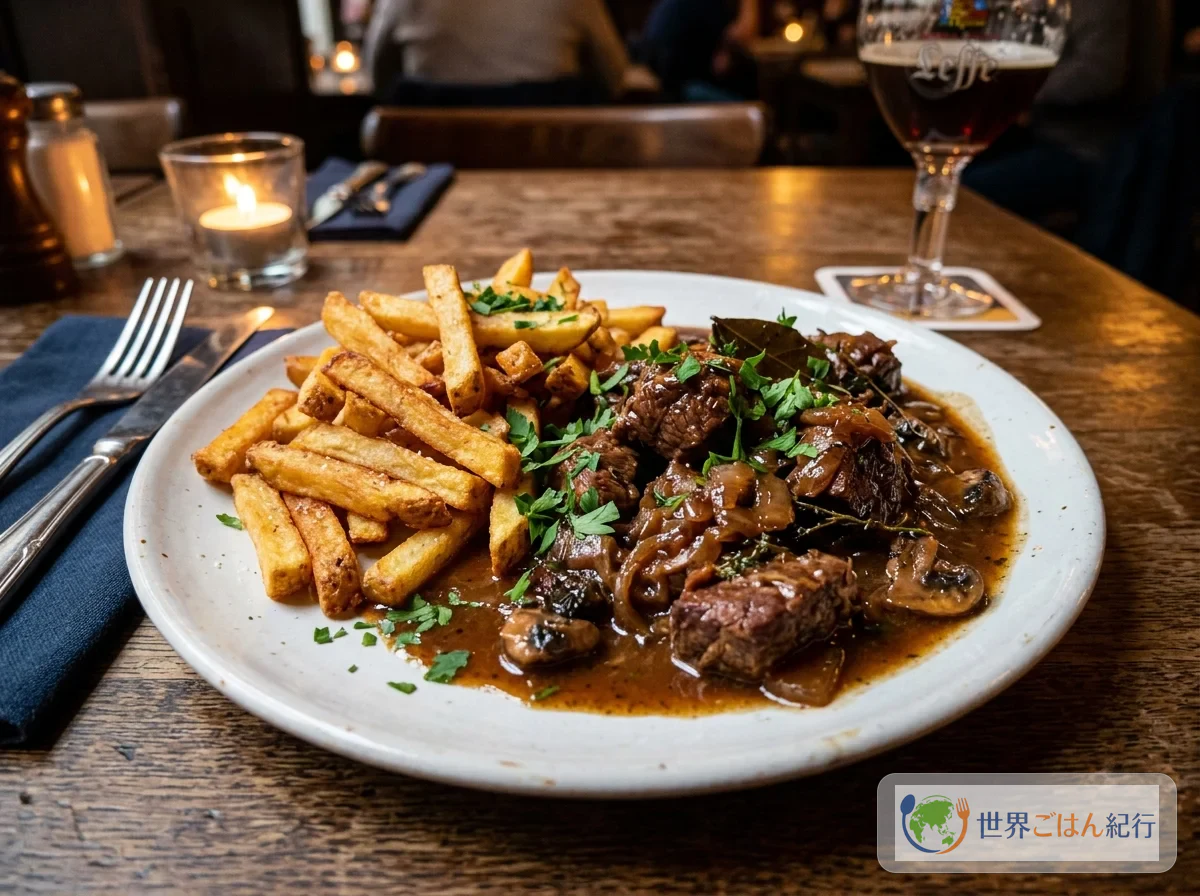

Plated carbonnade and frites: beef in amber sauce with golden frites
Carbonnade and frites on a plate. Amber beer-braised sauce and golden frites, a signature dish of the Belgian table

Carbonnade cooking tips

Always spread the mustard on the bread

Bread simply dropped in only thickens the sauce. Spread with mustard, when the bread dissolves, the mustard's pungency and aroma spread evenly through the whole sauce. Skip it and the result feels like something is missing.

The science of double-fried frites

The first, lower-temperature fry (325°F (160°C)) cooks the inside of the potato and gelatinizes the starch. The second, hotter fry (375°F (190°C)) drives off surface moisture at once and makes the outside crisp. It is the same idea as the two-stage "boil then pan-fry" cooking of Polish pierogi: finish the inside and the surface separately.


Serving, storing and varying carbonnade

Carbonnade is reliably better reheated the next day than on the day it is cooked. Overnight the sauce soaks fully into the meat and the beer's sharper edges mellow, which is why Belgians make extra on purpose; "make it Sunday, eat it Monday" is the rule in many homes. It keeps for 3 days in the refrigerator and 1 month in the freezer. Reheat it slowly over low heat.
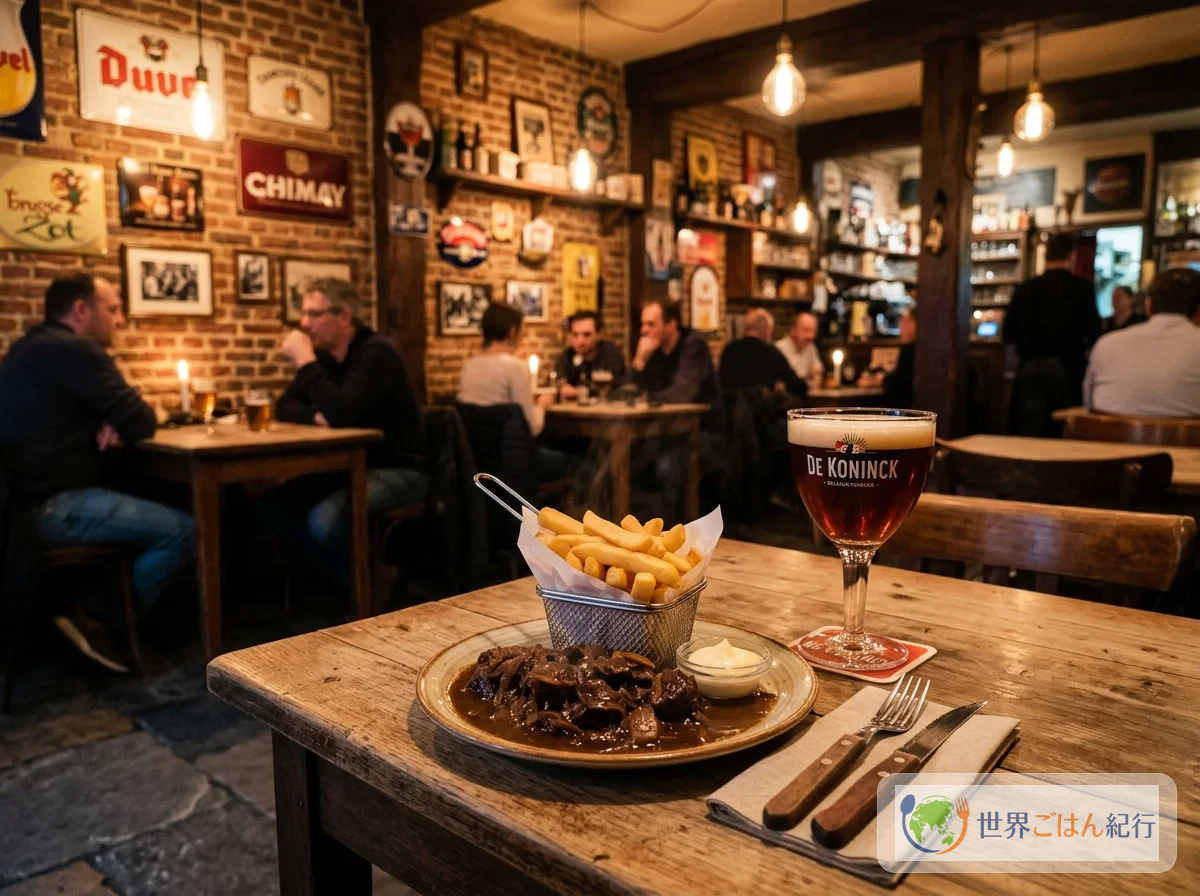
A table in a Belgian café enjoying carbonnade with beer
In a Belgian café. Carbonnade, frites and Belgian beer: for Belgians, this combination is bliss

Pork carbonnade

Use 2.25 lb (1 kg) pork shoulder instead of beef and shorten the braise to 3 hours, since pork turns tender faster. The sweetness of pork fat plays well against the bitterness of beer for a richer result. Pork turns up in dishes across Europe, like Serbian ćevapi.

Lamb carbonnade

You can also make it with lamb. Its flavor harmonizes with the thyme, and the bitterness of the beer tames the gaminess.

Slow cooker version

After steps 1–2, put everything in the slow cooker and cook on LOW for 8 hours. Set it in the morning and dinner is ready by evening.

Vegan version (mushroom carbonnade)

Use 14 oz (400 g) mushrooms and 10.5 oz (300 g) seitan (wheat gluten) instead of beef. Mushroom umami and the richness of the beer give a depth you would not guess is meatless. If you like bean-and-vegetable braises such as North Macedonia's tavče gravče, this one is for you.

Chocolate beer version

A chocolate stout adds cocoa flavor and makes the sauce extremely rich. Melt in 10 g dark chocolate at the end for a deep complexity reminiscent of Mexican mole poblano.

Nutrition (per serving, 6 servings total)

Most of the alcohol cooks off during braising, but the beer's B vitamins, minerals (magnesium, potassium) and fiber stay in the sauce, alongside the protein and iron of the beef.

Nutrient Amount
Calories 520 kcal
Protein 1.25 oz (38 g)
Fat 18 g
Carbohydrates 1.5 oz (42 g)
Fiber 4 g
Sodium 650 mg

The frites (about 300 kcal) are not included. About 5% of the alcohol remains after a 4-hour braise, so children and pregnant women should take care; non-alcoholic beer keeps much of the flavor and makes the dish alcohol-free.


More Belgian and European dishes

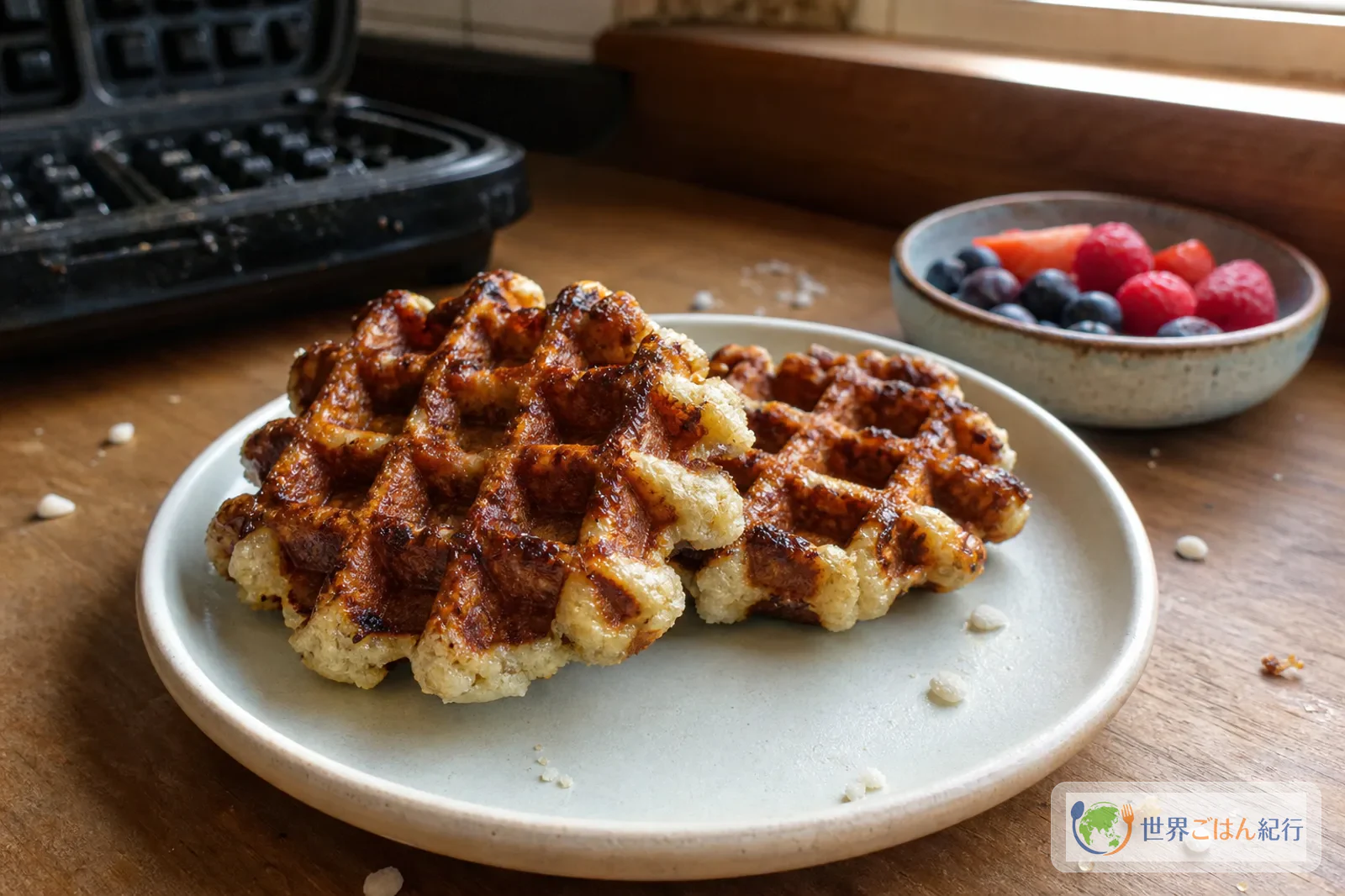
  • Belgian waffles: the day after the beer stew, carry on with Belgium's favorite street snack.
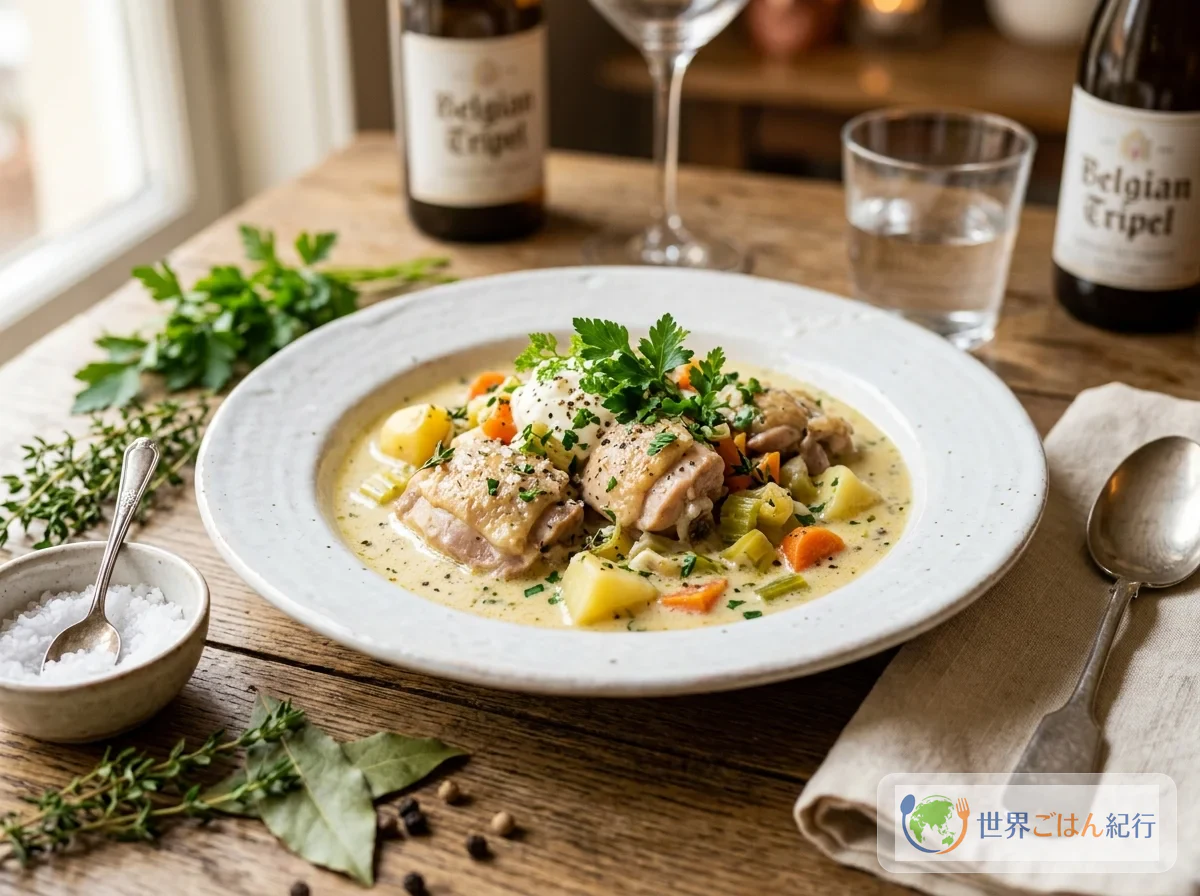
  • Waterzooi: another Flemish stew, with chicken or fish in cream.
  • Stuffat tal-fenek: a Maltese home dish of rabbit braised in wine, a southern European counterpart to the beer stew.
  • Pasticada: a Croatian braise with prunes and wine, for comparing wine and beer braises.
  • Goulash: a Hungarian paprika stew in which spice transforms the meat.
  • Svíčková: a Czech braise in a tangy cream sauce.
  • Borscht: a red Ukrainian stew whose sweet-and-sour beets contrast with carbonnade's beer bitterness.

FAQ

Q1. Can I make it with Japanese beer?

Yes. Dark Japanese beers (Asahi Kuronama, Kirin Ichiban Shibori Kuro) or craft beer (Yona Yona Ale) work well. Look for a dark beer with sweetness and malt character, and avoid ordinary lagers (Super Dry, Kirin Lager and the like), which turn too bitter.

Q2. Do I really need to braise it for 4 hours?

Give it at least 3 hours. At 3 hours the meat is tender, but at 4 hours it falls apart under a fork and the sauce is far deeper. A pressure cooker can shorten it to about 1–1.5 hours, though a slow braise gives the sauce more complexity.

Q3. What happens if I leave out the mustard bread?

The sauce loses some body and flavor. Without bread, dissolve 1 tbsp flour in 3 tbsp water and add it at the end of the braise for thickening. The mustard flavor then has to come separately, so stir in 1 tbsp Dijon mustard at the end as well.

Q4. Can I serve it with something other than frites?

Of course. Mashed potatoes, boiled potatoes and pasta (tagliatelle) all go well, and Belgian restaurants sometimes serve bread to soak up the sauce. Just be prepared for a Belgian to tell you, indignantly, that carbonnade can only be eaten with frites.
Sources

  • Wikipedia, "Flemish stew" (name, thickening with mustard-spread bread, pairing with frites; accessed 22 October 2026)
  • Do Eat Better Experience, "Flemish stew and waterzooi in Bruges" (regional dishes of Bruges; accessed 22 October 2026)
  • erfgoed.brussels, "Fritkot - inventarisfiche" (fritkot culture in the Brussels intangible heritage inventory; accessed 22 October 2026)
  • Van Waerebeek, Ruth. Everybody Eats Well in Belgium Cookbook. Workman Publishing, 1996. (Belgian recipe collection)
  • Scholliers, Peter. Food Culture in Belgium. Greenwood Press, 2009. (Belgian food culture)