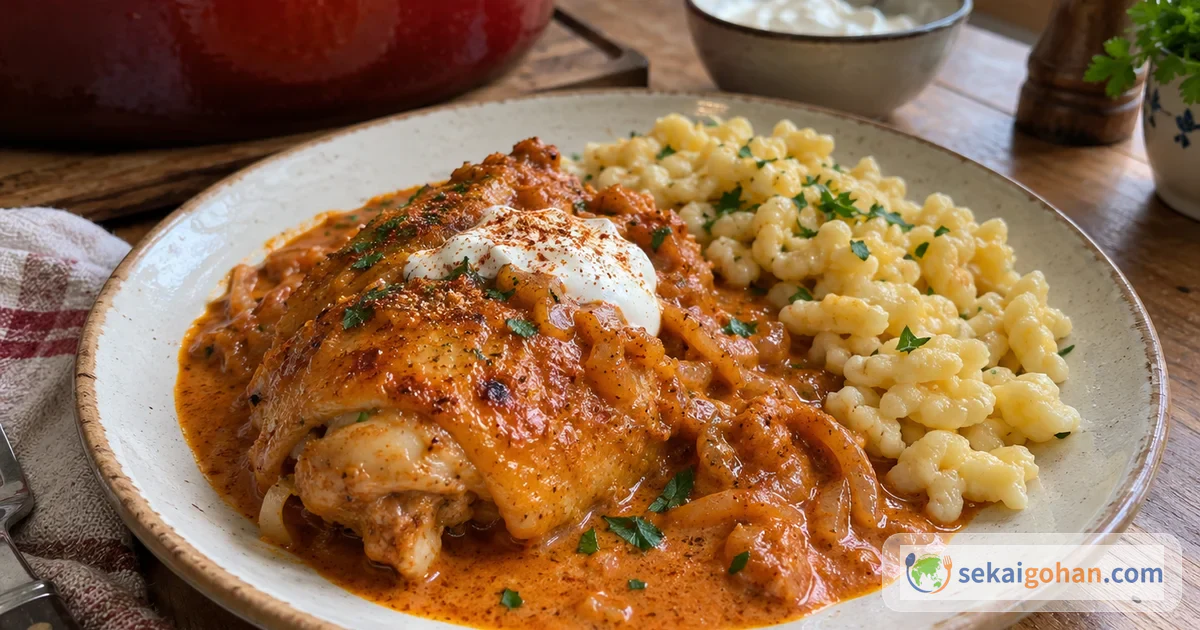
Tender slices of beef rest under a smooth, pale beige cream sauce, with fluffy slices of knedlíky, the distinctive Czech bread dumplings, alongside. A spoonful of whipped cream and a spoonful of cranberry sauce (brusinky) go on top, and the moment the sweet, sour, and creamy flavors melt together is the best part of svíčková. In the Czech Republic, people call Svíčková na smetaně "the taste of Sunday." It's beef sirloin simmered slowly with root vegetables, and the broth that has absorbed their flavor is finished with sour cream. It's the national dish of Czechia, and you can make a Czech home version with ingredients from an ordinary well-stocked supermarket.
About svíčková

Svíčková belongs to Czech "special days." It's served at wedding dinners, on the Christmas table, and at weekend family lunches. Outside Czechia it's far less known than Hungarian goulash.
"Svíčková" comes from the Czech word "svíčka," meaning "candle," because a beef sirloin (loin) looks like a long, slender candle. "Na smetaně" means "in sour cream," so svíčková na smetaně means "sirloin in sour cream sauce."
A Habsburg legacy
Svíčková dates to the 19th century, when Czechia was part of Austria-Hungary (the Habsburg Empire). It developed independently in Bohemia, influenced by Viennese court cooking. Its roots lie in Austria's "Tafelspitz," the boiled beef dish loved by Emperor Franz Joseph I. Tafelspitz is eaten with horseradish sauce, while the Czechs added their own twist: a sauce of root vegetables and sour cream.
Knedlíky culture
Knedlíky are indispensable on the Czech table. They form a staple category of their own, neither bread, rice, nor potato. Like Georgian khachapuri and khinkali, flour-based staples have developed in great variety across Eastern Europe and the Caucasus.
Knedlíky share roots with German Knödel and Austrian Knödel, but the Czech version developed with particular emphasis on the ability to "soak up sauce," and in Czechia knedlíky and braised dishes are inseparable. The dough is boiled as a log, so the air bubbles in each sliced cross-section absorb the sauce like a sponge.
Ingredients (serves 4)
Knedlíky use wheat flour, egg, and dairy. The sauce also contains sour cream (dairy) and wheat flour. People with wheat, egg, or milk allergies should take care. Boiled potatoes can be served in place of the knedlíky.
Choosing ingredients for svíčková
Svíčková is traditionally made with beef, but pork loin works well too. Shorten the braising time to 1 hour 30 minutes. Pork carries more fat richness into the sauce, so reducing the sour cream to ½ cup (150 ml) balances it.
For a lighter finish, use chicken breast and shorten the braising time to 45 minutes. Like Georgian satsivi, the combination of chicken and a creamy sauce is widely loved from Europe to the Caucasus.
If you can't find cranberry sauce, blueberry jam and lingonberry jam are the closest substitutes. Either gives the balance of sweetness and acidity that suits the sauce.
Method
Preparing and searing the beef
Sautéing the vegetables and braising
Finishing the cream sauce
Making the knedlíky (cook in parallel while the meat braises)
Plating
Finishing and plating (5 min) — Slice the beef 0.25 inch (5 mm) to 0.5 inches (1 cm) thick. Arrange 3 to 4 slices of knedlíky on a plate and lay the sliced beef alongside. Pour plenty of cream sauce over the beef and knedlíky, and add a spoonful of whipped cream and a spoonful of cranberry sauce. Garnish with a lemon slice and it is done.
Svíčková cooking tips
The sauce is defined by three elements: sugar for sweetness, vinegar and lemon juice for acidity, and sour cream for mellowness. If any one stands out, the sauce has failed; the ideal is for everything to melt into a single flavor. Add the vinegar and lemon juice a little at a time and adjust as you taste.
Always slice the braised beef across the grain. Cut with the grain, it is hard to bite through even when tender. The ideal thickness is 0.25 inch (5 mm) to 0.5 inches (1 cm). Too thin, and the presence of the meat fades; too thick, and the sauce doesn't cling.
A knife crushes the cut surface of boiled knedlíky and the fluffiness is lost. Use thick cotton thread or unflavored dental floss instead: slide it under the dough and pull the two ends up. The cut surface stays soft and you get clean round slices.
Serving svíčková and variations
Side dishes
Bramborové knedlíky (potato dumplings) are made from mashed potato instead of wheat flour, and their chewy texture clings to the sauce differently from bread dumplings. Make them with 10.5 oz (300 g) boiled potatoes, 3.5 oz (100 g) potato starch, and 1 egg.
If knedlíky are too much work, other familiar staples also go well with svíčková. It may seem surprising, but plain white rice goes very well with the cream sauce.
Pressure cooker version
A pressure cooker shortens the 2-hour braise to 40 minutes. Do everything through searing as usual, then after adding the vegetables and water, cook at pressure for 30 minutes and release naturally for 10. The meat comes out about as tender as with a regular braise.
Nutrition (per serving, 4 servings in total)
| Nutrient | Amount |
|---|---|
| Energy | 680 kcal |
| Protein | 1.5 oz (42 g) |
| Fat | 1 oz (28 g) |
| Carbohydrates | 2.25 oz (62 g) |
| Fiber | 4 g |
| Sodium | 780 mg |
The beef provides good-quality protein, and the root vegetables in the sauce (carrot, parsnip, celeriac) provide vitamin A, vitamin C, and potassium. The cranberry sauce contains proanthocyanidins, a type of polyphenol with antioxidant effects. The fat from the sour cream and butter is on the high side, though, so keep portions moderate.
More dishes to make with it
- Carbonnade - Shares ingredients and aromas from the same region.
- Waterzooi - Shares ingredients and aromas from the same region.
- Pasticada - Shares ingredients and aromas from the same region.
- Vepřo knedlo zelo - Also Czech knedlíky, but with roast pork and sauerkraut for a simple lunch.
FAQ
Q1. The sauce is too loose. What can I do?
Adjust the thickness with a flour roux. If the sauce is watery, make an extra roux from 10 g of butter and 1 tbsp of all-purpose flour and add it little by little. If it is too heavy, thin it with milk 1 tbsp at a time. It's right when a finger drawn across the back of a spoon leaves a track.
Q2. The knedlíky turned out hard. What's the cause?
There are two main causes: over-kneading and water that is too hot. Stop kneading once the dough is smooth, and cook the dumplings at a low to medium "gentle simmer." A violent boil sets only the surface, leaving the inside raw and the result hard.
Q3. Is svíčková better the next day?
Yes, and many Czechs say the next day is best. Overnight, the flavor of the meat and vegetables moves into the sauce and the taste becomes more unified. Rest it overnight in the refrigerator and reheat slowly over low heat. Knedlíky are best eaten the same day; the next day, warm them in the microwave for 30 seconds or re-steam them to restore their fluffiness.
Q4. Is larding really necessary?
The dish works without it, but the meat is noticeably juicier with larding. Lean meat dries out in a 2-hour braise, and the bacon fat moistens it from inside. If that is too much work, pierce the meat with a fork, wrap bacon around the surface, and tie it with kitchen twine for a similar effect.
Summary
Svíčková na smetaně is a "taste of the heart" that Czechs long for wherever they are in the world. The sweetness of root vegetables, the mellowness of sour cream, the acidity of cranberry, and tender beef: a plate in which everything is in harmony promises flavor worth more than two hours of braising.
All the ingredients can be found at a well-stocked supermarket. Knedlíky share with Uzbek manti the idea of "a flour-based dough that soaks up sauce," and should suit many palates.
Try it first on a slow weekend afternoon. The Czech "taste of Sunday" may bring a fresh breeze to your table. Together with Hungarian goulash and Greek moussaka, enjoy the depth of Europe's braised dishes.