A cream-colored walnut sauce wraps pieces of boiled chicken, with green cilantro and red pomegranate seeds scattered over the top like jewels. In Georgian homes, this is the dish that reaches the table on New Year's Day (January 1) and on Orthodox Christmas (January 7): satsivi (საცივი / Satsivi). It's served cold, straight from the refrigerator, and that is the whole point. Chilling lets the oils of the walnuts merge into the sauce and carries their savoriness into every corner of the chicken. You'll notice it at the first bite.
Satsivi, Georgia's cold holiday dish
"საცივი" means "something cold" in Georgian, and satsivi is exactly that: a cold dish that is chilled in the refrigerator after it is finished and then eaten. Walnuts are ground to a paste, seasoned with coriander, fenugreek, saffron, and garlic, and thinned with the chicken's cooking broth. The sauce goes over the boiled chicken, and the whole thing rests overnight. At a European winter feast, where hot dishes usually take the lead, a cold dish at the center of the table is quite unusual.
Walnuts in Georgian cooking
Georgian food uses a lot of walnuts, as the introduction to Georgian cuisine (in Japanese) explains. Bazhe (walnut sauce), pkhali (vegetables dressed with walnut paste), and satsivi all depend on the walnut trees that grow wild on the southern slopes of the Caucasus Mountains.

Why satsivi belongs to New Year and Christmas
Georgian Orthodox Christmas falls on January 7, and for about 40 days before it there is a fast without meat. When the fast ends on Christmas Day, people make the chicken dishes they've been waiting for. Church prayers and visits from relatives leave little time in the kitchen, though, so satsivi, which can be made the day before and chilled in the refrigerator, was the ideal holiday dish.
Satsivi at the supra

The supra is the Georgian banquet. A toastmaster called the "tamada" leads toast after toast while wine and food keep arriving. Satsivi matters here for a practical reason: being cold, its quality does not drop even over a long feast. However many hours the supra lasts, satsivi tastes the same at the end as at the start. If khachapuri stands for everyday Georgian food, satsivi stands for festive-day Georgian food.
The Georgian New Year table

A Georgian New Year begins on the night of December 31 with a grand feast of family and relatives. Alongside the satsivi, made the day before and rested overnight in the refrigerator, the table holds:
- Khachapuri, freshly baked cheese bread
- Lobio (red kidney beans stewed with spices)
- Badrijani (eggplant rolls with walnut paste)
- Khinkali (large dumplings full of juice)
For dessert there is Gozinaki (walnut and honey sweet) and Churchkhela (walnuts strung and coated in thickened grape juice). Then the tamada cries "Gaumarjos! (Cheers!)," wine made in qvevri is poured, and the long chain of toasts begins.
Chicken or turkey
Among English-language food bloggers, satsivi is sometimes called a "Georgian Thanksgiving turkey," and quite a few Georgians living in the United States make it with turkey. In Georgian homes the orthodox way is to boil a whole chicken. This recipe uses chicken thighs, easy to find at ordinary supermarkets, so an authentic satsivi fits even a weeknight dinner.
Ingredients (serves 4)
The oils in walnuts oxidize easily, and old ones turn bitter. Open the bag and smell it; if you get a sharp smell like paint, do not use it. Opened walnuts keep best in the freezer.
Choosing spices and substitutes for satsivi

Georgian cooking has two spice blends of its own, and both are worth knowing before you shop.
Utskho suneli (უცხო სუნელი)
The name means "foreign spice." It is the dried, ground seed of blue fenugreek (Trigonella caerulea), with a nutty, sweet aroma and a faint maple-syrup-like flavor. Like berbere, the blend behind Ethiopian doro wat, it is hard to find outside its home country, so ordinary ground fenugreek stands in.
Khmeli suneli (ხმელი სუნელი)
This is Georgia's all-purpose spice mix, a blend of coriander, basil, dill, marjoram, fenugreek, paprika, and others. Some satsivi recipes call for it, but this one measures individual spices instead, because the blend varies so much from maker to maker that the flavor changes every time.
Substitutes
| Georgian spice | Substitute | Caution |
|---|---|---|
| Utskho suneli | Ground fenugreek | Up to 1 tsp. More turns bitter |
| Saffron (Imeretian saffron) | Real saffron or turmeric | Georgian "saffron" is marigold; real saffron has a better aroma |
| Green chili (tsitsaka) | Mild green pepper or shishito | Georgian chilies are mild |
How to make it
STEP 1: Boil the chicken
Put 1.5 quarts (1.5 L) water, the chicken thighs, half the onion, the bay leaves, black peppercorns, and salt in a pot and, starting from cold water, set over medium heat. When it boils, keep the heat high and carefully skim the scum for about 5 minutes to get a clear broth. Lower the heat and boil 30 to 35 minutes, and take the chicken out when clear juices run after piercing with a skewer. The broth is the base of the sauce, so strain it through a sieve into a bowl, cool the chicken 10 minutes, then remove the bones and cut into 3 to 4 cm pieces.

You can remove the skin if you like, but Georgian homes often use it on, which adds richness when chilled.
How to get the most savoriness into the broth Starting the chicken in cold water and heating gradually moves the savoriness of the meat into the liquid for a rich broth. Putting it in boiling water keeps the savoriness in the meat and leaves a thin broth. Since satsivi uses the broth in the sauce, always start from cold water.
STEP 2: Combine the walnuts and aromatics
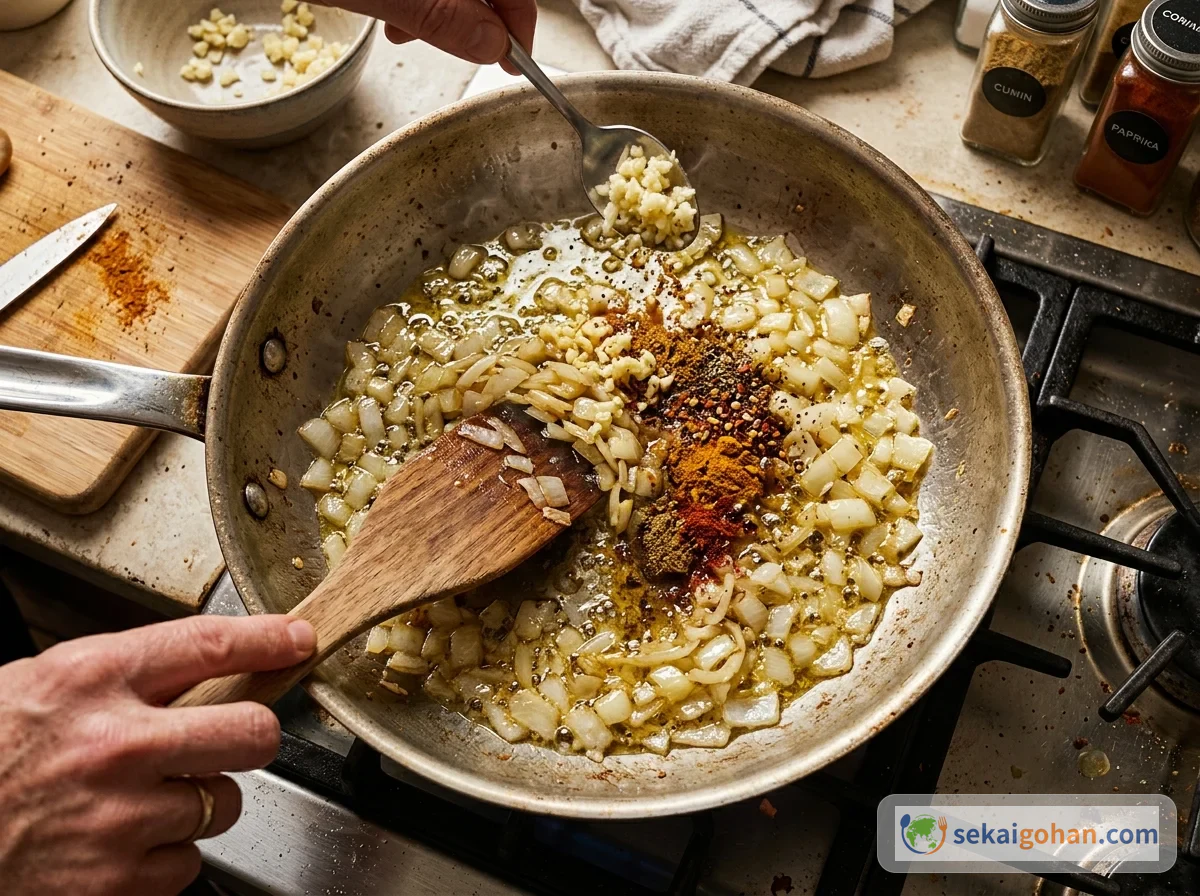
Run the walnuts in a food processor for 3 to 4 minutes until they become a moist paste. Without a food processor, crushing them in a mortar until some grains remain is enough. In a separate skillet, fry the chopped onion over medium heat for 5 minutes until translucent, add the garlic, and release its aroma for 1 more minute. Over low heat, let the coriander, fenugreek, cinnamon, cloves, and paprika blend in for 30 seconds, and when the powders have absorbed the oil and the aroma rises, add the walnut paste and mix for 2 minutes.

STEP 3: Thin the sauce and finish it
Add 1¾ cups (400 ml) of the chicken broth ½ cup (100 ml) at a time, each time working it smooth with a wooden spoon for 3 to 4 minutes. Putting it all in at once easily makes the walnuts lumpy, so the guide is a thickness where the trail of the wooden spoon fades slowly. Soak the saffron in 2 tablespoons of broth for 5 minutes and add it, then simmer 10 minutes over low heat, tracing the bottom of the pot so it does not scorch. After turning off the heat, return the tempered egg yolks and adjust with white wine vinegar and salt so that acidity, saltiness, and the richness of the walnuts are all felt together.

Always add the egg yolks after turning off the heat. Beat the yolks in a bowl, mix in about 3 tablespoons of the sauce (tempering), and return that to the pot. Without this step, the egg sets and the sauce turns grainy.
STEP 4: Combine the chicken and sauce and chill
Arrange the bite-size chicken in a deep dish or large bowl and pour the warm walnut sauce generously over everything. Turn gently for about 3 minutes, and when the surface of the chicken is evenly coated, cover with plastic wrap and rest in the refrigerator for at least 4 hours, ideally overnight. Take it out of the refrigerator 30 minutes before eating and let it come back to a not-too-cold state, and the aroma of walnut and the acidity come through clearly. Finish with pomegranate seeds and fresh cilantro and eat scooping up the sauce with bread.

Getting the satsivi walnut sauce right
Where the creaminess comes from
The sauce gets its creaminess without any dairy at all. Walnuts are about two-thirds fat, mostly polyunsaturated fatty acids that stay liquid at room temperature, so once the nuts are made into a paste they blend easily with water and form a natural emulsion. Egg yolk lecithin stabilizes it further and gives a smoothness comparable to a French béchamel.
That makes three emulsifiers working together: the natural oil of the walnuts + the lecithin of the egg yolk + the gelatin of the cooking broth. Cooks across the Middle East and Caucasus use nuts and seeds to emulsify sauces the same way, which is also where tahini gets the creaminess it brings to hummus.
Why it has to be chilled
If your sauce looks runny while warm, that's expected. In the refrigerator it thickens to a coating consistency, because the chicken collagen dissolved in the broth turns to gelatin and sets as it cools. Bone-in meat makes the gel much stronger and helps the sauce hold onto the chicken, so use it if your sauce tends to slide off.
Serving, storing, and varying satsivi
Make it ahead for guests
Because satsivi is made the day before and rested in the refrigerator, it is the strongest dish for entertaining. On the day, you just take it out and plate it. Make it the night before a New Year's party or a dinner with friends, and you can spend the next day calmly setting the table.
Side dishes
| Side | Role | Notes |
|---|---|---|
| Khachapuri | Staple, richness of cheese | Serve freshly baked |
| Lobio (stewed red kidney beans) | Fiber and volume | Shared spices make a perfect match |
| Tomato and cucumber salad | Acidity, refreshment | Resets the richness of the walnuts in the mouth |
| Eggplant rolls with walnut paste | Appetizer | Badrijani. Walnuts go with walnuts |
| Shotis puri (Georgian bread) | To scoop the sauce | Baguette or naan can substitute |
Wine with satsivi

Orange wine (amber wine) is the best match. Georgia is its home, and the tannins from white grapes fermented on their skins sit well with the richness of the walnut sauce. Other Georgian wines to consider:
- Rkatsiteli amber wine: somewhat dry, matches the astringency of the walnuts
- Mtsvane white wine: fruity with acidity, brings out the richness of the satsivi
- Saperavi red wine: if pairing with meat dishes. Strongly tannic, so a little at a time
Pomegranate juice also pairs well, and grape juice with a squeeze of lemon gives a similar mood without alcohol. Middle Eastern tables have the same habit of a drink to go with the meal, with lemonade and mint tea; the introduction to Middle Eastern cuisine touches on that drink culture.
Storage

| Method | Keeps | Caution |
|---|---|---|
| Refrigerated (airtight container) | 3–4 days | Take out of the refrigerator 30 minutes before eating |
| Frozen | about 1 month | The sauce's texture changes a little |
| Reheating | — | Originally a dish eaten cold. Microwave heating is not recommended |
Store the chicken fully submerged in the sauce, since any part exposed to air oxidizes and discolors. Press plastic wrap right onto the surface and put the lid on top. Honestly, day 2 is the best: by then the walnut oil and the savoriness of the chicken have fully come together.
Turkey, fish, and eggplant satsivi

Satsivi is really a format, a cold dish in walnut sauce, and Georgians make it with more than chicken. Turkey, called indauri (ინდაური), is the choice for big holiday gatherings. Boil it longer than chicken (60 minutes or more for bone-in) and make 1.5 times the sauce; as with kebab, temperature control matters when cooking turkey.
For fish satsivi, poach sea bream or sea bass in barely simmering liquid and pour the walnut sauce over. Use vegetable broth in place of the cooking broth and make the sauce a little more acidic.
The popular vegetarian version uses eggplant halved lengthwise and grilled until the skin chars, which gives a smoky flavor that suits the walnut sauce. Moussaka is another well-loved eggplant dish, but eggplant satsivi uses neither yogurt nor béchamel.
For more from the region, see the introduction to Georgian cuisine (in Japanese), the filled pastry burek, and Central Asia's plov and manti.
Frequently asked questions

Q1. Can I make it with cashews or almonds instead of walnuts?
Yes, to accommodate an allergy, though the flavor will differ. Cashews come closest to the creaminess of walnuts; almonds stay firmer, so grind them to a thoroughly smooth paste. The astringency and bitterness of walnuts blending with the spices give a complex flavor that other nuts can't quite reproduce.
Q2. How do I crush the walnuts without a food processor?
A mortar and pestle is the traditional way: add a little at a time and crush by pressing. You can also break the walnuts up with a rolling pin in a thick zip-top bag and finish them in the mortar. A few remaining grains are fine, and the uneven texture of hand-ground walnuts is closer to the handmade original.
Q3. Can I eat it warm?
It's safe to eat warm, but satsivi only reaches its best once chilled. Warm, the sauce is runny, it doesn't cling to the chicken, and the walnut flavor fades. Chill it at least 4 hours in the refrigerator, ideally overnight.
Q4. Some recipes seem to leave out the egg yolks. Can I omit them?
You can, but the sauce loses some thickness and richness. To make up for it, increase the walnuts to 12.5 oz (350 g).
Q5. Saffron is too expensive. How does the flavor change with turmeric?
You get a similar color but not saffron's lavish aroma. Since the "saffron" commonly used in Georgia is actually marigold petals, which are milder than real saffron, turmeric comes surprisingly close to the taste in Georgia. If color is the main goal, 1/4 teaspoon of turmeric is enough.