On the eve of an Uzbek wedding, the groom's family cooks plov for a crowd in a huge kazan, a cast-iron pot. The same dish marks the birth of a child and welcomes a friend home, and in Uzbekistan weddings and funerals alike begin with it. Plov (Plov / Osh / Палов) is the country's national dish and Central Asia's great pilaf: meat, onion, and carrot fried in oil, then rice cooked over them until the grains come out loose and rich.

Plov in Uzbekistan and Along the Silk Road
The structure of plov is simple. Fry meat, onion, and carrot in oil to make a base called zirvak, then layer rice over it and cook everything together. The details are where it succeeds or fails, and we'll get to those after the recipe.
Plov belongs to a wide family of rice dishes that spread across Persia and Central Asia along the Silk Road, and along the way it became a dish of festivals and gatherings. Its relatives reach far beyond the region: Iran's chelow-polow, Turkey's pilav, India's biryani, and West Africa's jollof rice. In 2016, "Palov culture and tradition" was inscribed on the intangible cultural heritage list.

Ingredients (serves 6)
Lamb (or mutton) is the mainstream in Uzbekistan, but beef works very well too. If you want lamb, try a butcher, a halal market, or a large warehouse store. Bone-in lamb gives a noticeably better broth.
Oil and Garlic for Plov

The amount of oil in plov will probably surprise you, but don't cut it back. The oil coats each grain of rice and gives plov its loose texture; with too little, the rice clumps and ends up like a sticky risotto.
The garlic goes in the traditional way: whole, in its skin. The skin protects the cloves as they steam, so they turn fluffy instead of collapsing into paste. At the table, peel a clove and mix the soft inside into your rice, and a sweet, mellow garlic flavor spreads through it.
Instructions
Make the zirvak (the base)
Eighty percent of the flavor of plov is decided by the zirvak. It is the rich base made by frying meat, onion, and carrot in oil and simmering them.
How to cut the carrots
In Uzbek plov, carrots are cut not into fine julienne but into strips about the thickness of matchsticks: roughly 0.25 inch (5 mm) wide and 2 inches (5 cm) long. Julienne breaks down in the simmer, the carrots lose their presence, and both the look and texture of the plov are spoiled. Chopping them fine, like the filling of pierogi, is strictly forbidden.
Add the rice and cook
The defining feature of plov is cooking rice "layered" over the zirvak. Do not mix the rice and zirvak.
Serving: turning the plov over
Plov is served in a distinctive way. A large platter is placed over the pot and the whole pot is turned over. The zirvak (meat and carrots) that was on the bottom ends up on top, and the rice underneath. At home, though, it is common to spoon the rice onto a large platter first and put the meat and carrots on top.
Take the garlic out whole and set it at the side of the plate; each person squeezes out the inside to mix into the rice. The steamed garlic turns soft and paste-like, a concentration of sweetness and savor.
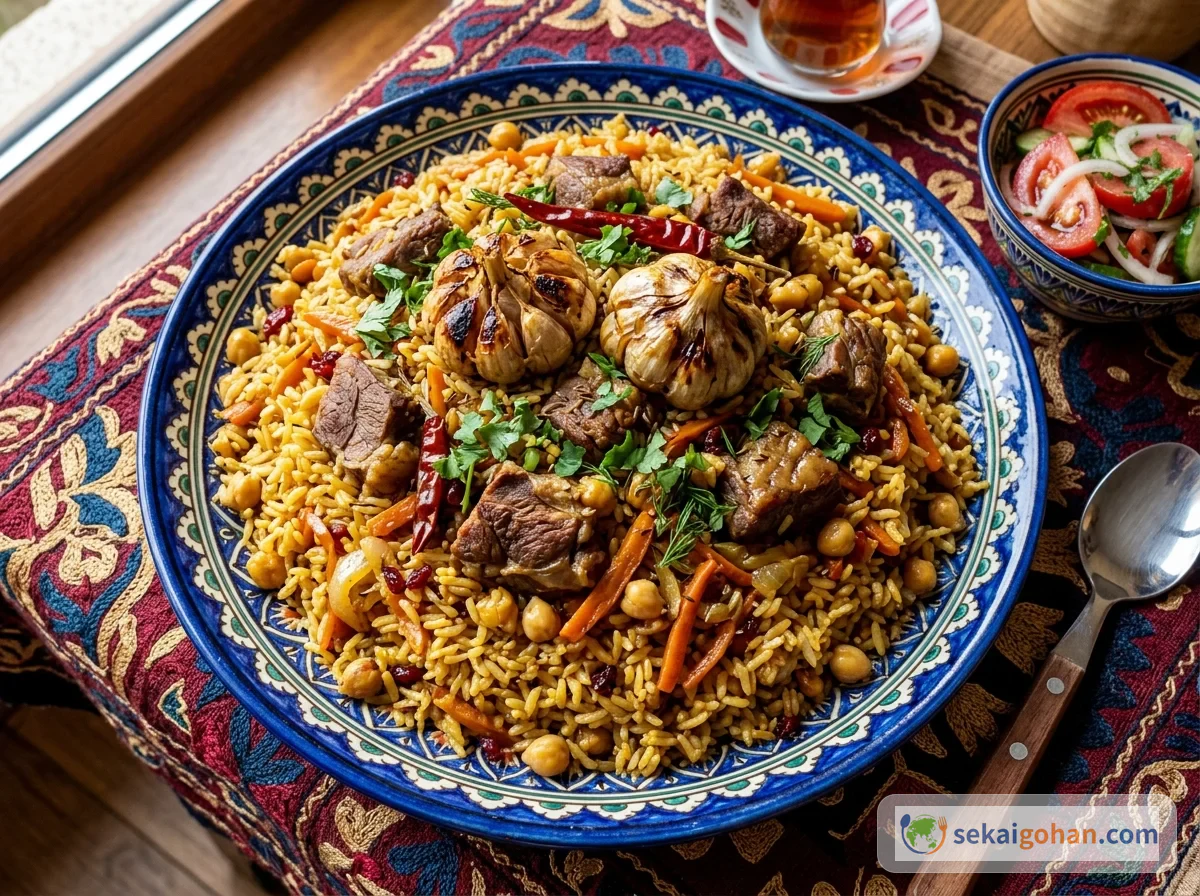
In Uzbekistan the traditional way is to eat plov by hand, but in modern cities spoons and forks are common. It is set on a large platter in the middle of the table and each person helps themselves with a spoon. Like dal bhat and qurutob, the culture of eating together around a large platter is basic to Central Asian meals. Usual accompaniments are a fresh tomato-and-onion salad (shakarap) and green tea (kok choy).
Common Plov Mistakes and How to Avoid Them
Get the timing or the heat wrong and the rice turns sticky, the meat tough, and the whole dish fails to come together. Most problems trace back to one of three things.
Stirring the rice
The iron rule of plov is not to mix the zirvak and rice. The rice cooks in a layer over the zirvak, and the two are combined only just before serving. Stirring breaks the grains and releases starch, which makes everything sticky. It's the opposite of a dish like nasi goreng, where the rice is fried and tossed.
Lifting the lid
Once the rice is layered and covered, leave the lid on for 25–30 minutes. If steam escapes, the rice cooks unevenly and you get plov that is hard on top and sticky underneath. Thirty minutes of patience is the real secret.
Getting the heat wrong
Plov cooks in three stages of heat: high heat for searing in oil, medium heat for simmering the zirvak, and low heat for steaming once the rice is layered on. That progression is what gives you tender meat, carrots with some bite, and rice that stays loose.
Plov is a bold cooked-rice dish. The amount of oil and the way you cut the carrots can surprise you at first, but follow the steps faithfully and it is hard to fail. Next to the delicate dumpling skins of manti, plov is far more relaxed to try.
Plov Variations
Plov changes from place to place in Uzbekistan, much as khachapuri changes shape from region to region in Georgia. City recipes differ in the ratio of carrots, in extras such as chickpeas, and in the cut of meat. Use the base here and adjust it to your own taste.
Frequently Asked Questions
Q1. Can I make it without lamb?
Yes. Beef (short rib or shank) has a different richness of fat, but it makes a perfectly good plov. Chicken thighs work too, and chicken plov exists in Uzbekistan as well. Avoid lean cuts such as tenderloin or breast.
Q2. Can I make it in a rice cooker?
I don't recommend it, but it can be done. Make the zirvak in a pan, move it to the rice cooker pot, add the rice and water on top, and cook. Since you can't adjust the heat, though, the grains won't come out as loose as they do in a pot.
Q3. Is short-grain rice all right?
It works, but the result is different from Central Asian plov, because short-grain rice is sticky and hard to keep loose. If you can, use basmati rice. Jasmine rice is also a good substitute.
If you have allergies, check the ingredient labels of the seasonings you use. The chickpeas are optional.