Simmer meat broth with grain and the sound of the pot slowly changes. The thin broth grows heavier as the pearl barley gives it body and the rice adds sweetness, until a wooden spoon drawn through it leaves a white line behind. Stir in kefir little by little, and a sour, milky aroma fills the kitchen. This is nauryz kozhe (Наурыз көже), the soup of grains, meat, and dairy that Kazakhstan eats at Nauryz, its spring festival. It sits somewhere between a soup you drink and a porridge you eat, rich with meat fat and soft grain and brightened by the sourness of fermented milk.

Nauryz kozhe and the spring festival
Nauryz is a spring celebration that spreads from Central Asia through the Caucasus and the Iranian cultural sphere. In Kazakhstan, nauryz kozhe is a central festival dish, set out with baursak, meat dishes, and dairy on the table that welcomes family and guests. It is often described as a dish of seven ingredients or seven elements (water, meat, salt, fat, grain, flour, and dairy), and together they carry wishes for health, abundance, and vitality.
In home cooking the variation is wide. Some households use horse meat or kazy, and others combine rice, wheat, millet, noodles, qurt, and ayran. In English, the name is most often written Nauryz kozhe.
The closest thing at a Western table is a porridge of grain simmered in meat broth, though nauryz kozhe is far livelier than plain rice porridge: meat fat, thick grain, and fermented milk all share one bowl. To see how meat and wheat meet elsewhere in Kazakh cooking, compare it with beshbarmak. If beshbarmak is the celebratory platter, nauryz kozhe is the spring pot everyone shares.
Ingredients (serves 4)

This quantity serves 4 as a lunch that doubles as the staple, or about 6 at a festival-style table with bread and other meat dishes. More grain makes it more filling but pushes it toward porridge. For a first time, use this amount and learn what the soupy finish looks like.
This recipe uses beef or lamb, wheat, and dairy. Add the dairy last and do not let it boil. If you have a milk allergy, don't force substitutions. Without the dairy, you are making a different dish, a meat and grain soup.
Choosing ingredients for nauryz kozhe
Grains and the pot

Meat, milk, rice, and pearl barley all come from a regular grocery store. The two things worth seeking out are coarse bulgur and a heavy pot that will not scorch during a long simmer. Choose coarse or cracked-wheat bulgur rather than the fine kind, which dissolves quickly and loses the feeling of "a soup with grains in it" that defines nauryz kozhe.
The soup simmers long and gently, so the pot matters. A thin pot can work, but if the bottom gets too hot, the grains stick before the dairy goes in. A heavy pot gives you more room on low heat.
Meat and dairy
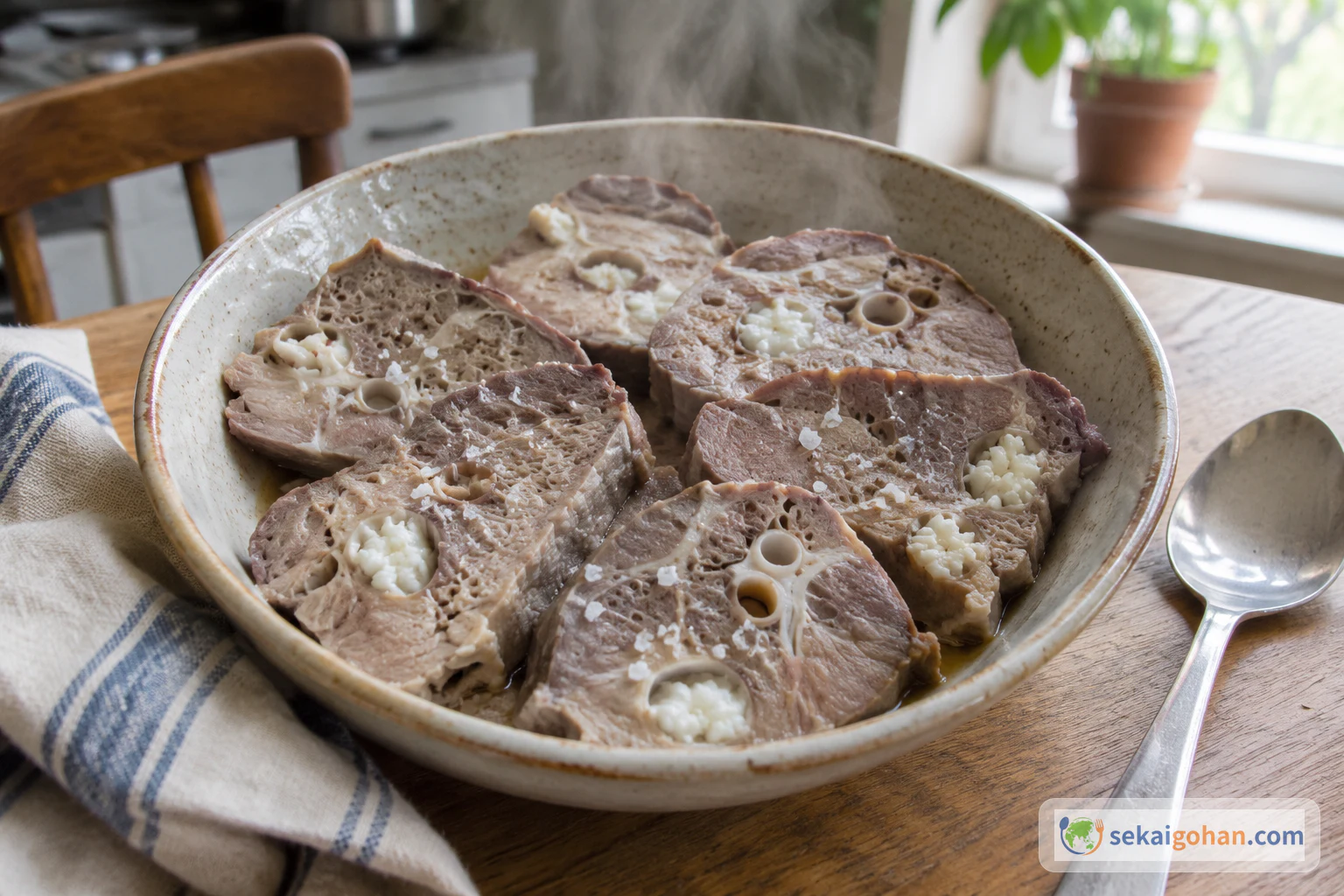
Beef shank or lamb shoulder makes a clear, savory broth, and horse meat and kazy can wait until you know you like this flavor. Start with beef shank and try lamb later. If you cut the meat into large chunks, check with a probe thermometer that the center has cooked through.
Unsweetened kefir is sold at import stores and some supermarkets. The sourness of fermented milk is the one thing to hold on to: milk alone comes together white, but the character of the dish weakens. If you have no kefir, thin plain yogurt with water, and always bring it up to temperature as in step 5 before returning it to the pot.
Home substitutions
| Point of doubt | Traditional | Practical home option | Avoid |
|---|---|---|---|
| Meat | Horse meat, kazy, mutton | Beef shank or lamb shoulder | Lightening it with chicken breast alone |
| Dairy | Qurt, ayran, fermented milk | Unsweetened kefir, or plain yogurt thinned with water | Sweet drinking yogurt |
| Grains | Wheat, rice, millet | Pearl barley, coarse bulgur, rice | Turning it into paste with oats alone |
| Flour element | Noodles or flour added | A small amount of short hand-cut noodles | Adding a lot of udon |
| Finish | Shared from the big pot to guests | Served in small bowls a little at a time | Finishing it as a one-big-bowl porridge |
When you swap out the seven elements, aim to keep every role rather than collect every unusual ingredient. Water becomes the meat broth, meat gives savoriness, salt is the core of the taste, fat gives a festive richness, grain gives staying power, flour carries the trace of handwork, and dairy brings the sourness of spring. Using both pearl barley and bulgur echoes the layering of grains found locally, and adding kefir last keeps the milk's sourness while bringing the whole pot together in white.
How to make it: layering grains onto the meat broth
If you boil nauryz kozhe hard in one go, the dairy splits and the grains stick to the bottom. Make the meat broth first, add the grains at staggered times, and bring the dairy to temperature at the end without a temperature shock. This gives a white, smooth finish.
Common nauryz kozhe failures and fixes
Three things decide the result: a clear meat broth, grains cooked short of falling apart, and dairy that never boils and splits.

| Symptom | Cause | Fix |
|---|---|---|
| The dairy split | Cold kefir added directly, or it boiled | Turn off the heat, scoop out only the smooth part into another pot, warm 3.5 tbsp (50 ml) of milk, and mix it in a little at a time |
| The bottom scorched | Heat too high after adding the grains | Leave the burnt part; move the clear top into another pot and warm it on low heat |
| Heavy like porridge | Pearl barley and rice overcooked | Warm ½ cup (150 ml) of hot water and 3.5 tbsp (50 ml) of milk, add, and thin on low heat for 3 minutes |
| The flavor is dull | Too little salt, or too much dairy | Add a pinch of salt and top with more dill or scallion |
| Too sour | The kefir is sharply sour | Warm ½ cup (100 ml) of milk, add, and let it blend for 4 minutes without boiling |
Split dairy can never be fully restored, which is why step 5, adding hot soup little by little to the cold dairy, deserves your patience. The thickness of the grains is more forgiving. If the soup is heavy, thin it with hot water and milk; if it is thin, take the lid off and simmer on low heat for a few minutes.
Serving and storing nauryz kozhe

Serve bread alongside: fried baursak-style bread, or at a home table thin naan, pita, or lightly salted focaccia. The bread catches the sourness of the white soup and the fat of the meat. Ladling the soup over white rice pushes it too far toward rice porridge, so the first time, keep the bread on the side.
Because it contains dairy, don't leave it at room temperature for long. Cool it, move it into shallow containers, and refrigerate for no more than 2 days. To reheat, warm it in a pot on low heat for 7 minutes, or microwave one serving at 600 W for 1 minute 20 seconds, stir once, and heat 40 seconds more. Boiling makes it split easily, so stop once steam rises.
By the next day the grains have soaked up liquid and the soup is much heavier. Add ¼ cup (80 ml) of hot water and 2.5 tbsp (40 ml) of milk per serving and thin it on low heat. If you want more kefir, stir in only 1 tbsp after the heat is off, and a little dill after reheating lightens the stewed feel of the day before.
Frequently asked questions
Can I make it without horse meat or kazy?
Yes. Horse meat and kazy are sometimes used in Kazakhstan, but they are hard to find elsewhere and expensive. A broth from beef shank or lamb shoulder, with the balance of grains and dairy kept, gives you a nauryz kozhe you can make at home. If you do find horse meat, learn the thickness and heat with the beef shank version first.
Can I use yogurt instead of kefir?
Yes. Thin 7 oz (200 g) of plain yogurt with 3.5 tbsp (50 ml) of water, mix in hot soup a little at a time as in step 5 to raise its temperature, then return it to the pot. Avoid sweetened yogurt, sweet drinking yogurt, and fruit yogurt.
Can I make it without noodles?
Yes. The short noodles cover the flour element of the seven, so they are optional. If you leave them out, skip the flour and increase the pearl barley by 20 g. A lot of udon turns it into a stewed noodle soup, so keep udon to a small amount.
Is it eaten cold?
Eat it warm. Straight from the refrigerator the fat sets and the grains feel heavy, so after storing, warm it on low heat without letting it boil.
What to cook next
For another Kazakh dish, the meat and wheat platter beshbarmak brings the same country's festival spirit in a different form. To move on to Central Asian rice dishes, try Uzbekistan's plov. If you like the pairing of dairy and bread, Tajikistan's qurutob (in Japanese) offers a similar pleasure.
- Turli tava - uses ingredients and aromas from the same region.