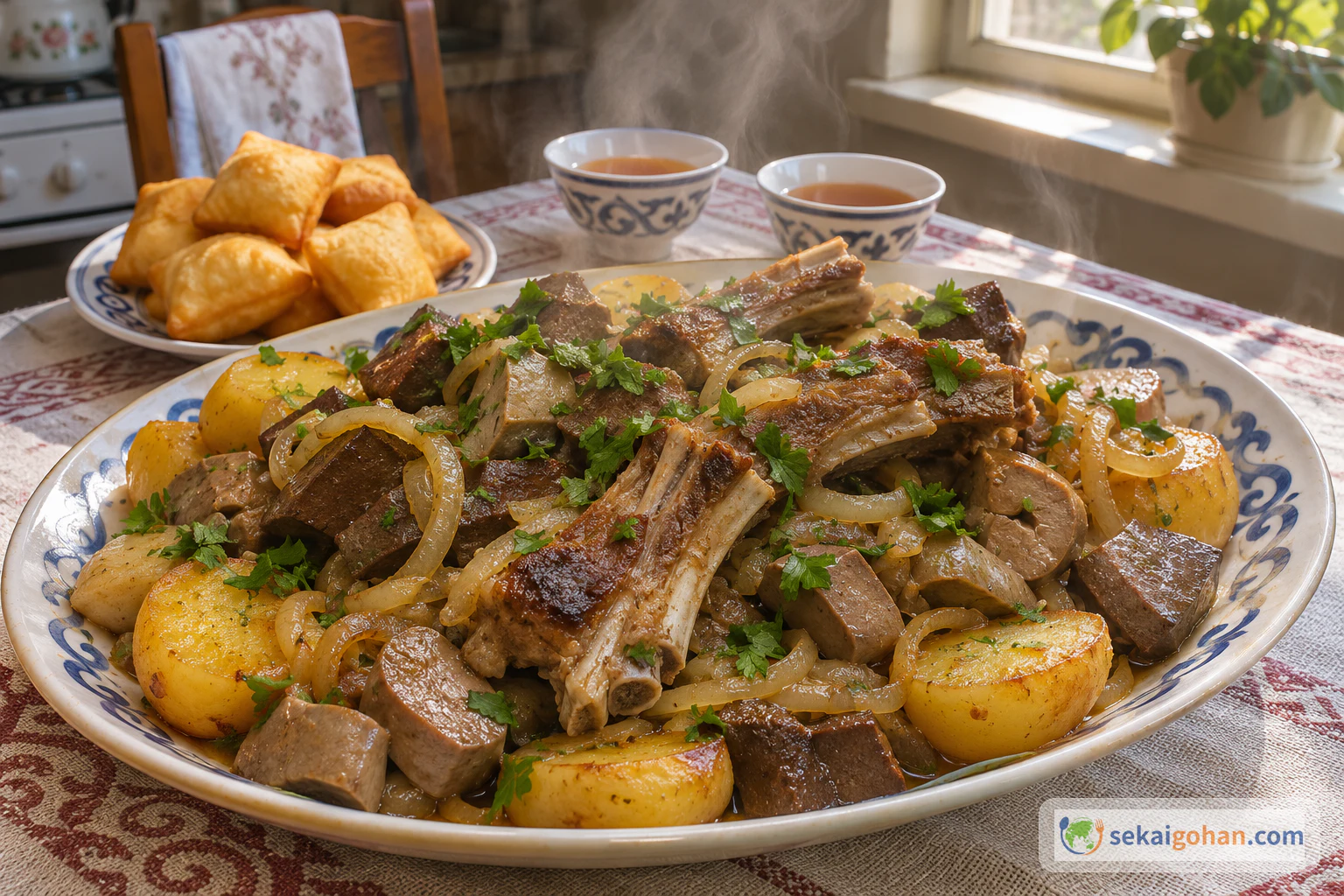
Wide, flat noodles are spread across a big platter, slow-boiled lamb (or horse meat) is piled on top, and the whole thing is blanketed in soft, sweet onions. Alongside come bowls of clear golden broth. This is beshbarmak (Beshbarmak / Besbarmaq), Kazakhstan's national dish, born of the nomadic life on Central Asia's vast grasslands and once reserved for celebration. Home cooks know it far less than other Central Asian classics like Uzbek plov and manti, but it comes together in a home kitchen with ingredients you can find easily.
Beshbarmak and the nomads of the steppe
A dish eaten with five fingers
In Kazakh, "bes" means five and "barmaq" means finger, so beshbarmak, a Turkic word, means "five fingers." True to the name, it is traditionally eaten with the five fingers of the right hand, picking up noodles and meat together with no fork or spoon. For people always on the move, that made sense: no utensils to carry, and a single platter was all it took to share a meal with family and guests.
Kazakhstan, the ninth-largest country in the world by area, is its home. Beshbarmak is also eaten in Kyrgyzstan, northern Uzbekistan, Bashkortostan (Russian Federation) and western Mongolia, and similar dishes turn up wherever Turkic peoples live, Tatarstan included.
The wisdom of the nomads
Kazakh cooking centers on lamb, horse meat and dairy, and its many long-keeping foods, such as smoked meats and fermented milk, are a legacy of life on the steppe. Livestock meat was precious, and the know-how to use every part of an animal was passed down through generations.
Beshbarmak reflects that thrift. Bone-in meat is boiled for a long time to draw out all of its flavor, and the cooking liquid (sorpa) is served separately as a nourishing broth. The noodles are made from flour, egg and water, all of which keep well. Meat, broth and carbohydrates in a single dish: nomadic practicality on a plate.
Dastarkhan and hospitality

Dastarkhan is the table or tablecloth laid with food to welcome guests, and when a Kazakh family entertains, beshbarmak sits at its center. The meat and noodles arrive on a big platter, with the sorpa in separate bowls. As with Uzbek plov, a shared platter is a way of showing respect to guests across Central Asia.
At feasts for special guests, a boiled sheep's head (koy bas) is presented to the guest of honor, who carves the meat from it and hands it out, starting with the eldest. Particular cuts go to particular people: the thigh bone to an older man, the tail portion to an older woman. At everyday city tables, these customs are often simplified.
A dish of national identity
Even after settlement in the Soviet era, beshbarmak remains an essential dish for family celebrations and for welcoming guests. Like Polish pierogi and Bosnian burek, it is inseparable from national identity. It belongs to the steppe nomadic tradition, distinct from the Caucasus food culture covered in our introduction to Georgian cuisine (in Japanese).
Ingredients (serves 4)
The noodles contain wheat flour and egg. Take care if you have a wheat or egg allergy. The meat broth (sorpa) on its own contains few allergens, but the egg noodles are boiled in that broth.
Choosing meat and noodles for beshbarmak
In Kazakhstan, horse meat is used as often as lamb, and for celebrations kazy, a horse-meat sausage with horse fat, goes in too. Horse meat has a distinctive sweetness and a flavor quite different from lamb; look for it at specialty butchers or online, where it is sold legally. Lamb alone still makes a delicious beshbarmak.
Beef works well and is milder than lamb, so it's easy for most people to enjoy: simmer 1.75 lb (800 g) beef shank for 2 1/2 hours. Chicken is the economical, easy choice. Simmer 1.75 lb (800 g) bone-in chicken thighs for 1 hour. The sorpa won't be as rich as lamb broth, but it suits anyone who prefers something lighter.
If you can't make or find flat noodles, use lasagna sheets or another wide, flat pasta; cooked in the sorpa, they soak up the flavor just the same. In Central Asia wheat dough is the staple, which is the same logic behind the thin flatbread (fatir) in Tajik qurutob.
Method
Boil the meat (make the sorpa)
Make the noodles
Make the onion sauce (tuzdyk)
Assemble
In Kazakhstan, a beshbarmak meal begins with sorpa (broth) sipped from small bowls called piala. The clear broth drawn from the meat and bones is nourishing and warms the stomach before the meal. Drinking sorpa again at the end to close the meal is the proper etiquette.
Beshbarmak cooking tips
A clear sorpa makes a big difference. For the first 15 minutes after it boils, stay by the pot and keep skimming until no more gray foam appears. That keeps the broth from going cloudy and gives you a beautiful, clear golden color.
A knife severs the fibers and tends to leave the meat dry. Pulled by hand, it splits naturally along the grain and clings better to the noodles and sauce. Pull it while it's still warm, taking care not to burn yourself.
Plain water in a separate pot works, but cooking the noodles in the meat broth lets the flavor soak in, and the salt in the broth seasons them too. This one extra step is what makes beshbarmak taste like a single, unified dish.
Serving beshbarmak
Bring the platter of meat and noodles to the table with bowls of sorpa alongside; that pairing is the basic form of beshbarmak. If you'd rather use what's already in the fridge, try udon: warm cooked udon in the meat broth, then top with the pulled meat and onion sauce, a twist on a bowl of meat-and-noodle soup.
| Nutrient | Amount |
|---|---|
| Energy | 620 kcal |
| Protein | 1.5 oz (45 g) |
| Fat | 24 g |
| Carbohydrates | 1.75 oz (52 g) |
| Fiber | 3 g |
| Sodium | 680 mg |
Per serving (1 of 4), the meat and noodles give you plenty of protein and carbohydrates. The sorpa is salted as well, so drink as much of it as you like.
To round out a Central Asian meal, these go well alongside:
- How to make plov - Central Asia's feast dish of lamb and rice cooked in a big pot.
- How to make manti - Central Asian steamed dumplings made with a similar dough and ground meat.
- How to make piti - An Azerbaijani soup of slowly simmered lamb.
Frequently asked questions
Q1. I'm worried about the gamy smell of lamb. What can I do?
Start the lamb in cold water, bring it up slowly and skim off the scum thoroughly; that's the most effective approach. Simmering it with 2 bay leaves, 10 black peppercorns and a halved onion also softens the smell. If it still bothers you, marinating the lamb in 7 oz (200 g) yogurt the day before reduces it considerably.
Q2. Is horse meat essential?
No. Horse meat is used in Kazakhstan's most formal version, but most households make beshbarmak with lamb or beef day to day. If you're curious, horse-meat sausage (kazy) can sometimes be found online or at specialty shops.
Q3. Do people really eat it with their hands?
Traditionally, yes, picking up noodles and meat with the five fingers of the right hand. In homes today, forks and spoons are common too, so a fork is perfectly fine for your first time.
Q4. Do I have to drink the sorpa (broth)?
We strongly recommend it. Full of the goodness drawn from the meat and bones and seasoned with just salt, black pepper and bay leaf, it has a simple, satisfying flavor and is an essential part of the meal.
Q5. How can I use leftover sorpa?
Drink it as soup the next day, use it as a broth for udon or soba, or make it the base of a risotto. It also works as a soup base for Ukrainian borscht. It keeps for 3 days in the refrigerator and 1 month in the freezer. The fat will rise and set on top, but it melts when reheated and can be used as is.
In summary
Beshbarmak is a dish without waste, shaped by nomadic life. From a single sheep come meat, broth and carbohydrates, and nothing is left over. That wisdom, concentrated on one platter, gives the dish a depth you would never guess from its simple looks.
All you need is lamb and flour, and you can make it at home. Swap in lasagna sheets or udon and it gets even easier. One sip of the clear golden sorpa should bring you the wind of the steppe.
Pair it with Uzbek plov, Tajik qurutob and Georgian khinkali for a culinary journey through Central Asia and the Caucasus.