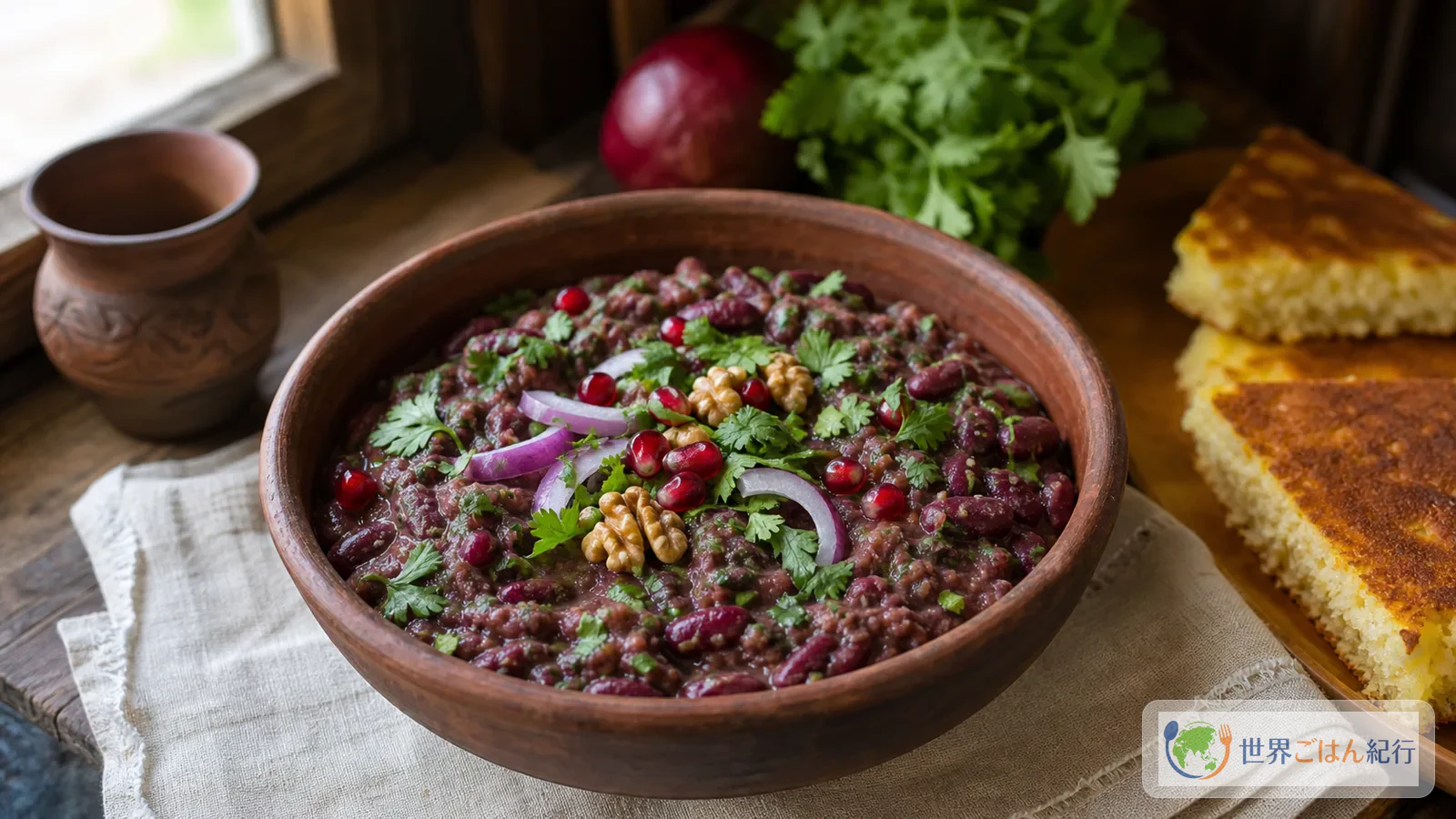
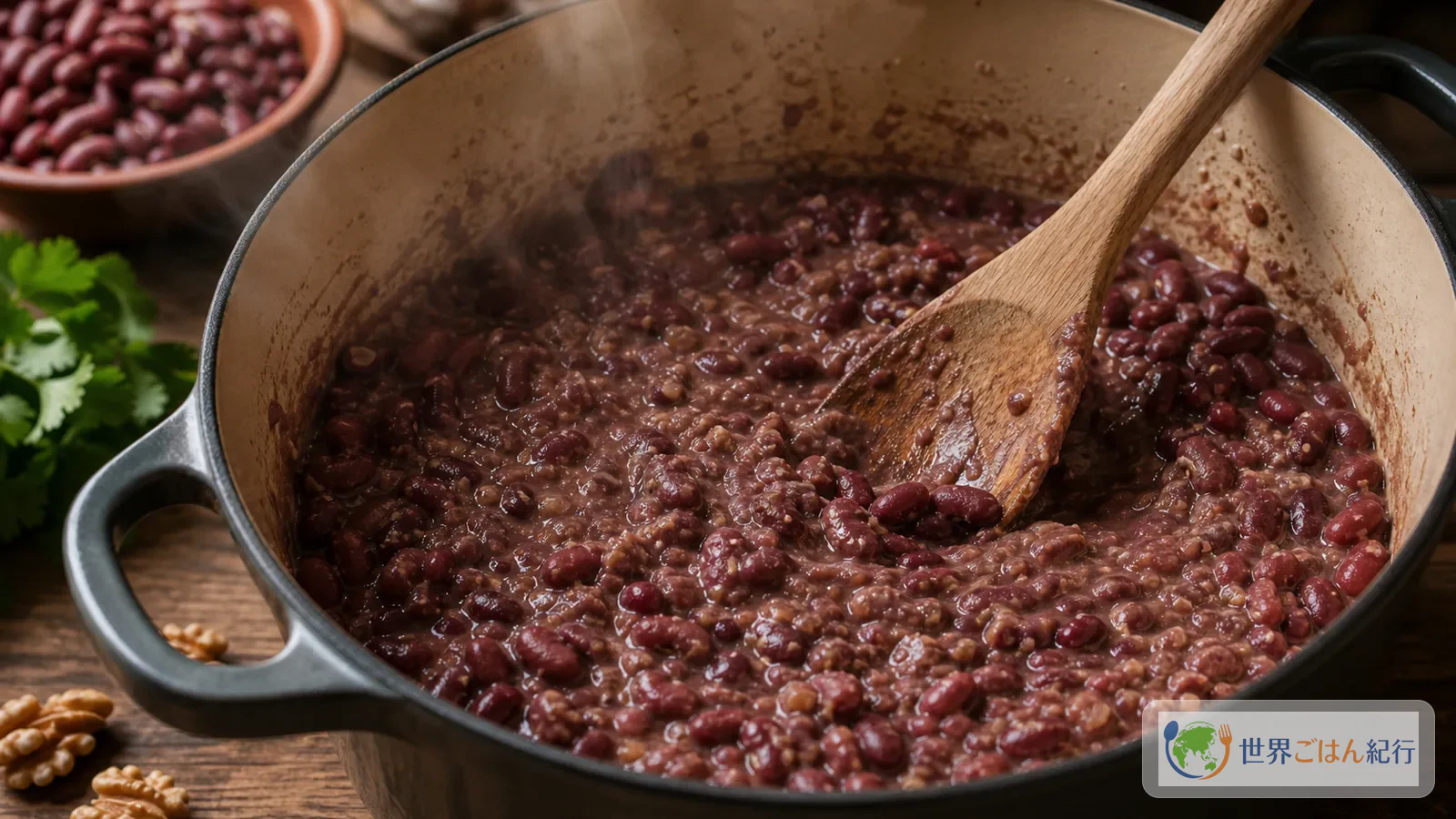
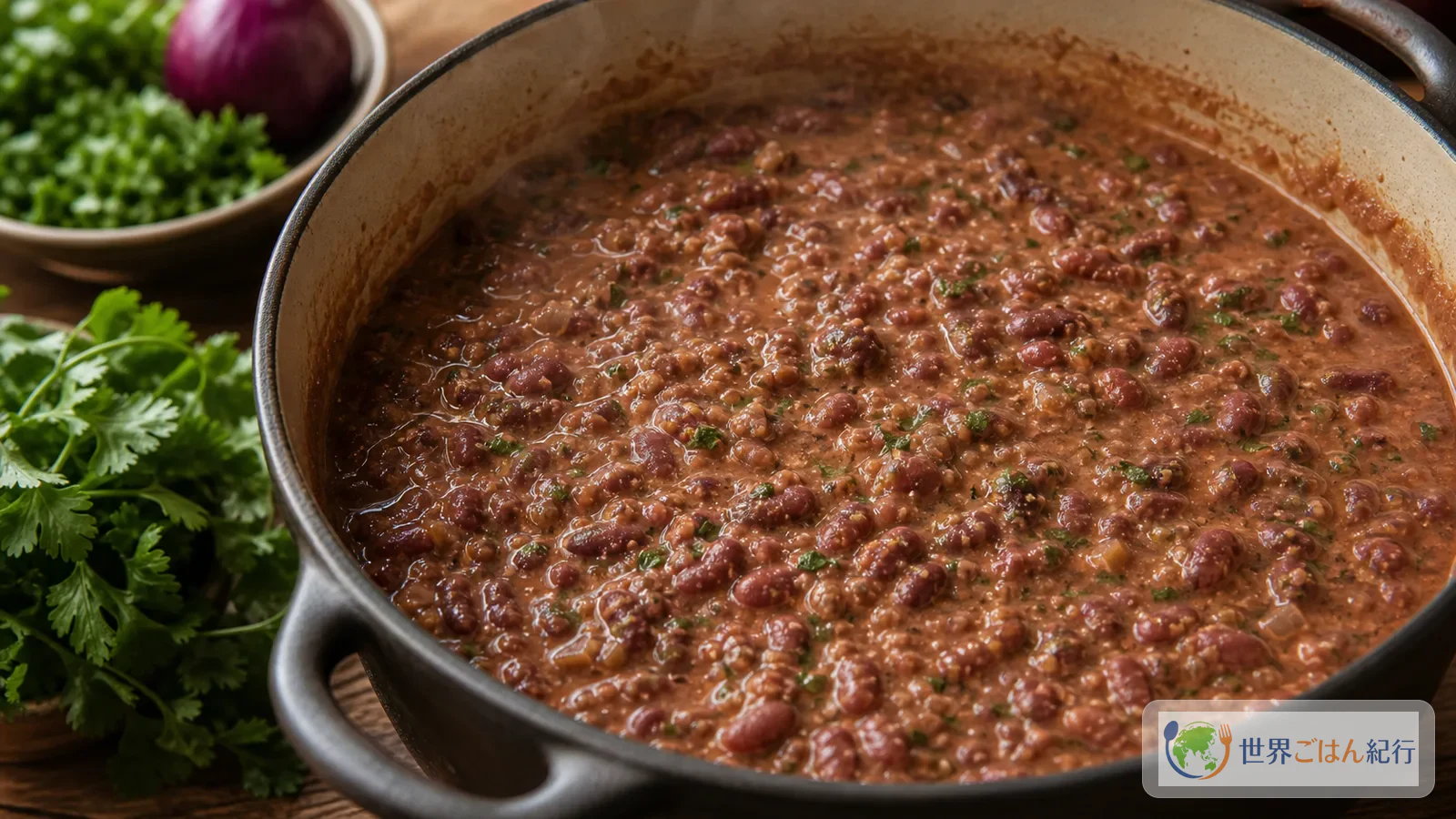
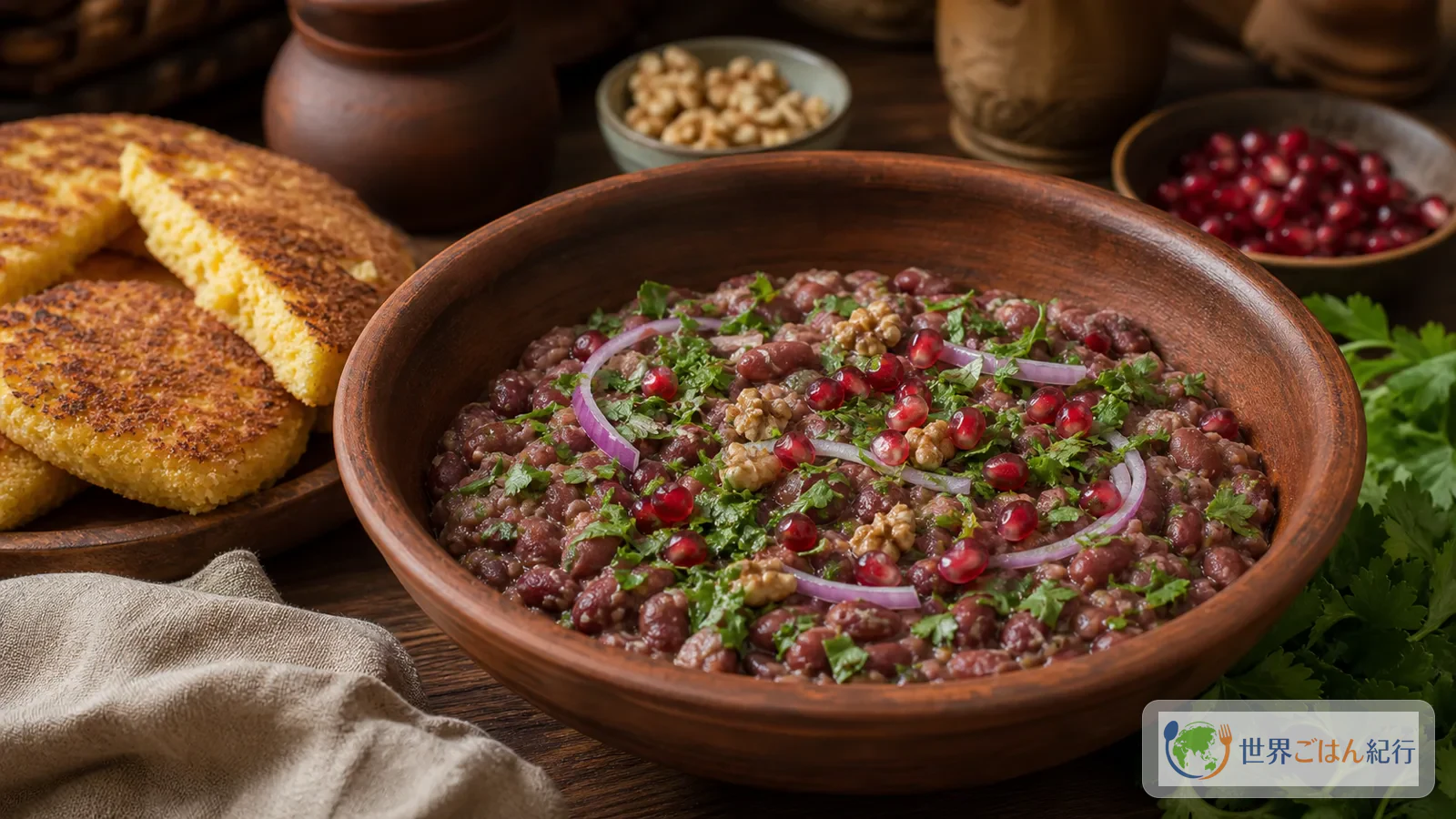
Picture a pot of red beans at a low simmer, the broth just starting to bubble at the edge. The smell of onion, garlic, coriander, and walnuts builds on itself, and you'll reach for the bread without thinking. That's lobio, Georgia's everyday bean dish. It's earthy, herb-bright, rich from walnuts, and sharpened by a little acidity. It isn't flashy, but it gets made again and again.
Lobio in Georgia
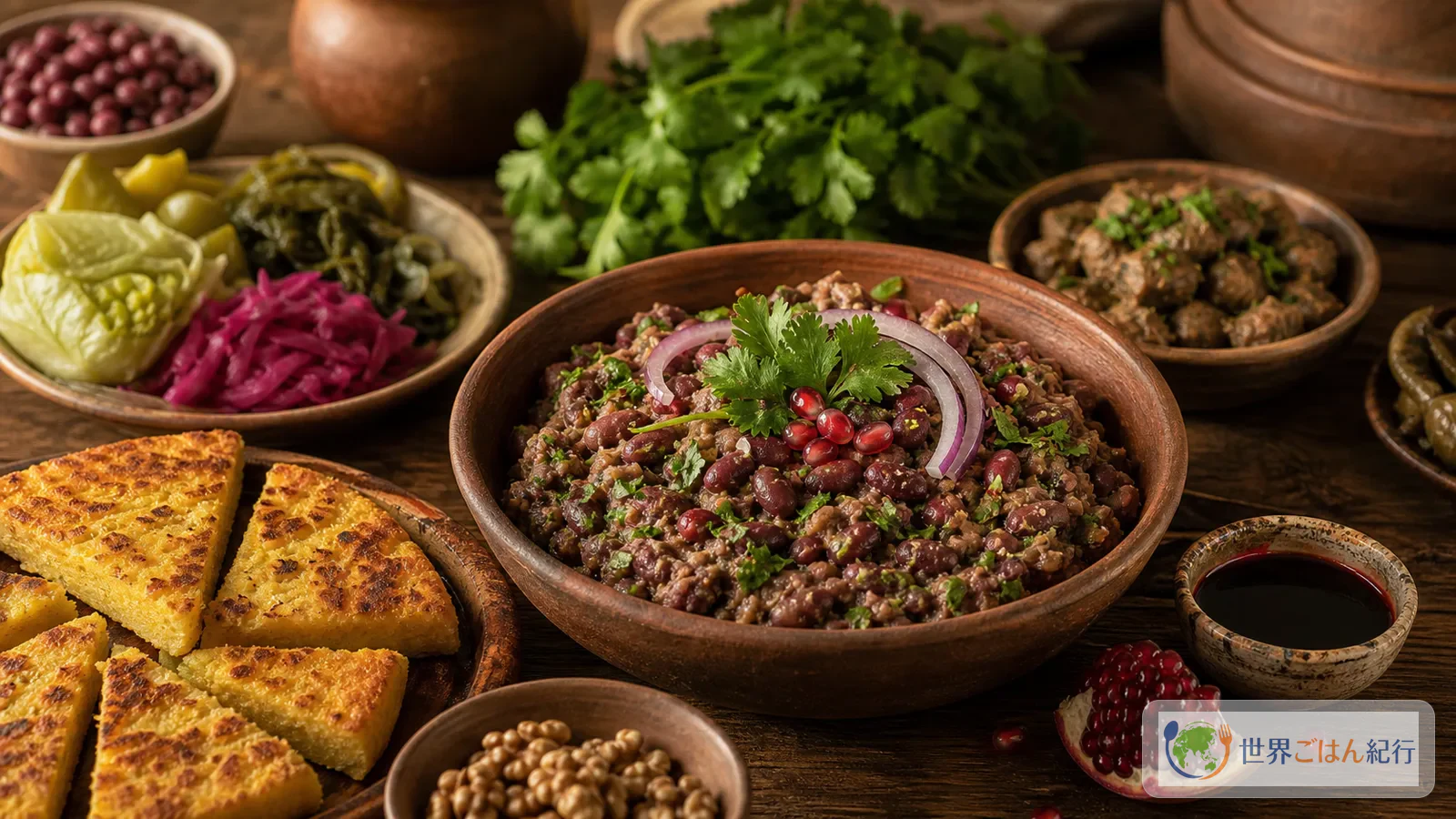
Lobio (ლობიო / lobio) simply means "beans." As a dish, it usually means a warm plate of red kidney beans cooked with herbs, garlic, onion, spices, walnuts, and some acidity. In Georgia it's sometimes brought to the table in a clay pot, with a corn bread called mchadi, pickles, herbs, and onion alongside.
Kidney beans reached Georgia in the 16th century and spread from Guria and Samegrelo in the west. Today there's no single right lobio. Megrelian, Imeretian, Gurian, and Rachan styles all have their own character. Some cooks add the sour plum sauce tkemali and some combine the beans with leeks. The Rachan style includes ham. Some versions use walnuts and some don't, and the finish can be anything from dry to brothy. This version is an easy one-pot lobio built on red beans, with walnuts, coriander, blue fenugreek, and acidity as its main flavors.
Next to showpieces like khachapuri, khinkali, and shkmeruli, lobio is a quiet dish, but it's very useful when you build a Georgian table. Beside a meat dish it adds vegetables and beans. On a bread day it makes a satisfying meal on its own.
Ingredients (serves 4): works with kidney beans or other red beans
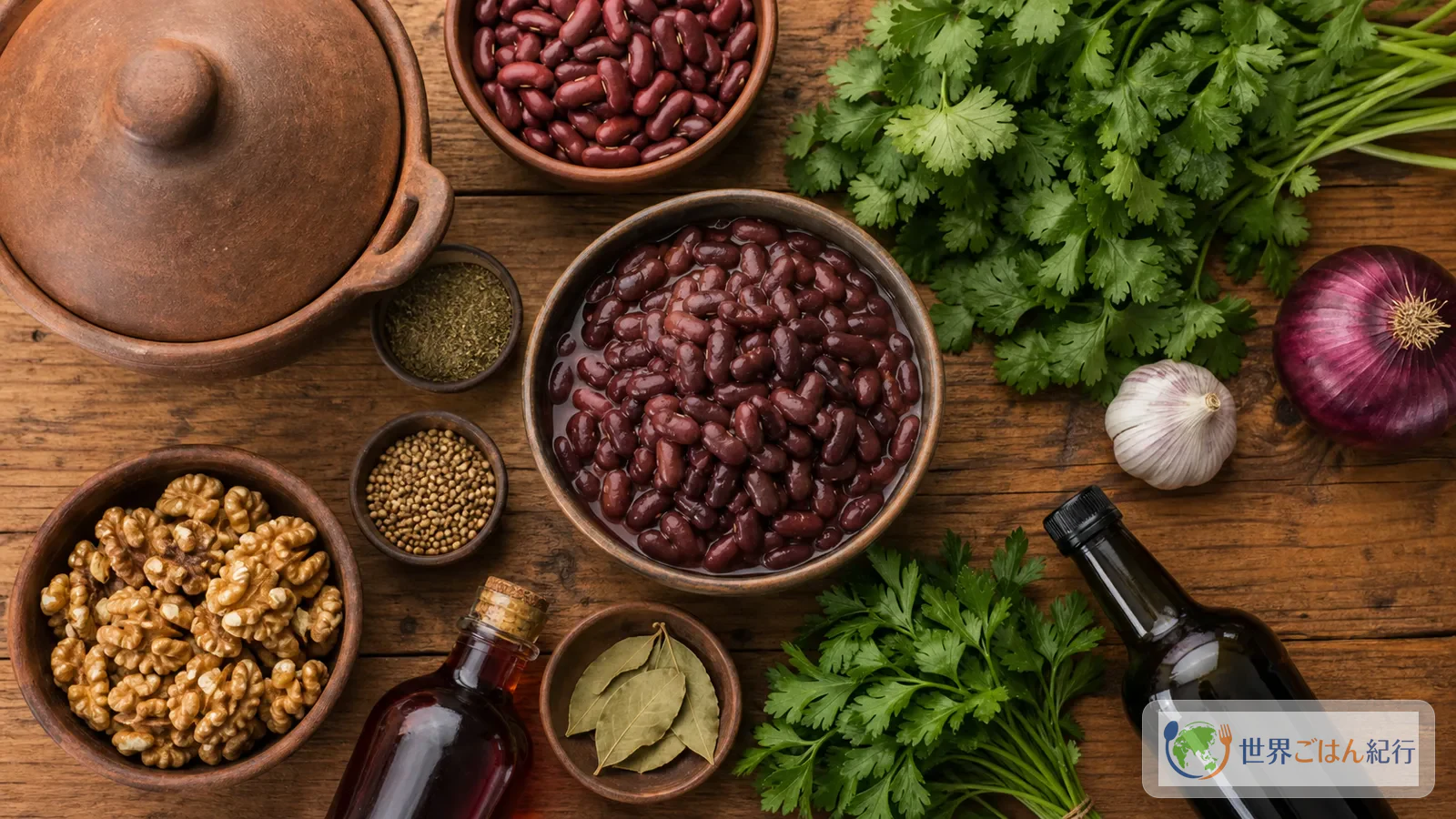
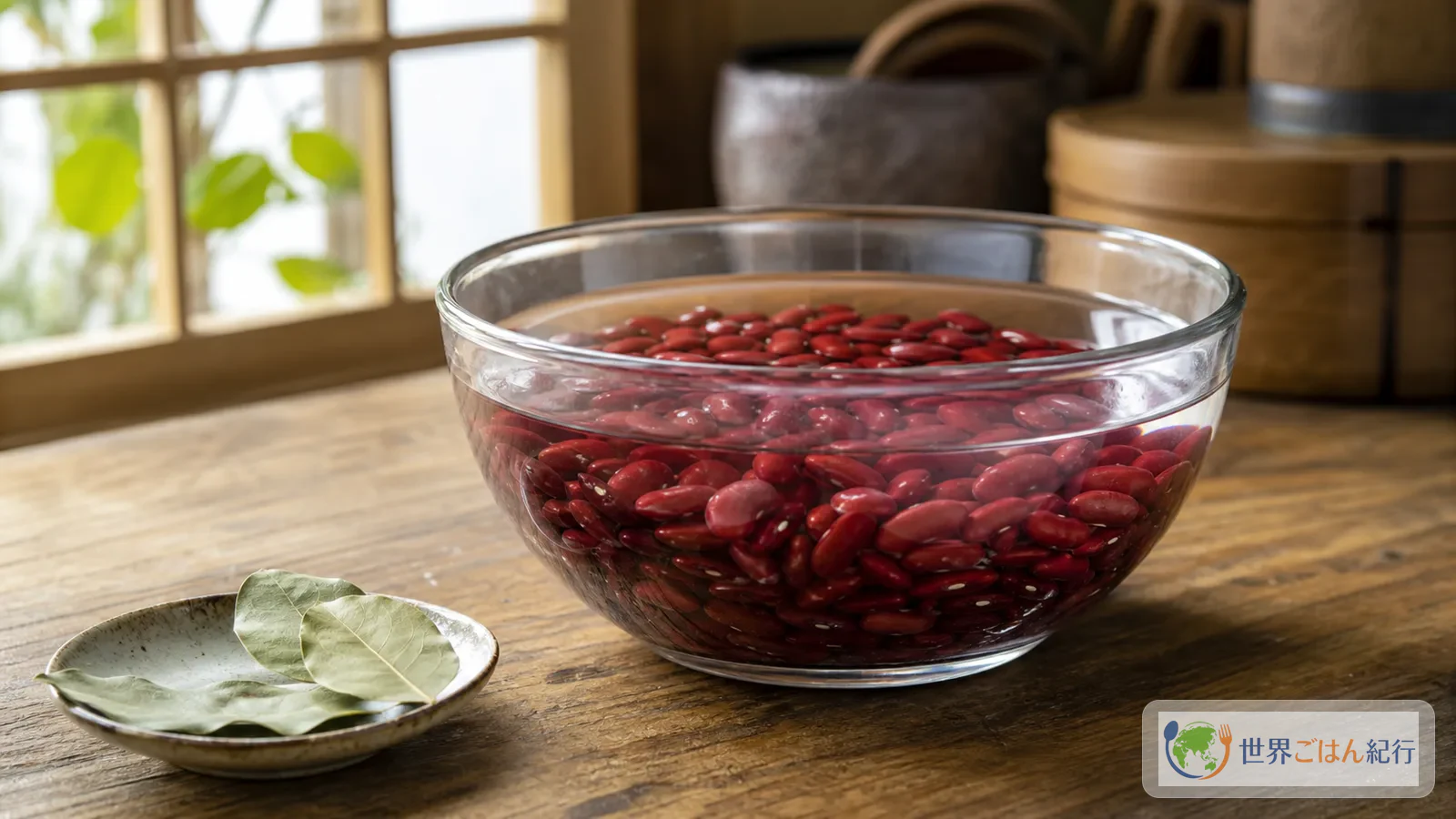
Dried beans swell to about 2.2 times their volume when cooked. Canned beans work too, but for your first time, use dried. The bean cooking liquid helps the walnut paste and aromatics come together naturally.
This recipe uses walnuts. If you have a nut allergy, omit the walnuts and reduce the bean liquid a little more to build body. Soak dried beans thoroughly and cook them until tender through the center before eating. Extending the cooking time is safer than forcing down hard beans.
Ingredients and tools for this dish
The difference in lobio comes from aroma and acidity more than from the beans themselves. Beans, onion, garlic, and herbs are easy to find at an ordinary supermarket. The harder-to-find items are whole coriander, pomegranate molasses, and a tool for grinding; look for them at a Middle Eastern or Caucasian grocery or online.
Choosing beans, acidity, and spices for lobio
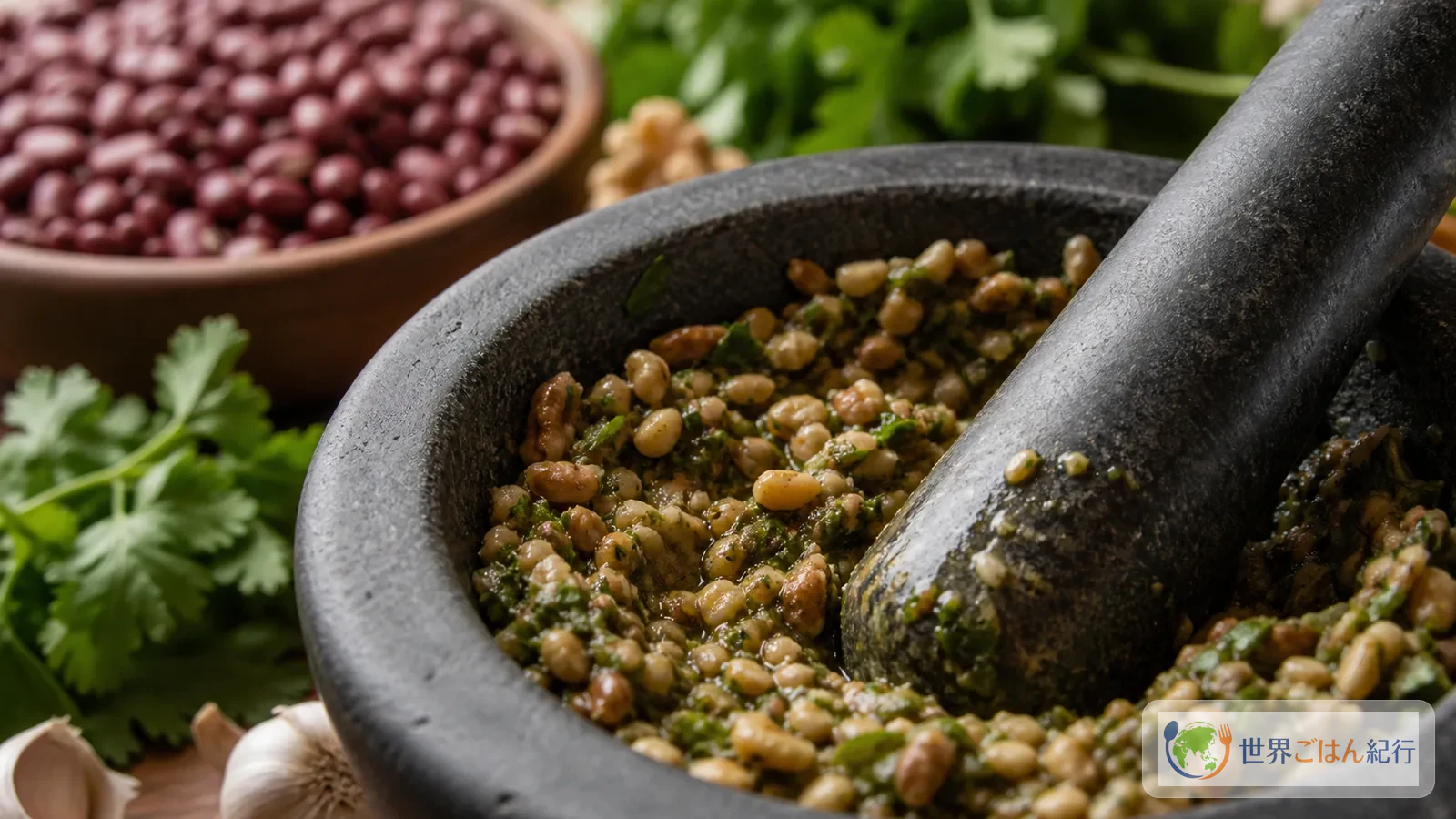
You don't need unusual ingredients to make good lobio. If you can't find red kidney beans, other red beans are fine. Red wine vinegar or pomegranate molasses can stand in for tkemali. A heavy pot does the work of a ketsi clay pot or a dedicated bean pot: cook the liquid down slowly, then let the lobio rest in the serving bowl at the end so the aroma comes together. A mortar handles the walnuts and spices.
Change everything, though, and it drifts away from lobio. Hold on to the soft beans, the aroma of coriander and garlic, the sweetness of onion, and the acidity that cuts the heaviness of the beans. Walnuts are optional in some regions, but at home they give the bean broth richness and make that Georgian character easy to reach, so they're included here.
| Element often seen locally | Home-kitchen substitute | Why keep it |
|---|---|---|
| Red kidney beans | Red kidney beans, other red beans, imported kidney beans | Skin and flesh keep their texture and the broth turns red |
| Tkemali, a sour fruit sauce | Red wine vinegar, pomegranate molasses | Cuts the heaviness of the beans and walnuts |
| Blue fenugreek, coriander | Khmeli suneli, whole coriander, a little fenugreek | Keeps the aroma from leaning toward curry |
| Clay bean pot | Heavy pot, cast-iron pot, clay pot | Resists scorching when reduced over low heat |
| Mchadi, pickles, herbs | Cornbread, baguette, quick-pickled cucumbers | Not eaten as beans alone; add acidity and a staple |
Method: soften the beans first, then layer the aroma
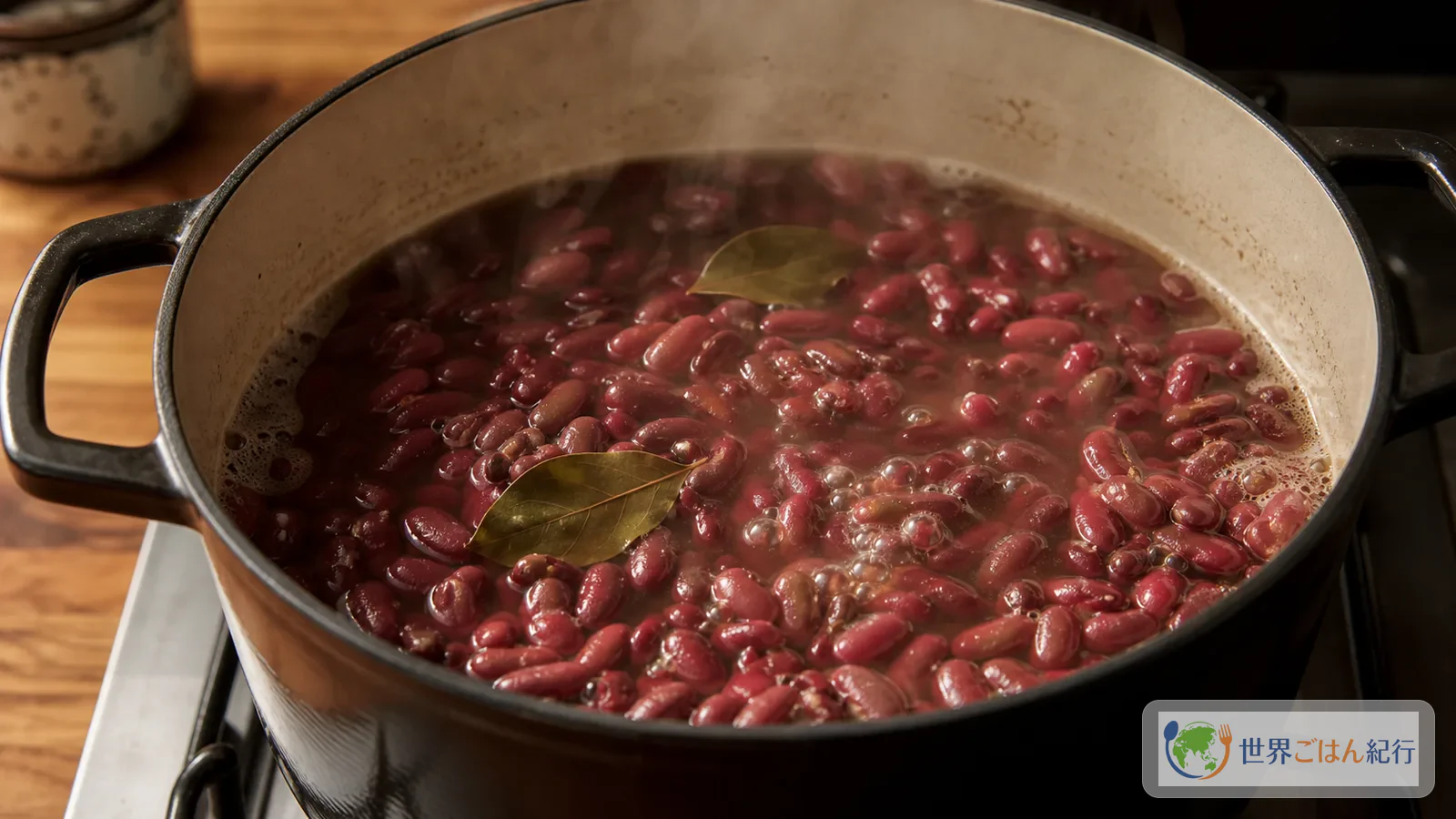
Timing varies with the condition of the dried beans. Old beans can take 90 minutes or more, so do not stop by the clock alone; press a bean with your finger and check that it crushes through the center. Do not discard the cooking liquid; use it for the final adjustment of thickness.
Fixing common lobio mistakes
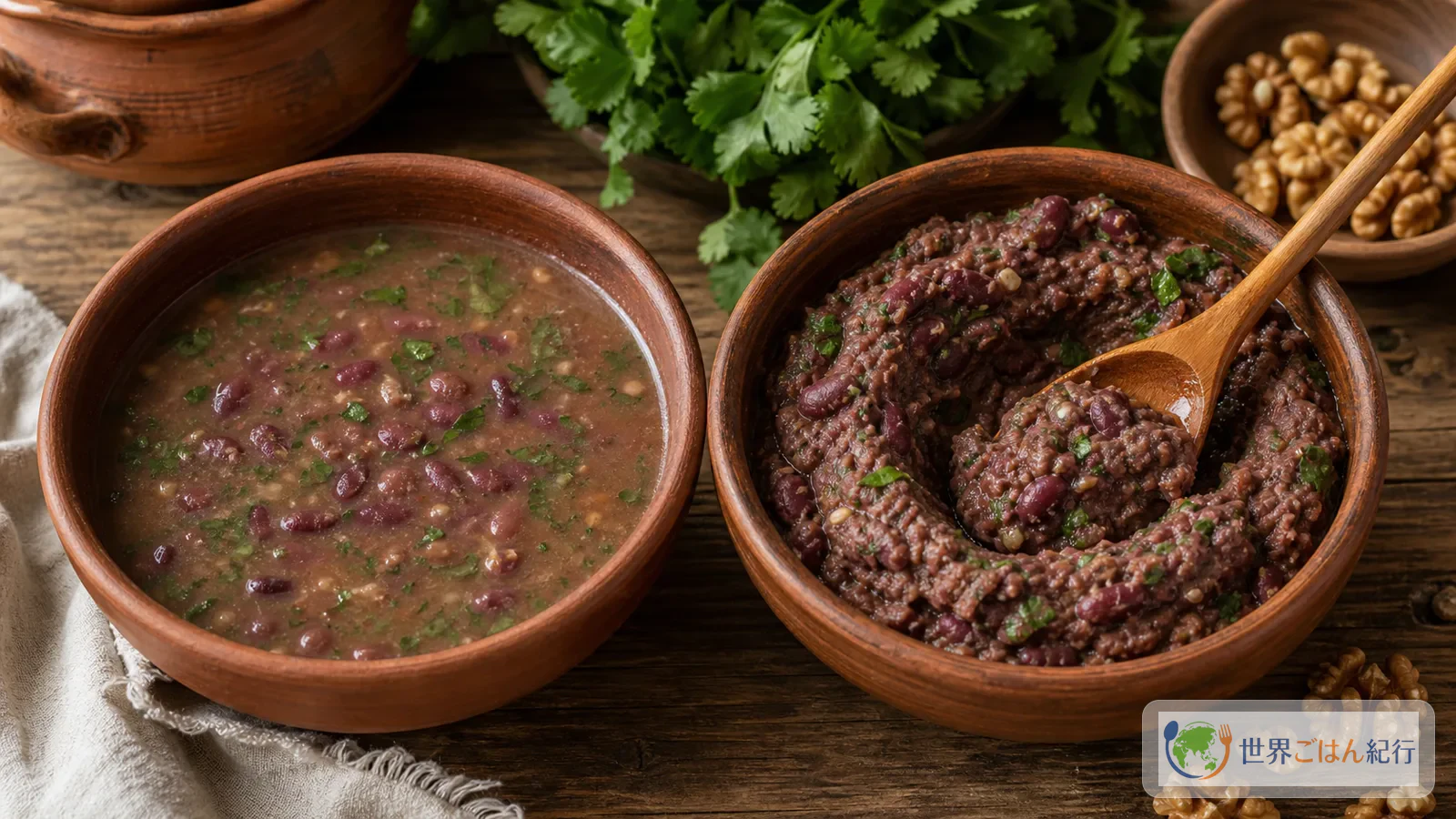
The ingredients are simple, so when lobio goes wrong the cause is usually easy to spot. The most common mistake is trying to settle the flavor before the beans are soft. If the beans stay firm, the broth never comes together, and spice added to hard beans only sits on the surface. Spices added only as powder also taste flat.
| Problem | Cause | How to fix |
|---|---|---|
| Beans are hard | Not soaked enough, old beans, heat too low | Add ¾ cup (200 ml) boiling water and extend by 20 minutes at a time over low heat |
| Watery | Too few beans mashed, too much liquid added | Mash another 1/4 of the beans and reduce over low heat for 10 minutes |
| Stiff and heavy | Too many walnuts, not enough liquid | Add the reserved liquid or boiling water 3.5 tbsp (50 ml) at a time |
| Shallow aroma | Spices were not heated, old powder | Warm 1/2 tsp coriander in 1 tsp oil over low heat for 1 minute and add |
| Only acidity stands out | Vinegar added too early, not reduced enough | Simmer 5 minutes over low heat to cook off acidity and add a pinch of salt |
| Bitter | Burnt garlic, too much fenugreek | Make half a batch of fresh sautéed onion, mix in, and add 1 tsp of acidity |
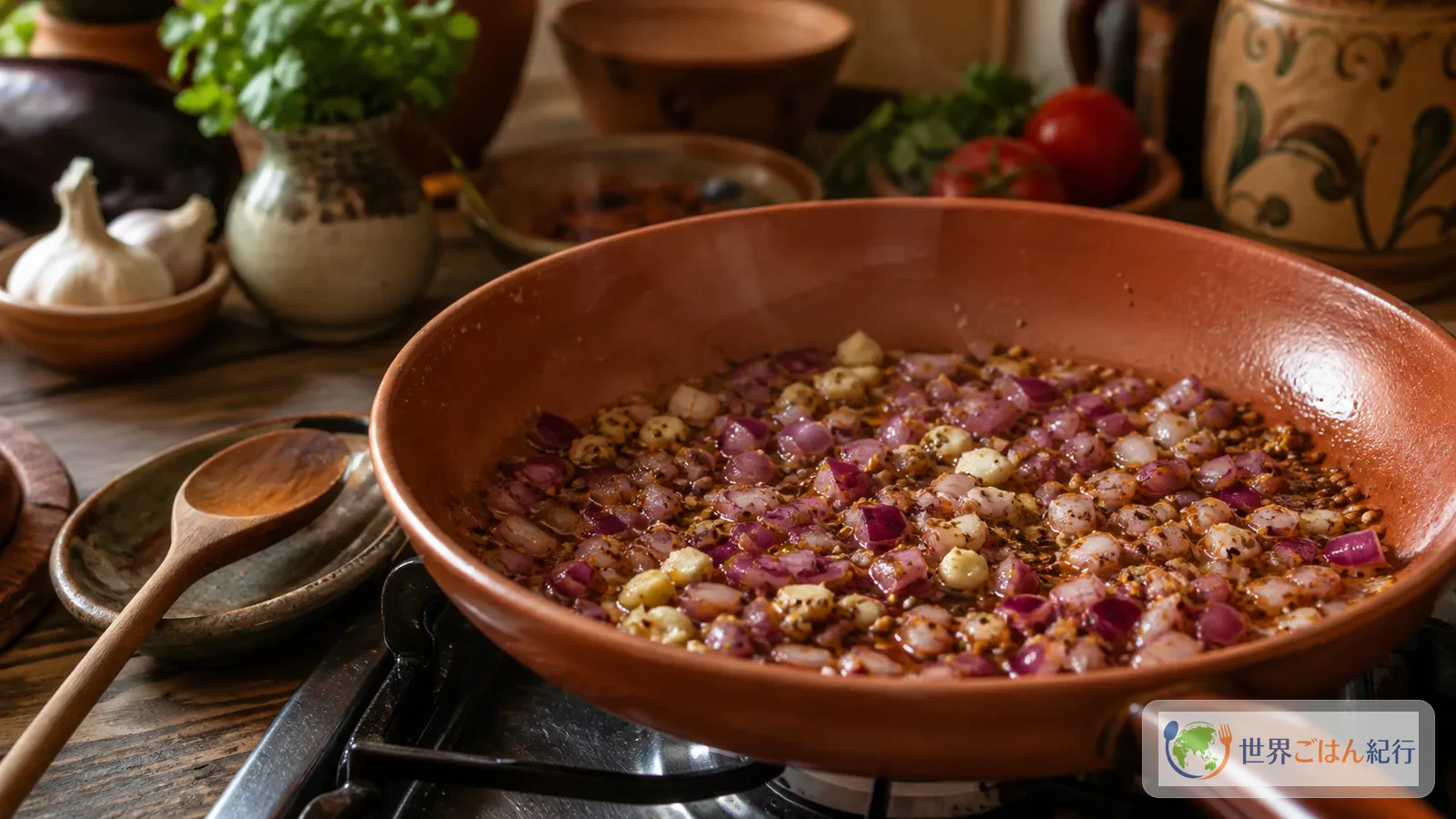
With canned kidney beans you can skip the parboiling (see the FAQ for quantities). Canned liquid alone gives a weak bean aroma, so even in the quick version, sauté the onion and spices. The flavor holds up much better.
Serving and storing lobio
Serving
Lobio is good hot from the pot, or after it cools to nearly room temperature. Hot, the sweetness of the beans comes forward. Cooled, the acidity and herbs come through more clearly. For a Georgian-style table, set cornbread, pickles, sliced onion, and herbs alongside. For an everyday dinner, a baguette, roasted potatoes, tomato salad, or grilled eggplant work just as well.
| Table setup | Pair with | Why |
|---|---|---|
| Beside a meat dish | Shashlik, grilled chicken, roast pork | Herbs and acidity meet the fat, and the beans add fullness |
| A bread-centered dinner | Khachapuri, baguette, cornbread | Bread scoops up the thick broth |
| A light summer lunch | Tomato, cucumber, pickles, red onion | The acidity of cooled lobio goes with vegetables |
| A make-ahead main | Boiled egg, roasted potato, steamed greens in oil | Easy to add protein and fiber without meat |
A Georgian menu with lobio
Cheese khachapuri, juicy khinkali, and walnut-sauce satsivi make a menu that moves through beans, bread, meat, and walnuts. With a beef main, a small portion of lobio next to chashushuli, stewed with tomato and herbs, catches the meat's fat. Next to the garlicky, creamy shkmeruli, make the lobio a little sharper to stand up to the dairy. And a sprinkle of Svan salt over roasted vegetables pulls the whole table in the same direction.
For more on building a table around beans, walnuts, herbs, and wine, see this introduction to Georgian cuisine.
Storage and reheating
| Storage | Keeps | When eating |
|---|---|---|
| Refrigerator | 3 days | 5 minutes over low heat in a pot. If stiff, add 2 tbsp of water |
| Freezer | 3 weeks | Freeze flat in single portions and thaw half a day in the refrigerator |
| Lunch box | Same day | Cool well before packing; use an ice pack in summer |
In the refrigerator, the walnuts and beans soak up liquid, so the lobio turns a little stiff by the next day. Reheat it in a small pot rather than the microwave alone, with a little water, over low heat until it bubbles gently and turns smooth again. Reheating dulls the acidity, so finish with a few drops of red wine vinegar.
FAQ
Q1. Won't it get too sweet with red beans?
Without sugar, it won't taste like a sweet bean dish. Red beans have soft skins and release a deep broth, which suits lobio. If it still tastes too sweet to you, add 1 tsp more red wine vinegar and a bit more black pepper.
Q2. Is there lobio without walnuts?
Yes. For a version without walnuts, mash up to half of the beans and add 1/2 an onion to make up the sweetness and body. Walnuts add richness but also heaviness, so in summer you can halve them and sharpen the acidity.
Q3. Can I make it without khmeli suneli?
Yes. Build it around whole coriander, with a pinch of fenugreek, 1/2 tsp of dried dill, and extra black pepper. Go easy on cumin, at most 1/4 tsp. More pushes the flavor toward Middle Eastern or curry and away from Georgian.
Q4. Is pomegranate molasses required?
No. In Georgia, lobio gets its acidity from tkemali, vinegar, or fruit, and red wine vinegar alone works. A little pomegranate molasses adds a sweet-sour depth against the beans and walnuts. If you buy a bottle, it's also useful beyond lobio, with the meat dishes you serve alongside khinkali and satsivi.
Q5. What are the quantities for the canned shortcut?
3 cans of kidney beans at around 8.5 oz (240 g) each after draining comes close to 12.5 oz (360 g) of dried beans. Put the beans, 1 cups (250 ml) of water, and 1 bay leaf in a pot, warm over low heat for 10 minutes, and mash one third. Then follow the recipe from step 3 onward.