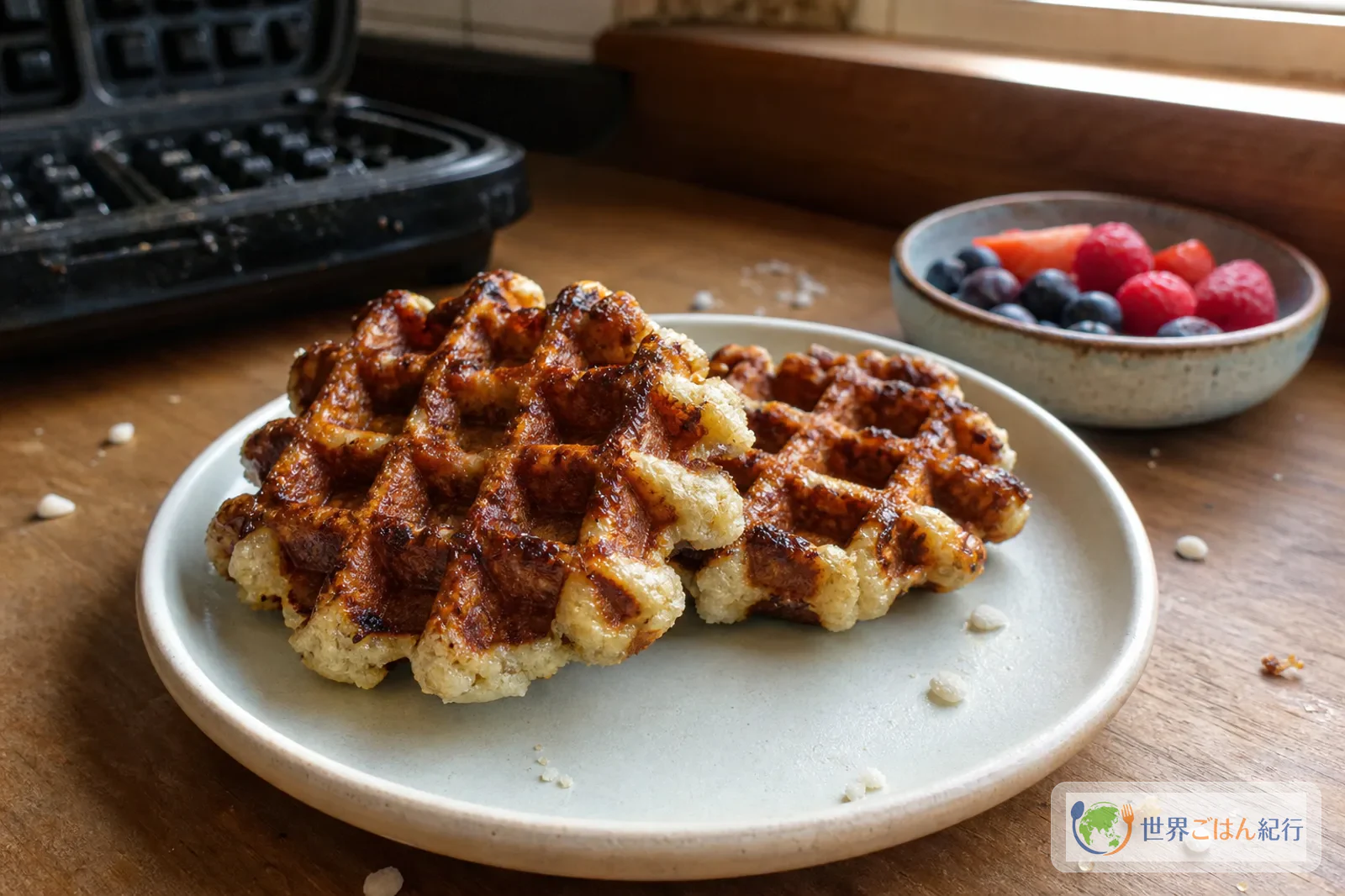
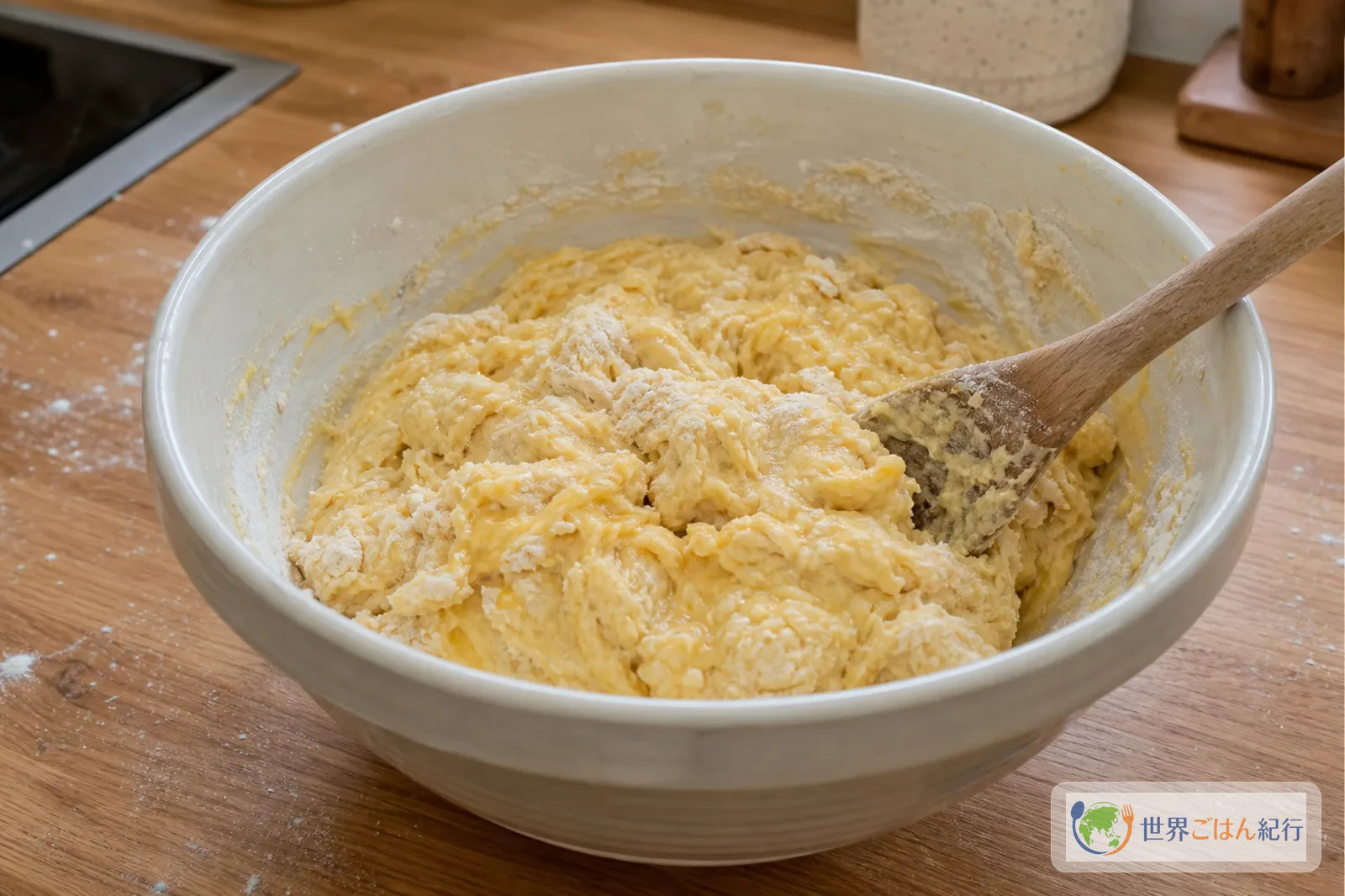
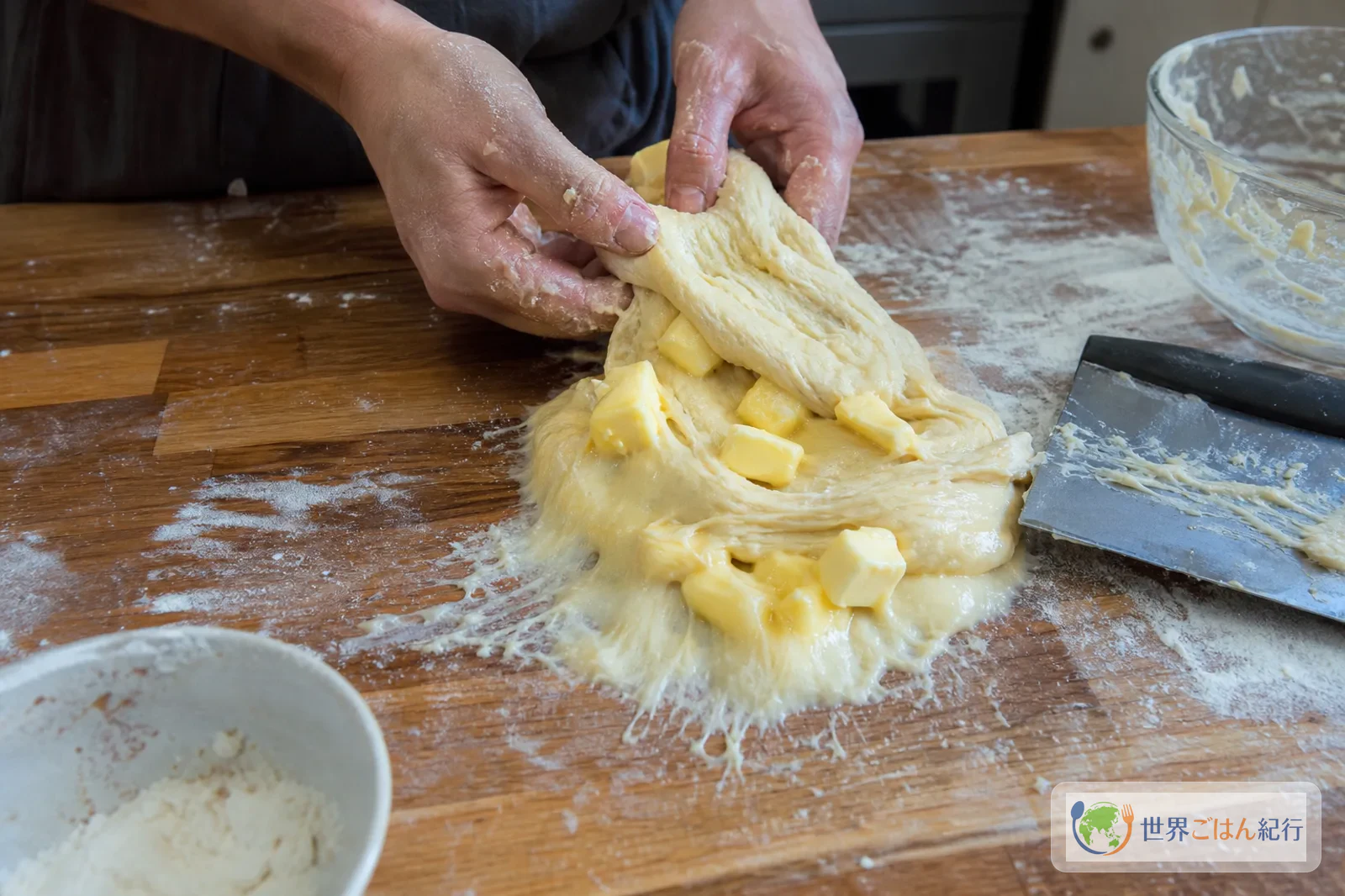
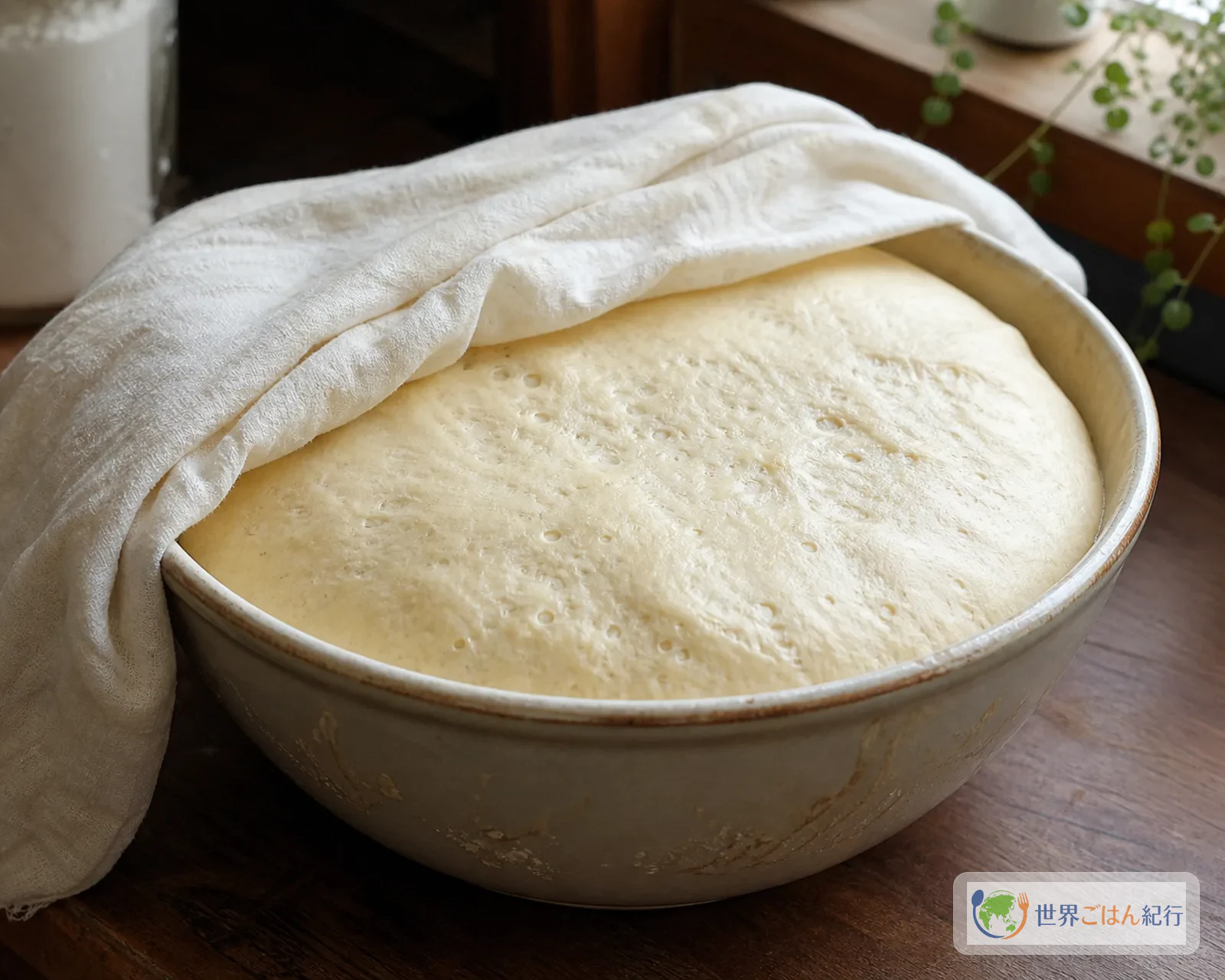
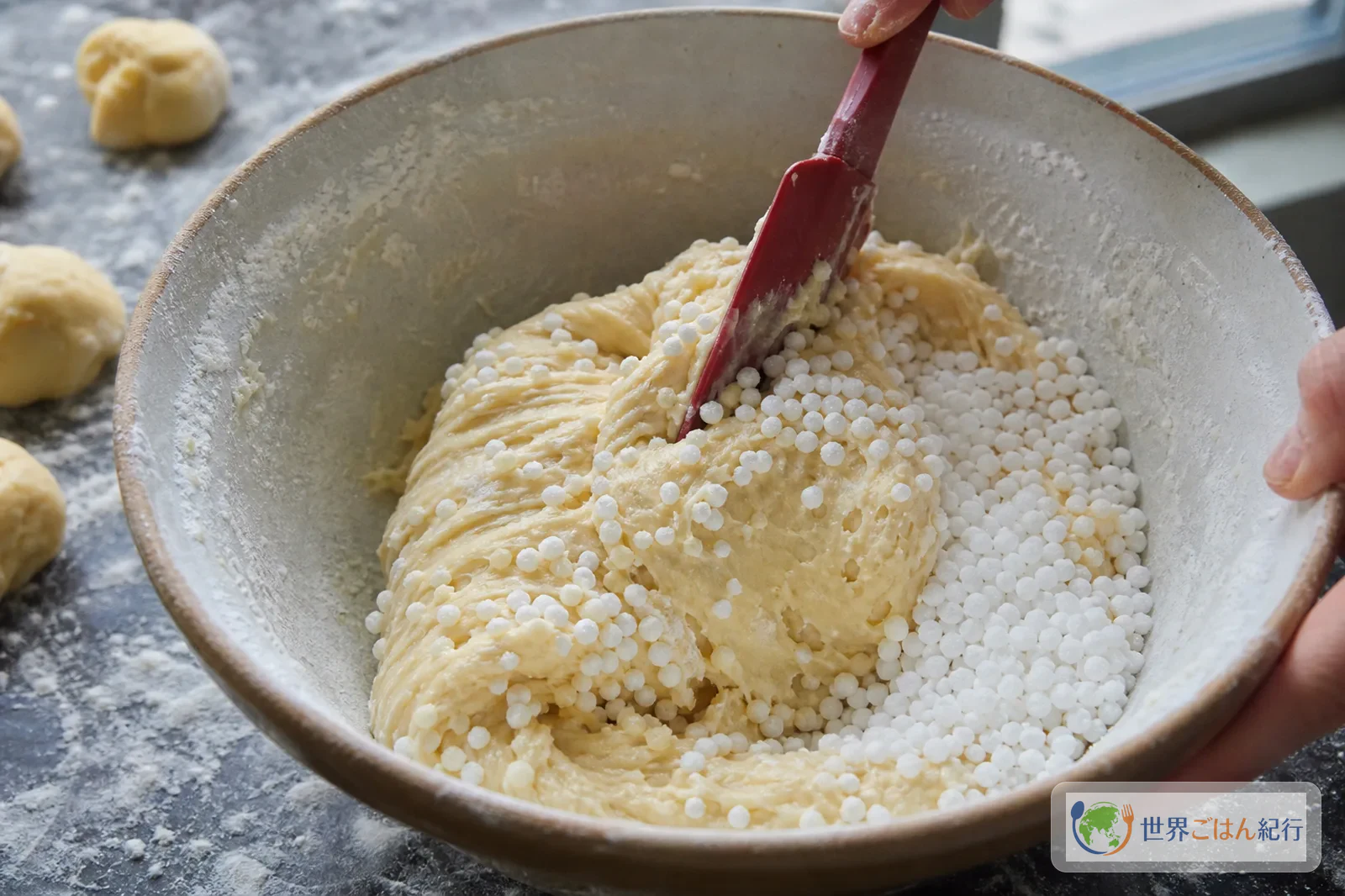
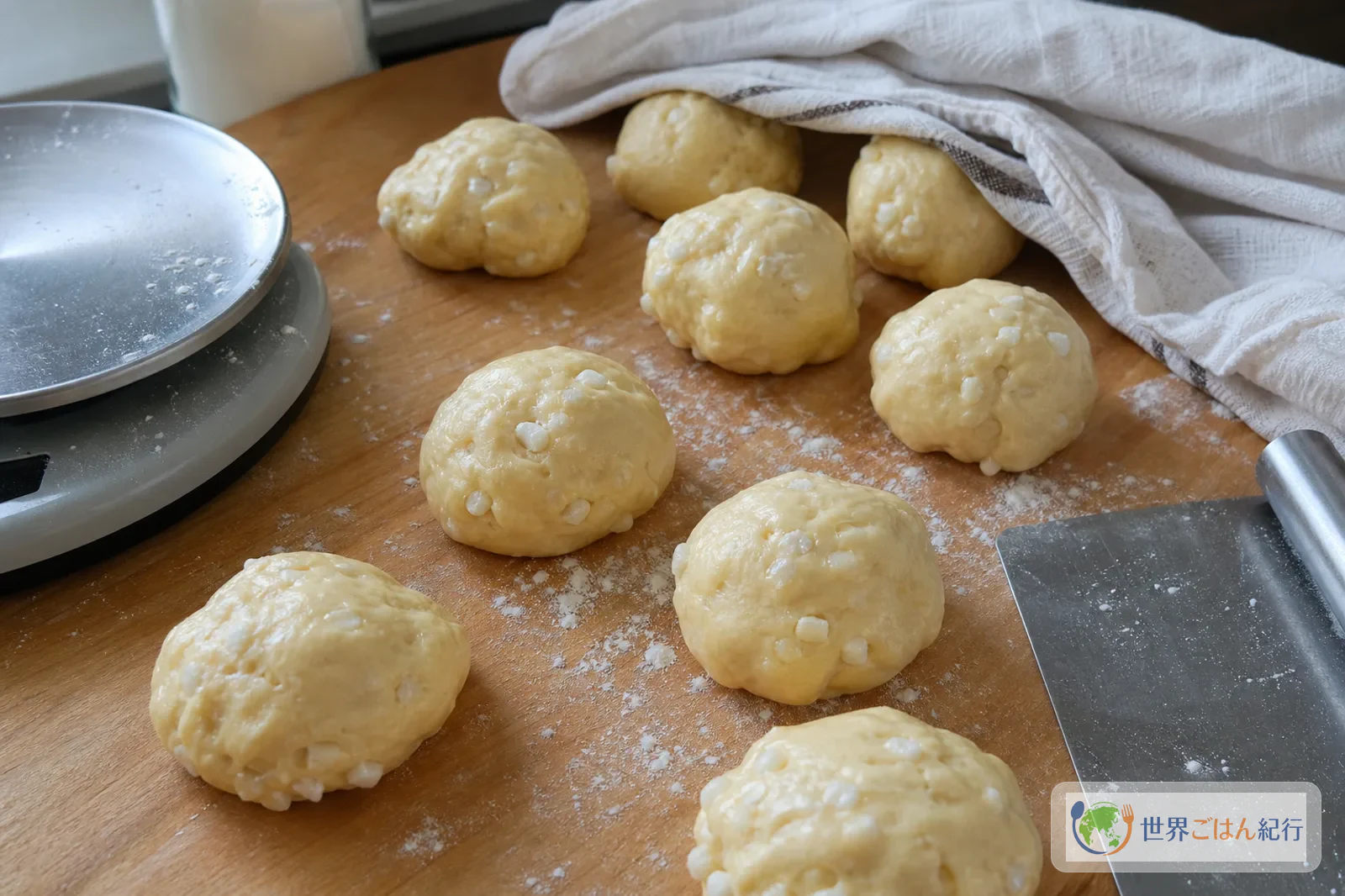
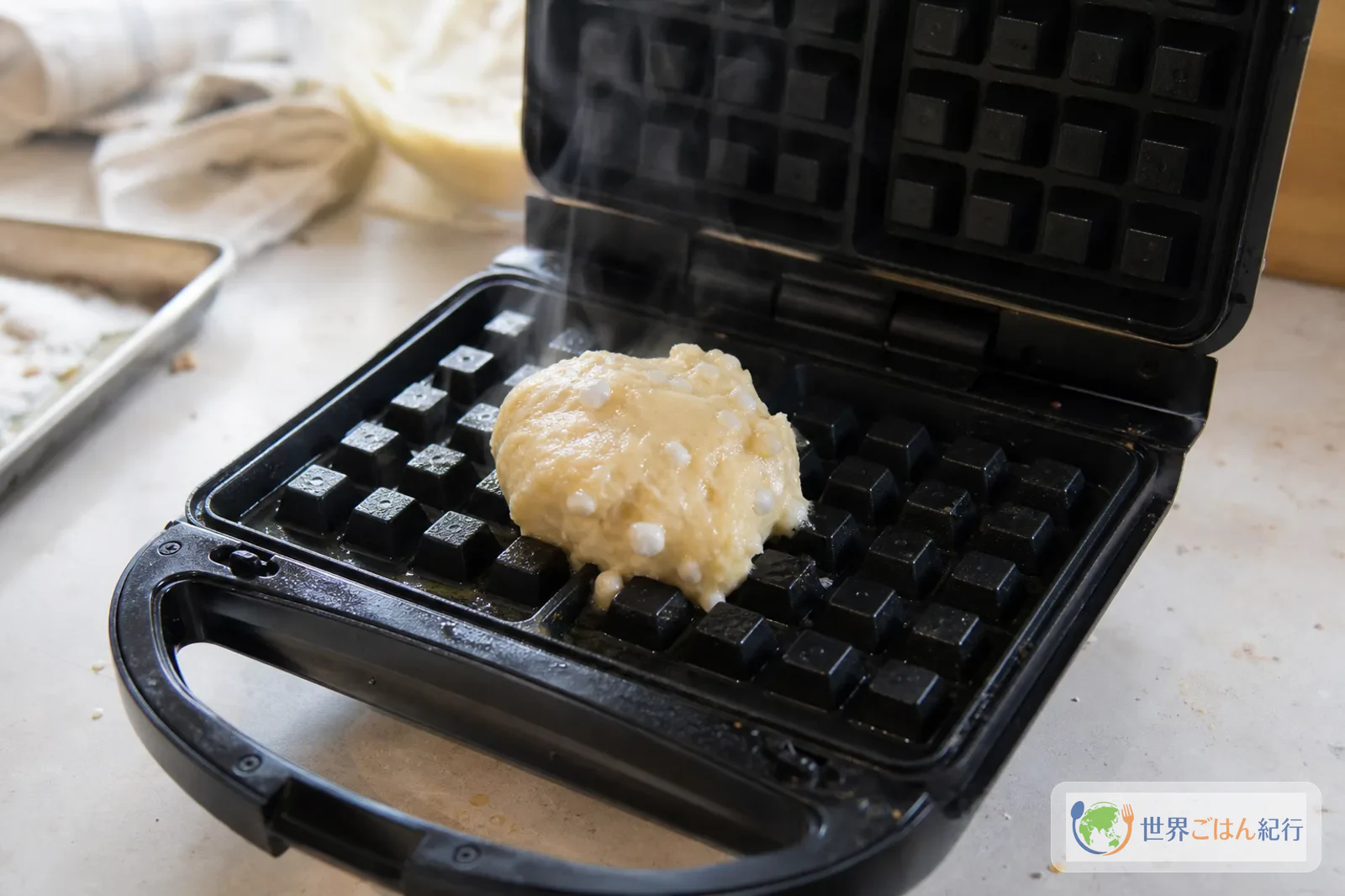
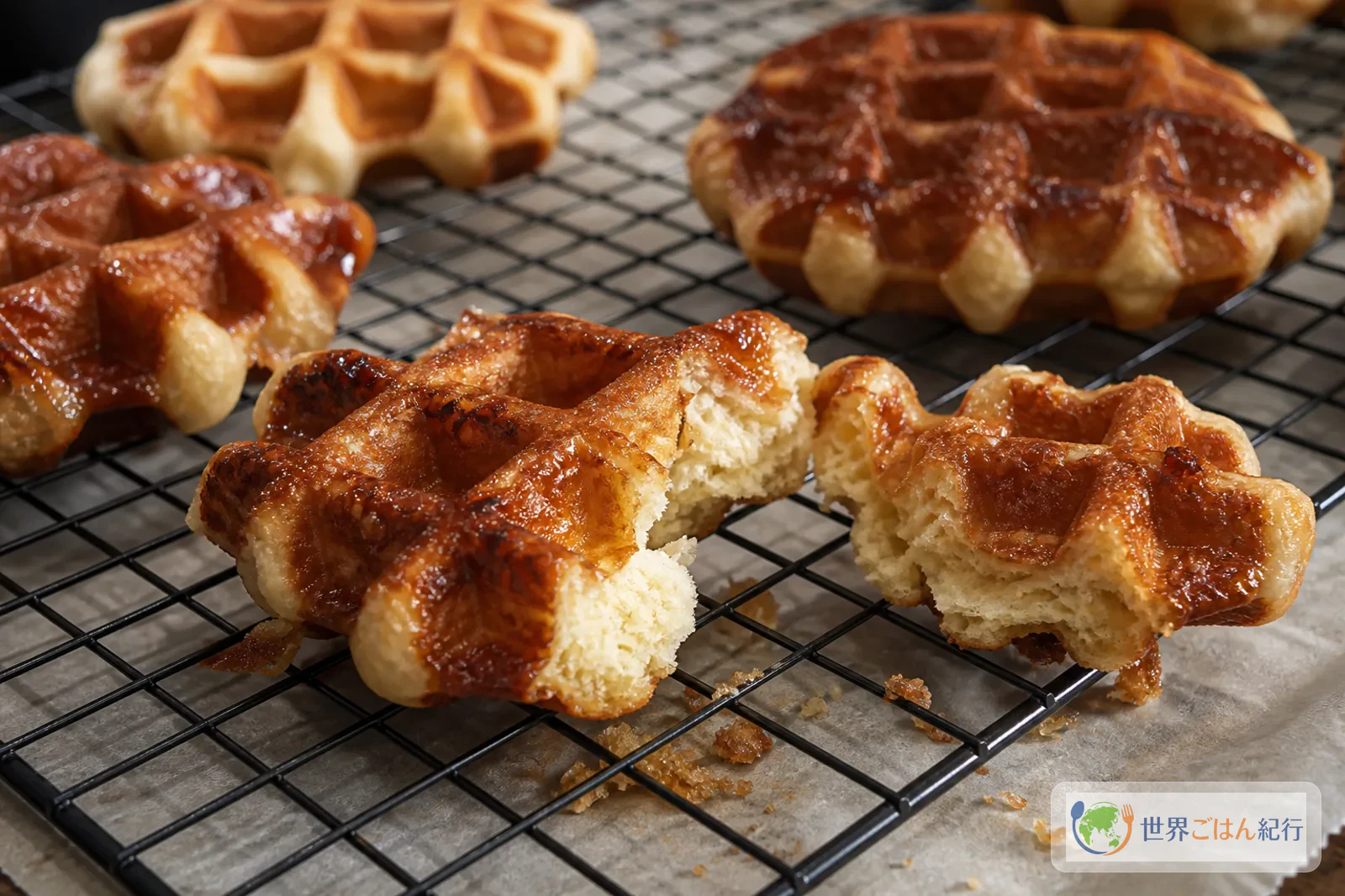
The moment you open the waffle iron, butter and sugar hit the hot plate and the kitchen fills with the smell of caramel. That smell belongs to the Liège waffle, a round yeasted waffle whose pearl sugar melts on the iron into hard amber patches. Outside Belgium, "Belgian waffle" brings to mind one round, sweet baked treat, but in Belgium the name covers two: the Liège waffle and the Brussels waffle, which differ in shape, in dough and in the way they are eaten. If carbonnade flamande and waterzooi are Belgium's food for the table, the waffle is its food for strolling, wrapped in paper at a station or market, with an aroma that stops people in their tracks.
Liège and Brussels waffles
Two doughs, two waffles
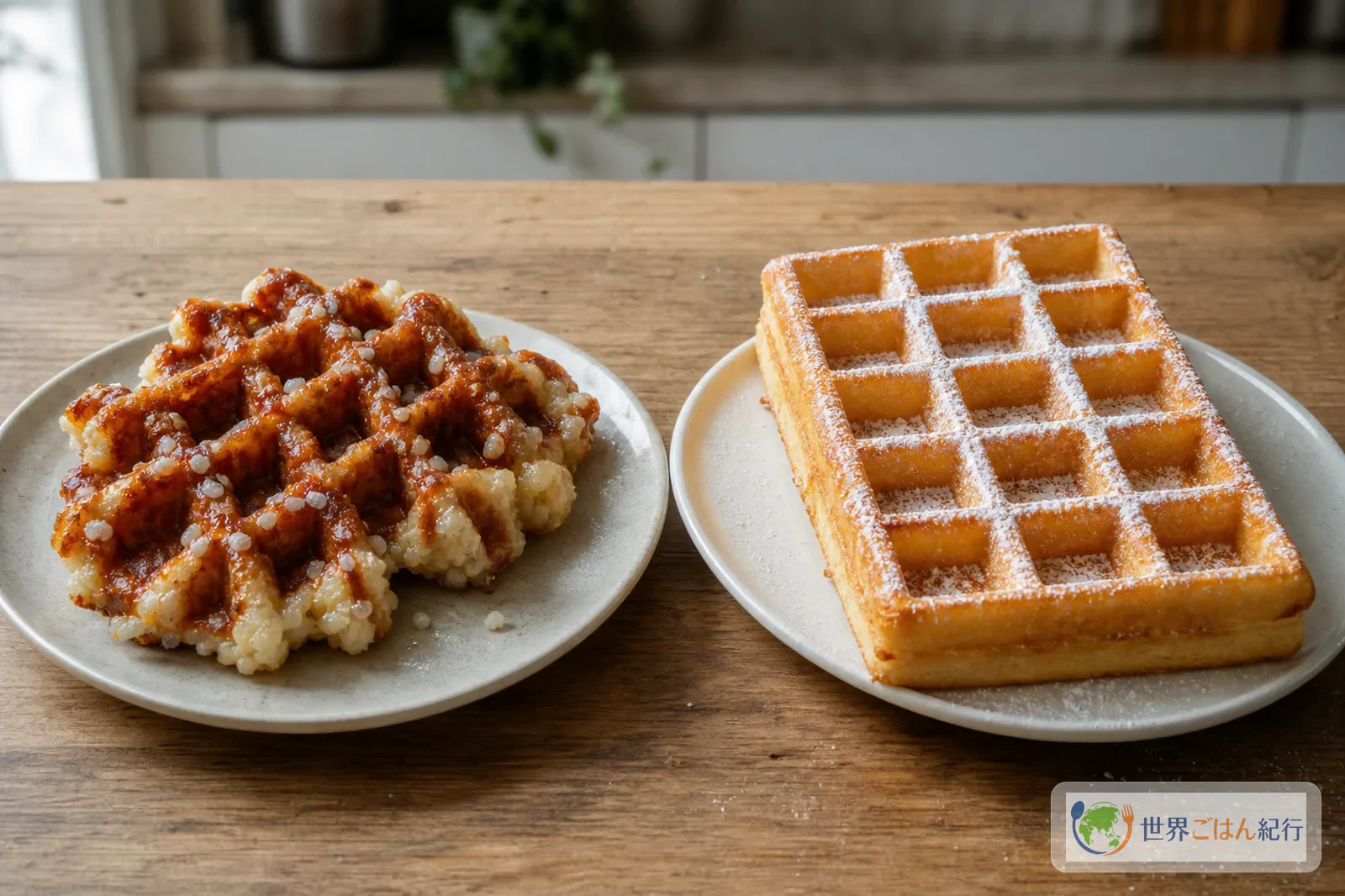
The Liège waffle, gaufre de Liège in French, is made from a stiff yeasted dough close to brioche, with pearl sugar folded in before baking. It comes out small and irregular, with rounded edges. The Brussels waffle, gaufre de Bruxelles, is baked from a light, liquid batter into a large rectangle with deep grids, a light interior and a crisp outside.
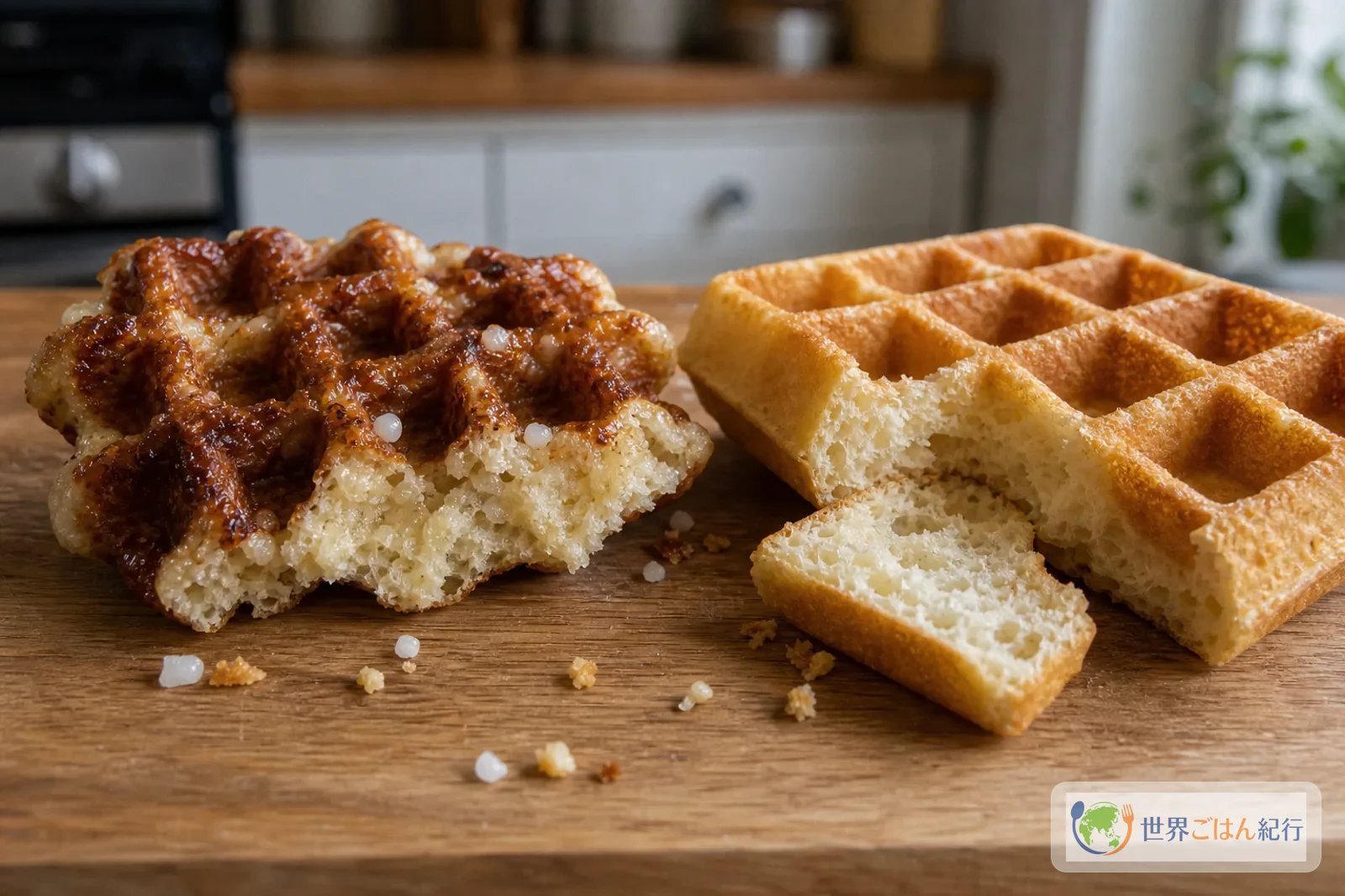
| What to look at | Liège style | Brussels style |
|---|---|---|
| Local name | gaufre de Liège | gaufre de Bruxelles |
| Dough | Stiff, yeasted dough | Light, liquid batter |
| Sugar | Pearl sugar mixed into the dough | Powdered sugar or toppings added on top |
| Shape | Smaller, round edges, irregular | Larger, rectangular, deep grids |
| How it is eaten | As is, warm or cooled | Warm, with powdered sugar, fruit, cream and so on |
| Hard part at home | Scorched sugar, fermentation, dough stiffness | Lightness, pouring into the iron, sogginess once cool |
The real difference is in the dough, well before anything goes on top. The Liège waffle holds its sweetness inside, in a yeasted dough full of sugar grains, which makes it a snack you can eat out of hand. The Brussels waffle is baked large and airy, leaving room for powdered sugar and fruit, so its sweetness is added after baking. Pour one dough into the other's iron and you won't get the other's texture.
That difference carries over to the home kitchen. The Liège style keeps its flavor when cool, so there's less pressure to eat it the second it's done. The Brussels style is all about the lightness right out of the iron, which means baking the whole batch in a row with the table ready to serve.
How the Liège waffle is eaten
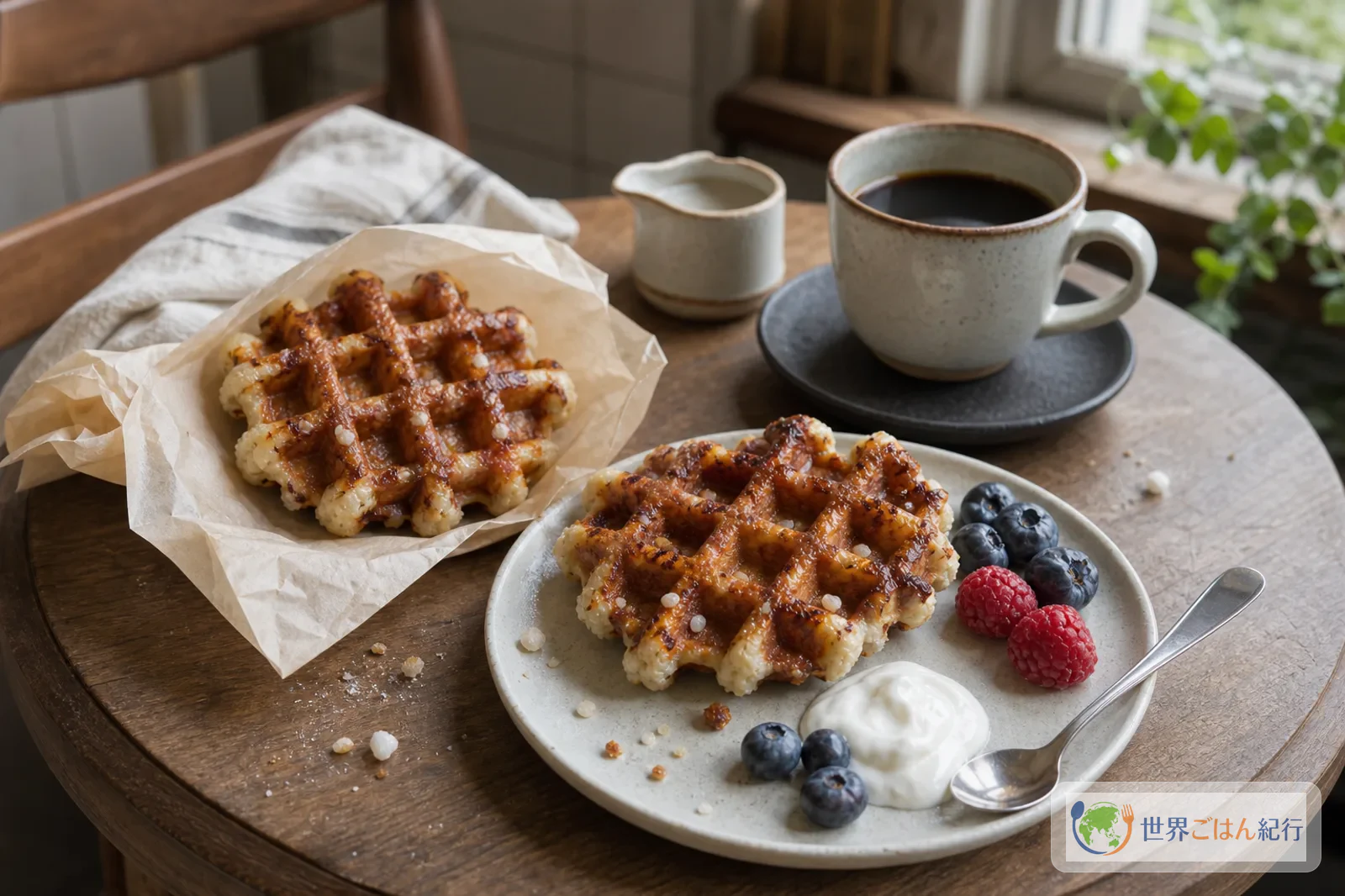
The Liège waffle is best with little or no decoration. In town it's often eaten on the move, wrapped in paper, a snack people buy for the aroma rather than a sweet dressed up for a fork and knife.
Ingredients (serves 4, makes 8 waffles)
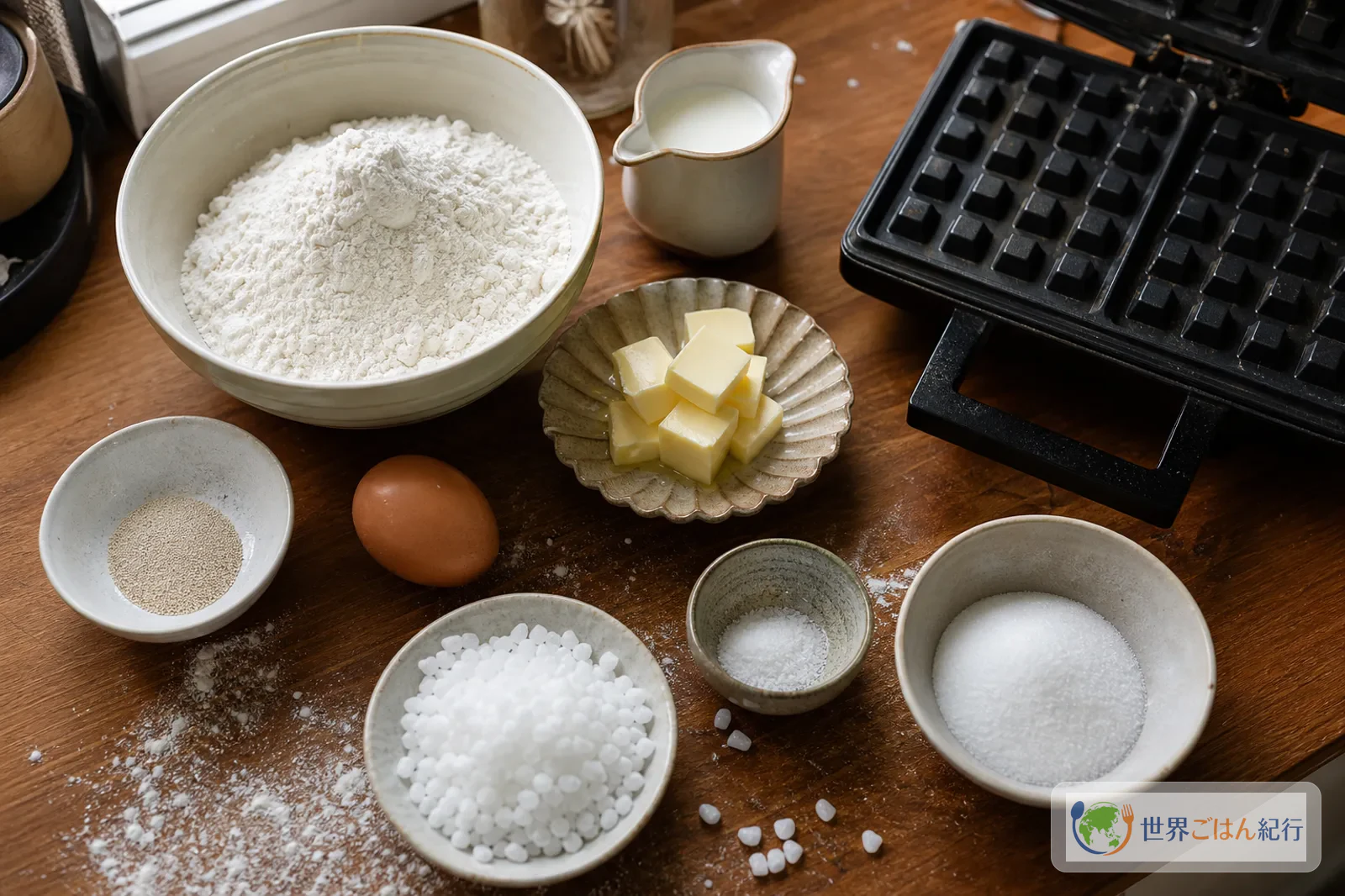
The main recipe is the Liège style. Home waffle irons have less heat than professional ones, so the butter and pearl sugar are slightly reduced from the local recipe, to cook the waffle through before the baking surface scorches.
This uses wheat, egg and milk. Melted sugar left on the waffle iron is extremely hot and will burn bare skin. After baking, switch it off, and wipe it with a damp cloth once it has cooled somewhat.
Ingredients that cause hesitation when shopping
Pearl sugar defines the outline of this dish. You can still make it without, but with granulated sugar alone the whole dough is evenly sweet and you lose the Liège feel of "crisp and sweet only where you bite." At baking supply stores, look under pearl sugar, waffle sugar or nib sugar.
For the waffle iron, choose one with deep grids and, if possible, temperature control. The grids of a thin sandwich press squash the dough and the center will not rise. An electric one that bakes at a medium-high 350–400°F (180–200°C) is good, and for a stovetop iron, a thick one that can hold about 2 1/2 minutes per side over medium-low heat is easier to use.
Ordinary butter, eggs and milk from the supermarket are enough. Spending on premium versions here matters less than putting the budget into the pearl sugar and the depth of the iron, which move the result closer to the local one.
Shopping priorities: look at the sugar first, then the iron
By the ingredient count Belgian waffles look familiar, but a wrong purchase pushes the result toward an ordinary pancake in an instant. If you spend money the first time, spend it not on flour or dairy but on the sugar grains and the iron. If you get those right, domestic bread flour, ordinary eggs and supermarket unsalted butter make a perfectly good waffle.
If you plan to bake the Liège style several times, a 9 oz (250 g) to 2.25 lb (1 kg) baking pack is safer than a 3.5 oz (100 g) bag. This recipe uses 4 oz (110 g) at a time, so a small bag can run out between a test bake and the real thing. For the iron, choose a deep plate if you also want the light Brussels batter, and if it is only Liège, put ease of cleaning first. Cleaning the grooves after the pearl sugar has melted is more of a chore than you would imagine, so look for removable plates or a structure that lets you get a cloth into the grooves.
Below are the ingredients and tools that are hard to find at a neighborhood supermarket and that make the most difference in the result. Eggs, milk, butter and cake flour are fine from your usual shopping, so they get no extra priority. Think of pearl sugar as the sugar you bake in, and the waffle iron as the tool that creates the thickness, and the reasons to buy become clear.
For the first batch, try one bag of waffle sugar or nib sugar with a sandwich press you already own. If you want to bake it again, buy a deep-plate waffle iron next. Trying the sugar first keeps you from buying an appliance you never use.
| Priority | What to look for | What to check | If you compromise |
|---|---|---|---|
| High | Pearl sugar, waffle sugar, nib sugar | Large grains that do not melt away completely when baked, made for baking. The Liège style uses 4 oz (110 g), so a 9 oz (250 g) bag is about two batches | Reduce coarse sugar crystals to 3.25 oz (90 g). With granulated sugar only, the texture is a different thing |
| High | A waffle iron with deep grids | Grids deep enough not to squash the dough, heat for 350–400°F (180–200°C), plates that are easy to wipe of sugar | In a shallow sandwich press, make each waffle smaller at 2 oz (60 g) and bake briefly at about medium-low |
| Medium | Temperature or browning control | Pearl sugar scorches quickly once it starts, so a model that lets you drop the browning one step is easier | With a timer-only model, open it for the last minute to check the color |
| Low | Premium butter, special milk | Better aroma, but not the star that makes the Liège style | Ordinary unsalted butter and milk are fine |
Words to look for on product pages
The differences among pearl sugar, waffle sugar and nib sugar are what cause hesitation while shopping. All can be used as grain sugar to bake in, but avoid any that is crumbled to powder in the bag. With a lot of powder, the sweetness spreads through the whole dough as soon as it is mixed in, and it scorches early in the grooves of the iron.
| Term to look for | What to check | What to avoid |
|---|---|---|
| Pearl sugar | Whether white pebble-like grains remain. Whether it is labeled for baking, baking in or waffles | Powdered sugar, fine granulated sugar, icing sugar |
| Waffle sugar | Whether the product description mentions "Liège," "waffle" or "baked in" | Sugar meant only as a fine topping |
| Nib sugar | Whether the grains are angular and there is not too much powder at the bottom of the bag | Extremely large grains that scorch easily in a shallow iron |
| Waffle iron | Deep grids, browning control, plates that are easy to clean | Thin sandwich-only presses, or ones with no temperature control and strong heat |
If you pick only one sugar, look at the condition of the grains rather than the product name. Choose one that leaves a few grains after baking and gives a crisp, sweet spot only where you bite. Avoid a bag whose photo shows grains fine as powder snow; that is closer to the powdered sugar you sprinkle on a Brussels waffle and does not suit mixing into Liège dough. When baking in a shallow home iron, grains that are too large also scorch easily, so the first time, do not put in the full 4 oz (110 g). Bake with 3.5 oz (100 g), look at the color, and increase next time.
If you use coarse sugar crystals, the grains are sharp and stay on the tongue, so reduce the amount to 3.25 oz (90 g) and keep them from collecting at the surface of the dough. Adding sweetness with granulated sugar alone moves the whole waffle toward an evenly sweet bread. To get the Liège-style "hard caramel in places" you buy at a station, a small amount of a grain sugar that survives baking is more effective than more ordinary sugar.
For the waffle iron, deeper is not automatically better. A model with removable plates is easy to clean, but a very light model loses temperature the moment dough goes onto the preheated plate. The Liège style is a butter-rich yeasted dough, so it cooks more slowly than thin pancake batter. A model that lets you adjust browning to low, medium or high, and not only a preheat light, makes it easier to stop the sugar from scorching.
For the Liège style alone, a deep home electric model is enough. If you also make the Brussels style often, a rotating iron that spreads the batter to all four corners, or a model that holds a higher temperature, suits better. But the closer you get to large professional equipment, the more the storage space, the weight and the cleaning of the plates become a daily burden. For a monthly treat, you will use it longer if you put three things first: deep grids, ease of wiping and a way to tell when preheating is done.
If you test the dough in a sandwich press you already own before buying a new iron, treat the first time as checking the flavor. With the full 2.75 oz (80 g) the center gets squashed, so divide into 2 oz (60 g) pieces and bake 2 to 2 1/2 minutes per side. Scorched sugar passes bitterness to the next dough, so rather than switching it off after each waffle, hold a wrung-out damp cloth with chopsticks and quickly wipe just the sugar from the grooves.
If you are unsure what to buy first, start with waffle sugar and then a deep waffle iron. Waffle sugar makes a difference in texture even in an existing sandwich press, but a shallow iron cannot be made deep. Conversely, even with a deep iron, baking with granulated sugar alone will not give the hard caramel spots of the Liège style. When both sugar and iron are in place, you come closest to the aroma of the one you buy at the station.
For a shopping list, check pearl sugar, waffle sugar and nib sugar on the same shelf at a baking supply store, and in the appliance section check three things: the depth of the waffle plate, temperature or browning control, and whether the plates come off for washing. Flour, eggs, milk and butter are fine from your usual supermarket. Putting the budget into the sugar grains and the depth of the iron, rather than special dairy, brings you closer to the Liège texture.
Small tools make temperature steady
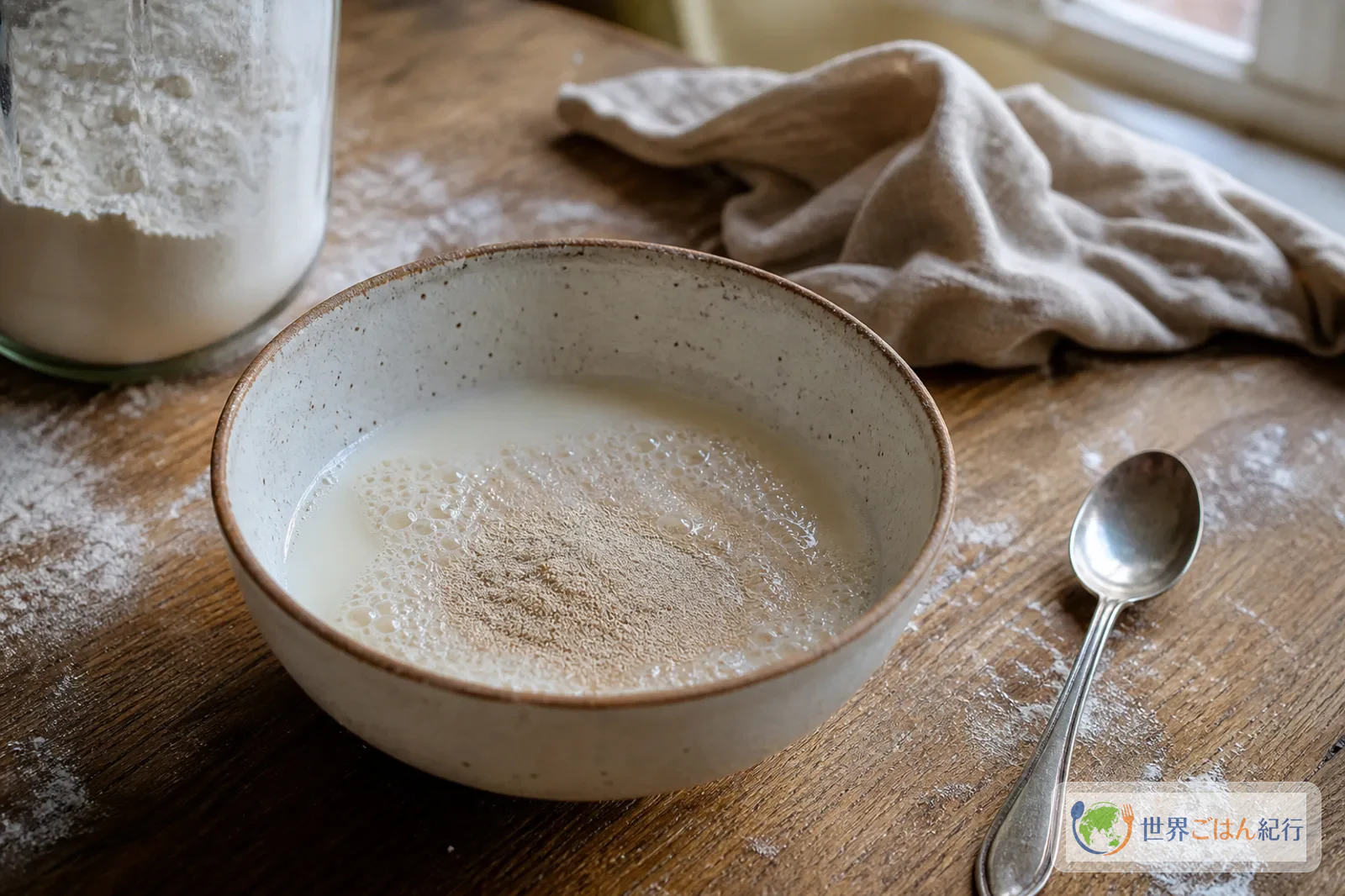
The Liège style uses 95–100°F (35–38°C) milk to wake the yeast, ferments at 26–28°C, and bakes on a plate at 350–400°F (180–200°C). The numbers look fussy, but real failures happen when you drift out of these ranges. If the milk is too hot, the yeast weakens; if the proofing place is too warm, the butter seeps out; if the baking surface is too hot, only the pearl sugar goes black first.
A thermometer is not essential. But because this dish sits between a yeasted dough and a baked sweet, a slim digital thermometer that works for both bread and pastry takes much of the guesswork out of your first attempt. Especially in a winter kitchen, or if you warm milk in the microwave, it makes judgment steadier than finger feel alone.
A tool that can read both the milk temperature and the dough's proofing temperature in one go makes it easier to sort out the cause of failure before you buy more sugar or a new iron.
If buying for the first time, one slim type that makes milk or dough temperature easy to read is enough. If you already own a thermometer, there is no need to buy another.
If you have no thermometer, just make sure not to overheat the milk. After 20 seconds in a 600 W microwave, stir once, and if it is hot, always let it cool before adding the yeast. For proofing, set the bowl where the bottom does not feel cold to the touch, and keep it within a range where the butter does not seep to the surface. Treat the first waffle as a test bake, and if it gets too dark at 3 1/2 minutes, lower the temperature from the next one.
Change the bake time by iron
The same dough bakes differently depending on the depth of the iron. The Liège style is not a dish you pour as liquid; it is a dish where a fermented mass is pressed and baked between hot grids. A deep iron keeps swelling at the center; a shallow one flattens quickly. On the first waffle, check "color, thickness and how the sugar remains," then change the dough amount and temperature from the second.
| Iron | Dough amount | Heat and temperature | Bake time | Sugar adjustment |
|---|---|---|---|---|
| Deep electric waffle iron | 2.75–3 oz (78–82 g) | 350–400°F (180–200°C). Start the browning control at medium | 3–4 min | Keep the pearl sugar at 4 oz (110 g) |
| Shallow sandwich press | 58–62 g | About medium-low. Do not push it to high | 2 1/2–3 min | 3.5 oz (100 g) the first time. 3.25 oz (90 g) if it scorches easily |
| Stovetop waffle iron | 2.25–2.75 oz (65–75 g) | Medium-low on the burner. Check the color one side at a time | 2 min on the first side, then 2–2 1/2 min after flipping | Start at 3.5 oz (100 g) and adjust from the second waffle |
| Large rectangular iron meant for Brussels style | About 2.5 oz (70 g) for the Liège dough | Around 375°F (190°C). Do not force it into the corners | 3–3 1/2 min | 4 oz (110 g) tends to stay in the grooves, so use 3.5 oz (100 g) |
Closing 2.75 oz (80 g) of dough in a shallow iron pushes the sugar grains to the surface the moment you shut the lid, and they scorch easily on the bottom of the plate. Making the dough smaller looks a little skimpy, but it makes an underbaked center less likely and holds down the bitterness of the caramel. With a deep iron, the opposite holds: if the dough is too small, the peaks of the grid do not form. Placing about 2.75 oz (78 g) in the center and letting the weight of the lid spread it slowly is easy to manage.
A stovetop iron lets you create the color yourself, but the heat hits one spot. Open it after 2 minutes on the first side, flip it for 2 minutes if it is a light golden brown, and lower the heat one notch if it is dark brown. If you keep strong heat on the melted pearl sugar, you get a result that is black outside and heavy only in the center. Right after buying an iron, a shortcut is to treat the first waffle as a note on the heat rather than aiming for one beautiful waffle.
Decide the baking-day schedule first
A Belgian waffle is a dish where you wait longer than you bake. What flusters you in the kitchen is searching for the waffle iron after fermentation is done, or starting to prepare the table after the sugar is folded in. On baking day, work backward from when you will eat before you mix the flour, and you will not miss the best aroma.
| Timing | What to do | Guide for judging |
|---|---|---|
| The night before or before starting | Weigh the flour, sugar and salt and cut the butter into 0.5 inches (1.5 cm) cubes | Do not take the butter out of the fridge too early; soften it on the day until it yields to a finger |
| 2 hours before eating | Warm the milk, wake the yeast and knead the dough | Milk at 95–100°F (35–38°C). If hot, cool it before use |
| 1 hour before eating | Watch the first rise and get out the waffle iron | The dough at 1.7 to 2 times its size. Have a cloth ready to wipe the iron |
| 30 minutes before eating | Fold in the pearl sugar, divide into 8 and rest | Do not make the dough wait long once the sugar is in. Bake before it turns damp |
| Just before eating | Test bake the first waffle to settle the temperature | If pale at 3 minutes, add 30 seconds; if too dark at 3 1/2 minutes, lower the temperature from the next |
When serving guests, use the first waffle as a taste test and bring the second and later ones to the table. The Liège style can be eaten cool, but the aroma is best about 5 minutes after baking, at the moment the surface sets. Set the plates, brew the drinks and put out a rack before you bake, and you can bake calmly to the last waffle.
Choosing pearl sugar and butter for Liège waffles
How much sugar and butter
A rich local Liège dough uses 1 lb (500 g) butter and 1.25 lb (600 g) pearl sugar to 2.25 lb (1 kg) flour. A home version still uses 14 oz (400 g) butter per 2.25 lb (1 kg) flour, with the pearl sugar added at the end, and assumes a thick, near-professional iron. Scale that straight down to 8 waffles and you get about 6.5 oz (180 g) pearl sugar for 10.5 oz (300 g) flour. A thick Belgian iron caramelizes that boldly, but in a home waffle iron the sugar left in the grooves scorches first, and the second and later waffles turn bitter.
That's why this recipe holds the pearl sugar to 4 oz (110 g) and the butter to 4 oz (120 g): enough to keep the sugar spots without the surface going too dark.
| How to read the mix | Rich local Liège style | This recipe, adapted for home |
|---|---|---|
| Butter relative to flour | About 40–50% of the flour | 4 oz (120 g) to 10.5 oz (300 g) flour, which is 40% |
| Pearl sugar relative to flour | Some mixes go up to about 60% of the flour | 4 oz (110 g) to 10.5 oz (300 g) flour, about 37% |
| Dough per waffle | 3.25–5 oz (90–140 g) depending on the iron | About 2.75 oz (80 g), easy to handle at home |
| How to bake | Lower for a thick iron, higher for a shallow one | Test bake at 350–400°F (180–200°C) and lower if too dark |
Don't cut the sugar too far, though. Granulated sugar dissolved into the dough will never give you those hard caramel spots. Bake your first batch with 4 oz (110 g); if your iron is deep and the heat steady, go up to 4 oz (120 g) next time, and if it's shallow, go back to 3.5 oz (100 g).
Buying pearl sugar
Look at the photo of the grains and the description of use before you buy. Some products called pearl sugar are fine and powdery, and they dissolve into the dough before baking, so no hard spots remain. Choose one with white, angular grains whose description mentions "waffle," "baking in" or "baking supplies." If you only have a shallow iron, skip products with oversized grains and start with 3.5 oz (100 g) to see how it scorches.
A bag of about 9 oz (250 g) or more is the practical size, since a 3.5 oz (100 g) bag runs out after the test bake. Damp grains clump, so move an opened bag to an airtight one and plan your next baking day so less goes to waste.
Substitutes for pearl sugar
Waffle sugar, nib sugar and pearl sugar all do the same job at home; the difference is grain size. Large grains leave crisp spots, while small grains scatter through the dough and scorch faster on the plate. Nib sugar works at the same 4 oz (110 g), and fine coarse sugar crystals at 3.25 oz (90 g). Folding the sugar into the dough gives a more Liège-like texture than sprinkling extra on top.
Without any of these, the Liège character is weaker. With granulated sugar only, add 1.5 oz (40 g) to the dough and expect no grainy texture on the surface. Pressing 10 g of coarse sugar crystals into the dough surface just before baking gets you closer to caramel spots.
If you prepare the night before
If you want to bake in the morning, stop the first rise in step 4 short. Leave it at room temperature for about 30 minutes, and when the dough has swelled to about 1.3 times, press plastic wrap right onto the surface so it does not dry out, and rest it in the refrigerator for 8–12 hours. The next morning, take it out and leave it for 30 minutes, and fold in the pearl sugar once the dough is no longer too cold. If you mix the sugar in while cold, the butter is firm and the dough tears easily, so wait until a finger press leaves a slight dent.
Dough with pearl sugar in it should not sit in the refrigerator for long. The sugar draws water from the dough, and the surface turns damp and sticks to the iron. If it must wait after dividing, divide the sugar-folded dough into 8, place it on baking parchment, and start baking within 1 hour. For an easy night before, finish weighing the flour, cutting the butter and deciding where the waffle iron goes, and leave only the sugar folding for the day.
Liège waffle color and common failures
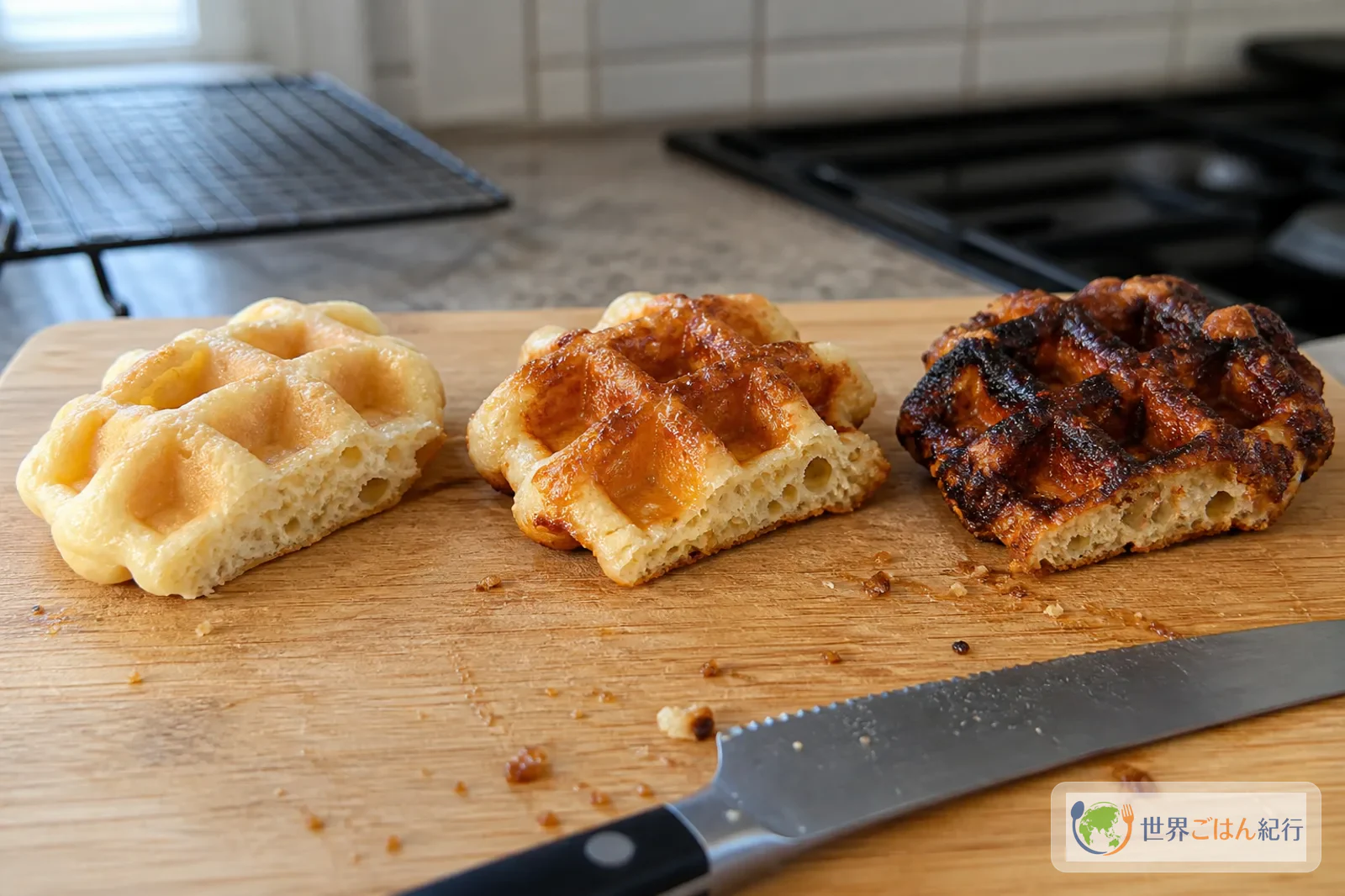
Reading the first waffle
Most Liège failures come down to sugar and temperature. Some of the pearl sugar stays undissolved to give texture, while the grains touching the iron caramelize. The good range is narrow: too pale and the aroma is weak, too black and it turns bitter.
Treat the first waffle as a thermometer rather than a finished product. Open it at 2 1/2 minutes and, if the surface is still white, add 30 seconds at a time. If the peaks of the grid are dark brown at 3 1/2 minutes, lower the temperature one step for the next dough. On home electric models the center of the plate often runs hotter than the display and the edges weaker, so put the dough in the center and don't let the lid spread it too far.
Trust your nose as much as your eyes. When the sweet smell turns into caramel with just a little bitterness, stop. By the time it smells burnt it's too late, so on a home iron it's fine to open the lid during the last minute to check.
| Symptom | Cause | Fix |
|---|---|---|
| White surface, weak aroma | Not enough preheating, bake too short | Wait until at least 350°F (180°C) and bake 30 seconds more at a time |
| Black, bitter sugar | Temperature too high, sugar left on the iron | Wipe the iron with a damp cloth before the next dough and lower the temperature by 50°F (10°C) |
| Raw inside | Dough too large, baking surface too shallow | Divide to about 2.75 oz (80 g) and bake 4 minutes to let the steam out of the center |
| Hard and heavy | Underproofed, too much flour added | Wait for 1.7 times or more in the first rise and add flour in 10 g steps |
| Sticky and will not release | Butter melted out, sugar too fine | Keep proofing at 82°F (28°C) or below, and cut coarse sugar crystals to 3.25 oz (90 g) |
Keeping the grooves clean
Sugar left in the grooves is why the second and later waffles suddenly turn bitter. After moving a waffle to the rack, leave the iron on, open the lid and lightly touch a damp cloth, held with chopsticks, to the grooves. Wring the cloth out firmly, because too many drops make the steam spatter. Wipe off only the black grains and put in the next dough before the plate cools fully, and the color comes out more even.
Serving, pairing and the Brussels style
Serving Liège waffles at home
Before you plate anything, eat one by hand. Leave a fresh waffle on the rack for 2 minutes, until the surface sugar has set a little, then break it open: the outside is hard and the inside still holds steam. It's sweet enough as it is, and chocolate sauce or whipped cream from the start would bury the pearl sugar spots. Dress it like a café waffle and it turns heavy.
| Occasion | Suitable way to serve | What to keep in mind at home |
|---|---|---|
| Nibbling fresh from the iron in the kitchen | Nothing on top, break it by hand | Leave on a rack for only 2 minutes, until it cools enough that the hot sugar will not burn you |
| Afternoon snack | Coffee, tea, a few berries | Make the cream unsweetened or lightly sweetened, up to 1.5 oz (40 g) per waffle |
| Dessert after a meal | Thin powdered sugar and a tart fruit | If adding chocolate sauce, about 2 tsp so the whole is not too sweet |
| Eating with children | Bake small, with a lighter color | Fewer hard caramel spots |
At home it works better as an afternoon snack with coffee or strong tea than as breakfast. Unsweetened yogurt, about 2.75 oz (80 g) berries and a little powdered sugar pile less sweetness onto the pearl sugar than a heap of whipped cream.
For children, cut the pearl sugar to 3.25 oz (90 g), bake them small at 2.25 oz (65 g) each, for 2 1/2–3 minutes. A slightly lighter color and less hard outer caramel make them easier to eat.
Pairing with other European dishes
The Belgian waffle sits between bread and baked sweets: the wait for fermentation is close to bread, and the iron is close to appliance cooking. Once you can bake it well, other European flour and cheese dishes come easily, and a savory stew or melted cheese on the table keeps things from getting too sweet and heavy.
| How to build a table | Recipe to pair | Connection |
|---|---|---|
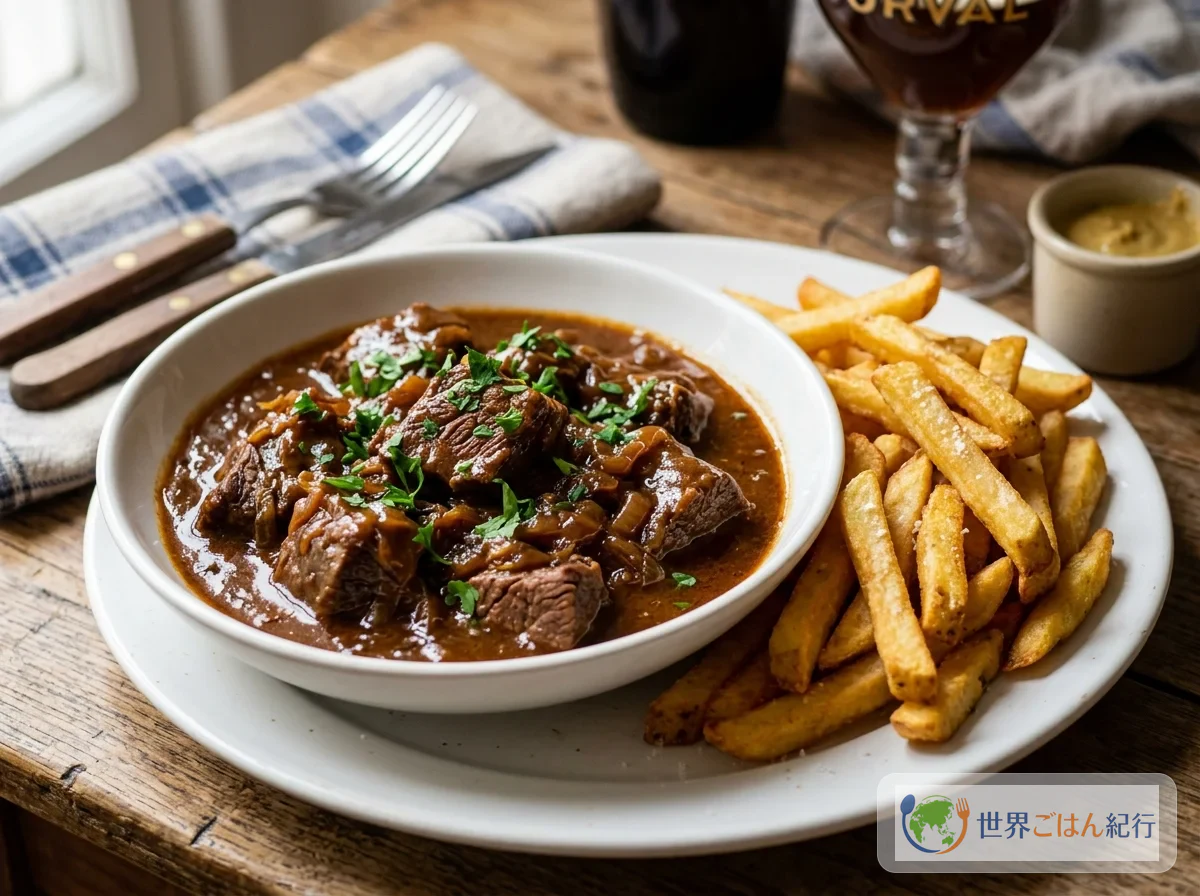
| Make the dinner more Belgian | Carbonnade flamande | Beef braised in beer for dinner, waffles as the next day's snack |
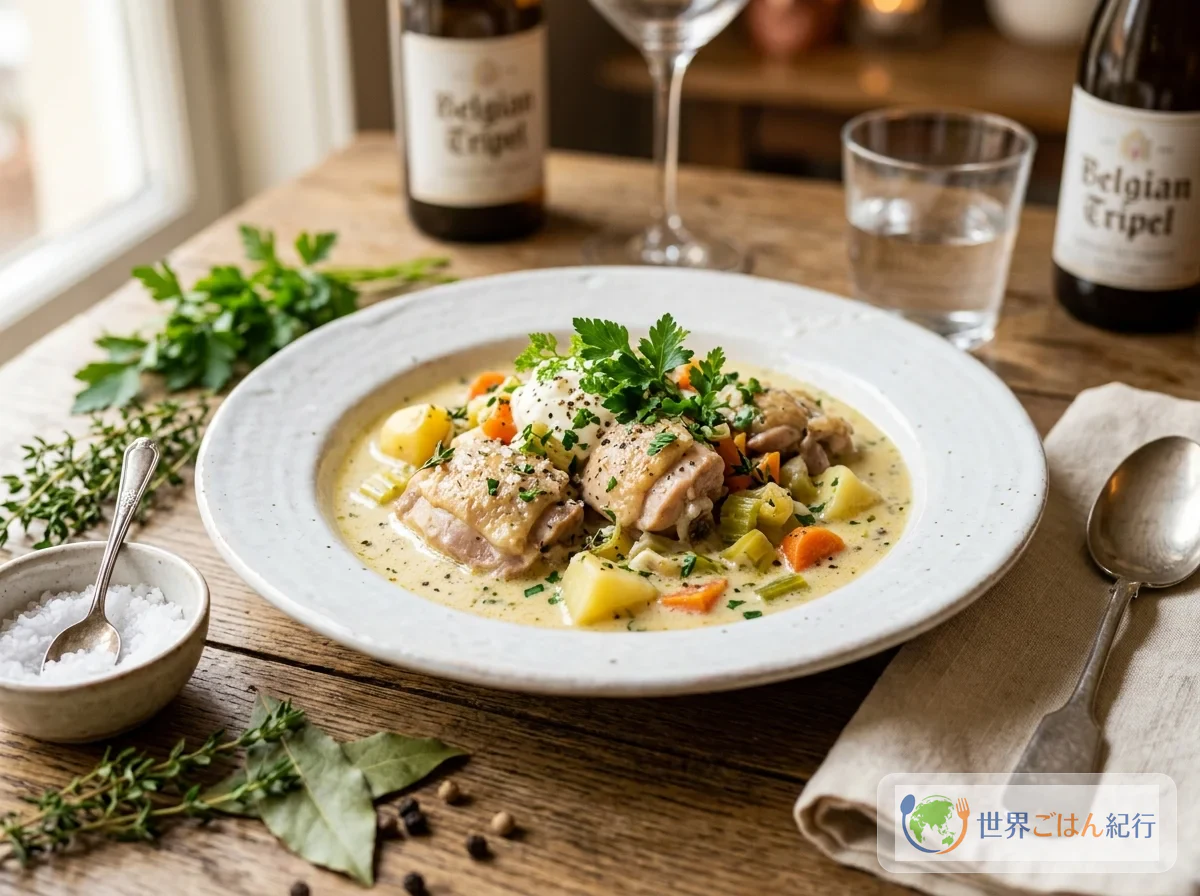
| Slip in a gentle creamy dish | Waterzooi | Chicken or fish with cream, a different take on dairy |
| Move from the sweet stroll to savory | Frikandel | A fried sausage from Dutch snack bars; the "special" comes with onion and sauce |
| Line up cheese and flour dishes | Crozets de Savoie | Small flour pieces, good for a cold-day European menu |
| Widen the talk about baking irons and table tools | Raclette | A useful reference before you buy a dedicated appliance |
| Compare how sugar is handled | Baklava | Soaked in syrup rather than baked with grain sugar |
| Move to the plain sweetness of flour dishes | Ballokume | A pastry baked without an iron |
| Move to the sweet meringue family | Pavlova | Light meringue against caramel spots |
Making the Brussels style
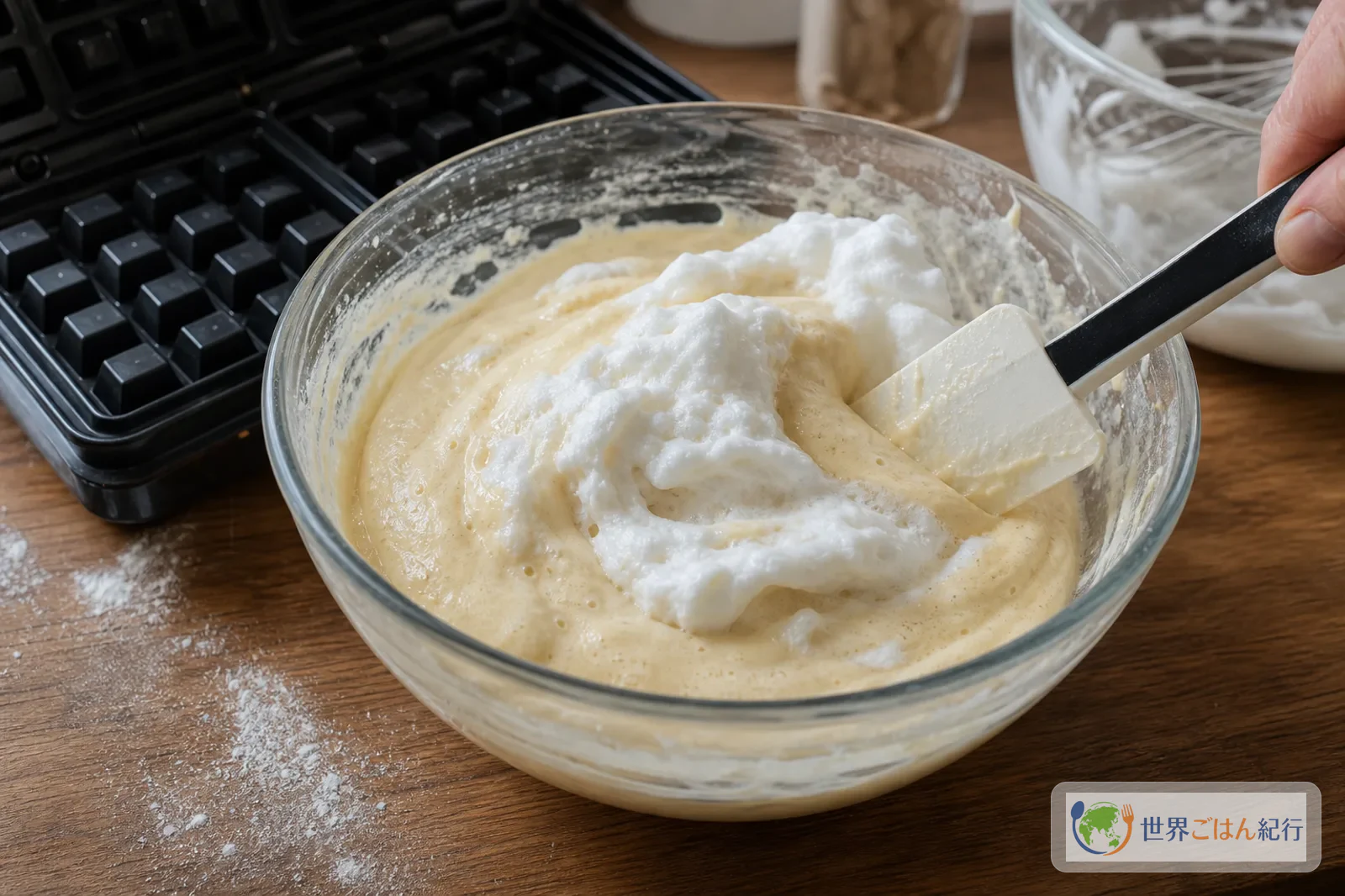
For Brussels waffles, make a separate batter from the start rather than thinning the Liège dough. A yeasted dough with pearl sugar baked in a square iron scorches on the plate and never turns light.
| Ingredient | Guide for 4 servings |
|---|---|
| Cake flour | 8 oz (220 g) |
| Bread flour | 1.5 oz (40 g) |
| Milk | 1 cups (260 ml) |
| Egg yolks | 2 |
| Egg whites | 2 |
| Melted butter | 2.5 oz (70 g) |
| Dry yeast | 4 g |
| Sugar | 25 g |
| Salt | 3 g |
| Vanilla extract | 0.25 tsp (1 ml) |
Wake the yeast in the milk, mix in the flour, egg yolks and melted butter, and rest 30 minutes. Whip the egg whites in a separate bowl to soft-firm peaks and fold them in at the end without crushing the foam. Preheat the iron well to 375–400°F (190–200°C), pour in the batter and bake for 3–4 minutes. You've got it right when the outside is light golden brown and the waffle is light enough that its corners stand up when lifted.
Wait 30 seconds after the steam settles before sprinkling powdered sugar; any sooner and the sugar melts and the surface turns damp. With fruit or cream, use a plate that isn't warmed and serve the waffle itself hot, and it stays crisp a little longer.
Storage and frequently asked questions
Can I make them ahead?
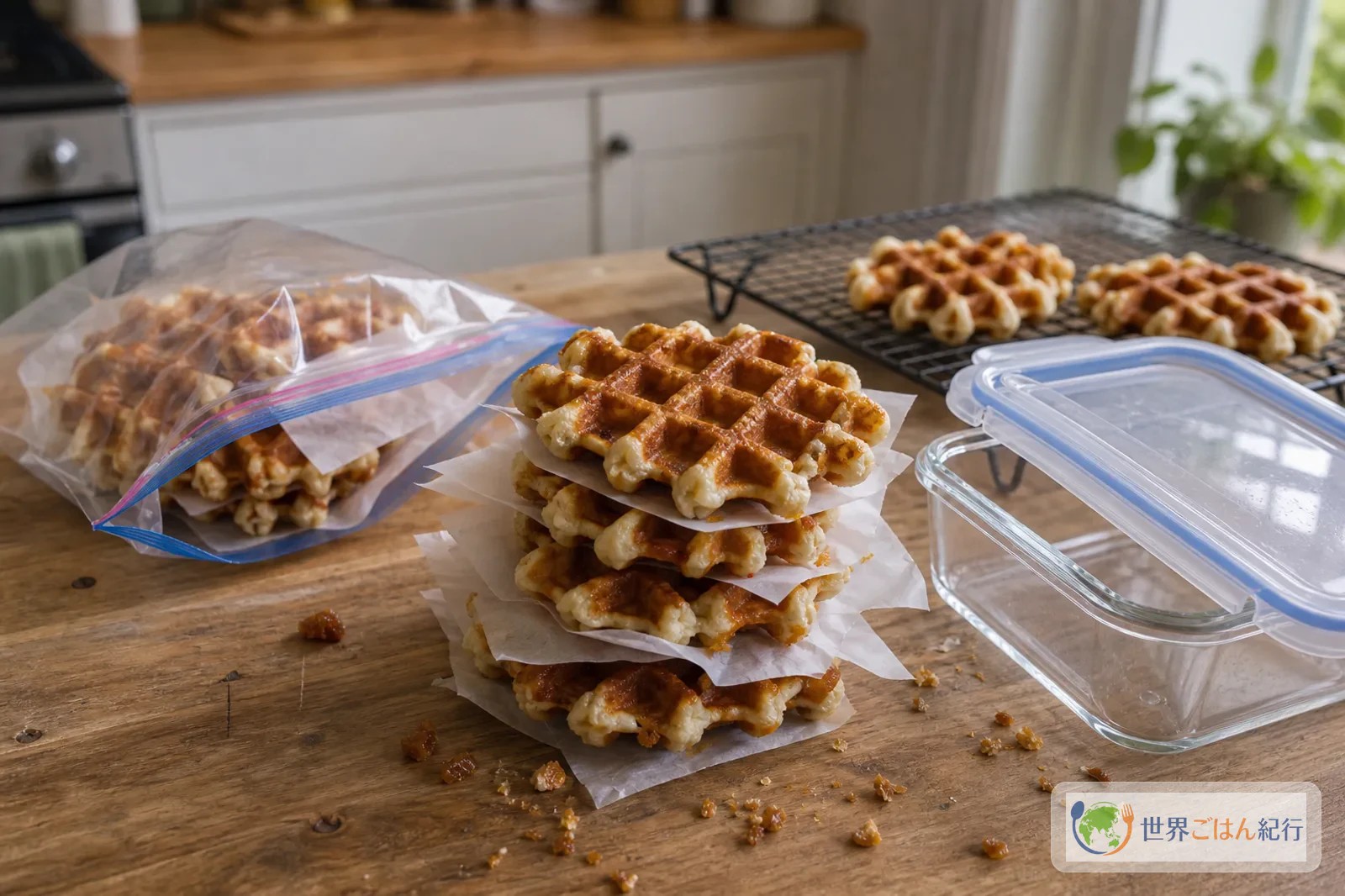
They taste best the day they're baked. To store, cool them completely on a rack, wrap in paper and put them in an airtight container. They keep for 12 hours at room temperature, 2 days in the refrigerator, or 3 weeks in the freezer; for freezing, wrap each one in plastic wrap and put them in a storage bag.
How do I reheat them?
After refrigeration or freezing, warm the center for just 20 seconds in a 600 W microwave, then bake 2 minutes in a toaster oven at 350°F (180°C). The microwave alone leaves the surface sugar damp, and the toaster alone scorches the outside while the center stays cold.
Can I make the dough the day before?
Yes, up to step 4. Let the dough sit about 30 minutes at room temperature without finishing the first rise, then refrigerate it. The next morning, bring it back to room temperature for about 30 minutes before folding in the pearl sugar. Sugar left in the dough overnight turns damp and sticks to the iron, so add it right before baking.
Is a cooking thermometer essential?
No, but it helps on your first Liège waffle. Milk warmed by feel can be too lukewarm in winter and slow the fermentation, or too hot if you rush to rewarm it. Checking 95–100°F (35–38°C) once teaches you what that lukewarm feel is. Being able to check the milk, the proofing spot and dough fresh from the fridge also makes it easier to tell whether a problem came from scorched sugar, slack dough or underproofing.
Can I bake it in a sandwich press?
A shallow-grid sandwich press works, though you won't get the Liège thickness. Reduce to 2 oz (60 g) each and bake 2 1/2 minutes per side over medium-low heat. A stovetop iron scorches quickly, so treat the first waffle as a test bake and lower the heat one notch if the color is strong.
What should I check before buying a waffle iron?
Look at the depth of the grids, temperature or browning control, and ease of cleaning. Pearl sugar melts into the grooves, so removable plates, or at least grooves a cloth can reach, make the iron easier to keep using. A shallow iron will do for a trial, but the thick center and irregular roundness are hard to get.
If you also want the Brussels style, choose a deep iron that bakes large and square. For Liège only, a clear preheat signal and a light, easy-to-store body matter more than professional size; for a monthly treat, you won't keep at it if it's a hassle every time.
Which is better, electric or stovetop?
Electric suits a first attempt: the temperature is steady and one side is less likely to scorch. A stovetop iron lets you watch the color closely, but on strong heat the sugar blackens fast. Start with 2 minutes on the first side over medium-low heat, adding 30 seconds at a time once the peaks of the grid are light golden brown. With either type, let the hot sugar cool before cleaning.
Which is better for a beginner, Liège or Brussels?
Start with Liège. There's waiting time for the yeast, but the dough is firm, the amount for the iron is easy to adjust, and the flavor holds up once cool. The Brussels style needs to be eaten fresh, plus whipped egg whites and a hot, deep square iron. Get a feel for the sugar and color with Liège first, and the Brussels style will go more smoothly.
Sources
- Focus on Belgium, "Did you know there is a difference between the Liege waffle and the Brussels waffle?"
- Visit Brussels, "Everything you need to know about waffles in Brussels"
- Visitez Liège, "L'Authentique Gaufre de Liège"
- Ampi, "The differences between Brussels waffle and Liege waffle"
- Ampi, "Recipe: Home-made Liege waffles"