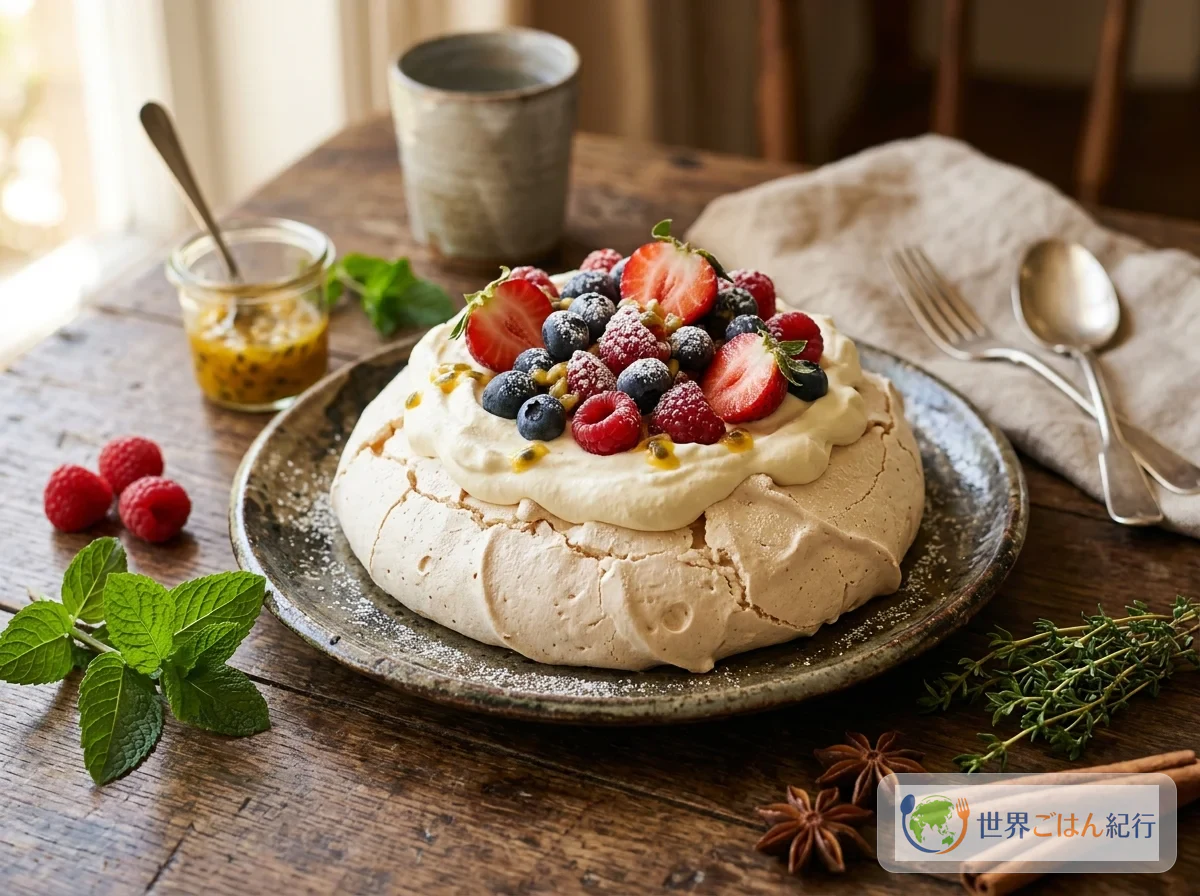
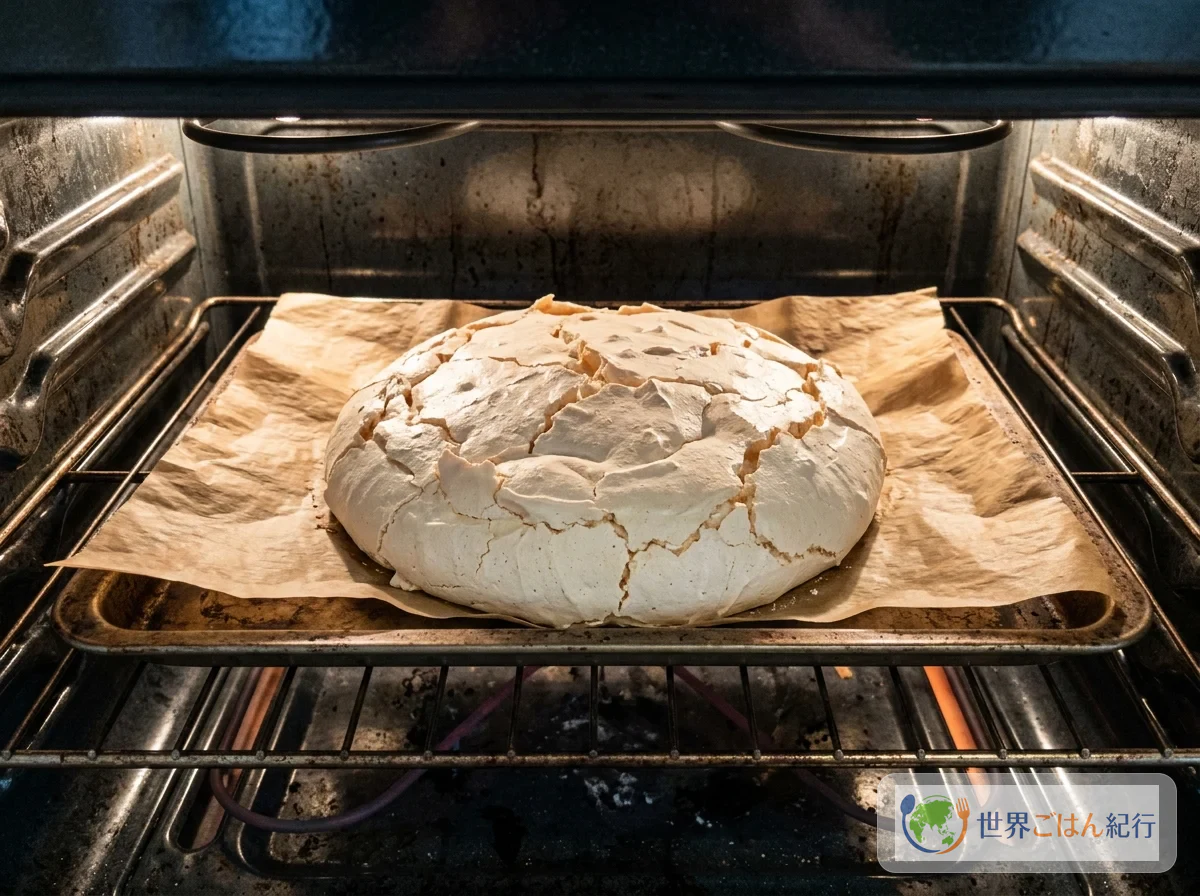
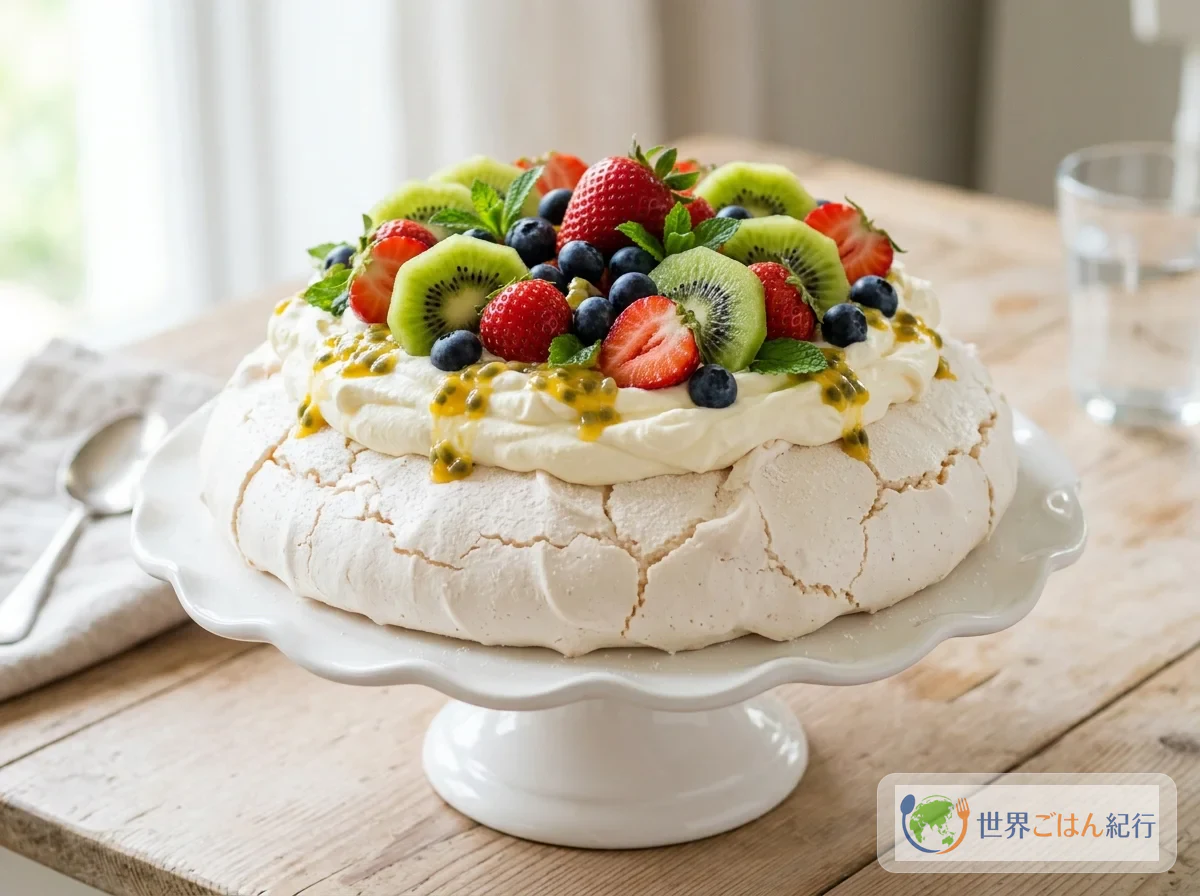
Open the oven door just a little and leave the white meringue inside to cool. You aren't supposed to move it to a plate yet, but once the thin shell dries and fine cracks start to run across it, you already want to cut the fruit. Spoon cream onto the cooled base and pile on kiwifruit, strawberries and passion fruit, and the kitchen starts to feel like a Southern Hemisphere summer.
Pavlova is the classic dessert of New Zealand and Australia. It's a meringue base with a crisp, dry outside and a marshmallow-soft inside, topped with whipped cream and fruit. It is named after the ballerina Anna Pavlova, who toured both countries in the 1920s. The pure white base is said to be her tutu, and the bright fruit the bouquets thrown onto the stage.
Pavlova in New Zealand and Australia

Pavlova is a large dessert made for sharing. The meringue bakes low and slow until it has a thin shell outside and stays soft inside. Both countries serve it at celebrations and summer gatherings, usually topped with tart fruit such as kiwifruit, strawberries, passion fruit and berries. In New Zealand homes it isn't a cake cut into neat slices. People scoop up big spoonfuls, broken shell and all.
It turns up after a barbecue, on an afternoon back from the sea, or at a lunch where relatives each bring a plate. You'll see it at Christmas too, though it's less a strict ritual dish than the thing that pulls the table together when people gather on a hot day. It suits that kind of day well. You bake the base the day before, and the oven is the only heat you need. Just before eating, one person whips the cream while another cuts the fruit.
The origin dispute
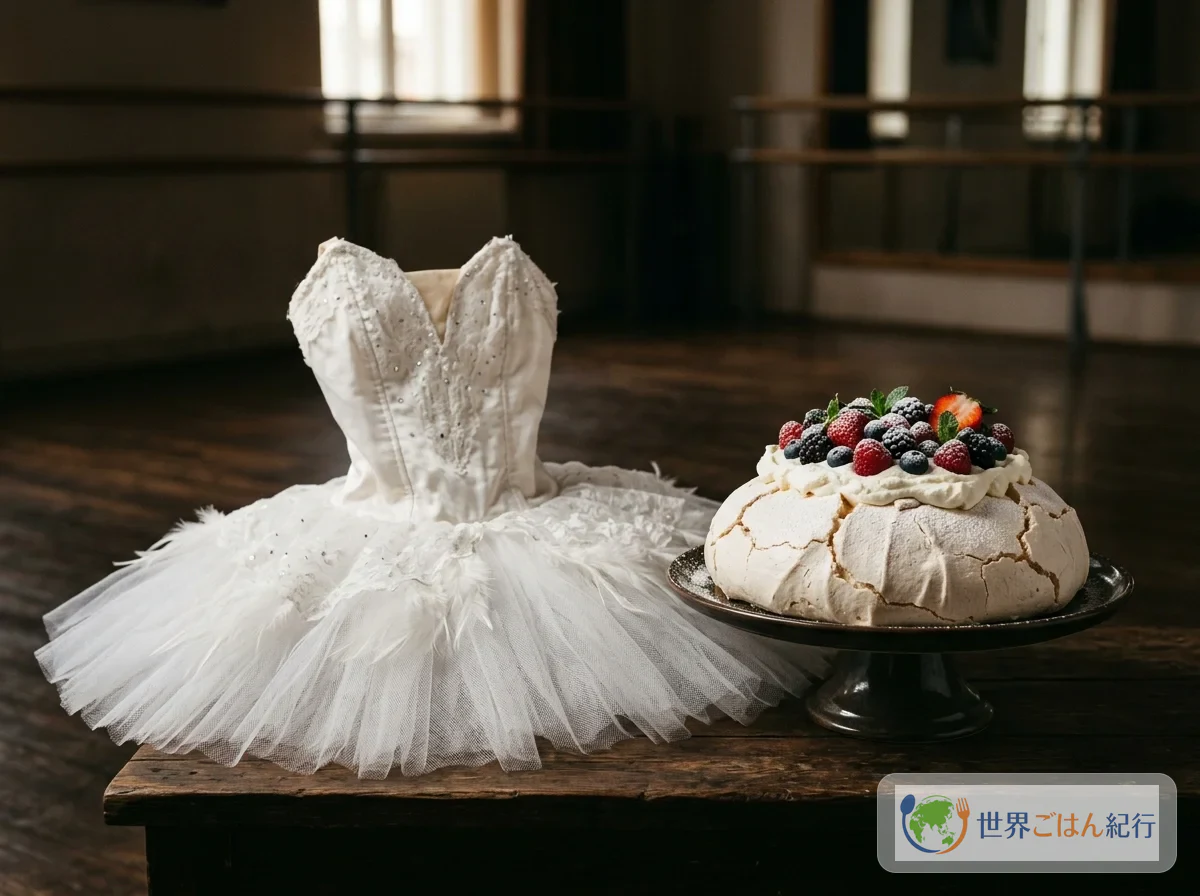
New Zealand and Australia have argued for a long time over who invented pavlova. New Zealand points to newspapers and recipe names from the late 1920s. Australia points to a hotel in Perth and the pastry culture around it. The dessert is part of how both countries remember themselves, so the argument goes deeper than the name of a sweet.
Regional differences
New Zealand-style pavlovas tend to use tart fruit such as kiwifruit, strawberries and passion fruit to sharpen the white base. In Australia, some households combine mango, berries, bananas and chocolate. The differences are really more household-by-household than regional: you pile on whatever fruit is ripe that day.
Ingredients (serves 8)
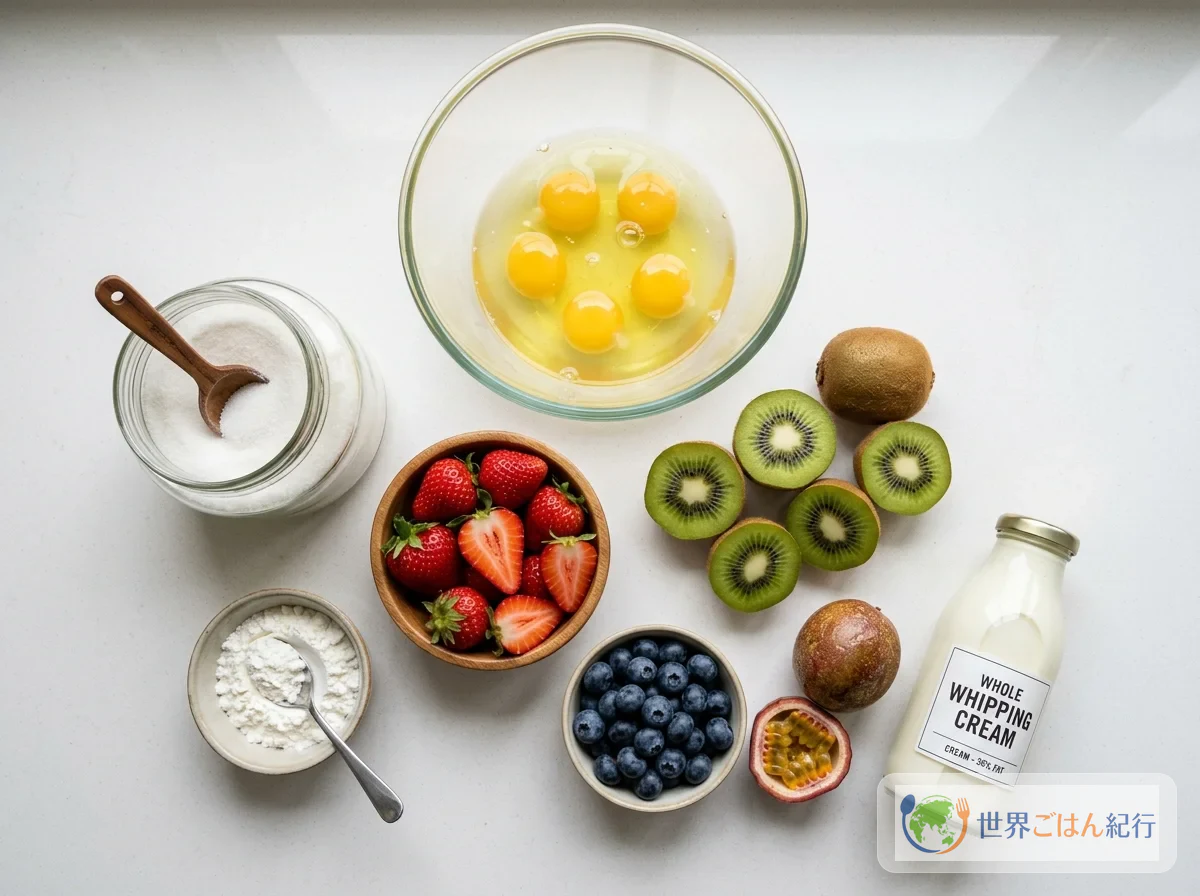
Meringue base
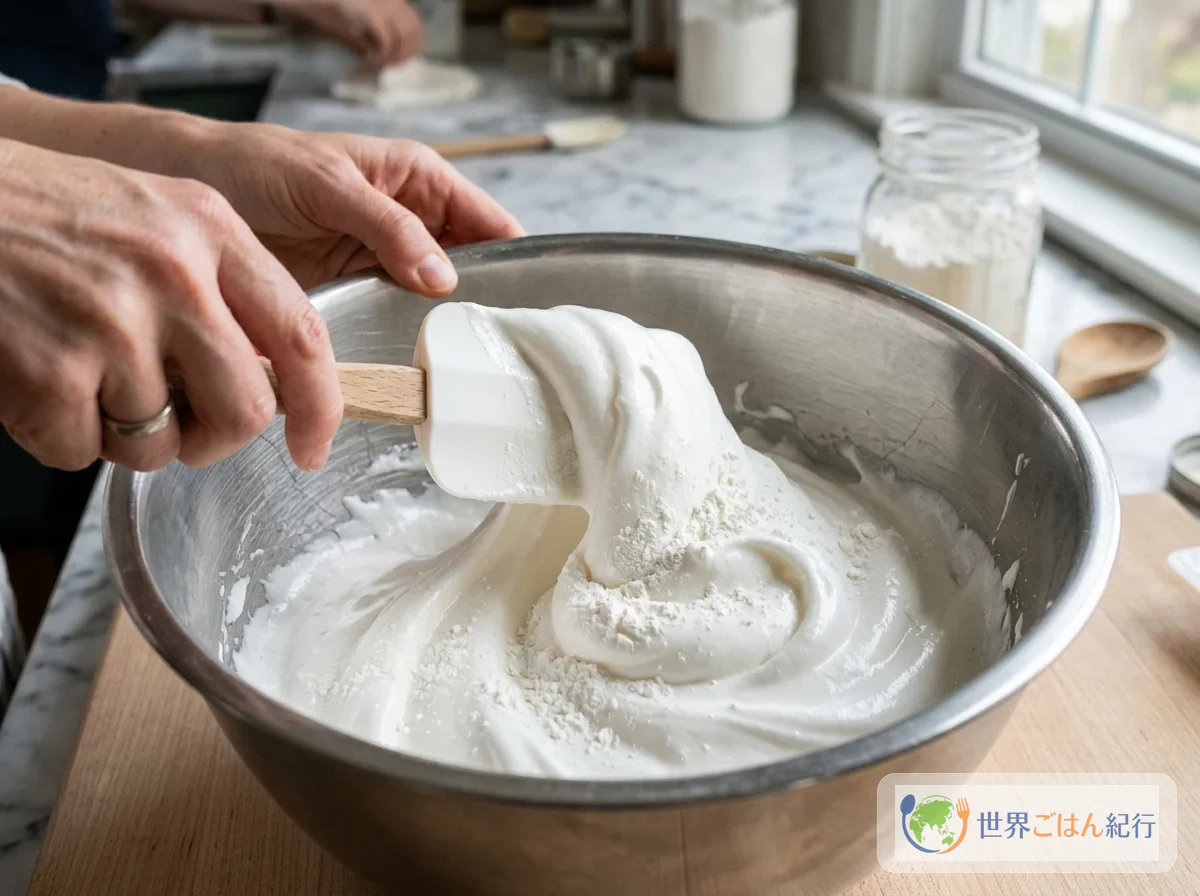
Pavlova is not a meringue dried out completely. The outside dries into a shell while the inside keeps a little moisture. Cornstarch holds the moisture inside, and the acid in vinegar or lemon juice stabilizes the foam of the egg whites. Too much gives a powdery texture or sourness, so for 6 egg whites stop at 1 tablespoon cornstarch and 1 teaspoon acid.
Toppings
Ingredients and tools for this dish
Eggs, sugar, heavy cream, strawberries and kiwifruit are all easy to find at an ordinary supermarket. What's worth adding is cornstarch, which has a clear role even in a small amount; an electric whisk to keep the foam stable until all the sugar is in; and a thermometer to check the temperature difference in your oven. With pavlova, what makes the difference isn't expensive fruit but tools that don't disturb the foam or the temperature.
Cornstarch is a small amount, but without it the inside dries out easily. Potato starch also sets it, but it gets sticky and the texture differs a lot, so using cornstarch the first time makes it easier to isolate what went wrong.
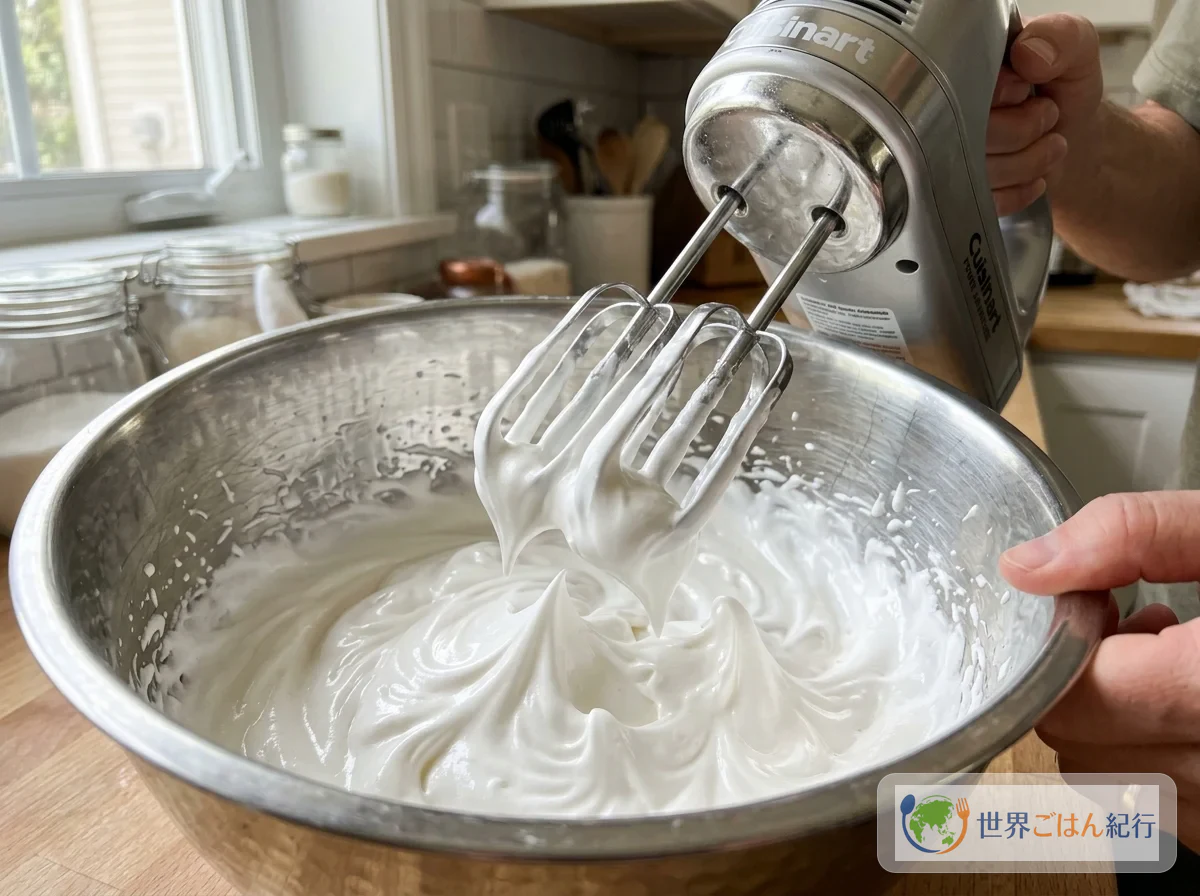
You can whip by hand, but with 6 egg whites it takes a long time to get all the sugar in. With an electric whisk you can watch how the peaks stand and how well the sugar has dissolved, and stop before the foam takes on the sugar while still coarse.
The oven's displayed temperature and the real temperature inside can differ. If the surface browns early in your oven, the oven is often too hot when baking starts, and a thermometer makes it easier to find the cause. A thermometer isn't only for pavlova; it also serves for meat and frying.
Choosing ingredients for pavlova
Egg whites start whipping more easily at room temperature because they loosen up. You can use them straight from the refrigerator, but getting all the sugar in will take longer. Use a metal or glass bowl, and make sure it holds no trace of water or fat. A chilled bowl helps when whipping cream, but for meringue, a fat-free bowl matters more than a cold one.
Vinegar or lemon juice isn't there for sourness. It stabilizes the egg white foam. Cornstarch holds moisture inside and gives the center its marshmallow softness. Don't increase either one: too much acid brings out an odor, and too much starch makes the texture heavy. Stick to the small amounts in the ingredient list.
Choose fruit for acidity first, then aroma, then water content. The meringue is very sugary and the cream is rich, so kiwifruit, strawberries, blueberries, citrus and passion fruit cut the heaviness of each bite. Sweet canned fruit makes the whole thing flat and cloying. When passion fruit is expensive, a little frozen mango with lemon juice, or some chopped orange, works in its place.
Common pavlova failures and fixes
The hard part of pavlova at home isn't finding special ingredients. If you bake before the sugar has dissolved, the surface weeps. If the oven is too hot, it browns. Rush the cooling and the center sinks and hardens. Like Finland's karjalanpiirakka or Iceland's plokkfiskur, it looks simple, but the order of the work decides the result. With clear stopping points, a large pavlova made with 6 egg whites works in a home oven, even in a humid kitchen.
Adding the sugar
Add a lot of sugar at once and its weight crushes the air bubbles. About 1 tablespoon every 30 seconds is slow enough, so getting all the sugar in takes 6 to 7 minutes, and that wait decides the texture. Sri Lanka's kottu is all about fast chopping, but pavlova rewards going slowly.
Baking and cooling
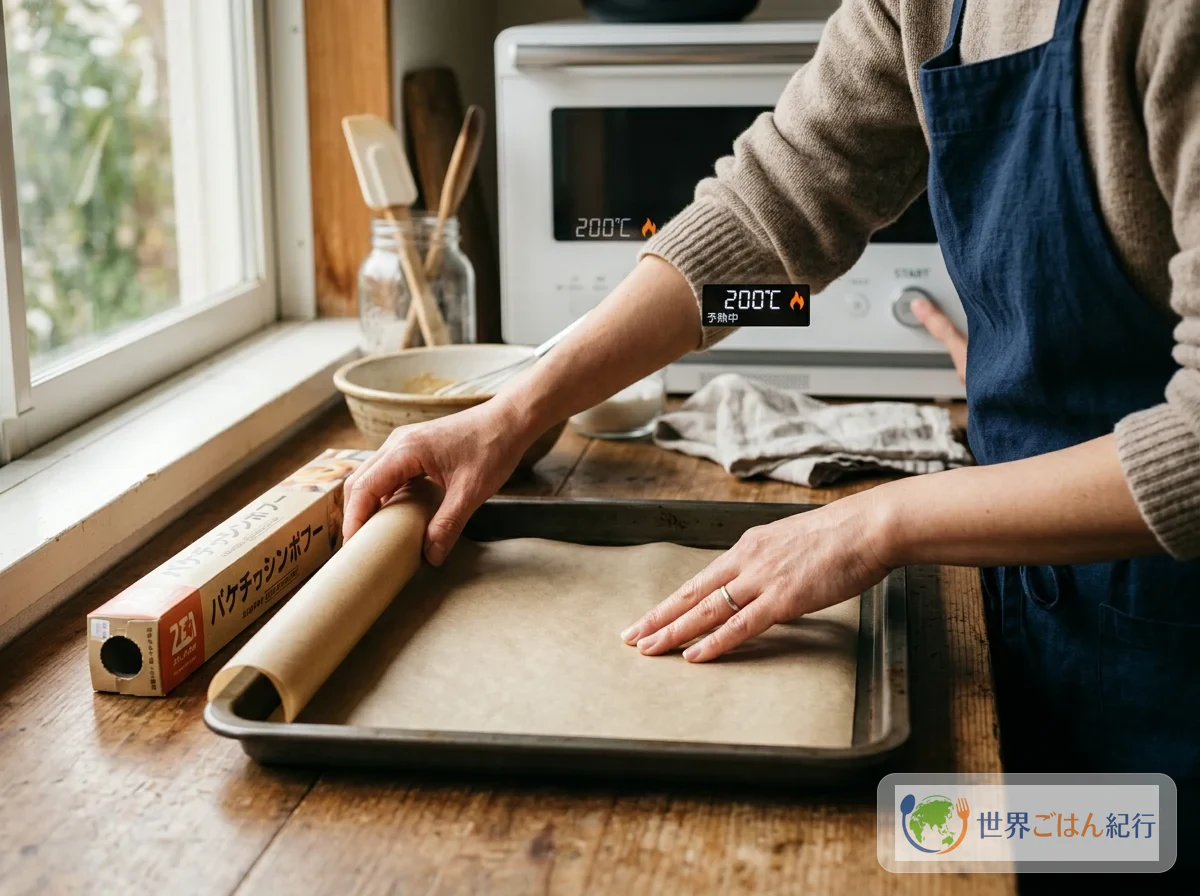
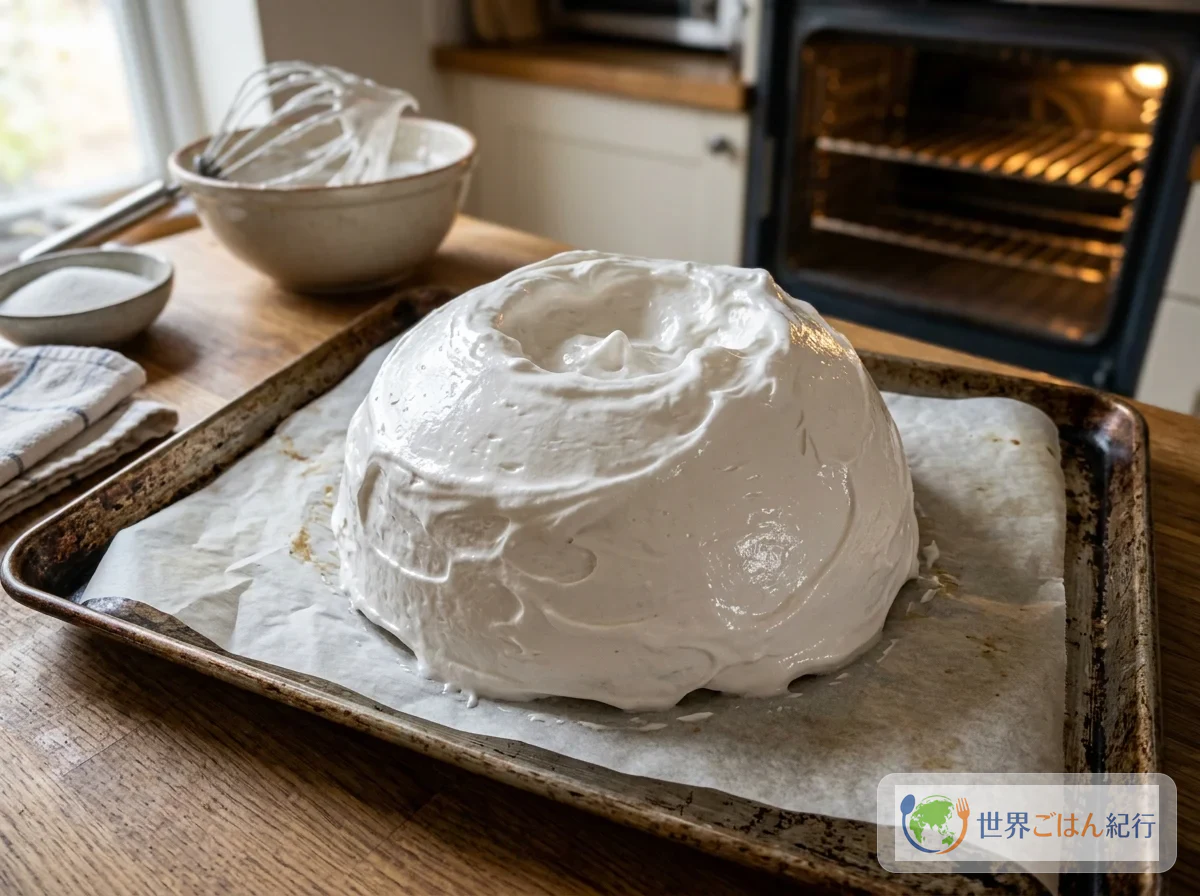
The texture comes from driving moisture out of the surface while leaving a little in the center. The long, low bake isn't meant to brown the meringue. It turns the outside into a thin shell. If the drying time at around 250°F (120°C) is too short, the center stays sticky. Too long, and the whole thing turns into a dry meringue confection. A sticky inside means the bake was too short or the meringue left the oven too soon. Dry it slowly at 250°F (120°C) for more than an hour, then let it cool in the oven for at least 2 hours.
Keep the oven door shut until it's done. Opening it drops the temperature suddenly, and a shell that has started to dry will crack easily. Aim for a base that doesn't sink badly rather than one with no cracks at all. Fine cracks give it character once the cream and fruit are on.
Juice and humidity
Put the cream and fruit on too early and the shell you worked to dry turns damp and collapses before you cut it. If juice is spooned on and left to sit, the base gets soggy, so assemble as close to serving as you can.
Serving pavlova: variations, nutrition and pairings
Variations
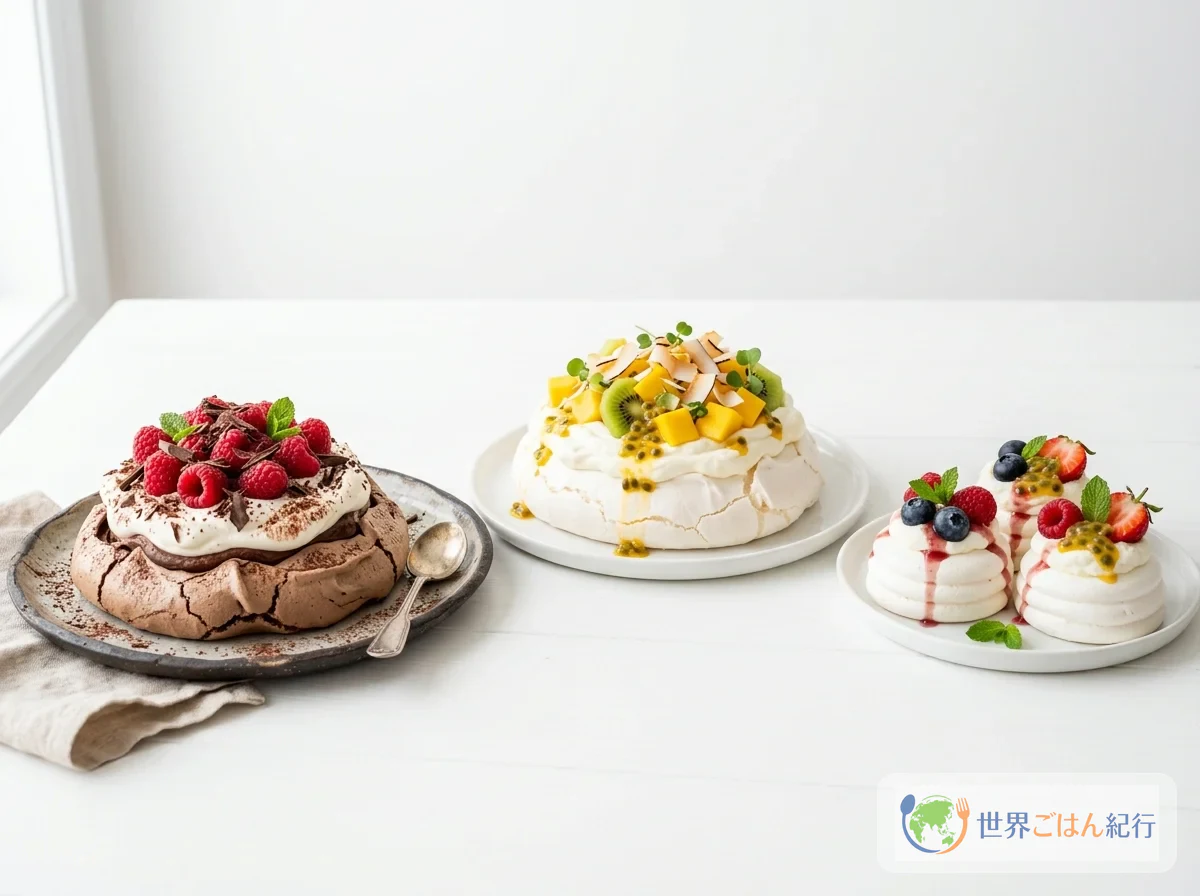
Variations are less likely to fail if you think about balancing the sweetness of the base. When in doubt, go back to the basic idea of putting acidity on a white base.
| Variation | What changes | Notes for the kitchen |
|---|---|---|
| Chocolate pavlova | Sift 2 tbsp cocoa into the meringue | Cocoa deflates foam easily, so fold in only 2 to 3 times at the end |
| Tropical version | Use mango, passion fruit and lime | Don't use only sweet mango; add acidity with lime or passion fruit |
| Mini pavlovas | Make small ones about 3 inches (8 cm) across | Bake about 45 minutes at 250°F (120°C). Avoid drying them out too much |
| Crushed pavlova | Layer broken pieces with cream and fruit in glasses | It softens easily, so assemble just before eating |
The chocolate version looks showy, but for your first pavlova, stick with a white base. It's easy to see the color, the cracks and any undissolved sugar, so you'll know what to fix next time. Minis are easy to hand around, but if they dry out too much they become plain meringue cookies. Get a feel for a large base first.
Nutrition (per serving, from 8 servings)
| Nutrient | Amount |
|---|---|
| Calories | 320 kcal |
| Protein | 4 g |
| Fat | 18 g |
| Carbohydrates | 1.25 oz (38 g) |
| Fiber | 1 g |
| Sodium | 45 mg |
The egg-white base is low in fat but high in sugar, and the heavy cream adds fat. Because pavlova looks light, people tend to cut big pieces, but fruit on top doesn't make it a light dessert. After a meal, cutting it into 8 slices is easiest. For afternoon tea, cut about 6. The fruit is there to balance the flavor, not just to decorate, so include at least one tart fruit such as kiwifruit or berries.
Dishes to make alongside
- Baklava: the opposite of pavlova, a Middle Eastern sweet of thin pastry and nuts soaked in syrup. Its sweetness goes in a completely different direction.
- Knafeh: a warm Levantine dessert of stretchy cheese and fine pastry strands, a different way to end a meal than a chilled fruit sweet.
- Sapin-sapin: a Filipino glutinous rice sweet that shows its color in layers. Next to pavlova's idea of putting color on a white base, it changes how you see celebration sweets.
- Catànies: a small almond-and-chocolate confection, good when you want something to nibble after a meal rather than a large-plate dessert.
Middle Eastern ashure, shared from a big pot, makes another good contrast. Even sweets made from the same eggs and sugar end up very different from place to place.
Frequently asked questions
Q1. My meringue won't whip.
Check whether there's fat on the bowl or utensils, whether any yolk got in, and whether the egg whites are too cold. Wash the bowl with hot water and dry it well. If you're still worried, wipe it lightly with paper towel dampened with lemon juice. If even a little yolk has mixed in, don't force it. Use those whites in another dish.
Q2. The meringue cracked badly while baking.
Large cracks mean the oven was too hot or the sugar hadn't dissolved enough. Before baking, rub a little meringue between your fingers and keep whipping until the gritty feel of sugar is gone.
Q3. Can I make it ahead the day before?
You can make the meringue base the day before. Once it has cooled completely, store it at room temperature in a dry airtight container or dry box. In the rainy season or high summer, a baked base absorbs moisture from the air easily. Keep it out of the refrigerator, which makes the shell damp. Chill only the cream and fruit, and add them just before eating. If you finish it more than 30 minutes ahead, the juice and the moisture from the cream will soften the shell.
Q4. I have 6 leftover egg yolks. What can I do with them?
Custard cream is the easiest use. Cook 6 yolks, 3.5 oz (100 g) sugar, 3 tbsp cake flour and 2 cups (500 ml) milk into a thick custard, and use it the next day in a tart or a glass dessert. If you won't make it right away, mix a little sugar into the yolks, cover the surface, refrigerate them and use them within the day.