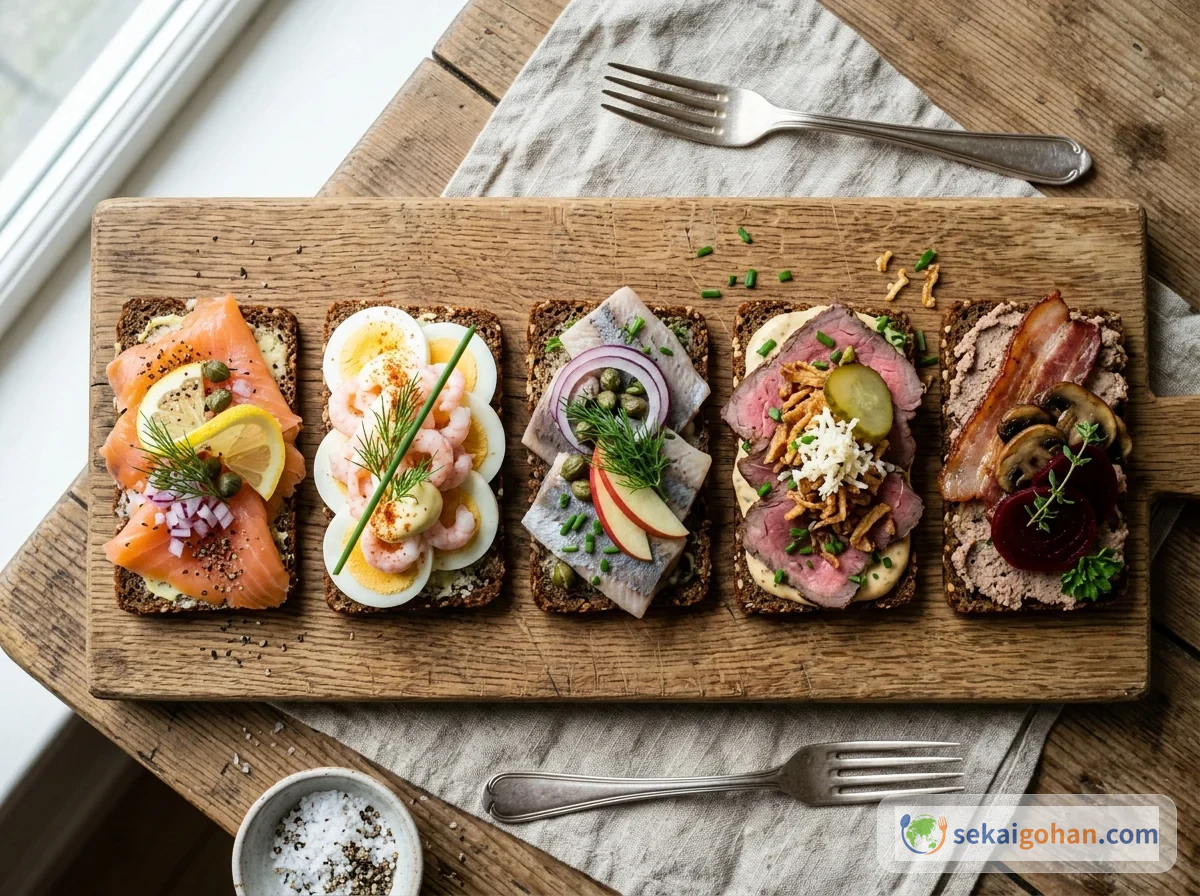
At lunchtime in Copenhagen, people head for the smørrebrød shops. A hearty slice of rye waits there, with seafood, meat, vegetables, and sauces stacked on top in careful, beautiful layers. It's about as close to edible art as lunch gets. The name means "buttered bread" in Danish, from smør (butter) and brød (bread), and the base really is that simple. Everything on top, from the topping combinations to the order you eat them in, has been handed down with care, and you can make it with ingredients from an ordinary supermarket.
Smørrebrød History and Danish Lunch Culture

From a field lunch to Copenhagen's shops
Rye bread has been baked in Denmark since around the year 1000, and the Vikings also ate bread, herring, cheese, and ham. Smørrebrød began as plain bread spread with butter or fat, eaten by farmhands in the fields. Rye bread was also laid under moist dishes as a stand-in plate, a forerunner of the open sandwich.
As industrialization took hold in the 19th century, workers who couldn't go home for lunch brought packed lunches to work, and those without one bought smørrebrød at taverns. That was the start of Copenhagen's smørrebrød shops. In 1883 the restaurant Nimb in Tivoli Gardens introduced an order sheet for smørrebrød, and in 1888 Oskar Davidsen began selling it from his wine shop. Davidsen's order sheet was 55 inches (140 cm) (about 4 1/2 feet) long and listed up to about 170 varieties, a tradition that lives on today at Ida Davidsen's restaurant.
Why smørrebrød is open-faced
Most of the world's sandwiches put the filling between two slices; smørrebrød uses just one. Danish rye bread is so heavy that two slices would be awkward to eat, and a lid would hide the arrangement, which is half the point. Then there's history: on the farmhouse table the bread was the plate, and you don't put a lid on a plate.
If Ethiopian injera is the classic example of bread used as a plate, smørrebrød takes the idea one step further: you eat the plate too. And where Norwegian fårikål earned its national-dish status through subtraction, smørrebrød is an art of addition, building beautifully and logically on a simple base.
Frokost and the eating order
The Danish word for lunch is frokost, and smørrebrød sits at its center, whether at a business lunch or a family gathering. At formal occasions, more than ten kinds can be served, usually eaten with a knife and fork.
When you eat several kinds, there's an order. Start with fish, and if there are several, begin with herring: cold herring, with a glass of aquavit in hand. Next come vegetable, chicken, and meat smørrebrød, such as roast beef, liver pâté, or frikadeller, with beer alongside. Cheese always comes last.
Decline and revival
From the 1960s on, smørrebrød was no longer seen as food for special days, and with competition from other lunch options, its quality declined. Oskar Davidsen's restaurant closed in 1974.
The tide turned in the 2000s. Long-established restaurants such as Schønnemann and Told og Snaps raised their standards, and in 2006 Adam Aamann opened his own place, reviving the tradition with close attention to the bread, the toppings, and seasonal ingredients. The New Nordic movement, centered on the restaurant Noma (opened in 2003), also sparked fresh interest in Nordic ingredients. Today traditional and modern smørrebrød can be enjoyed side by side, and whether in a city shop or a country home, the foundation of buttered rye bread hasn't changed.
Choosing Bread for Smørrebrød
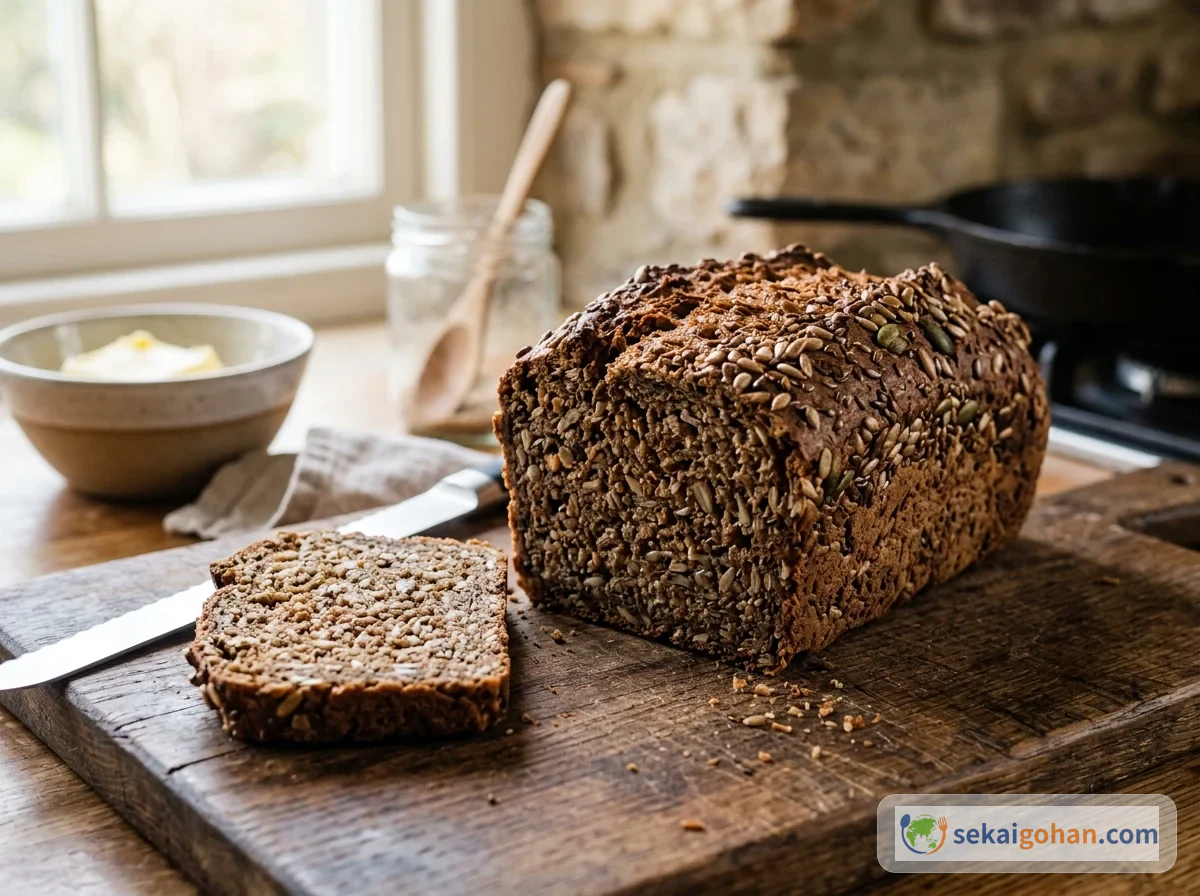
Danish rye bread is dense and grainy, with a distinctive tang. In a home kitchen, a dense German pumpernickel gets you closest to that foundation, so if you plan to make smørrebrød regularly, it's worth keeping some on hand.
Regular sandwich bread is too soft to hold up the toppings and tends to go soggy. If you have to substitute, toast whole-wheat bread first so it firms up enough to carry the load. You still won't get rye's tang and grainy flavor, a reminder that every country's bread is rooted in its cooking, just like the knedlíky dumplings served with Czech svíčková.
How to Make a "Cheater's Rugbrød"
A homemade recipe for when you can't find authentic Danish rye bread.
| Ingredient | Amount |
|---|---|
| Whole-grain rye flour | 12.5 oz (350 g) |
| Bread flour | 5.5 oz (150 g) |
| Beer (dark beer recommended) | ¾ cup (200 ml) |
| Plain yogurt | 3.5 oz (100 g) |
| Dark brown sugar | 2 tbsp |
| Salt | 1.5 tsp |
| Active dry yeast | 2 tsp |
| Lukewarm water | ½ cup (100 ml) |
| Sunflower seeds | 3 tbsp (optional) |
| Flaxseed | 2 tbsp (optional) |
Dissolve the yeast in the lukewarm water and let it stand for 10 minutes. Mix the rye flour, bread flour, and salt, then add the beer, yogurt, brown sugar, and yeast mixture and knead for 5 minutes. It doesn't need as much kneading as regular bread. Work in the sunflower seeds and flaxseed, transfer to an oiled loaf pan, cover with plastic wrap, and let it rise for 90 minutes in a warm place. Bake at 180°C (350°F) for 60 minutes. It's done when a skewer comes out clean. Turn it out of the pan and let it cool completely before slicing; fresh from the oven it crumbles to pieces. Ideally, let it cool for at least 12 hours before slicing.
Smørrebrød Tips and Common Mistakes
Melted butter soaks too far into the bread and loses half its waterproofing power. Aim for butter soft enough that a finger leaves a dent, which takes about 30 minutes out of the fridge. In winter you can microwave it at 200 W for 10 seconds, but if it turns liquid, start over.
Layer in this order: bread → butter → sauce (cream cheese, remoulade, or sour cream) → main topping → accent → finishing herbs. That way every cut with your fork gives you every layer in one bite. Pour the sauce on top instead, and the surface tastes strong while the bread underneath tastes of nothing.
Aim for at least three colors of toppings and the plate comes together: salmon (pink) + dill (green) + red onion (purple), or egg (yellow) + shrimp (orange) + scallion (green). The contrast looks beautiful and makes it more appetizing.
Smørrebrød Variations

Japanese-style smørrebrød (shime saba + shiso)
Swap the pickled herring for shime saba (vinegar-cured mackerel) and garnish with shiso leaves instead of dill. Spread yuzu kosho mayonnaise (2 tbsp mayo + 1 tsp yuzu kosho) in place of sour cream, and add thinly sliced myoga ginger for a pop of color. The balance of acidity and richness is close to pickled herring.
Vegetarian (avocado + beets)
Spread hummus on the buttered bread (see Lebanese hummus, in Japanese), then layer avocado slices, roasted beets, sprouts, and pumpkin seeds. Season with lemon juice and salt. Pay attention to how you layer the colors, and even vegetables alone give you a plate that feels like true smørrebrød.
Frikadeller version
Frikadeller (Danish meatballs) are a classic topping. Mix 10.5 oz (300 g) ground beef-and-pork blend, 1/2 finely chopped onion, 1 egg, 3 tbsp breadcrumbs, 2 tbsp milk, and 1 tsp salt. Shape into ovals and pan-fry over medium heat for 5 minutes per side. Spread remoulade on the bread, top with the frikadeller, and add pickled red cabbage on the side.
Ceviche-inspired
This one borrows from Peruvian ceviche. Cut white fish (such as sea bream or flounder) into 0.25 inch (5 mm) cubes and toss with 2 tbsp lime juice, 1 tbsp finely chopped red onion, and 1 tbsp cilantro. Spread avocado mash on the bread and pile the fish on top. The lime's acidity pairs surprisingly well with rye.
Beef tartare
Beef tartare is one of the most indulgent toppings. Finely chop 5.5 oz (150 g) very fresh beef tenderloin into 0.25 inch (5 mm) cubes and mix with 2 tsp capers, 1 tbsp finely chopped red onion, 1 tsp Dijon mustard, and 1 egg yolk. Mound it on the bread and drop the egg yolk into a hollow on top. Freshness is everything. Use only beef bought the same day from a butcher you trust.
Breakfast version (cheese and jam)
Butter the rye bread, top with Gouda or cream cheese, and add 1 tsp strawberry jam. It's a Danish breakfast staple, easy and familiar, and kids love it.
Middle Eastern style (hummus + lamb)
Spread a generous layer of Lebanese hummus on the bread and top with ground lamb spiced like Turkish köfte. Finish with pomegranate seeds and mint. It's a modern smørrebrød that reflects Copenhagen's multicultural food scene.
Smørrebrød Nutrition (per salmon smørrebrød)
With fiber from whole-grain rye bread, omega-3 fatty acids from the salmon, and protein from the eggs, smørrebrød makes a well-balanced light meal. Because the toppings sit on one hearty slice, even a single smørrebrød is genuinely filling.
| Nutrient | Amount |
|---|---|
| Calories | 380 kcal |
| Protein | 22 g |
| Fat | 18 g |
| Carbohydrates | 1.25 oz (32 g) |
| Fiber | 6 g |
| Sodium | 820 mg |
Dishes to Serve With Smørrebrød
- How to make fårikål: Norway's national dish of lamb simmered with cabbage.
- How to make karjalanpiirakka: Finnish pies of rye dough wrapped around rice porridge.
More bread dishes from Europe
- Fårikål (in Japanese): Norway's lamb and cabbage stew, Nordic like smørrebrød but built on subtraction.
- Burek (in Japanese): Bosnia's phyllo pie, with thin dough wrapped around the filling.
- Pierogi (in Japanese): Poland's dumplings, a beloved national dish.
- Karjalanpiirakka (in Japanese): Finland's rye pies, another gem of Nordic rye culture.
Bread dishes from the Middle East
- Shawarma (in Japanese): Lebanon's pita wrap, where the bread wraps the filling instead of carrying it.
- Falafel (in Japanese): Lebanon's chickpea fritters, a street food tucked into pita.
- Tabbouleh (in Japanese): Lebanon's parsley salad, which also makes an excellent side for smørrebrød.
Bread dishes from other regions
- Bánh mì (in Japanese): Vietnam's baguette sandwich, French bread culture gone its own way in Southeast Asia.
- Roti canai (in Japanese): Malaysia's thin flatbread, from the South Asian tradition of wrapping food in bread.
FAQ
Q1. Is it OK to eat smørrebrød with your hands?
In Denmark, the proper way is with a knife and fork, since a piled-high smørrebrød falls apart if you pick it up. At a casual meal at home, nobody minds, though a knife and fork really are easier. When you cut, press the blade straight down; sawing sideways makes the toppings slide off.
Q2. Can I make it ahead?
You can butter the bread up to 2 hours ahead, but once the toppings are on, eat within 30 minutes, before the bread absorbs moisture. For a party, butter the bread in advance and add the toppings just before eating.
Q3. Is there a smørrebrød kids will enjoy?
The egg smørrebrød (æggemad) is the biggest hit with kids; leave out the curry powder and add a bit more mayonnaise. The cheese-and-jam breakfast version above is kid-friendly too, and so is a simple liver pâté with cucumber.
Q4. What drinks go with smørrebrød?
Aquavit is smørrebrød's faithful companion in Denmark, a spirit flavored with caraway or dill that's especially good with herring. Look for it at well-stocked liquor stores. For beer, Denmark's own Carlsberg and Tuborg are the go-to choices, though any crisp lager works; as with Belgian carbonnade, beer with food is a pillar of Northern and Western European cooking. For wine, a dry Riesling suits fish smørrebrød and a Pinot Noir suits the meat ones.
Sources
This article draws on Danish encyclopedias, travel media, and other sources, adapted for the home kitchen.
- lex.dk (Den Store Danske) "smørrebrød" (origins, 19th-century workers' lunch, Nimb's 1883 order sheet, Davidsen in 1888, decline from the 1960s and revival in the 2000s, eating order; accessed 22 October 2026)
- lex.dk "Oskar Davidsen" (accessed 22 October 2026)
- Traveller "What is smørrebrød? The origins of the Danish open sandwich" (accessed 22 October 2026)
- Wikipedia "Smørrebrød" (accessed 22 October 2026)
- Hahnemann, Trina. Scandinavian Baking. Quadrille Publishing, 2014. (Nordic rye bread)