Drop dendê oil into the pot and the reddish oil runs into the gaps between the onions. Keep the heat low. The smell of dried shrimp rises first, and then the coconut and nut paste slowly gives off a scent that recalls a seaside table. Vatapá is the thick stew Bahia makes from bread, coconut milk, shrimp, nuts and dendê oil. You barely notice the bread. What you taste is the saltiness of dried shrimp, the round sweetness of cashews, the sharpness of ginger and the earthy aroma of dendê, all pulled together into one paste.
Vatapá in Bahia
Vatapá looks like a sauce, but a spoon meets a little resistance. It's thick enough to cling to white rice or fried acarajé. The bread is not left as an ingredient; it becomes the body that holds the shrimp and aromatics. It's ground fine with the aromatics and left to take up liquid over low heat, so the taste of wheat stays in the background.
In Bahia, vatapá is served beside white rice as a stew, and it's also packed into split acarajé as a filling. At street stalls, the baiana who sells acarajé sets out vatapá and dried shrimp together on her tabuleiro.
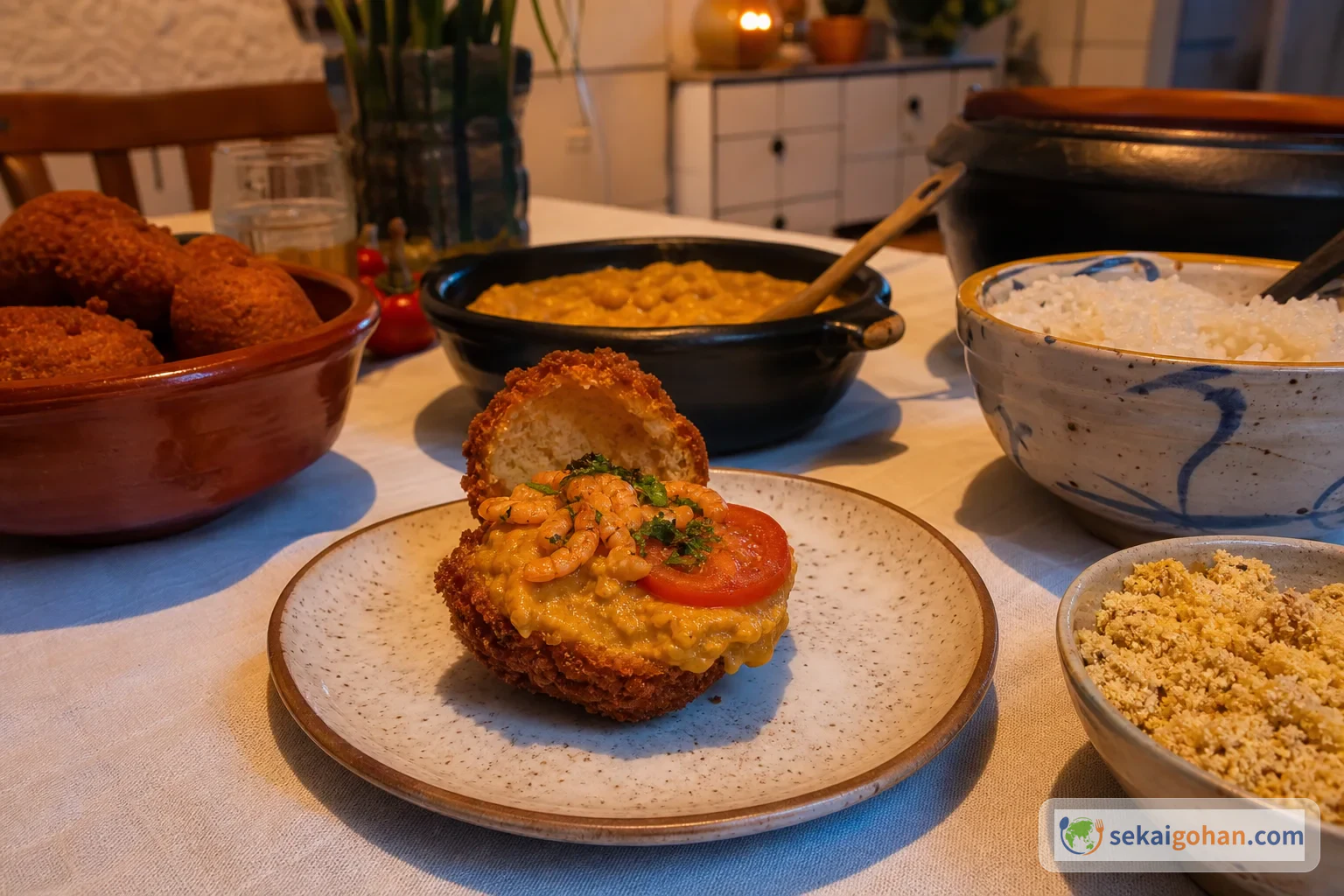
Vatapá and acarajé show how much African food knowledge lives on in Bahian cooking. Acarajé comes from the Bight of Benin in West Africa, and vatapá and dried shrimp go into its fillings. Rather than trying to trace vatapá to a single origin, think of it as part of the food culture handed down in Bahia. That makes it easier to understand how the stalls plate it and how its aromas are layered.
Bahian and Pará vatapá
In the Bahian style, bread and nuts give the stew its body and roundness, and dried shrimp and dendê oil carry the aroma. "Vatapá do Pará" is a regional dish made with wheat flour, coconut milk, dendê oil and shrimp. The name is the same, but bread versus flour changes the texture on the tongue and how you judge when the pot is ready. The version here is the Bahian one, the same one that goes into acarajé. For the Pará style, start from flour and adjust the seafood. Adding tapioca flour or tucupi to this pot later won't get you there.
If you want to make the fried bean dough too, the acarajé recipe shows where vatapá fits in.
Ingredients: serves 4

What to serve with it
Prepare 4 servings of white rice, and a small amount of farofa or toasted bread crumbs.
When stuffing acarajé, prepare 4 fried bean-dough fritters.
You don't have to gather everything from the start; white rice alone is enough to check the flavor.
The order of substitutions
Dried shrimp is the core of the aroma. Don't replace it first; even a small amount keeps vatapá's character. Without powder, soak and chop whole dried shrimp, and add the soaking liquid a teaspoon at a time while you watch the saltiness.
Bread crumbs work in place of sandwich bread, but they absorb liquid quickly, so the smoothness is harder to judge. Make it with crustless sandwich bread the first time. Next time, use bread crumbs to see the difference in thickness.
Cashews and peanuts add a round sweetness and toastiness. With only one, the flavor gets thinner, but the dish still holds its direction as long as you keep the dried shrimp and dendê oil. If someone has a nut allergy, don't swap in another nut. Make it as a home version with both omitted.
Because dried shrimp, nuts, shrimp, and coconut overlap, check the labels for crustaceans, tree nuts, peanuts, coconut, and wheat.
If someone in your kitchen has an allergy, don't share the cutting board, food processor, or oil.
Deciding on the aroma of dendê oil
What is hard to replace in this dish is edible dendê oil, with its red-orange color and distinctive aroma.
You don't have to make the whole dish with dendê oil, but using it for sautéing the onion and as a spoonful at the end keeps the sweetness of the coconut milk from blurring.
If you buy it, check on the product page or label for "edible," "azeite de dendê," or "edible red palm oil," and make sure it is not for cosmetic use.
It suits those who cook Bahian food repeatedly and don't mind using small amounts selectively.
If you dislike strongly scented oils, or want to try the dish just once, make it with rice bran oil. You can look for a small bottle next time.
The one point to check is the edible labeling and the net weight.
Choosing ingredients for vatapá
Dendê oil is the one ingredient worth buying with care. Look for a small bottle with edible labeling and the net weight clearly marked. If this is your first time, sauté the onion in rice bran oil and save a small amount of dendê for the end, so you can see how strong you like it. Leaving dendê out completely weakens both the color and the earthy aroma, so keep at least a little if you want the Bahian character. If you plan to make acarajé and moqueca too, keep a bottle on hand and compare how it tastes in each dish.
As for equipment, a substitute for the food processor is enough for one batch of vatapá (see the FAQ). Buy a processor only if you'll keep making paste dishes.
Method: make the paste, then welcome the shrimp over low heat
Vatapá looks like ingredients added to a pot in order, but there are three states to tell apart.
Watch for the onion turning translucent, the spatula track in the paste closing slowly, and the shrimp turning opaque to the center.
Check these three by eye, not only by the clock. If the pot size or the thickness of the coconut milk changes, you can still get back on track.
Prep: cut the aromatics and shrimp
Of 5.5 oz (150 g) of onion, cut 3.5 oz (100 g) into 0.25 inch (5 mm) dice and 1.75 oz (50 g) coarsely.
Chop the garlic, ginger, and cilantro stems coarsely, and remove the seeds of the red chili depending on the heat you want.
Devein the raw shrimp, pat the surface dry with paper towels, and if they are a good bite size, use them uncut.
Dried shrimp powder can be used as is.
If you use whole dried shrimp, soak in warm water for 10 minutes, drain in a colander, and chop fine.
The soaking liquid tends to be salty, so don't add all of it to the stock from the start.
Vatapá tips and fixes
Bread, dendê oil and paste
Soak the bread in the liquid while still large, and grind it once it is soft. Rather than chopping it small from the start, coconut milk gets inside the bread more easily, and fewer pieces remain when you work it in the pot. The bread crust has strong color and fiber, so it is removed here.
The 1 tbsp (15 ml) for sautéing the onion carries the aroma through the whole pot, and the 1 tbsp (15 ml) at the end leaves the red-orange color and earthy aroma. If you put the full amount in at high heat from the start, the aroma rises only once. If it feels strong, next time use 1 tsp (5 ml) at the end and add a little rice bran oil.
If nut pieces remain on the tongue, increase the time you grind the paste. With a small home food processor, repeating 5 seconds of running and scraping the sides, rather than cramming it in at once, gives a more even paste.
When the spatula track vanishes at once
If you add the shrimp while the stew is too liquid, it will still run across the rice by the time the shrimp are cooked. Before adding them, cook it down over low heat 2 minutes at a time, until a line drawn with the spatula holds for about 2 seconds. If the bottom of the pot looks close to scorching, stop reducing, add coconut milk 1 tsp at a time and lower the heat further.
When it gets firm
Bread and nuts keep absorbing liquid even after the heat is off. If the stew turns heavy and stops moving in the pot, loosen it with coconut milk 1 tbsp at a time while scraping the bottom. Water alone dulls the roundness of the coconut, so reach for coconut milk first.
When grains remain
Longer simmering won't smooth coarse nuts or bread crust. Before adding the shrimp, turn off the heat, put a small amount back in the food processor, run it in 5-second bursts and return it to the pot. Never fill the processor with hot liquid, because it can blow out. Let it cool, work in small batches and follow the machine's instructions.
When the shrimp got tough
Turn off the heat as soon as the shrimp turn opaque through the center, and let the residual heat finish them. Shrimp heated until red and tightly curled won't get their tenderness back. Next time, settle the thickness before the shrimp go in, and split one thick shrimp to check the center. If you're using pre-cooked shrimp, just warm them through in the last minute.
Serving and storing vatapá
With acarajé
Split the fried bean dough sideways and spoon in 1 to 2 tbsp of vatapá. Too much hides the bean aroma of the dough, so stop while you can still see the layers of dried shrimp and salad. If you're making the dough too, read through the soaking and frying in the acarajé recipe first.
With rice and farofa
At home, the easiest way to serve it is with white rice and farofa on the side. The rice soaks up the thick stew, and the dry farofa changes the texture from bite to bite. Keep them separate on the plate and vary the amounts as you eat. That also lets you judge how strong the dendê oil is. For more Bahian cooking, see how dendê oil works in moqueca baiana, or make a batch of farofa to get the same aroma in a drier texture.
Fish, chicken or nut-free
Some vatapá uses white fish or desalted dried cod instead of shrimp. Fish breaks up easily, so simmer the paste thoroughly first, add the fish at the end and turn off the heat once the center is warm.
For a version without seafood, shred about 12.5 oz (350 g) of cooked chicken thigh into the paste once the thickness is set. Make sure the chicken has reached 167°F (75°C) at the center for at least 1 minute, and only reheat it in the pot. The bread and nuts take the lead instead of the seafood aroma.
To avoid tree nuts and peanuts, leave out the cashews and peanuts and add 10 g more bread to make up the thickness. You'll lose some toastiness and sweetness, so season to taste with an eye on the dried shrimp and dendê oil. If someone has an allergy, don't share cookware or oil with nut dishes either.
Storage and allergies
Treat vatapá like any stew containing shrimp. Don't leave the pot at room temperature after the meal. Divide the leftovers into shallow containers so they cool quickly, refrigerate them and eat them by the next day. Take out only what you'll eat, and reheat it to 167°F (75°C) at the center for at least 1 minute. If anything smells or looks off, throw it out. Don't taste it to decide.
Vatapá contains crustaceans, tree nuts, peanuts, wheat and coconut. Check the labels on the dried shrimp and seafood stock as well. If someone in the family has an allergy, use separate serving spoons and a separate food processor.
FAQ
Can I replace sandwich bread with bread crumbs?
Yes. Bread crumbs absorb liquid faster and set firm even at the same 2.75 oz (80 g). Start with less, and loosen the stew with coconut milk while you watch the spatula track.
The dried shrimp made it too salty.
Stop adding salt and loosen it with unsalted coconut milk 1 tbsp at a time. Water or acidity only hides the salt. Serving it with more white rice lowers the saltiness in each bite and keeps the aroma of the dried shrimp.
Can I make it without a food processor?
Yes. With a mortar, crush the nuts finely first, then add the soaked bread and aromatics a little at a time and keep crushing. With an immersion blender, put everything in a deep container and run it in short bursts so it doesn't splatter. A few grains left in a home version are fine.
Can I freeze vatapá?
Freezing changes the texture of the bread and coconut milk, so it's best to make only as much as you can finish. If you do freeze it, reheat only what you need, over low heat, rather than the whole batch. If you're adding more shrimp, put them in at the very end of reheating.