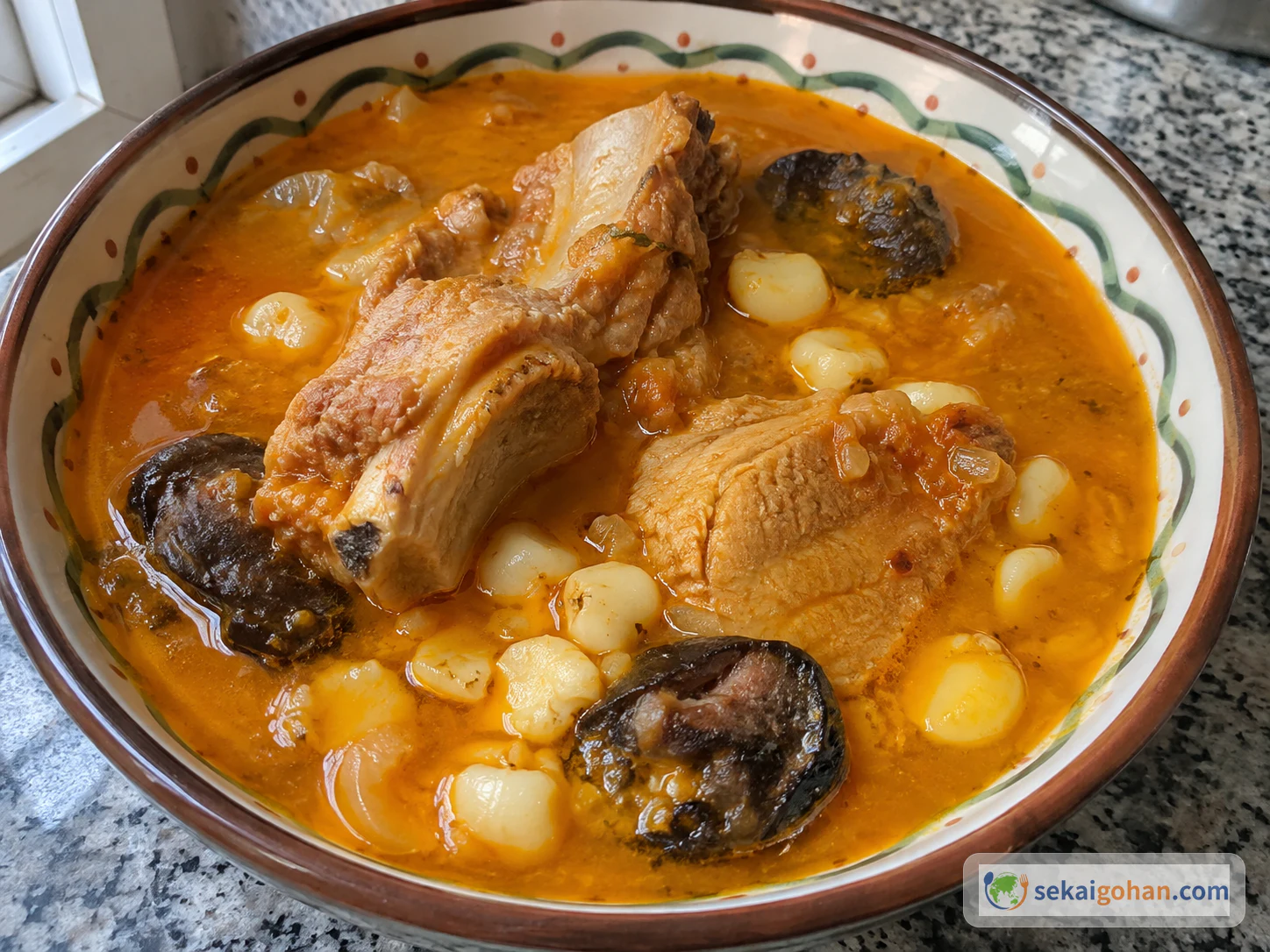
Late morning on a day off, beef and pork broth rises from the pot, and in go white hominy, chickpeas, red beans, potatoes, and squash. The clear soup slowly turns a cloudy yellow, and when you drag a wooden spoon across the bottom, the kernels and meat shift lazily. Mute santandereano is a hearty soup from Santander in Colombia that brings together corn, beans, beef, pork, mondongo (beef tripe), root vegetables, and short pasta. It's earthy and filling, the kind of dish you make when you've decided that today is the day to tend a pot.
Mute Santandereano and Its Place in Colombian Cooking
Mute, written Mute in Spanish and Mute santandereano for the Santander version, is an emblematic soup of the region. Traditional versions use beef mondongo and feet, white corn, chickpeas, potatoes, squash, and hogao. Local recipes share a common core of beef, pork, tripe, hominy, beans, carrot, potato, achiote, cumin, and short pasta.
Each town and household makes it a little differently. Some add beef feet, some add chorizo, some mix in yellow corn, and some use guascas for aroma. Locally, mute is a hearty, rich dish. Think of it less as a light soup, like Japanese miso soup, and more as a main course where you scoop up kernels with a spoon.
Among Colombian soups, Bogotá's ajiaco is enjoyed for the aroma of chicken and potatoes. Mute is earthier, and you eat it for the texture of kernels and meat. Set it beside the platter dish bandeja paisa, and you see that Colombian cooking eats meat boldly but also makes deep use of beans, corn, and aromatics.
Other corn-and-bean dishes make a useful comparison. Kenya's githeri is closer to a stir-fried stew, and Argentina's locro is richer still with squash and beans. Mute sits between them, with enough liquid to drink as a soup while the meat and kernels stay the stars.
Ingredients (serves 4)
Even pre-cleaned tripe gets blanched once at the start. For canned hominy, choose the large-kerneled white kind, not sweet corn, to get closer to mute's "soup you chew."
This uses beef, pork, tripe, beans, and wheat pasta. Tripe can retain an odor even when pre-cleaned, so blanch it over high heat and discard the water before the main simmer. If you are avoiding wheat, omit the pasta and add 2.75 oz (80 g) more potato.
Ingredients That Cause Confusion When Shopping

The meat can be made from beef shank and pork shoulder from a supermarket. What causes confusion when shopping is hominy, annatto, and the pot used for long simmering. Replacing hominy with sweet corn changes the sweetness and the firmness of the kernels, and it becomes quite a different dish. Even a little annatto gives the soup a South American color, so it is worth getting once rather than settling for paprika alone.
Canned hominy saves the time of soaking dried corn. Do not put the canning liquid into the dish; drain it in a sieve before using, so the soup does not get too cloudy.
Annatto seed can be used without grittiness if you bring out its color in oil over low heat and then remove it. If you use achiote powder, it scorches easily, so add the onion about 30 seconds after it goes into the oil.
If you make it with dried corn or dried beans, a pressure cooker makes it suddenly realistic. This quantity can be made in an ordinary pot, but the tenderness of the meat and tripe is more consistent in a pressure cooker.
Choosing Ingredients and Substitutes for Mute

Beef feet and whole local corn are hard to find for most home cooks, so this recipe uses canned hominy, beef shank, pork shoulder, and pre-cleaned honeycomb tripe. Rather than hunting down every unusual cut, make sure each role in the table below is covered.
| Role | Local representative | Realistic approach at home |
|---|---|---|
| Kernel core | maíz mute, maíz pelado | Canned hominy, or dried corn for pozole |
| Broth and gelatin | Beef feet, beef ribs, mondongo | Beef shank, beef sinew, pre-cleaned honeycomb tripe |
| Fat and body | Pork, chorizo | Pork shoulder, a little pork belly |
| Fluffiness | Potato, squash, beans | Russet potato, squash, chickpeas, red kidney beans |
| Color and aroma | Hogao, achiote, cumin | Scallion, onion, garlic, annatto seed, cumin |
If you dislike tripe, leave it out and make the soup with beef shank and pork. Still, the chew and aroma of mondongo are a big part of what makes mute taste like mute. For a first try, use just 5.5 oz (150 g) of tripe and let the meat and kernels take the lead.
How to Make It: Soften the Meat Without Breaking the Kernels
Mute is a one-pot dish, but if you put everything in from the start, the kernels split and the meat stays tough. Layer it in the order of pre-boiling the meat, making the broth, the aromatic base, kernels and root vegetables, and the finish, and even canned hominy keeps its texture.
Fixing Watery or Heavy Mute

Mute's failures are easy to spot in the pot. If the hominy sits in a thin, clear broth, the broth and root vegetables haven't come together. If the squash and potato have all broken down like porridge, it was stirred too much or cooked too long.
| State | Cause | Fix |
|---|---|---|
| Watery and bland | Too much broth, beans and root vegetables undercooked | Remove the lid and simmer 5 minutes over medium-low heat |
| Meat is tough | Pressure time too short, or the heat too high in an ordinary pot | Return only the meat and cook 20 more minutes over low heat |
| Tripe smell is strong | Not blanched enough | Next time, blanch for 5 minutes and put 2 tsp lime juice in the blanching water |
| Kernels split | Cooked over high heat, stirred too much | Add the hominy and beans from step 4 on, and cook quietly over low heat |
| Fat is heavy | Too much pork belly, beef sinew fat left on | Skim off about 2 tbsp of the oil from the surface and serve with lime |
A little richness is just right, so don't chase a light broth.
Serving and Storing Mute
What to Serve with Mute

One bowl of mute is quite filling. With white rice, avocado, lime, and a Colombian arepa alongside, it makes a full lunch. Put the lime on the table instead of squeezing it into the pot, so everyone can adjust the acidity to their taste.
For a Colombian-themed meal, let mute be the star with a small salad on the side rather than piling on starters. Leftovers spooned over white rice the next day become a rich, bean-filled rice porridge.
Storage and Reheating

With all that meat and beans, mute cools slowly in a deep pot. After eating, divide it into shallow containers and refrigerate as soon as the heat is off. It keeps 2 days in the refrigerator or 2 weeks in the freezer.
To reheat, return it to a pot, add 3.5 tbsp (50 ml) to ½ cup (100 ml) water or broth, and warm over low heat. Beans and pasta sink, so stir once from the bottom before it boils. In a microwave, put it in a deep dish, heat at 600 W for 2 minutes, stir once, and add 1 more minute. Store the soup without herbs, lime, and avocado, and prepare those fresh just before eating so the aroma comes back.
FAQ
Can I make it without tripe?
Yes. Use 5.5 oz (150 g) beef sinew, or add 5.5 oz (150 g) more beef shank. The elasticity and aroma of the tripe will be weaker, but as long as the backbone of hominy, beans, achiote, and cumin remains, it's a delicious mute-style Colombian soup.
Can I use sweet corn instead of canned hominy?
It's best avoided. Sweet corn is quite sweet, and its kernels lose firmness when simmered. If you must substitute, add only 3.5 oz (100 g) frozen corn kernels on the side, and let white beans or chickpeas carry the kernel role, since they hold together better.
What if I don't have achiote?
Use 1 tsp paprika, 1/4 tsp turmeric, and 1 tsp cumin for color and aroma. Achiote's red color and earthy aroma are hard to match, though, so try annatto seed next time and you'll taste the difference.
How long does it take with dried beans and dried corn?
Soak dried chickpeas and dried corn overnight. In a pressure cooker, cook for 20 to 25 minutes at high pressure; in an ordinary pot, simmer for 70 to 90 minutes over low heat. The flavor is deeper than with canned hominy, but for a first time, canned hominy is the easier way to learn the dish.
Sources
Mute's ingredient makeup, its place in Santander, household regional differences, and the treatment of tripe and hominy were organized by cross-checking the following materials.
- Ministerio de Cultura de Colombia, Paseo de olla. Recetas de las cocinas regionales de Colombia
- Colombia Sí Sabe, Mute santandereano
- Recetas de mi Colombia, Mute Santandereano
- My Colombian Recipes, Mute Santandereano (Santander-Style Soup)
- Wikipedia en español, Mute