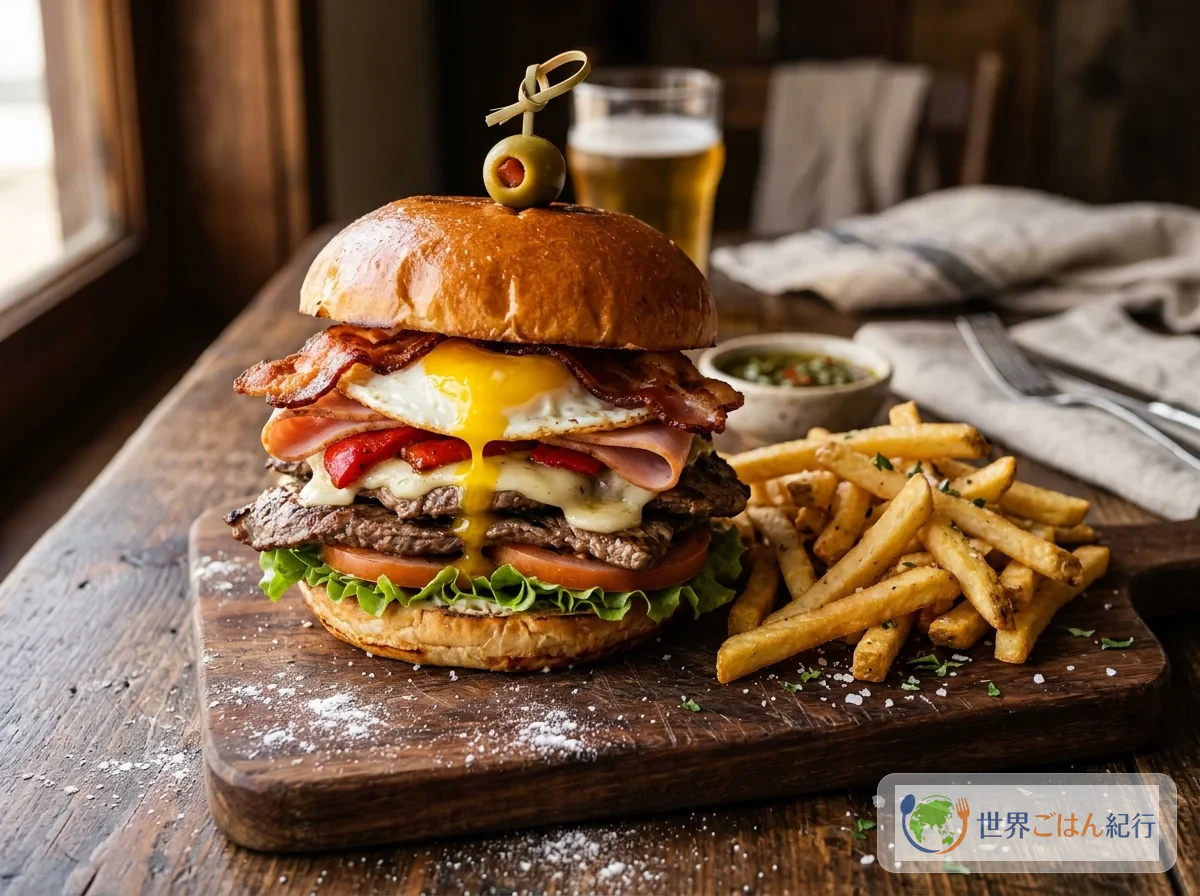
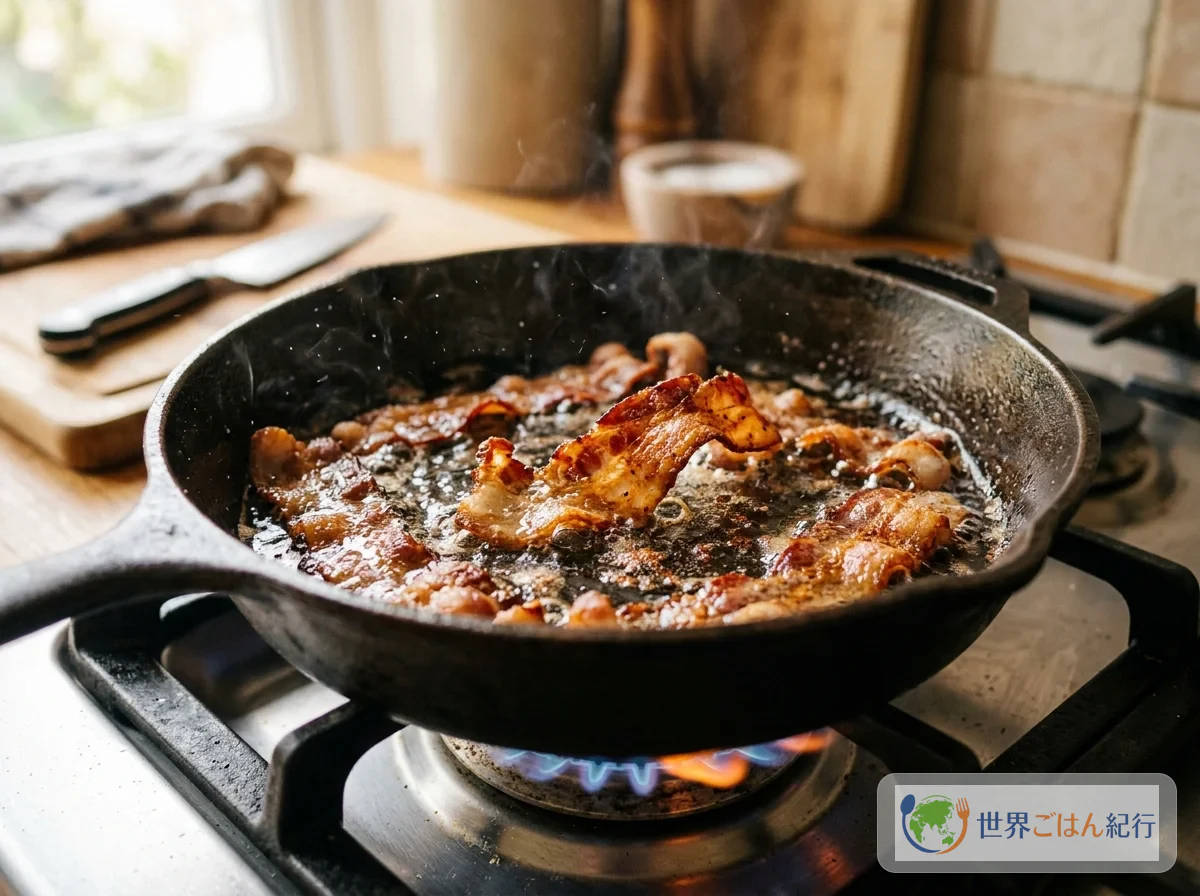
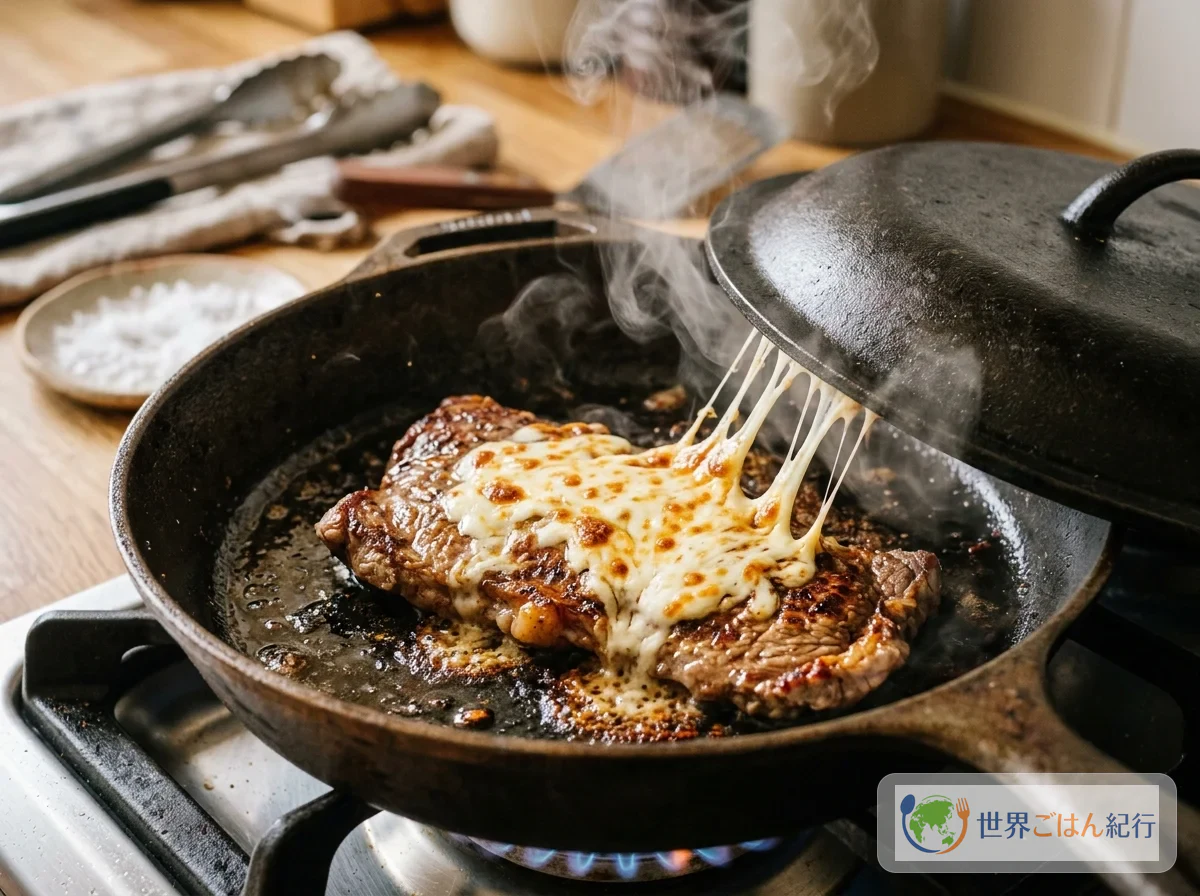
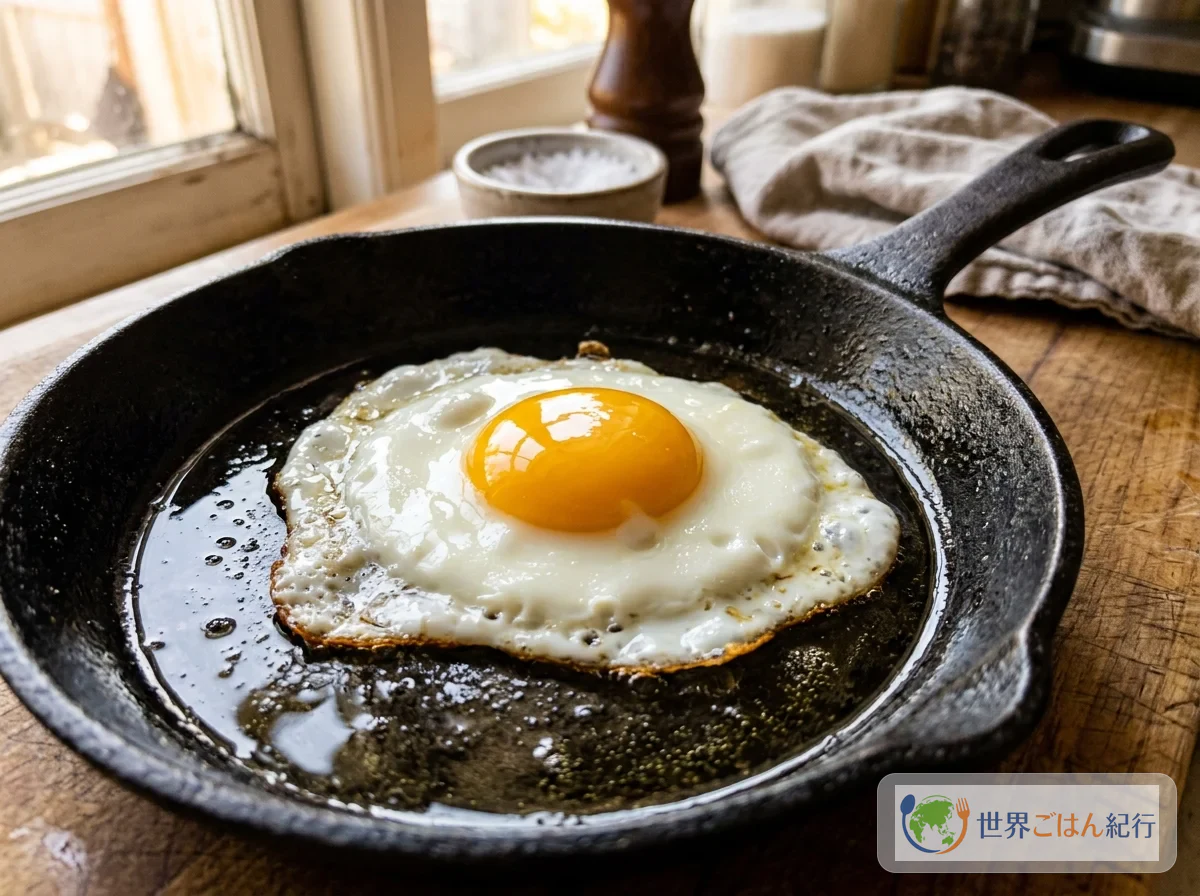
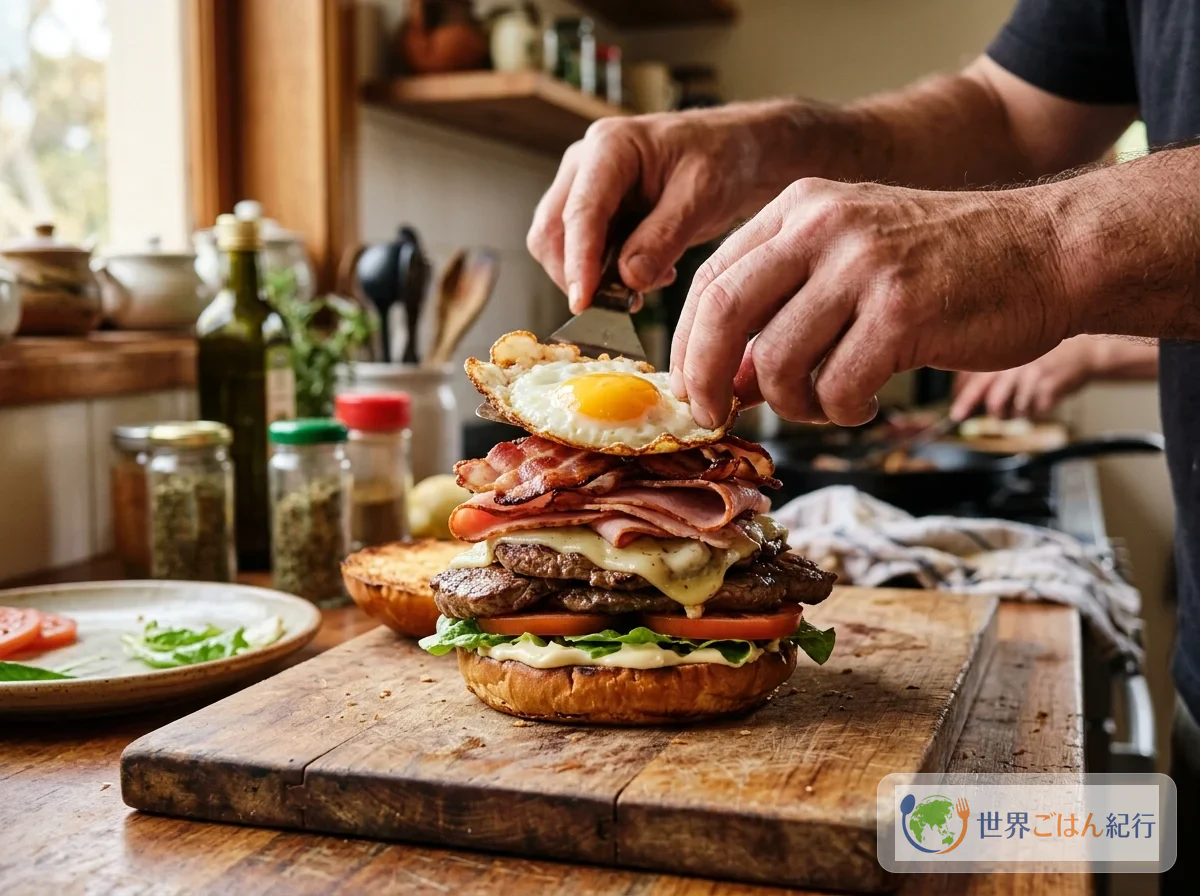
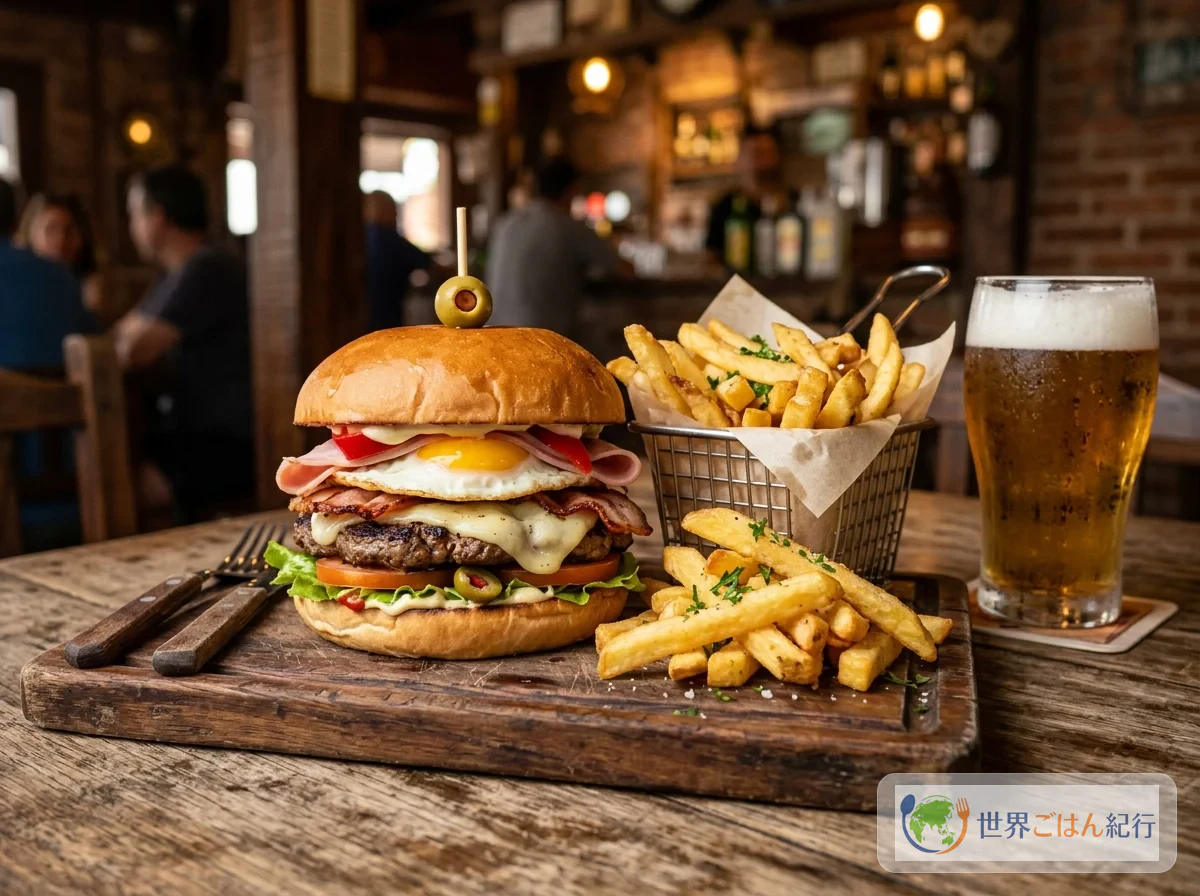
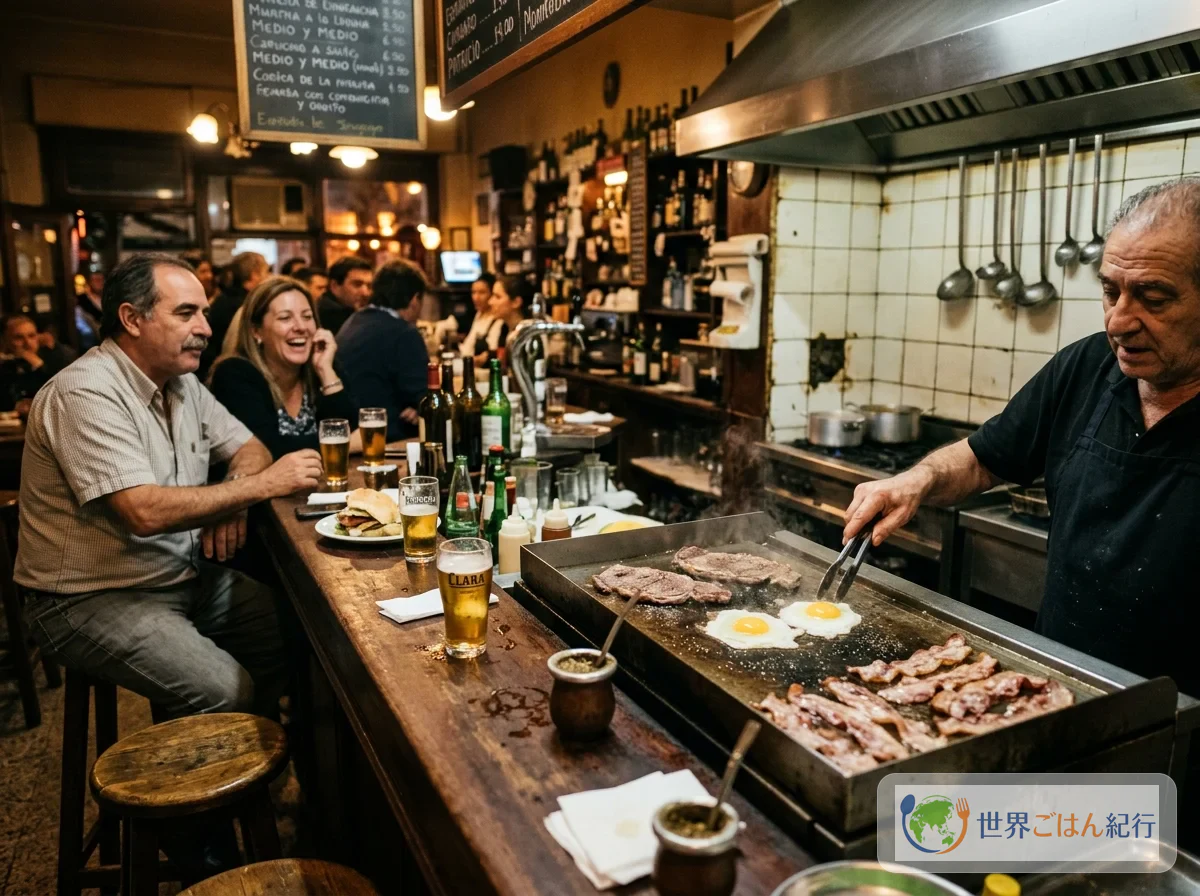
Walk the cobblestones of Montevideo's old city and you pass small bars and parrilladas (grill restaurants) on nearly every corner. Sit at the counter, ask for "chivito, uno," and before long someone sets down a sandwich so enormous you need both hands to hold it. That is the chivito, Uruguay's proud national sandwich: thin pounded beef steak in a bun, piled with fried egg, ham, bacon, mozzarella, tomato, lettuce, and mayonnaise. It takes the "enjoy the meat to the fullest" spirit of South and Central American cooking and puts it between bread, and it belongs in the same company as Argentine empanadas and Cuban ropa vieja.
The Chivito and Its Origins
From an improvisation in Punta del Este to national dish
"Chivito" is the Spanish diminutive of "chivo," a goat, yet the modern chivito contains no goat at all. Every Uruguayan knows why. In the late 1940s, at a small bar in the Atlantic resort of Punta del Este, a traveler from Argentina ordered "chivito" (grilled kid goat). The bar had no goat meat in stock, so the owner improvised, serving toasted bread with butter, ham, and beef steak instead.
That first chivito was a simple affair. From the 1960s onward, Montevideo's bars competed to add more, and lettuce, tomato, egg, and bacon arrived one after another. This "culture of addition" gave the sandwich its present form, and today the chivito is a candidate for Uruguayan intangible cultural heritage.
A different meat culture in the country of asado
Uruguay has one of the highest per-capita beef consumptions in the world, and, as in Argentina, "asado" (charcoal-grilled meat) sits at the center of the food culture. The chivito comes from a different lineage. It lives on the border between fast food and slow food: the country's emblematic ingredient, cooked quickly and eaten casually, but layered by established rules, with each bar as proud of "our chivito" as of any traditional dish.
Uruguayans sometimes put it this way: "If asado is what you gather around with family on Sunday, the chivito is what you bite into with friends on Saturday night."
The peak of South American sandwich culture
Every country in South America has its own hearty favorite. Colombia's bandeja paisa overwhelms with quantity and variety, the Cuban medianoche presses pork, ham, and cheese together, Chile has the "barros luco" (a hot sandwich of beef and cheese), and Argentina has the "lomito" (a steak sandwich).
For thickness of layers, complexity of flavor, and its open "you can add anything" attitude, though, the chivito beats them all. In 2019 it was named one of "the world's most underrated sandwiches," and in 2023 it appeared on a list of the world's 50 best sandwiches.
At an ordinary neighborhood bar in Montevideo a chivito costs about 450–650 Uruguayan pesos (about 1,500–2,200 yen as of 2024). At a high-end restaurant it can exceed 1,000 pesos. Against an average monthly income of about 45,000 pesos, it is a "small luxury," more weekend reward than everyday food. In student districts and around football stadiums, smaller chivitos ("chivitito") sell for around 300 pesos.
Ingredients (serves 2)
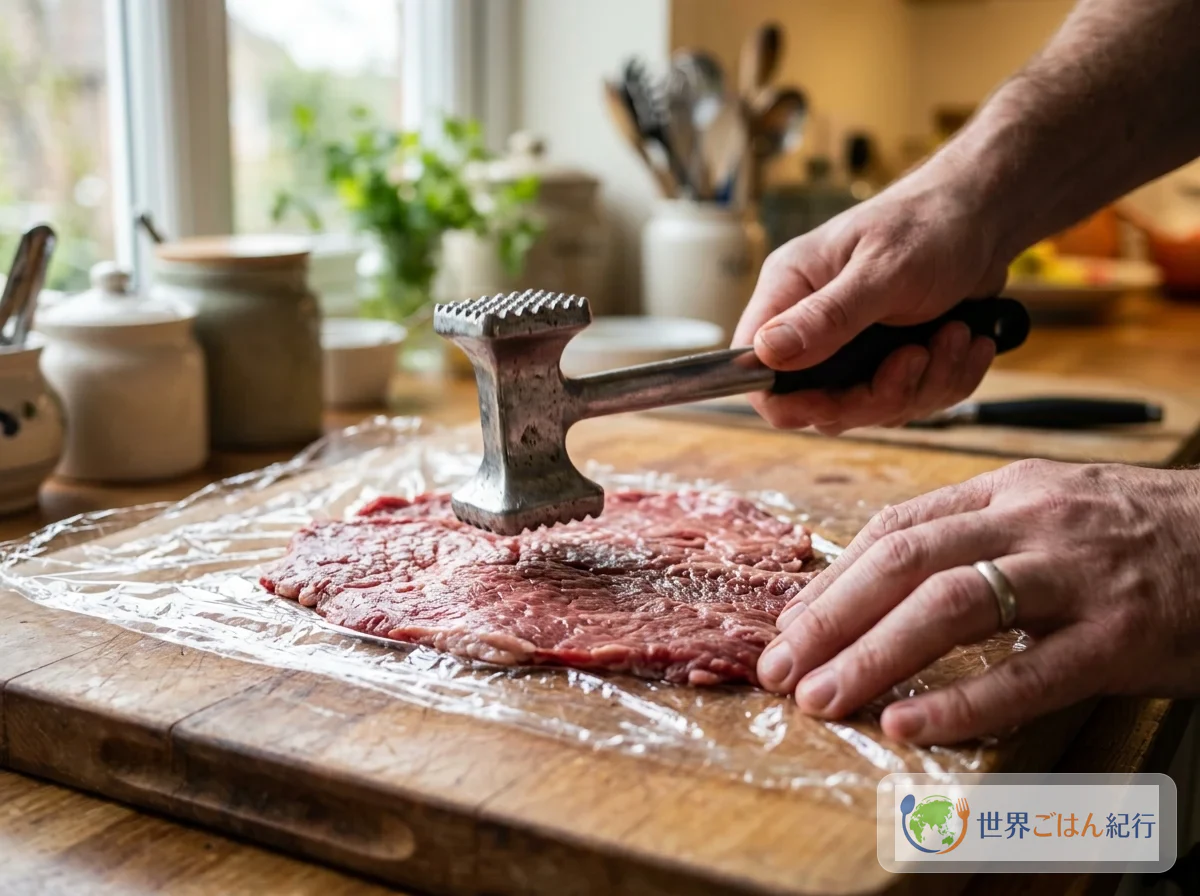
In Uruguay, "lomo" (tenderloin) or "nalga" (inside round) is traditionally used. The simplest method is to cut a block of beef round into 0.25 inch (5 mm) slices, then pound them thin with a meat mallet, or with a rolling pin over plastic wrap. You can also pound sirloin steak thin, but if there's too much fat it gets greasy once it's in the bun. For a chivito, the thinner the meat, the better. Hamburger-patty thickness is out of the question.
Choosing Ingredients for Chivito
In Uruguay, provolone is traditional rather than mozzarella. It stretches into strings when heated, and its smoky flavor is a perfect match for beef and bacon. Look for Argentine or Italian provolone at a good cheese counter or specialty grocer. Mozzarella still makes a delicious chivito.
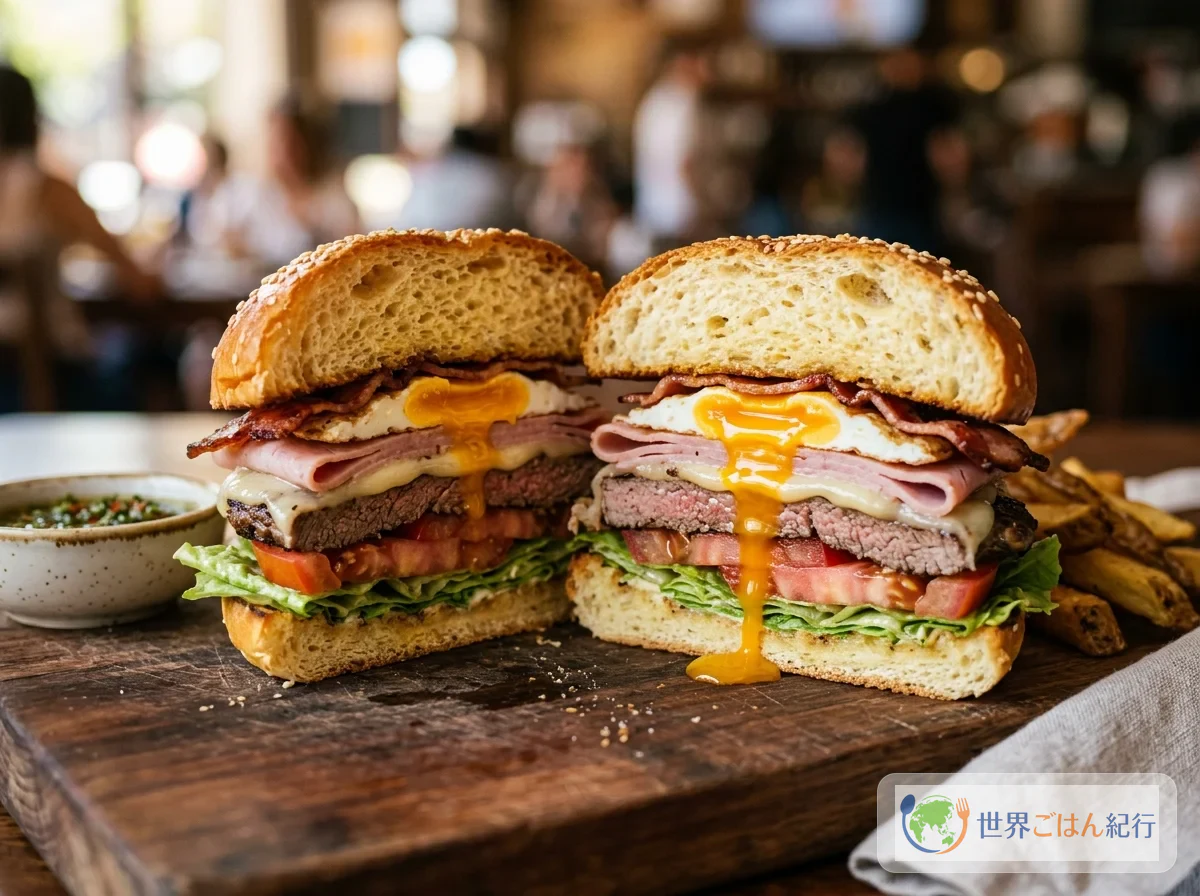
Soft bread is the orthodox choice, as the name "chivito al pan" suggests; in Uruguay that means a soft white bread called "pan de miga." Ordinary hamburger buns work fine, and brioche buns bring out the meat with their buttery flavor. Hard breads such as baguette and focaccia make the layers collapse easily, so skip them. Ciabatta is a middle option.
Some bars in Montevideo use an "aioli-style sauce." Stir 1/4 tsp tube garlic and 1 tsp lemon juice into store-bought mayonnaise, and it makes a noticeable difference. That said, ordinary neighborhood bars in Montevideo use plain mayonnaise.
Chivito Variations
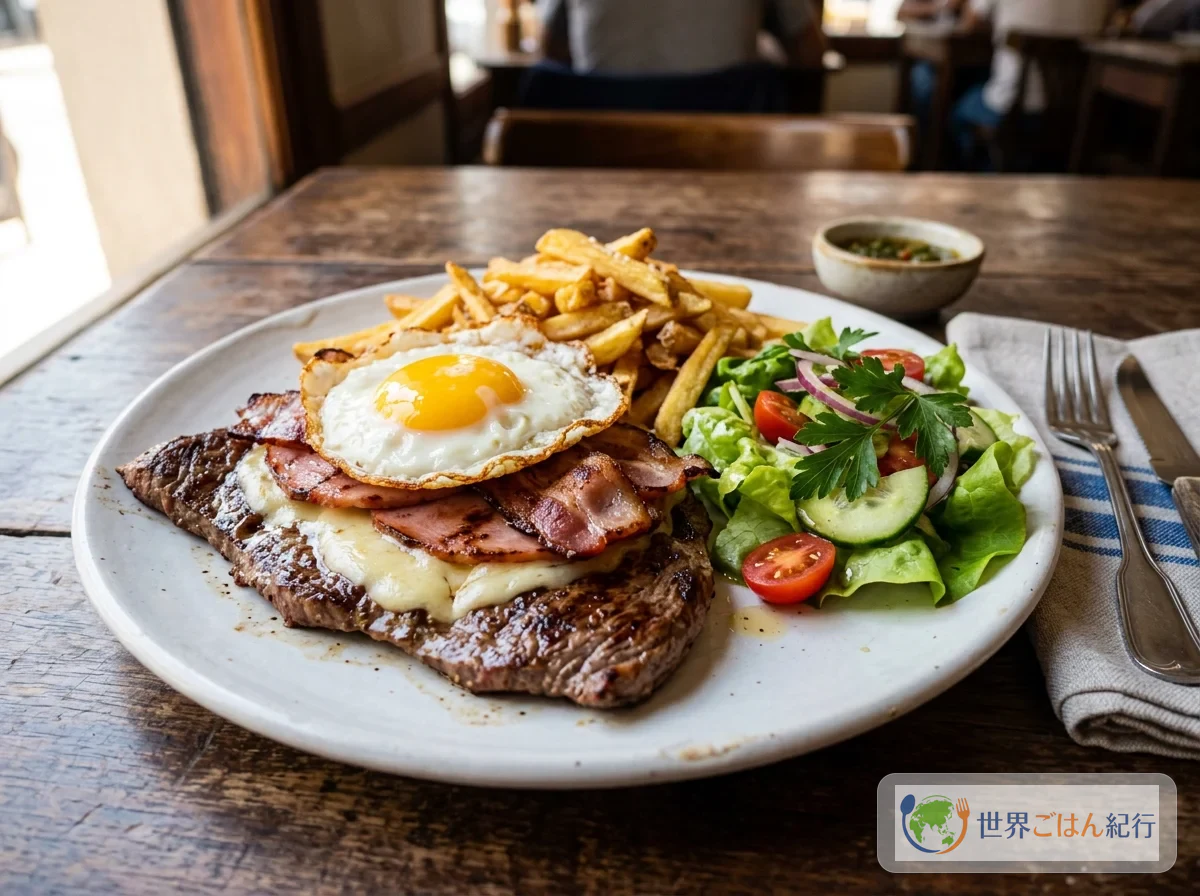
Chivito al plato (the plated version)
Alongside the "chivito al pan" in a bun, Uruguayan restaurants always offer the "chivito al plato," served on a plate without bread. The same fillings are laid out on a large plate and eaten with a knife and fork, which suits anyone cutting carbohydrates or wanting the meat and egg on their own. The al plato version typically costs 100–150 pesos more.
Chivito canadiense (Canadian style)
Some bars in Uruguay serve a "canadiense" that swaps the bacon for Canadian bacon (back bacon) and the cheese for cheddar, giving lighter fat and bright orange cheese. The style spread from the Canadian community in Montevideo in the 1960s.
Vegetarian chivito
In recent years Montevideo has seen a vegetarian version that grills thick slices of portobello mushroom in place of beef. The mushroom's meaty texture and earthy flavor go surprisingly well with the fried egg and cheese. Traditionalists aren't fans: "A country without meat is not Uruguay. A chivito without meat is not a chivito."
Chicken version (chivito de pollo)
Here chicken breast pounded thin replaces the beef. The taste is lighter, so the tomato and mayonnaise come more to the front. It is popular at Uruguayan school cafeterias and cafés, and bar menus list it separately as "chivito de pollo."
Chivito Nutrition (per serving, of 2 servings)
The chivito is high in calories and fat, but the beef supplies good-quality protein and iron. As with Brazilian feijoada, eating substantially is part of the cultural value of South American meat dishes.
| Nutrient | Amount |
|---|---|
| Energy | 920 kcal |
| Protein | 2 oz (58 g) |
| Fat | 1.75 oz (48 g) |
| Carbohydrates | 1.75 oz (52 g) |
| Fiber | 4 g |
| Sodium | 1,280 mg |
| Iron | 6.8 mg |
| Vitamin B12 | 4.2 μg |
More South American Dishes
From neighboring countries:
- Empanadas (Argentina): fried pies of beef and onion
- Chimichurri (Argentina): ingredients and aromas from the same region
- Ropa vieja (Cuba): Cuba's national dish, where the beef shreds like "old rags"
- Bandeja paisa (Colombia): Colombia's "everything on top" platter
- Feijoada (Brazil): a stew of black beans and pork
From the Caribbean:
- Jerk chicken (Jamaica): spice and smoke
- Griot (Haiti): fried pork marinated in citrus
FAQ
Can I make it with cuts other than beef round?
Yes. Sirloin, rump, or tenderloin all make a delicious chivito. Pounding thin matters most, so always pound thick cuts to 0.25 inch (5 mm) or less. Tenderloin is tender and refined, but at ordinary bars in Montevideo the majority opinion is that "a chivito of round is wilder and tastier."
Do I have to put in all the fillings?
Using all of them is orthodox, but even at Uruguayan bars, orders for "sin bacon" (no bacon) or "sin huevo" (no egg) are common. Leave out meat, cheese, or ham, though, and Uruguayans will say "that's not a chivito." Adding avocado, mushrooms, or hot sauce is perfectly normal in Montevideo.
Why do they put an olive on it?
The green olive on a toothpick is a classic chivito topping, and it also has a practical job: holding the bun in place. Many bars serve it, though it's a matter of preference. Its saltiness and acidity make a welcome accent that tightens the rich flavor of the meat and cheese.
Can I eat chivito outside Uruguay?
Buenos Aires has many Uruguayan restaurants that serve it, and you'll also see it in southern Brazil and Paraguay, with slightly different fillings and names. Farther from the region, restaurants with chivito on the menu are rare, but you can find it at South American food festivals and events held by Uruguayan communities abroad.