Freshly cooked rice is mounded on a large platter, and a small bowl of raw vegetables sits beside it. Tomato that has given up a little red juice, cucumber that keeps its crunch, and the cool scent of mint cut through a mouthful of meat and rice. That small bowl is salata, Afghan salad: finely chopped tomato, cucumber, onion, and herbs dressed with lemon or lime, salt, and pepper. It tastes bright and sharp, with no richness of its own, and that is what it's for. This version uses 7–8 mm dice that are easy to scoop up with rice, and the dressing goes on late so the acidity is still bright when you eat.
What Is Afghan Salad?
Everyday Afghan meals are wheat bread with soup or stew. Palaw, rice piled high in a mound, comes out for festive meals. Rice costs more than wheat, so it is eaten mostly in cities and in regions where it is easier to get. Raw vegetables come as a small salad rather than a full platter, and yogurt shows up as a sauce or a side. At gatherings, salata is often served with plain yogurt. Home cooking there is closely tied to hospitality and celebration.
Among the bread and stew, rice dishes, dumplings, and mild yogurt, the salad isn't the star. It adds acidity and crunch between the staple and the stew and lightens the whole meal. So at home, place a small amount beside the main dish. That suits its role better than serving it as a platter of its own.
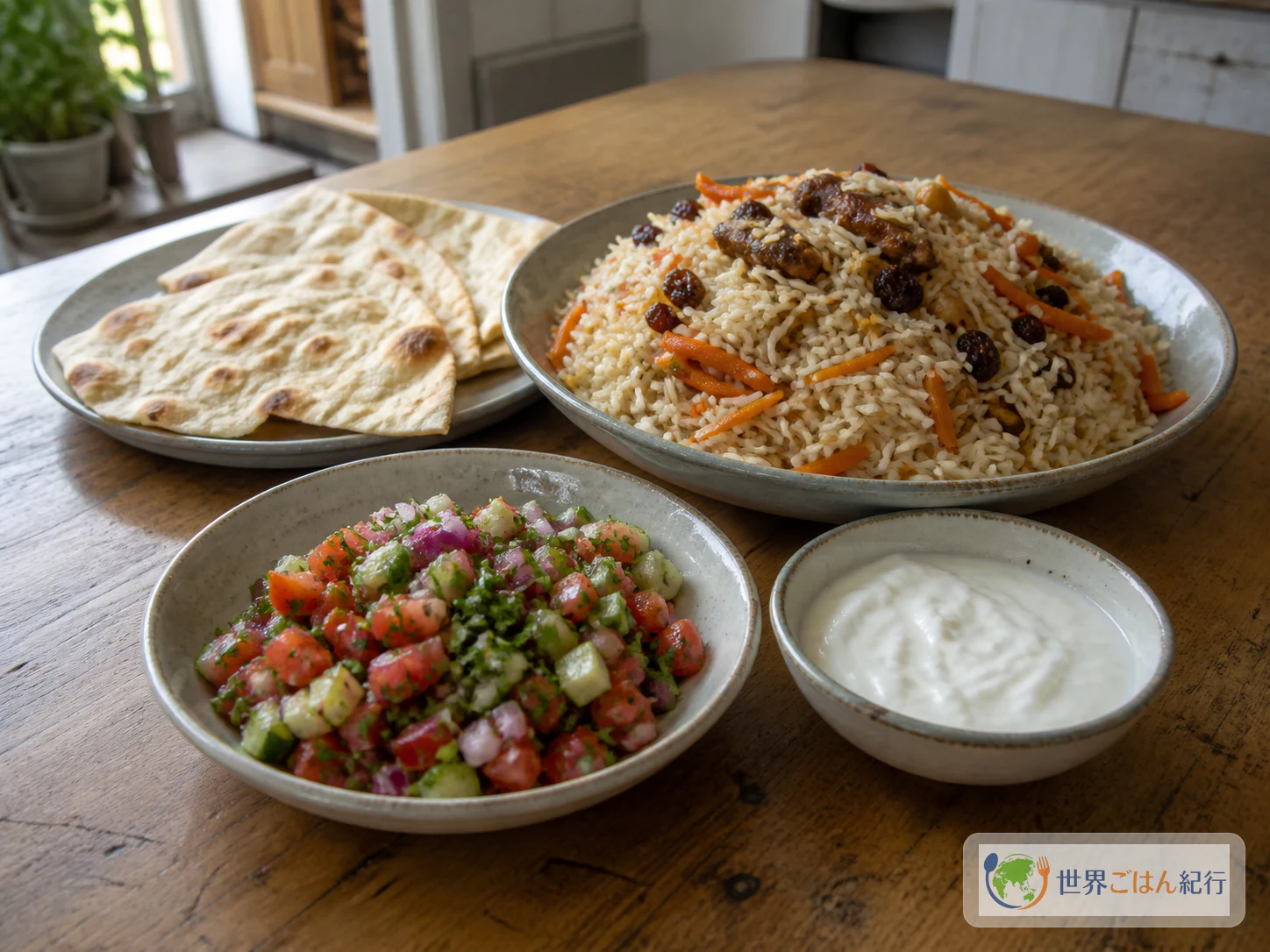
If "salad" makes you think of lettuce and a heavy dressing, this one works differently. There are no leaves for bulk, and everything is diced small so you can scoop a portion up with rice. One bite gives you the green of cucumber, the acidity of tomato, the bite of onion, and the fresh scent of herbs. With no heavy fat to hold it together, it's best eaten before the juices spread across the plate.
Origin and Regional Versions
Afghan salad has no single birthplace and no one correct set of ingredients. Afghan cooking sits close to Central Asia, Persia, and Pakistan, and ingredients and techniques have overlapped through trade and movement. Chinese tea and Indian spices left their mark along the Silk Road, and regional dishes spread through urbanization and migration. Some cooks use dried mint, others fresh. Some add carrot, chili, or oil. It's best understood as a side dish put together from the day's staple and whatever vegetables are on hand.
Regional differences show up in the staple and the way the meal is served, not in the salad itself. The north is linked to livestock and rice dishes, and the east has many plant-based dishes built on farming, but the same tomato and cucumber work for both. Next to a northern rice dish, keep the juice down so the salad scoops easily with the rice. Next to bread or a bean stew, push the acidity up slightly to lighten each bite.
Eating It the Afghan Way
You don't need spices to recreate these regional differences. Decide whether the staple is basmati or bread and how much meat or yogurt goes alongside, then adjust the size of the dice and the amount of lemon.
| Point | Why it matters | Where to land in a home kitchen |
|---|---|---|
| Keep the dice small and even | Easy to scoop with rice or meat | Aim for 7–8 mm cubes |
| Add acidity just before serving | Tomato and cucumber release too much juice | Plate within 5–7 minutes of mixing |
| Keep the onion mild | A strong bite stops it cleansing the palate | Chop to 2–3 mm and let it meld briefly with salt and lemon |
| Include the herbs | Without them it's a plain chopped-vegetable salad | Combine small amounts of cilantro and mint |
| Serve small portions | Juice runs into the rice dish | Use a small bowl or the edge of the platter |
Ingredients
Serves 4. This amount goes in a small bowl beside rice or bread. If you want to eat the salad like a main dish, make 1.5 times the vegetables and increase the lemon and salt as you taste.

This is a raw, uncooked vegetable dish. Wash vegetables and herbs well under running water, don't leave them out at room temperature for long after cutting, and keep chilled until serving. Grit left on herbs spoils both texture and hygiene, so swish them in a bowl of water and then drain. The salad itself contains no dairy or wheat, but check labels for dairy if you serve yogurt and for wheat if you serve it with bread or dumpling dishes.
Shopping notes
The salad itself needs only supermarket vegetables. The reason to look further is the long-grain rice and spices that carry over to the Afghan dishes you place beside it. If you only make the salad, you don't need to buy anything special and the core of the flavor won't suffer. If you are also making Kabuli palaw, choosing basmati, which cooks to slender grains, makes it easier to build the table around the salad.
There is no need to hunt for expensive vegetables for the salad. Firm tomatoes, fresh cucumbers, and a small amount of herbs are enough. If you buy online, limit it to long-grain rice that is hard to choose locally or to spices you can use in other dishes such as ashak, so that what you buy has a use afterward.
Choosing Ingredients and Substitutes for Afghan Salad
Any grocery store will have everything you need. For tomatoes, firm medium or Roma types hold their shape better than sweet fruit tomatoes. Japanese cucumbers have thin skin and lots of water. If the seeds bother you, cut them lengthwise and scrape the seeds out lightly with a spoon. Red onion suits the salad best, but if you have none, use less regular onion and soak it in water.
Herbs give the salad its character. Without cilantro it ends up close to a plain tomato and cucumber salad. If someone at the table dislikes it, use only 5 g of cilantro plus 10 g of Italian parsley and 3 g of mint. That keeps the herbs noticeable better than replacing it all with mitsuba. If you do use only mitsuba, the aroma turns gentler, so add a bit more lemon and black pepper to stand up to the meat and rice. Otherwise, start with 6 g of fresh mint, or 1/2 tsp if dried. Dried mint has a concentrated scent, so don't add more at the start.
Some households add carrot, chili, or oil. Make it once without oil, the way it's written here, before reaching for extras. If you add carrot, chop 1 oz (30 g) a bit smaller than the tomato and cucumber, because large pieces are hard to scoop with rice. For green chili, slice 1/4 of one thin and start by mixing in half. A strong chili turns a palate cleanser into a hot side dish. Every addition releases more juice, so don't increase the lemon and salt all at once.
Method
There is no cooking. The size of the cut, the order of adding salt and lemon, and the resting time decide the result. A knife, a bowl, and a spoon are all you need.
Keeping Afghan Salad from Turning Watery
A little juice at the bottom of the bowl is fine. If the pieces keep their corners and the juice runs off a spoon, the acidity and vegetable flavor are intact. The real trouble comes from adding salt and acid too early. The tomato flesh collapses, and the liquid soaks into the rice dish too.
| Problem | Cause | How to fix it |
|---|---|---|
| Bowl bottom full of juice | Salt added early, tomatoes too ripe | Scoop only the vegetables and add 1 tsp lemon juice and a few herbs |
| Onion is harsh | Cut too big, not soaked in water | Soak 2 more minutes, drain well, and return |
| Flavor is blurry | Not enough salt or acidity | Add a pinch of salt, 1 tsp lemon juice, and black pepper, in that order |
| Herbs too strong | Too much mint | Add 1/2 tomato and a little more lemon |
| Tastes like a Japanese quick-pickle | Made with vinegar only, no herbs | Add lemon juice and a little cilantro; don't increase the sugar |
Serving and Storing Afghan Salad
The classic pairing is Kabuli palaw, rice topped with sweet carrots and raisins. The tomato and lemon cut through the oil in the rice and the richness of the meat, so the next bite doesn't feel heavy. It also works with ashak, onion-filled dumplings in yogurt sauce, where a few crisp vegetables play off the soft dough and dairy. With grilled meat like Bihari kebab, you can serve a little more salad to balance the fat.
Similar side dishes in the region rely on different flavors. Indian raita is yogurt-based and adds coolness and acidity. The achar served with Nepal's dal bhat covers a broad range of pickled and hot sides. Afghan salad relies on crunchy raw vegetables, citrus, and herbs, and puts freshness ahead of heat.
| Main dish | Amount to serve | What else to add |
|---|---|---|
| Kabuli palaw | 1/2 small bowl per person | Plain yogurt, thin bread |
| Ashak | 1/3 small bowl per person | Leftover lemon, black pepper |
| Kebab-style grilled meat | 1/2 small bowl per person | Grilled eggplant, flatbread |
| Bean stew | 1/3 small bowl per person | Warm long-grain rice |
Storage and Make-Ahead
The cucumber stays crunchy and the lemon fresh if you eat the salad within 30 minutes of mixing. If you can't serve it right away, drain the juice lightly, put the salad in an airtight container, and refrigerate it. These are raw vegetables, so throw out any salad that has sat at room temperature for a long time or has started to smell off or turn slimy. Freezing doesn't work.
To make it ahead, refrigerate three things separately: the cut tomato and cucumber in one container, the onion with its salt and lemon in another, and the herbs wrapped in paper towels. Combine everything just before eating. After half a day, the finished salad loses its crisp edges and herb aroma, so if texture matters, eat it the same day.
FAQ
Can I make it with vinegar instead of lemon?
You can, but the aroma changes, and rice vinegar alone makes it taste like a Japanese vinegared dish. Splitting the acid works better. With 1 tbsp lemon juice and 1 tbsp rice vinegar, you keep both the sharpness and the lemon scent, and the salad still sits easily beside a rice dish.
What should I change for kids?
Use red onion and cut it back to 2 oz (60 g). Use 3 g mint and a pinch of black pepper, and stop at 2 tbsp lemon juice. Put lemon wedges on the side so the adults can add more at the table.
How can I use leftover salad?
Drain the juice lightly and mix in 3 tbsp yogurt for a side similar to raita. Serve it with grilled chicken or bean soup, add a few more herbs, and eat it the same day you make it.