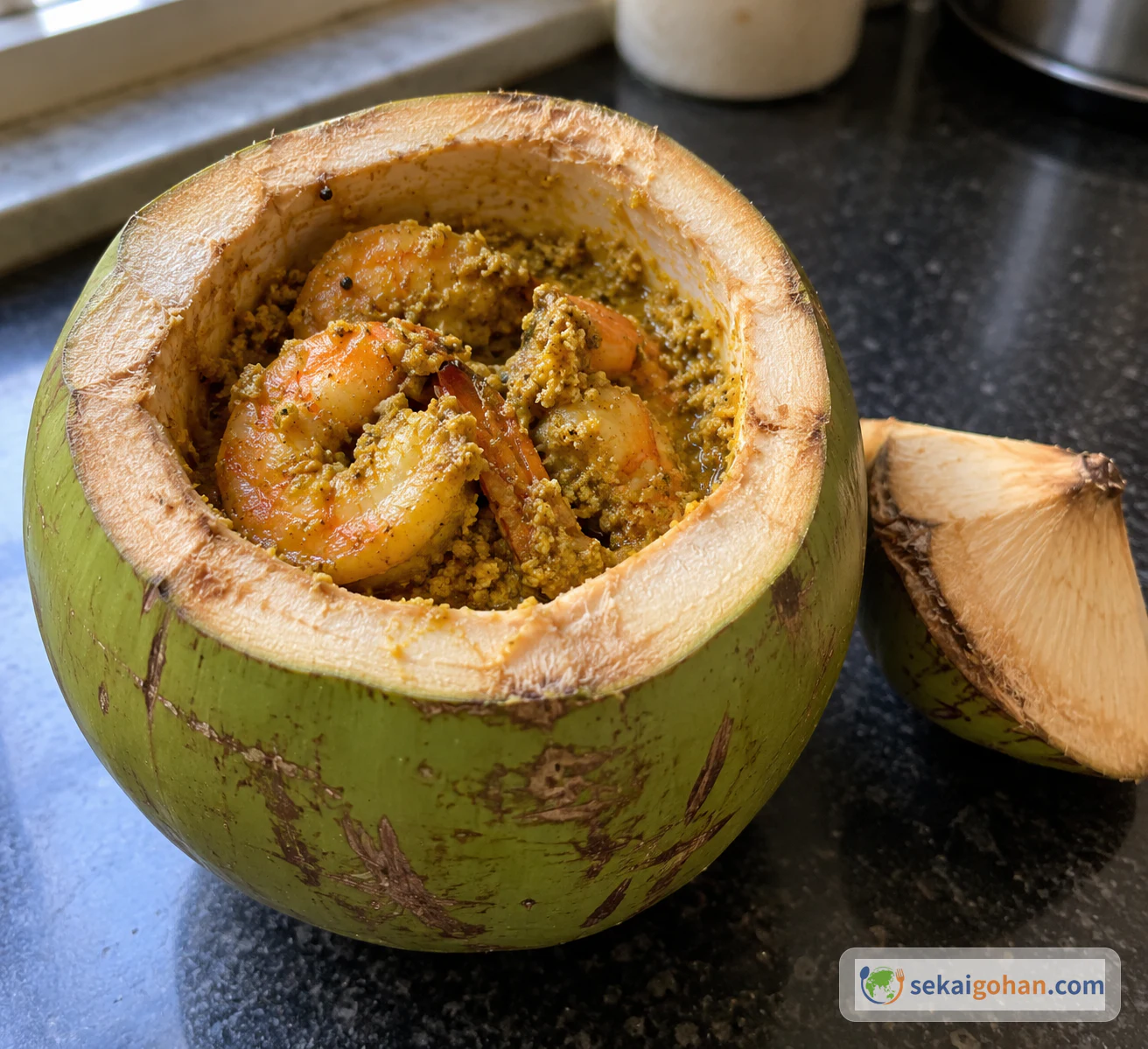
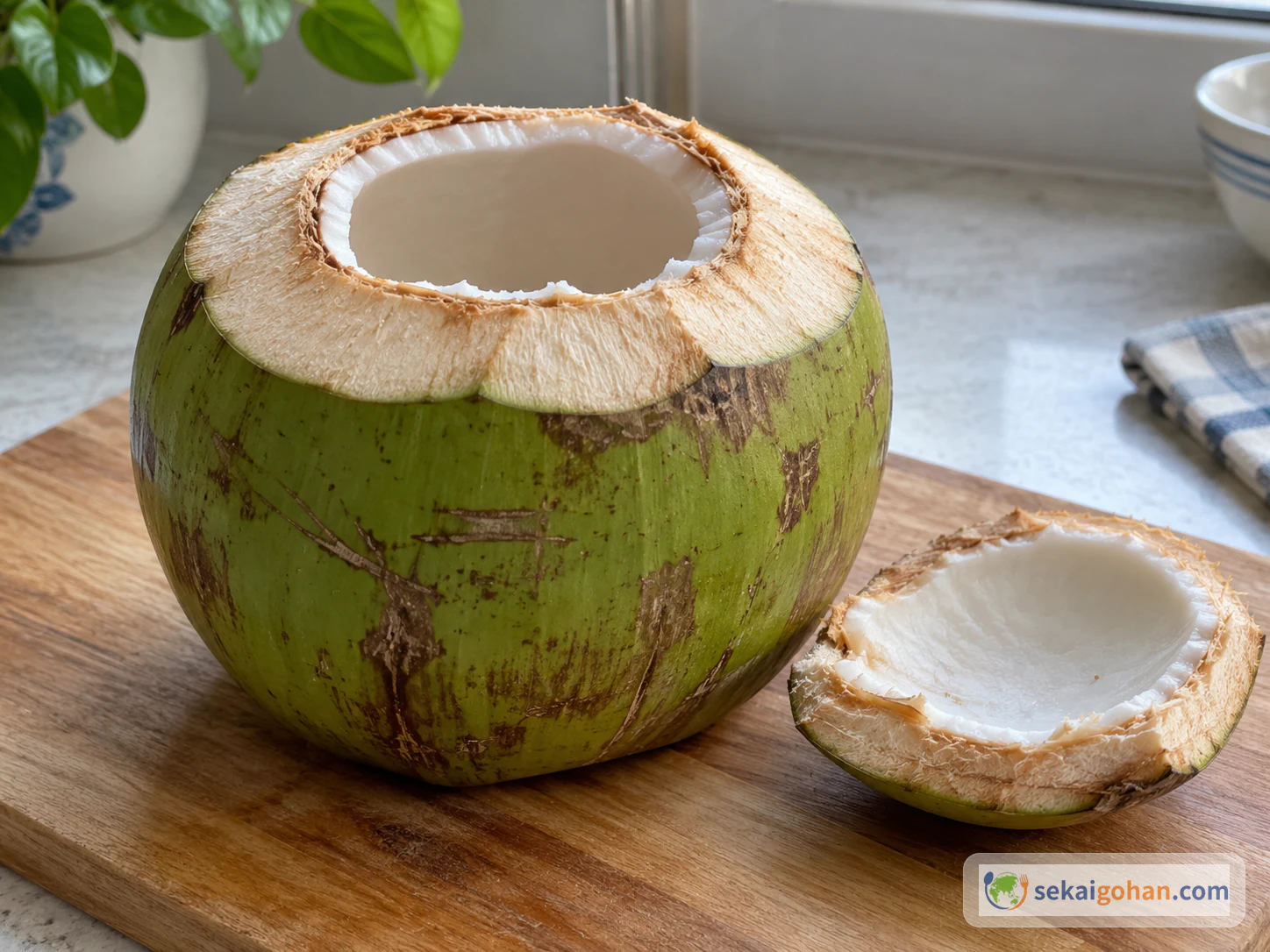
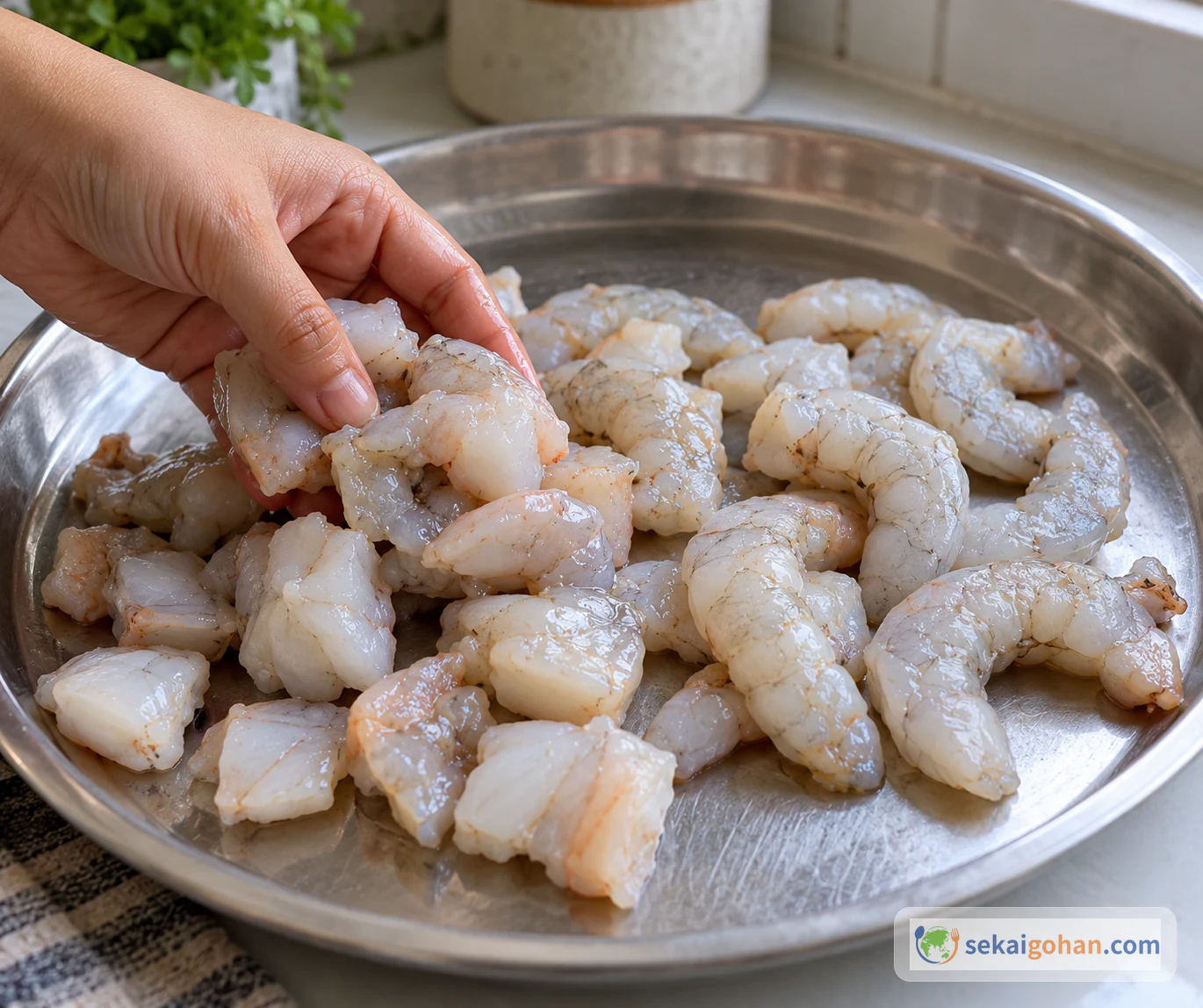
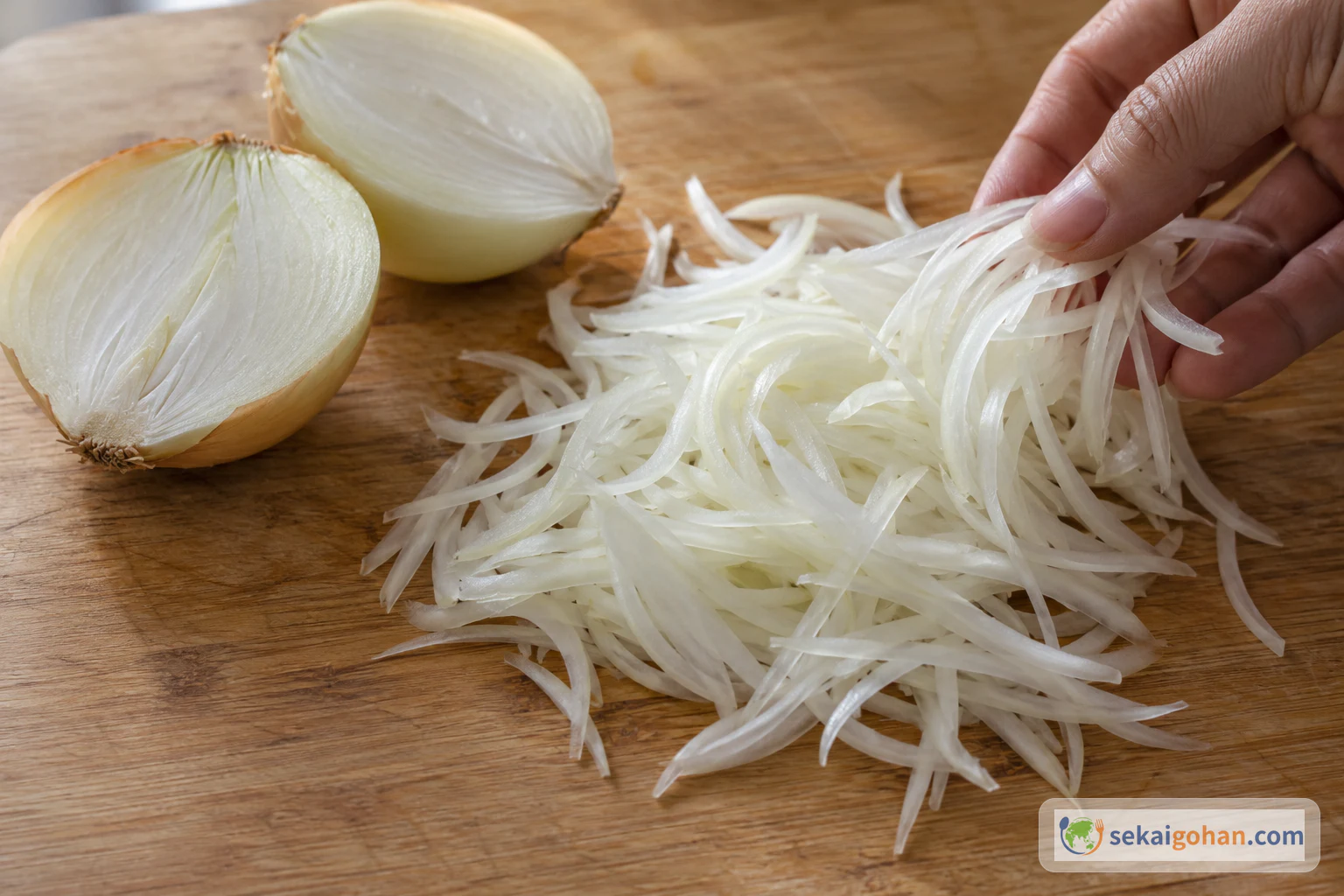
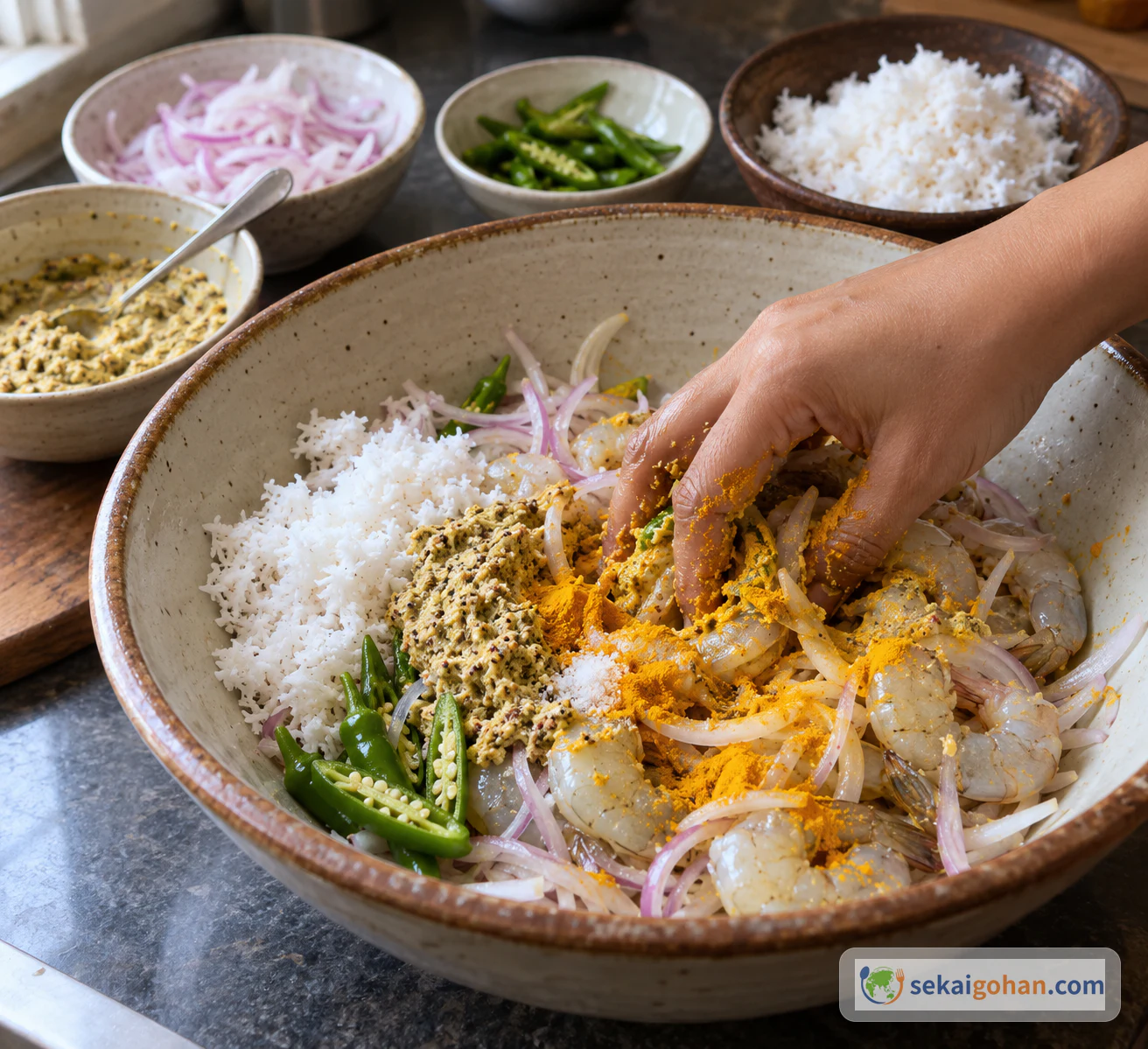
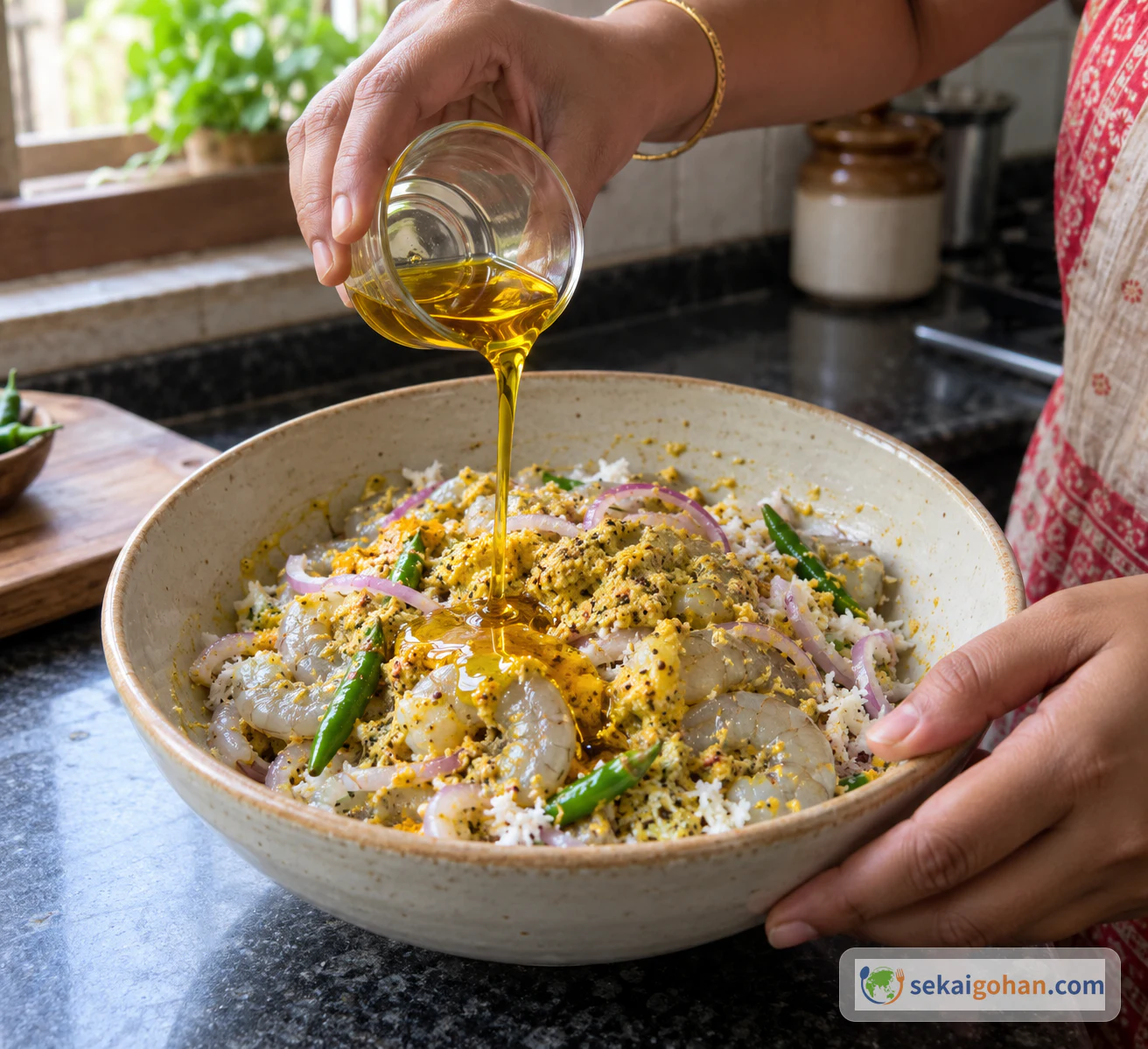
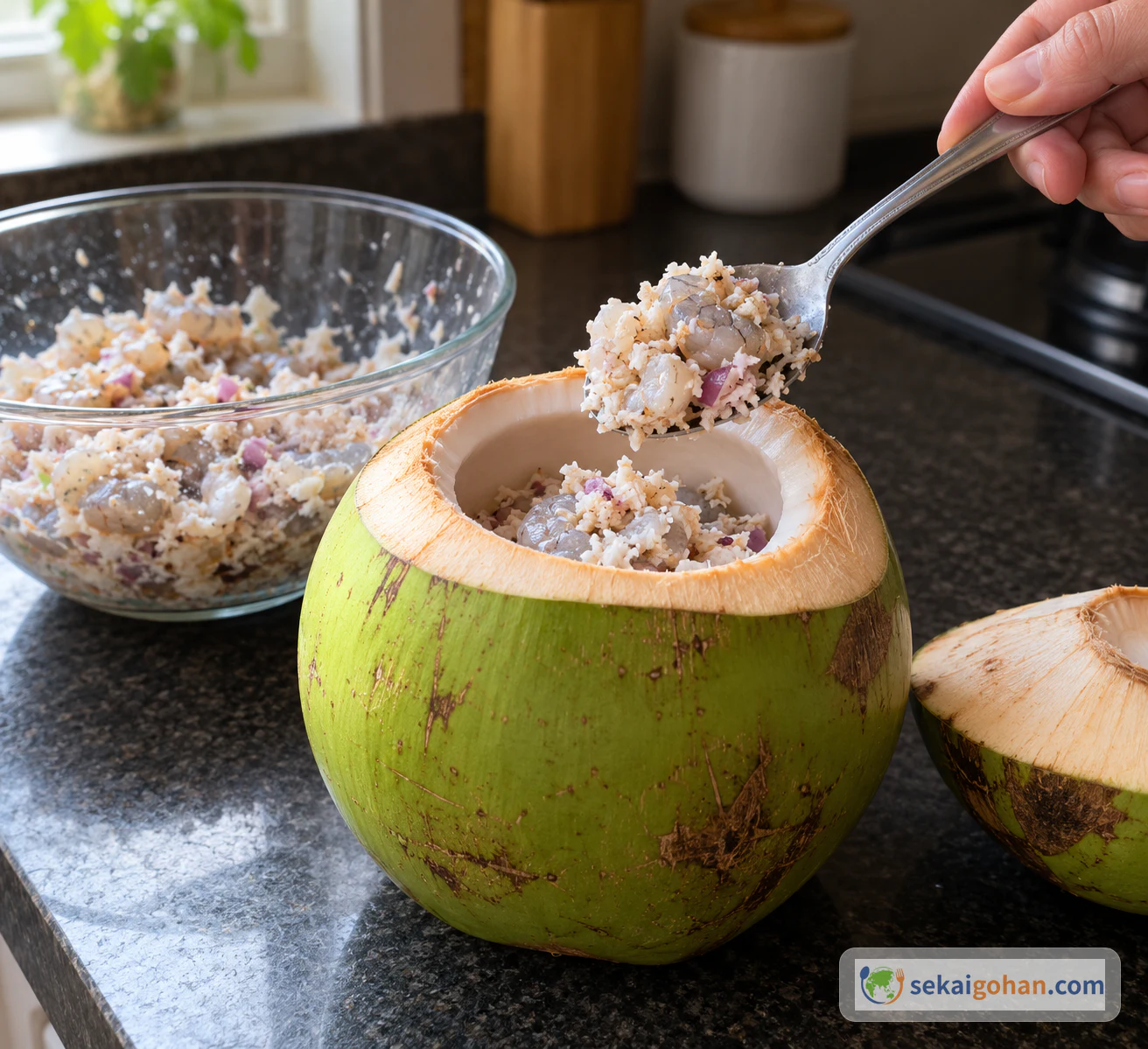
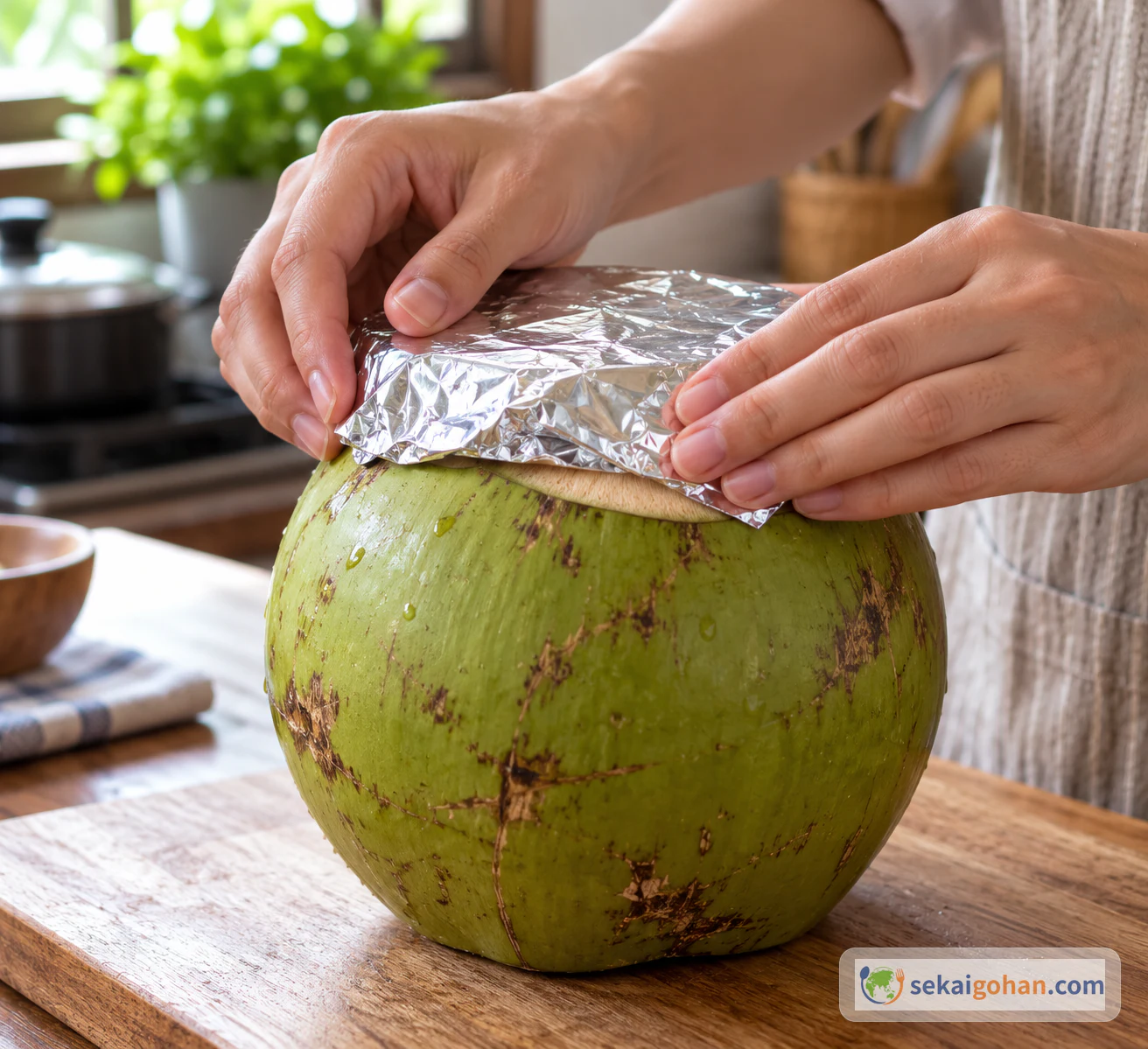
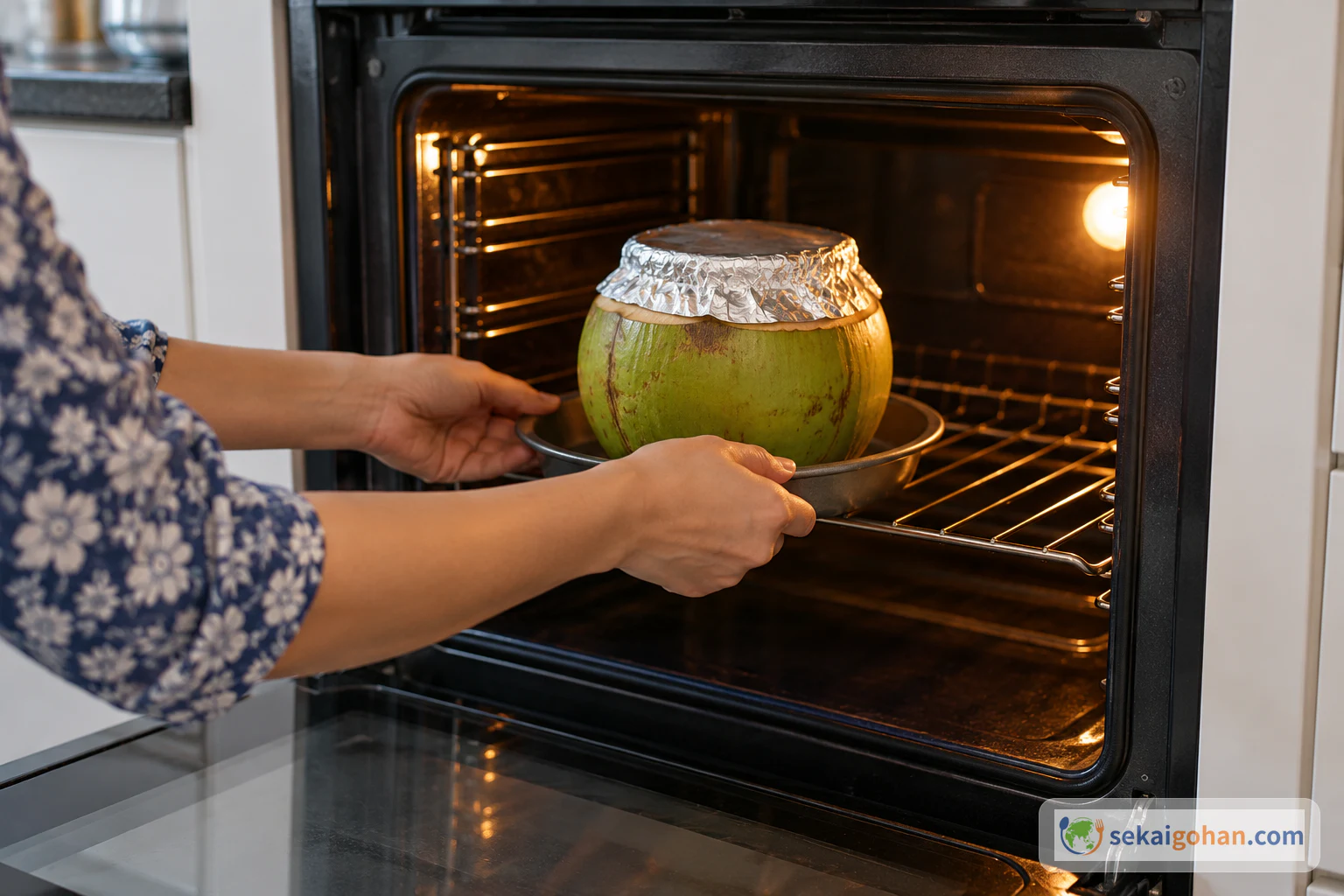
A young green coconut has its top sliced off and its water poured away. The hollow is then packed with raw prawns, thinly sliced onion, slit green chilies, grated coconut and mustard. The cut top goes back on as a lid, a piece of foil seals the opening, and the whole coconut goes into the oven. This is daab chingri, a Bengali prawn dish cooked inside a tender green coconut. For more dishes from the country, see Indian recipes.
About Daab Chingri
Chingri is the Bengali word for prawns, and daab means tender coconut. In Bengali script it is written ডাব চিংড়ি. What sets the dish apart is the method. Instead of making a coconut curry and spooning it into a shell afterwards, the coconut holds the food while it cooks.
Daab Chingri and Other Bengali Prawn Dishes
Daab chingri belongs to a wider family of Bengali dishes that pair prawns with coconut. Narkel chingri is made with ground mustard and fresh coconut. Bhapa chingri uses similar ingredients and is steamed in a pressure cooker, and chingri maacher malaikari is made with coconut milk. If you know chingri malai curry or mustard fish dishes such as sorshe ilish, the difference is easy to spot: daab chingri uses no coconut milk and bakes in its shell.
Celebrations and the Foil Lid
Daab chingri is linked with birthdays, weddings, Bengali New Year and Durga Puja. Making it at home was laborious, and the method has changed over time. In rural Bengal, tender coconuts coated with clay were slow-roasted over a wood fire, and a recipe using a half-ripe coconut shell dates from 1902.
In cities, the oven took over. In the 1960s, aluminum foil replaced dough as the seal and the coconut was baked in an oven. The method was written down in 1982, and a family restaurant opened in 1998.
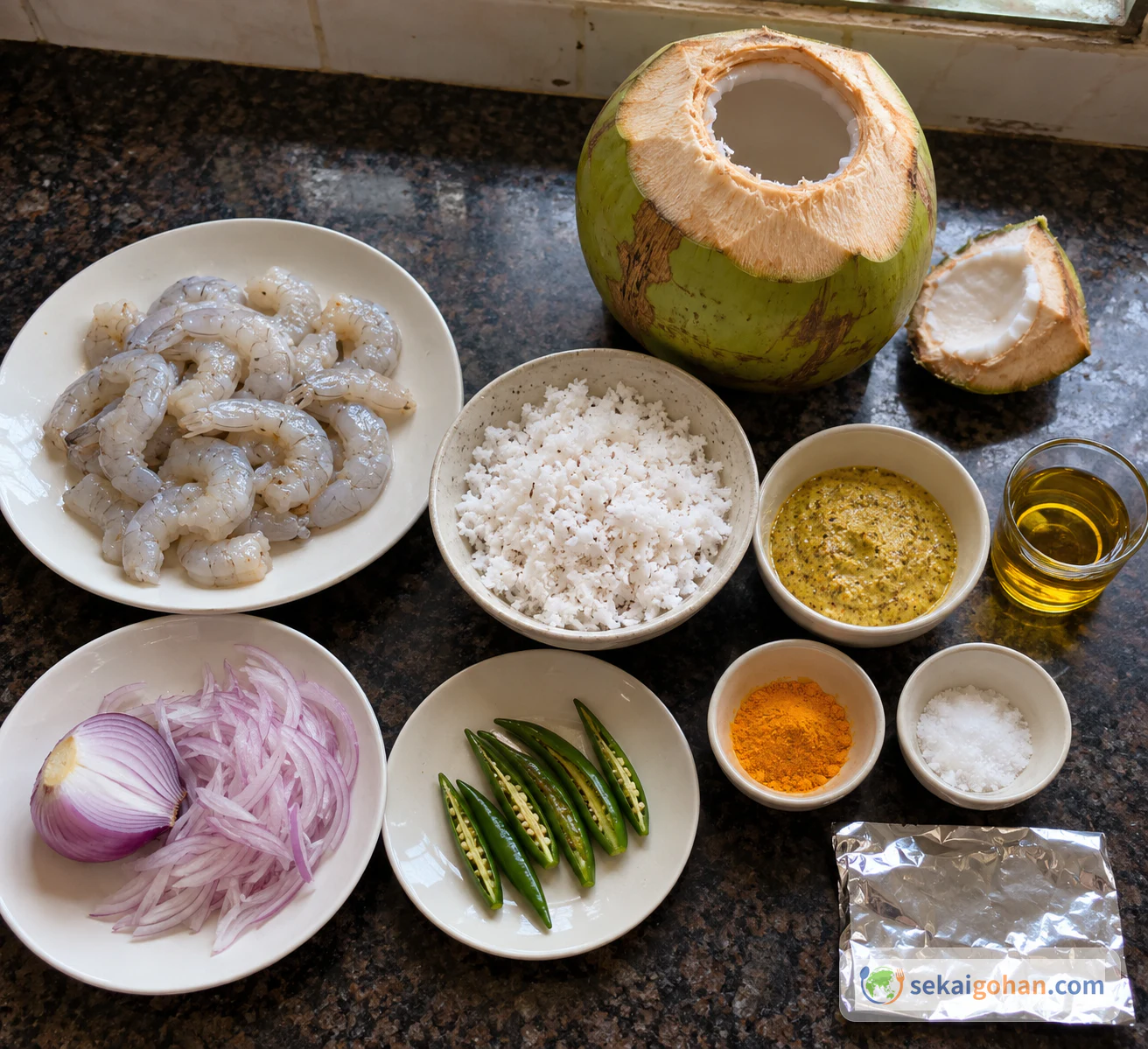
Ingredients: One Daab, Prawns, Coconut and Mustard
Equipment
- A mixing bowl
- One piece of aluminum foil, enough to cover the top opening of the coconut
- An oven
Choosing Coconuts and Mustard for Daab Chingri
You need two coconuts, and they do different jobs. The tender green coconut (daab) is the pot: it is drained and filled, and its flesh stays in place as part of the shell. The grated coconut comes from a second coconut and is mixed into the filling. Keep them separate, and use freshly grated coconut rather than flesh scraped from the daab or coconut milk.
The mustard goes in as a ready-made mustard seed paste, and the mustard oil is added last. Stick with these ingredients as listed. Cream, coconut milk or a different mustard will change the dish.
Method: Fill the Drained Daab and Bake
Open and drain the daab; prepare the prawns and onion; mix everything except the oil; add the mustard oil last; fill the daab; replace the lid and seal the top with foil; bake at 350°F for about 1 hour. Nothing is fried beforehand.
Check that the full mixture fits inside one daab before you start. Don't judge doneness by the oil rising in the shell; cut into a prawn to check that it is opaque all the way through. Refrigerate any leftover seafood promptly.
Daab Chingri Mistakes and Fixes
Several recipes share the name daab chingri, so it is easy to borrow a step from one of them without noticing. These are the points to watch.
| Tempting step | What to do instead | Why it matters |
|---|---|---|
| Adding coconut milk | Leave it out | Coconut milk moves the dish toward a malai curry |
| Scraping out the daab's flesh to add to the filling | Leave the flesh in place as part of the shell | The grated coconut comes from a separate coconut |
| Using the coconut water | Drain it and set it aside | No liquid is added to the filling |
| Frying the onion or heating the oil first | Put everything in raw and add the oil last | The mixture cooks only inside the coconut |
| Sealing with dough or wrapping the whole coconut in foil | Put the lid back on and cover only the top with one piece of foil | Keeps the method on track |
| The mixture seems too much for one daab | Check the fit before you start | The recipe gives no capacity for the coconut |
Other Versions of Daab Chingri
Other cooks make daab chingri quite differently. These are separate recipes, so their ingredients, temperatures and equipment don't swap into the method above.
A paste-based version. This one uses onion, garlic, green chili paste, panch phoron, mustard paste and mustard oil, and scrapes the flesh from the tender coconut to grind into a paste with its water. The coconut is sealed with dough and baked at 220 for about 45 minutes; there is also a pressure-cooker method.
A family version. This one includes black mustard, poppy seeds, ½ cup (100 ml) coconut milk, the coconut's own flesh and water, and sugar. The prawns rest in the paste for 10 minutes, and the dish is cooked in a pressure cooker. A microwave alternative is also mentioned.
Frequently Asked Questions
Does daab chingri use coconut milk?
Not in this version. The filling uses grated coconut from a separate coconut instead. Coconut milk appears in the family version described above.
Do I use the daab's water or flesh?
The water is drained and not used. The flesh stays in place as part of the shell. Recipes that use the flesh and water are described under Other Versions.
Will 2.25 lb (1 kg) of prawns fit in one daab?
The recipe lists 2.25 lb (1 kg) of prawns and one daab, but gives no capacity for the coconut. Check that the mixture fits before you start.
How do I store or reheat leftovers?
No storage or reheating guidance comes with this recipe. Refrigerate any leftover seafood promptly.