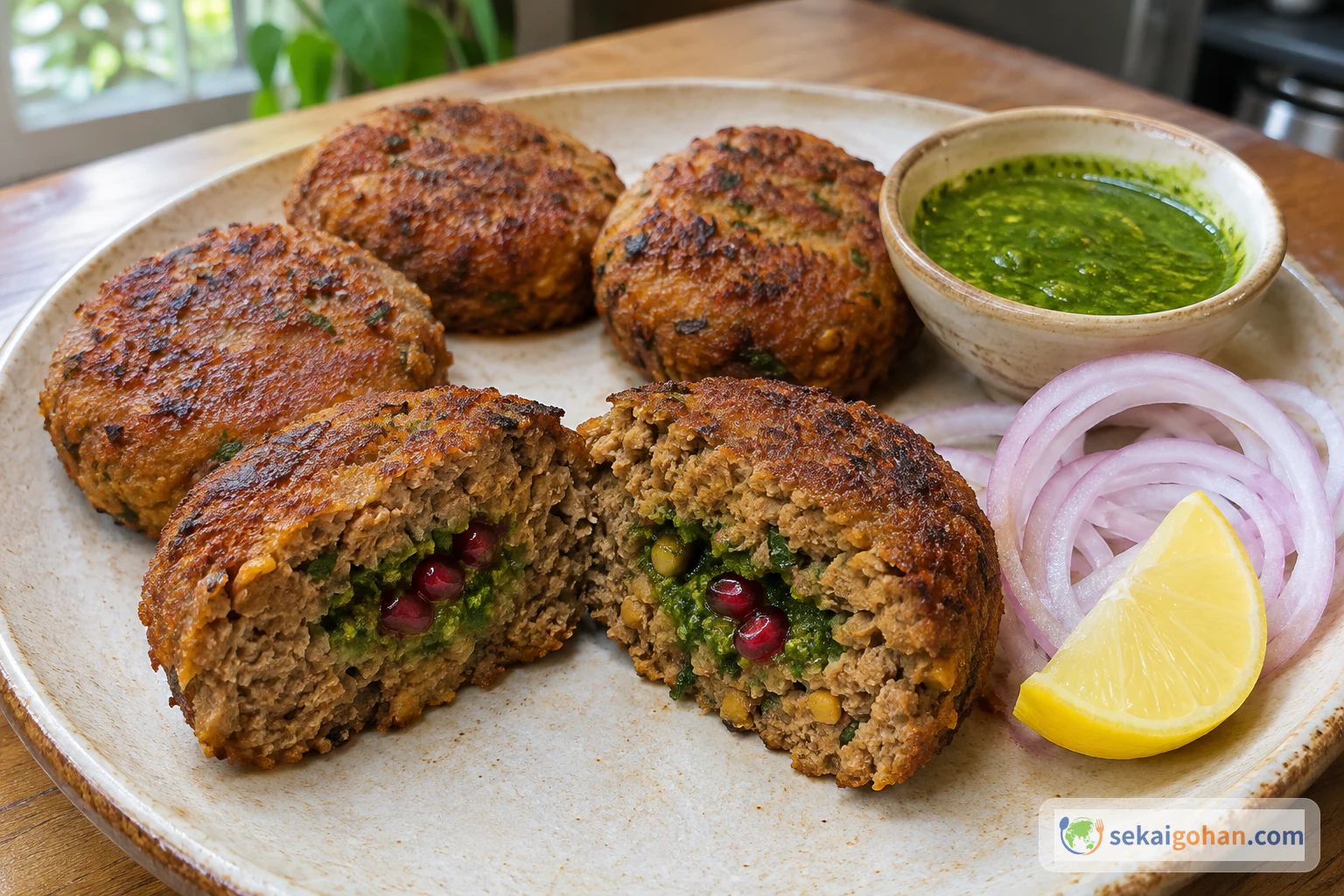
The moment the meat mixture hits the pan, the aroma of coarsely crushed coriander rises on the oil. What goes in is a flat disc a little bigger than your palm, thin, with a slightly rough edge, and a round slice of tomato pressed into the middle leaves a red circle in the browning. This is chapli kebab, the Pashtun minced-meat kebab of Peshawar. It tastes of savory beef and coarse spice, with a sour note from dried pomegranate seeds and a toasty edge set in hot fat.

About chapli kebab
Chapli kebab (also Chapli Kabab; Pashto: چپلي کباب) is closely tied to Peshawar in northwestern Pakistan and to Khyber Pakhtunkhwa province. The name comes from a Pashto word for a flat shape, and that's the best way to think about it. It isn't skewered. The meat is pressed out thin and large and then shallow-fried.
Three things give it its local character: coarsely crushed coriander seeds, anardana (dried pomegranate seeds) with its sourness and astringency, and tomato mixed into the meat. Unlike a hamburger patty, it has no onions fried until sweet and no breadcrumbs to lighten the mixture. The savor of the meat, the coarse fragrance of the spices and the moisture of the tomato all set at once in that flat shape.
Restaurants in Peshawar and Khyber Pakhtunkhwa cook it far more wildly than a small home frying pan allows. Fat pools shallowly in a big flat pan, the cook slides the shaped mixture in by hand, and the outside sets first. Some stalls mix beef or lamb with fatty meat, and even marrow or beef tallow. The local character comes from technique more than from a long spice list: coarse-grained aroma, sourness, and an edge set by hot animal fat.
If nihari is Pakistan's long-simmered morning dish, chapli kebab is the one you grab fresh from the pan with naan.
A flat minced-meat kebab known around Peshawar. Made with beef, lamb or chicken, mixed with coarsely crushed coriander seed, cumin, green chile, tomato and anardana and shallow-fried. Usually eaten with naan, lemon, onion, chutney and a yogurt-based side.
Ingredients (serves 4)

Spices
| Spice | Amount | Role |
|---|---|---|
| Coriander seed | 2 tbsp | Dry-roast and crush coarsely. Powder alone has weak aroma |
| Cumin seed | 1 tsp | Dry-roast and crush coarsely |
| Anardana (dried pomegranate seeds) | 1 tbsp | Sourness and astringency. Crush coarsely |
| Red chile powder | 1/2 tsp | Heat. For cayenne, start at 1/4 tsp |
| Black pepper | 1/2 tsp | Coarsely ground |
| Garam masala | 1/2 tsp | Go easy; too much moves it toward Indian |
| Turmeric | 1/4 tsp | For color. Do not use much |
This recipe contains egg, and it contains wheat if you use all-purpose flour in place of chickpea flour. Check labels on naan and commercial chutney, which can contain wheat, milk or nuts, when you buy. Because it is a ground-meat dish, cook it thoroughly through the center.
Substitute ingredients
| Ingredient in doubt | Closer to the local style | Realistic substitute | Effect on the result |
|---|---|---|---|
| Meat | Coarsely ground beef or lamb, fatty | Beef mince; if mixed mince, mostly beef | Mixed mince adds sweetness. All beef is closer in aroma |
| Anardana | Dried pomegranate seeds | Pomegranate molasses 2 tsp and lemon juice 1 tsp | It is a liquid, so too much makes it crumble easily |
| Chickpea flour | Dry-roasted besan | A mix of rice flour and all-purpose flour | Less toasty, but it absorbs moisture |
| Green chile | Fresh green chile | 1 shishito pepper and a little chile flakes | Milder aroma. You can add heat afterward |
| Naan | Tandoor-baked naan | Store-bought naan, frozen roti, thin pita | Any flat bread that can take up the juices is fine |
Anardana is the ingredient people hesitate over most when shopping for this dish. Used whole, it gives not only sourness but a bit of chewy astringency. On days you cannot find it, put just 2 tsp pomegranate molasses into the mixture and add 1 tsp lemon juice. Because the liquid increases, add 5 g more chickpea flour. Replacing it with only pickled plum or vinegar moves the aroma too far toward other flavors.
Worth looking for when shopping
Chapli kebab can be made with ordinary mince. But without the coarse aroma and the sourness, it gets close to "spiced hamburger." You do not need to gather everything on the first try, but whole cumin, a pomegranate-based sour and a tool to check center temperature can be reused in other world dishes.
Choosing ingredients for chapli kebab
Beef mince with some fat is the practical choice at home, since marrow and tallow are hard to find outside Peshawar. Pair the fatty mince with neutral oil rather than melting a lot of tallow, which only adds smoke and spatter. Fatty mince, vegetables with their moisture drawn out, a chilled mixture and a pan that stays hot are the four things that keep the patty from crumbling or turning watery.
Keep the coriander and anardana coarse. Leave about half as whole grains, because with powder alone the aroma goes flat. If you can't find anardana, use 2 tsp pomegranate molasses and 1 tsp lemon juice, and add 5 g more chickpea flour. You lose the chewy astringency of the grains, but the sourness heads the same way. Vinegar alone pushes the sourness ahead of the meat.
The tomato matters too. Chunks or rounds of tomato are a hallmark of chapli kebab, and finely chopped tomato in the mixture cuts the heaviness of the fat a little. It also brings water, so seed it, press it dry with paper, and chill the mixture. Skip that step and the tomato you added for flavor will split the patty in the pan.
Lamb suits this dish well. Its fat has a strong aroma, so serve plenty of lemon and onion alongside. Chicken mince is milder and releases water easily. For chicken, use 1 lb (500 g) thigh mince and 1.5 oz (40 g) chickpea flour, and cook to a center temperature of 167°F (75°C) or more.
Method
Chapli kebab crumbles easily if you mix it and cook it right away. Draw out the moisture of the onion and tomato first, chill the mixture and cook it briefly with the oil temperature held. In that order, the outside is toasty and the inside keeps its juices.
Bacteria can work into ground beef, not just the surface. Cook it until the center reaches 160°F (71°C). Insert a thermometer into the thickest part. Without a thermometer, if the center is still red, cook 1 minute more at a time.
Cooking chapli kebab in a home pan
Don't try to copy the street-stall pan at home. A lot of melted tallow smokes, and the tomato's moisture makes the spatter worse. Keep the oil to 4–5 tbsp, cook the patties two at a time, and focus on holding the pan's temperature. Leave each patty alone once it goes in, turn it only when the bottom releases on its own, and rest the finished patties on a rack. Do those three things and the toasty edge holds up, even with less fat.
| What works at local shops | What to keep at home | What happens if you overdo it |
|---|---|---|
| A large flat pan and plenty of fat | Cook two at a time in a pan of at least 10 inches (26 cm) | Crowding lowers the temperature and the juices run out |
| Beef tallow or animal fat | Combine neutral oil with beef mince that has fat | Too much tallow increases smoke and spatter |
| Coarse coriander and anardana | Do not powder them; leave half as grains | With powder alone the aroma goes flat |
| Chunks and rounds of tomato | Seeded cubes plus one round in the center | If you do not draw out the moisture it splits easily |
Serving and storing chapli kebab

How to serve it
Freshly cooked chapli kebab looks best piled up on a big platter, not set out neatly one to a plate. Tear the naan, break off a bit of the meat's edge, and top it with onion, lemon and green chutney. Mixing the aromas in your hand is the pleasure of this dish.
The fat and spice are strong, so give each side dish one job: sourness, moisture or cold dairy. Warm the naan, slice the onion thin, stir the yogurt, and you're set. Adding lemon and thin onion slices as you eat, rather than piling up shredded cabbage as you would for fried food, is closer to how it's eaten locally. Keep the sides simple. A kachumber-style salad of 1/2 onion sliced, 1/2 lemon, 1/2 cucumber and 1/2 tomato cut small is enough to lighten the meat.
| Side | Role | Quick way to make it |
|---|---|---|
| Naan, roti, thin pita | Takes up juices and oil | Spritz store-bought naan and warm in a toaster oven |
| Thin onion slices and lemon | Cut the fat | Soak 1/2 onion in water for 3 minutes and add lemon |
| Green chutney | Adds aroma | Grind cilantro, mint, lemon juice, salt and yogurt |
| Raita | Cools the heat | Mix yogurt, cucumber, salt and cumin |
| Tomato and cucumber | Adds moisture | Cut into 0.5 inches (1 cm) cubes and dress with just salt and lemon juice |
For the green chutney, grind together 20 g cilantro, 10 g mint, 1 tbsp lemon juice, 1/4 tsp salt and 2 tbsp yogurt. It adds aroma without adding heat. Raita takes the edge off the chile, and naan or roti picks up the juices better than rice. For a fuller South Asian dinner, add a small dish of chana masala and a little aloo gobi. With meat, beans, vegetables and yogurt on the table, the meal doesn't feel too heavy.
To compare it with Middle Eastern kebabs, set it beside Turkey's kofte or Adana-style kebab. The differences show right away: chapli kebab is a flat patty with tomato and sourness mixed in, and the astringent sourness of coarse coriander and anardana lightens the meal a little.
Leftovers and making ahead

Cool cooked chapli kebab, store it in a container in the refrigerator, and finish it within about 2 days. To reheat, microwave for 40 seconds at 600 W, then cook 1 minute per side in a frying pan over medium-low heat to bring back the surface aroma. High heat scorches the spices before the center warms. The next day, the kebab makes a good naan sandwich with thin onion slices, cucumber, lemon and yogurt sauce, which make the fat of the cold meat less noticeable.
To make ahead, freeze the patties before cooking. Separate the shaped patties with parchment, put them in a flat container or freezer bag, and use them within two weeks. On the day you cook, thaw them in the refrigerator for half a day, press off the surface moisture with paper, and cook at the usual heat. Cooked from frozen, the surface scorches while the center warms slowly.
If you refrigerate the mixed raw mixture in a bowl, cook it the same day. The onion and tomato release moisture, and by the next day the mixture holds together poorly. If you need to prepare the day before, refrigerate only the meat and spices and add the vegetables just before mixing.
Why it goes wrong, and common questions

Why does it split while cooking?
Usually the mixture is too wet or wasn't chilled long enough. Squeeze the onion, remove the tomato seeds, and chill the mixture for 10 minutes before shaping. If it still splits, add chickpea flour 1 tsp at a time. More egg also adds moisture, so don't reach for it first.
The surface turns black but the inside stays red
The heat is too high and the patty is too thick. Aim for about 0.5 inches (1.2 cm) thick, with oil at 170–180°C. If the surface starts to blacken, lower the heat to medium-low and leave the pan uncovered. A lid steams the surface soft and weakens the toasty edge that defines chapli kebab.
What goes with it besides naan?
Thin pita, roti and tortillas all work. Over rice, the fat of the meat feels heavy, so add more lemon, onion and yogurt sauce. It works best as grilled meat you pick up with bread, not as the main dish on a curry plate.
Can I lower the heat for children?
Halve the green chile and leave out the red chile powder. The coriander and cumin still carry the aroma, so the dish holds up without heat. Adults can add green chutney, chile flakes and lemon at the table.