Bánh Cam: Vietnamese Sesame Balls with Sweet Mung Bean Filling

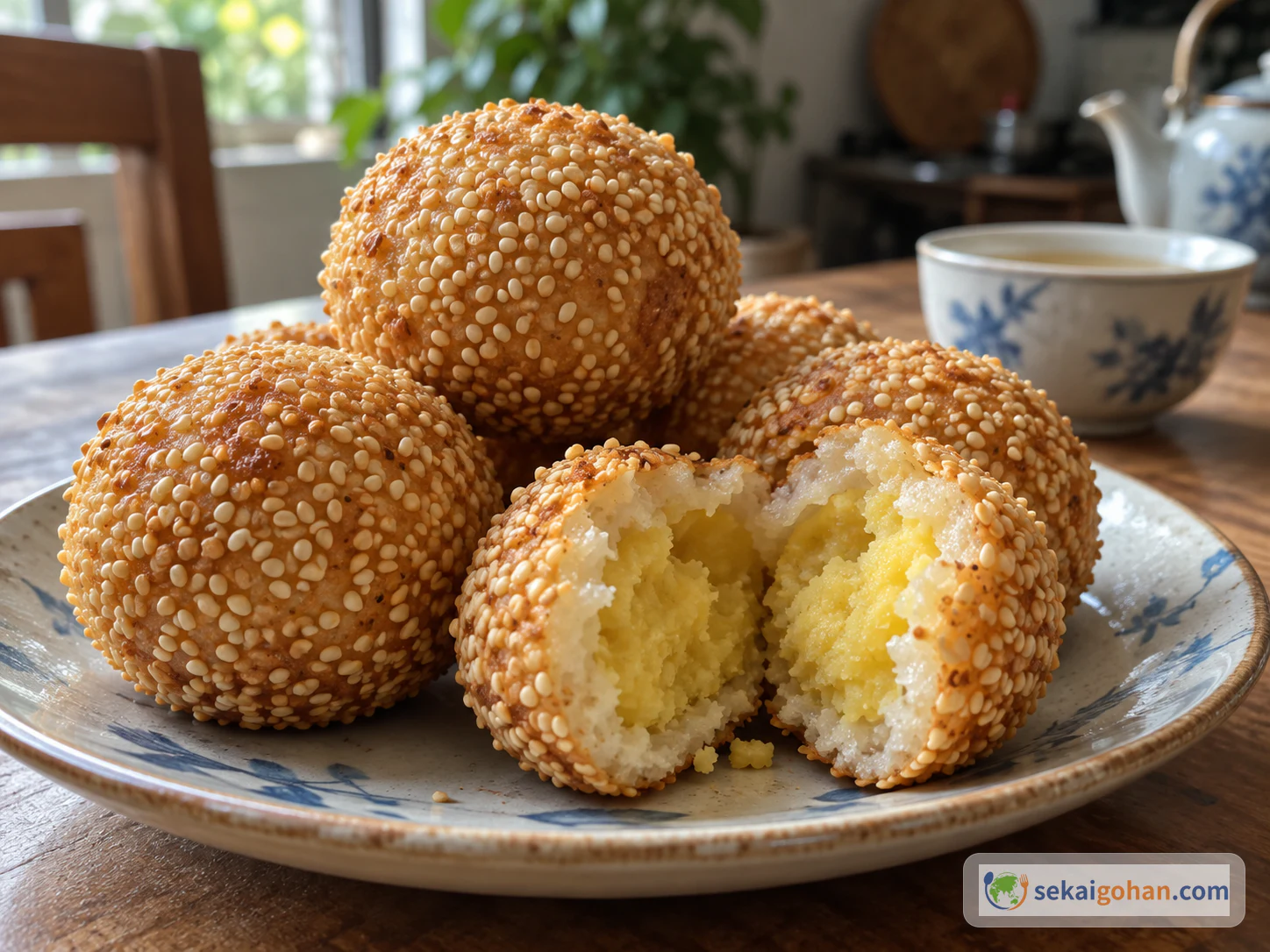
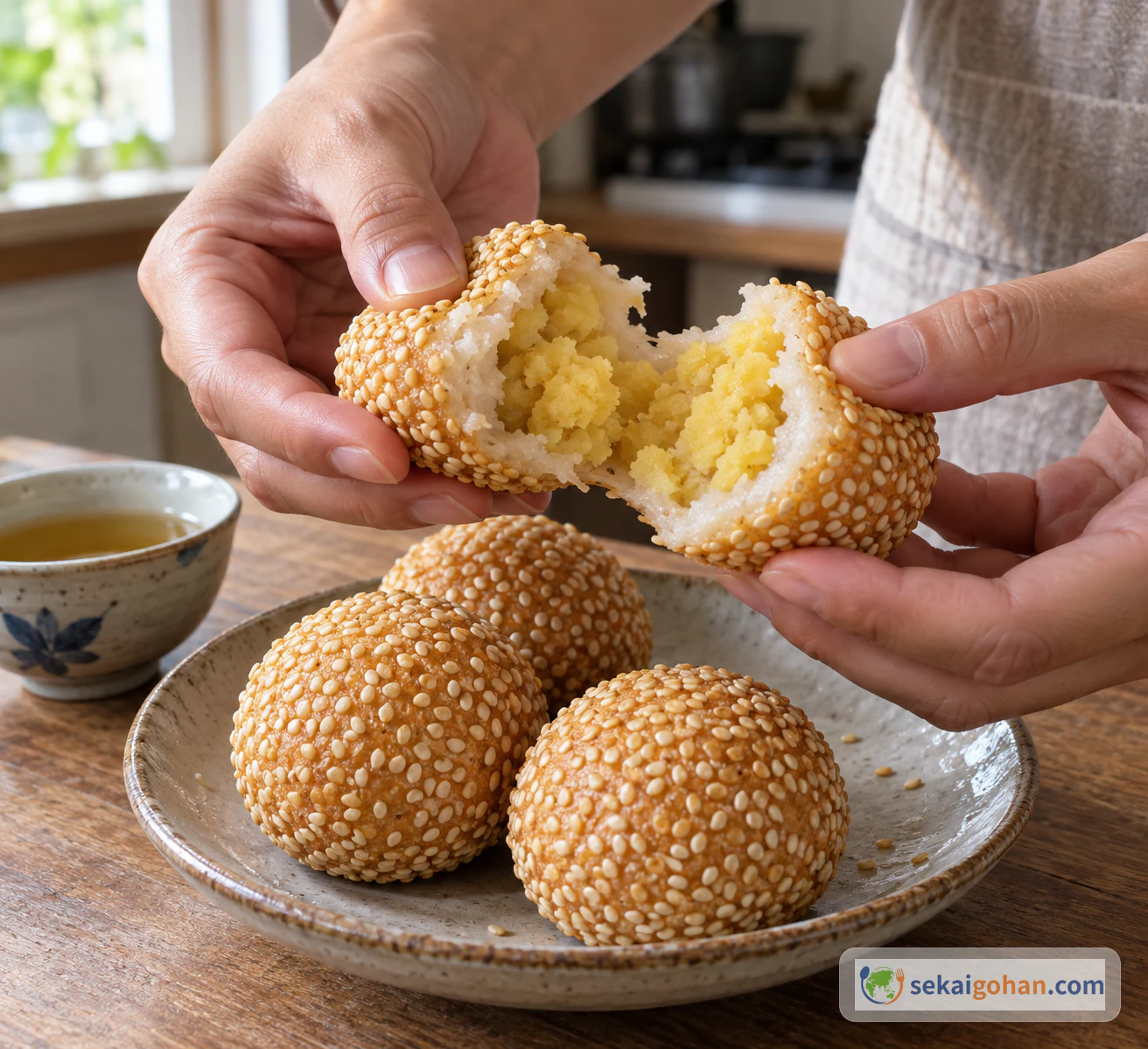
Southern Vietnamese bánh cam coated in white sesame, one broken open to show the glutinous rice shell and mung bean filling
Serves
10–12 pieces
Cuisine
Vietnamese

How to make bánh cam, the southern Vietnamese fried sesame ball: a sweet mashed mung bean filling wrapped in glutinous rice dough, rolled in white sesame and fried at 180°C until golden. Covers the source recipe's amounts for 10–12 pieces, wrapping without air gaps, reading the frying color, the northern name bánh rán, and how to judge the optional coconut.

Cooking flow

Cooking steps

STEP11 / 10

Rinse and soak the mung beans

STEP 1

Rinse 1/2 cup (100g) peeled split mung beans and soak them in water for 1 hour.

STEP22 / 10

Steam the beans until soft

STEP 2

Drain the beans and steam them for about 15 minutes, or until soft. They are ready when a bean crushes easily between your fingers. Do not mash beans that have only been soaked; they must be cooked through first.

STEP33 / 10

Mash the filling with sugar and oil

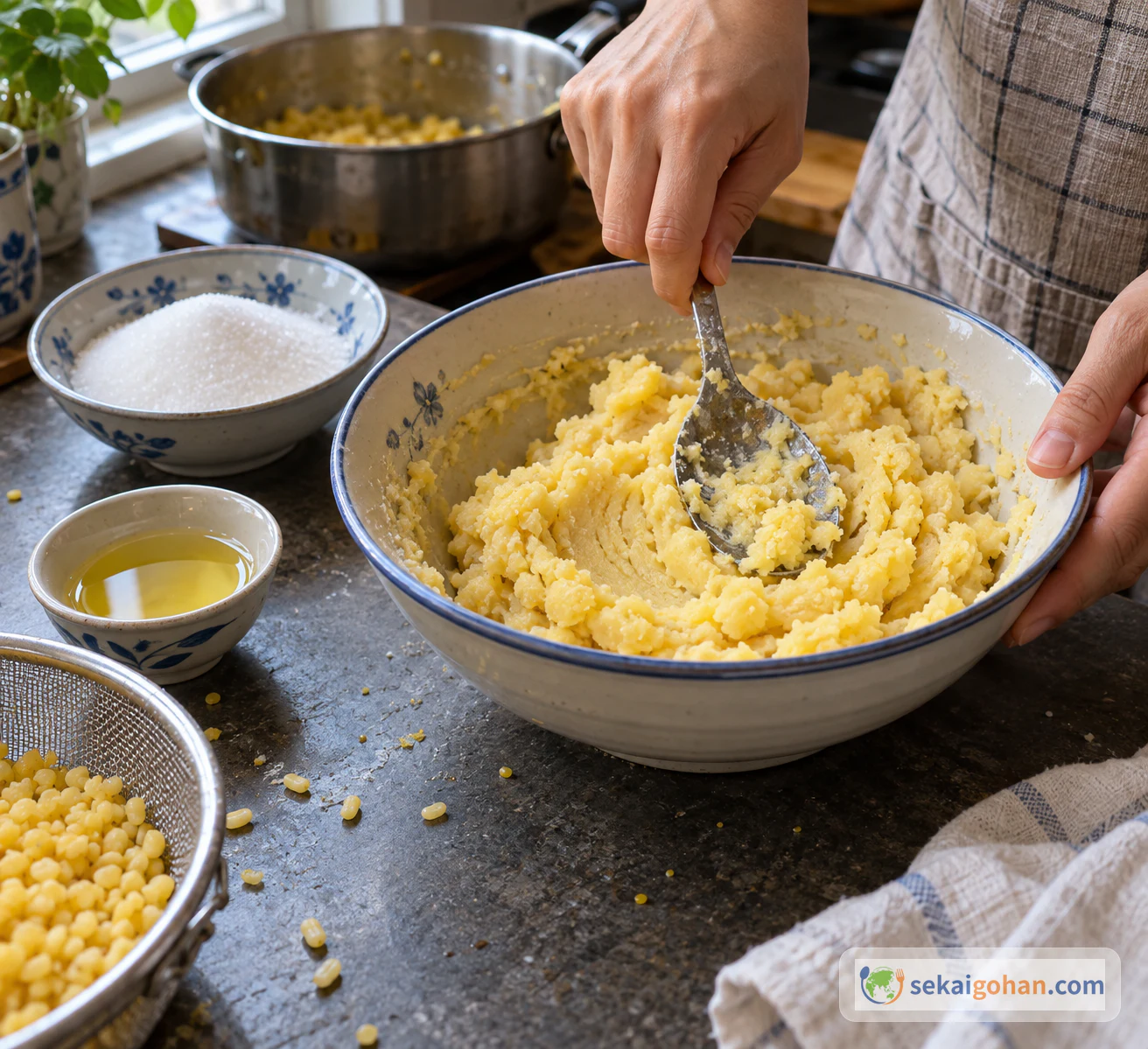
Steamed peeled split mung beans being mashed with sugar and vegetable oil into a thick filling
Mash the cooked beans into a thick paste, not a runny purée

While the beans are still warm, mash them finely in a bowl. Mix in the 4 tbsp sugar for the filling and 1 tbsp vegetable oil until you have a thick, smooth paste. No salt goes into the filling.

STEP44 / 10

Make the dough and rest it for 30 minutes

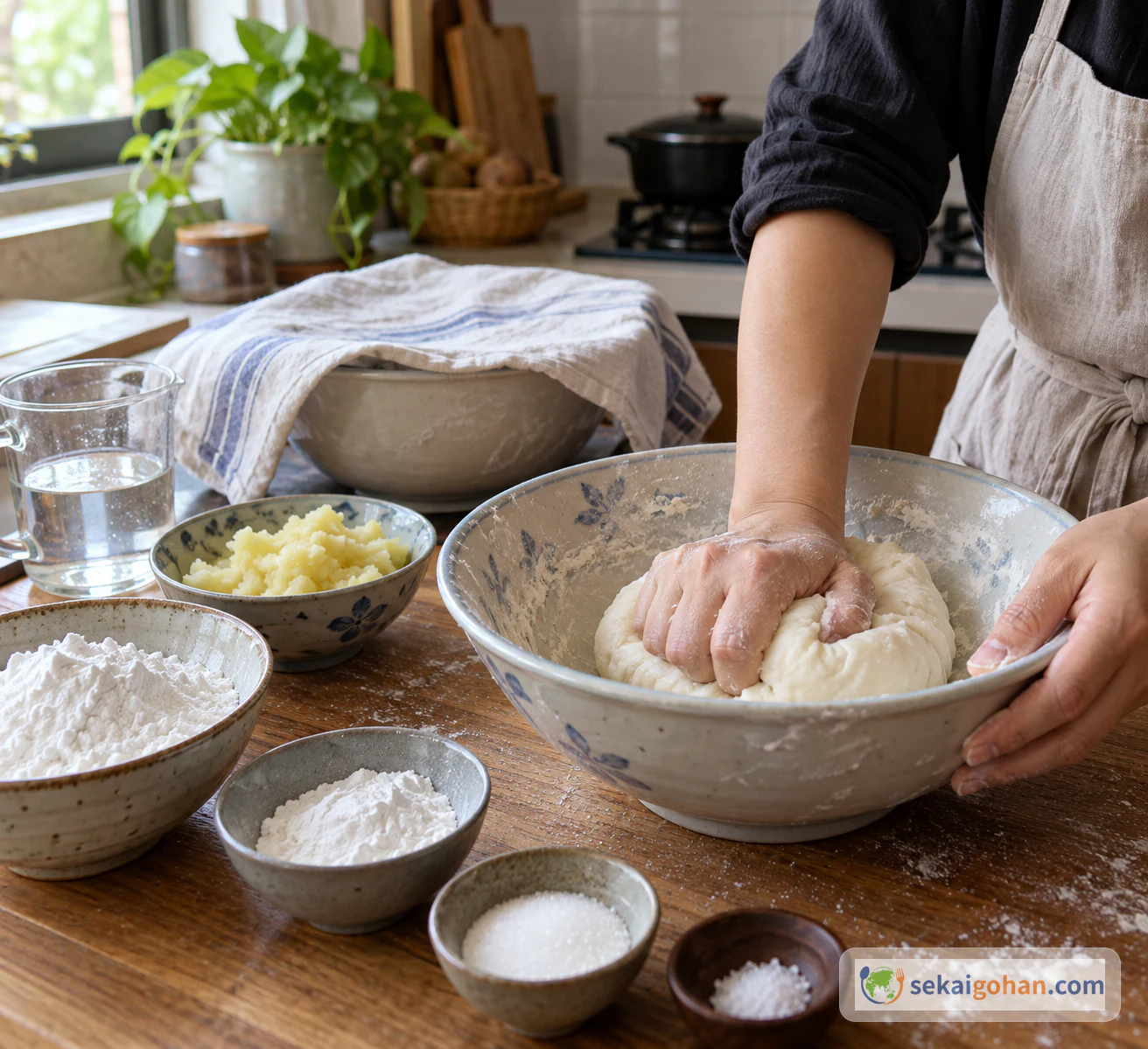
Hands kneading bánh cam dough of glutinous rice flour, rice flour, mashed potato, sugar, salt and lukewarm water
Add the water gradually until the dough holds together, then cover it to rest

In a mixing bowl, combine 2 cups (250g) glutinous rice flour, 2 tbsp white rice flour, 1/4 cup mashed potato, the 4 tbsp sugar for the dough and 1/2 tsp salt. Add the 200ml lukewarm water little by little, kneading as you go, until the dough comes together into a soft mass you can handle. Flours absorb water differently, and the amount may need to go a little up or down, so do not pour it all in at once.

Cover the dough and let it rest for 30 minutes.

STEP55 / 10

Divide the filling and dough into the same number of portions

STEP 5

Divide the filling and the dough into the same number of equal portions; the recipe makes 10–12 pieces. Roll each portion of filling into a ball.

STEP66 / 10

Wrap the filling and seal it into a ball

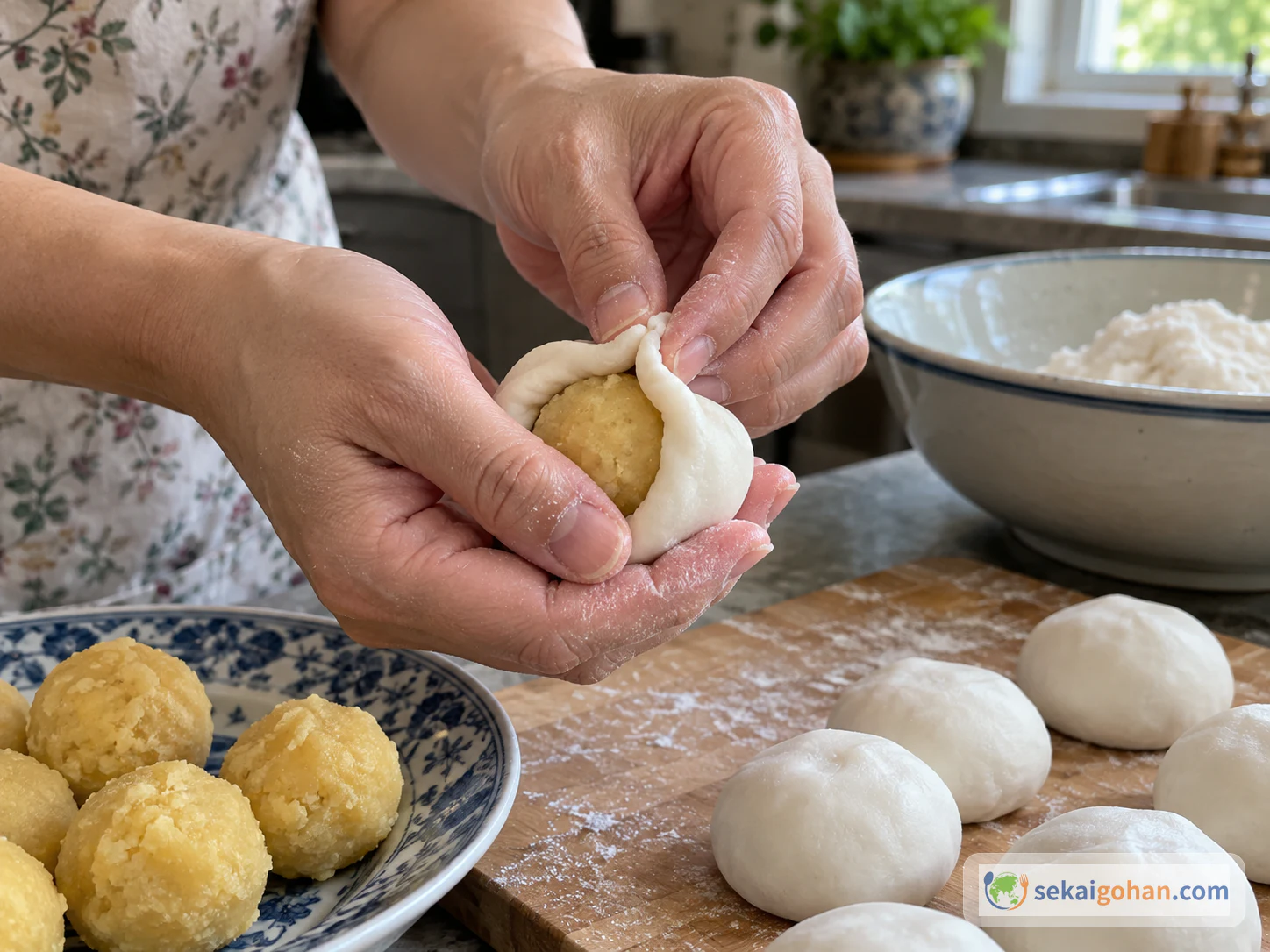
Hands closing a disc of glutinous rice dough around a ball of mung bean filling
Bring the dough up around the filling and seal the seam without trapping air

Flatten one portion of dough into a disc and set a ball of filling in the center. Draw the edges of the dough up around the filling and pinch the seam closed, pressing out any air as you go. Roll it gently between your palms into a round ball and check that no cracks or gaps remain. Repair any thin or torn spots before frying.

STEP77 / 10

Roll in white sesame seeds

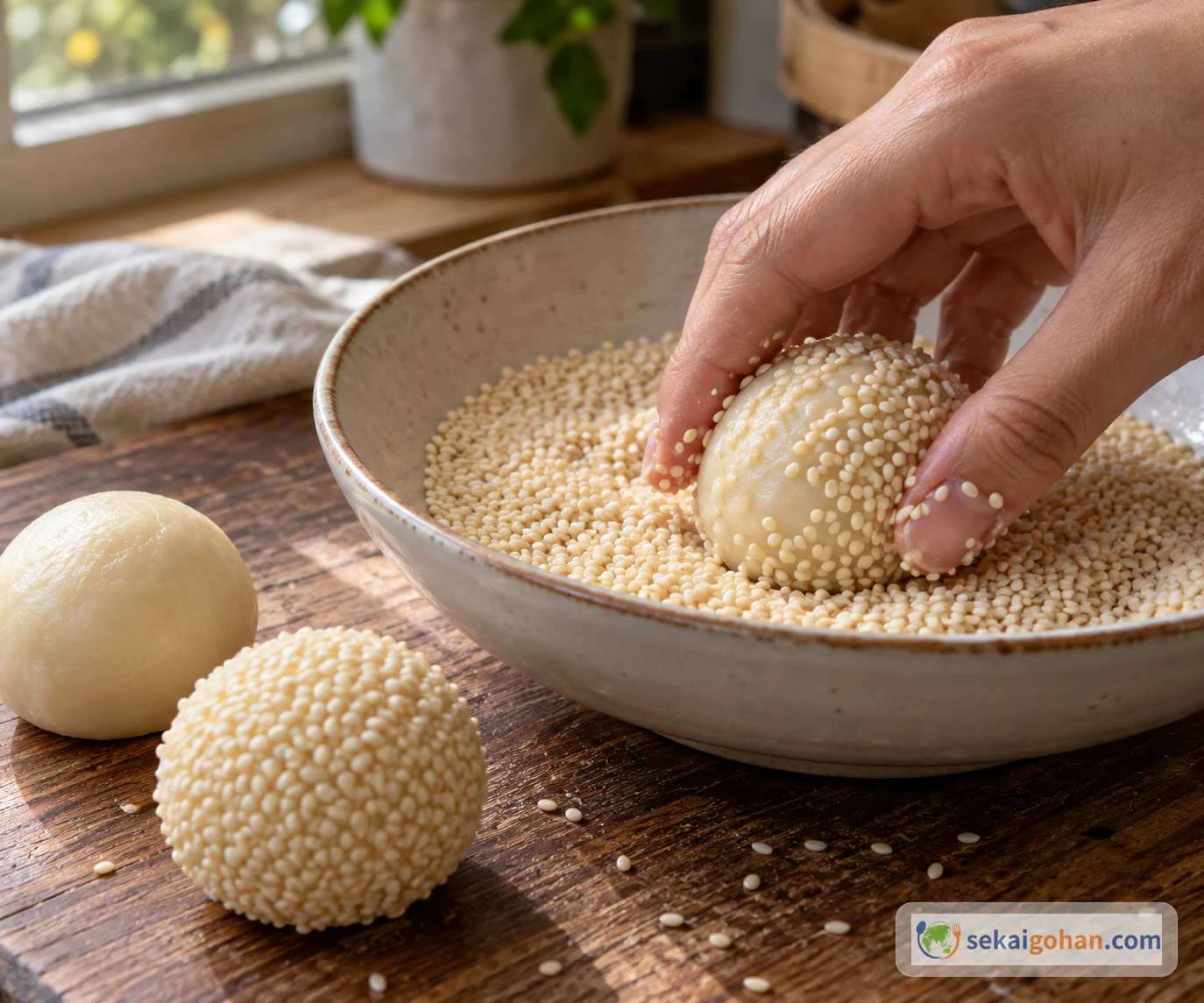
A shaped dough ball being rolled through white sesame seeds, next to an uncoated ball and a coated one
Roll each ball in sesame and press the seeds on by hand

Put the 1/2 cup white sesame seeds in a shallow bowl. Roll each ball through the seeds, then press them on with your hands so they stick. Some sesame will be left in the bowl.

STEP88 / 10

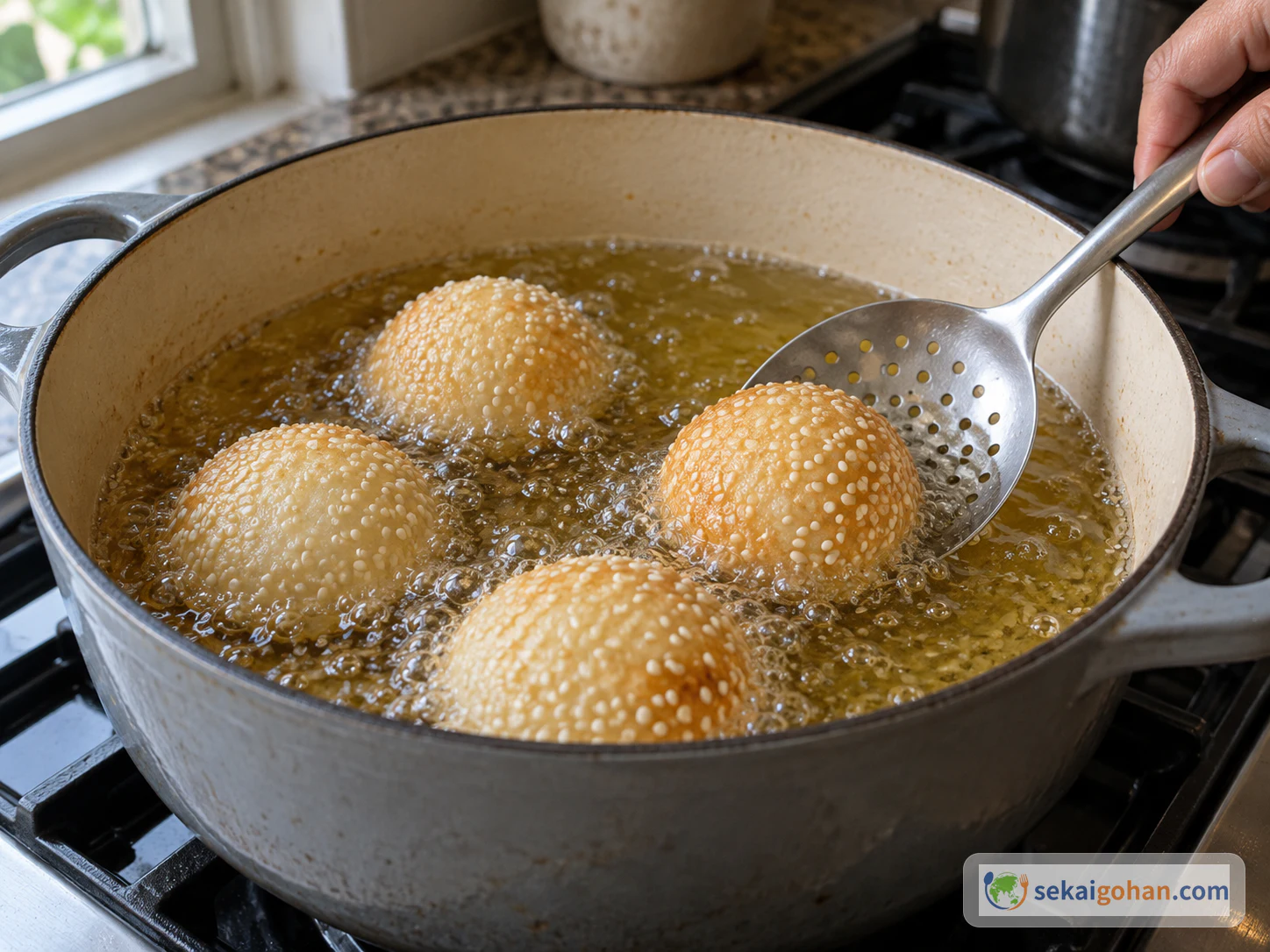
Fry at 350°F (180°C) until golden

Sesame-coated bánh cam frying a few at a time in oil heated to 180°C, still pale gold and being turned with a slotted spoon
Fry a few at a time and turn them now and then; they are not done while still pale and uneven

Pour vegetable oil into a deep, heavy pot to a depth of about 2 inches and heat it to 350°F (180°C), checking with a thermometer. Lower in a few balls at a time without crowding the pot, and turn them occasionally so they color evenly. Keep frying until the whole surface is golden.

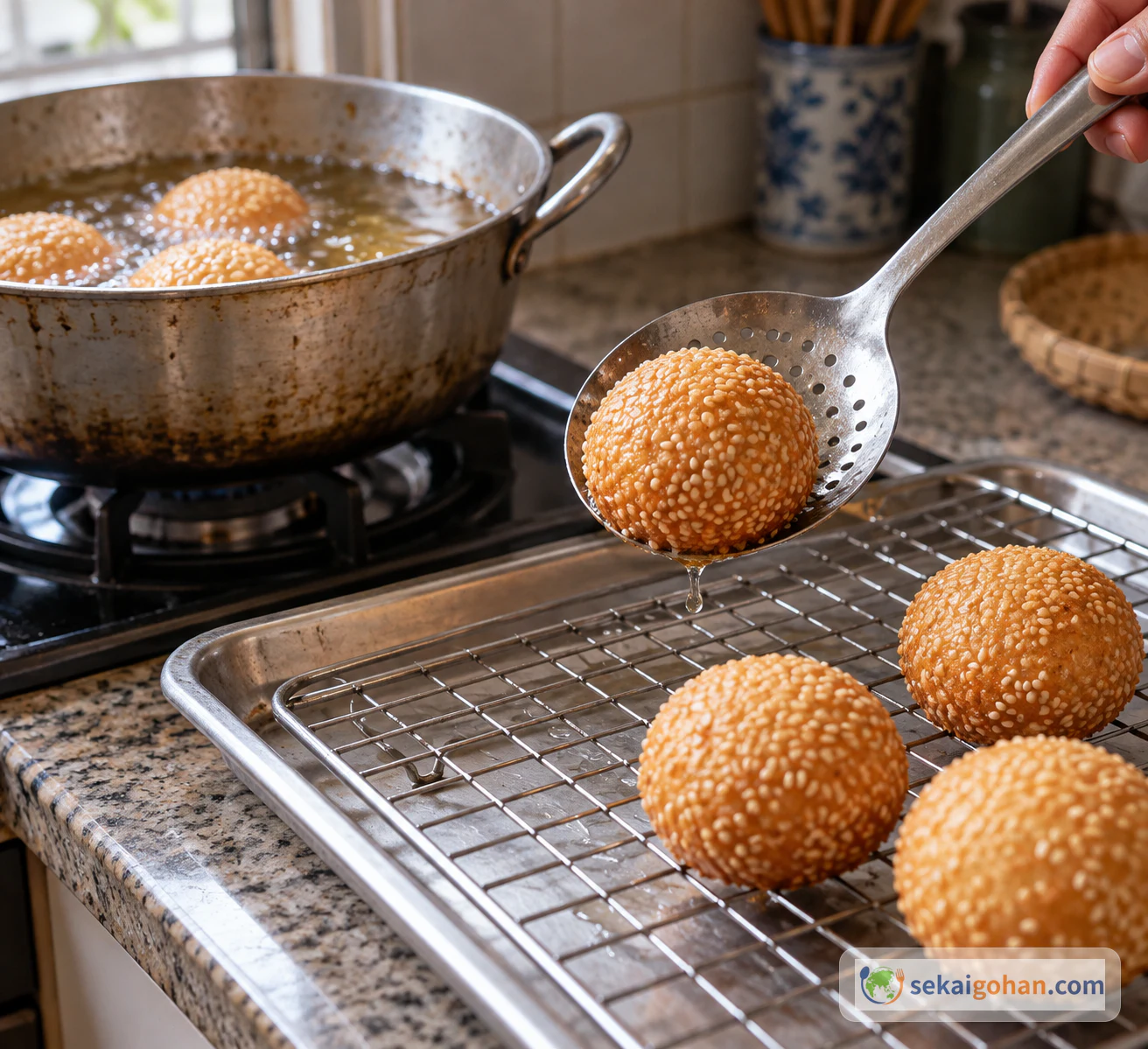
STEP99 / 10

Lift out and drain

A golden fried bánh cam being moved from the oil to a wire rack to drain
Move each golden ball onto a rack or paper to drain off the oil

When the balls are evenly golden, lift them out with a slotted spoon and drain them on a wire rack or paper.

STEP1010 / 10

Serve hot

A bánh cam broken open once cool enough to handle, showing the toasted sesame crust, glutinous rice shell and mung bean filling
Break one open once it is cool enough to hold; there is no need to cool them fully before eating

Serve bánh cam hot. Once a ball is cool enough to handle, you can break it open to see the yellow mung bean filling inside the pale rice shell under its golden sesame crust. A small natural gap near the edge is normal. They go well with tea or coffee.

0 / 0
Ingredients

Ingredients

1 / 1

Ingredients

Ingredient Amount Role
Peeled split mung beans (đậu xanh cà vỏ) 1/2 cup (100g) Filling. Rinse and soak for 1 hour before cooking
Sugar, for the filling 4 tbsp Sweetens the mashed beans
Vegetable oil, for the filling 1 tbsp Mixed into the filling for a smooth paste; separate from the frying oil
Glutinous rice flour (bột nếp) 2 cups (250g) The chewy base of the shell
White rice flour (bột gạo) 2 tbsp Part of the shell dough
Mashed potato 1/4 cup Part of the shell dough
Sugar, for the dough 4 tbsp Sweetens the shell
Salt 1/2 tsp For the dough only
Lukewarm water 200ml Brings the dough together; add gradually, as the amount needed varies with the flour
White sesame seeds (mè trắng) 1/2 cup Rolled over the shaped balls before frying
Vegetable oil, for frying Enough for a depth of about 2 inches Heated to 180°C for deep-frying
0 / 0

In the pot, small bubbles gather around pale, sesame-covered balls, and as they turn in the oil the seeds slowly shift from white to gold. Break one open and you find a soft yellow paste of mashed mung beans inside a pale, stretchy rice-flour shell. Bánh cam is a fried sweet from southern Vietnam, sold as a snack and eaten with tea or coffee. Each bite brings toasted sesame, a chewy glutinous rice shell, and a filling that is gently sweet and soft.

Bánh Cam and Bánh Rán

Bánh cam is the southern name for this sesame-coated fried sweet. In the north the same kind of sesame ball is called bánh rán. The southern name is said to come from the ball's round shape, which resembles an orange (cam). Bánh cam is also described as a Chinese-influenced sweet.

Southern sellers don't agree on coconut. Some fold shredded young coconut into the mung bean filling and others leave it out. This version leaves it out, so the mung bean flavor stays at the center.

Making bánh cam at home comes down to three things. The mung bean filling should be mashed smooth and seasoned simply with sugar and oil. The glutinous rice dough should be brought together slowly with water. The oil needs to stay at the right temperature so the balls color evenly.

For more dishes from the same country, see our Vietnam recipes.

Ingredients (Makes 10–12 Pieces)
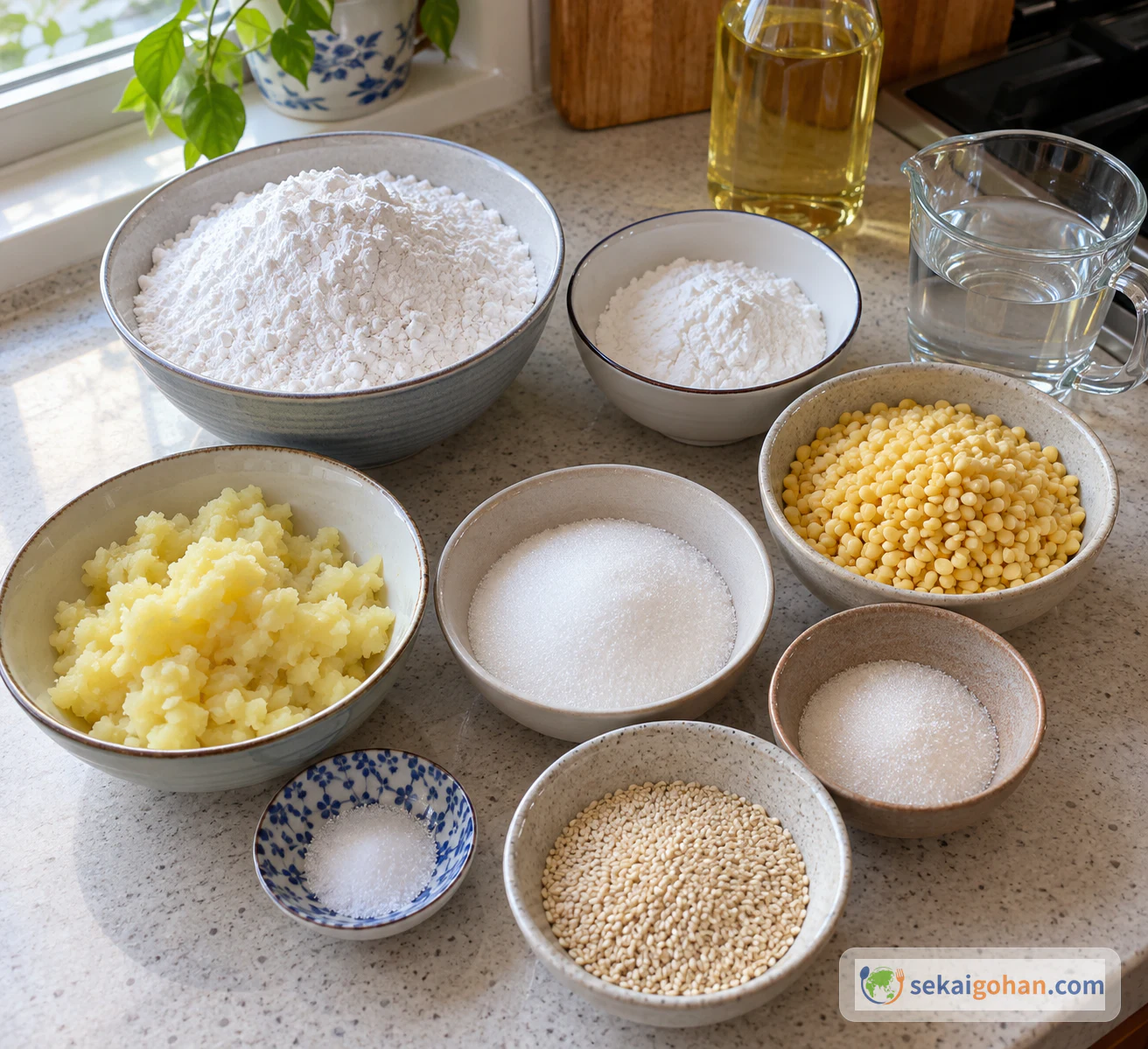
Ingredients for bánh cam in separate bowls: glutinous rice flour, rice flour, peeled split mung beans, sugar, potato and white sesame
The filling, the dough and the coating each use their own ingredients; sugar goes into both the filling and the dough

The yield is a count of pieces, not servings. Where a weight is given in brackets, it is shown too. Sugar appears twice: 4 tbsp for the filling and a separate 4 tbsp for the dough. Salt goes only into the dough, never into the filling.

Equipment

  • Steamer (or a rice cooker, if you use the alternative method for the beans)
  • Bowl and a sturdy spoon or masher for the filling
  • Mixing bowl for the dough, plus a cloth or lid to cover it
  • Shallow bowl for the sesame seeds
  • Deep, heavy pot for frying
  • Kitchen thermometer to confirm 350°F (180°C)
  • Slotted spoon
  • Wire rack or paper for draining

Choosing Ingredients for Bánh Cam

Mung beans. Look for peeled split mung beans, which are yellow inside, at Asian grocers or online. Whole green mung beans with their skins are a different product.

Glutinous rice flour. This is what makes the shell chewy, and ordinary rice flour can't take its place.

Mashed potato or potato flakes. In place of the 1/4 cup mashed potato, you can use 2 tbsp potato flakes plus 4 tbsp hot water. Use one or the other, not both.

Cooking the beans. This version steams the soaked beans, but a rice cooker works too, with 1/2 cup water or enough to cover the beans. Pick one method. If you steam, leave that 1/2 cup water out of the filling.

Allergy notes

This recipe contains sesame. Check the labels of the mung beans, rice flours and any other packaged ingredients for allergen information and shared-facility statements.

Method: Filling, Dough, Wrapping, Sesame and Frying

Read the color, not the clock

The beans soak and the dough rests, but there is no fixed frying time. Fry by the color: an even golden brown.

Frying safety

Stay with the pot the whole time the oil is hot. Keep water and wet utensils away from the oil, and lower each ball in gently. Fry only balls whose seams are fully closed and free of cracks.

Fixing Bánh Cam Problems

Problem Likely cause What to do
The dough won't come together Flour absorbs water differently Keep adding the lukewarm water a little at a time, rather than all at once
The filling is hard to wrap Beans not soft enough or not mashed finely Make sure the beans are fully soft before mashing, and mash until smooth. Don't add extra ingredients to stiffen it
Cracks or gaps after wrapping Seam not fully closed, or air trapped Reseal and reshape before coating. Press out air as you close the dough
Uneven color Oil not at temperature, crowded pot, not turned Confirm 350°F (180°C), fry fewer at a time, and turn the balls occasionally
Sesame falling off Seeds not pressed on Press the sesame on with your hands after rolling. Some natural loss in the oil is normal

Some imperfection is normal. The sesame can look patchy, the balls won't always be perfect spheres, and a cut ball sometimes shows a thin gap between filling and shell. What you want to avoid is a ball that has burst open, a hollow with little filling, or raw dough inside.

Serving and Variations

Bánh cam is best hot, with a cup of tea or coffee alongside, so fry only as many as you plan to eat.

For a coconut version, mix 1/4 cup shredded young coconut into the filling along with the sugar and oil. If you'd rather have a chewier ball where the shell comes forward, wrap a little less filling in each one.

Frequently Asked Questions

Can I use regular rice flour instead of glutinous rice flour?

No. Glutinous rice flour is what gives the shell its chew, and regular rice flour would change the texture.

What oil temperature and frying time should I use?

Heat the oil to 350°F (180°C) at a depth of about 2 inches. There is no fixed frying time. Fry until the balls are evenly golden all over, turning them occasionally.

Sources

  • Helen Le, "Sesame Balls – Bánh rán / Bánh cam," Helen's Recipes. The recipe followed here: all ingredient amounts, the 10–12 piece yield, the 30-minute dough rest, frying at 180°C in oil about 2 inches deep, the northern and southern names, and the author's description of the sweet as Chinese-influenced. https://helenrecipes.com/recipe-sesame-balls-banh-ran-banh-cam/
  • Hungry Huy, "Sesame Balls Recipe (Vietnamese Bánh Cam)." The southern bánh cam, variation in coconut use between sellers, eating it as a snack with tea or coffee, and the advice to avoid air pockets when filling. Its own recipe uses different proportions and is not used here. https://www.hungryhuy.com/banh-cam-banh-ran-recipe-vietnamese-fried-sesame-balls/
  • Nhã Linh, "Cách làm Bánh Cam bằng bột nếp với nhân đậu xanh," Food Vietnamese. The Vietnamese name, its presentation as a southern sweet, and the site's explanation that the name comes from the round, orange-like shape. Its recipe is a different method and is not used here. https://foodvietnamese.com/vi/cach-lam-banh-cam/