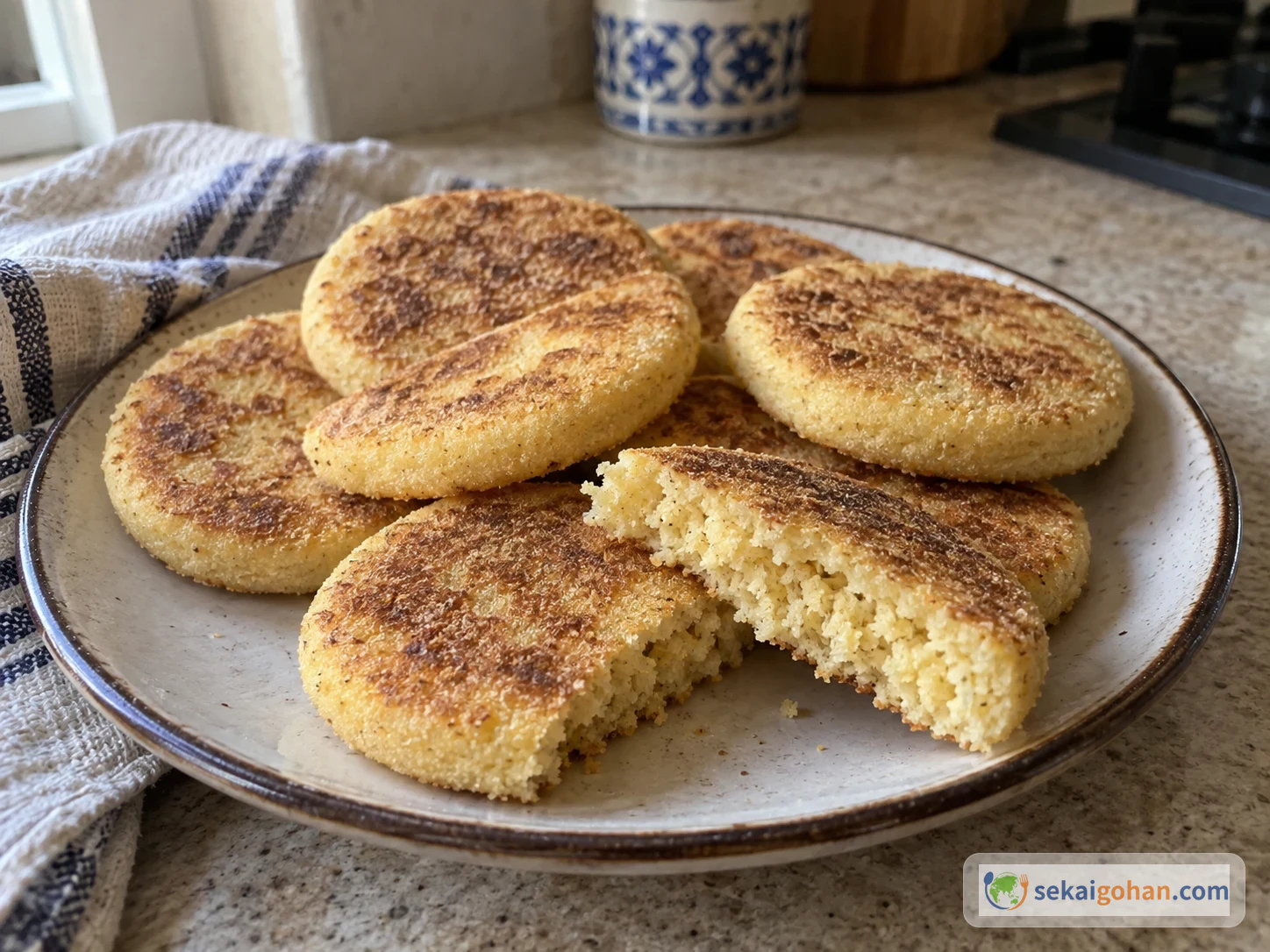
Let harcha cool a little before you split it horizontally with a bread knife, because it crumbles easily while it's piping hot. The outside keeps the rough feel of fine semolina grains, and the inside is a tender dough that falls apart. Spread a thin layer of jam on the cut face or tuck in some cheese, and tea time in Morocco begins. Harcha is a Moroccan semolina flatbread cooked on both sides in a skillet and leavened with baking powder, so there's no long fermentation to wait for. A bread that lets you enjoy the grain of semolina: that is harcha.
Harcha on the Moroccan Table
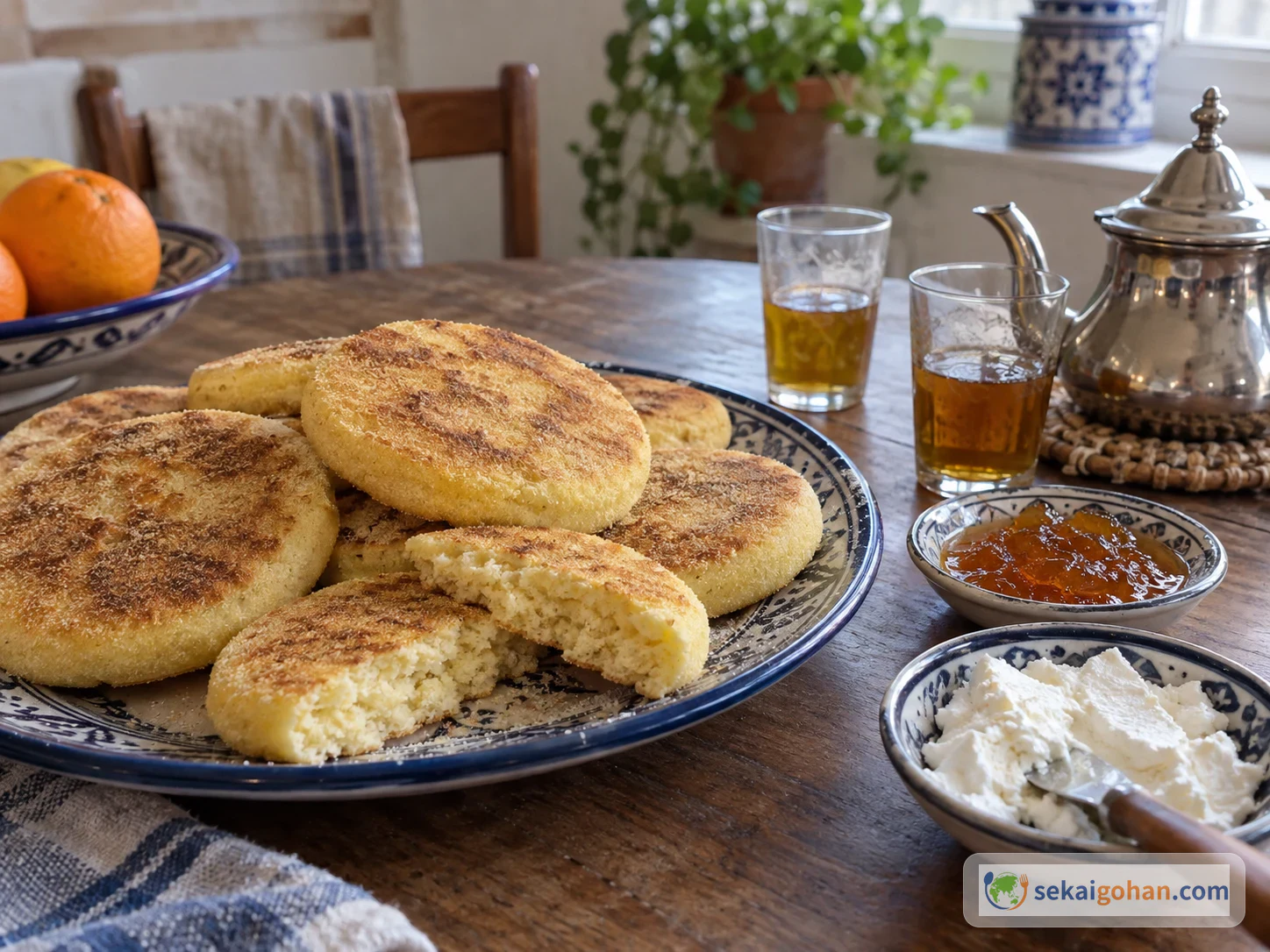
Harcha shows up at both breakfast and afternoon tea, alongside butter, honey, jam, and cheese. Some people cut it horizontally and fill it. Others leave it whole, set the toppings out beside it, and tear off pieces as they eat.
It's called bread, but it has little in common with a stretchy, fluffy fermented loaf. It's closer to cornbread, with a crumbly texture that falls apart. That's why it works as well with salty cheese as it does with sweet jam or honey, and why the dough stays a bread rather than a pastry.
The name is spelled Harcha or Harsha, written حرشا in Arabic, and it refers to a coarse, rough surface. Cook it with semolina clinging to the outside and that's exactly what you get: fine grains you can still see and feel.
The same name also covers harcha dyal ferran, or harcha au four, a semolina cookie baked in the oven. Moroccan snack shops sell large versions, some flavored with anise, raisins, and sesame. Both its formula (eggs, wheat flour, sugar, and so on) and its method differ from the skillet flatbread here, so this dough can't simply go into the oven instead.
Household Formulas and Shapes
There is no single formula for harcha. One version uses 3.5 oz (100 g) butter, ½ cup (100 ml) milk, and 9 oz (250 g) semolina. Another household formula uses olive oil and water and combines yeast with baking powder; there, the yeast is pre-activated for 10 minutes and the dough rests 10 to 15 minutes. Those times belong to that dough only. The baking-powder dough in this recipe rests just 5 minutes, long enough for the flour to absorb moisture.
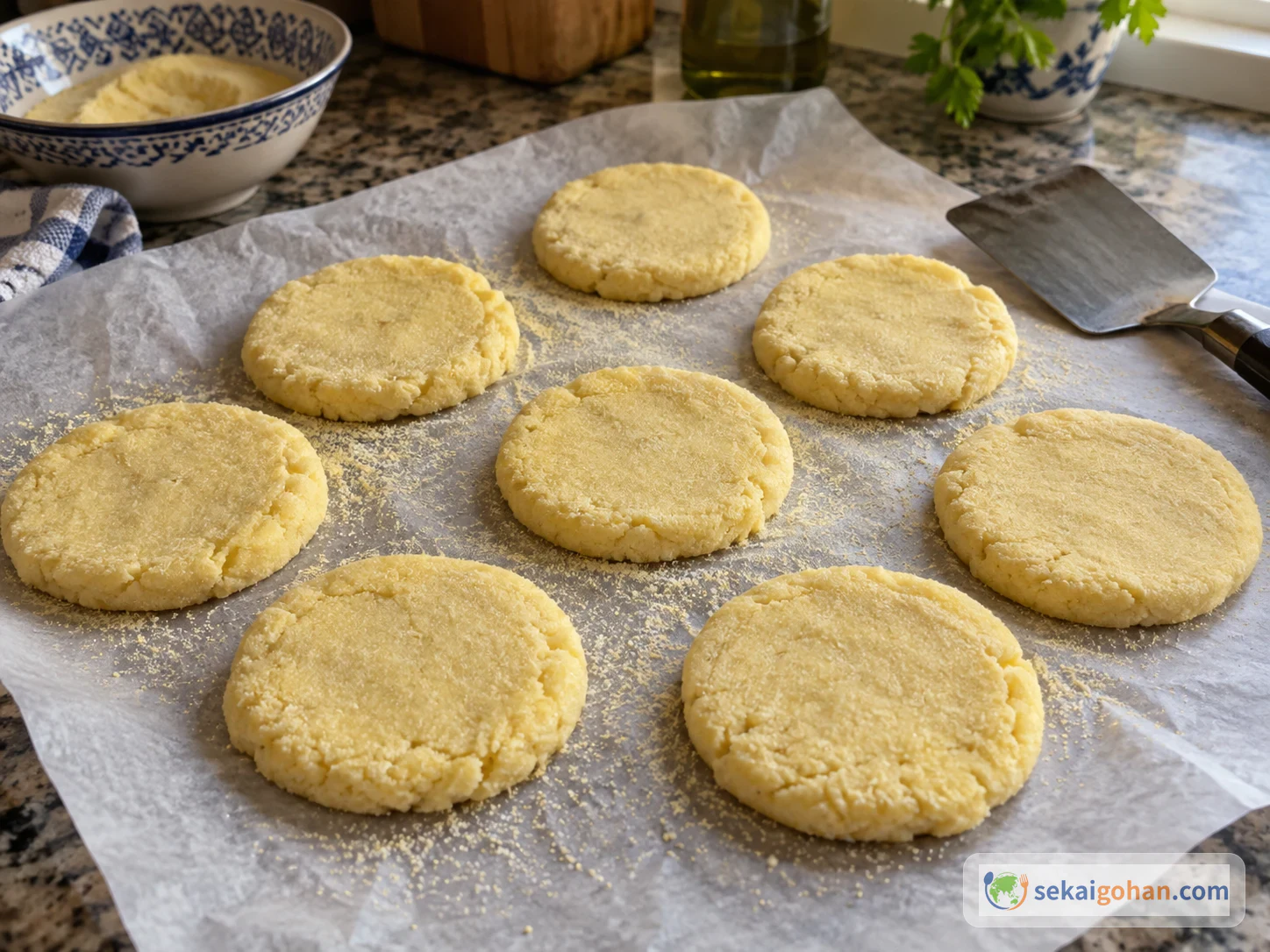
The shape is just as flexible. Harcha can be one large round or several small ones, crisp when cooked thin and soft when cooked thick. This recipe makes 8 small rounds about 3.5 inches (9 cm) across, cooked in two batches of 4 in a skillet around 10 inches (26 cm), and takes about 60 minutes. Small rounds are easy to support with a wide spatula. A single large round handles differently and heats through to the center differently, so the timing for 8 pieces won't carry over.
Harcha is cooked on both sides, which sets it apart from baghrir, cooked on one side only so the surface forms holes, and from msemen, prized for its folded layers. For more Moroccan breads, see how to make baghrir and how to make msemen.
Ingredients (serves 4)
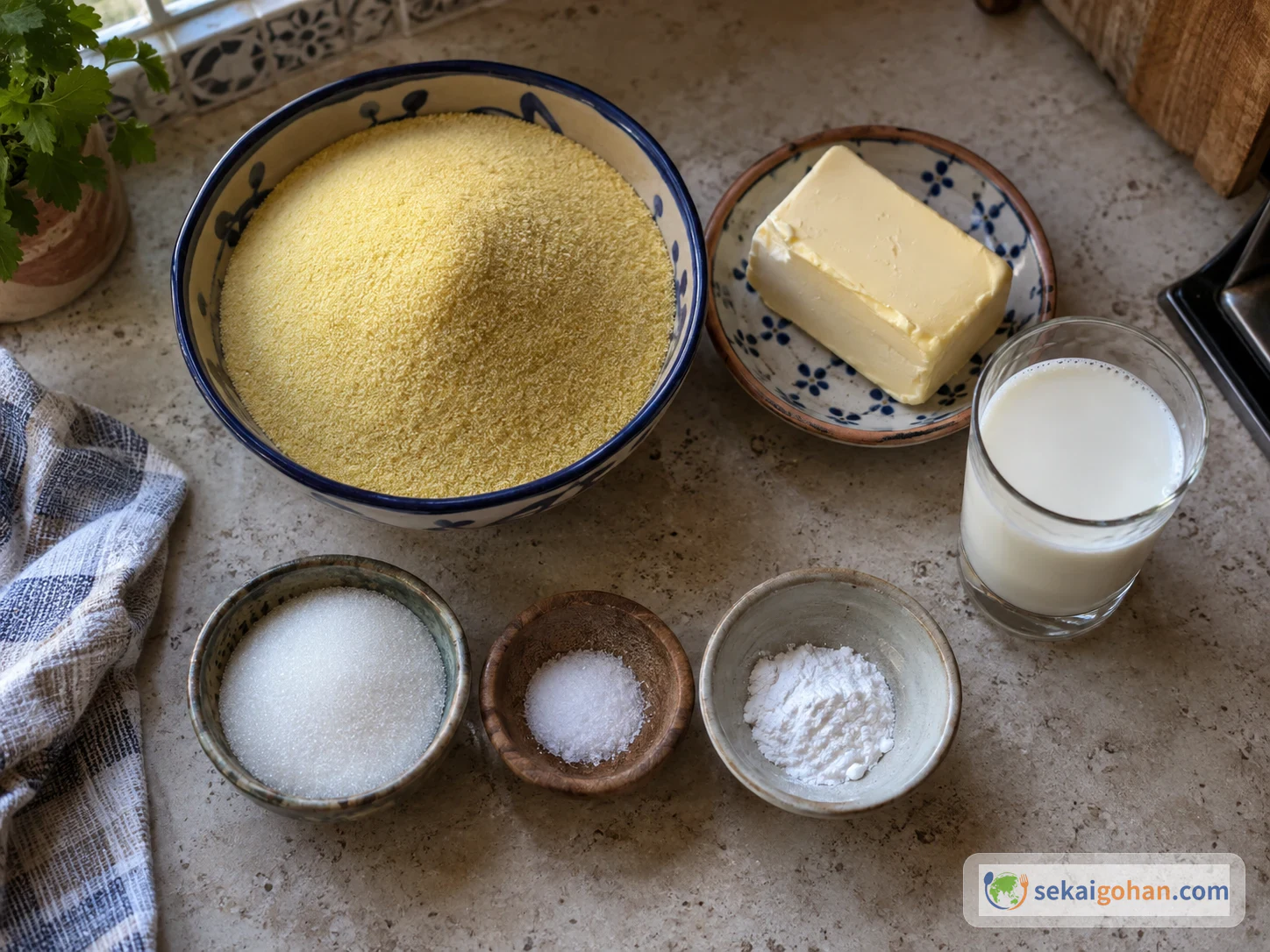
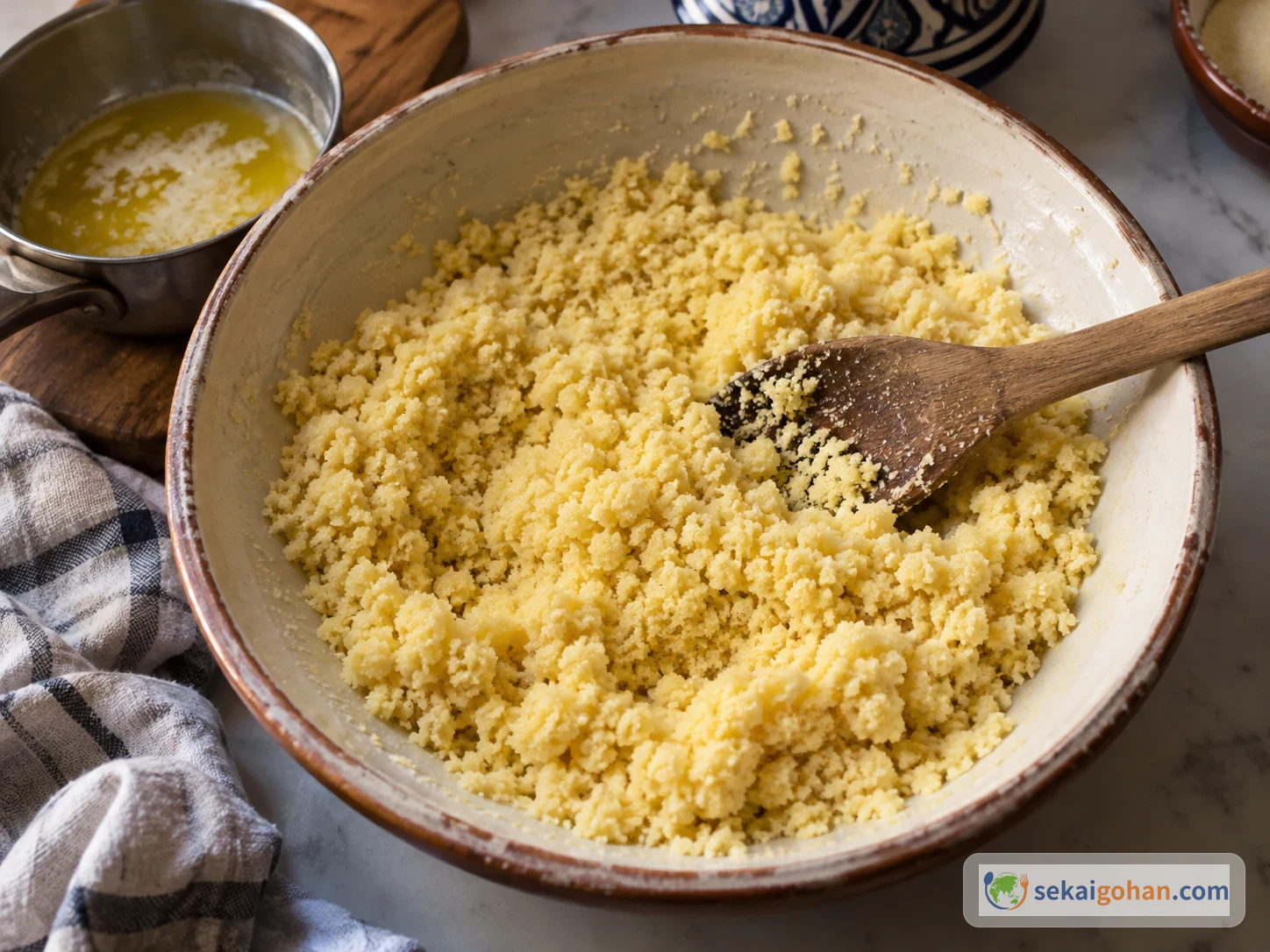
Make 8 small rounds about 3.5 inches (9 cm) across and 7 to 8 mm thick, and divide them among 4 people, 2 pieces each. The base is 9 oz (250 g) semolina, 3.5 oz (100 g) butter, and ½ cup (100 ml) milk, with 25 g sugar, 1.5 g salt, and 3 g baking powder. Start with ½ cup (100 ml) of milk. After resting, check the dough and add milk 1 tsp (5 ml) at a time, up to 1.5 tbsp (20 ml) in total. Don't add the full amount from the start.
Look for fine semolina. It is different from finely milled durum flour, so check the grain size in the product description. Look for the generic name "semolina" at baking-supply stores or online. Ordinary cake flour will not give the texture of the grain. What you need is fine-ground durum semolina; the grain size on the bag is the clue. Choose semolina that is fine but still has grain. This is the only specialty ingredient; butter, milk, sugar, salt, and baking powder come from ordinary shopping.
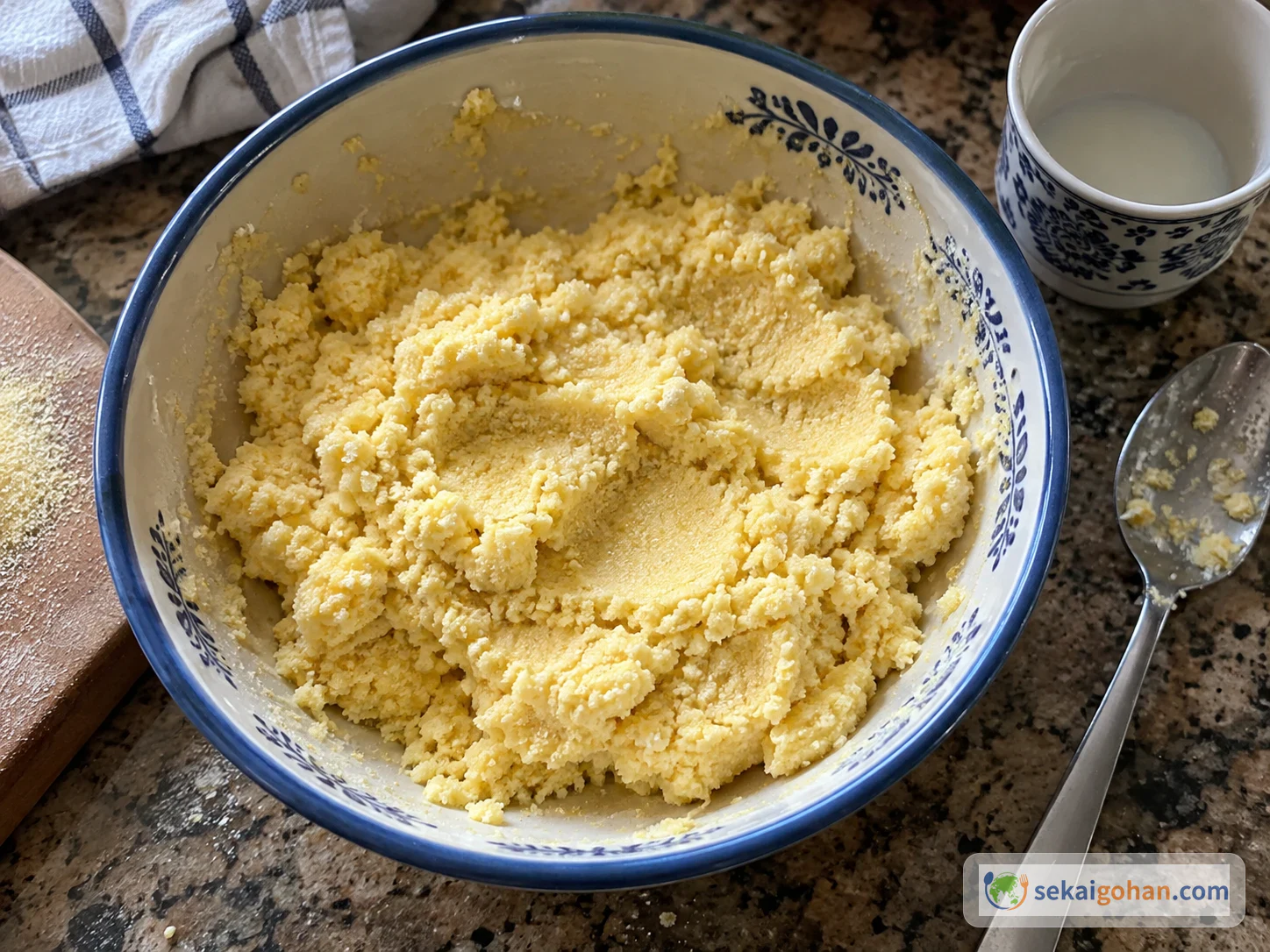
The dough firms up between right after the milk goes in and 5 minutes later. After resting, press it to check whether it holds together. Only when it is dry and cracks, add milk 1 tsp (5 ml) at a time, and stop at 1.5 tbsp (20 ml). If it still won't hold together, recheck the grain size of the flour and your measuring.
Choosing Semolina for Harcha
This bread depends on the grainy texture of semolina, so choose a fine semolina that still has some grain to it. A label that says durum wheat isn't enough on its own, since finely milled durum flour is a different product. Cake flour won't work as a full replacement.
Method
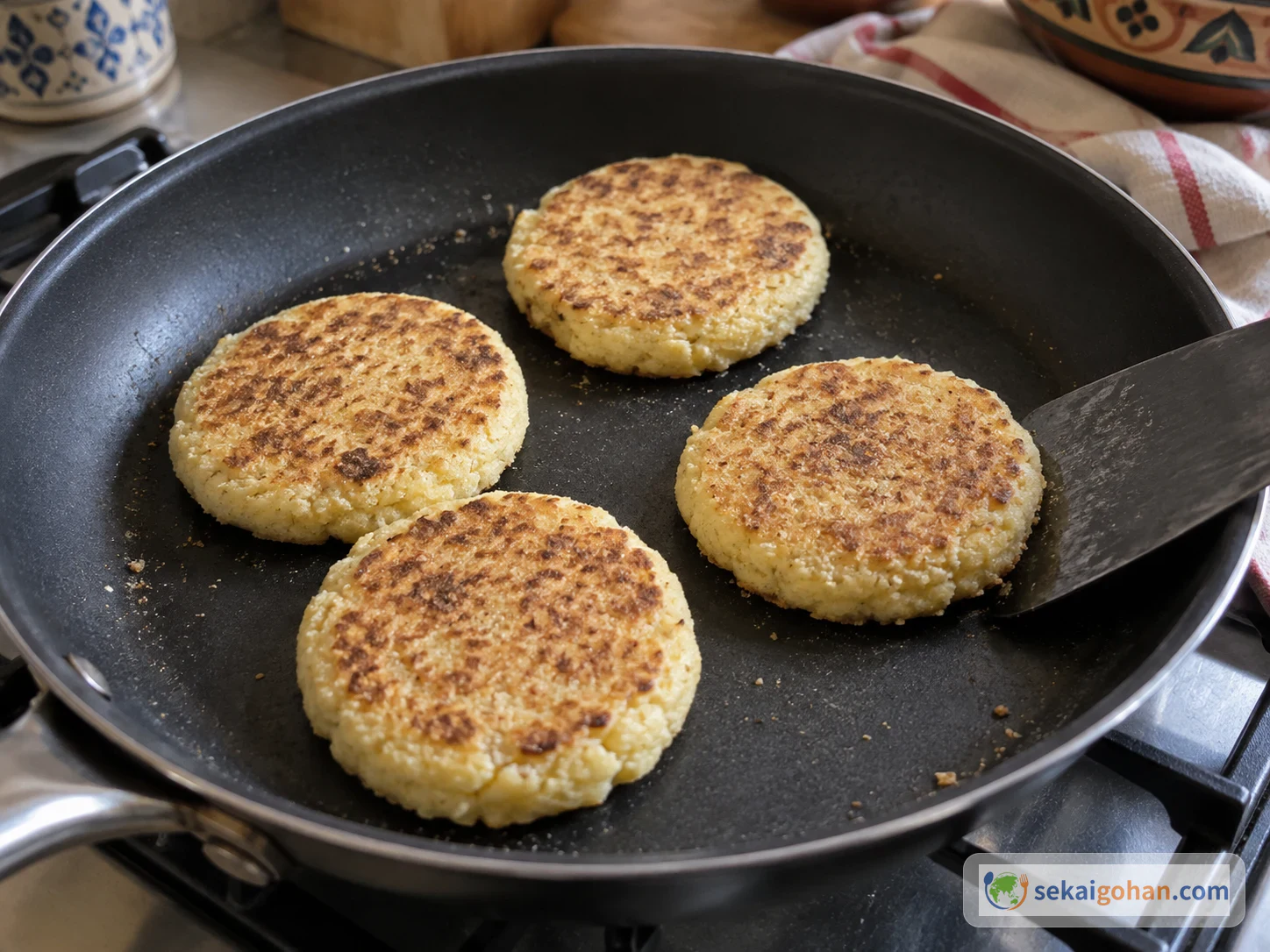
You will need a nonstick skillet around 10 inches (26 cm), a bowl, a wide spatula, and a scale. Cook 4 at a time, in two batches. If 4 pieces would overlap in your skillet, cook fewer at a time; the total time grows accordingly. The parchment is only for the work surface and stays out of the skillet. Support the dough with a wide spatula so you can carry it without breaking it.
On high heat only the outside scorches and the center doesn't cook. Look together at the color of the surface, the dryness of the edge, and the cross-section of one piece cooled slightly. Cooking time changes with the skillet and the heat, so the trick is not to aim for a deep brown.
Let it cool about 5 minutes before cutting. Cut horizontally in half with a sharp bread knife. Set the bottom face on the board, and keep your fingers out of the blade's path. If it looks likely to break apart badly, don't force a horizontal cut; serve the toppings on the side and tear the bread by hand.
Common Harcha Problems and Fixes
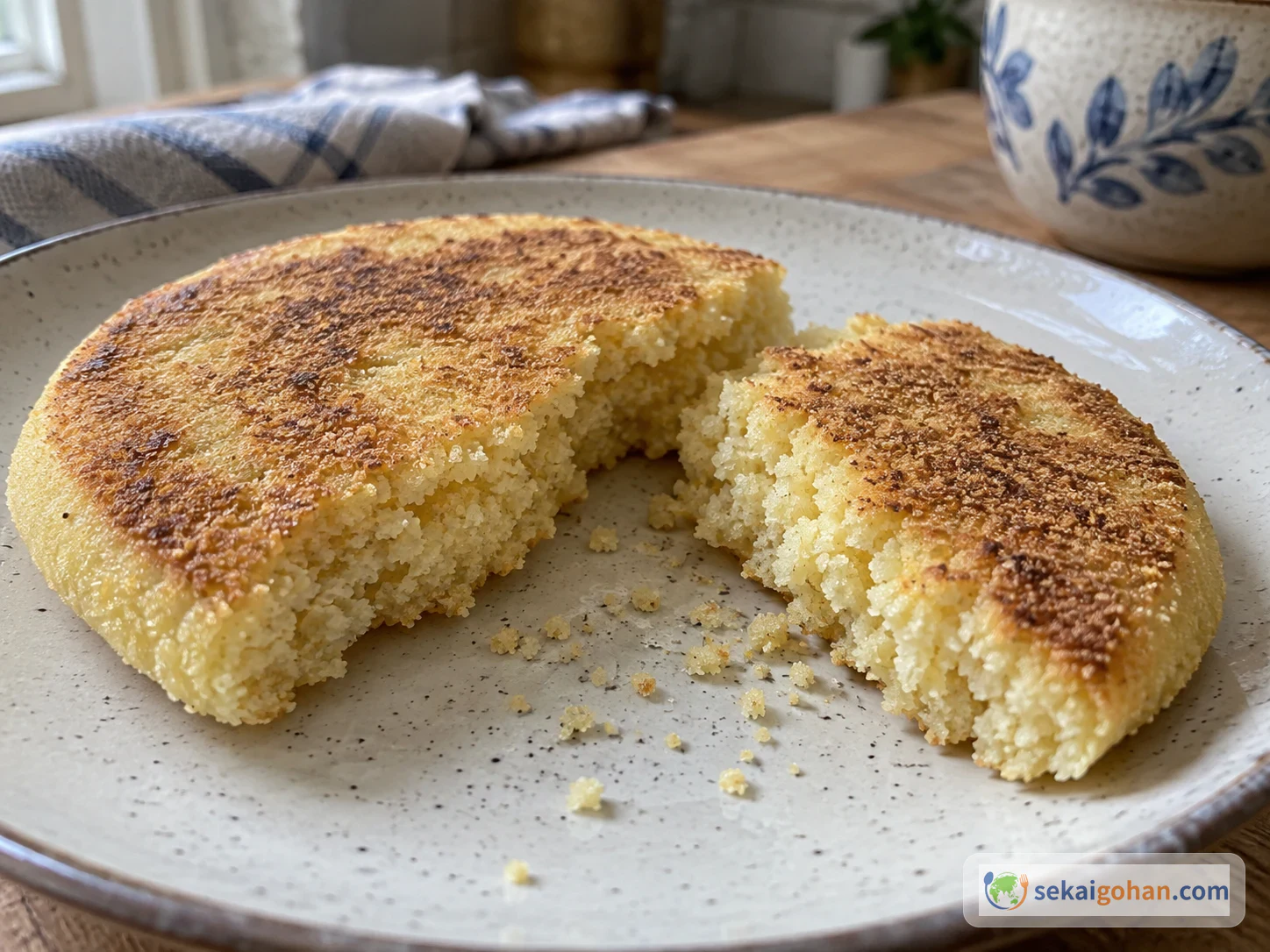
Most of the work comes down to the flour and the heat. Cook it through over low heat and you get a golden outside and an inside whose grains fall apart. Finished harcha won't have the elasticity or height of sandwich bread; its crumbly cross-section is its charm. If you want more rise, look at the grain size of the flour, the moisture, the thickness, and the heat rather than adding more baking powder.
Separating scorch from undercooking tells you what to do next. A cracked edge can be fixed by rechecking the moisture or the shaping, but a surface that has scorched and turned bitter won't come back. When the outside has colored and the center is still damp, keep the heat low and cook longer, and next time aim for an even 7 to 8 mm. If a round falls apart right after cooking, let it cool slightly before touching it instead of reaching for more flour.
| Symptom | What to check | How to recover / adjust next time |
|---|---|---|
| Edges crack badly when shaping | Whether the dough is dry after absorbing | Add milk 1 tsp (5 ml) at a time. Up to 1.5 tbsp (20 ml) of adjustment |
| Dough runs and won't hold shape | Too much milk, not rested enough | Rest 5 minutes first. Recheck the measuring and don't add a lot of flour |
| Only the surface quickly turns dark | Heat level and an overheated skillet | Take it off the heat to cool, then restart over low heat |
| Damp dough left at the center | Uneven thickness, undercooked | Add 1 to 2 minutes per side over low heat and recheck the cross-section |
| Crumbles when cut horizontally | Too hot, dull knife | Cool slightly and use a sharp knife. You can serve the toppings on the side |
Serving Harcha, Sweet or Savory
Change the topping and the same harcha becomes a different breakfast. On the Moroccan table it's paired with butter, honey, jam, cheese, and olive oil. Serve toppings on the side so everyone can choose their own.
| How to enjoy | Per-person guide | How to eat |
|---|---|---|
| Jam | 10 g | Cut horizontally and spread thinly |
| Cheese | 20 g | Tuck into the cut or serve on the side |
| Honey | 5 g | Drizzle a little just before eating |
| Butter | 5 g | Spread thinly on the warm cut face |
| Olive oil | 1 tsp (5 ml) | Put in a small dish and dip torn bread |
Rather than piling everything on at once, pick a direction, sweet or savory; this bread suits that choice well. If you have semolina left over, try baghrir, cooked on one side only, or make the layered msemen and compare textures as bread beside a main dish.
Semolina contains wheat, and milk, butter, and cheese contain dairy. Do not serve to people with allergies to these, and check the ingredient labels. Honey carries a risk of infant botulism, so do not give it to infants under 1 year. When handling a hot skillet or a knife, let the bread cool slightly and cut it on a stable surface.
Nutrition
Counting 2 pieces as one serving, harcha comes to about 457 kcal, 9 g protein, 22 g fat, and 56 g (2 oz) carbohydrate. These figures use 9.5 oz (265 g) semolina (counting all 15 g of dusting semolina as eaten), 3.5 oz (100 g) unsalted butter, ½ cup (100 ml) milk taken as about 3.5 oz (100 g) at 3.25% fat, and 25 g sugar, divided by 4. Extra milk for adjustment and the trace amount of baking powder are not included. Toppings are not in the calculation, so count jam or cheese served alongside separately.
Storage, Reheating, and Frequently Asked Questions
Harcha tastes best fresh from the pan. For leftovers, store it in small portions without fillings. Let it cool briefly, then refrigerate or freeze within 2 hours of cooking, or within 1 hour when the temperature is above 90°F (32°C). Refrigerated cooked food keeps up to 4 days, but for the best texture, eat this bread by the next day. To freeze, wrap each piece and eat within 2 weeks for the best quality.
Discard cooked food left at room temperature for more than 2 hours, or in an environment above 90°F (32°C) for more than 1 hour. Even if it smells and looks normal, don't keep food that has been out too long. When reheating stored portions, heat until the center reaches 165°F (74°C). Don't use browning alone as the check for reheating.
Can I leave the dough overnight and cook it the next morning?
Not at room temperature. This dough contains milk, and the 5-minute rest is only for absorbing moisture. To make it ahead, cook it, divide it into portions, and refrigerate or freeze.
How do I reheat frozen harcha?
Thaw it in the refrigerator, then reheat both sides in a skillet over low heat; high heat tends to scorch the outside while the inside stays cold. Time depends on thickness and how cold the bread is, so start with 2 to 3 minutes per side and keep going until the center reaches 165°F (74°C). The point is to reheat through to the center over low heat. Add the toppings afterward.
Is it spicy?
No. The basic dough has no chile or spices, just a plain flavor centered on semolina and butter with a restrained sweetness from the sugar. Savory toppings are an option, but spicy sauces aren't part of the basic recipe.