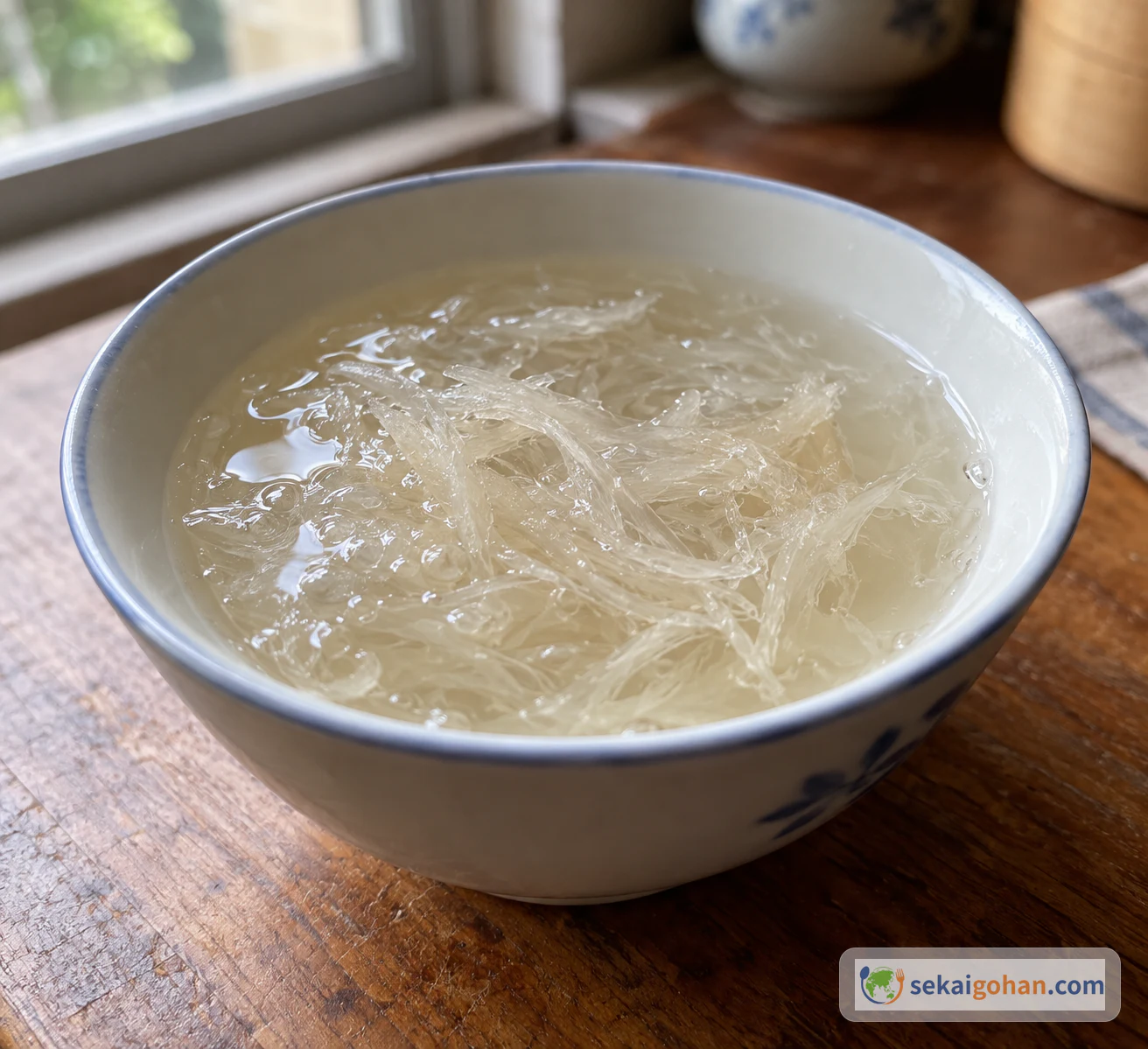
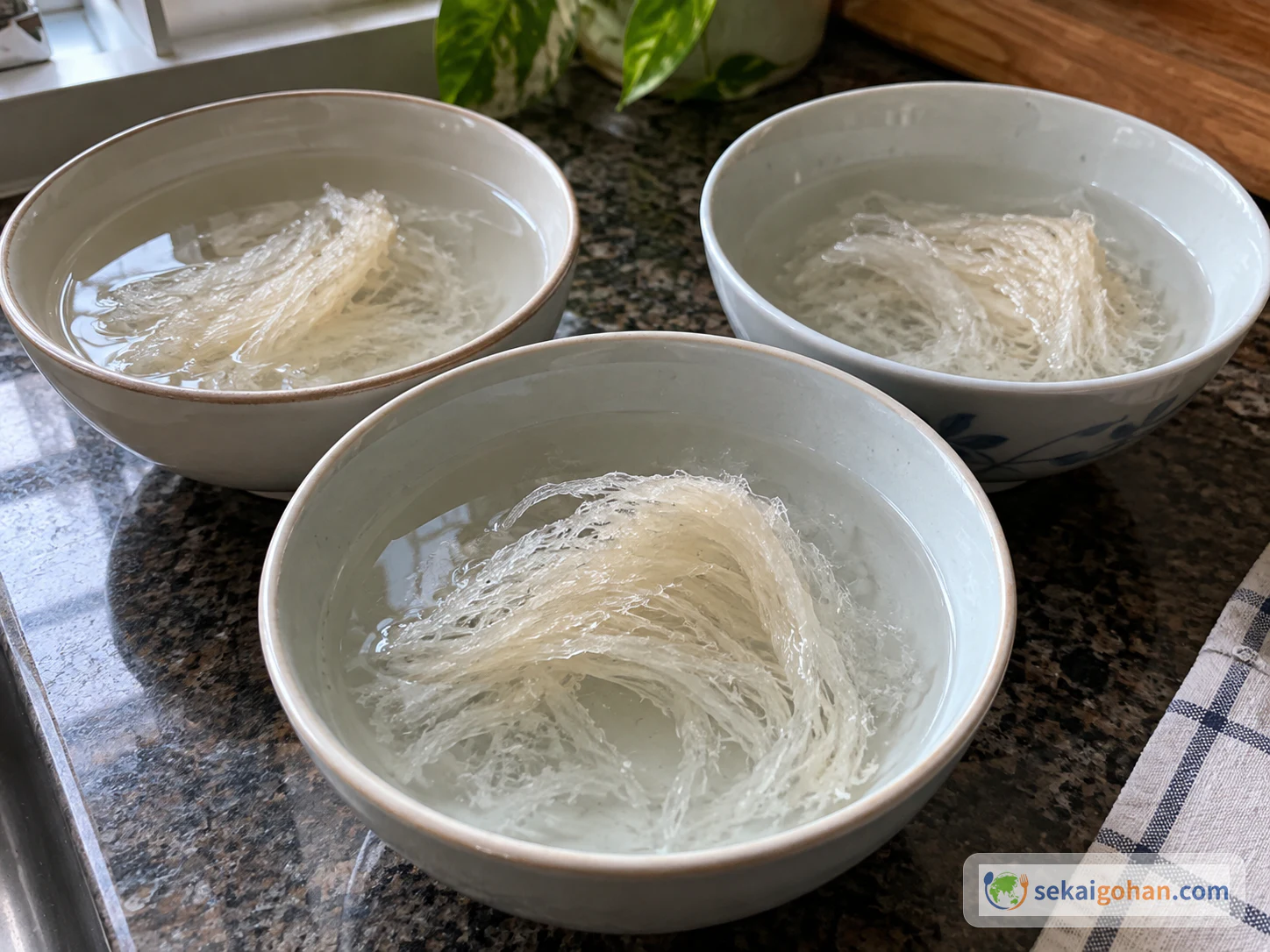

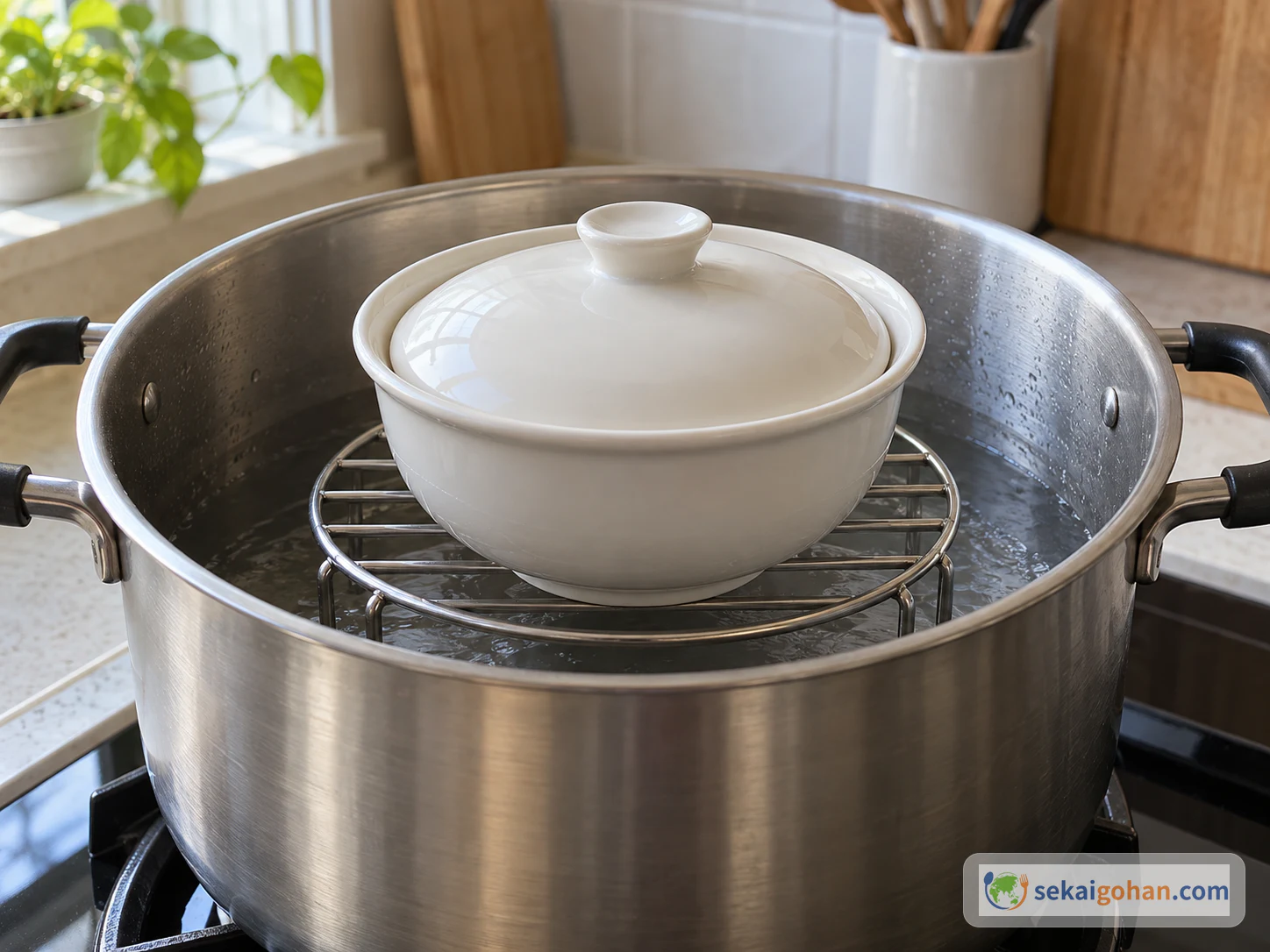
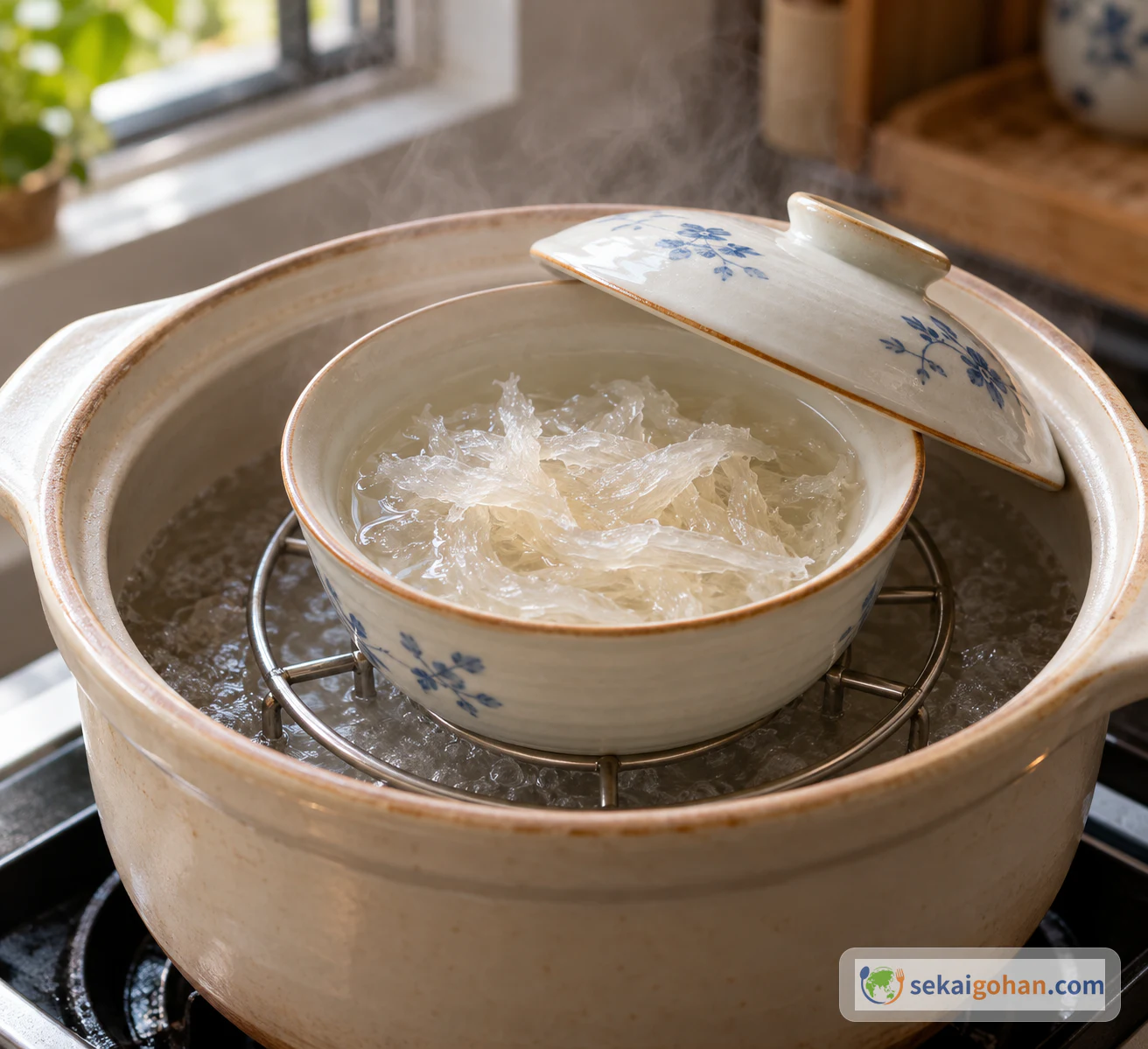
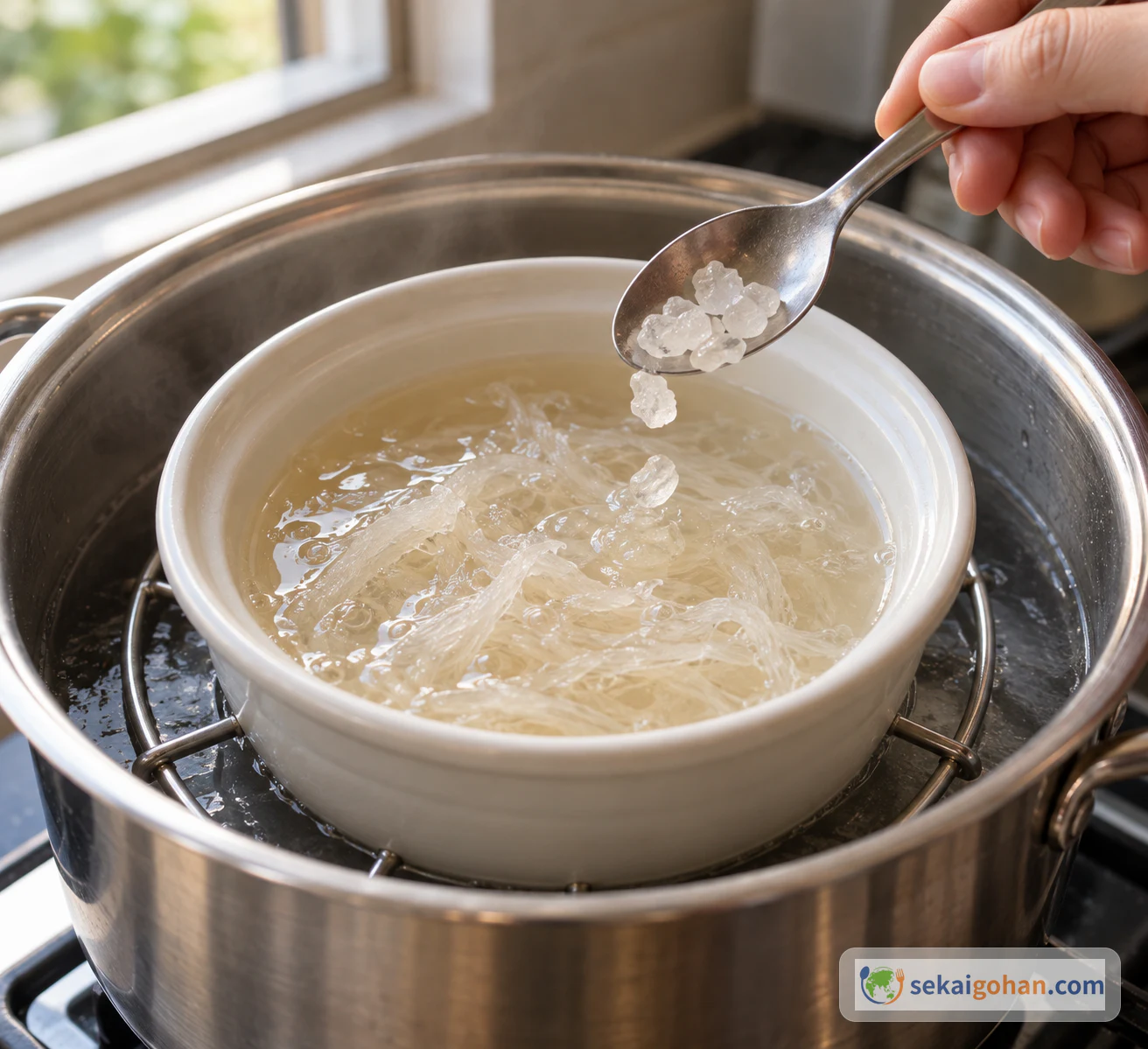
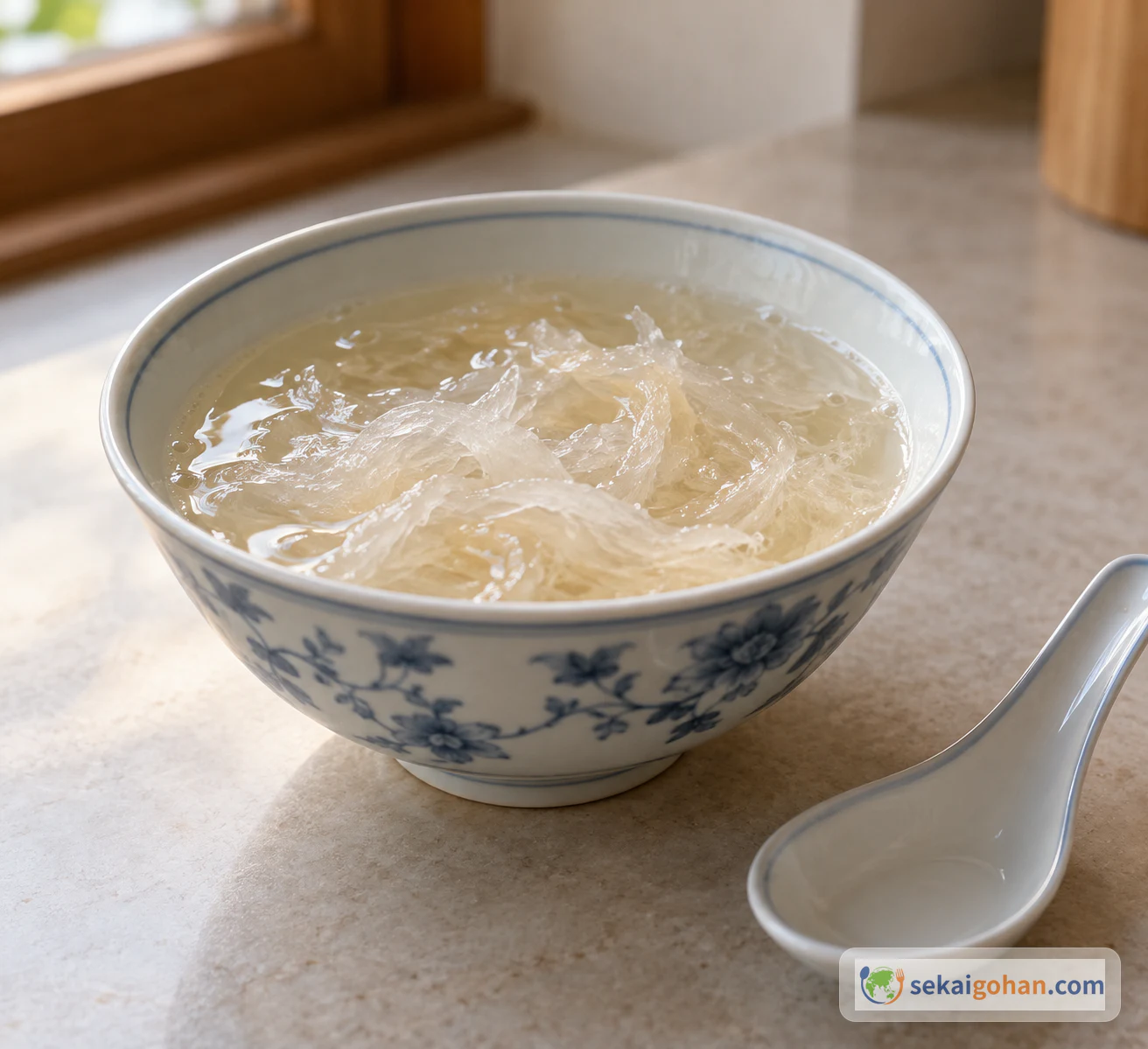
A small, dry, pale piece of edible bird's nest goes into a bowl of room-temperature water, and over time it softens and expands into fine strands. After a rinse, it cooks in a small lidded bowl set inside a larger pot of water, so the heat reaches it slowly and gently. Rock sugar goes in at the very end. What you end up with is 冰糖燕窝, bird's nest with rock sugar: a sweet, dessert-style soup from Chinese cooking, with soft, translucent strands suspended in a clear, lightly sweet liquid and nothing else in the bowl.
About Bird's Nest Soup with Rock Sugar
The English name causes some confusion. The nest here is edible bird's nest, a processed food ingredient made from swiftlet nests. The Chinese name is plain: 冰糖 is rock sugar and 燕窝 is edible bird's nest. In English the dish usually goes by bird's nest soup or bird's nest with rock sugar. It is also different from the restaurant dish in which fried taro or noodles are shaped into a nest and filled with seafood.
Edible bird's nest has a long history as a traded luxury food, linking the places in Southeast Asia where nests were collected and produced with markets in China. That history involves migration, trade networks and changes over time. Because the nest has long been expensive, a bowl of it carries a social meaning beyond an everyday dessert. For more of the country's cooking, see other dishes from China.
The appeal of this version lies in the method: a dry, fibrous ingredient loosens in water, softens over gentle indirect heat, and is finished with just enough rock sugar to sweeten without covering the nest.
Ingredients: Three Pieces of Nest, Water and Rock Sugar
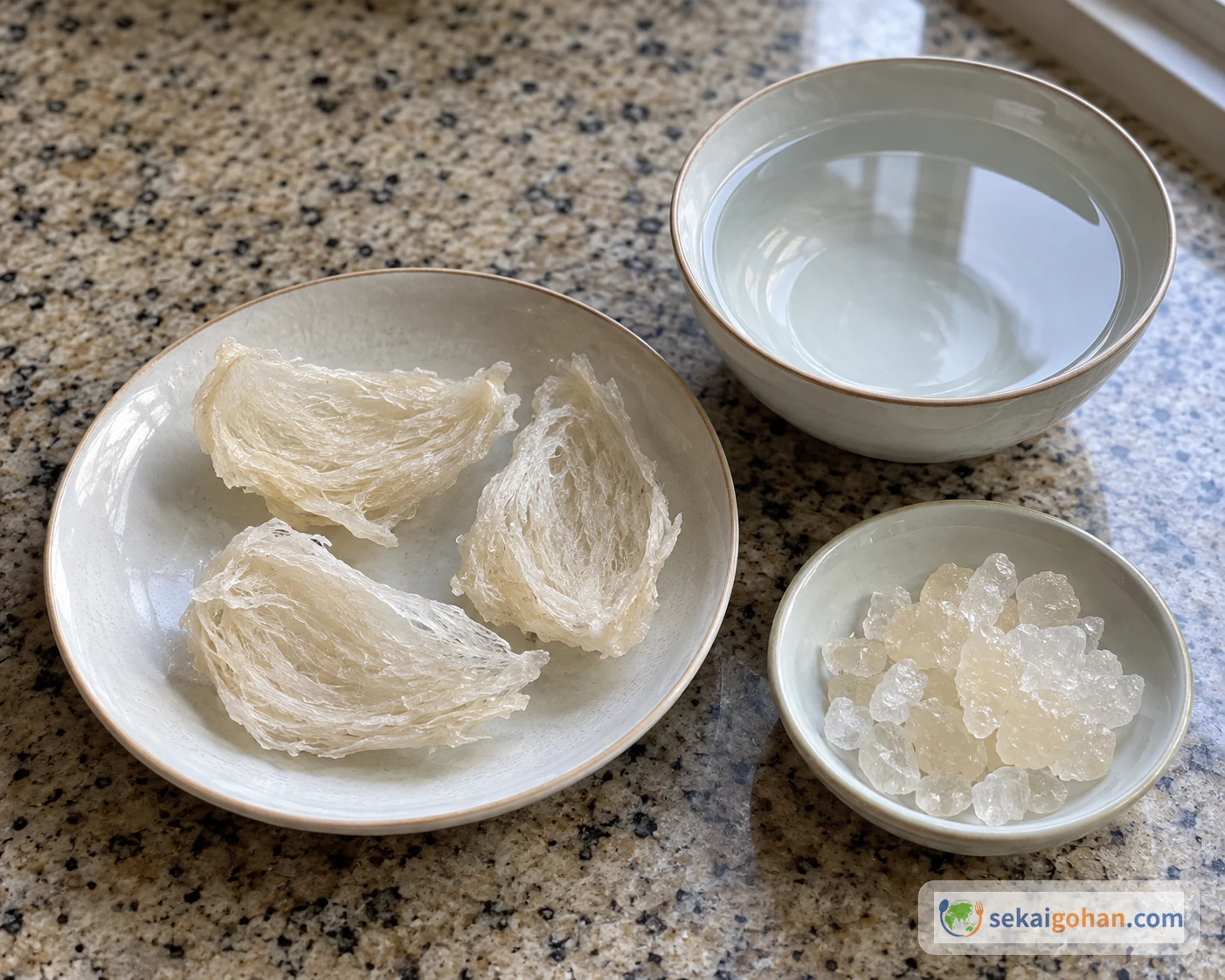
This makes 2–3 servings. Keep the soaking water, the water that cooks with the nest, and the water in the outer pot separate.
Choosing Bird's Nest and Rock Sugar
Bird's nest. Buy dried nest that is clearly labeled as food, from a reliable seller, and avoid wild-collected nest or nest of unknown origin. Check the label or the seller's information for:
- the type of nest (for example, house nest or cave nest),
- how much it has already been cleaned,
- specific soaking and cooking instructions,
- any additives, if it is a processed product.
The label also matters for allergies, so read it with that in mind. Products differ in shape and processing, and their instructions differ too; when the package gives a method, follow it.
Soaking and cooking times vary widely with the type of nest and how it was processed. House nest typically soaks 30 minutes and double-boils 30 minutes. Cave nest soaks 60 minutes and double-boils 60–90 minutes. Some nests need 3–4 hours of soaking and 20–25 minutes of double-boiling.
Buy bird's nest from reliable sellers. Wash and soak dried nest thoroughly for a few hours before stewing, changing the soaking water once or twice and discarding it. Thorough washing and soaking can remove a substantial amount of the water-soluble nitrite that bird's nest may contain, but it does not guarantee that all of it is removed. Do not give bird's nest to young children, and especially not to infants.
Rock sugar. Rock sugar is crystal sugar that dissolves gradually. Because it goes in at the end, you can taste and adjust as you go, so sweeten it to your liking.
Equipment
- Small heatproof bowls with lids (a Chinese stewing bowl, or any small lidded heatproof bowl)
- A larger pot that holds the small bowls with room around them
- A steaming rack or stand, so the small bowl does not sit directly on the bottom of the outer pot
- Small bowls for soaking
- A fine sieve
- Clean tweezers
- A spoon
Checking Softness and Fixing Common Problems
When it's done, the nest should be soft and translucent, its strands loosened rather than stiff. Nests vary, so treat how clear the strands look as a guide to doneness only, not a test of safety.
Rock sugar is the one flavor you control. It goes in at the end and cooks for 10 more minutes, which gives you room to taste and add a little more without overshooting. Keep it light and the delicate texture of the nest stays at the center of the bowl.
| Problem | Likely cause | What to do |
|---|---|---|
| The nest is still firm | Nest type or product needs a longer time | Check your product's instructions; cave nest generally needs longer than house nest |
| Tiny feathers in the strands | Not fully removed after soaking | Pick them out with tweezers while rinsing, before cooking |
| The small bowl spills over | Filled too full | Leave room at the top of the bowl next time |
| The outer pot is nearly dry | Long cooking at too strong a heat | Check the water level and add water to the outer pot as needed; never let it boil dry |
| Too sweet | Too much rock sugar at once | Add sugar a little at a time next time and taste after it dissolves |
| Not sweet enough | Sugar not fully dissolved, or too little | Add a little more and keep double-boiling until it dissolves |
Serving and Other Versions of Sweet Bird's Nest
Serve the soup warm. Other sweet versions add more to the bowl, each with its own times:
| Version | How it differs |
|---|---|
| Longer soak with optional flavorings | Soak dried nest 3–4 hours, drain and rinse it 2–3 times, then double-boil over low heat for 20–25 minutes. Rock sugar, ginseng, gingko, goji or red dates are optional flavorings |
| With American ginseng | Uses 1–2 nests with American ginseng and rock candy, stewed in a covered pot for about 40 minutes before the sugar goes in for 5 more minutes |
If you try one, follow its times and ingredients as a whole, along with your nest's own instructions.
Frequently Asked Questions
Can I use the soaking water for cooking?
No. Discard the soaking water and cook the nest in fresh water.
How much rock sugar should I use?
Rock sugar is listed only as "to taste." Add a little, let it dissolve during the last 10 minutes, taste, and adjust.
Is this the dish served in a fried nest-shaped basket?
No. That is a seafood dish in which fried taro or noodles are shaped like a nest. This one uses real edible bird's nest and is a sweet soup.