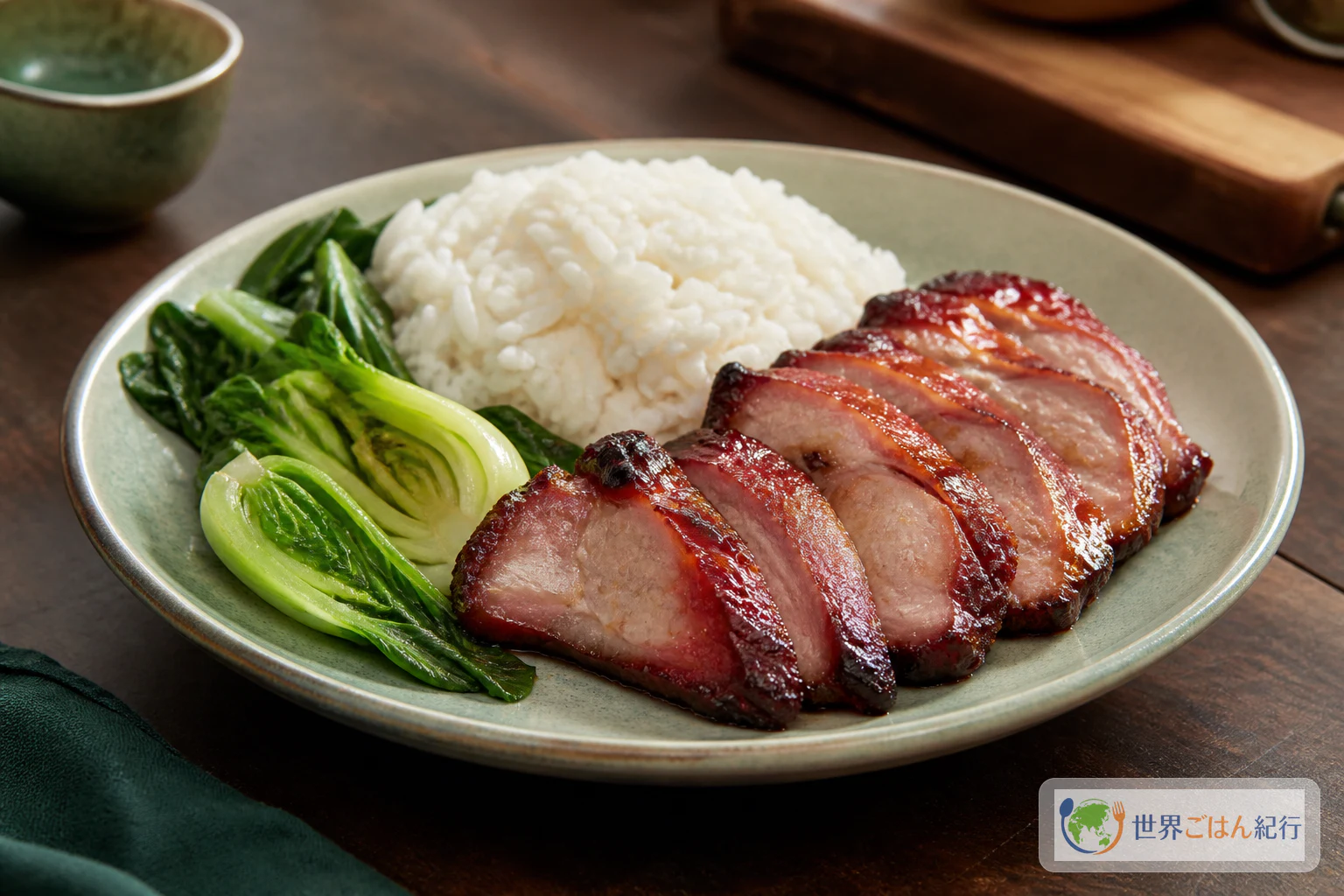
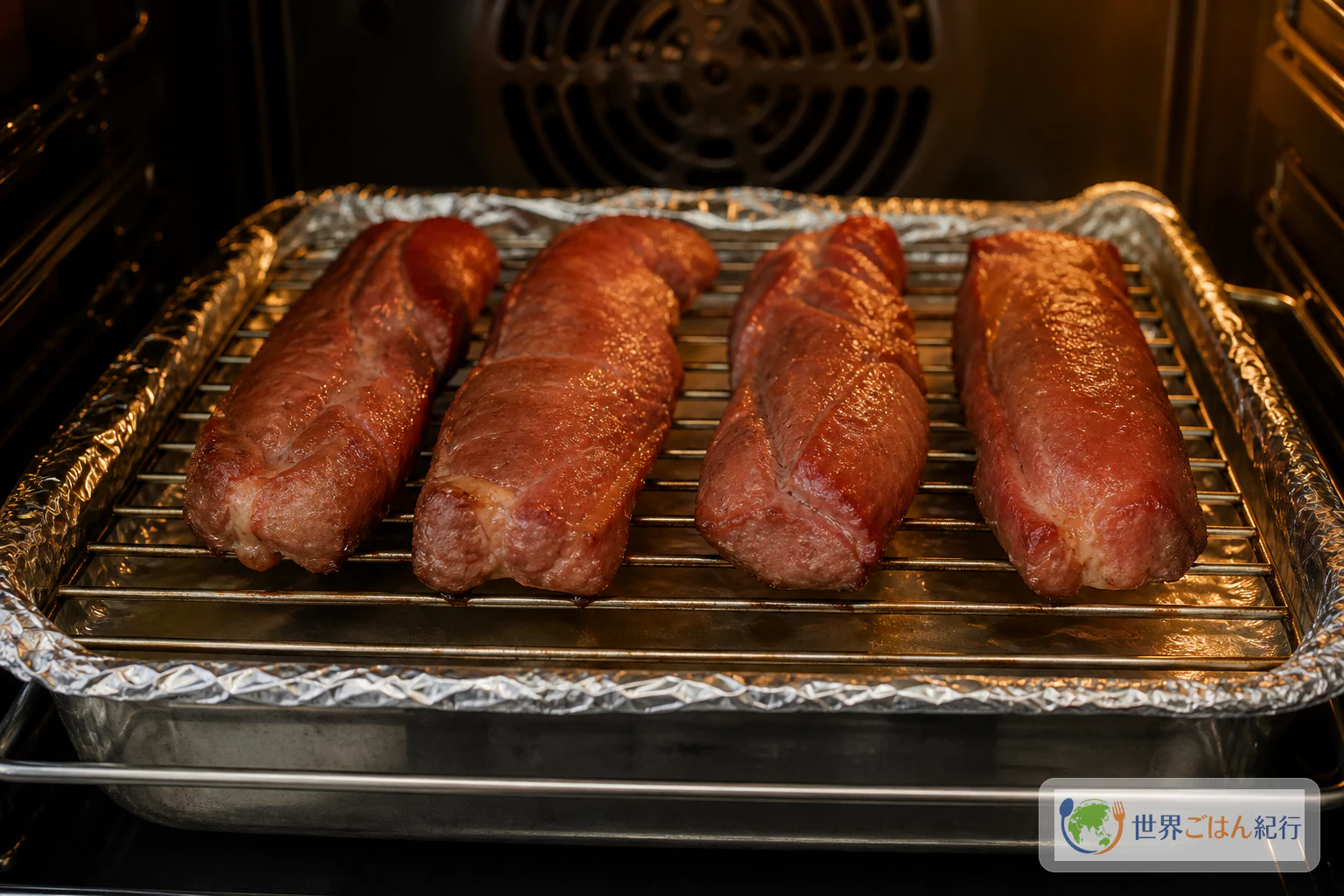
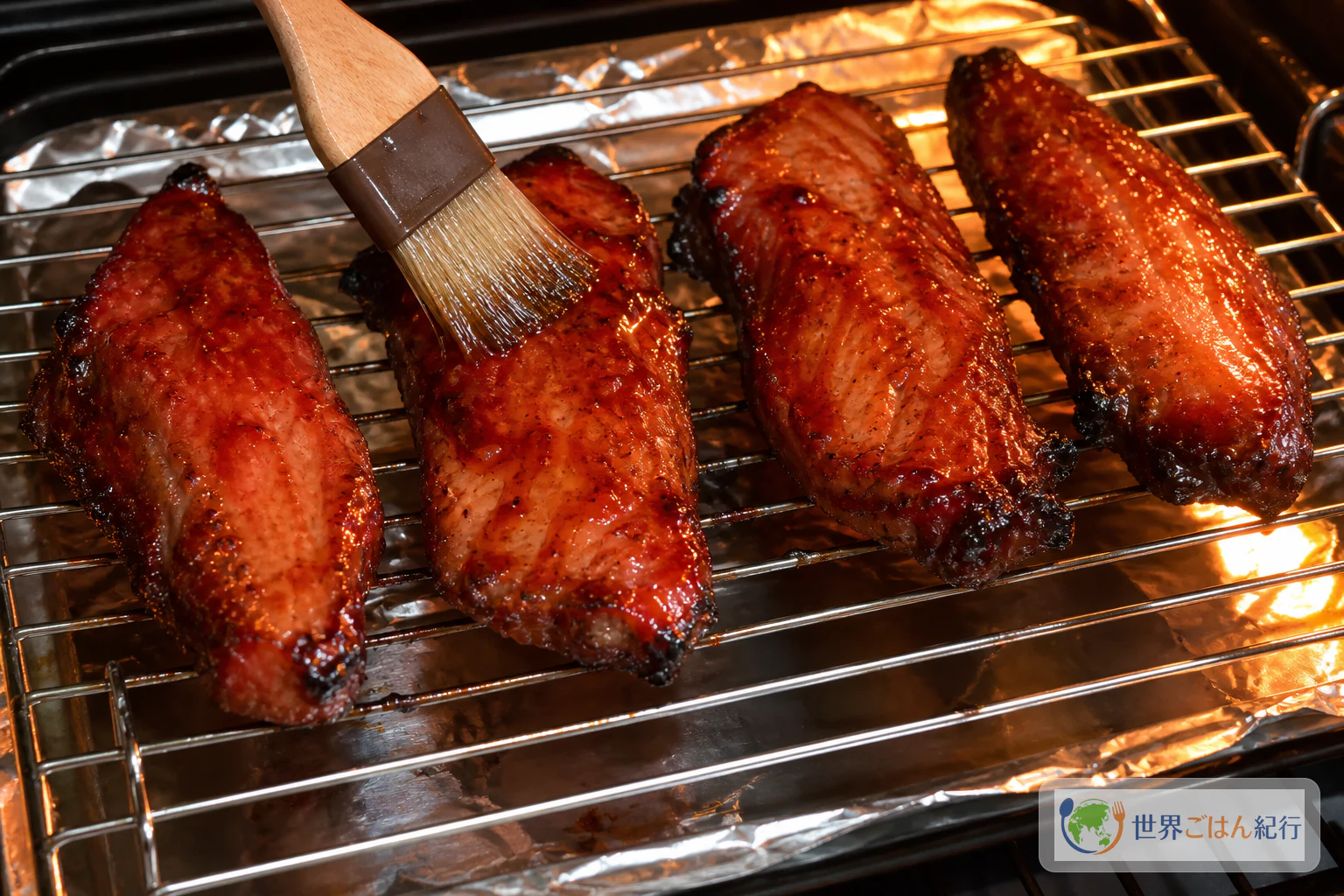
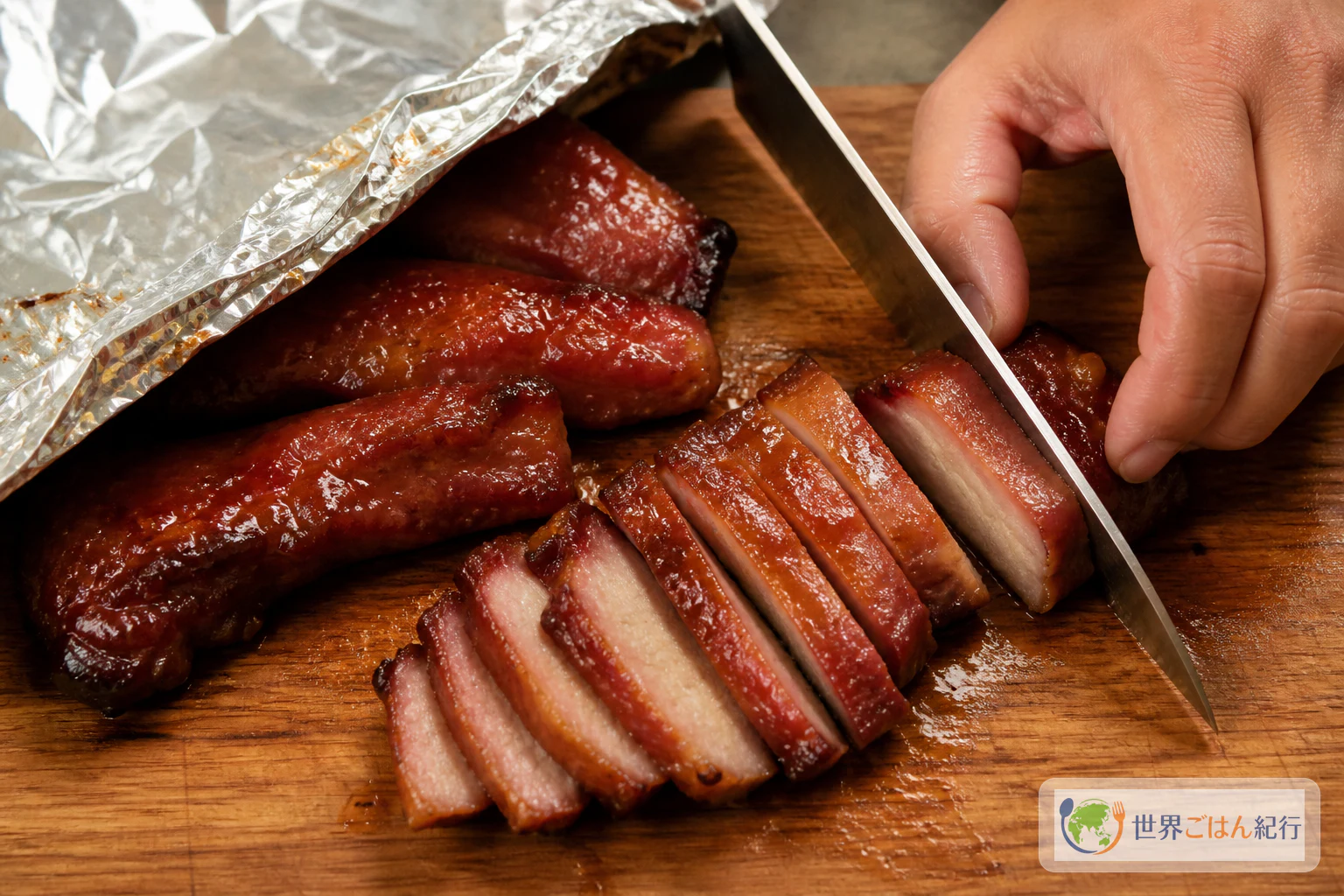
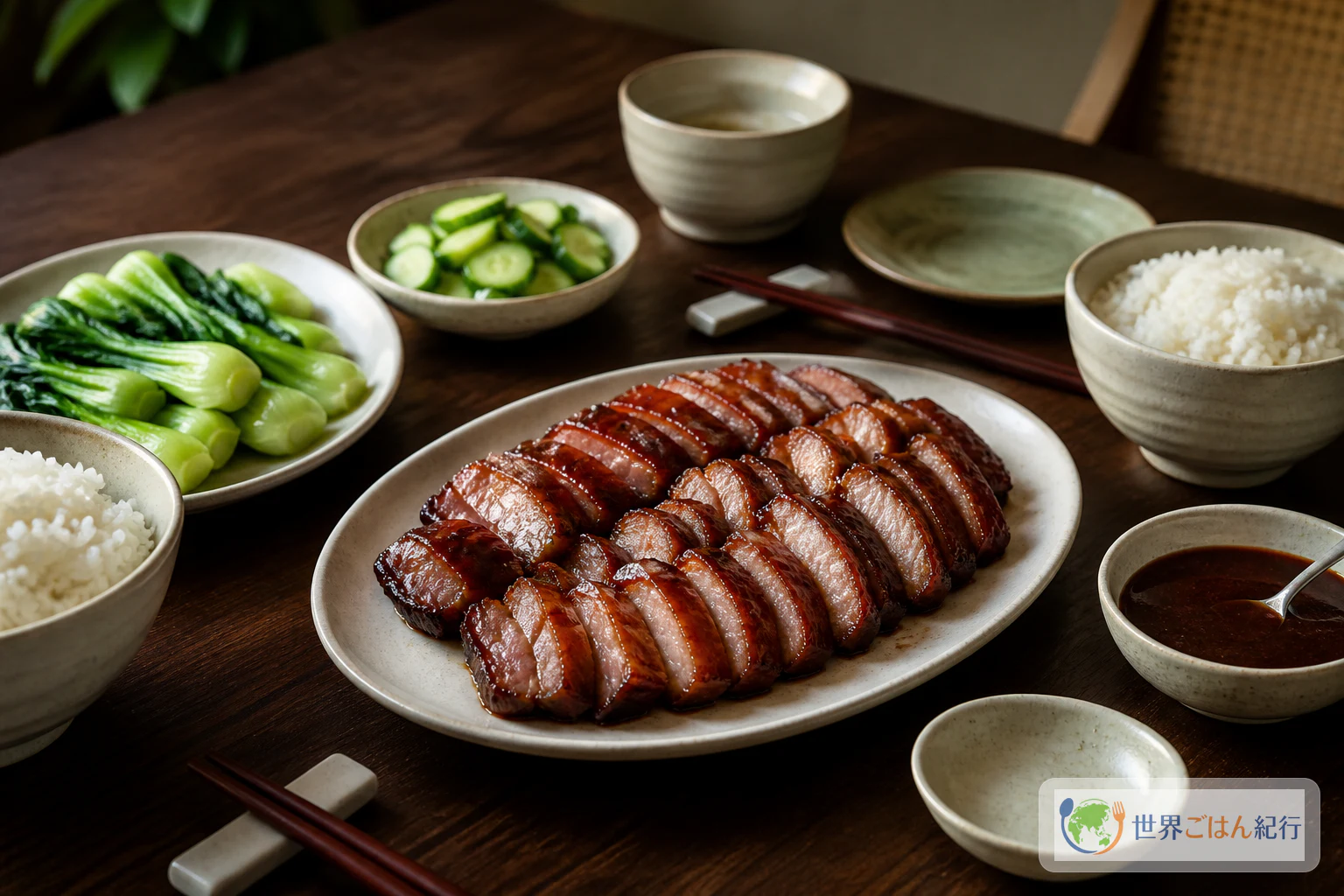
Pork just out of the oven glows red-brown, its surface the first to take the heat. Cut into it and the glaze clings to the blade in a thin film. The fat at the edges is soft, and the center still has the grain of the meat. This is char siu, one of the signature roast meats of Cantonese cooking. Long strips of pork are marinated in a sauce and then roasted while you build up layer after layer of sweet, glossy glaze.
Char siu and the Cantonese siu mei tradition
In Cantonese it's called char siu (叉燒); in Mandarin it sounds closer to chāshāo. The name describes the cooking method, "roasted on a fork." It belongs to siu mei, the family of meats and poultry roasted until fragrant and hung on display at the shop front: char siu, siu yuk (crispy roast pork), siu ngo (roast goose) and more. Shops roast in round ovens with heat coming from every direction, which a rack in a home oven can't copy. The principle still carries over: build up color while drying the surface, rather than keeping the meat in sauce.
In Chinese it's written 叉烧 in simplified characters and 叉燒 in traditional. The Cantonese pronunciation is sometimes written caa1 siu1 in Jyutping.
How char siu is eaten in Hong Kong
On Hong Kong tables, char siu is everyday food, not something saved for banquets. People buy it from a siu mei shop and have it sliced thin over white rice with greens or a braised egg for lunch. The leftover ends go into fried rice or noodles. At dim sum restaurants, a sweet, saucy char siu filling is wrapped in steamed dough for char siu bao. Roast meat keeps getting passed along into other dishes, and that's exactly why it's worth making a batch at home.
How char siu is roasted
The logic of char siu is the opposite of a braise. It's about drying the surface of the meat, caramelizing the sugar and turning fat and spices into a thin, fragrant layer. At home, the keys are cutting the meat to a moderate thickness and letting it rest before you slice it.
Regional cuts and sauces
There's no single true char siu sauce. Some shops add hoisin sauce or fermented red bean curd (nam yu), while some households stick mainly to soy sauce, sugar, wine and spices. Some regional styles use fatty pork and finish with a sweet glaze brushed over the surface. The differences come down to how fat, sugar, aroma and color combine.
The cut varies as much as the sauce. Hong Kong shops often use the shoulder near the neck, which is finely marbled and less likely to toughen in the oven. Older styles used fattier cuts from the belly side. Some shops have moved toward shoulder because of health concerns and what they can source. In Singapore and Malaysia, restaurants use fatty pork belly, leaner cuts or pork shoulder, depending on the place. Change the amount of fat and the same sauce gives a different sweetness and tenderness.
| Comparison | Range seen in Guangdong and Hong Kong | What to do in a home kitchen |
|---|---|---|
| Meat | Shoulder near the neck, belly, lean cuts | Start with pork shoulder. Switch to belly only if you want more fat |
| Sweetness | Sugar, honey, maltose, etc. | Make it with honey; substitute maltose only if you have it |
| Color | Ranges from red-brown to deep brown depending on sauce and roasting | Add color with 2 tsp (10 ml) dark soy sauce; no red food coloring |
| How it's eaten | White rice, dim sum, fried rice, chow mein | Fresh with rice; the next day in fried rice or noodles |
| Roasting | Siu mei shop ovens, hanging roast, each shop's equipment | Use a rack and drip pan; save the glazing for the end |
Ingredients (serves 4)
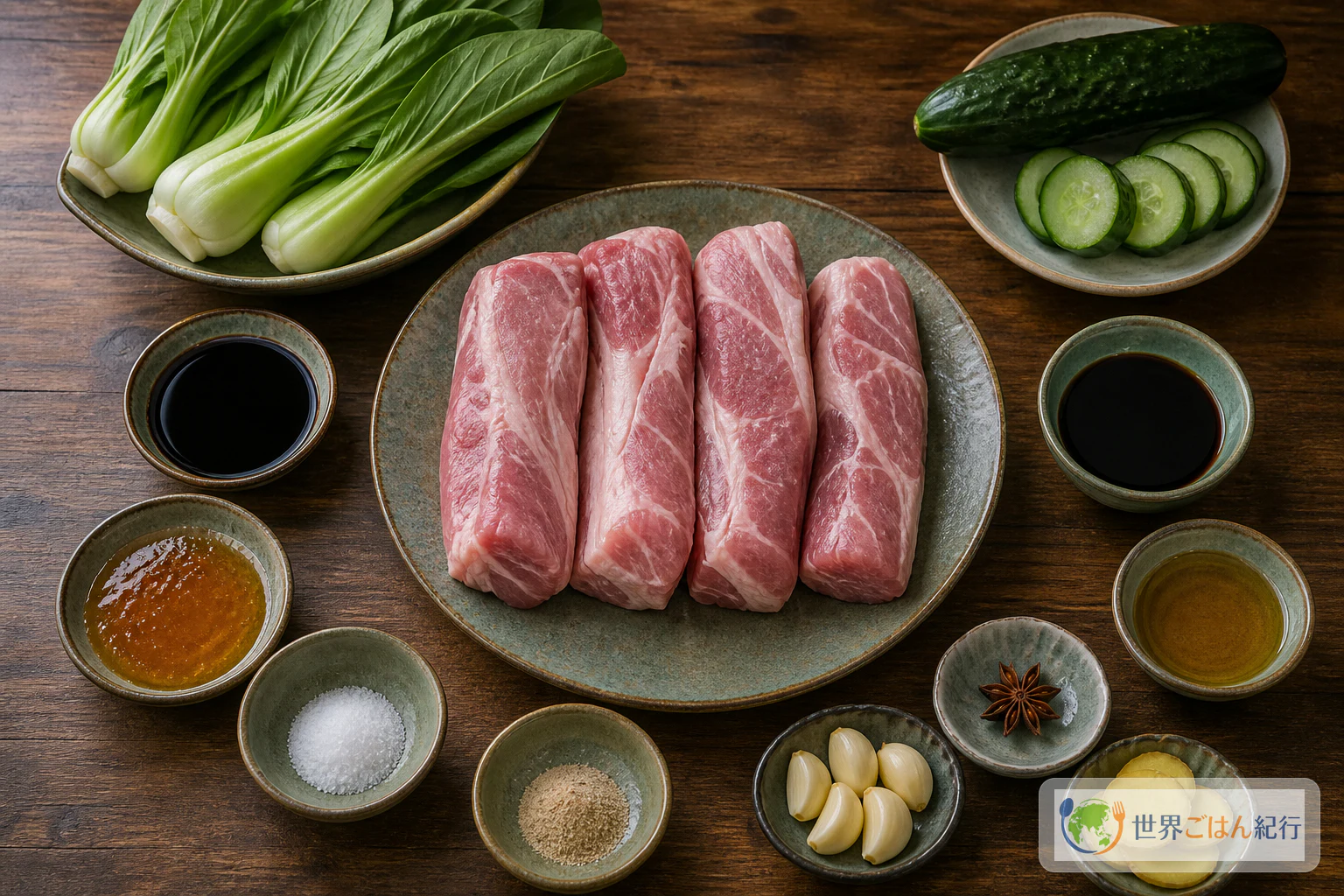
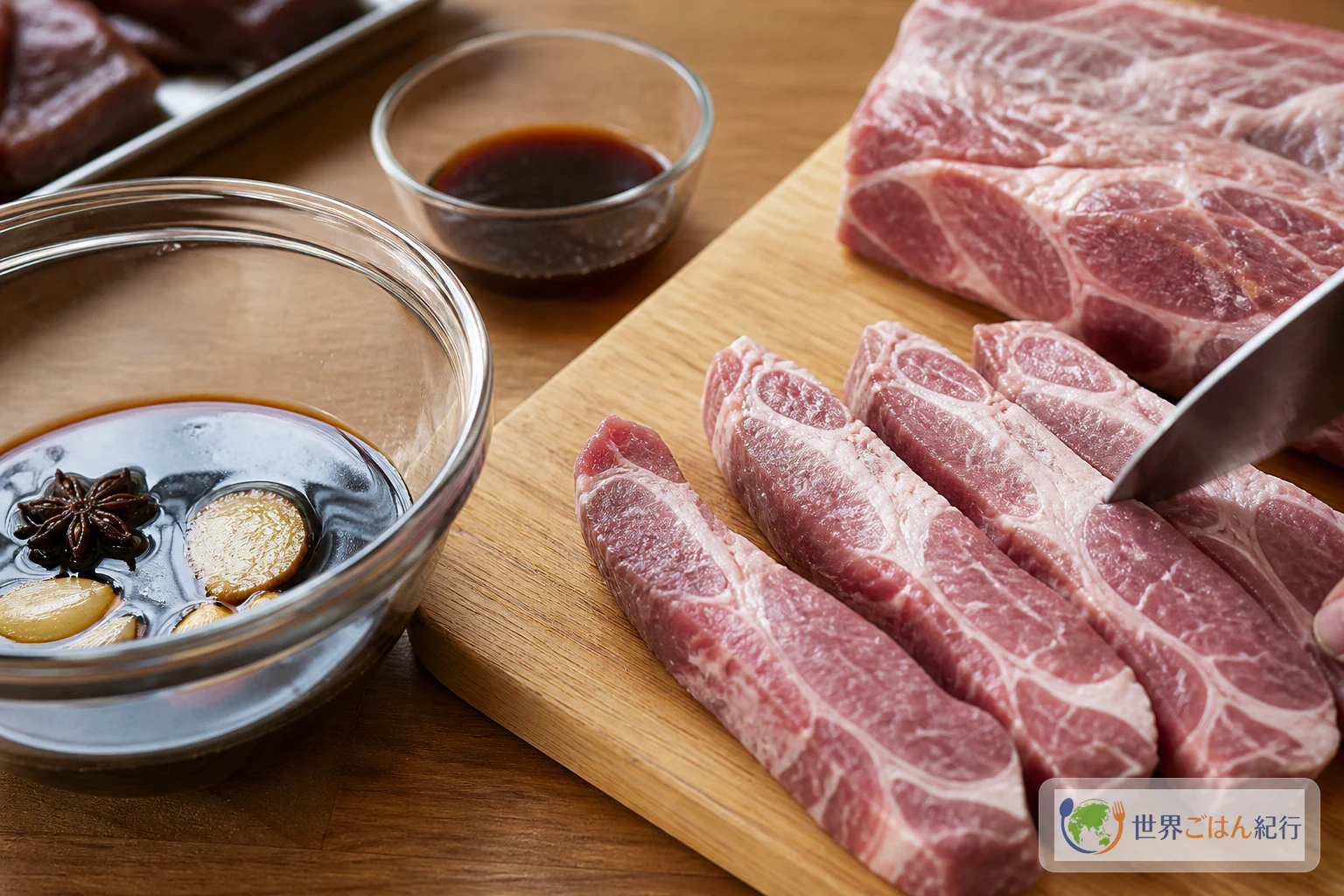
Choose a piece of pork shoulder about 1 inch (3 cm) thick. Roasted as one large piece, the center struggles to heat through before the sugar on the surface burns, so once you've bought it, cut it into strips 5–6 inches (12–15 cm) long. Don't trim off all the fat; leave about 0.25 inch (5 mm) on the surface.
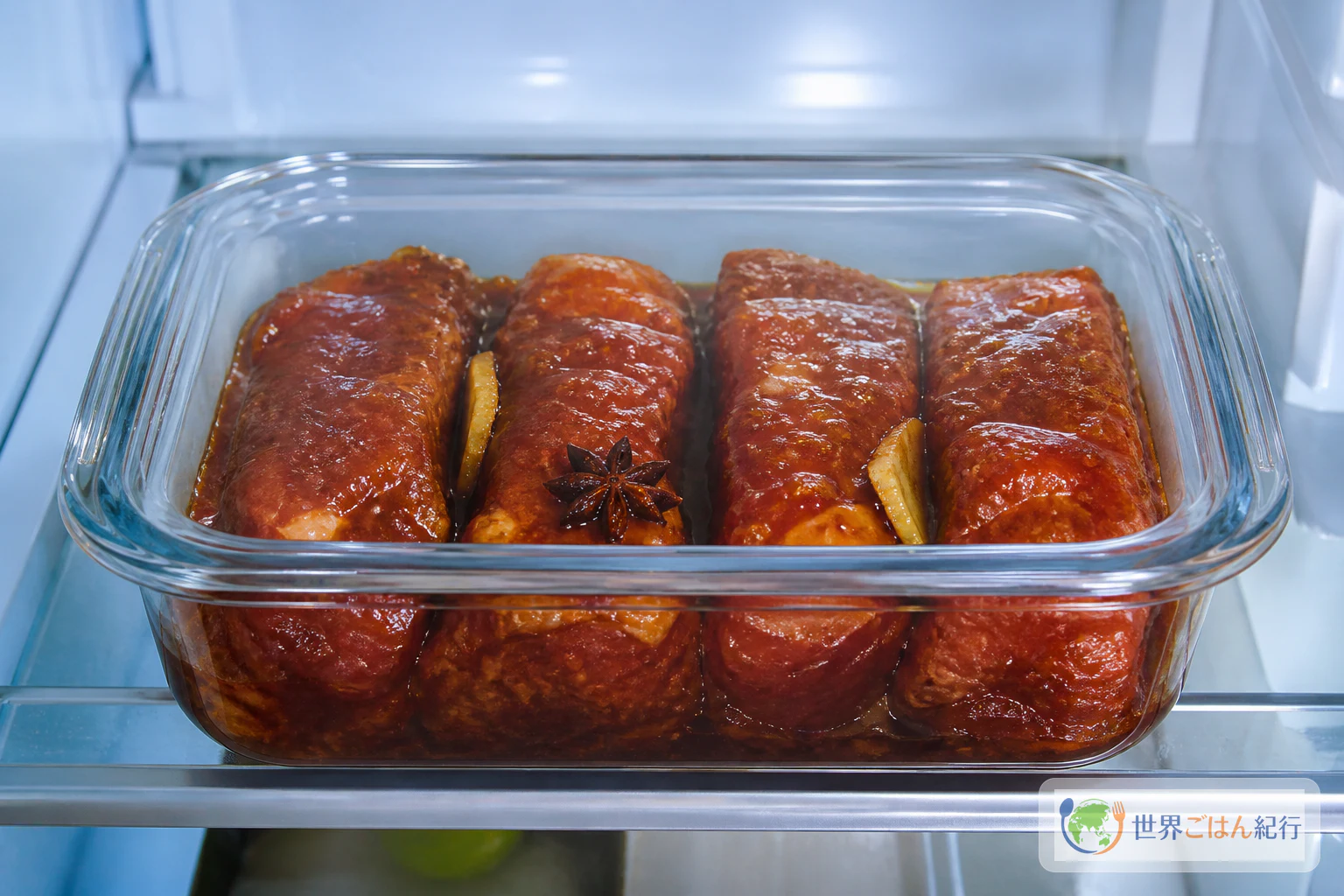
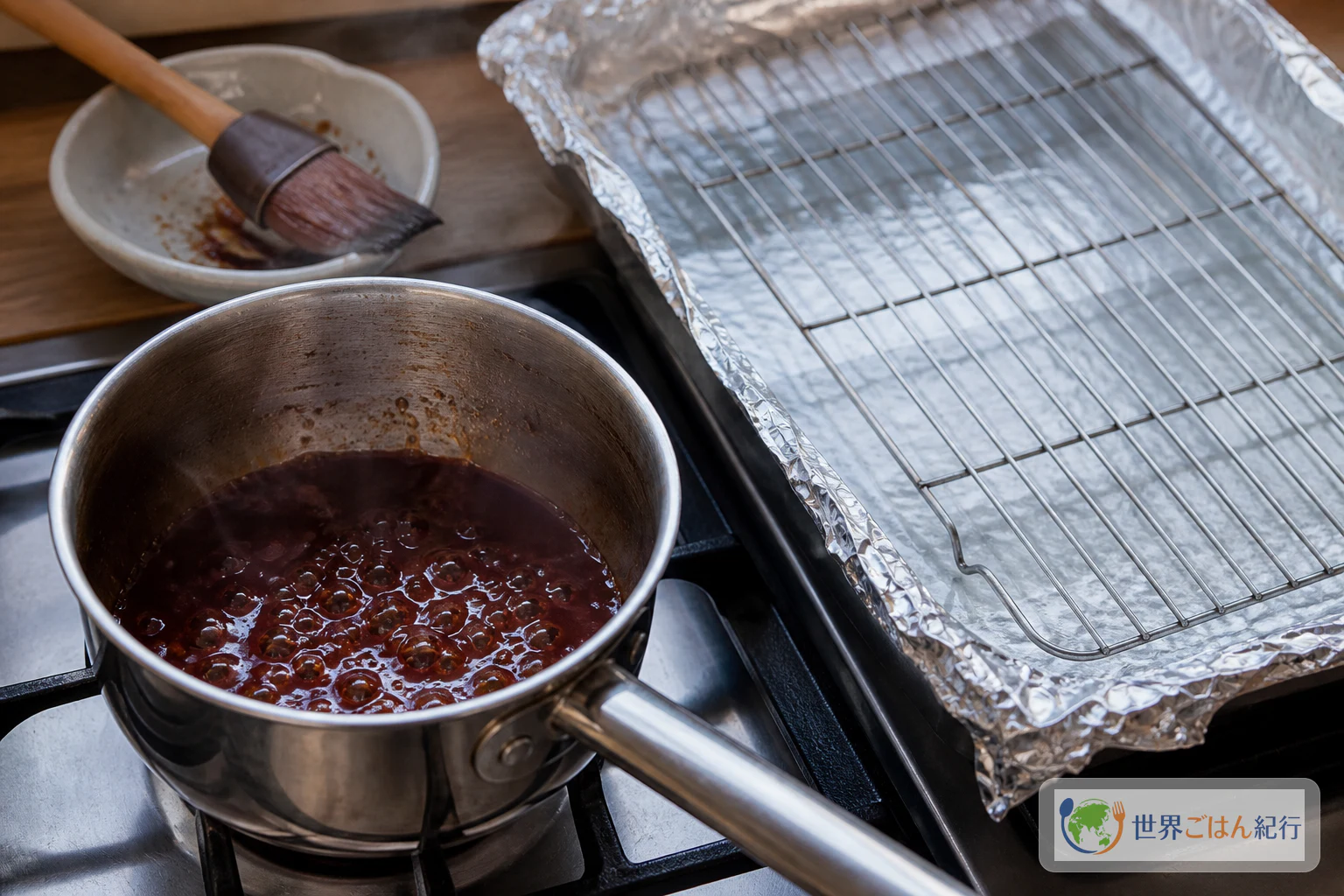
Before you marinate, set aside 60 ml (¼ cup) of the sauce in a separate container, before it touches the meat. You'll reduce it into the glaze you brush on while the meat roasts. Don't use liquid that raw meat has been marinating in as a finishing glaze. If you have marinade left over, bring anything that has touched the meat to a boil before using it in another dish.
This recipe uses pork, honey, soy, wheat and sesame. If you add soy sauce, dark soy sauce, Shaoxing wine, hoisin sauce or similar, check the ingredient labels. Never give dishes made with honey to infants under 1 year old. Wash knives, cutting boards and containers that touched raw meat separately from the utensils you use for serving.
Ingredients worth thinking about before you shop
Dark soy sauce isn't a substitute for simply adding more regular soy sauce. Just 2 tsp (10 ml) deepens the surface color and makes the honey gloss look red-brown. If you're only trying char siu once, regular soy sauce alone is fine. If you plan to make it several times and want to add color to fried rice and braises too, look for a bottle labeled "dark soy sauce" or 老抽 and check the ingredients at an Asian grocery or online.
Star anise is a supporting player: you only use one pod, to back up the aroma of the meat. A bag of it will also go into Chinese-style braises, the sauce for Hainanese chicken rice, or dishes where you want a little of the aroma of five-spice powder. If you don't like its sweet scent, you can skip it and the pork will still roast fine. If you do buy it, choose whole pods rather than broken pieces, which makes it easier to adjust the amount.
An oven rack keeps the underside of the meat out of a pool of sauce and lets fat and sugar drip into the pan below. If you don't have a rack, put the meat on a foil-lined sheet pan and turn it once partway through. The underside won't color as well, but there's no need to buy a rack just for char siu.
Choosing pork and sweeteners for char siu
A piece of pork shoulder (Boston butt or pork collar) is the easiest place to start. Cut into strips about 2–2.5 inches (5–6 cm) wide and 1 inch (3 cm) thick, it keeps the gap between surface and center small in a home oven. Pork belly gives gloss and rich, satisfying fat. The fat drips through the rack, though, so put water in the drip pan and keep a close eye on the sugar so it doesn't burn. Pork leg is beautifully lean but dries out if overcooked.
The sweetness comes from sugar, honey, maltose and the like. Honey is easy to find and builds gloss when brushed on at the end. It's high in sugar, so keep its time at high heat short. Dark soy sauce (lou chau) is darker than regular soy sauce and is a seasoning that deepens the red-brown color in small amounts, not a source of extra saltiness.
Method: divide the sauce in two before roasting
If you're hunting for the sauce after you've started roasting, you'll miss the moment the sugar starts to burn. Lay out the meat, a brush, a thermometer, the sauce and tongs for turning before you start, and move the meat onto the rack only once the oven has finished preheating.
Common char siu problems and fixes
With char siu, the meat cooks through while the surface caramelizes, both at once. When something goes wrong, first decide which one needs help: does the meat need more cooking, or does only the surface need protecting?
| Problem | What's happening | Fix |
|---|---|---|
| Surface is turning black | Honey brushed on too thick, or top heat too strong | Tent with foil, drop to 180°C (350°F) and keep cooking until the internal temperature is high enough |
| Surface is pale with little gloss | Sauce too thin, too little time at high heat at the end | Check the internal temperature, add just 2–3 minutes at 200°C (400°F), then brush thinly |
| Meat is tough | Pork leg overcooked, or cut too thick | Next time switch to shoulder and cut to an even 3 cm. Slice cooked meat thin and use it with sauce or in fried rice |
| Center is cold | Meat cut too large | Cut into pieces 2–3 cm thick, tent with foil and keep roasting at 180°C (350°F), checking the internal temperature |
| Sauce is too salty | Too much dark soy or soy sauce | Simmer 10 g honey with 10 ml water to dilute it and spoon it sparingly beside the sliced meat rather than over it |
| Fat drips and smokes | The pan dried out and sugar burned | Turn off the oven and ventilate. Add water to the pan, return the rack and meat, and lower the temperature |
Resist adding more dark soy sauce for a deeper color: the saltiness goes up before the color does. A thin layer of glaze and a short return to high heat works better.
Storing and using leftover char siu
Once you've sliced what you'll eat, move the rest to a shallow container and cool it quickly without trapping steam. Keep separate areas and utensils for raw and cooked meat. Keep it at room temperature for no more than 2 hours. Anything that has been out for 2 to 4 hours should be eaten right away, and anything out for more than 4 hours shouldn't be kept.
Refrigerated char siu should be eaten within 3 to 4 days. For longer storage, wrap slices in single-meal portions in plastic wrap and freeze them in a freezer bag; they'll keep their flavor well for about 1 month. To reheat, sprinkle with a little water, cover loosely and microwave in short bursts. Long, hard heating renders out the fat and toughens the meat.
| What's left | Use it in | What to do |
|---|---|---|
| A few slices | Siu mei rice with white rice and greens | Reheat and add a little of the leftover glaze |
| Small end pieces | Fried rice | Dice into 0.25-inch (5 mm) cubes and add at the end, after the egg and rice are stir-fried |
| Lots of sauce | Chow mein | Add 1 tsp at a time and taste before tossing with the noodles |
| Frozen meat | Filling for steamed buns or spring rolls | Thaw in the refrigerator, pat dry and chop |
Frequently asked questions
Is it the same dish as the chāshū on Japanese ramen?
The names sound similar in Japan, but the method and texture are different. Char siu is roasted so the sugar and fat on the surface turn fragrant. Ramen chāshū is often simmered, steamed or cooked at low temperature, making the meat tender in liquid. You can put char siu on ramen, but amounts and cooking methods don't transfer between the two.
What changes if I use maltose instead of honey?
Maltose is stickier than honey and easily gives the thick sheen you see at siu mei shops. It's very stiff, so warm the jar a little in lukewarm water before measuring. If you're only trying it once at home, honey is plenty. If you use maltose, start with the same amount, and if the surface colors quickly, shorten the final time at 200°C (400°F).
Can I use pork belly?
Yes. Since fat dripping through the rack easily turns to smoke, put water in the pan, shorten the first stage at 180°C (350°F) to 15 to 20 minutes, and check the internal temperature before finishing. Choose belly when you want a dish that's all about the fat, and shoulder when you want both meaty texture and glaze.
Can I make it if I don't like star anise?
Yes. The single pod of star anise adds aroma; it doesn't affect how the meat cooks or how thick the glaze gets. Start by reducing it to 1/2, and if the sweet scent still feels strong, skip it next time and roast with just white pepper and ginger.
What if I don't have an oven rack?
Put the meat on a foil-lined sheet pan and turn it once during the 180°C (350°F) stage. Because the underside sits in the sauce, the surface steams more than it would on a rack and browns one side at a time. If sauce pools on the pan, move the meat onto a fresh sheet of foil before the 200°C (400°F) finish.