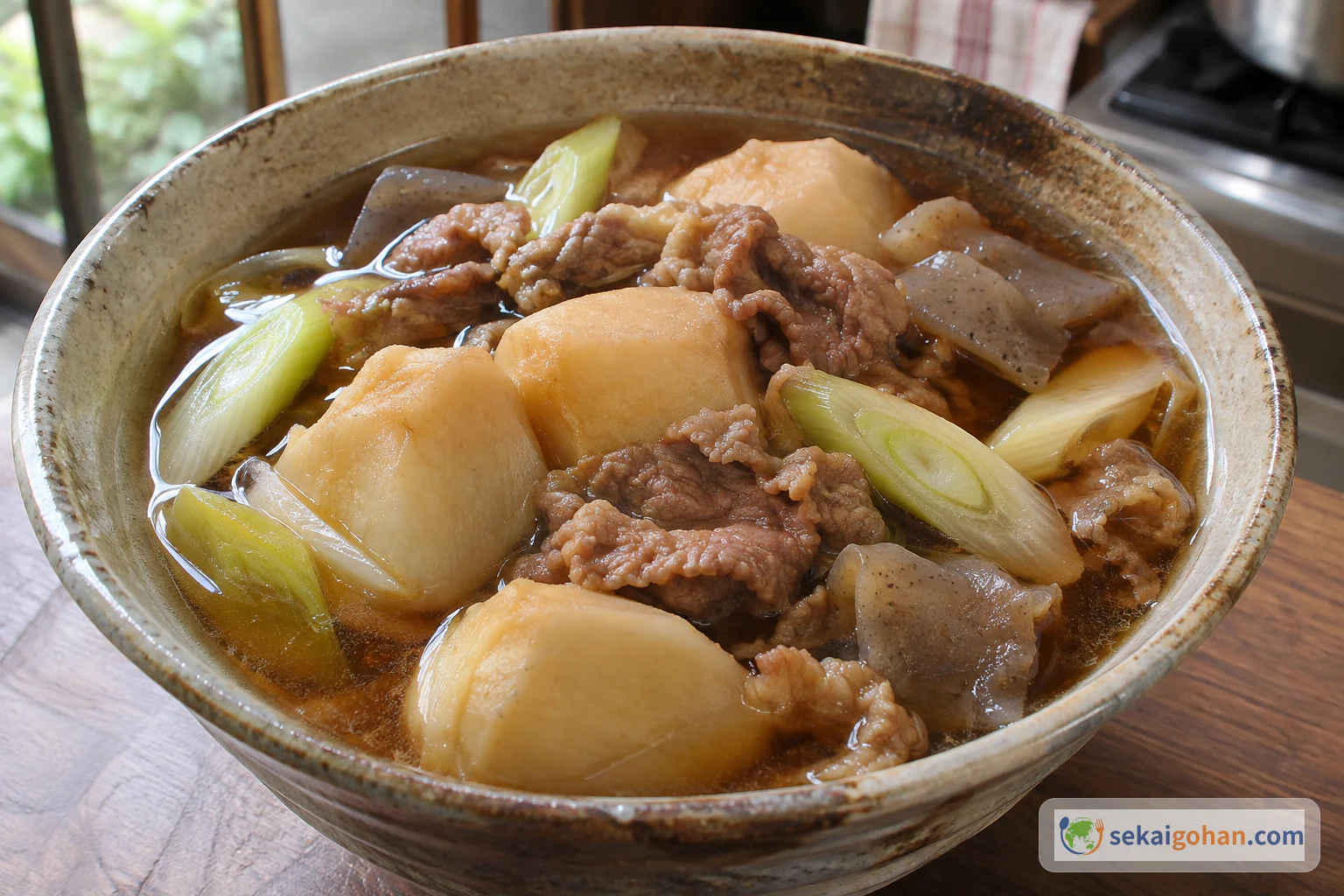
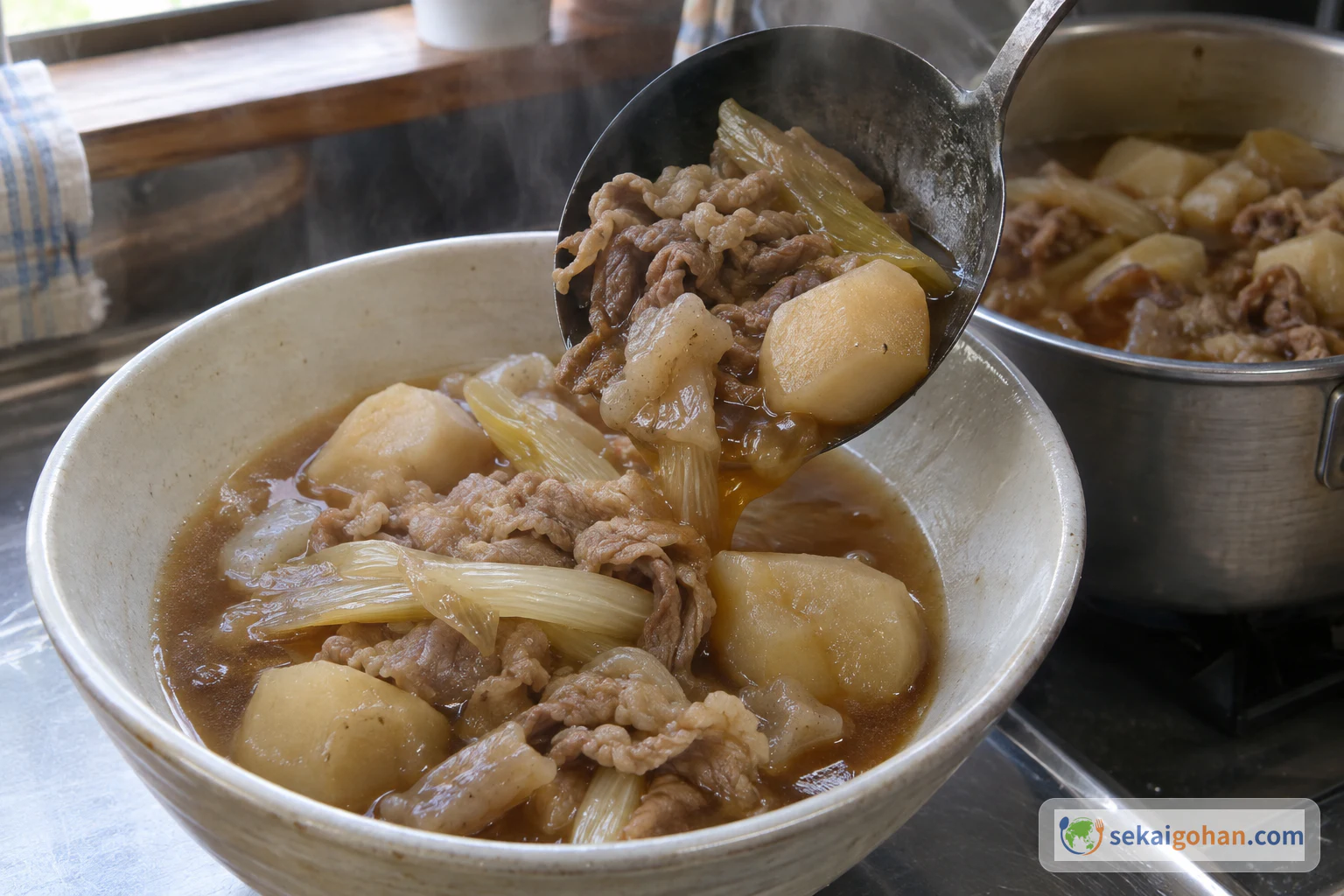
In autumn in Yamagata Prefecture, the taro harvest comes in, and families and friends carry it down to the riverbank to gather around a big pot. What they cook is imoni (芋煮): taro soft all the way through, hand-torn konnyaku and beef in a sweet-savory soy broth, with long scallion simmered at the end until it slumps. The broth has no oil, no stock and no salt; the beef fat, soy sauce, sugar and sake give it all its flavor. This version scales the riverbank pot down for a home kitchen. For more dishes from the same country, see our Japan page.
Imoni in Yamagata: Riverbank Parties and Regional Pots
The outdoor gathering is called an imoni-kai, an "imoni party," and it is an established seasonal custom from autumn into winter. People bring taro from the harvest and share a pot with family and friends. In Yamagata City, the Mamigasaki riverbank is a well-known place to do it.
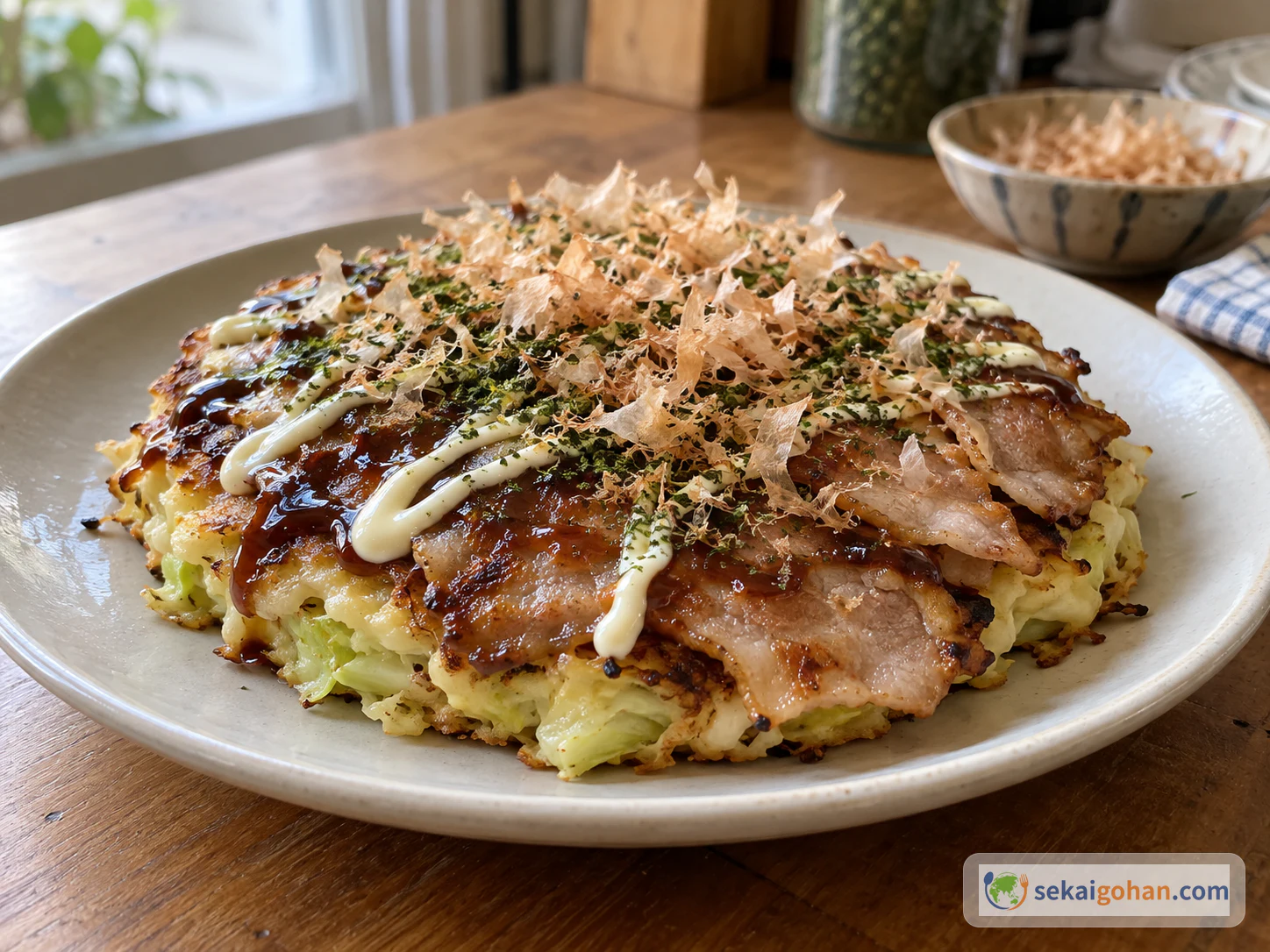
Imoni is not one fixed recipe, even within Yamagata. Inland, the basic pot is taro, beef, konnyaku and long scallion seasoned with soy sauce, and that is the style here. On the Sea of Japan side, in Shonai, pork and miso are the standard. In the Mogami area, some households add wild mountain vegetables or mushrooms, and in the Okitama area there are versions with large pieces of firm tofu or a little miso as a hidden seasoning. Even Yamagata City and Nakayama Town each have their own beef-and-soy recipes, with different amounts and steps.
Nobody knows exactly where the custom began. One theory dates it to the mid-1600s; another story tells of boatmen on the Mogami River gathering around a pot on the riverbank. Both are traditions rather than documented history. Beef is commonly said to have come into use around the early Showa era. Nakayama Town also has imobōni, taro cooked with dried cod (bōdara), which belongs to the area's imoni culture but is a different dish from the beef imoni common today.
Ingredients: 4–5 Large Bowls, Inland Yamagata Style
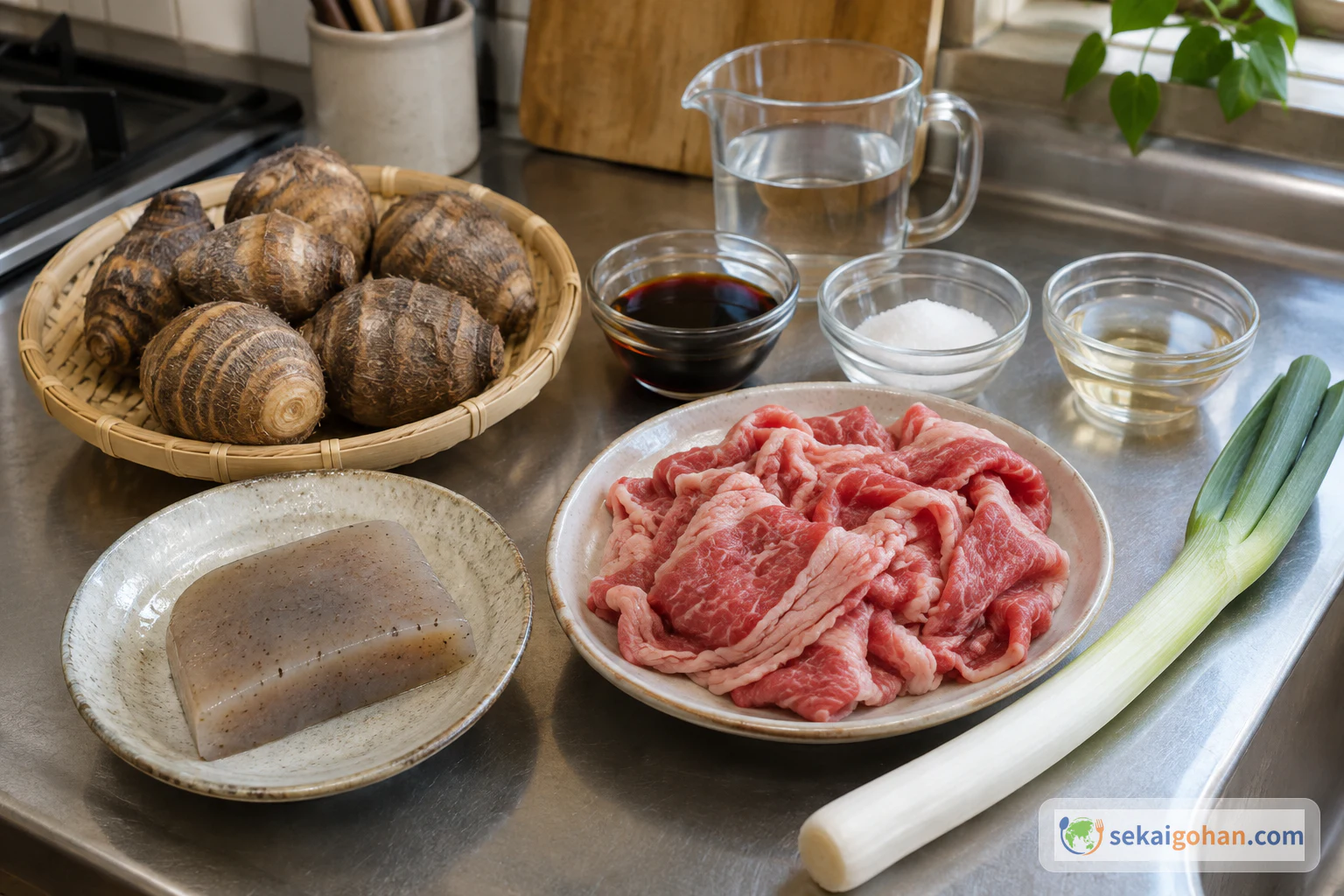
Equipment
- A cooking pot large enough to hold 800cc water with the taro, konnyaku and beef
- A knife or peeler for the taro
- A knife
- A cutting board for vegetables, and a separate cutting board for raw beef
- A bowl for the torn konnyaku and cut taro
- A ladle for skimming and serving
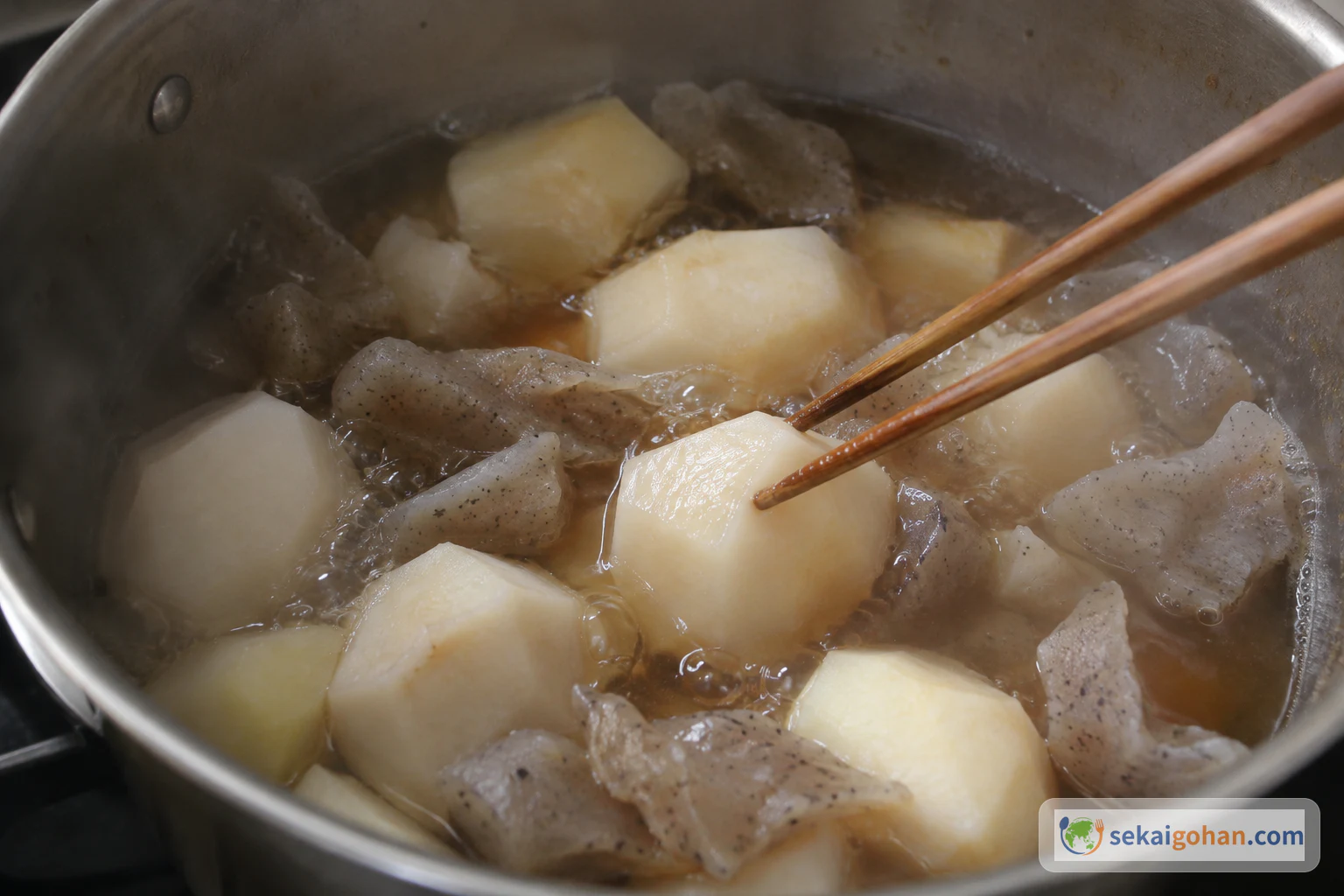
- Chopsticks for checking the taro
- A food thermometer for checking the beef
- Large bowls (donburi or large soup bowls) for serving
Choosing Ingredients for Imoni
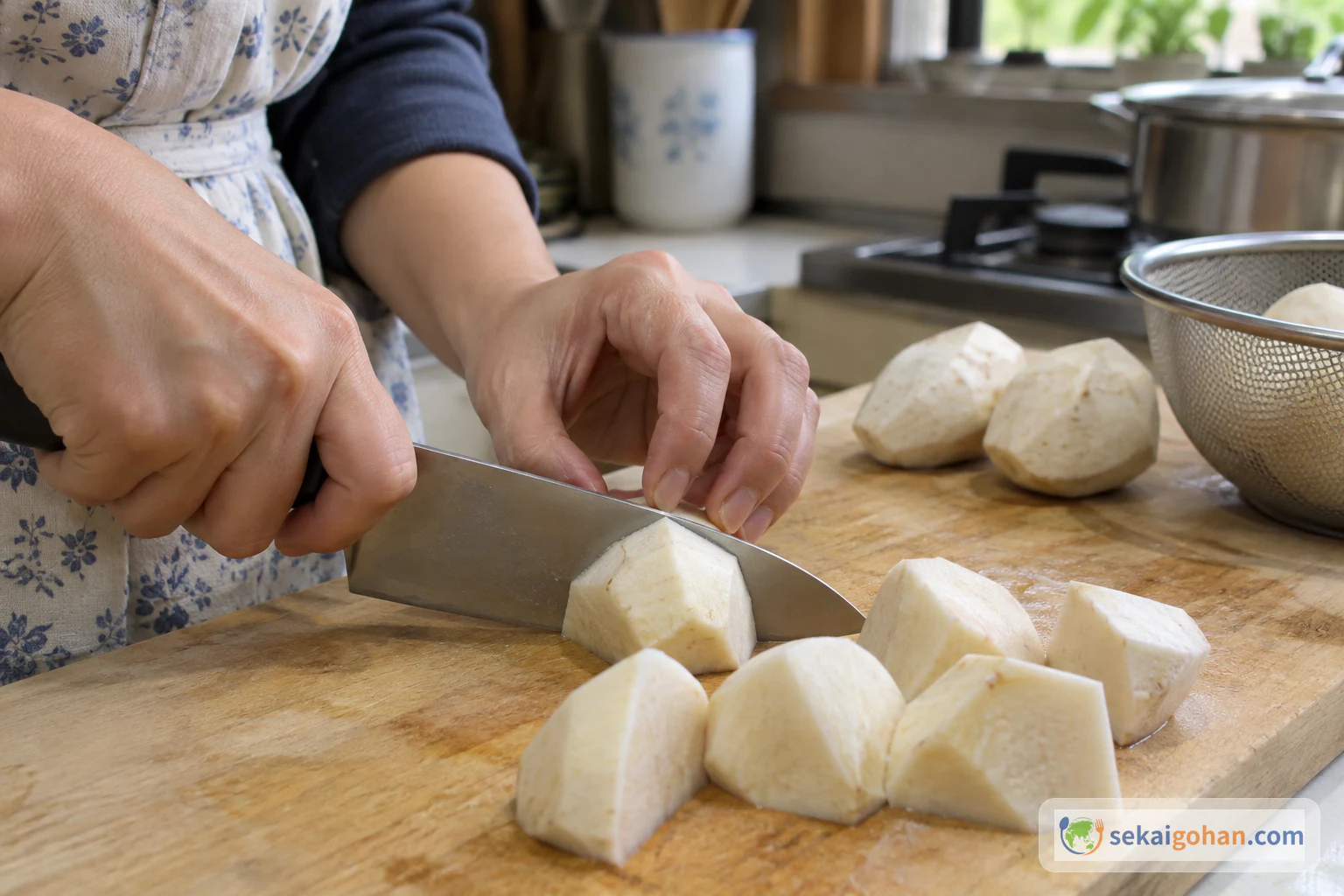
Taro. Pre-peeled taro, sold in Japan as arai-satoimo, saves you the peeling. The 1 lb (500g) in the table is a skin-on weight, though, so adjust pre-peeled taro by eye rather than by a fixed conversion.
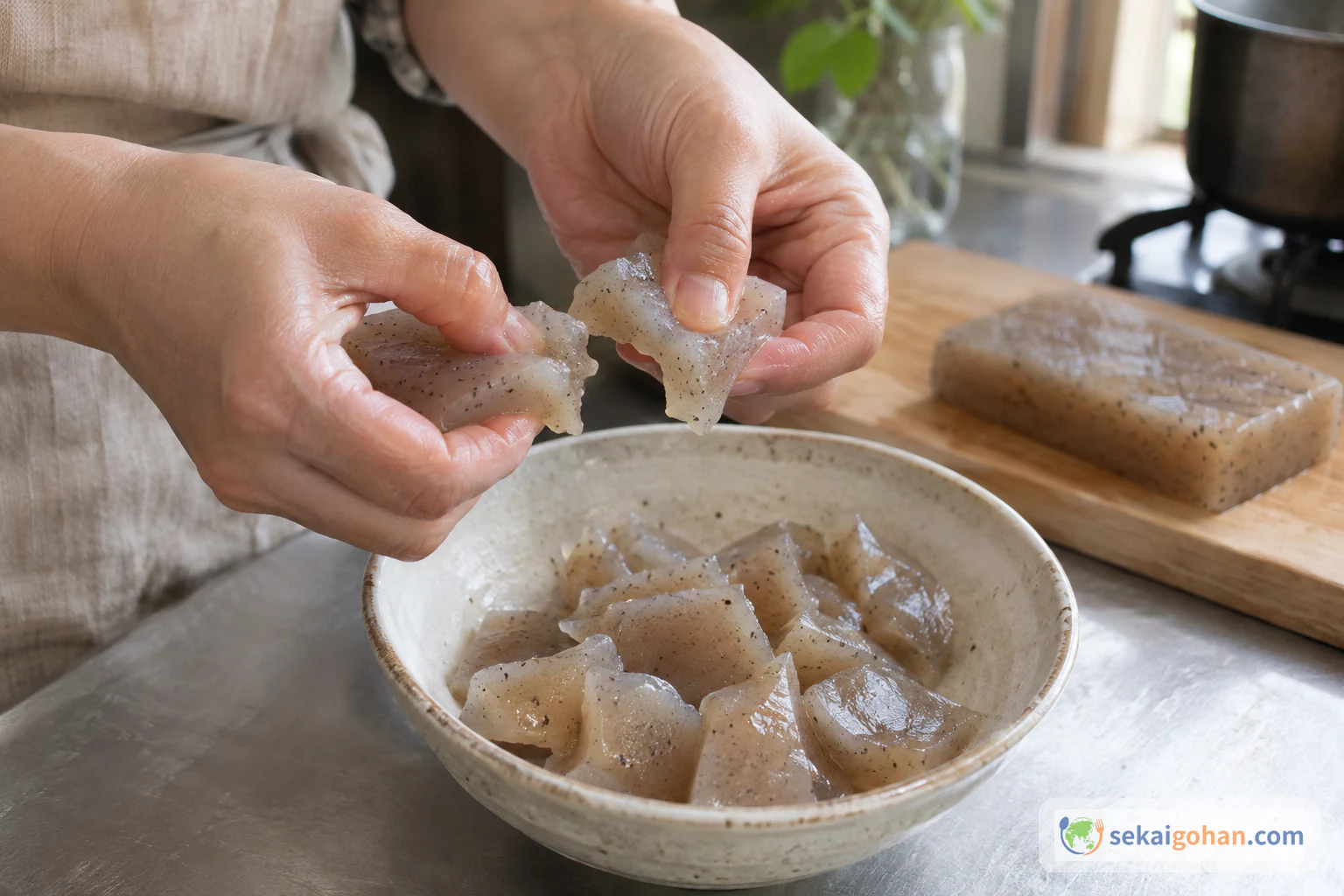
Konnyaku. Slab konnyaku is made either from konjac flour (seiko) or from fresh konjac corm (namaimo), so check the label. Konjac-flour konnyaku, the kind used here, can go straight into the pot. Konnyaku made from fresh konjac corm needs to be boiled and drained (yudekoboshi) first.
Beef. Fatty cuts such as thin-sliced belly or fatty trimmings give the broth its richness. Lean thin slices cook fine, but the broth will be lighter in body. Pork changes the dish: pork with miso is the Shonai pot.
Sake. Use ordinary drinking sake (seishu). Japanese cooking sake (ryōrishu) often contains salt and other additions, so if that's what you have, taste before adding more soy sauce.
Soy sauce and sugar. Soy sauces differ, so stick to the two-stage soy addition and taste at the end rather than adding extra up front.
This dish contains beef and soy (soy sauce). Many soy sauces also contain wheat; check the product label. Handle raw beef on its own board, and wash your hands and any tools that touched raw beef before handling the vegetables or serving bowls.
Method: Taro First, Beef Second, Scallion Last
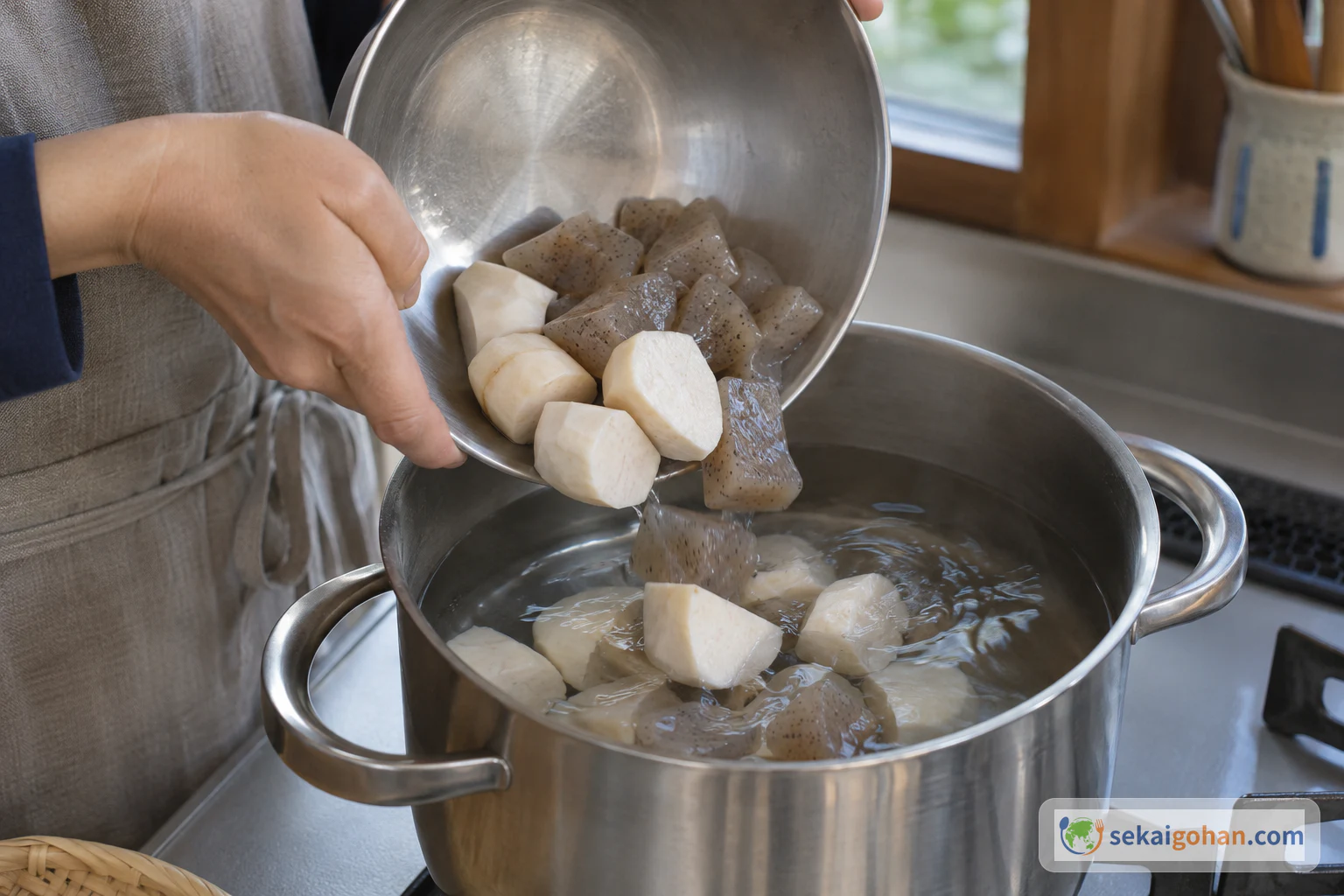
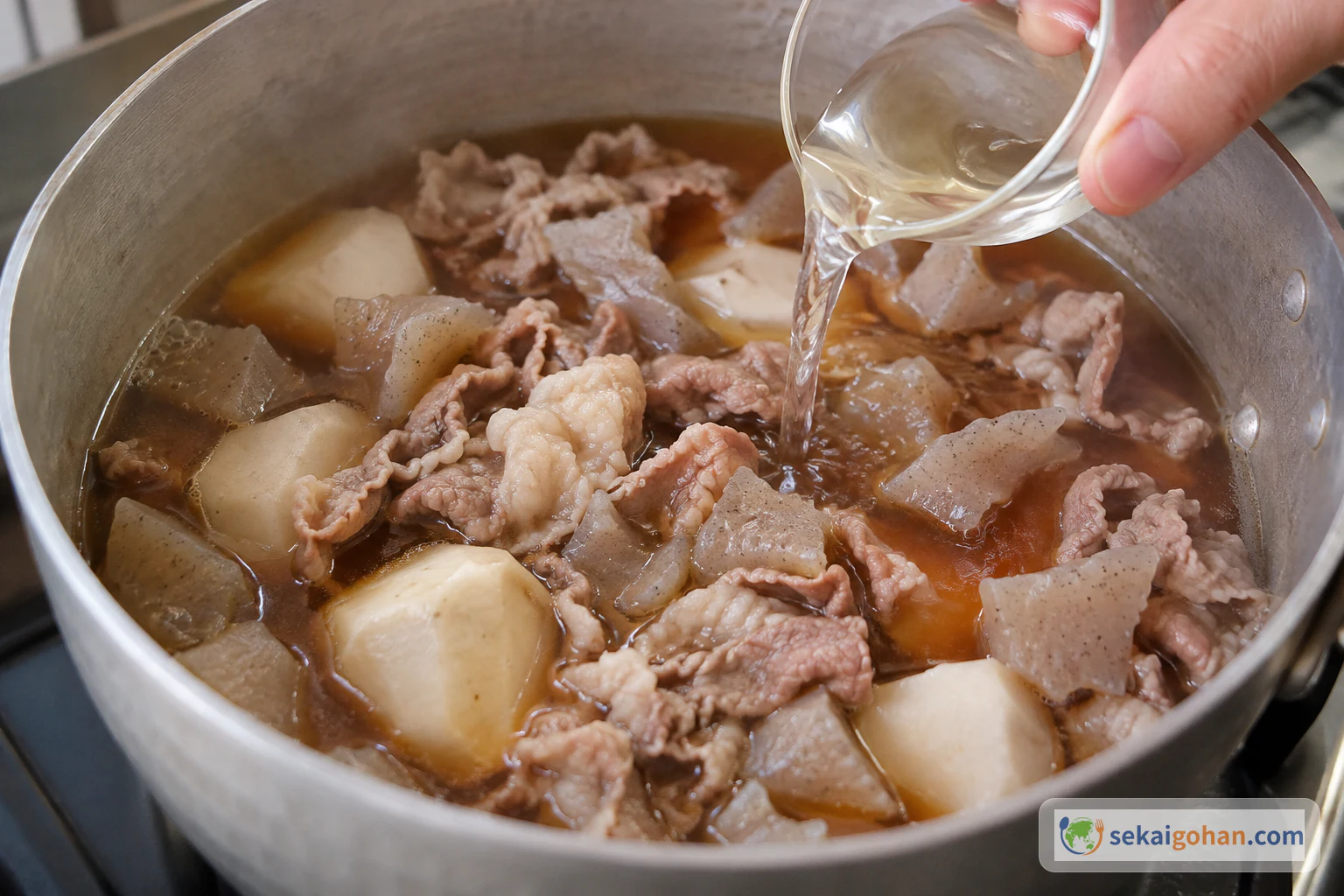
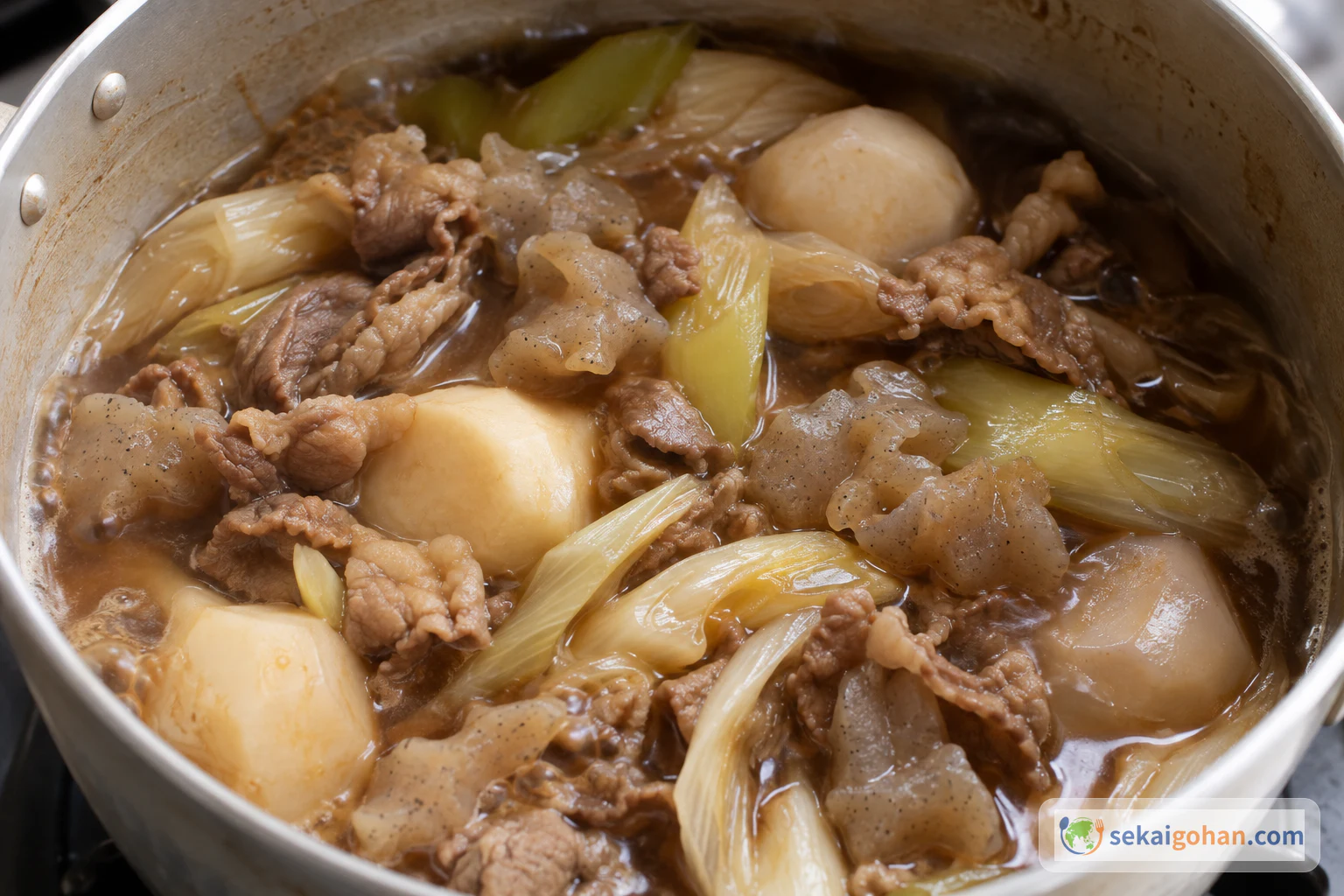
The first two steps are preparation. From step 3 on, the order is fixed: water, then taro and konnyaku, then heat, 1 tbsp soy sauce, soft taro, beef, the remaining seasoning, skimming, and the scallion last.
No cooking times are given here. Judge each stage by its state: taro that a chopstick goes into easily, beef cooked through, scallion very soft. Your pot, your heat and the size of the taro set the pace.
Heat the center of the beef to 167°F (75°C) and hold it there for at least 1 minute. The look of the pot cannot show this, so check with a thermometer. If you need to pause partway through cooking, refrigerate the pot, and when you resume, reheat it thoroughly.
Fixing Common Imoni Problems
Most problems come down to timing: the beef goes in only once the taro is soft, and the scallion needs real time in the pot.
| Problem | Likely cause | What to do |
|---|---|---|
| Taro still firm when the beef is in | Beef added before the taro was soft, or pieces cut unevenly | Keep simmering and check the largest piece with a chopstick. Next time, wait for soft taro before adding the beef |
| Some taro soft, some firm | Pieces of very different sizes | Keep simmering until the largest piece is soft. Cut pieces more evenly next time |
| Konnyaku has a strong smell or odd texture | Fresh-potato konnyaku used without parboiling | Boil and drain fresh-potato konnyaku before adding it |
| Konnyaku pieces look smooth and slip around | Cut with a knife instead of torn | Tear by hand; rough edges hold the broth |
| Broth too salty | All the soy sauce added at once, or salted cooking sake used | Add the soy sauce in two parts and taste before adding more |
| Broth thin and lacking richness | Lean beef | Use fatty thin-sliced beef such as belly or trimmings |
| Scallion still crisp | Not simmered long enough after adding it | Keep simmering until it is very soft |
| Unsure the beef is cooked | Thick folded pieces | Check the thickest piece with a thermometer; hold 167°F (75°C) at the center for at least 1 minute |
Serving, Leftovers and Ways to Finish the Pot
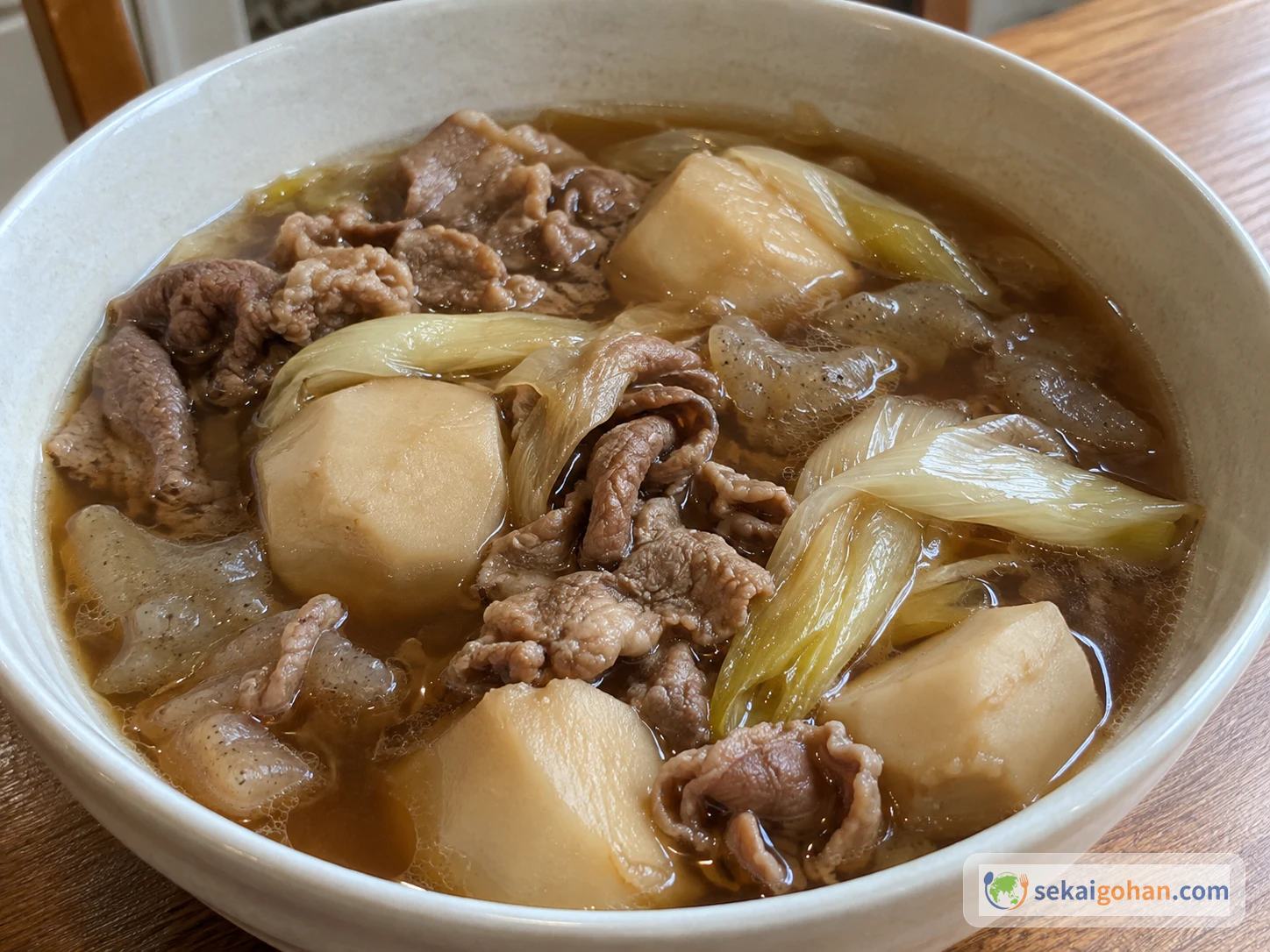
Inland imoni goes into a big bowl for each person, with plenty of broth over the soft taro, beef, torn konnyaku and scallion. It needs no garnish. Shichimi is an optional table seasoning, best shaken over your own bowl rather than into the whole pot.
When the pot runs low, udon noodles can go into the remaining broth to finish it off. A more recent habit is to stir curry roux into the leftovers, turning them into a second dish altogether.
For storage, divide leftover imoni into shallow containers so it cools quickly, and don't leave it at room temperature for long. Refrigerate it covered once cooled, reheat it thoroughly before eating, and don't keep it long.
Frequently Asked Questions
Is Yamagata imoni flavored with miso or soy sauce?
Both, depending on where you are. In inland Yamagata, beef and soy sauce are typical; in Shonai, on the coast, pork and miso are typical. This recipe is the inland beef-and-soy style.
Do I need to parboil the taro?
No. Cut the taro and put it straight into the pot with the water and konnyaku. Some local versions rub the taro with salt to remove its sliminess, but that is a different method.
How long does it take to cook?
There are no fixed cooking times, since your pot, your heat and the size of the taro all change the pace. Cook by the state of the pot instead: soft taro, beef cooked through, very soft scallion.