Tonkotsu Ramen: Kurume-Style Cloudy Pork Bone Broth at Home

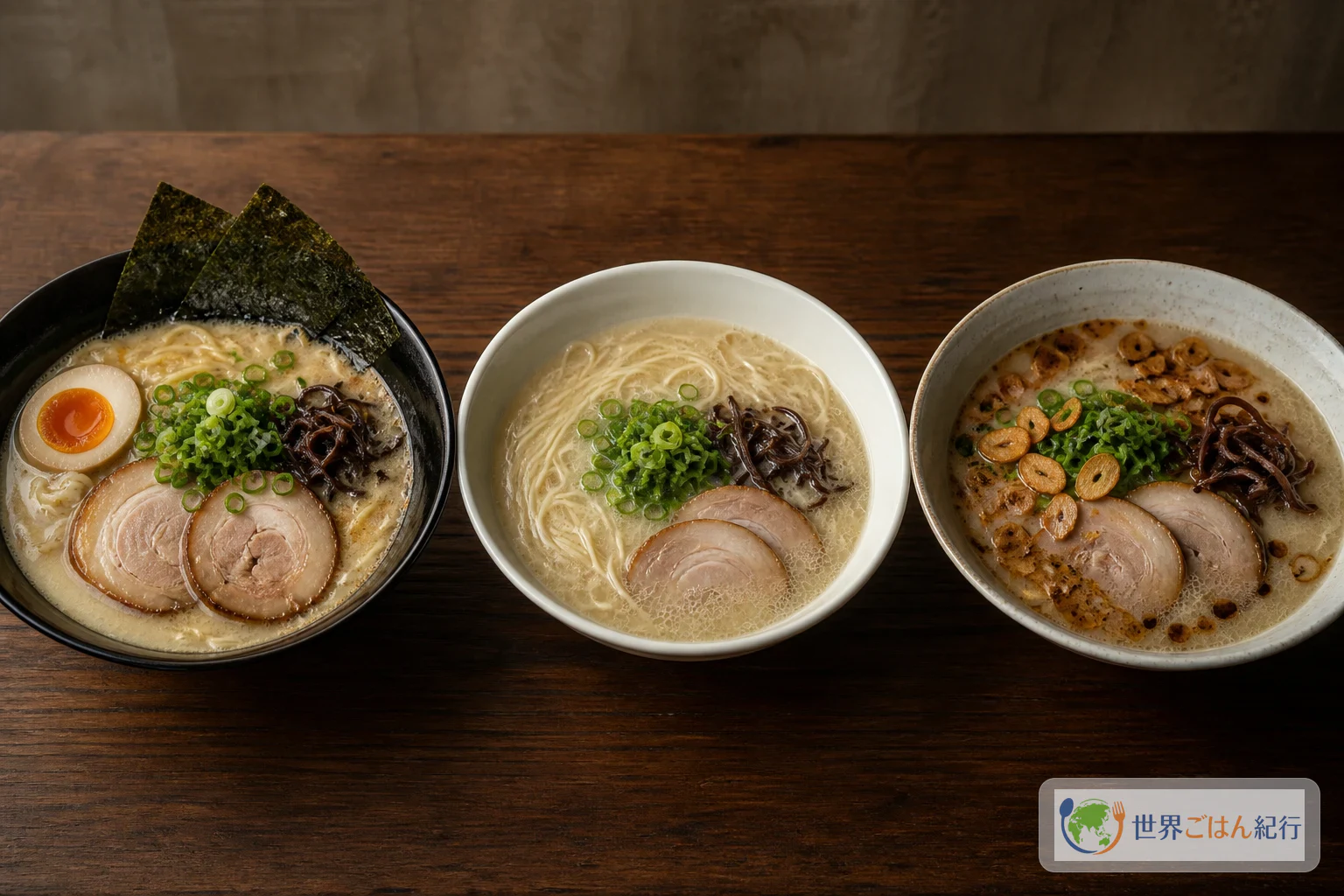
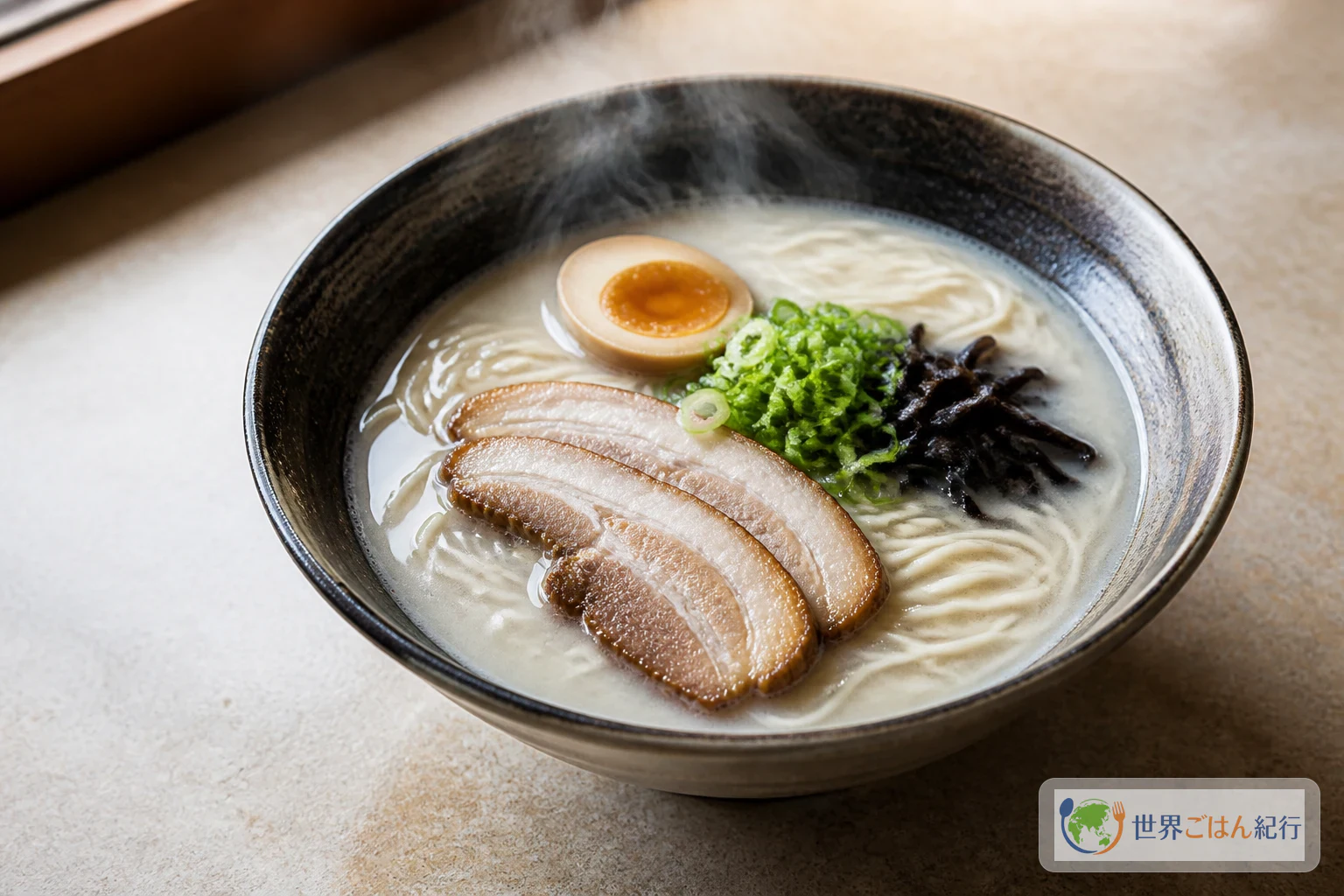
Tonkotsu ramen with thin straight noodles, chashu, wood ear mushrooms and scallions in cloudy pork bone broth
Prep
45 min
Cook
6 hr 30 min
Total
7 hr 15 min
Serves
4 servings
Level
Advanced
Cuisine
Japanese and Kyushu

Tonkotsu ramen with a home-sized mix of pork knuckle bones and trotters boiled hard. The cloudy broth born in Kurume, Hakata's thin noodles and kaedama refills, Kumamoto's garlic: bone prep, heat control, tare, substitutes, storage and safe reheating, and the yatai street-stall culture.

Cooking flow

Cooking steps

STEP11 / 5

Blanch the bones, and wash the pot and the bones

25 min

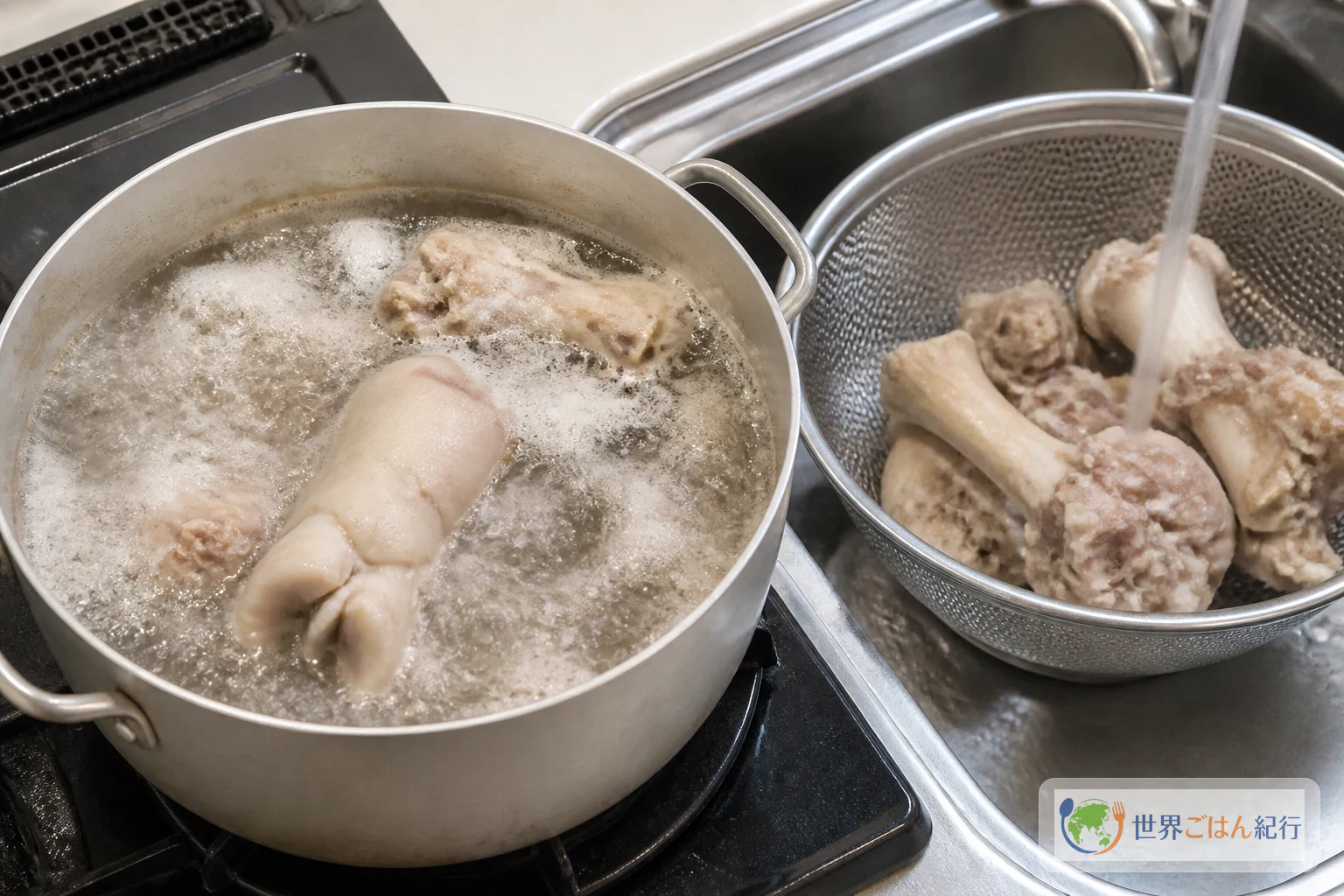
Blanching pork knuckle bones and trotters and rinsing off surface foam and blood clots under running water
Blanch the pork bones 20 minutes, rinse the surface under running water and wash the pot to remove what causes the smell

Put the pork knuckle bones and trotters in a large pot, pour in water to cover and bring to a boil over medium heat. After boiling, keep gray foam coming for 20 minutes, then turn off the heat and drain in a colander. Wash the bones one at a time under running water, remove clots of red blood and surface foam with your fingers, and wash the inside of the pot with detergent too.

Wash raw meat in water with the sink emptied so splashes don't spread around. The signal to move on is that no red clots remain on the washed bones and the rinse water doesn't keep turning cloudy. Cutting bones at home makes knives slip, so use uncut bones as they are. The cloudiness will be a little weaker, but prioritize working safely.

STEP22 / 5

Build a hard boil in fresh water

60 min

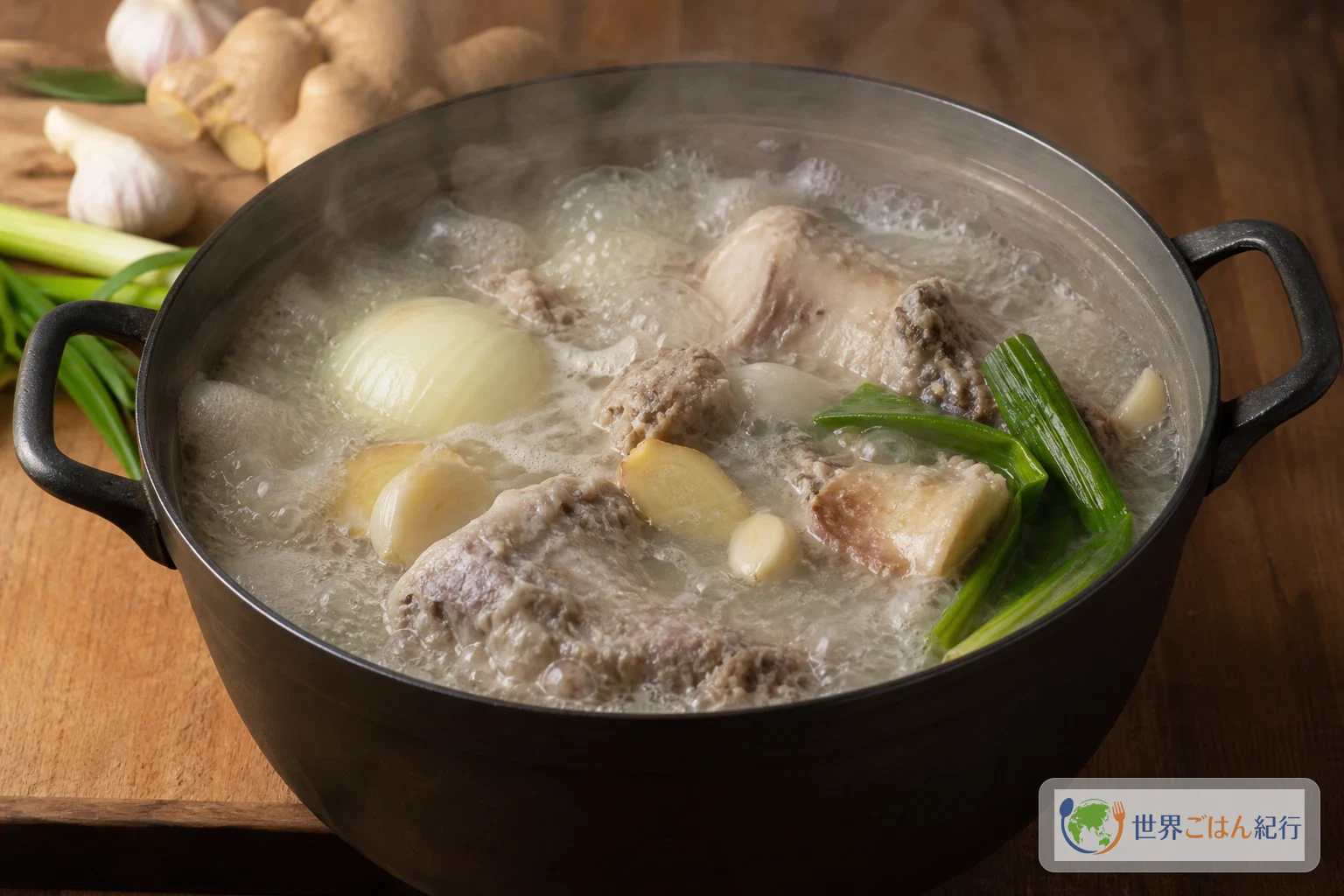
A pot with pork bones and aromatics in fresh water, raising large bubbles over high heat
The base of the cloudiness is a strong boil with the lid off and the whole pot rolling

Return the washed bones and trotters to a clean pot and pour in 4.75 quarts (4.5 L) water. Start over high heat, and even after it boils, leave the lid off and hold it for 10 minutes with the whole surface rolling. When the foam rises high, lower the heat a little and keep a strong boil within what won't overflow the pot. After about 30 minutes, add the onion, the green part of the scallion, the ginger and the garlic.

For the first 30 minutes only, skim off the gray foam that floats with a ladle. Skimming out even the beads of fat weakens the cloudiness, so leave the oil on the surface. If the water only rises and falls quietly, the heat is too low, and if bubbles aren't colliding around the bones the white is slow to come. After 60 minutes, if the broth is pale milky white and fine fat floats at the edge of the bones, move on to the long simmer.

STEP33 / 5

Grow the cloudiness while adding boiling water

4 h 30 min

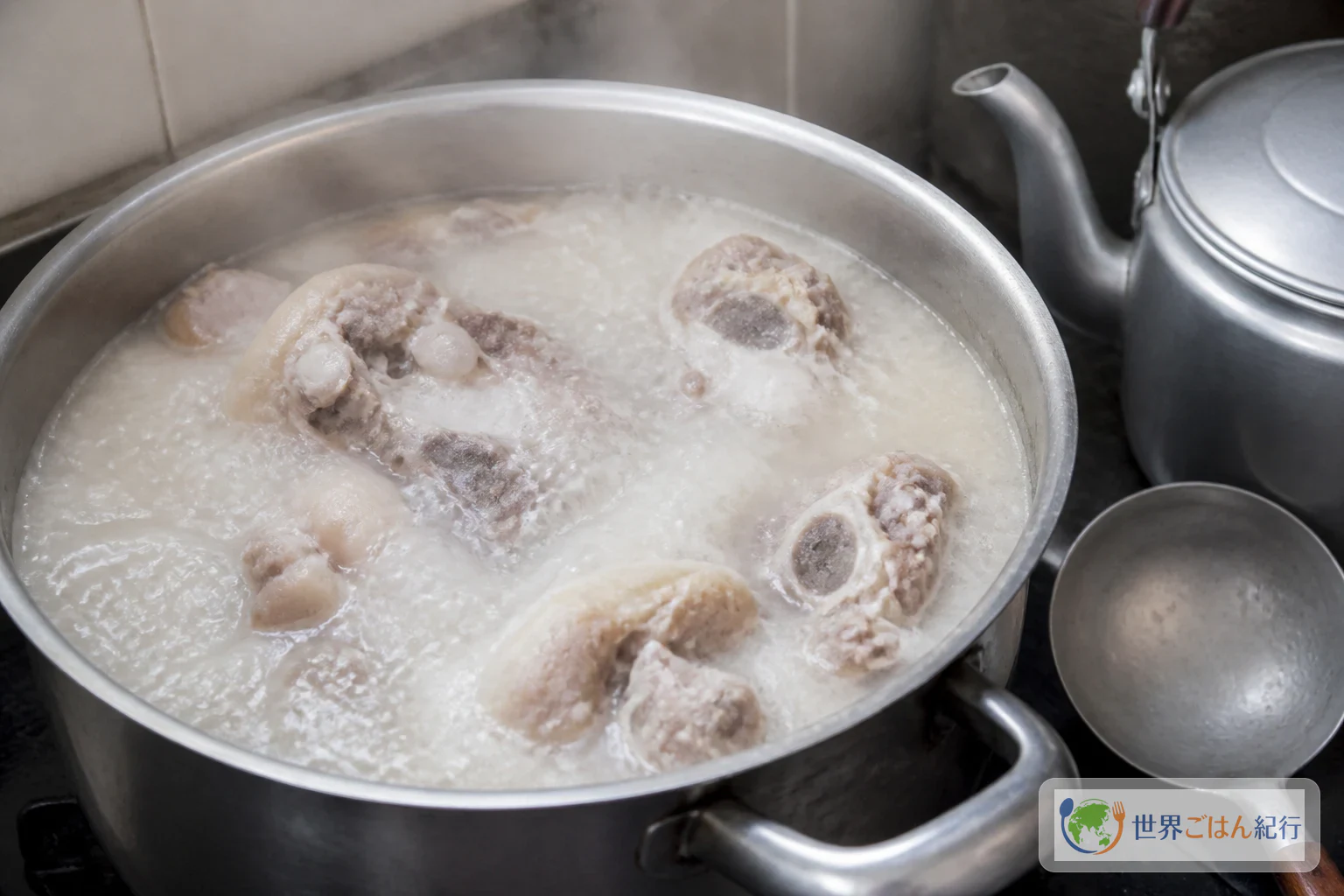
Cloudy tonkotsu broth with a strong boil that moves the bones and fine beads of fat floating on the surface
Keeping a strong boil while adding boiling water makes the broth white and opaque with fine beads of fat

Adjust from high to medium-high and keep a boil in which the bones move now and then. Check the water level every 40–50 minutes, and if the bones are about to rise above the surface, add 200–300 ml boiling water at a time. Don't pour in cold water; it stops the boil and tends to separate fat and water. Cook for 4.5–5 hours in total, until the area around the bones breaks down and the broth is white and opaque, with fine beads of fat floating continuously on the surface.

So that adding water doesn't make too much broth, reduce the amount you add in the final hour to about ½ cup (100 ml). If it drops until you can see the bottom of the pot, add 1¾ cups (400 ml) boiling water before the bones' essence reduces too far, and return to a strong boil. Conversely, if the water level is high and some transparency remains after 5 hours, boil with the lid off another 30–45 minutes. Check not only the white but that the liquid scooped in a ladle doesn't run thin and clear and leaves a thin film.

Leaving the pot at this stage leads to boilovers and dry-firing. If you need to turn off the heat, bring it back to high on restart and begin counting the time over. Don't just add up the simmering time; judge by the time it was actually boiling.

STEP44 / 5

Prepare the chashu and tare in a separate pot

90 min

Braising pork belly with soy sauce in a separate pot to finish the chashu and tare
Cook the chashu through to the center in a separate pot, and set the broth's saltiness separately with the tare

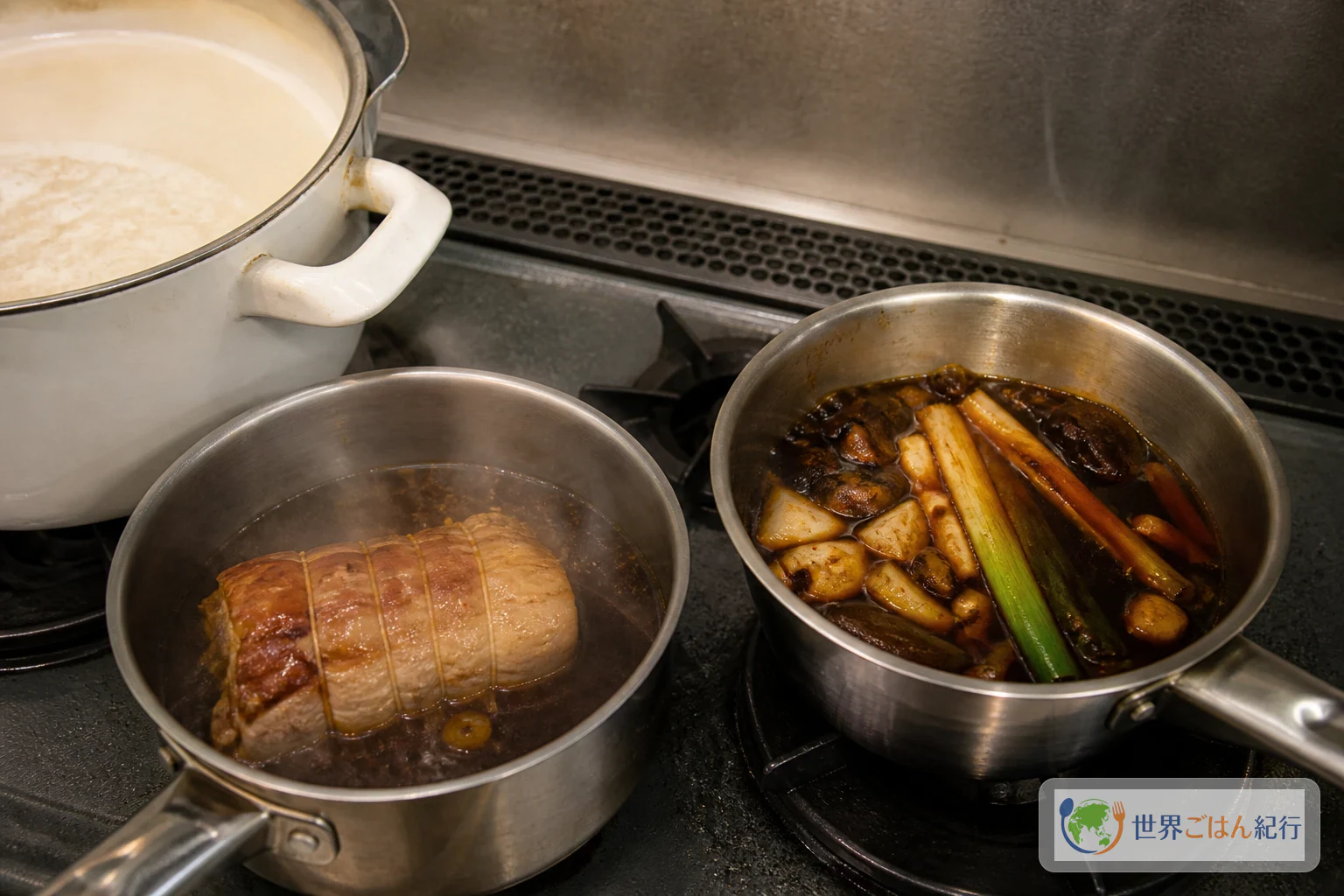
Shape the pork belly into a block about 2 inches (5 cm) wide and tie it with kitchen twine in 2 places. In a small pot put 1¾ cups (400 ml) water, ¼ cup (80 ml) soy sauce, 3.5 tbsp (50 ml) sake, 2 tbsp (30 ml) mirin, 15 g sugar, ginger and garlic, and add the meat when it boils. Put a drop lid on, lower to low heat, and simmer 75–90 minutes, turning the meat over every 20 minutes. Confirm the center of the thickest part reaches 167°F (75 °C) or higher and no red remains on a cut face.

Take out the meat and rest it 20 minutes in the cooking liquid, then slice 4–5 mm thick once the heat has gone. For the tare, in another small pot warm ½ cup (100 ml) soy sauce, the remaining 2 tbsp (30 ml) sake, 1.5 tbsp (20 ml) mirin, 12 g salt, the kombu and 5 g sugar over low heat for 2 minutes, and take out the kombu before it boils. Don't settle on a strong flavor all at once; setting it so you can use 1.5 tbsp (25 ml) per bowl lets you adjust when kaedama thins things out.

Heating the center to 167°F (75 °C) for 1 minute or more kills many microorganisms, and thicker meat takes longer to reach it. Without a thermometer, heat until the red at the center is gone and the juices run clear. Adding a lot of the chashu cooking liquid straight into the broth makes it too salty and sweet, so make the tare separately.

STEP55 / 5

Strain the broth and finish the thin noodles one bowl at a time

15 min

Boiling thin straight noodles briefly, dropping them into cloudy broth and topping the bowl
Boil thin noodles briefly one portion at a time, drain, and put them straight into the broth

Strain the tonkotsu broth through a fine strainer and remove the bones and aromatics. Aim for about 1.75 quarts (1.6 L), using 1¼ cups (300 ml) per bowl for 4 servings. If there is a lot, reduce it 10 minutes at a time over medium-low heat; if it is short, add a little separately warmed unsalted water, not boiling water straight from the pot. Rehydrate and thinly slice the wood ear mushrooms, and slice the scallions.

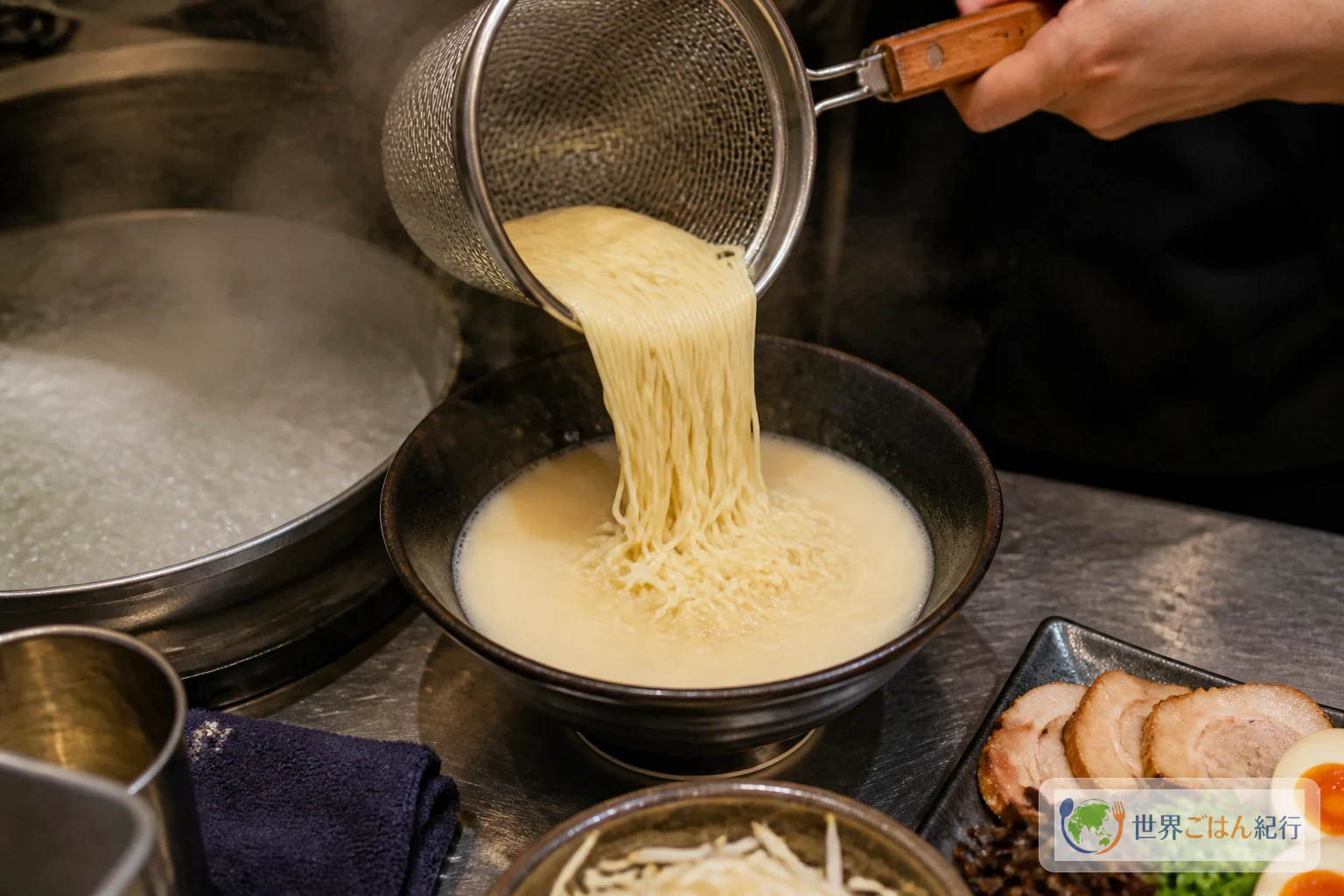
Warm the bowls with boiling water, put 1.5 tbsp (25 ml) tare and 1¼ cups (300 ml) hot broth in each bowl and mix. In a separate pot boil 2 quarts (2 L) or more of water hard, loosen fresh noodles one portion at a time and put them in, and boil 45–60 seconds if the package gives no instruction. Loosen the noodles with chopsticks, lift them out when a slight spring remains at the center, and shake the strainer up and down 3 times to drain. Drop the noodles into the broth before they absorb water, and top with chashu, wood ear mushrooms, scallions, seasoned egg and nori.

Mix the tare and broth until oil doesn't form only a big ring and the trail of the spoon smooths back. When fine beads of fat are scattered on the surface and the soy sauce color doesn't remain only at the bottom of the bowl, it is ready for the noodles.

Kaedama started in Nagahama. Thin noodles go soft in a large bowl, and fish market workers needed to eat quickly. Don't drink too much of the broth while eating the first noodles. Boil an extra 2.75–4 oz (80–120 g) of noodles in the same pot and put them into the bowl. Adding 1 tsp tare to the kaedama restores what the broth has thinned. Noodles boiled and left waiting in broth lose the texture of thin noodles, so serve and eat one person at a time.

0 / 0
Ingredients

Ingredients

1 / 4

Tonkotsu broth

Ingredient Amount Substitutes & notes
Pork knuckle bones (genkotsu) or pork backbone 3.25 lb (1.5 kg) Cut to 6–8 cm. Mixed types of bone are fine
Pork trotters 1 lb (500 g) Hooves removed. If unavailable, add 10.5 oz (300 g) more pork bones; the richness will be a little lighter
Water 4.75 quarts (4.5 L) Also have 1 quart (1 L) of boiling water ready to add during cooking
Onion 1/2, about 4 oz (120 g) Halved. Can be omitted if you don't want extra sweetness
Green part of a long scallion 1 stalk Cut into 2 inches (5 cm). Keep the white part for the finish
Ginger 1.5 oz (40 g) Sliced. Tempers the pork aroma
Garlic 4 cloves, about 25 g Crushed. Use it to strengthen a Kyushu-style aroma
2 / 4

Tare and chashu

Ingredient Amount Substitutes & notes
Pork belly, in a block 1 lb (500 g) Pork shoulder loin also works, with less fat
Dark soy sauce ½ cup (100 ml) For the tare. Salt content differs by product, so start with 1.5 tbsp (25 ml) per bowl
Sake ¼ cup (80 ml) Divided between the tare and the braised pork
Mirin 3.5 tbsp (50 ml) Reduce to 2 tbsp (30 ml) for less sweetness
Sugar 15 g For the chashu. Can be omitted
Salt 12 g For the tare. Not added to the broth itself
Kombu 4 g Only to soften the tare's edge. Remove before it boils
Ginger 20 g For the chashu. Sliced
Garlic 1 clove For the chashu. Crushed
3 / 4

Noodles and finish

Ingredient Amount Substitutes & notes
Fresh thin straight noodles 1 lb (480 g) 4 oz (120 g) per person. For dried noodles go by 2.75–3.25 oz (80–90 g) per person, following the package
Wood ear mushrooms (dried) 15 g Rehydrate and slice thin. About 2.75 oz (80 g) if fresh
Scallions (green) 2 oz (60 g) Thinly sliced. White scallion works too
Seasoned eggs 4 Store-bought or separately boiled eggs. Can be omitted
Red pickled ginger 1.5 oz (40 g) Served a little at a time at the table. Don't put it in the bowl from the start
Toasted sesame seeds 2 tbsp Optional, as a Nagahama-style table seasoning
Toasted nori 2 sheets Serve half a sheet each for a Kurume-leaning presentation
4 / 4

Ingredients if making noodles yourself

Ingredient Amount Substitutes & notes
Bread flour 10.5 oz (300 g) For 4 servings. Make a stiff, low-hydration dough
Water 3.75 oz (105 g) 35% hydration. Adjust by up to 5 g depending on how the flour absorbs
Powdered kansui 3 g Follow the product's stated amount. Mix directly into the flour
Salt 3 g To help the dough firm up
Potato starch for dusting 20 g Prevents noodles sticking. Shake off well before boiling
0 / 0

The surface of the pot heaves, and white foam circles around the bones. A cloudy tonkotsu broth comes from a boil strong enough to move the bones, not from a long, quiet simmer. At the end, thin noodles are boiled briefly in a separate pot and dropped into the hot broth, so each bowl comes together with the noodles still springy. This version starts from the cloudy tonkotsu born in Kurume and adds the thin noodles and kaedama (extra noodles) that spread from Hakata and Nagahama. You're aiming for a white, opaque broth with fine beads of fat on the surface, and noodles that hold up when you lift them instead of going watery.

Tonkotsu Ramen in Kyushu

Tonkotsu ramen is defined by its creamy broth, which comes from pork bones rather than from salt or soy sauce, and it is loved across Kyushu. In Hakata, the basic toppings are thin straight noodles, chashu, wood ear mushrooms and scallions. The way the pork bones are handled overlaps with Korean dwaeji gukbap, which also brings toppings and broth together into one meal. The two dishes differ in noodle boiling time and in how the richness of the broth is decided.

From Chinese noodles to Kurume's white broth
Three ramen with Kurume-style rich tonkotsu, Hakata-style thin noodles and Kumamoto-style garlic
Compare the differences of Kurume, Hakata and Kumamoto by richness of broth, noodles and how garlic is added

Ramen has its roots in China. In 1910, a Chinese restaurant in Asakusa, Tokyo, served a dish called ramen, and the combination of wheat noodles, meat or fish broth and kansui changed as it spread across Japan, splitting into bowls suited to local eateries and stalls. Kansui is an alkaline solution that gives noodles their distinctive spring.

Tonkotsu ramen started at Nankin Senryo, a stall in Kurume, Fukuoka Prefecture. In 1937, Tokio Miyamoto, who ran a udon shop, drew on the "shina soba" popular in Tokyo and Yokohama and on the champon of his hometown Nagasaki to create it. Pork bones were cheaper than chicken bones, and the broth back then was fairly clear, not the pure white it is today.

The cloudy form appeared in 1947 at Sankyu, another Kurume stall. As the story goes, the broth boiled for a long time while the owner was out, and when the owner came back, they tasted the cloudy white liquid and seasoned it. That is one origin story, and not every tonkotsu shop uses the same process, but a strong boil in a home pot heads in the same direction.

Kumamoto, Nagahama and Hakata

Sankyu's flavor was passed on to Saga and to Tamana in Kumamoto. In Kumamoto, a different style grew up: pork bones combined with chicken bones and other bones, fried garlic or garlic oil, and medium straight noodles. The broth is gentler, and the aroma of roasted garlic stands out. The regions differ in more than whether the broth is cloudy. They also differ in which broths get layered together and which aromas are added at the table.

Nagahama stalls served ultra-thin noodles that could be eaten quickly, to suit the hours of the fish market. Thin noodles go soft in a large serving, so people started keeping the first portion small and adding only noodles to the same broth. That practice is kaedama. The usual picture of Hakata ramen brings together Kurume's cloudy cooking, Nagahama's thin noodles and kaedama, and the way Hakata's stalls and shops serve it. Shops keep experimenting, and no classification cleanly separates the three.

How it is eaten in shops

In a typical shop, you buy a meal ticket, choose your noodle firmness, and order kaedama before you finish. You don't have to drink all the broth. Eating the noodles and toppings and leaving a little broth is one way to show you're done.

Ingredients and tools (serves 4)
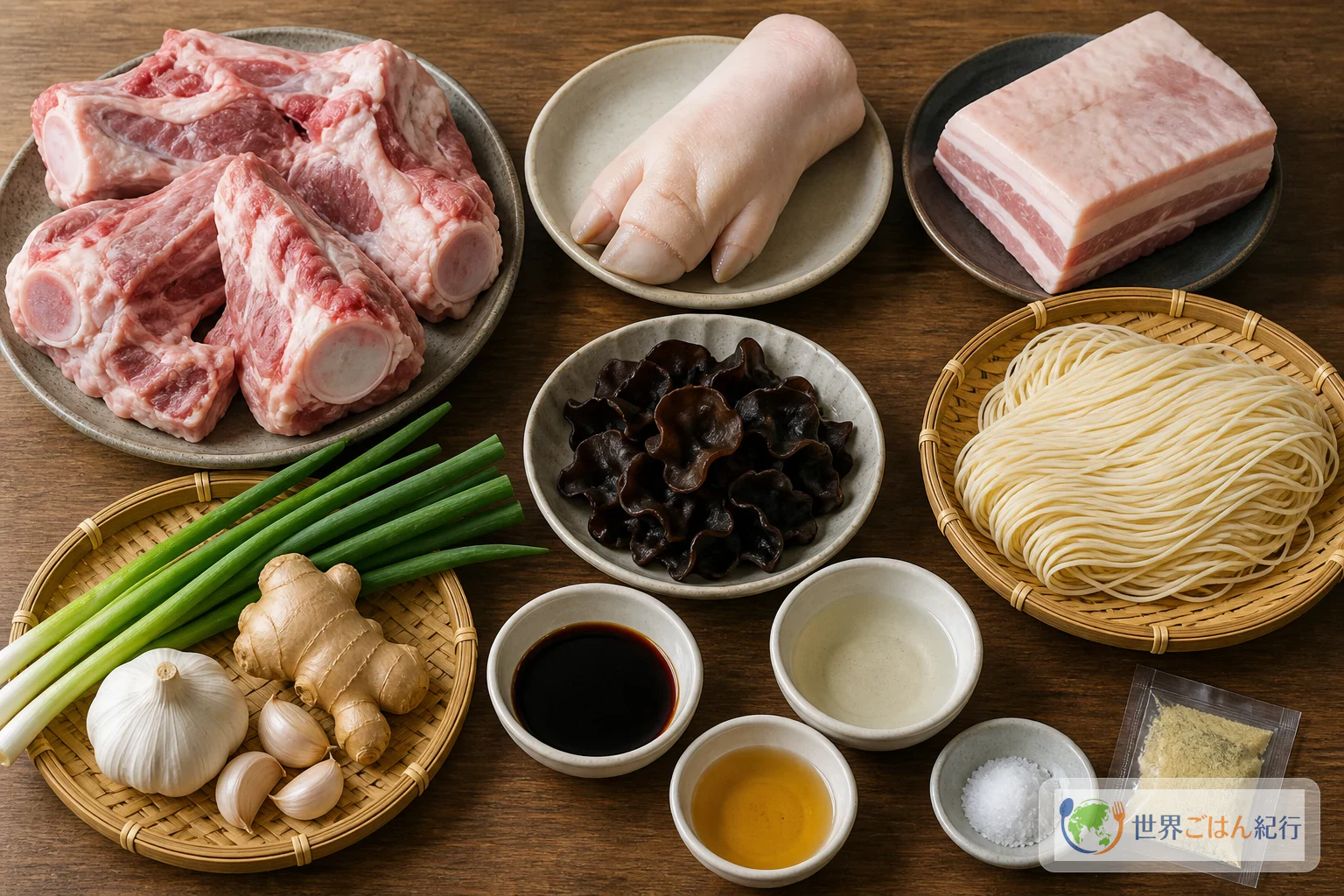
Ingredients for tonkotsu ramen: pork knuckle bones, trotters, pork belly, thin noodles, wood ear mushrooms, scallions and soy sauce
Prepare the pork bones, trotters, thin noodles and the pork belly for chashu separately

Choose the bone cuts a butcher counter sells as pork knuckle bones ("genkotsu") or pork backbone. Bones cut into pieces of about 6–8 cm expose the marrow to the water and cloud easily, but cutting them at home with an axe or saw is dangerous. If you only have large bones, don't force-cut them; make a broth that is paler from the start.

If you use store-bought thin noodles, you don't need the ingredients for homemade noodles. Powdered kansui is an alkaline solution that gives ramen its characteristic spring. Don't add more than the label says. Measure carefully so you don't inhale the powder. Prepping the pork bones requires a large pot and a fine strainer, so you don't need special equipment just for noodles.

Pork bones and pork belly are raw ingredients. Don't let knives, cutting boards and tongs that touched raw meat touch cooked noodles and toppings; wash them with detergent before moving to the next task. Cook the pork through to the center, and don't eat chashu that is still red, since freshness and smell can't tell you whether meat is safe.

Choosing Ingredients for Tonkotsu at Home

A shop's big stockpot cooks a huge amount of bones and gets topped up again and again, which a 5.25 quarts (5 L) home pot can't match. If you keep adding bones to chase the same color, the pot boils over and the heat gets hard to manage. Focus on cloudiness, thin noodles and keeping the tare separate, and swap out the parts that need shop equipment. The key to the home version is to watch the boil, add water as needed, and boil the noodles only just before eating.

Element that brings it closer to the shop Home replacement Guide for judging
Long extraction of bone marrow and skin Cut pork knuckle bones combined with trotters Prioritize white and beads of fat; don't cut bones at home
Holding a strong boil for a long time Lid off, watching the water level and adding boiling water Make it on a day you can stay near the pot
A topped-up stockpot broth Cook one batch, strain, and use it that day The depth of flavor won't be quite the same
Serving ultra-thin noodles quickly Boil store-bought fresh thin noodles one portion at a time Adjust firmness using the package's time as a reference
Flavor changes at the table Sesame, garlic and red pickled ginger on a separate dish Taste first, then add

Pork bones alone still make a good broth if you can't get trotters. If you swap the pork bones for chicken bones or a vegetable stock, you'll still get a white ramen, but it won't be tonkotsu. Tell everyone at the table whether the dish contains pork, soy sauce, wheat or egg, and read labels carefully when anyone has allergies.

Method: keep it cloudy, boil the noodles last

The broth pot takes about 5 hours 30 minutes including the first blanching, and the chashu takes about 90 minutes of that. Because it is on the heat so long, don't leave it cooking while you go out or sleep, and turn off the heat whenever you leave the pot. Cook the broth unsalted and add the tare bowl by bowl, so you can adjust the thickness with the amount of noodles and kaedama.

Fixing Cloudiness and Noodle Firmness

When tonkotsu goes wrong, it's easier to rescue by reading the pot than by adding ingredients. Check the white, the beads of fat, the water level and the strength of the noodle water one at a time, and you'll find where the flavor slipped.

If the broth stays clear, first strengthen the boil.

Six hours at a quiet simmer won't make much cloudiness. Take off the lid, go back to high heat so the bones move now and then, and boil 30–45 minutes. If it's still clear, the bones may have been too large, there may be too much water, or the boil may have stopped too many times. Don't recut bones at home; next time, buy bones the butcher has already cut.

If fat separates, restore it in the hot broth rather than diluting with cold water.

If you see big patches of oil when you lift a ladle, put the pot back on medium-high heat and stir from the bottom with a wooden spoon for 5 minutes. Bring back the heat and the movement until the fat breaks into fine white beads, instead of covering the problem with salt or tare.

If the noodles are going soft, check the water and the serving order before you blame the noodles. Putting 4 portions at once into less than 2 quarts (2 L) of water drops the temperature, so the noodles soak up water even when you keep to the stated time. Boil hard in a large pot, cook one portion at a time, and get each into the broth within 10 seconds of lifting it out.
If the pork smell is too strong, keep the fat in the broth. Use less than 1.5 tbsp (25 ml) tare and add a little ginger and scallion. Throwing out the blanching water and skimming only the first foam also soften the aroma. Add garlic and red pickled ginger a little at a time at the table, so you can still taste how the tonkotsu itself is changing.

Serving Tonkotsu Ramen and Regional Variations

Taste the broth on its own first, then add sesame, garlic and red pickled ginger a little at a time, just as you would in a shop. That way you can tell what each table seasoning does to the flavor. Once you've made the basic bowl with local ingredients, try changing the noodle firmness and the amount of garlic. The differences across Kyushu get easier to taste that way.

Region / style Notable traits What to change at home
Kurume Starting point of cloudiness; strong aroma and body in many shops. Some use slightly thicker noodles and nori Use trotters and strain the broth richer. Serve nori; kaedama is optional
Nagahama Ultra-thin noodles and kaedama; sesame, garlic and red pickled ginger added at the table Cut noodles to 2.75–3.5 oz (80–100 g) and serve a light first bowl. Add seasonings partway through
Hakata The form that spread nationwide: cloudy tonkotsu with thin straight noodles This recipe's basic form. Start with "regular" firmness and keep back broth for kaedama
Kumamoto Gentler broth of pork bones with chicken bones and so on, fried garlic or garlic oil, somewhat thicker straight noodles Replace part of the broth with chicken stock and add 1 tsp fried garlic at the end
Miyazaki / Kagoshima Miyazaki: gentle tonkotsu with medium-thick noodles. Kagoshima: chicken and pork soups with thicker noodles If you change the broth ratio and noodles, serve it as a regional bowl rather than Hakata style

Real shops mix and match, too. Some pair Kurume's way of cooking with Nagahama's noodles, and others tone down the cloudiness. Combining elements from two regions at home is fine. Just keep track of what you borrowed from where, and adjusting the taste gets easier.

Adding Kumamoto-style garlic

Warm 1¼ cups (300 ml) of the basic broth. In a separate small skillet, put 2 tbsp (30 ml) vegetable oil and 15 g thinly sliced garlic and cook over low heat for 5–7 minutes, until small bubbles rise and the garlic turns pale golden. Turn off the heat, pull the garlic out before it burns, and add 1 tsp of the oil and the garlic chips to a bowl. If the garlic goes black, the bitterness won't go away, so make a fresh batch with fresh oil. Take your first bite before adding it. You'll be able to compare the pork flavor with the garlic aroma.

FAQ

Can a pressure cooker shorten the broth?

A pressure cooker softens the bones faster, but gentle heating in a sealed pot won't give you the cloudy broth this recipe is after. After releasing the pressure, move everything to a large pot, leave the lid off, and boil hard for 30–60 minutes while you check the richness and the white. If you already own one, it's a good way to save time, but it isn't worth buying just for this.

Can I eat it if the broth doesn't turn white?

Yes. A clear pork bone broth simmered over low heat has a lighter aroma and flavor, and it's still good to eat. To get some cloudiness back, follow the first tip above. Don't add salt to make up for the missing white.

Can I make noodles without kansui?

Store-bought thin ramen noodles let you skip kansui entirely. For homemade noodles you do need it, because kansui gives the spring and color; use exactly the amount stated on the product. Udon and somen look similar but differ in mix and texture, so start with fresh thin straight noodles to get a feel for how they balance with the broth.

How do I store the broth, chashu and noodles?

Don't store the noodles in the broth. Cool the broth, chashu and toppings separately. Divide the broth into shallow containers, refrigerate once the heat has gone, and use it within 2–3 days. For longer storage, freeze it one bowl at a time; quality is best within about 1 month. Reheat frozen broth in a pot until it's hot right through to the center, and don't refreeze it. As a general guide, soups and stews with meat keep 3–4 days in the fridge and 2–3 months frozen, and cooling the pot quickly helps the fridge hold them safely. If there's any off smell or the container bulges, throw it out.

Can I substitute if I can't eat pork or wheat?

Chicken bones or seafood stock make a different ramen, not tonkotsu. With a wheat allergy, check the labels on the noodles, the soy sauce, processed chashu and anything containing kansui. Seasonings can contain egg, soy or seafood, so skip any ingredient whose label you can't check. Renaming the dish doesn't make it safe for allergies; consult a specialist if needed.
Sources