Rinderroulade: German Braised Beef Rolls with Bacon and Pickles (Rinderrouladen)

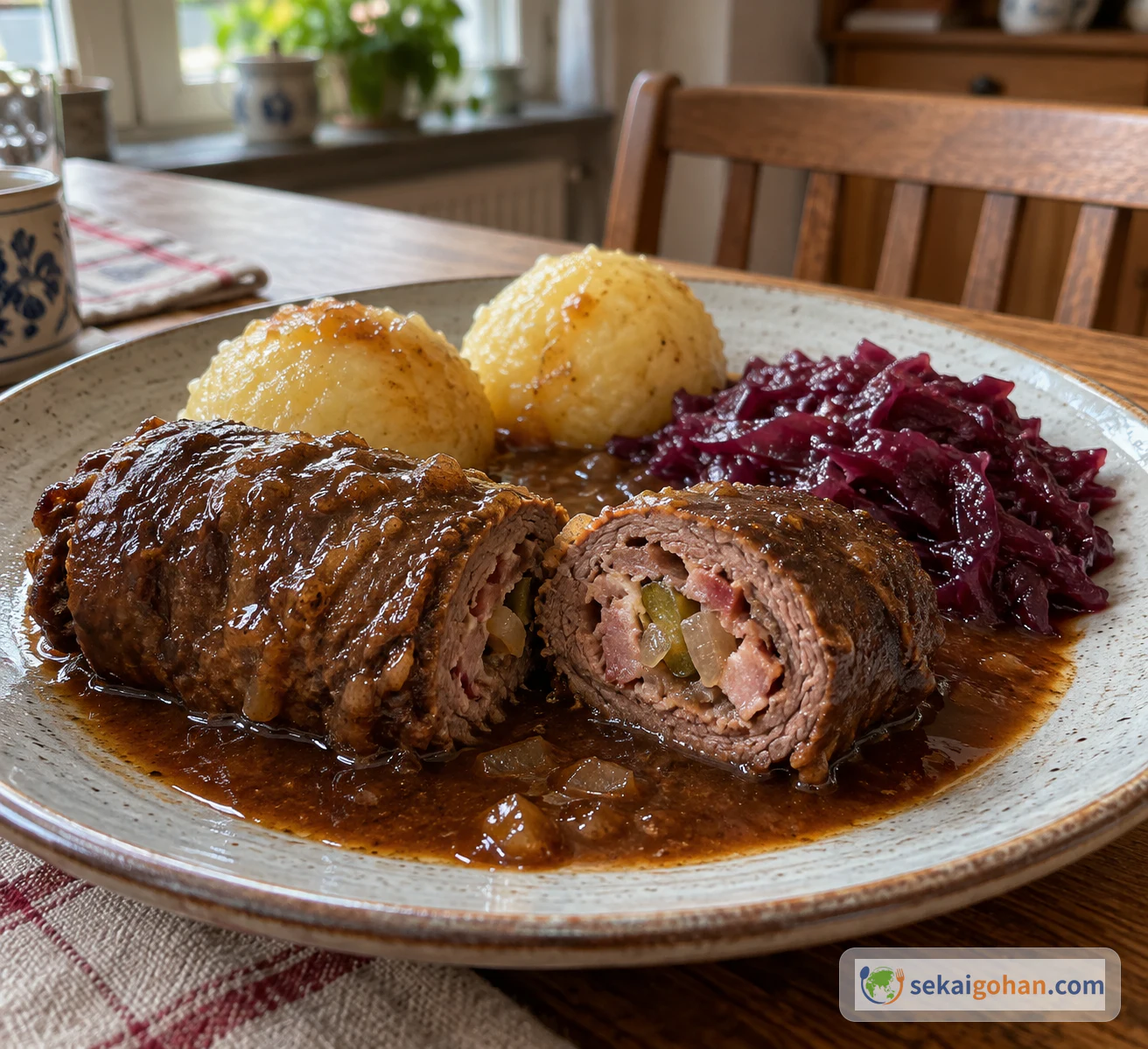
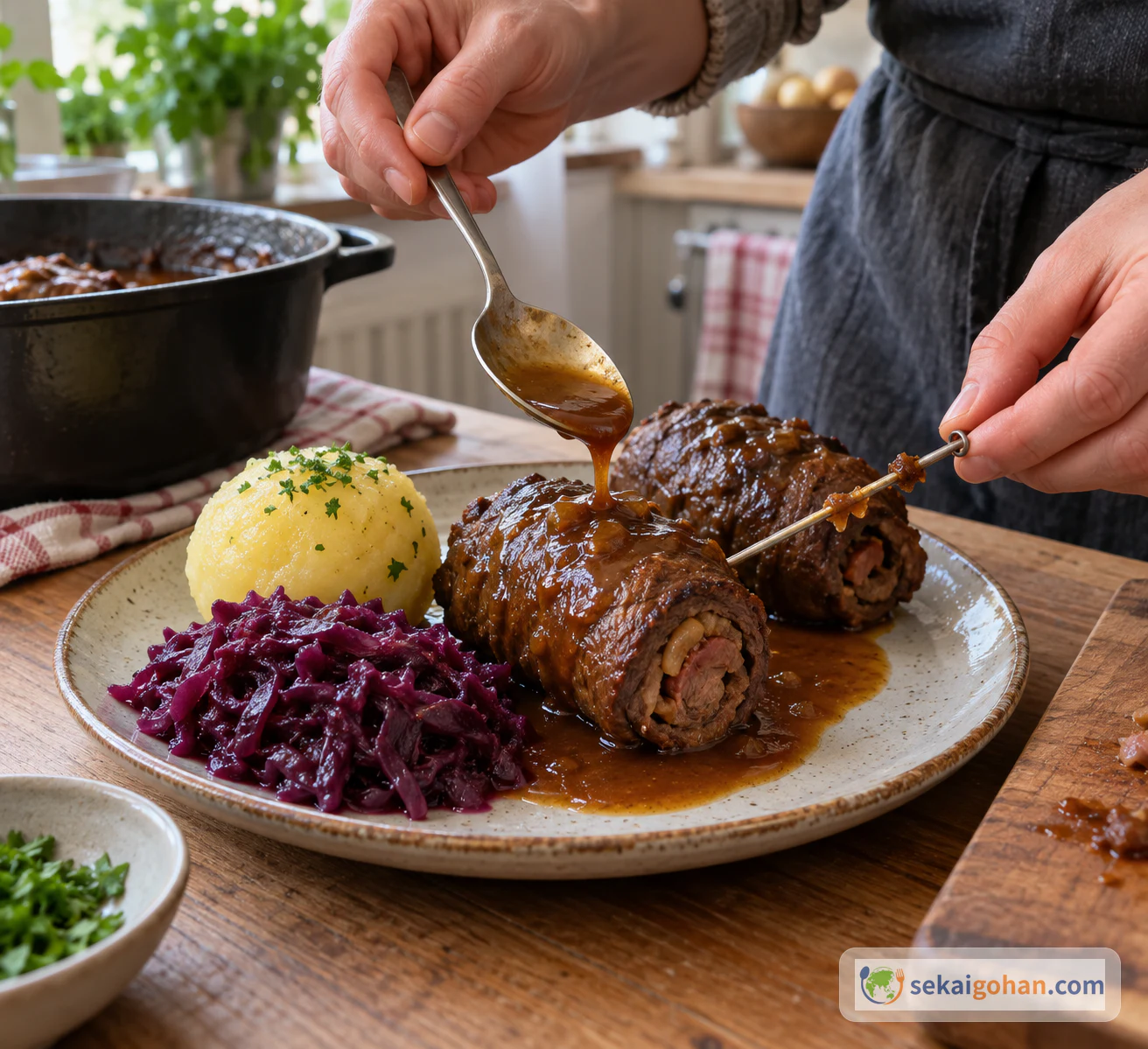
German beef roulade rolled with bacon and cornichons, coated in a dark sauce and served with dumplings and red cabbage on a German table
Serves
4 servings
Cuisine
German

How to make Rinderroulade, the German beef roll filled with mustard, bacon, onion and cornichons and braised covered in the oven. Includes a 4-serving recipe, choosing the beef cut, rolling and pinning, judging tenderness with a skewer, finishing the sauce, Franconian and Saxon serving examples, substitutions, and storage guidance.

Cooking flow

Cooking steps

STEP11 / 10

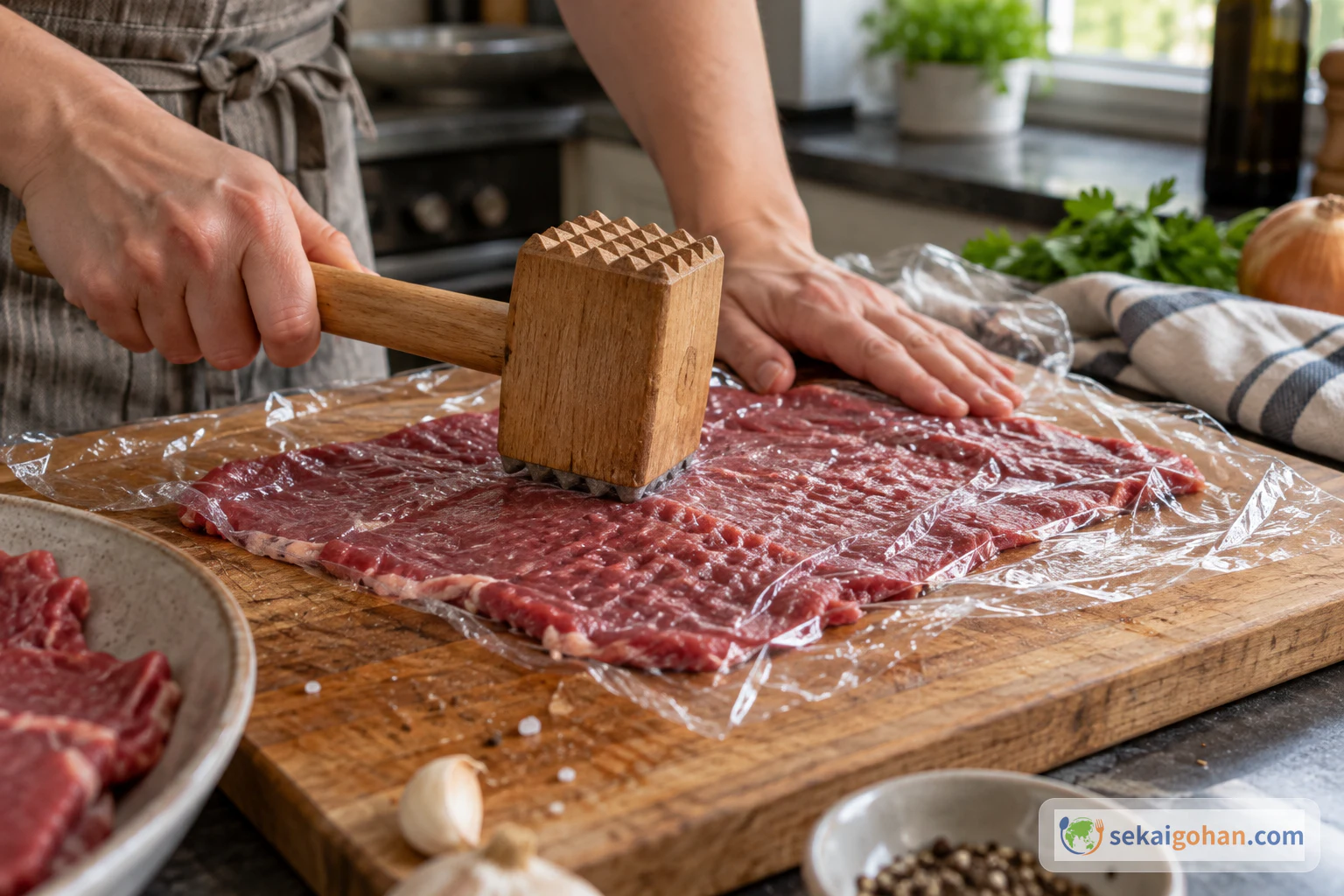
Flatten the beef

Beef sandwiched between sheets of plastic wrap, being flattened evenly with a meat mallet
Flatten the meat evenly, stopping before it tears

Place each beef slice between sheets of plastic wrap and pound it gently with a meat mallet until evenly thin. Aim for a slice you can roll without tearing. After handling raw meat, wash your hands and tools, and keep them away from foods that won't be cooked.

STEP22 / 10

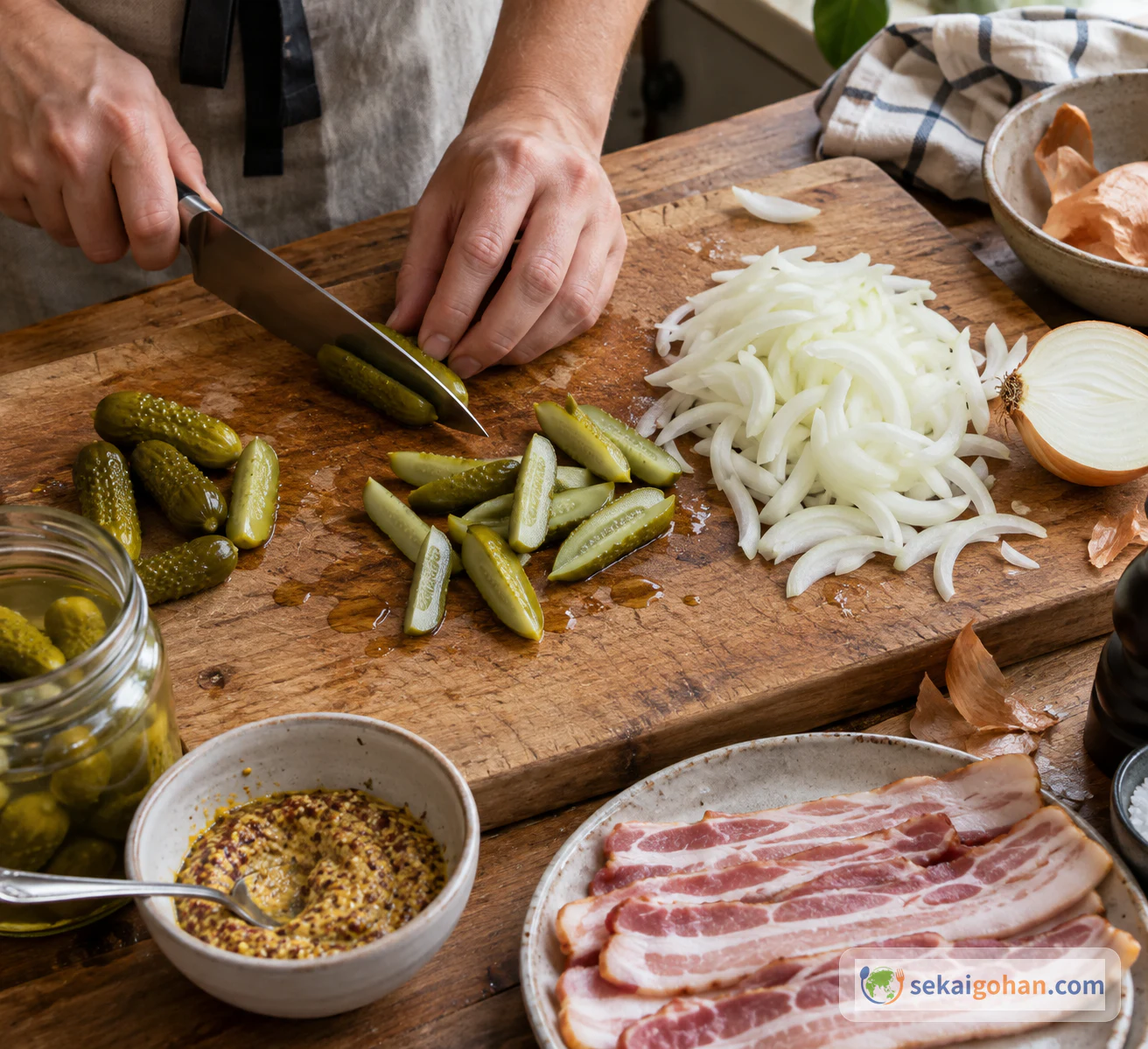
Cut the filling and the sauce vegetables

Cornichons cut lengthwise and onion sliced thinly to prepare the filling
The filling is prepared before any beef is filled

Cut the 8 cornichons lengthwise into quarters, and slice the 2 white onions for the filling thinly. Separately, dice the carrot, celeriac, leek and the 3.5 oz (100 g) of sauce onion into pieces about 0.5 inches (1 cm). Keep the filling onion and the sauce onion apart.

STEP33 / 10

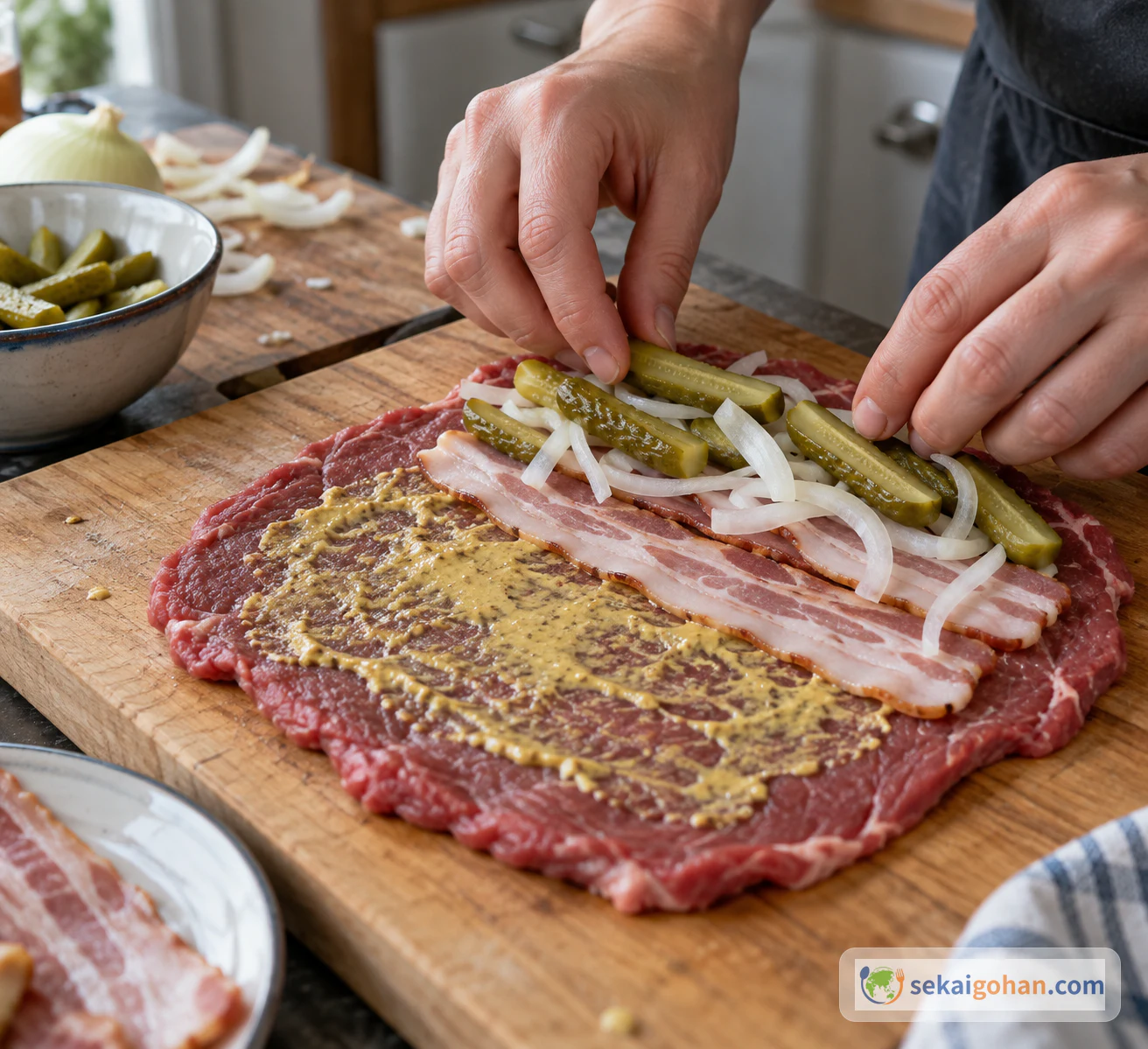
Season and layer the filling

Bacon, onion and cornichons layered on beef thinly spread with mustard
Keep the filling toward the wide end and leave the edges free for rolling

Lay the flattened beef out and season it with salt and pepper. Spread 1 tsp of mustard thinly over each slice. Lay 3 slices of bacon on each, then place 2 cornichons' worth of quarters and a quarter of the sliced onion toward the wide end. Leave the edges clear so the meat can close around the filling.

STEP44 / 10

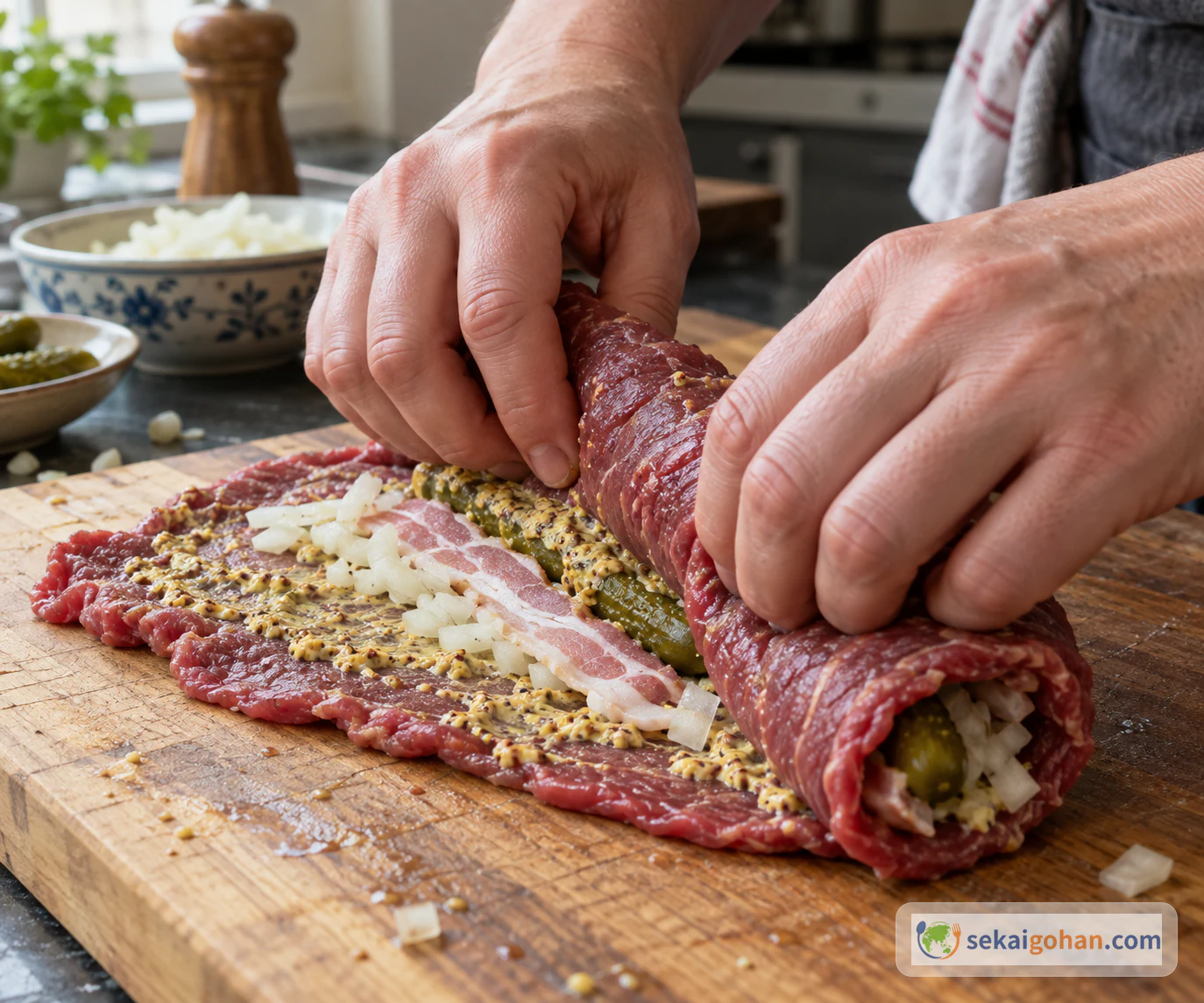
Roll

Folding the long sides of the beef inward and rolling it from the wide end around the filling
Folding in the sides first helps close the ends of the roll

Fold the long sides of the beef inward over the filling, then roll tightly from the wide end. Don't push the filling to the edges, or it will escape as you roll.

STEP55 / 10

Secure the rolls and season the outside

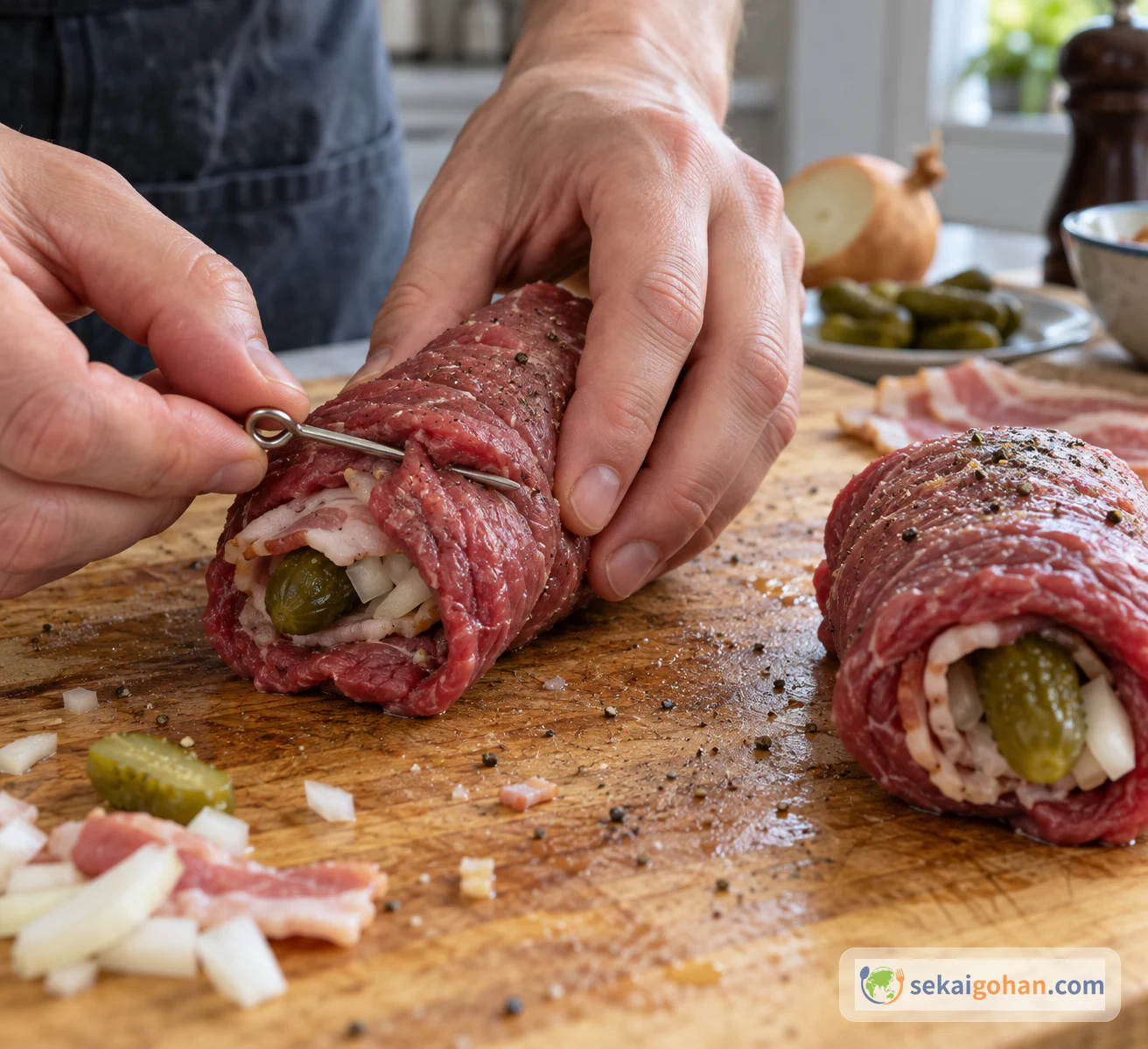
Securing the rolled beef with a metal roulade pin and shaping it
Pin across the seam so the roll keeps its shape

Secure each roll across the seam with a roulade pin (Rouladennadel); kitchen twine is another option. Then season the outside of each finished roll all over with salt and pepper. Remember how many pins or how much twine you used, since all of it comes off before serving.

STEP66 / 10

Brown the rolls all over

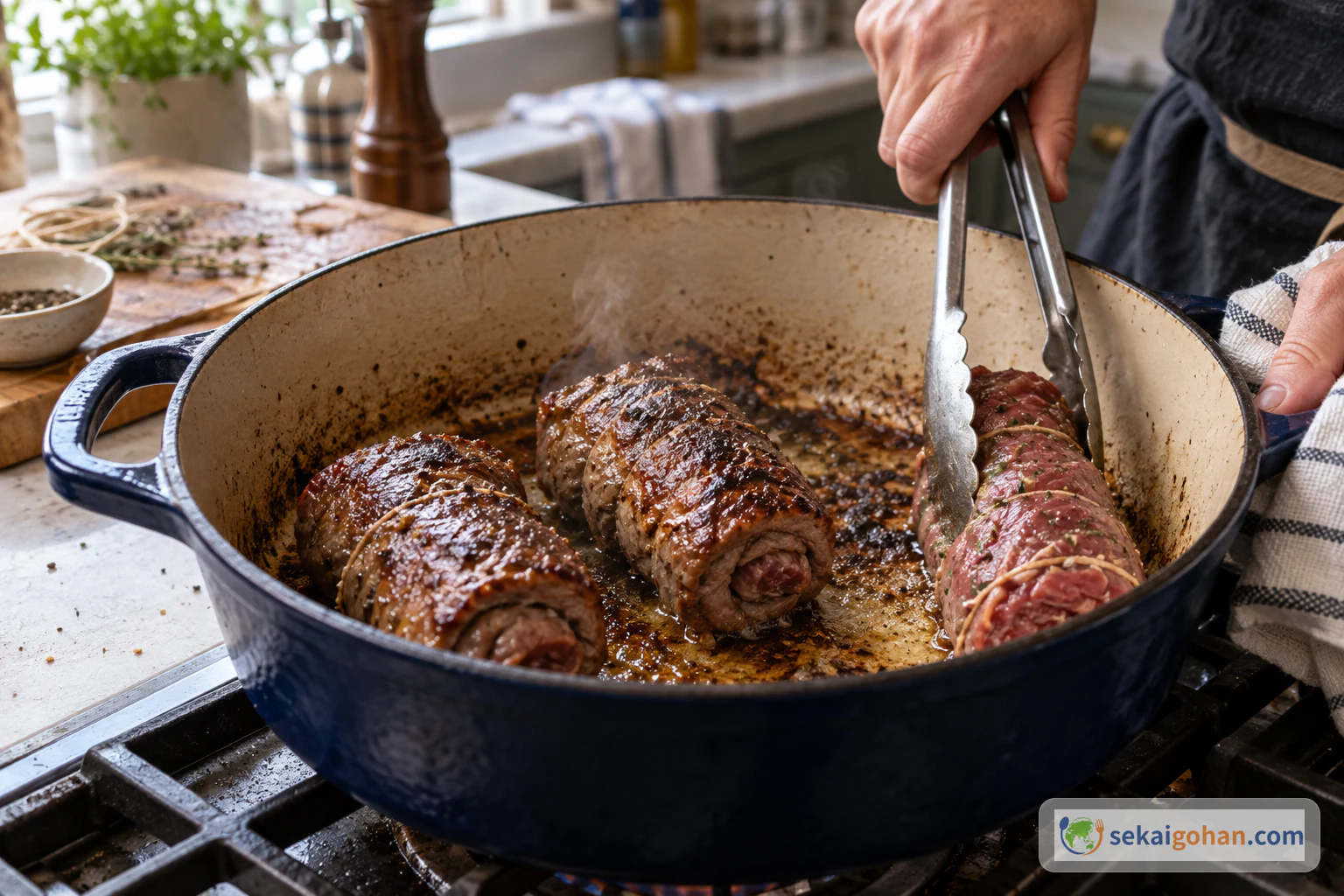
Searing the roulades in oil in a heavy pot, browning the seam side too
The browned bits on the bottom of the pot become part of the sauce

Heat 3 tbsp of the oil in the oven-safe pot and brown the rolls on all sides, including the seam side. Then take them out of the pot. If the pot is crowded, the meat won't brown well, so brown in batches if your pot is small. Watch the browned bits on the bottom: you want deep color, not scorching, which makes the sauce bitter.

STEP77 / 10

Sauté the vegetables and tomato paste

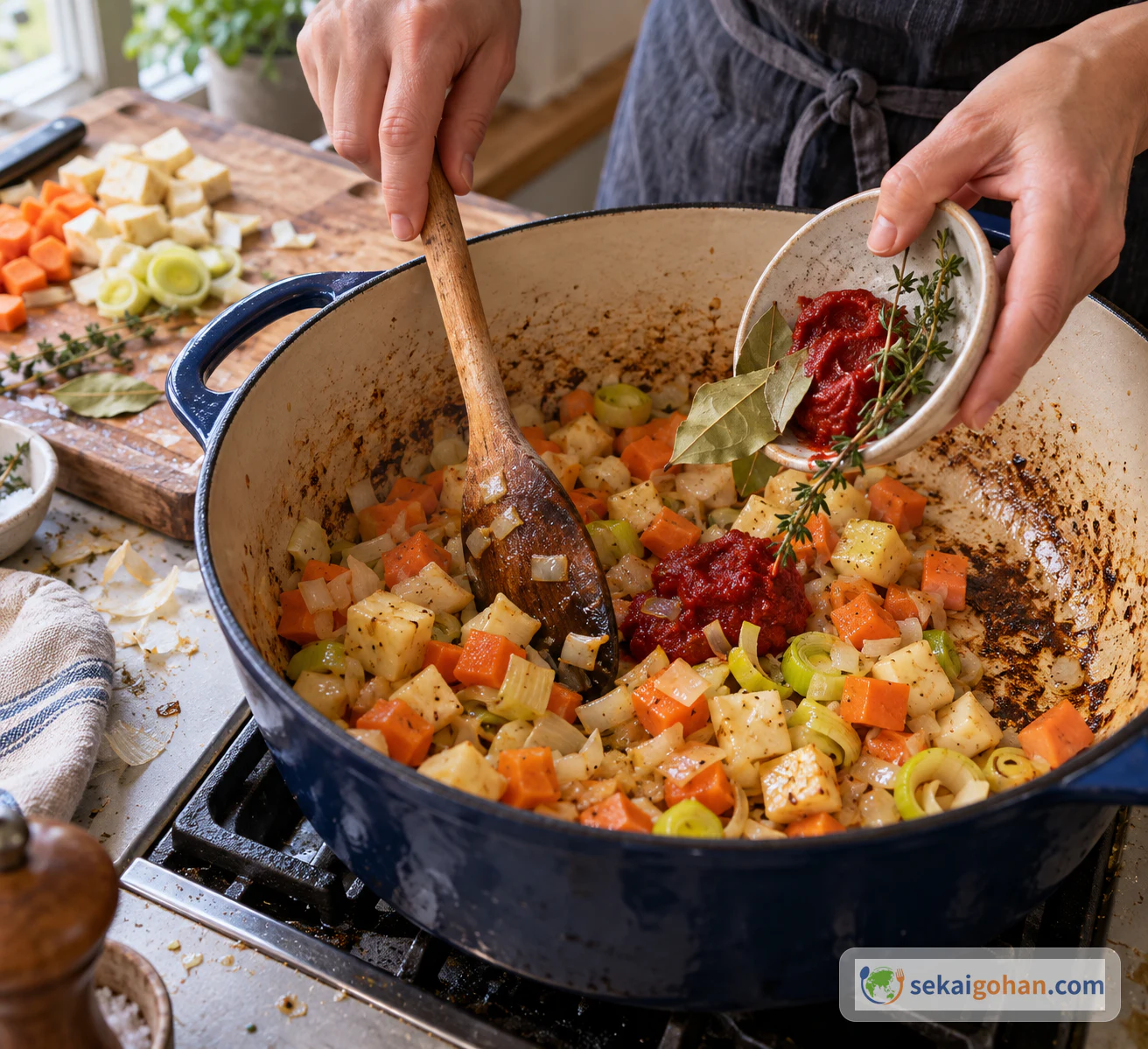
Sautéing diced carrot, celeriac, leek and onion in the pot after browning the meat
No wine or meat in the pot yet; just the vegetables, herbs and tomato paste

Preheat the oven to 350°F (180°C) (fan 325°F (160°C)). Add the remaining 2 tbsp of oil to the pot (the oil total stays at 5 tbsp) and sauté the diced carrot, celeriac, leek and onion. Add the bay leaves, thyme and tomato paste and sauté briefly.

STEP88 / 10

Add the wine and water, and braise covered

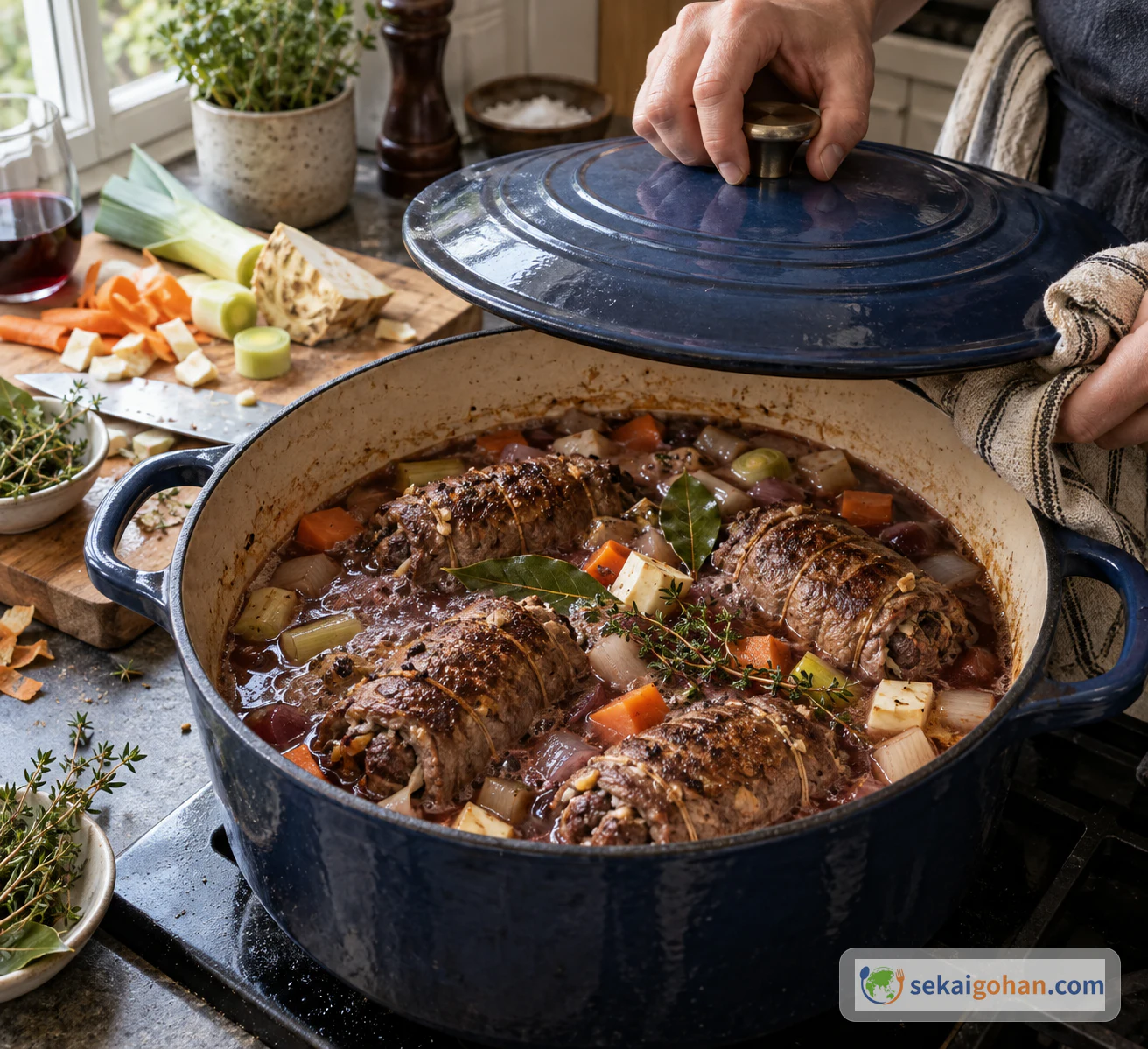
Braising the roulades covered in a pot with red wine, water and aromatic vegetables
Cover the pot and braise in the oven until a skewer meets no resistance

Pour in the ½ cup (150 ml) red wine and let it reduce briefly. Return the beef rolls to the pot and add the 1¾ cups (400 ml) water, plus salt and pepper. Cover with the lid and braise on a lower rack of the oven for 90 to 120 minutes, turning the rolls once partway through. The rolls are ready when a skewer slides in without resistance. If they are still firm, keep braising beyond 120 minutes, checking that enough liquid remains in the pot.

STEP99 / 10

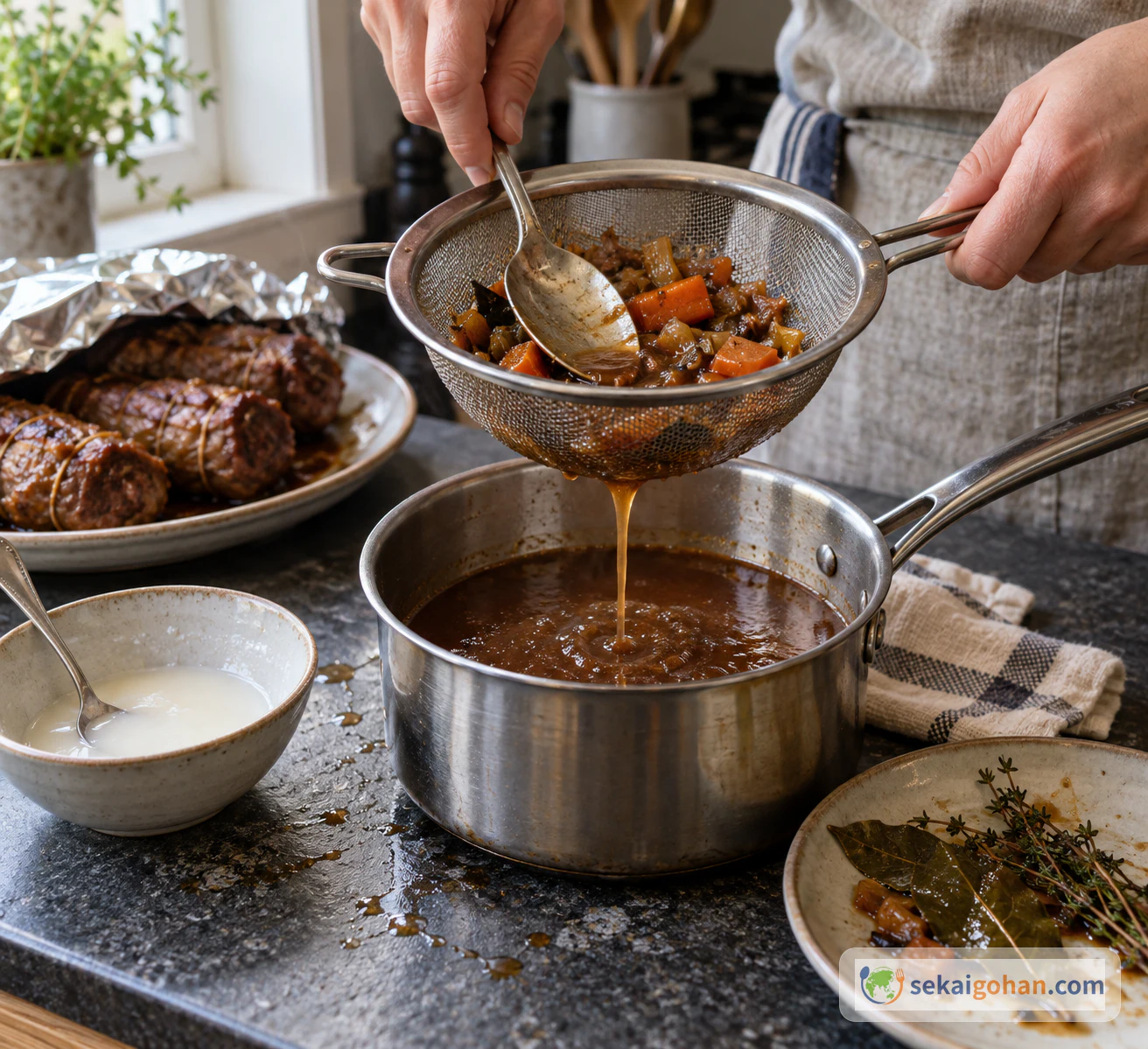
Strain and thicken the sauce

Pressing the braising liquid and softened vegetables through a sieve, with cold-water starch slurry ready beside it
Press the softened vegetables through the sieve to give the sauce body

Take the rolls out and keep them warm. Remove the bay leaves and thyme. Press the vegetables and braising liquid through a sieve, bring the sauce to a boil and season it with salt and pepper. Dissolve 1 tbsp cornstarch in a little cold water, stir it in to thicken the sauce, then return the rolls and warm them in the sauce over low heat for 8 to 10 minutes. If you use potato starch instead, the thickness will differ.

STEP1010 / 10

Remove the pins and serve

Spooning braising sauce over a beef roulade while removing its metal pin, with dumplings and red cabbage alongside
Check that every pin has come out before the plate goes to the table

Remove all the pins or twine, place the rolls on plates and spoon the sauce over them. Add dumplings and red cabbage if you like.

0 / 0
Ingredients

Ingredients

1 / 1

Ingredients

Ingredient Amount Role
Beef roulade slices (Rinderrouladen) 4 slices, about 7 oz (200 g) each The wrapper. Oberschale is suited; Unterschale or Hüfte also work
Cornichons (Cornichons) 8 Filling. Cut lengthwise into quarters; 2 cornichons' worth per roll
White onions, for the filling (weiße Zwiebeln) 2 Filling. Thinly sliced and divided into four portions
Medium-hot mustard (mittelscharfer Senf) 4 tsp 1 tsp spread thinly on each slice
Bacon (Bacon) 12 slices 3 slices per roll
Salt and black pepper (Salz / Pfeffer) to taste For the meat, inside and outside, and for the sauce
Carrot (Möhren) 3.5 oz (100 g) Sauce vegetable, diced about 0.5 inches (1 cm)
Celeriac (Knollensellerie) 3.5 oz (100 g) Sauce vegetable, diced about 0.5 inches (1 cm)
Leek (Lauch) 2.75 oz (80 g) Sauce vegetable, diced about 0.5 inches (1 cm)
White onion, for the sauce (weiße Zwiebeln) 3.5 oz (100 g) Sauce vegetable, diced about 0.5 inches (1 cm)
Oil (Öl) 5 tbsp 3 tbsp for browning the meat, the remaining 2 tbsp for the vegetables
Bay leaves (Lorbeerblätter) 2 Braising aroma; removed before finishing the sauce
Thyme (Thymian) 1 sprig Braising aroma; removed before finishing the sauce
Tomato paste (Tomatenmark) 1 tbsp Sautéed briefly with the vegetables
Red wine (Rotwein) ½ cup (150 ml) Loosens the browned bits and adds acidity and aroma
Water (Wasser) 1¾ cups (400 ml) Braising liquid
Cornstarch (Speisestärke) 1 tbsp Thickens the sauce
Cold water, for the starch a little Separate from the 1¾ cups (400 ml) braising water; for dissolving the starch
Cooked potato dumplings optional, as desired Side dish, prepared separately
Cooked red cabbage optional, as desired Side dish, prepared separately
0 / 0

When you cut a roulade open at the table, the spiral shows in the middle: bacon, onion and sour pickle wound tight inside the beef, with dark sauce running into it. Rinderroulade (plural Rinderrouladen) is a thin slice of beef wrapped around mustard, bacon, onion and little pickles, browned, then braised slowly with root vegetables and red wine until a skewer slides in without resistance. The sauce comes from the same pot. In Franconia, it's a dish people know from Sunday and holiday meals, both at the family table and in regional restaurants, and it takes its time.

Rinderroulade in German Cooking

Rinderroulade is beef that is filled, rolled and braised. The word Roulade comes from the French rouler, "to roll," and "Rind" means beef. That sets it apart from Kohlroulade, the German cabbage roll, which is wrapped in cabbage leaves rather than meat.

An early written record is a "Rollade" in a cookbook of 1733. That version filled beef with bacon, boiled ox tongue and pistachios and cooked it in a wine sauce, quite a different filling from today's. How the dish developed after that isn't recorded, so the 1733 recipe is an early glimpse rather than a direct ancestor.

Fillings and side dishes vary by region. In Franconia, the classic filling is bacon, onion and sour cucumber pickle, and the rolls come with dumplings and red cabbage. In Crimmitschau, in Saxony, the restaurant Schloßbräu makes them with Bautzener Senf (a mustard from Bautzen), cucumber, onion and smoked bacon, and serves them with Kürbisklitscher, potato pancakes made with pumpkin. For more dishes from the same country, see more German recipes.

Ingredients (4 servings, 4 rolls)
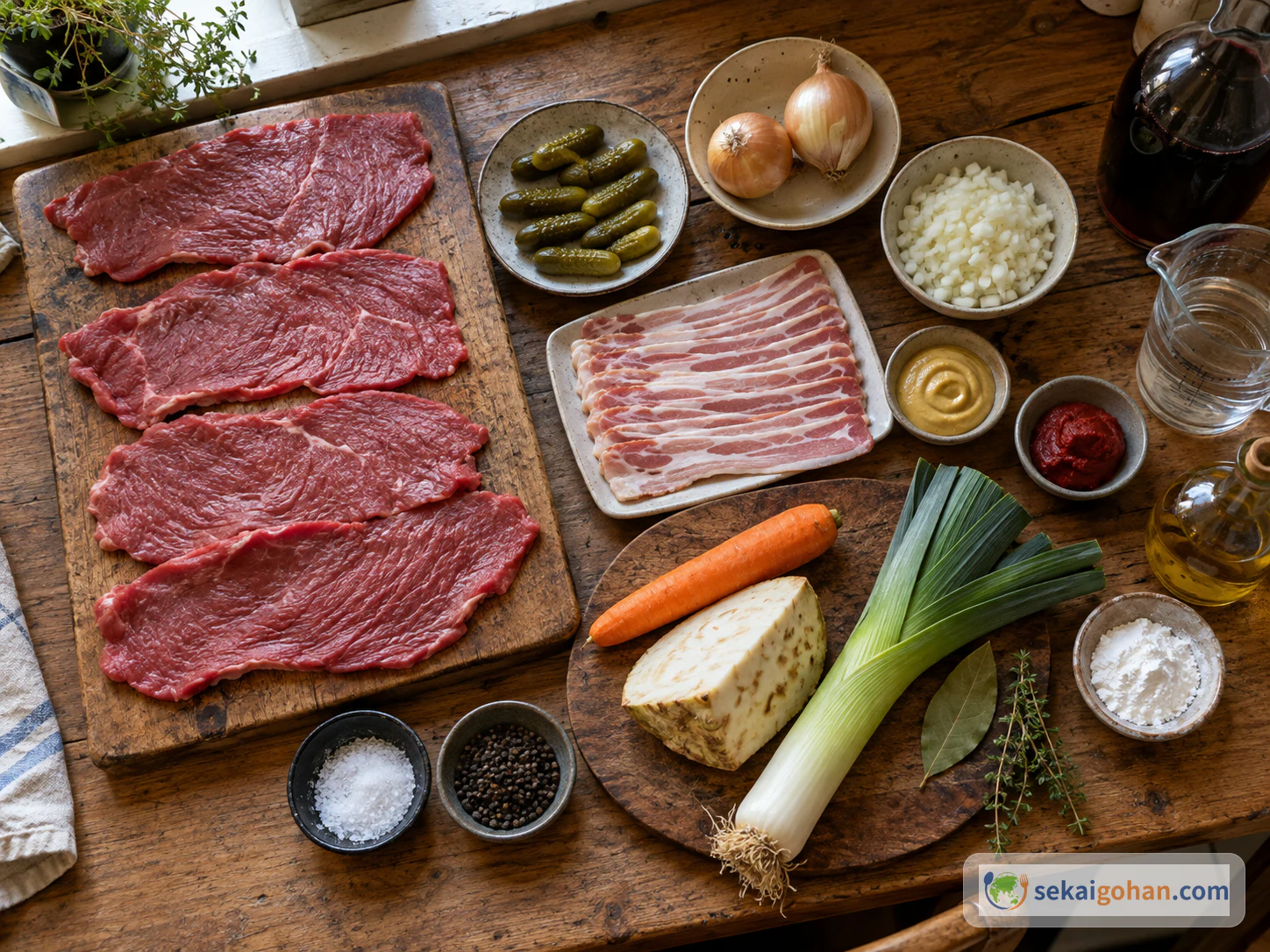
Ingredients for Rinderroulade: four slices of beef, cornichons, onions, bacon, medium-hot mustard and root vegetables for the sauce
The filling and the sauce use separate onions, so set them out separately

Salt and pepper to taste. There are two separate onion entries: whole onions for the filling and diced onion for the sauce.

Dumplings and red cabbage are optional sides, shown in the photos. Prepare them separately.

Allergens and labels

This dish contains beef, pork (bacon), mustard and wine. Check the labels on bacon, mustard, pickles and any prepared sides for allergen information.

Equipment

  • Plastic wrap or kitchen film and a meat mallet, for flattening the beef
  • Cutting boards and a knife (keep raw meat apart from other foods)
  • Roulade pins (Rouladennadeln) or kitchen twine, for securing the rolls
  • A heavy, oven-safe pot with a lid; check that the lid and handles can also take 350°F (180°C)
  • A sieve and a spoon for pressing the vegetables
  • A skewer, for checking tenderness

Choosing Beef, Pickles and Bacon for Rinderroulade

The beef needs to be large and thin. Use Oberschale (topside); Unterschale (silverside) or Hüfte (rump) also work. Ordinary thin-sliced beef is often too narrow to roll around a filling, so ask a butcher for large, thin slices meant for rolling and braising. Overlapping smaller slices won't give you quite the same roll as one large slice of the right cut. Either way, flatten the meat until it rolls without tearing.

Cornichons are small, sour pickles. Sweet pickles change both the acidity and the sweetness of the filling, so stick with a sour type.

Bacon differs by product. Smokiness and saltiness vary from one bacon to the next, which affects how much salt you'll want later, so taste the sauce before seasoning it. The recipe calls for medium-hot mustard; other mustards change the heat and the acidity.

Starch: Speisestärke is the German word for food starch and doesn't name a plant. This version uses cornstarch. Potato starch won't give exactly the same thickness or texture at the same amount.

Sauce vegetables: celeriac (celery root), not celery stalks, gives the sauce much of its aroma, and the sauce is less fragrant without it. Replacing the leek with a different kind of onion changes the aroma too.

Method: Roll, Brown, Braise, Finish the Sauce

How to judge doneness

Pot, oven and the thickness of the meat all change the time. Judge tenderness by how easily a skewer goes in.

Steps 1 to 6 build and brown the rolls. Steps 7 and 8 carry the browned bits from the pot into the braise, and steps 9 and 10 turn the braising liquid into the sauce.

Heating and hygiene

149°F (65°C) is a guide temperature for the meat, not a safety standard. A skewer sliding in easily shows tenderness, but it doesn't prove the food is hot enough, and neither does a change in color. For food safety, heat to 167°F (75°C) at the center for at least 1 minute. Keep raw meat, and the tools and hands that touched it, away from foods that will be eaten without further cooking.

Fixing Tough Meat, Loose Rolls and Sauce Problems

Problem Likely cause What to do
The roll comes undone Filling spread to the edges; sides not folded in Keep the filling toward the wide end, fold in the long sides before rolling, and pin across the seam
Little browning Pot too crowded Brown in batches, depending on pot size
Bitter-tasting sauce Browned bits on the bottom scorched Brown over heat that colors the meat without blackening the pot
Meat still tough after 90–120 minutes Not braised long enough, the main cause Keep braising, covered, until a skewer slides in easily
Liquid running low during a long braise Extended cooking time Check the liquid level when you turn the rolls and when you extend the braise
Sauce too thick Reduced too far, or too much starch Add starch dissolved in cold water gradually rather than all at once
Sauce too thin Not reduced enough Simmer it a little longer before adding the starch, then thicken as needed

Variations and Storing Rinderroulade

A few changes are easy to make at home. For a gentler sourness, use fewer cornichons than the 8 in the recipe. To cook without alcohol, replace the red wine with beef stock or water; the sauce will have a different aroma and less acidity.

Rouladen keep well, which makes them a good make-ahead dish. Store them with their sauce in an airtight container for 2 to 3 days in the refrigerator, or up to 3 months in the freezer. Divide leftovers into shallow containers so they cool quickly before refrigerating.

Reheat to 167°F (75°C) or above, and bring the sauce to a boil. Thaw frozen rouladen in the refrigerator, then reheat them in a pot with their sauce until everything is thoroughly hot.

Frequently Asked Questions

Why is my roulade tough?

Almost always, the braise was too short. Don't stop at 90 minutes: check with a skewer and keep braising, covered, until it slides in without resistance, keeping an eye on the liquid level.

What do I serve with it?

Potatoes, dumplings, red cabbage and Spätzle are typical choices. Dumplings with red cabbage is the classic Franconian pairing, while Schloßbräu in Crimmitschau serves its rolls with Kürbisklitscher.
Sources

  • essen & trinken / Deutsche Medien-Manufaktur, "Rinderrouladen – klassisches Rezept." The 4-serving recipe used here: ingredients and amounts, rolling, browning, sautéing the vegetables, the covered oven braise at 180°C (fan 160°C) for 90–120 minutes, suitable cuts of beef, checking tenderness, toughness from under-braising, typical side dishes, and refrigerator and freezer storage guidelines. https://www.essen-und-trinken.de/rezepte/klassische-rinderroulade-das-beste-rezept-12067572.html
  • Genussregion Oberfranken e.V., "Rouladen nach fränkischer Art." Rouladen as filled, rolled and braised meat; their place at Sunday and holiday meals in families and regional restaurants; the link between Roulade and rouler; the 1733 "Rollade" in Johann Albrecht Grunauer's cookbook, with later development undocumented; the Franconian filling of bacon, onion and sour cucumber; and serving with dumplings and red cabbage. https://www.genussregion-oberfranken.de/spezialitaeten/rouladen-nach-fraenkischer-art/
  • Tourismus Marketing Gesellschaft Sachsen mbH, "Rezept für Rinderrouladen, ein typisch sächsisches Gericht." The rouladen of Schloßbräu in Crimmitschau, with Bautzener Senf, cucumber, onion and smoked bacon, served with Kürbisklitscher. One restaurant's example, used here for regional comparison only. https://www.sachsen-tourismus.de/blog/rezept-rinderrouladen
  • Ministry of Health, Labour and Welfare (Japan), "Six points for preventing food poisoning at home." General home guidelines: heating to 75°C at the center for at least 1 minute, dividing leftovers into shallow containers, reheating to 75°C or above (soups until boiling), and preventing cross-contamination between raw meat and ready-to-eat food. https://www.mhlw.go.jp/stf/seisakunitsuite/bunya/kenkou_iryou/shokuhin/syokuchu/01_00006.html