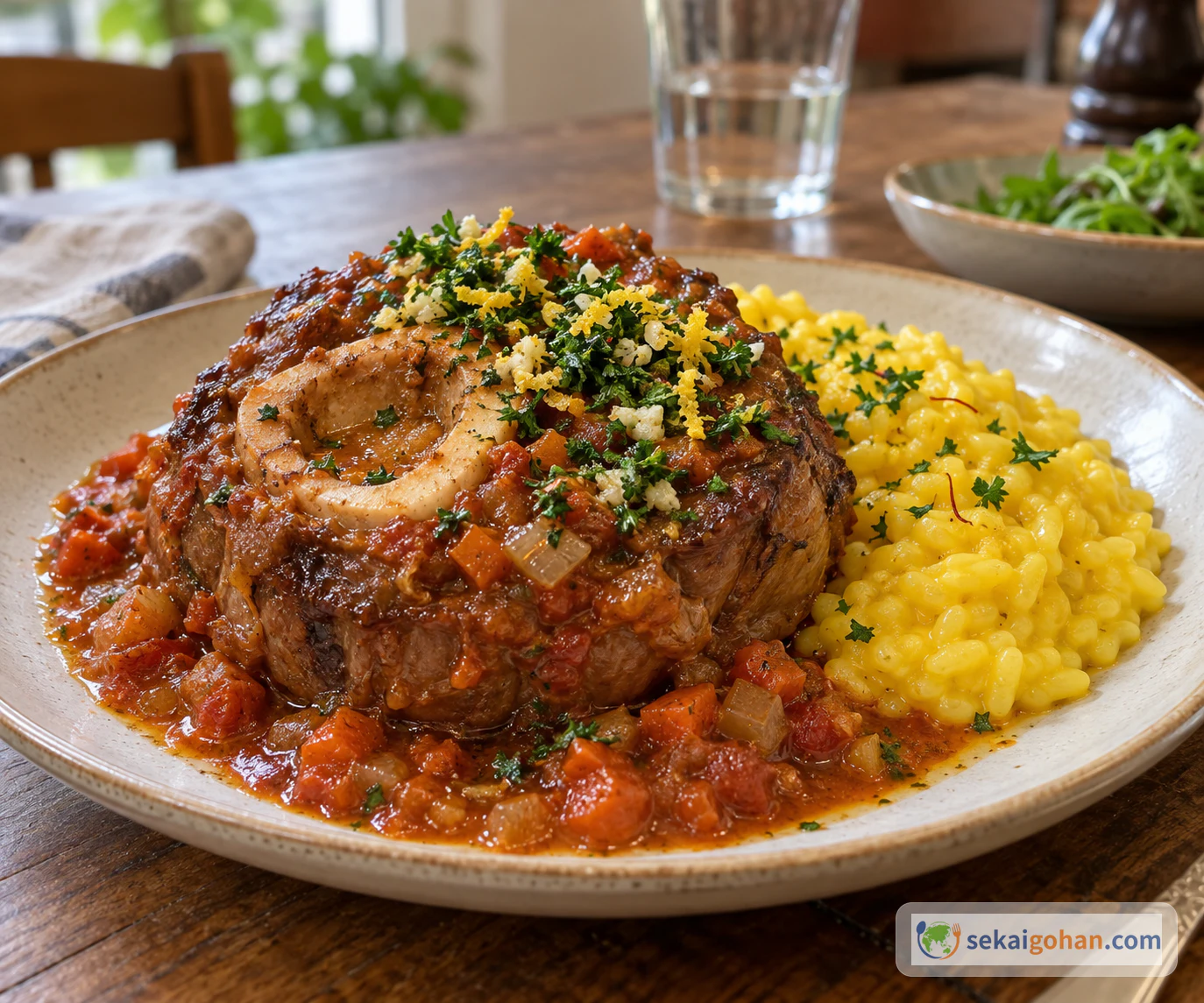

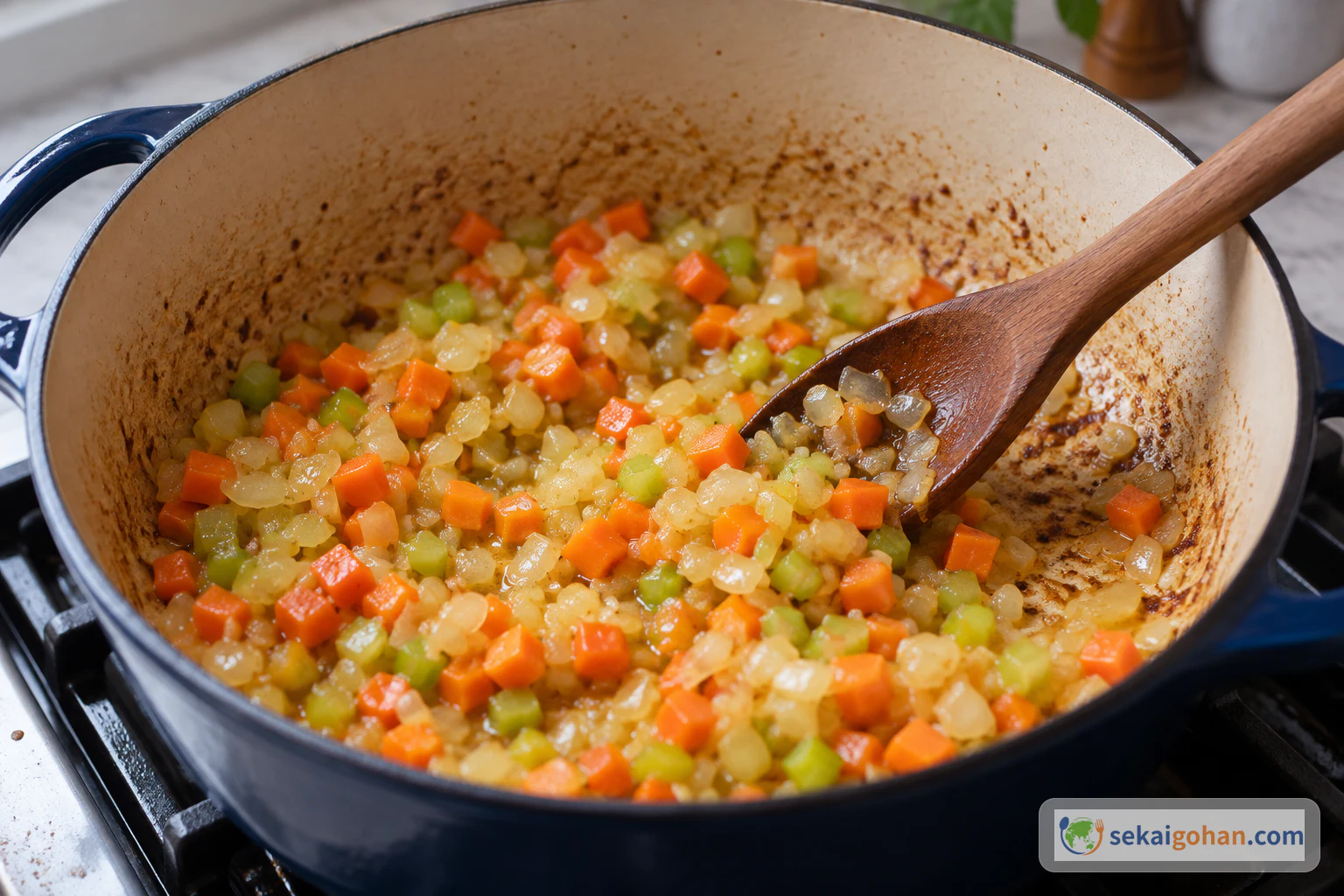
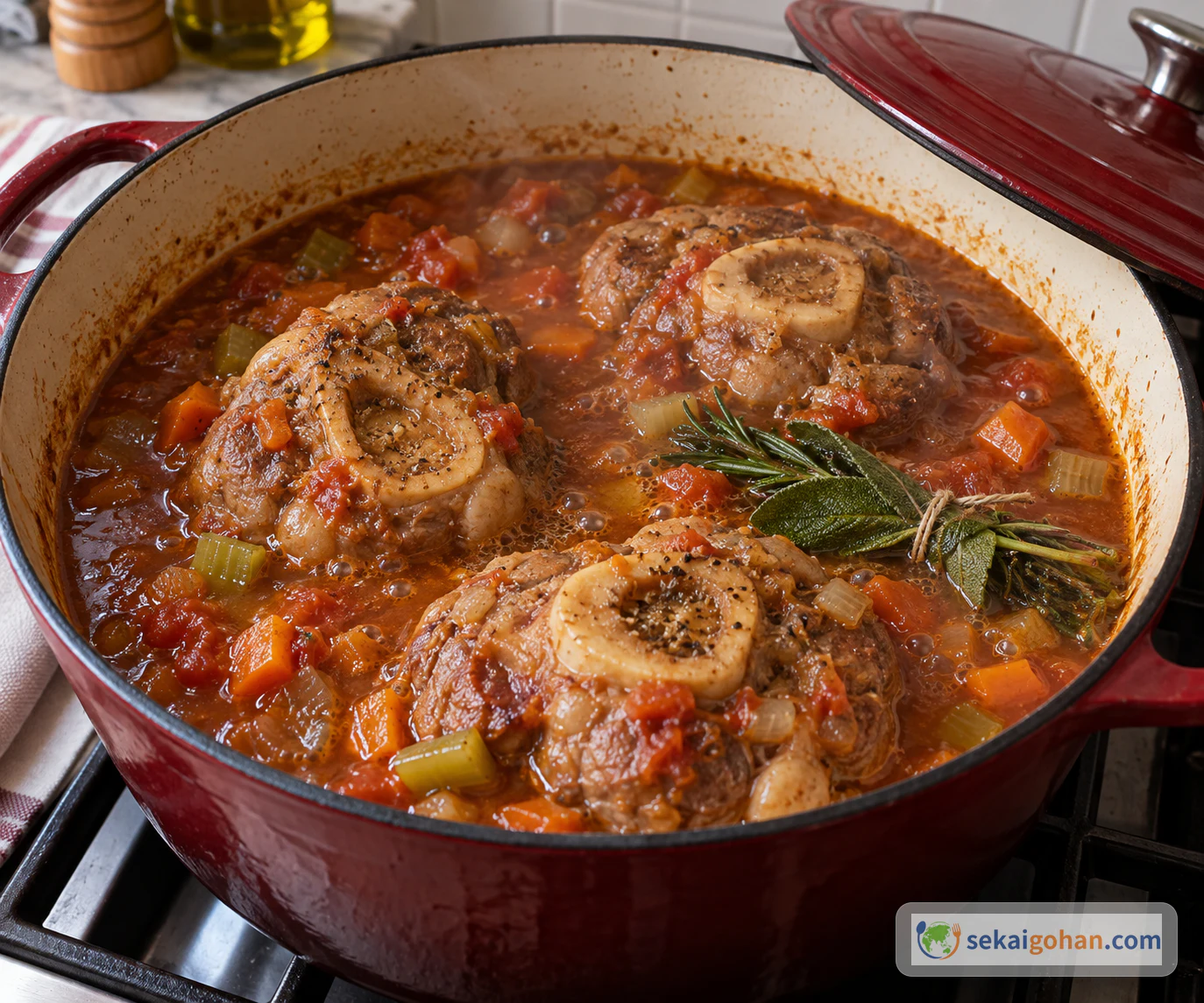

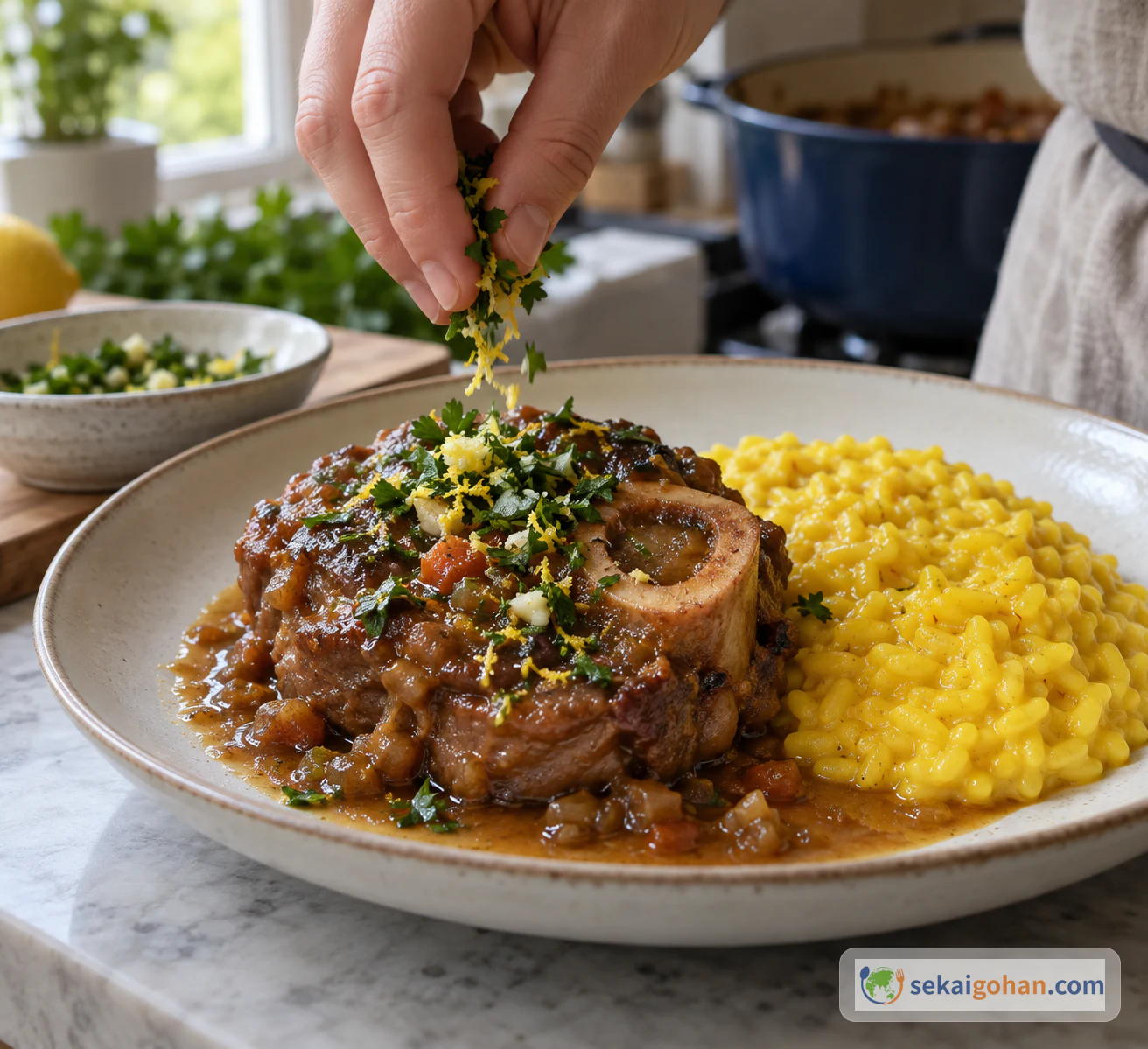
Lift the lid and the shank slices are sitting low in a sauce of soft vegetables and tomato, each one ringed around a round bone with marrow at its center. Then comes the bright smell of chopped lemon zest and parsley, scattered over just before serving, and beside it on the plate, a mound of yellow saffron risotto. This is ossobuco alla milanese, the braised veal shank of Milan. The meat cooks long and gently until it is tender in a concentrated sauce, and the raw, fresh finish keeps all that richness from feeling heavy. For more dishes from the same country, see the Italy country page.
What Makes Ossobuco alla Milanese
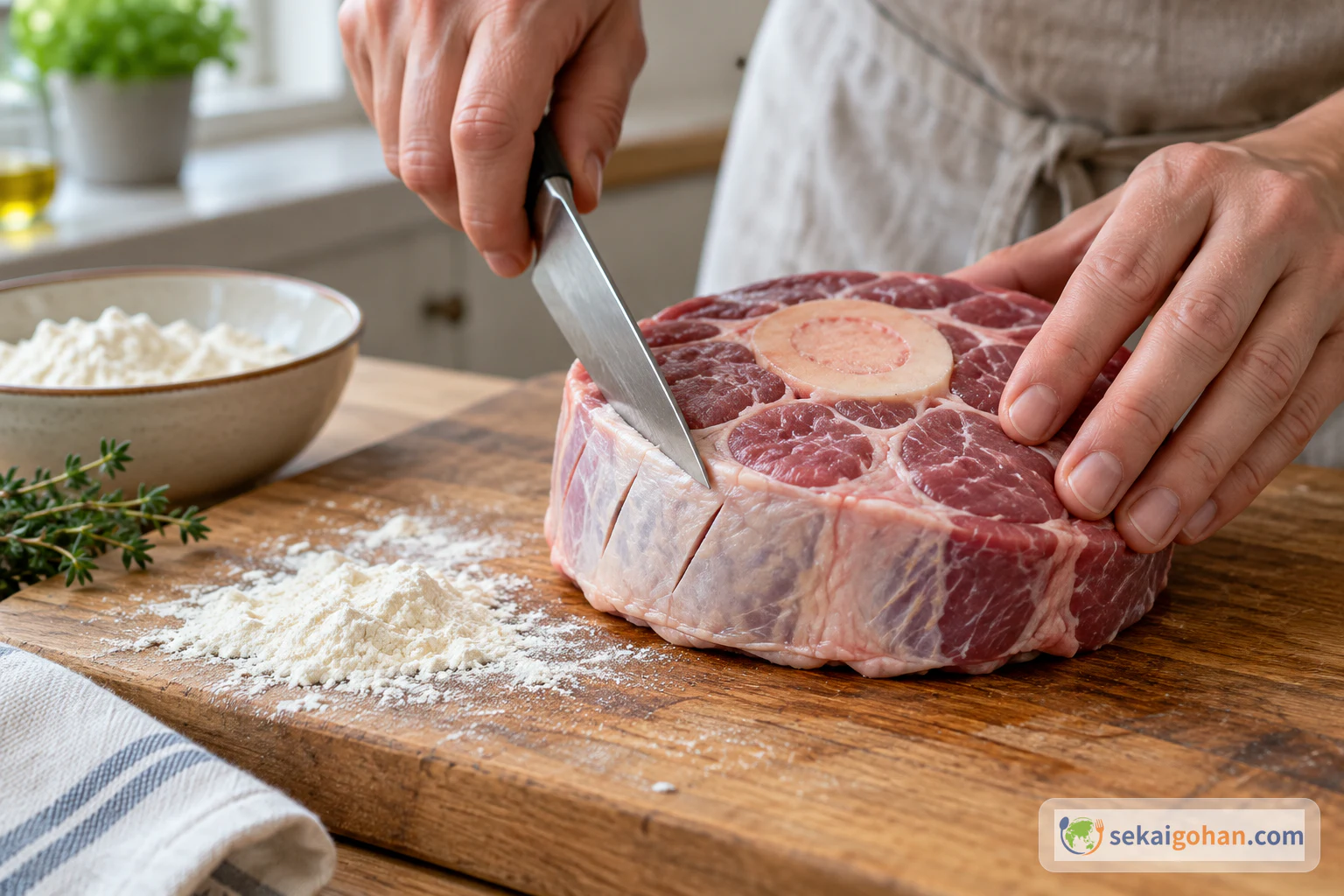
The name describes exactly what you see. It comes from the Milanese dialect os büs, "bone with a hole," and refers to a thick crosswise slice of veal shank, cut through the bone so that a ring of meat surrounds a round bone holding marrow. Slices are about 3–4 cm thick, and cuts from the hind leg carry more meat. The cut is what defines the dish.
The Milanese version has its own markers: a long, gentle braise, a finishing gremolata of parsley, garlic and lemon zest, and saffron risotto alongside. The gremolata does real work. After the braise, the meat and marrow are rich and heavy, and lemon zest, parsley and garlic added raw at the end cut through that and lift the whole plate.
The marrow is part of the meal. At the table, whatever is left is scooped out of the hole in the bone with a special spoon, nicknamed the "tax collector."
The recipe has also changed over time and from household to household. The 18th-century definition of ossobuco had no tomato; from the late 18th century onward, tomato was almost always added. The version here includes passata, so it is one modern form of the dish.
Ingredients for 4 Servings
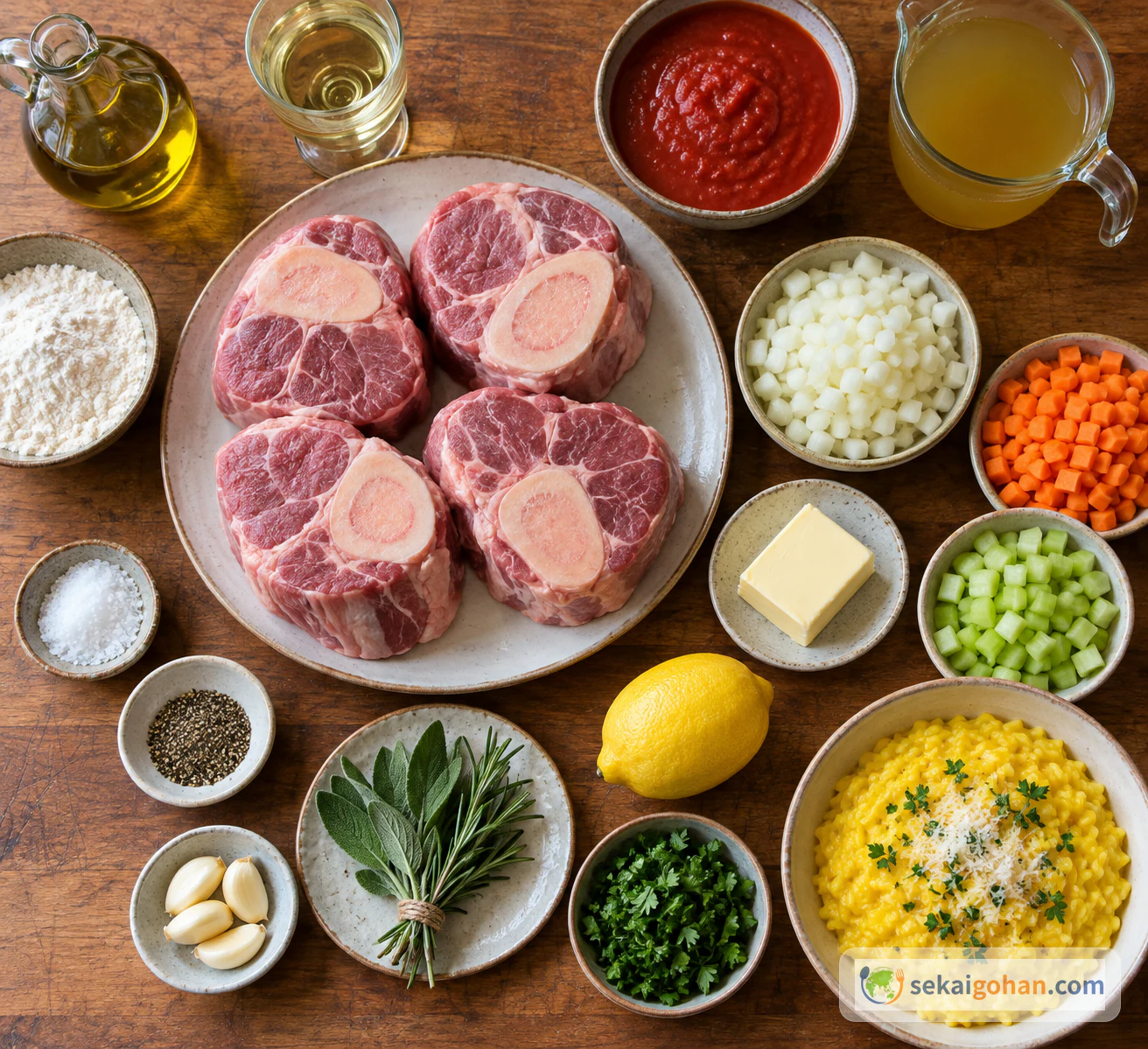
Several ingredients have no set weight; the notes say how much to use.
Equipment
- A heavy, wide pot with a lid, large enough to brown the 4 shank slices without overlapping
- A separate saucepan to keep the broth hot
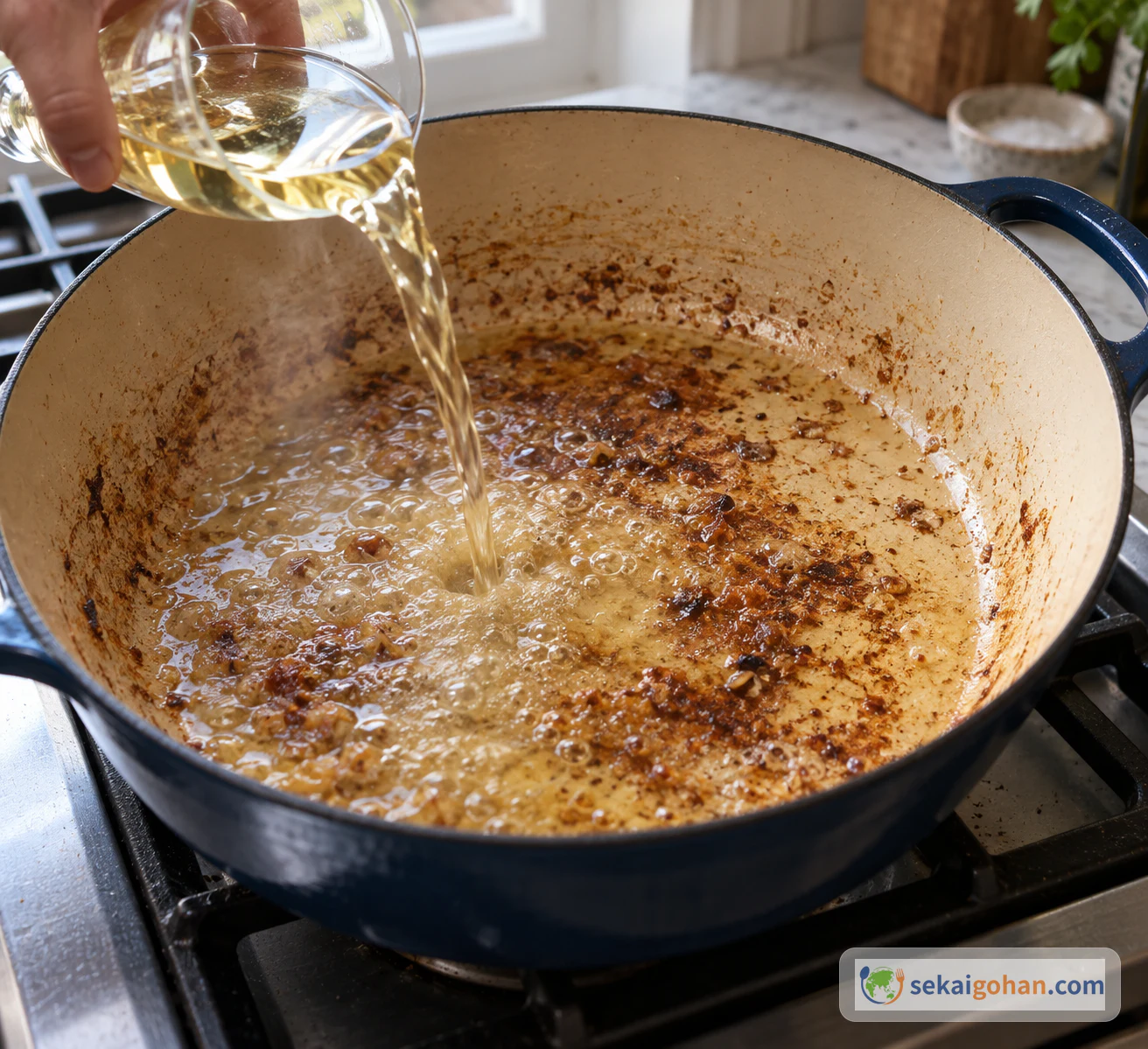
- A bowl to hold the wine juices after deglazing
- A wooden spatula
- A knife and cutting boards, with a separate board for the raw meat
- Tongs for turning the meat
- A food thermometer, if you want to check reheated leftovers
Choosing Veal Shank and Substitutes
Look for slices with the marrow hole in the middle. Ask for cross-cut veal shank with the round bone and its marrow intact in the center; hind-shank slices carry more meat. Veal shank cut this way is easiest to find through a butcher or by special order.
Beef shank instead of veal. If you can't get veal, cross-cut beef shank is a practical substitute, though the result is a variation rather than the same dish. Expect a stronger flavor and a longer braise. The braising time is set for veal, so with beef, judge by the meat rather than the clock.
Wine and broth. An ordinary wine is all you need. Any broth works as long as it goes in hot. If you use a ready-made one, check the label for allergens and salt.
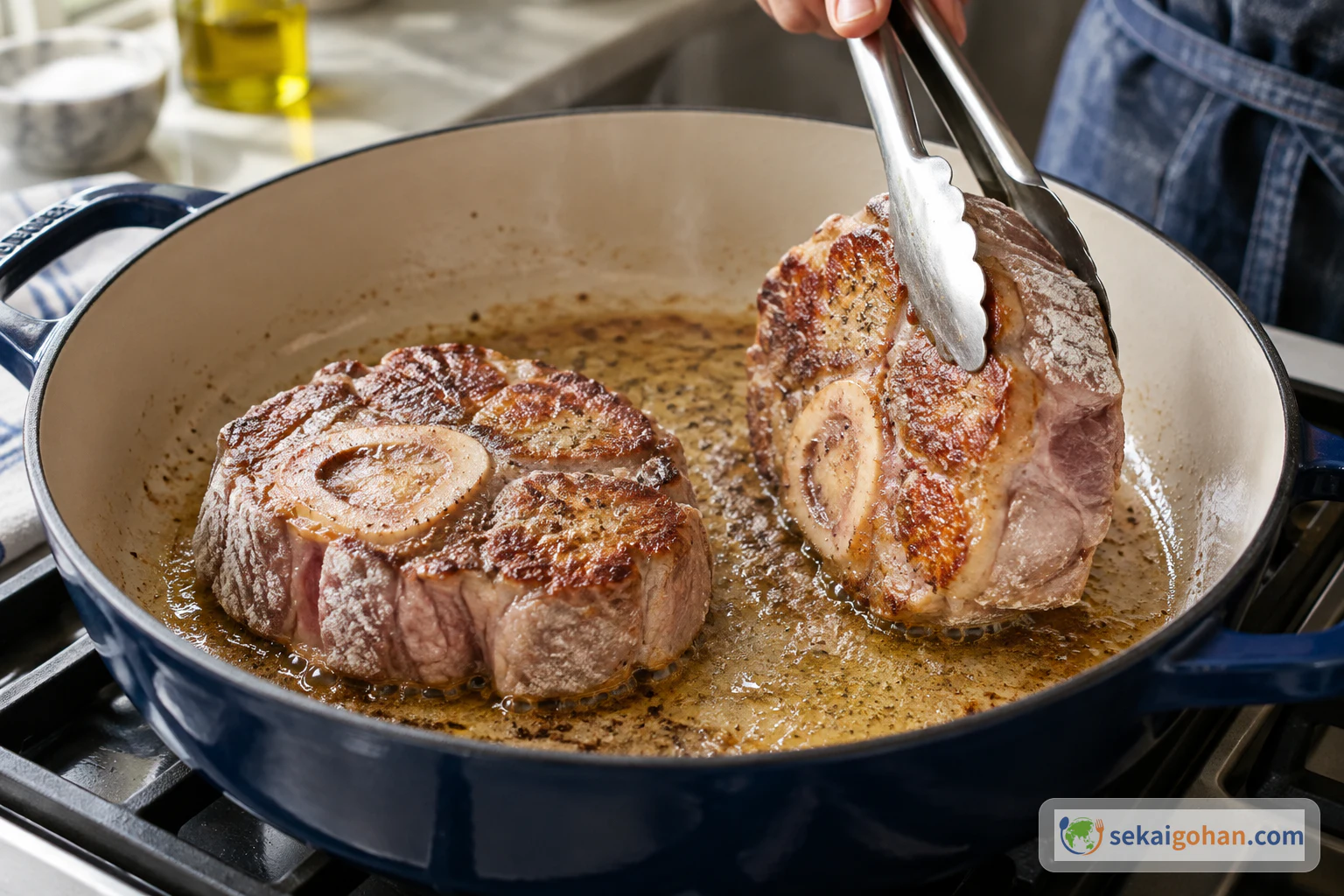
Method: Brown, Deglaze, Then Braise Quietly
Allow about 2 hours overall and about 1 hour 30 minutes for the covered braise. Judge the other steps by what you see: color on the meat, softness in the vegetables, and how easily the meat comes away from the bone.
Fixing Common Ossobuco Problems
| Problem | Likely cause | What to do |
|---|---|---|
| The slices curl up in the pan | The outer membrane tightens as it cooks | Next time make a few shallow cuts through the membrane before flouring. Keep them shallow, or the slice loses its shape |
| The meat is still tough after the stated time | Thickness and cut vary, and beef shank can take longer | Keep braising over low heat and check with a fork |
| The sauce looks thin | Plenty of broth was needed to cover the meat | Keep a gentle simmer rather than turning up the heat sharply, and check the bottom of the pot |
| The bottom is close to catching | The liquid has dropped or the heat is too high | Lower the heat, add a little hot broth, and check that the meat is simmering quietly |
| The vegetables browned in step 5 | Heat too high under the butter | Lower the heat. The goal is soft, glossy vegetables, not color |
| The finish tastes flat | Gremolata made too early or skipped | Chop it fresh near the end and scatter it on just before serving |
The braising time is for making the meat tender. It is not a food-safety test. For leftovers, follow the reheating guidance below.
Serving, Leftovers and Variations
In Milan, ossobuco is eaten with yellow saffron risotto, made separately as its own dish; nothing from it goes into the braise. Polenta is another classic accompaniment.
This recipe contains milk (butter) and wheat (flour). Check the label of any ready-made broth for other allergens. Keep raw meat on its own board and wash utensils after handling it.
For leftovers, divide them into shallow containers so they cool quickly, refrigerate them promptly, and do not leave them at room temperature for long. When reheating, heat until the center reaches 167°F (75°C) or above, for at least 1 minute.
Beyond the version here, the dish turns up in several other forms. Each is its own take rather than something to mix into the ingredient list above.
| Variation | What changes | Notes |
|---|---|---|
| Without tomato | A "white" braise with no passata | The original 18th-century form |
| Gremolata with other herbs | Versions that bring in rosemary or sage | A local variation on the parsley, garlic and lemon base |
| Beef shank | Stronger flavor and a longer braise | A substitute when veal is hard to find |
| Polenta or mashed potatoes | Changes the side served with the meat | Alternatives to saffron risotto |
| Served as a meat course | Greens, beans or purée alongside | When ossobuco is served on its own rather than with risotto |
Frequently Asked Questions
Can I make it without tomato?
Yes. The 18th-century definition of the dish had no tomato. Leaving out the passata gives you that older "white" version, a different dish rather than a small change.
What should I serve with it?
In Milan, saffron risotto is the classic pairing. Polenta and potato purée are also served with it.
Can I use beef shank instead of veal?
You can, when veal is hard to find, though it isn't quite the same dish. Beef shank tastes stronger and can need longer than 1 hour 30 minutes to become tender, so check the meat with a fork.
What is gremolata?
It is a finishing mix of finely chopped parsley, garlic and lemon zest, here seasoned with salt and pepper. It is scattered over the meat just before serving.