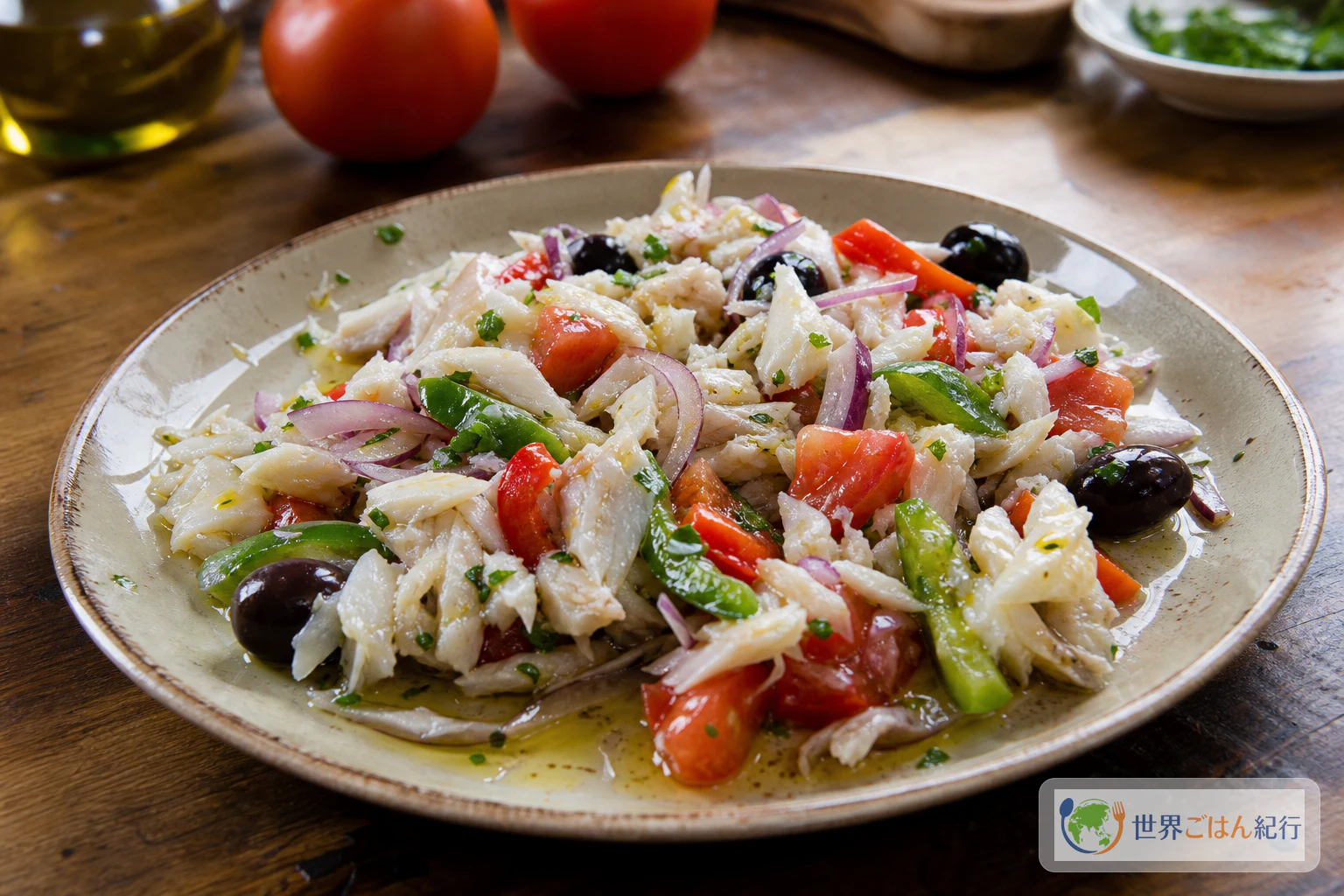
Lift the salt cod out of its soaking water and pull it apart with your fingers. When the white flesh tears cleanly along the grain, it's ready for ripe tomato, thinly sliced onion, black olives, and a swirl of green olive oil. You never take out a pot, yet the cutting board alone turns into a summer table. This is esqueixada (esqueixada de bacallà), Catalonia's cold salt cod dish: salty, juicy, and fragrant with oil. If gazpacho is Andalusia's cold soup, esqueixada is its Catalan counterpart on the fish side.
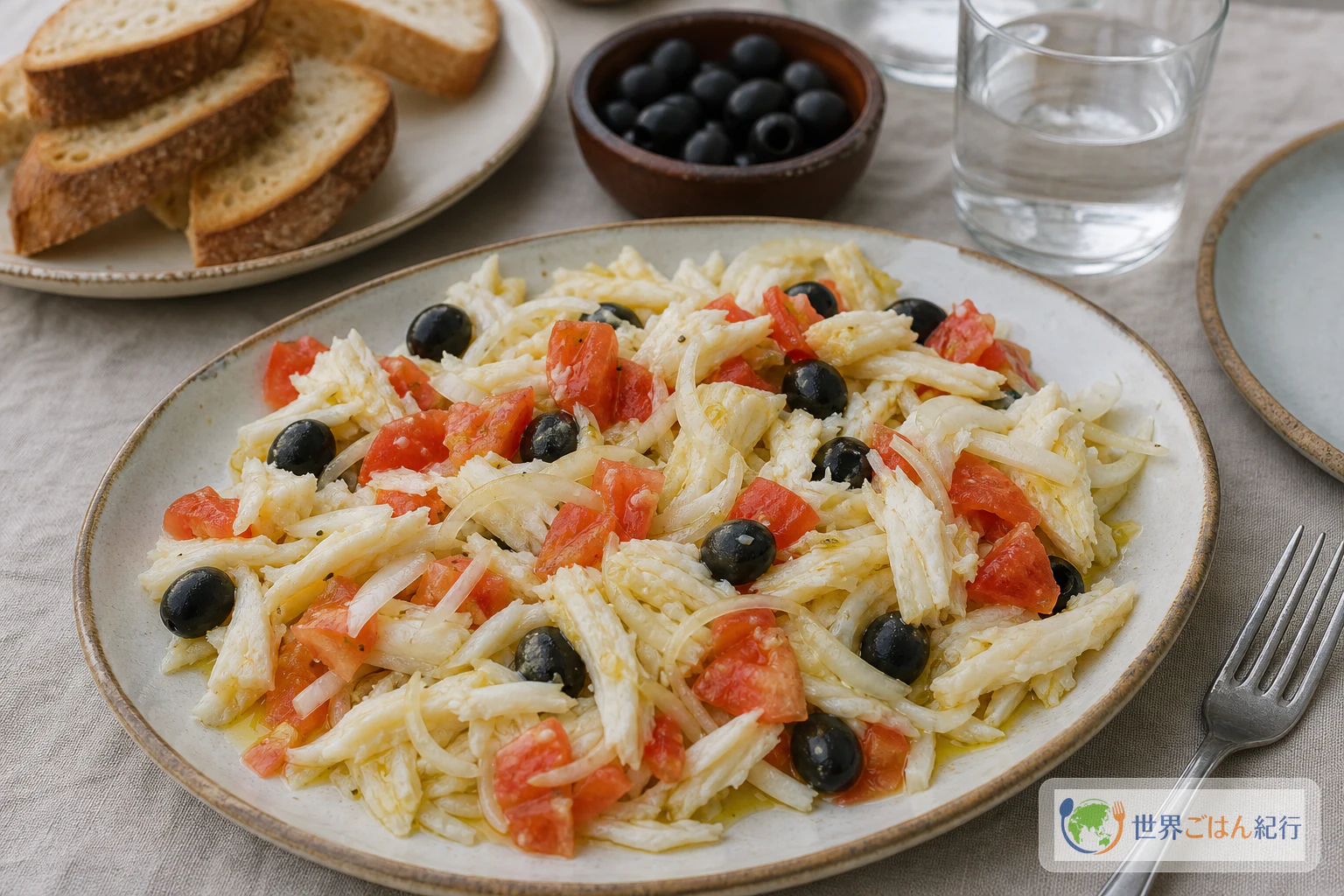
What esqueixada is
The name tells you how to make it. Bacallà is Catalan for cod, here the salt-cured kind, and esqueixar means to tear or shred. Esqueixada is a cold dish of soaked cod torn into threads by hand rather than finely chopped, and those intact fibers are where the texture comes from.
Cod is a cold-sea fish. It isn't caught off the Catalan coast but comes from the North Atlantic and the Bay of Biscay. Through salting and desalting, though, it went deep into Catalan home cooking, and esqueixada brings that preserved fish back to the table with local tomato, onion, and olive oil. A fish from far away turned into a local flavor: that sense of distance is what makes the plate interesting.
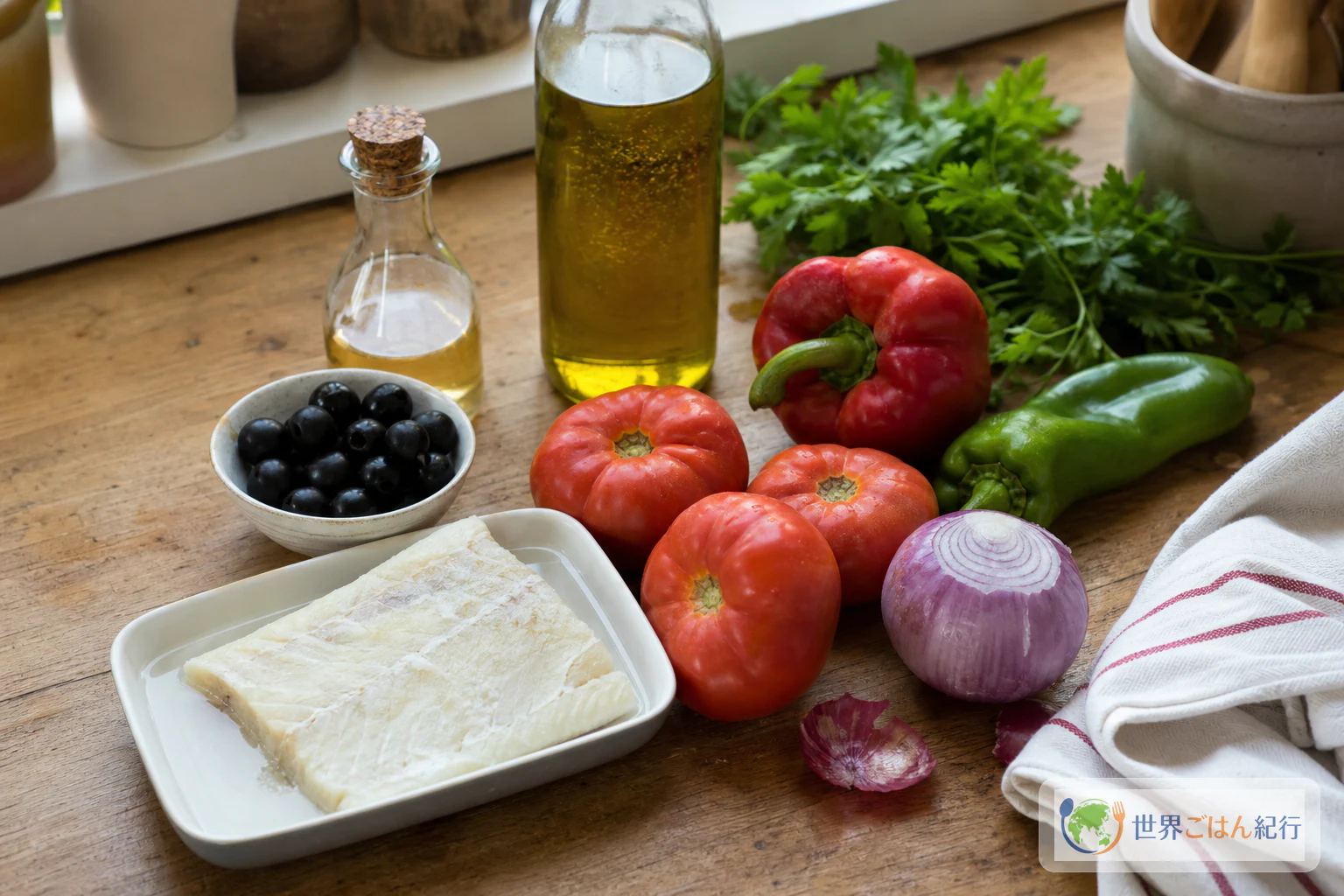
The ingredients vary a little. One basic version uses salt cod, onion, black olives, tomato, oil, and black pepper, served cold. Another combines desalted cod with tomato, green and red peppers, parsley, and extra virgin oil, with no added salt because the cod already brings it. Think of it as a dish built on the saltiness of the fish and whatever vegetables the season offers.
White beans are where people tend to wander off. Beans, tomato, onion, olives, and salt cod all suit a Catalan cold dish, but once the beans take the lead, you're making empedrat, not esqueixada. Nor is it a ceviche: the fish isn't a raw fillet cured in acid but cod that has been salted and then desalted. The heart of the flavor is the savor of a preserved food and the richness of the oil, not acidity.
Ingredients (serves 4)
First, decide the state of the cod. The least confusing choice is 10.5 oz (300 g) of "pre-soaked, ready to use" bacalao desalted as labeled. If you buy dry salt cod, prepare 8 oz to 9 oz (220 g to 250 g) before soaking. Soaking depends on the thickness of the fish and the saltiness of each product, so follow the package instructions first and taste the center at the end.
This dish does not cook the fish. Soaking raw cod in salt or vinegar does not make it safe, so do not use fillets without a label saying they are for raw consumption. Use salt cod that has been soaked, or a product already desalted as labeled. If you have a fish allergy, do not eat it, and avoid sharing tools used with fish. Wash vegetables under running water, and wash the knife and cutting board used for fish before using them for plating. Keep seafood refrigerated, and do not leave the finished dish at room temperature. For more on handling seafood at home, see the food safety guide.
Lightly salted cod as a substitute
350 g of lightly salted cod gives up some of the aroma and firm fibers of dried cod, but you can buy it at an ordinary supermarket. Follow the desalting instructions on the label. Without them, wipe the surface, soak in cold water for 20 minutes, and taste the center. The longer it sits in water, the more of the fish's savor escapes, so don't soak it until it is completely unsalted.
Don't salt raw fillets yourself in place of this recipe. Buy fillets labeled 'for raw consumption' and follow the label and the seller's guidance, or use them in cooked dishes. For esqueixada, use already soaked salt cod, which is safer and gives a more consistent flavor.
Choosing salt cod, olive oil, and vinegar for esqueixada
Tomato, onion, bell pepper, and green pepper from an ordinary supermarket are fine. The two things worth seeking out are the salt cod and the olive oil that goes straight onto a cold plate. For both, the most expensive option isn't the point; buy something whose condition and quantity you can judge.
Salt cod
Dried salt cod, pre-soaked cod, and lightly salted cod are not the same thing, so know which one you're holding. For dried cod, check that the label says 'bacalao,' 'salted cod,' or 'needs desalting,' and confirm the net weight and whether bones are included. Pre-soaked cod labeled 'desalted' or 'ready to use' is the shorter route and makes the fish easier to keep consistent.
Olive oil
The oil is a main ingredient here, the thing that links the salt cod and the vegetables. Choose an extra virgin you'll also happily use cold on other salads and bread after opening; if you already have a fragrant one at home, use that. The recipe needs ¼ cup (80 ml), so a small bottle stays fresh, though it can work out pricey if the rest sits unused.
Sherry vinegar
Vinegar is optional. The basic versions rely on oil, black pepper, vegetables, and salt cod, so skip it if you won't finish a bottle. If you will use it for other marinades and dressings, look for a sherry vinegar from Jerez. Add it at the end, 0.5 tsp (2.5 ml) at a time and no more than 1 tsp (5 ml), only after you've tasted the tomato's sweetness. Too much acidity hides the saltiness of the fish and makes it easier to misjudge the desalting.
Method: soak out the salt, drain, and bind with oil
No heat is used, so desalting, draining, and resting time do the work. The soaking time for dried salt cod changes with the thickness of the fish, so skip the memorized times and go by the saltiness at the center and the state of the flesh.
duration: 40 min to 24 hours
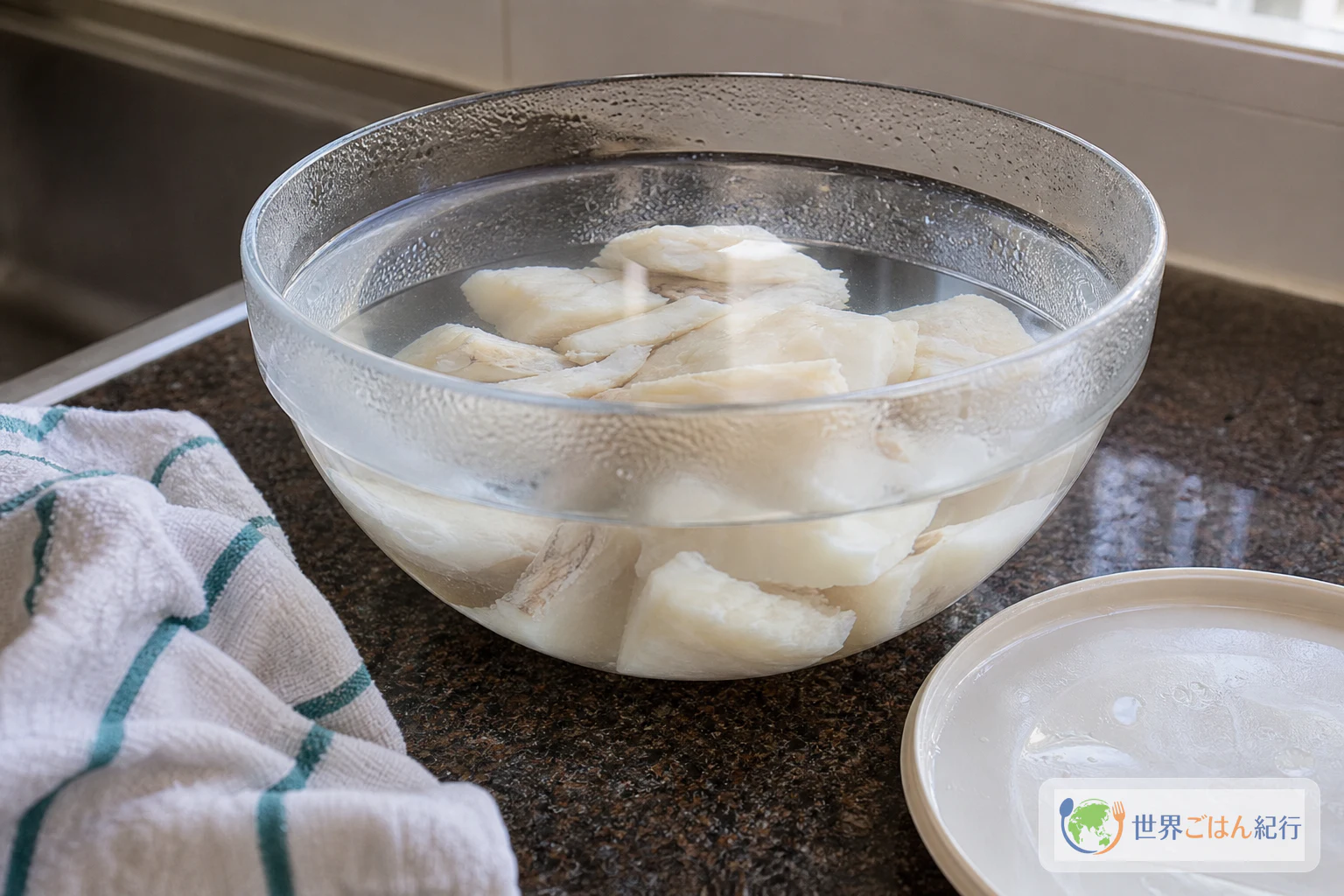
If you have pre-soaked salt cod, skip this step. If you bought dried thin salt cod in strips, soak it in cold water for about 40 minutes, changing the water 3 to 4 times. For a thick block, wash the surface, submerge it in 1.5 quarts (1.5 L) of cold water, cover, and refrigerate. Change the water every 6 to 8 hours, and after 12 hours tear off an edge about 0.5 inches (1 cm) wide and taste the center. If the salt is still strong, extend in 6-hour increments, and stop at 24 hours. If the product gives soaking instructions, follow those first.
- Pat dry and flake the flesh
duration: 8 min
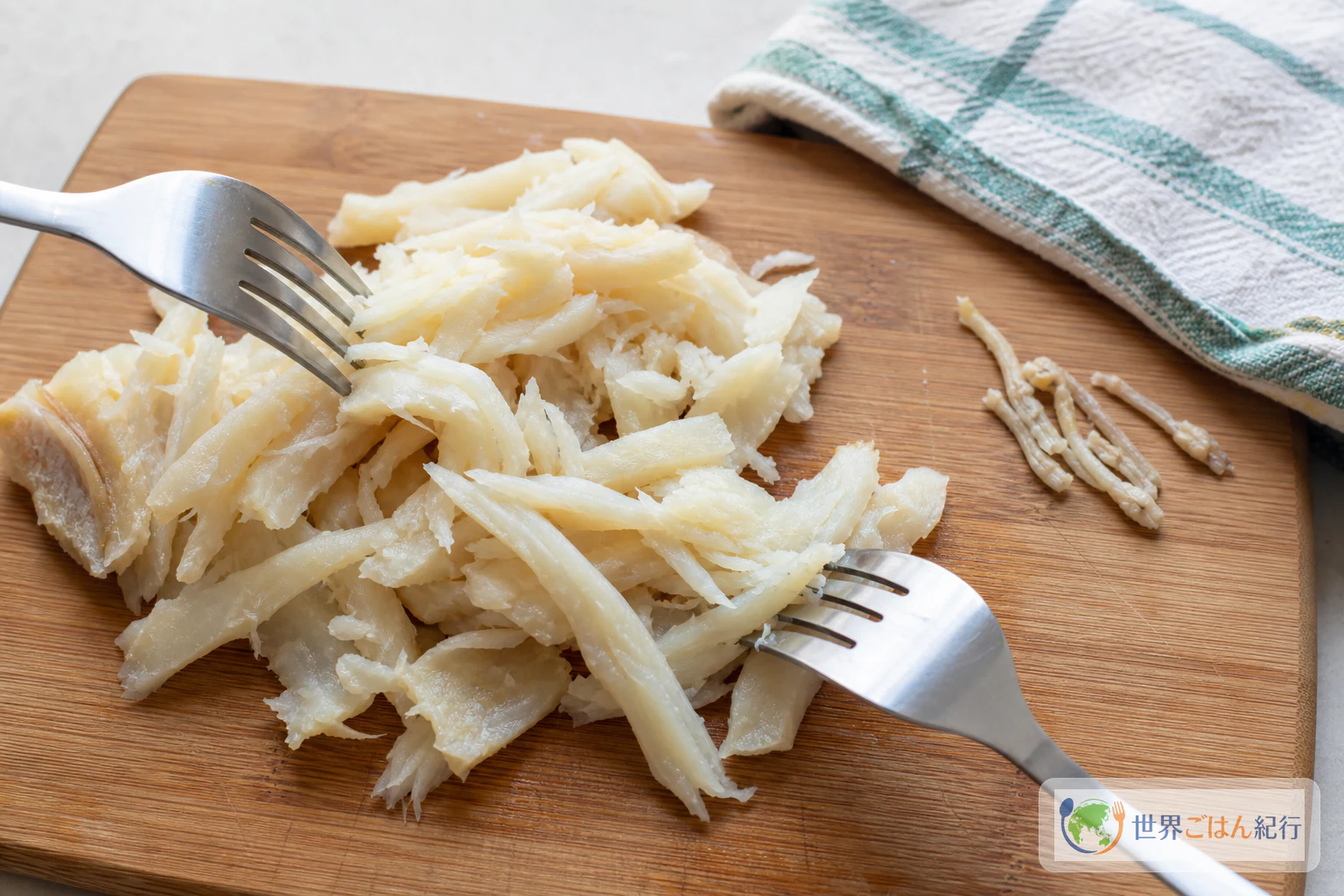
Press the salt cod, drained in a colander, with paper towels to remove surface moisture. Remove the skin and bones, and tear along the grain into pieces about 0.5 inches (1 cm) wide and 3 to 5 cm long. Don't chop it into crumbs with a knife; leave pieces large enough that white fibers show when lifted on a fork. If the center is still salty, resoak in 1¼ cups (300 ml) of cold water for just 30 minutes and wipe dry again.
- Cut the vegetables to eat together on the same plate
duration: 10 min
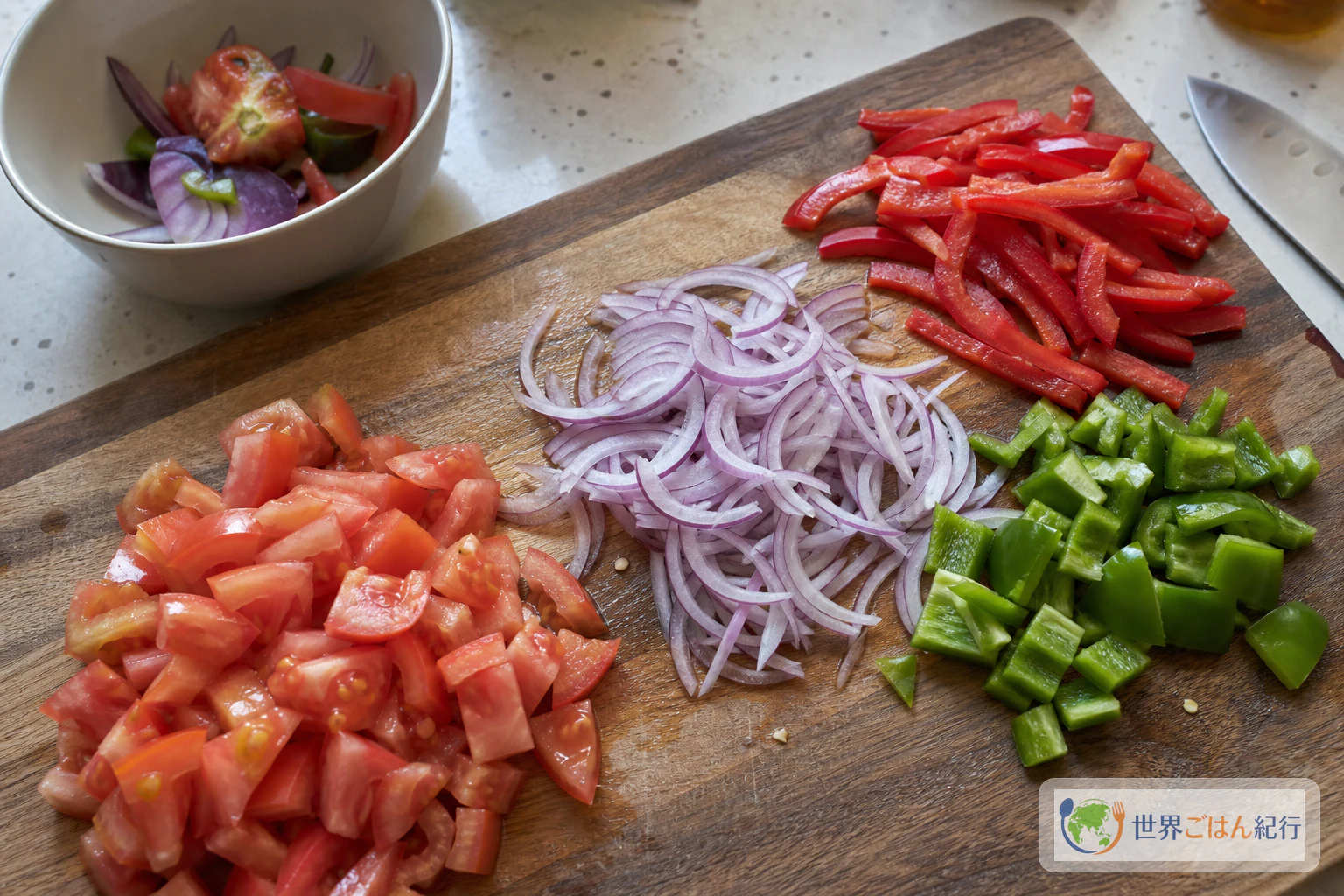
Remove the stem of 10.5 oz (300 g) of tomatoes and cut into 0.5 inches (1.5 cm) cubes. Cut 3.5 oz (100 g) of onion 0.125 inch (2 mm) wide and 1.75 oz (50 g) each of red bell pepper and green pepper 0.25 inch (5 mm) wide. If the onion's sharpness is strong, soak in 1¼ cups (300 ml) of cold water for 5 minutes and drain in a colander. Use the juice that clings to the tomato seeds and flesh, but don't return the thin liquid that runs onto the cutting board to the bowl.
- Adjust the moisture of the vegetables
duration: 10 min
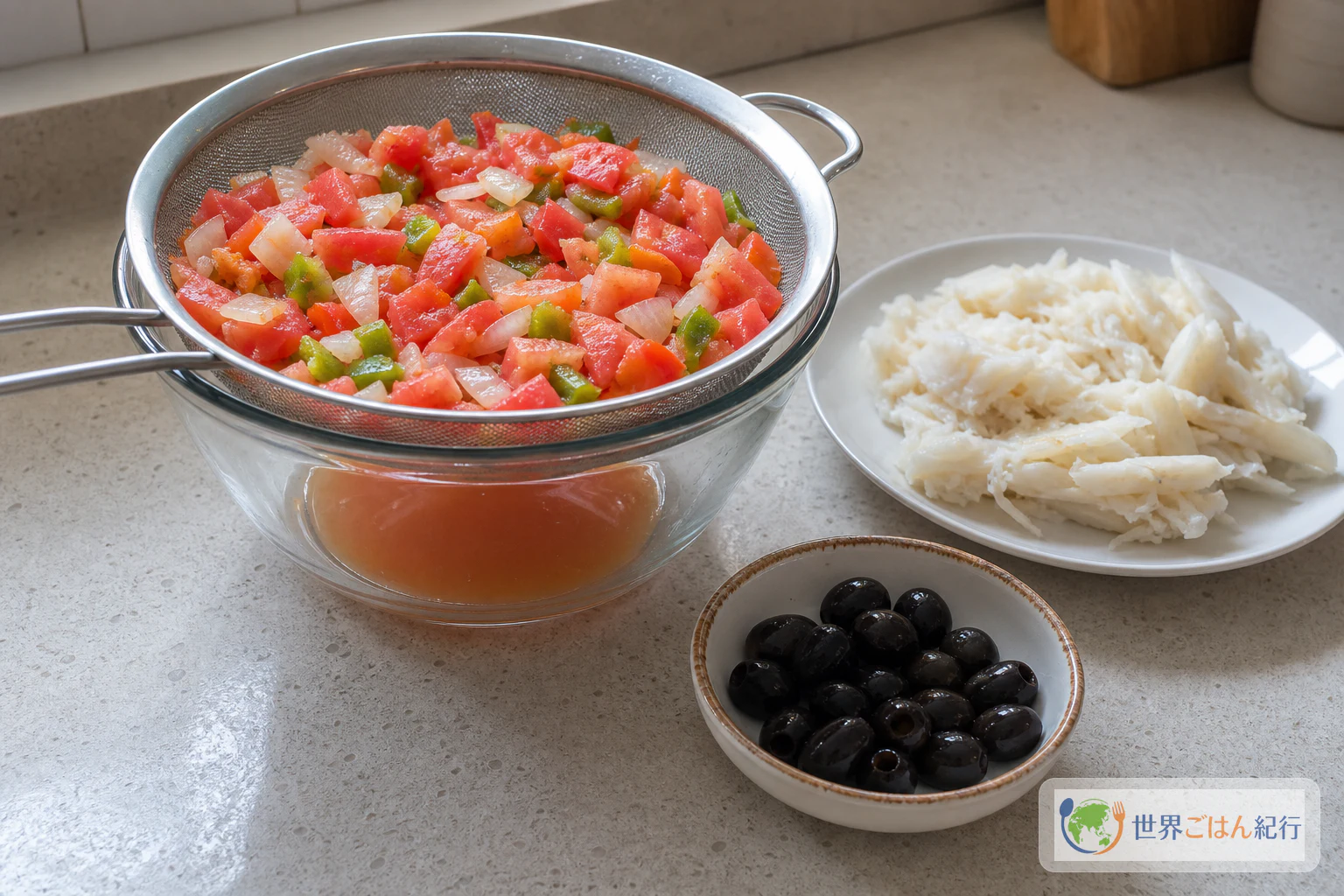
Spread the vegetables, cut as tomato 0.5 inches (1.5 cm) cubes, onion 0.125 inch (2 mm) wide, and bell pepper and green pepper 0.25 inch (5 mm) wide, in a colander set over a bowl, and rest for 10 minutes. If 2 tbsp or more of liquid collects at the bottom, use that liquid in a soup or another dressing. Do not add salt here. If salt draws water from the vegetables, the oil thins after resting in the refrigerator and the ingredients feel as if floating in water.
- Bind the salt cod and vegetables with oil
duration: 5 min
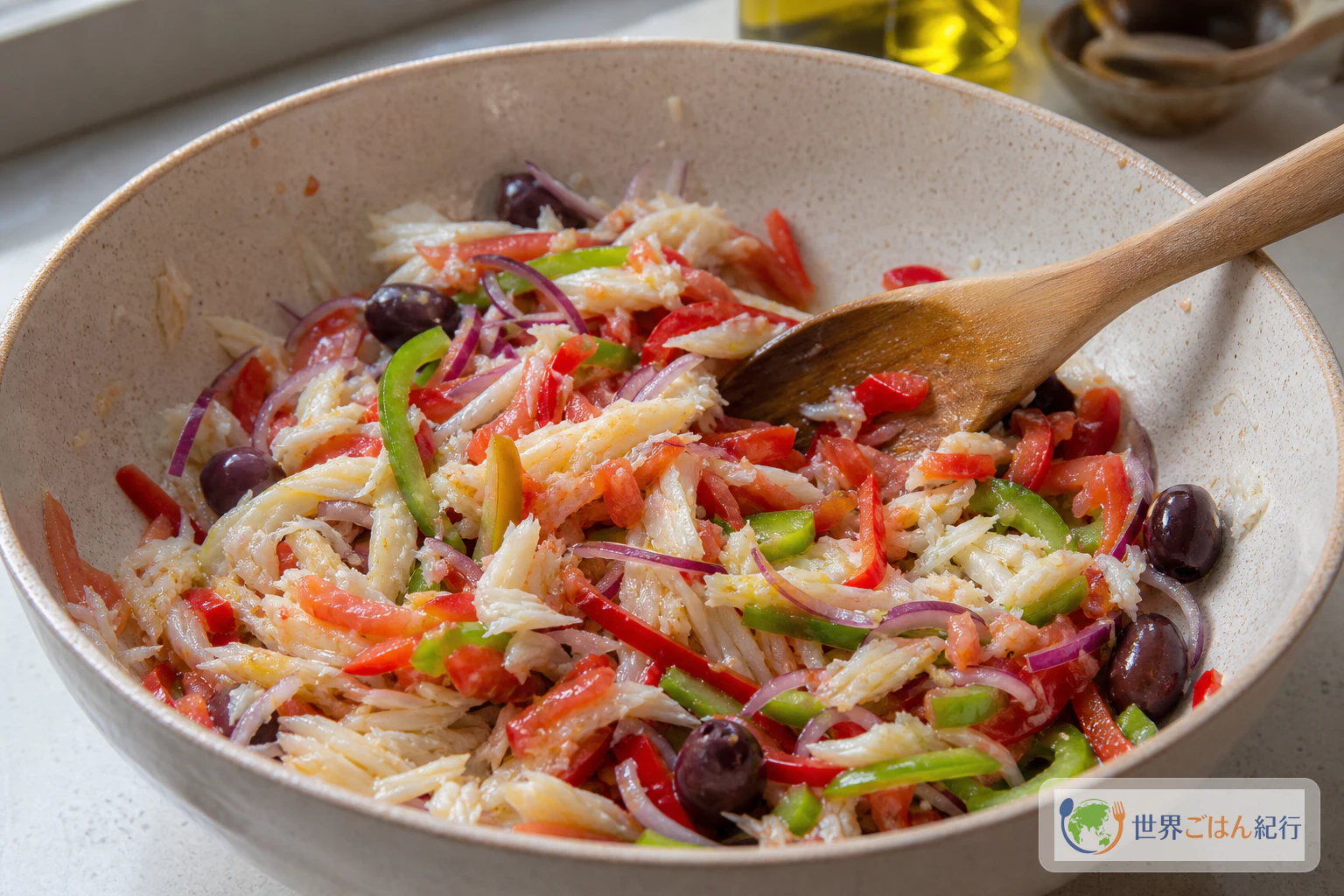
In a large bowl put the salt cod, vegetables, 3.5 oz (100 g) of black olives, half the parsley, and 1 g of black pepper. Drizzle with ¼ cup (70 ml) of olive oil and turn from the bottom 3 to 4 times with a wooden spoon. It is enough when the white flesh of the cod shows a sheen of oil and the tomato's red juice does not keep running to the bottom. Taste first without vinegar, and add 0.5 tsp (2.5 ml) of sherry vinegar only if you want acidity.
- Rest in the refrigerator and finish
duration: 30 min
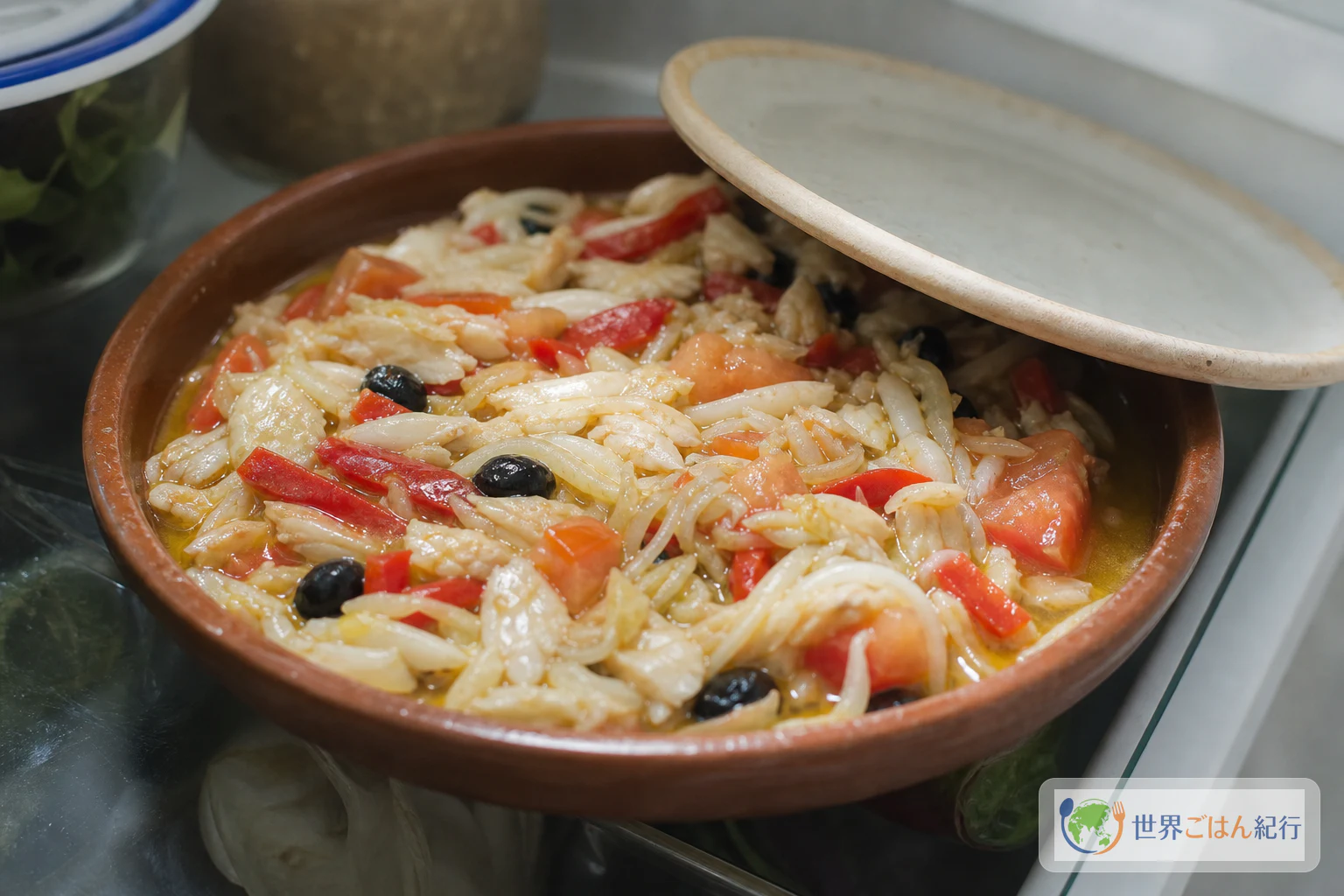
Cover and rest in the refrigerator for 30 minutes. Just before eating, add the remaining parsley and 2 tsp (10 ml) of olive oil, and if needed add sherry vinegar up to a total of 1 tsp (5 ml). It is done when, taken up with a fork, the cod fibers, tomato, and onion lift together and what is left at the bottom of the plate is a thin film of oil, not water. Only if the saltiness is lacking, add finishing salt 0.2 g at a time.
Why esqueixada turns out too salty, watery, or fishy
Most trouble comes from salt and water, not from the cutting. Soak too long and the fish loses its character; too briefly and even the tomato's sweetness loses to the salt. Judge by the center, not the edge: salt lingers in the thick part, so tear off a piece and taste the inside. If it's salty, resoak in cold water 30 minutes to 1 hour at a time, changing the water. Over-soaked cod is harder to rescue, because adding salt back won't restore its aroma or firm flesh.
Tear the fish into pieces about 0.5 inches (1 cm) wide rather than crumbs. Finely shredded fish soaks up the vegetable juices and turns heavy in the refrigerator. With proper pieces, the tomato's acidity comes first, then the savor of the cod, and finally the green bitterness of the oil. Draining carefully at the end protects that order more than soaking time does, since salted tomato left to sit leaves water on the plate that dilutes the oil.
| Result | Main cause | How to fix |
|---|---|---|
| Too salty | Salt remains at the center | Extend desalting in 30-minute steps and wipe dry again after soaking |
| Watery | Salted the tomato, returned the colander liquid | Return the ingredients to a colander for 10 minutes and add oil 1 tsp at a time |
| Heavy fish smell | Moisture left on the surface of the flesh | Press with paper and coat thinly with oil first |
| Flavor is blurred | Cod soaked too much, too little oil | Add olives and adjust finishing salt 0.2 g at a time |
Serving and storing esqueixada
At the table
Esqueixada is a chilled starter, and bread is its natural partner: you can mop up the olive oil clinging to the tomato and cod down to the last drop. Plate it in a small dish and follow with something warm, like a tortilla or fideuà. If you want another tomato dish, serve gazpacho in a small glass. On a hot day, mixing in bread, eggs, and one warm plate rather than lining up only cold ones also softens the saltiness. For more ways with salt cod, try Portuguese bacalhau à Brás.
Make-ahead
You can soak, flake, and pat the cod dry the day before. Cut the vegetables on the day, rest them in a colander for 10 minutes, and combine everything with the seasoning about 30 minutes before eating. Left overnight as a finished dish, the tomato and onion give up water and the texture suffers.
Storage
Put the finished dish in a clean container, keep it in the refrigerator, and eat it the same day or the next. You can't judge the safety of a cold seafood dish by look or smell alone, so keep fish drip away from other foods and don't leave the dish at room temperature for long. For refrigerated storage, follow the storage guide.
Don't freeze the finished dish: water comes out of the tomato and onion on thawing and the flaked fish breaks down. If you freeze the salt cod alone, follow the product's storage instructions.
FAQ
Can I make it with fresh cod?
No. Fresh cod differs from salt cod in fiber and saltiness, and soaking it in salt or vinegar does not make it safe to eat uncooked. Cook fillets that aren't labeled for raw consumption, and make esqueixada with salt cod. Don't salt raw cod yourself to imitate it.
Is one night enough for desalting?
Sometimes, for a thick block, but it can take nearly 24 hours. Thin strips need about 40 minutes with several water changes as a starting point. Either way, go by taste, not the clock: tear open the center and check.
Can I use pre-soaked bacalao?
Yes. Pat off the moisture with paper and start from step 2, treating it as 10.5 oz (300 g) of salt cod.
Can I substitute if I can't eat fish?
Nothing gives the same flavor. A salad of white beans, tomato, onion, olives, and bell pepper dressed in oil is a good dish in its own right, just not esqueixada. If you have a fish allergy, use a knife, cutting board, and bowl that have never touched fish, and follow medical advice.