İmam Bayıldı: Turkish Eggplant Stuffed and Simmered in Olive Oil

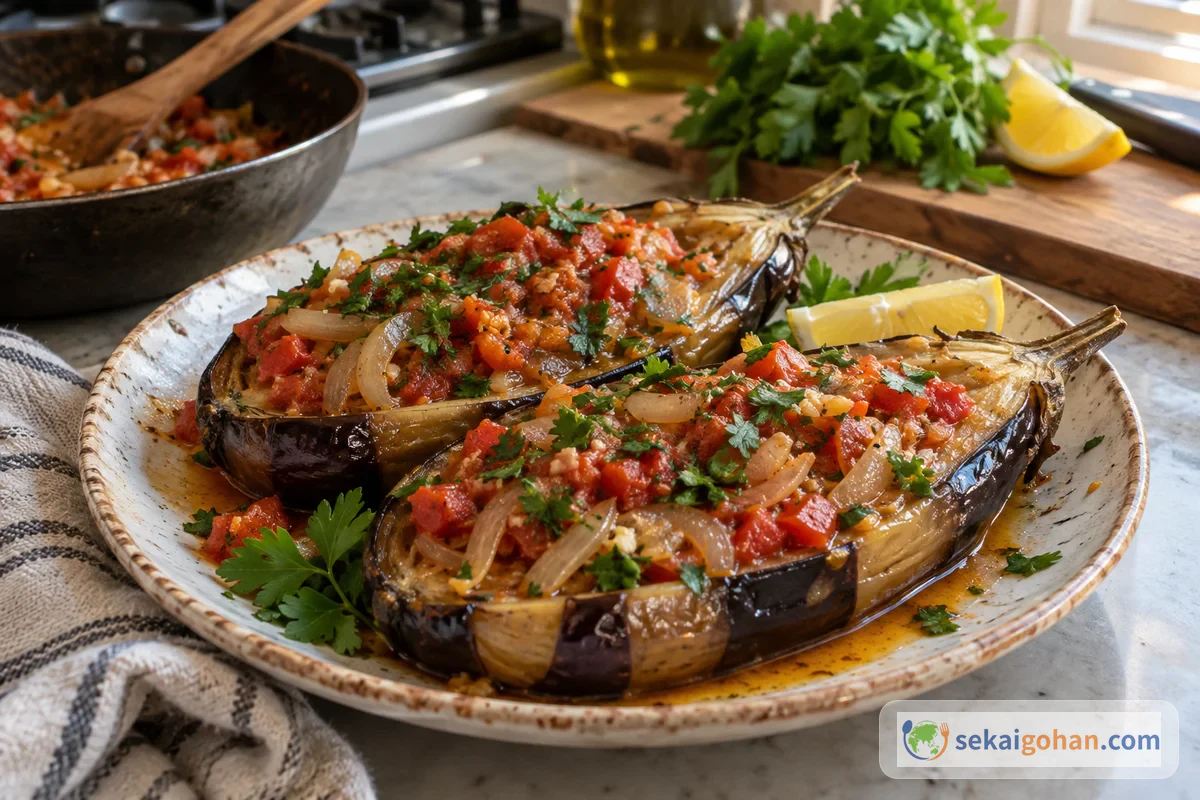
İmam bayıldı: striped eggplant stuffed with onion and tomato and simmered, served on a plate with parsley and lemon
Prep
35 min
Cook
1 hr
Total
1 hr 35 min
Serves
4 servings
Level
Intermediate
Cuisine
Turkish

A recipe for imam bayıldı, the Turkish eggplant dish whose name means 'the imam fainted,' made with globe eggplants. It covers peeling in stripes, salting to draw out moisture, the onion and tomato stuffing, simmering 45 to 50 minutes in olive oil, why it is eaten cool, and storage.

Cooking flow

Cooking steps

STEP11 / 8

Peel the eggplants in stripes

5 min

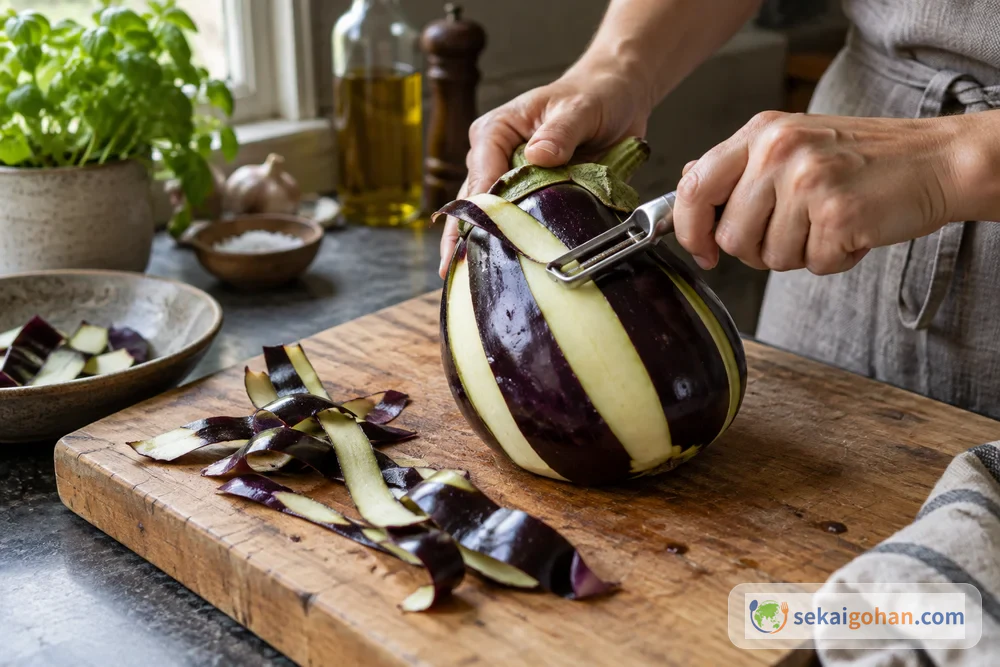
Hands peeling a globe eggplant lengthwise in stripes with a peeler
Leave skin in alternating 1.5 to 2 cm bands to make stripes

Leaving the stem on, peel the eggplant lengthwise with a peeler. Don't peel it all; peel alternating strips, leaving skin in bands about 1.5 to 2 cm wide, to make a striped pattern. Leaving skin helps prevent the eggplant from falling apart, and the flavor soaks in through the peeled parts.

STEP22 / 8

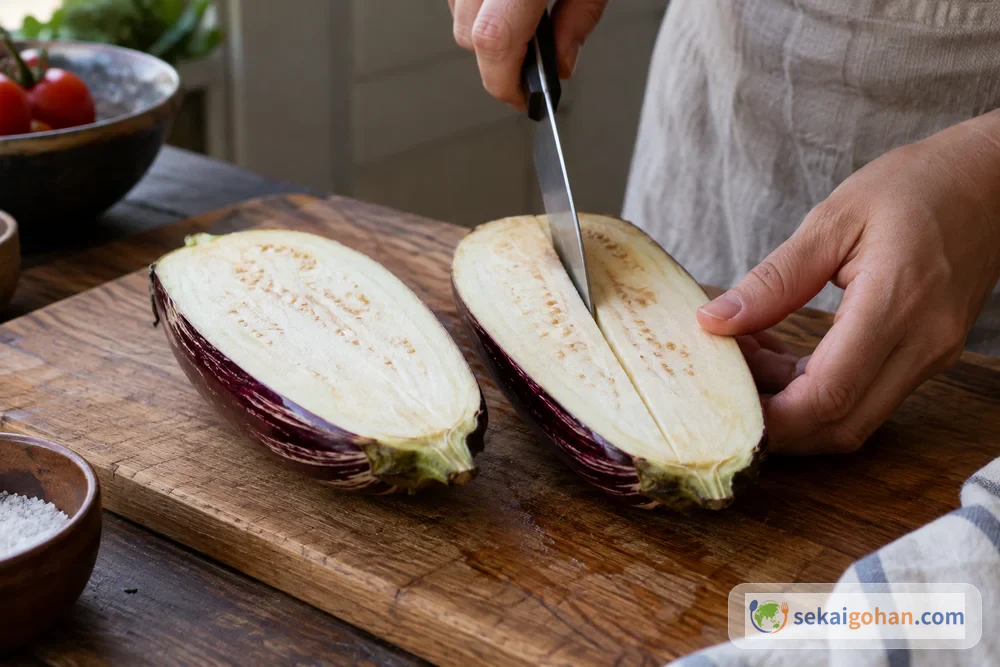
Halve lengthwise and cut a slit

5 min

Cutting a lengthwise slit into the flesh of a halved eggplant, leaving the ends intact
Leave about 1.3 cm at each end and cut to a depth that doesn't go through the skin

Cut the eggplant in half lengthwise. Set it cut side up and cut a long, deep slit down the center of the flesh. Leave about 0.5 inches (1.3 cm) uncut at each end, and stop the knife short of the skin so you don't cut through. This slit becomes the pocket for the stuffing.

STEP33 / 8

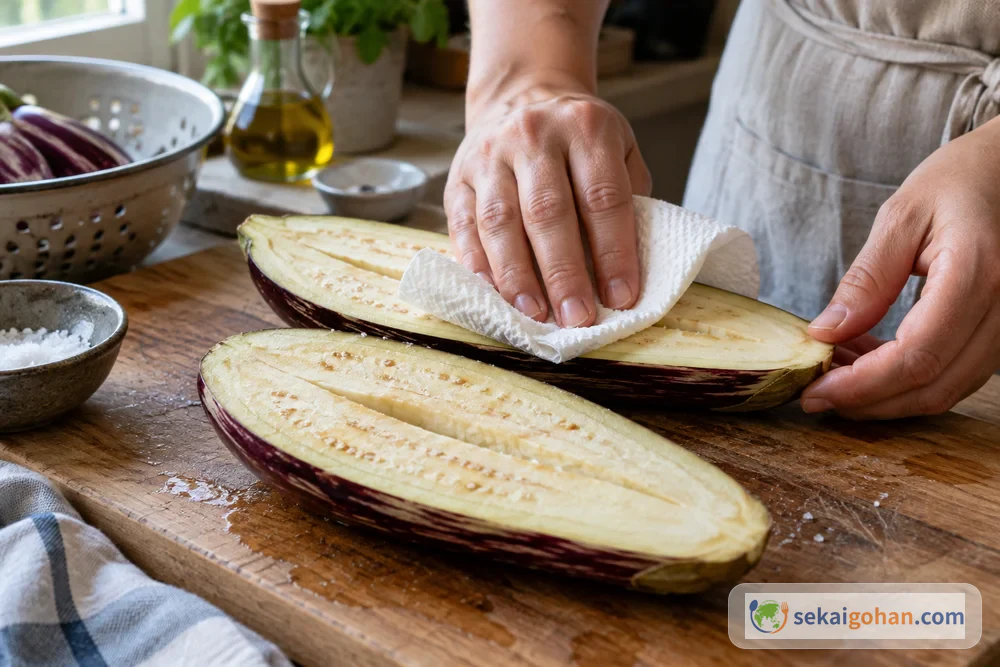
Salt to draw out moisture

10–15 min

Wiping the salted eggplants dry with paper towels
When droplets appear, rinse and wipe thoroughly with paper towels

Sprinkle salt evenly over the cut surface and inside the slit, which is about 1 inch (2 to 3 cm) deep, and leave at room temperature for 10 to 15 minutes. When fine droplets bead on the surface and the flesh darkens slightly, it is a sign that water has come out. Rinse lightly to wash away the water and bitterness that came out with the salt, and wipe thoroughly dry with paper towels. If moisture remains, the finished dish turns soggy.

STEP44 / 8

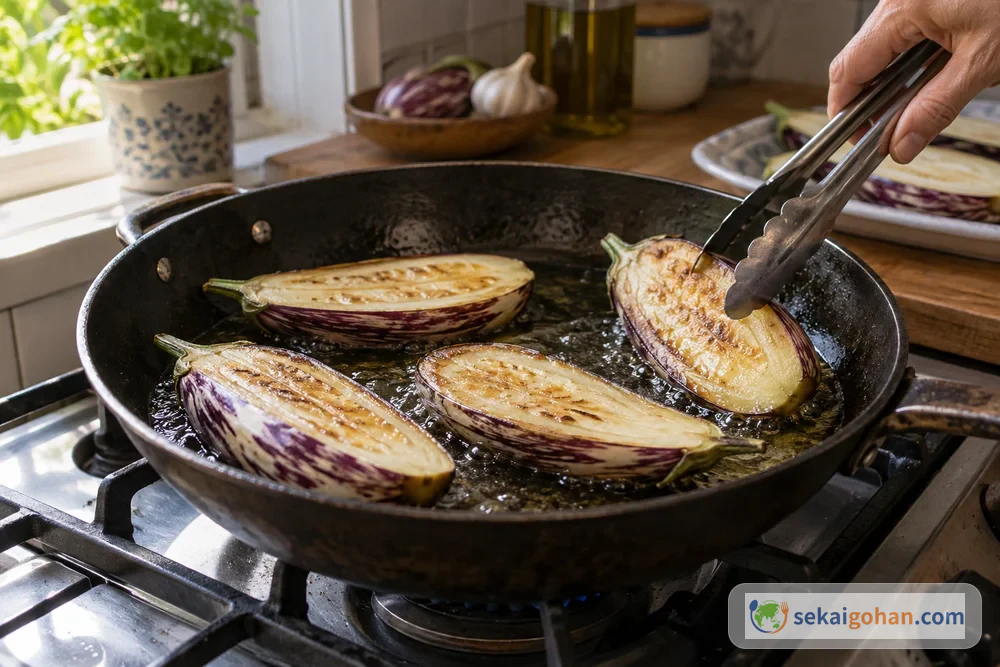
Pan-fry the eggplant

3–5 min

Pan-frying both sides of the eggplant in 1 cm of oil to a light browning
Take it out when the flesh is soft and lightly browned

In a deep pot or frying pan, heat oil 0.5 inches (1 cm) deep over medium heat. Add the eggplant and cook both sides for 3 to 5 minutes in total, until the flesh is soft and the surface has a light browning. You don't need to cook it through. Lift onto paper towels and drain the excess oil.

STEP55 / 8

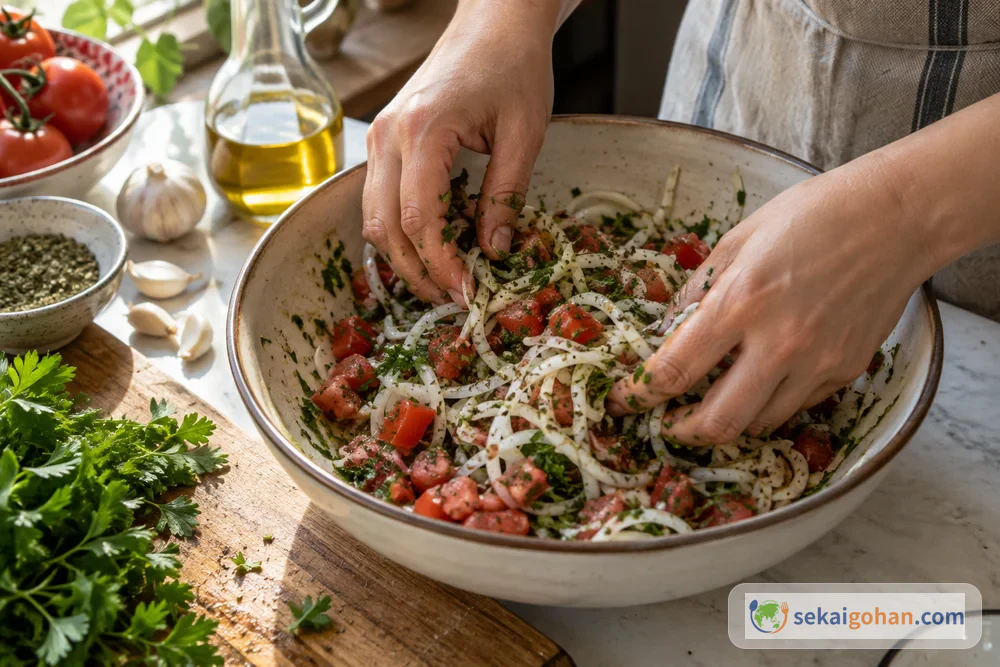
Make the stuffing

5 min

Massaging thin-sliced onion and garlic with olive oil and mint in a bowl, then adding tomato and parsley
When the onion has softened, mix in the tomato and parsley

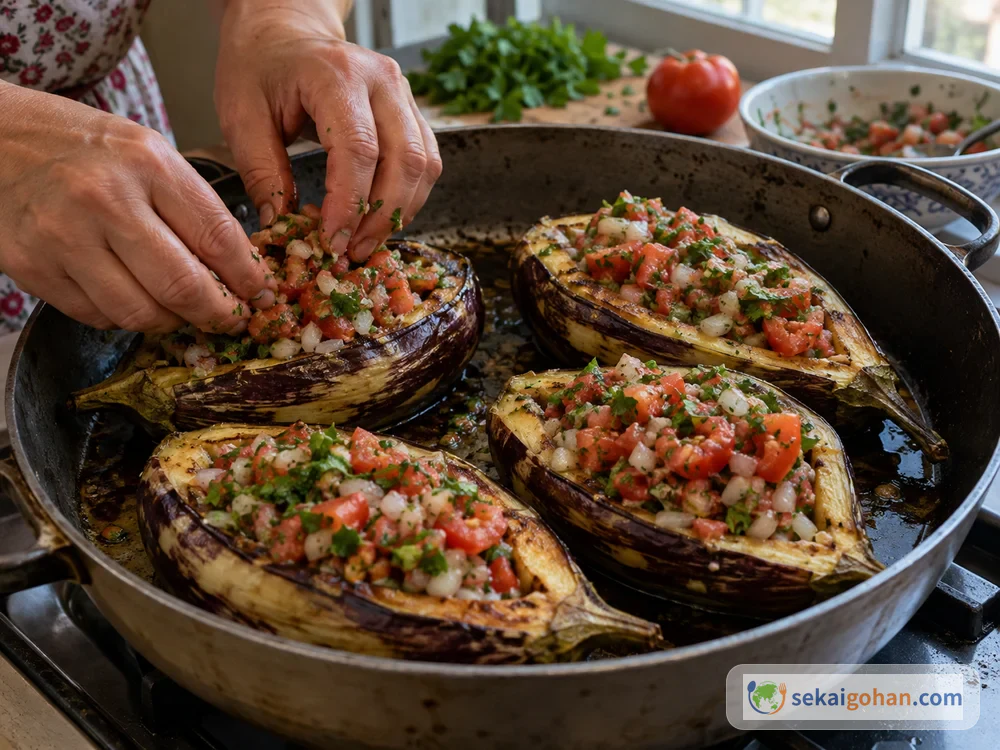
In a bowl, put the onion sliced lengthwise 2 to 3 mm thick, the garlic, 2 tbsp olive oil, dried mint, salt, and black pepper, and massage by hand for 1 to 2 minutes, until the onion softens a little and turns translucent. Add the tomatoes chopped to about 0.25 inch (5 mm) and the parsley, and toss roughly. Use about half a fistful per eggplant half.

STEP66 / 8

Stuff and arrange in the pot

5 min

Mounding onion and tomato stuffing into the opened slit of the eggplant and arranging them in a pot
Press in the stuffing, mounding it high, and arrange in the pot

Open the slit of the eggplant with your fingers to about 1 inch (3 cm) wide and press in the stuffing, packing it in firmly. It's fine to mound 1 inch (2 to 3 cm) high. In a wide, heavy pot, arrange the eggplants with the stuffing facing up. Tuck any leftover stuffing into the gaps between the eggplants and cook it together.

STEP77 / 8

Cover and simmer over low heat

45–50 min

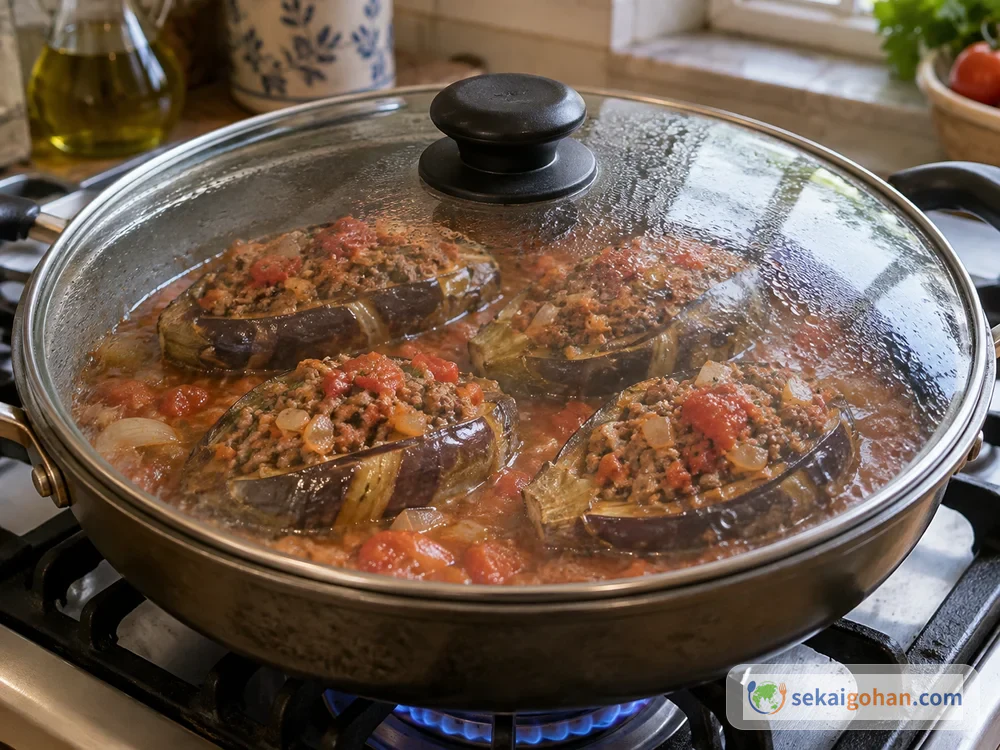
Simmering the stuffed eggplants in a covered heavy pot over low heat
Simmer until the eggplant cuts easily and a little liquid remains

Mix 2 tbsp olive oil, 1/2 cup water, the lemon juice, and the sugar until the sugar dissolves, and pour it from about 5 cm high over the eggplants. Cover and set over medium heat, and when the liquid is warm and steaming, lower to low heat. Simmer 45 to 50 minutes, until the eggplants are soft enough to cut easily with chopsticks or a fork. Finish when the tomato in the stuffing has softened and about 5 mm of liquid remains on the bottom of the pot, and if it looks about to scorch, add 1 to 2 tbsp water at a time.

STEP88 / 8

Cool in the pot and serve

at least 30 min

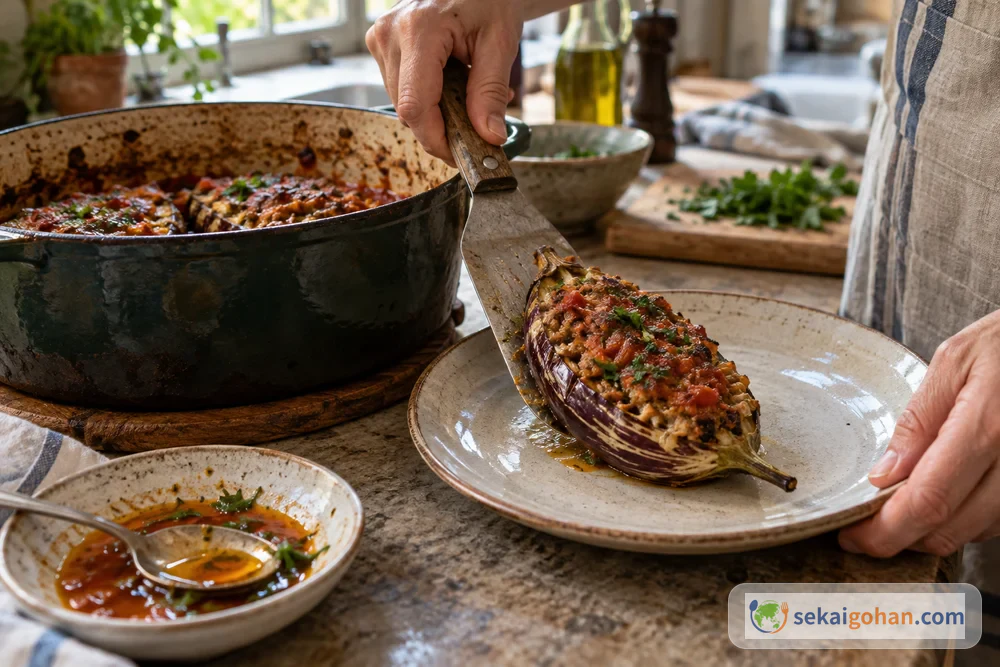
Moving the pot-cooled eggplants to a plate, pouring over the liquid, and scattering parsley
Cool in the pot, then plate and spoon on the leftover oil and liquid

Turn off the heat and cool the eggplants in the pot with the lid on so the flavors blend. When they are at room temperature, gently move the eggplants to a plate and spoon over the olive oil and liquid left in the pot. Scatter chopped parsley and add lemon wedges, and it is done.

0 / 0
Ingredients

Ingredients

1 / 4

Eggplant

Ingredient Amount Substitutes & notes
Globe eggplant 2 large 4 if using slender eggplants
Salt as needed For drawing out moisture and bitterness in prep
Oil for pan-frying 0.5 inches (1 cm) deep in the pan Pure olive oil or canola oil
2 / 4

Stuffing

Ingredient Amount Substitutes & notes
Onion 1 large Halved lengthwise, then thinly sliced
Tomatoes 3 Finely chopped
Garlic 3 to 4 cloves Minced
Flat-leaf parsley 1 bunch Chopped. Keep a little for garnish
Extra virgin olive oil 2 tbsp
Dried mint 1 tsp
Salt and black pepper as needed If using whole peppercorns, grind fresh in a spice mill
3 / 4

Cooking liquid

Ingredient Amount Substitutes & notes
Extra virgin olive oil 2 tbsp
Water 1/2 cup (about 120 ml)
Lemon juice 1/2 lemon
Sugar 2 tsp Rounds out the tomato's acidity
4 / 4

To serve

Ingredient Amount Substitutes & notes
Lemon 1/2 Cut into wedges
0 / 0

Lift the lid of the pot and there they are: eggplants lying soft and slumped in a broth of olive oil and tomato. Don't eat them right away. Take the pot off the heat and let the eggplants cool all the way so the flavors can settle. İmam bayıldı, long loved on Turkish tables, is eggplant stuffed with onion and tomato, slowly simmered in olive oil and eaten cool. The name means "the imam fainted," which is quite a dramatic thing to call a dish.

About İmam bayıldı
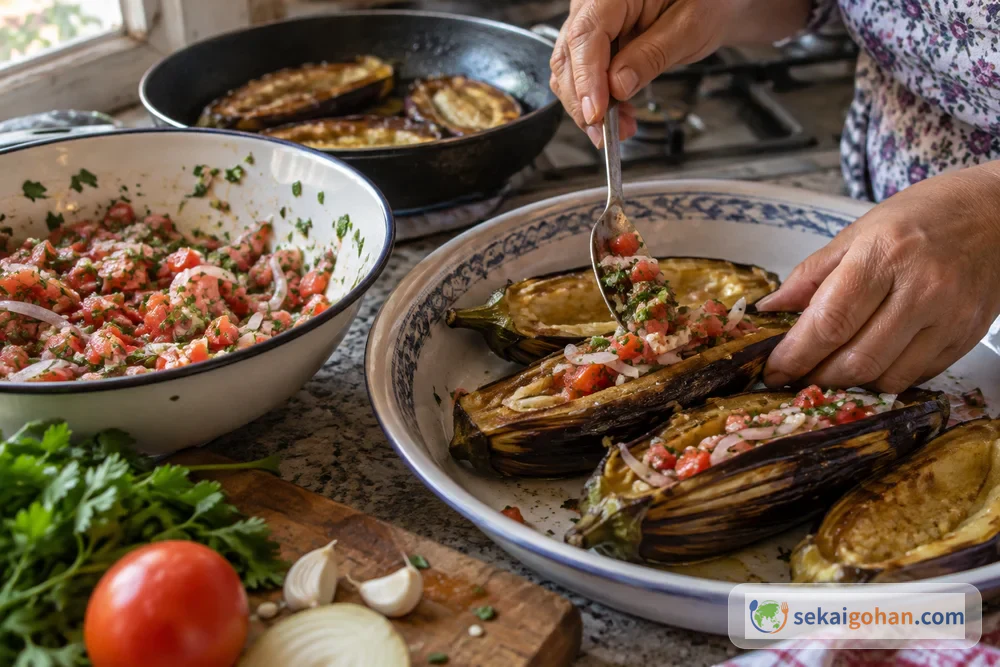
Hands stuffing striped, peeled eggplants in a Turkish home kitchen

The story behind the name

Several stories explain the odd name. In the best known, an imam was so carried away by the aroma and taste of the dish that he fainted. In another, he fainted from shock at the cost of all the olive oil it used. One version has an imam who married the daughter of an olive oil merchant: each night, the 12 jars of oil from her dowry went into this dish, and on the 13th day, when the oil ran out, he fainted.

The Turkish verb "bayılmak" means both "to faint" and "to be very fond of something, to be enchanted." Read that way, "İmam bayıldı" is also a compliment: "so delicious you'd faint."

Did you know?

Turkey also has Karnıyarık, in which eggplant is split open and filled with ground meat. It looks very similar; you can think of karnıyarık as imam bayıldı with ground meat added. Imam bayıldı has no meat, so it belongs with the vegetable dishes simmered in olive oil.

A dish simmered in olive oil

Imam bayıldı belongs to the family of Turkish dishes called "zeytinyağlı," meaning "with olive oil." In these dishes, vegetables are slowly simmered in olive oil and a little water. Seasonal vegetables such as celery and zucchini are cooked this way and set out on the table as appetizers (meze).

The Ottoman court long cooked with animal fats such as tallow. With the olive oil trade, olive oil came into the palace kitchens, and dishes made with it spread. Towns on the Aegean coast, where olive trees are abundant, are deeply tied to these dishes as well.

So why eat it cool? While hot, the aroma of olive oil is too forward and the broth hasn't yet settled into the eggplant. As it cools in the pot, the eggplant soaks up the juices of onion and tomato, and the broth and the eggplant become one.

Did you know?

Eggplant in Turkish is "patlıcan." Imam bayıldı is one of the best-known of the many eggplant dishes in Turkish cooking.


Ingredients (serves 4)
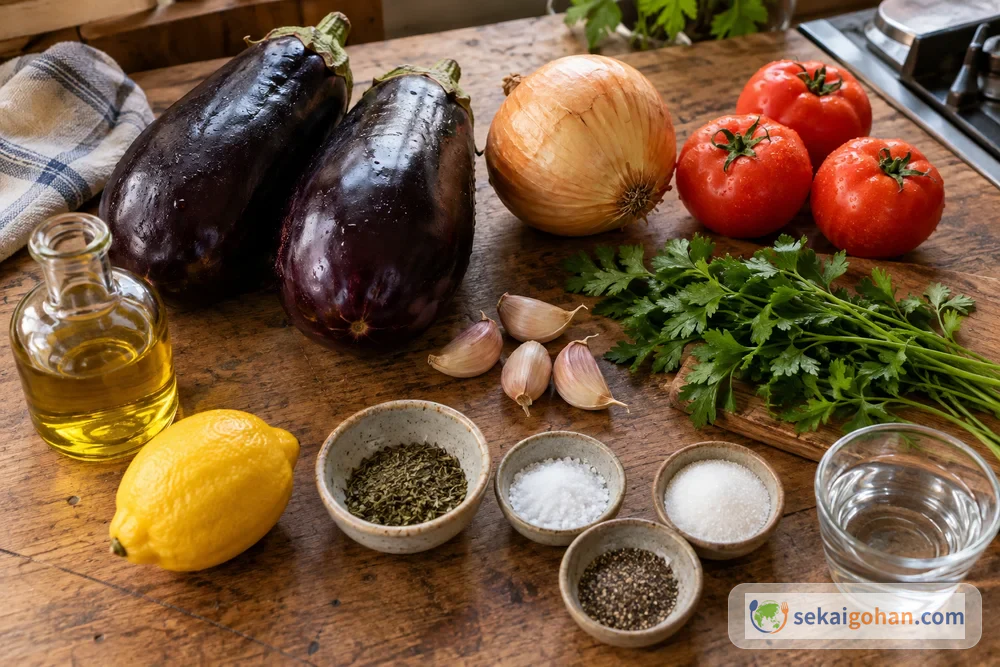
Ingredients: globe eggplants, onion, tomatoes, garlic, flat-leaf parsley, olive oil, dried mint, and lemon laid out

The oil for pan-frying is a generous 0.5 inches (1 cm) deep, but the eggplant absorbs only part of it. Cool the rest, strain it, and reuse it for sautéing. Don't skimp on olive oil. It is the source of this dish's deliciousness. If you want less oil, use a little less in the stuffing and cooking liquid.

Tip

Choosing very ripe, red tomatoes makes the flavor of the cooking liquid much deeper. If you only have watery tomatoes, increase the sugar a little, or use some canned diced tomatoes.

Choosing eggplant, olive oil and mint

Since the eggplant is cut in half lengthwise and stuffed, a big, stout globe eggplant suits it best. If you can't find one, use one slender eggplant per person. Small eggplants cook faster, but they leave a smaller gap for the stuffing.

Look for glossy, taut skin and eggplants that feel heavy for their size. Wrinkled or limp skin means they have been off the plant longer and are prone to bitterness. Eggplants are at their best in summer, from July to September.

Use extra virgin olive oil for the stuffing and the cooking liquid, and a mild oil such as pure olive oil or canola for pan-frying the eggplant. That balances aroma and cost nicely. Dried mint, a regular in Turkish home cooking, goes into the stuffing; look for it in the spice aisle or on the herbal tea shelf.


Careful with hot oil

When pan-frying the eggplant, wipe off the moisture before putting it in the oil. If water remains, the oil spatters badly. If the oil gets too hot and starts to smoke, turn off the heat and let the temperature drop.

Tip

Before rushing it into the refrigerator, give it time to cool to room temperature in the pot. During this time the eggplant draws in the liquid, and the sweetness of the tomato and onion moves into the flesh.

Tip

If the eggplants look about to stick to the bottom during simmering, tilt the pot gently to spread the liquid around. Eggplants are soft and fragile, so do not turn them over or move them with chopsticks.

Serving İmam bayıldı
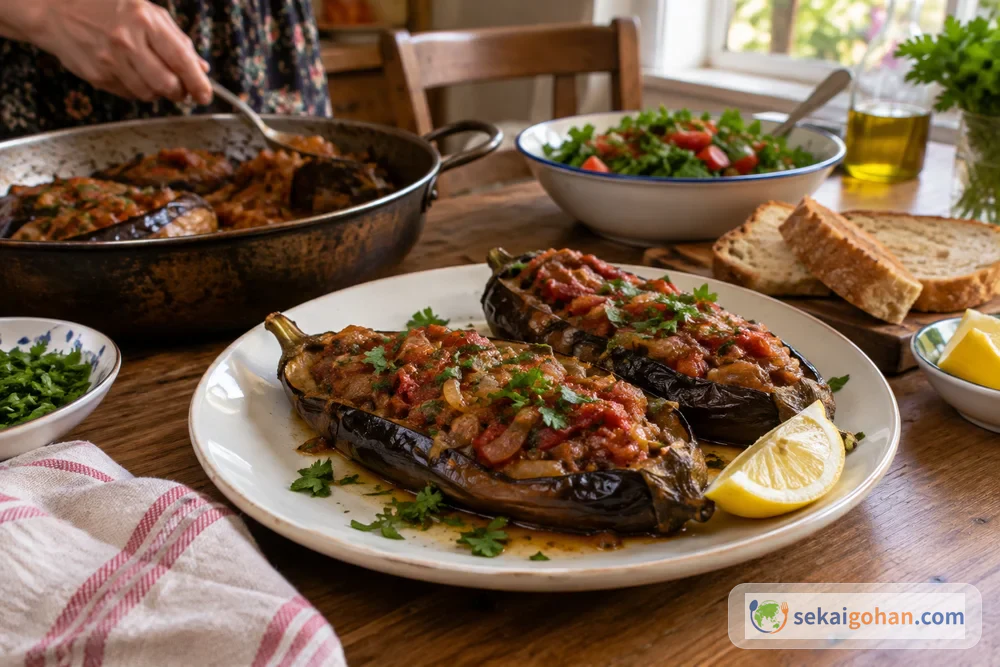
Imam bayıldı on a white plate with lemon and parsley, and bread on the table
Plated at room temperature and eaten with a squeeze of lemon

Imam bayıldı is usually served at room temperature or chilled, as a meze, and with no meat it suits a vegetarian table too. A squeeze of lemon adds a fresh acidity to the richness of the olive oil, so it never feels heavy. Put out bread to wipe up the liquid left on the plate.

For a Turkish-style spread, set it beside a little ezme, chopped tomato and chili; kısır, a bulgur salad; and piyaz, a white bean salad. All of them can be made ahead to start dinner. For another cooked-eggplant dish, try Turkey's hünkar beğendi.

Frequently asked questions

May I eat it while warm?

Yes. It is sometimes served warm, though it is more often eaten at room temperature. Warm, it tastes a little different: the olive oil aroma is stronger and the eggplant holds more moisture.
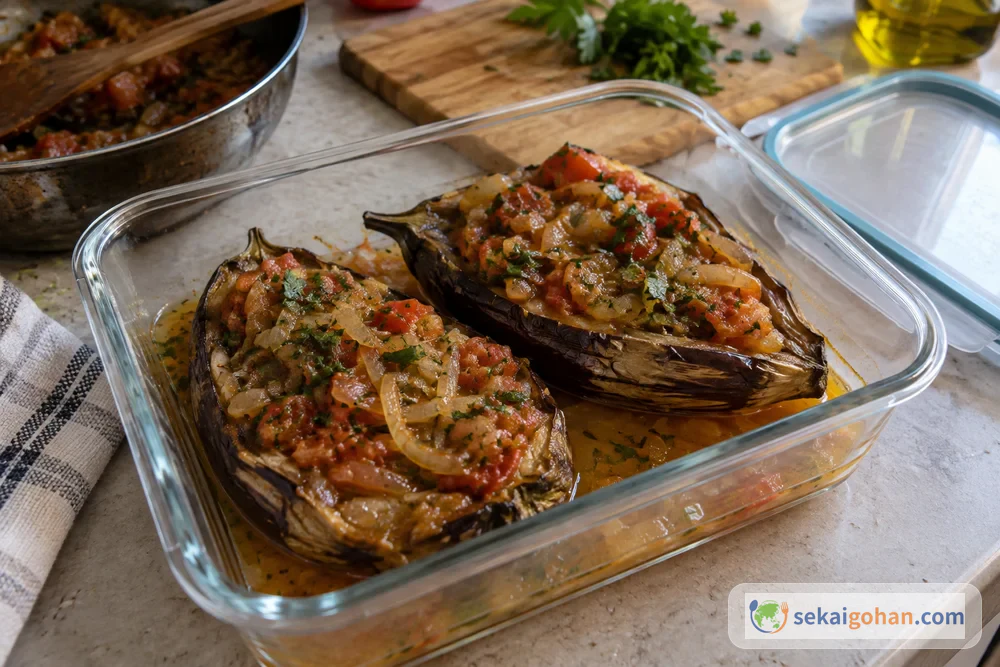
Imam bayıldı arranged in a storage container and chilled

Can I make it ahead?

Yes. Cool it, put it in a storage container, and eat it within 2 to 3 days in the refrigerator. Straight from the fridge the olive oil can solidify and turn white, so take it out a while before eating and let it come back to room temperature for a smoother mouthfeel.

Can I make it without pan-frying?

If you want less oil, you can roast the eggplant in the oven or a frying pan before stuffing; just cook it until the flesh is soft. Pan-frying does make the flesh meltingly soft and lets the stuffing's flavor soak in better.

What if I want it spicy?

Basic imam bayıldı isn't spicy. For heat, add a little chopped green chile or Turkish chile flakes (pul biber) to the stuffing; it goes well with the sweetness of the tomato.

What if I don't have dried mint?

It can be made without. If you have fresh mint, chop a small amount and add it. With no mint at all, a little extra parsley makes up the freshness.

Sources