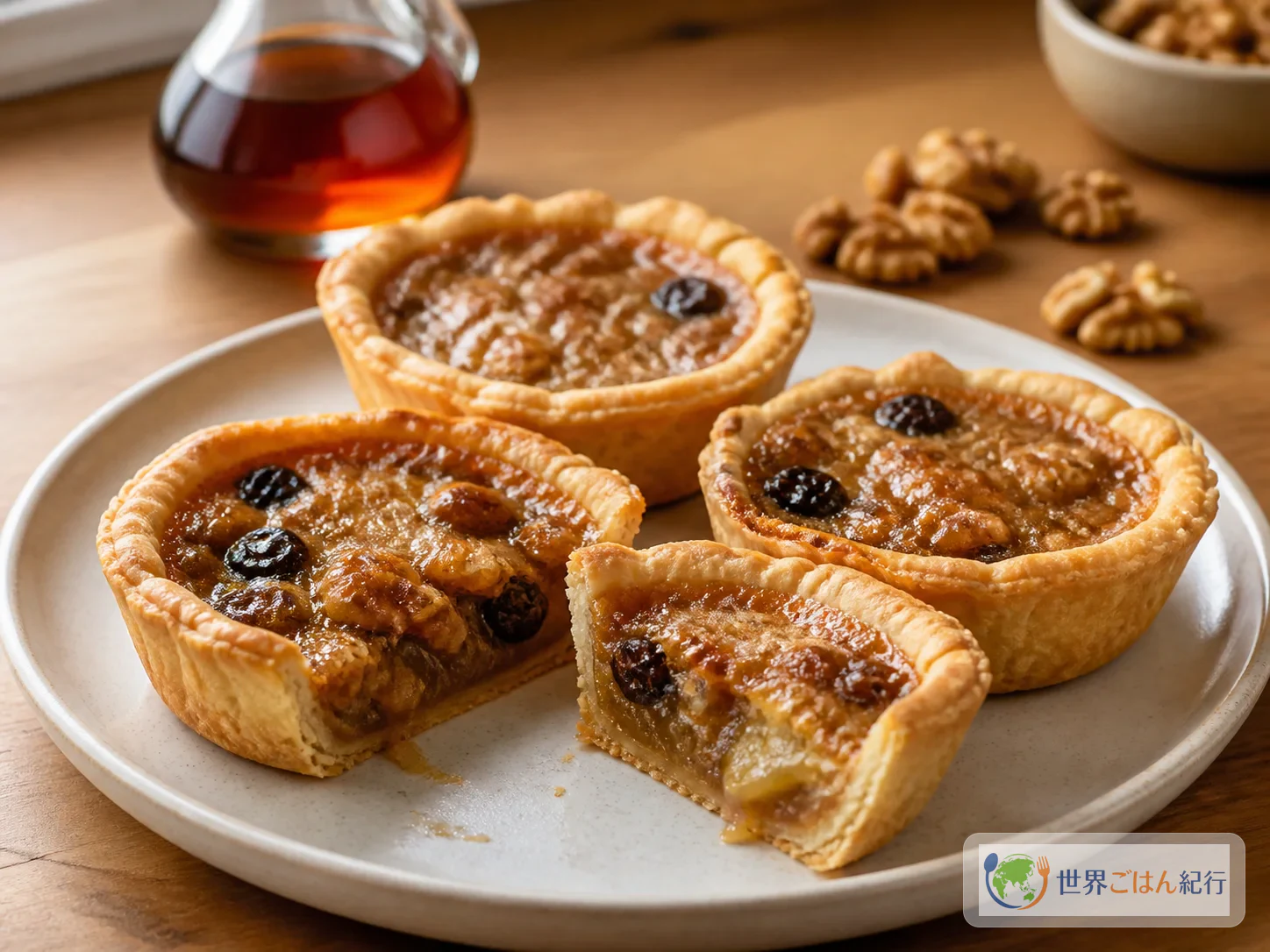
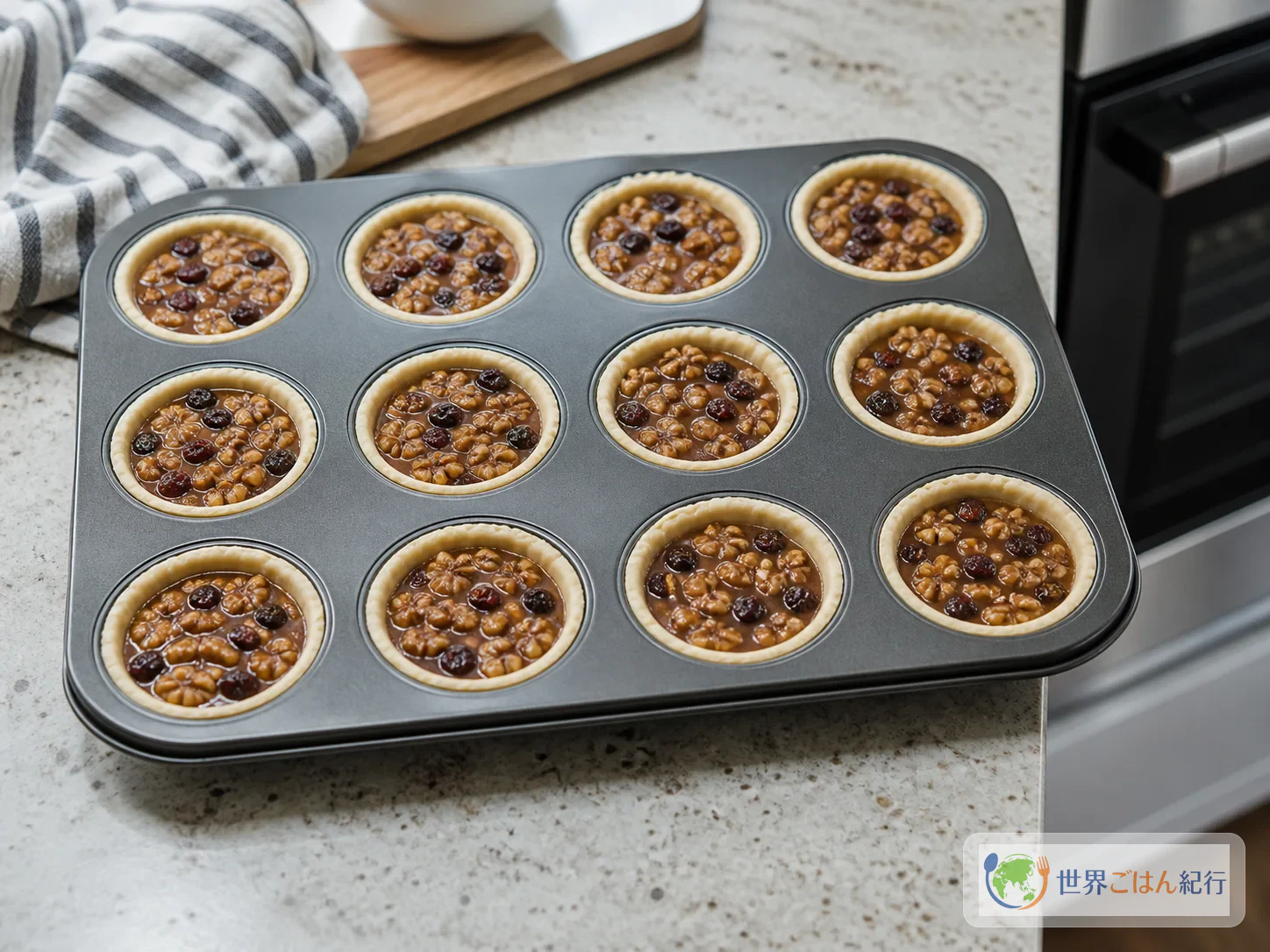
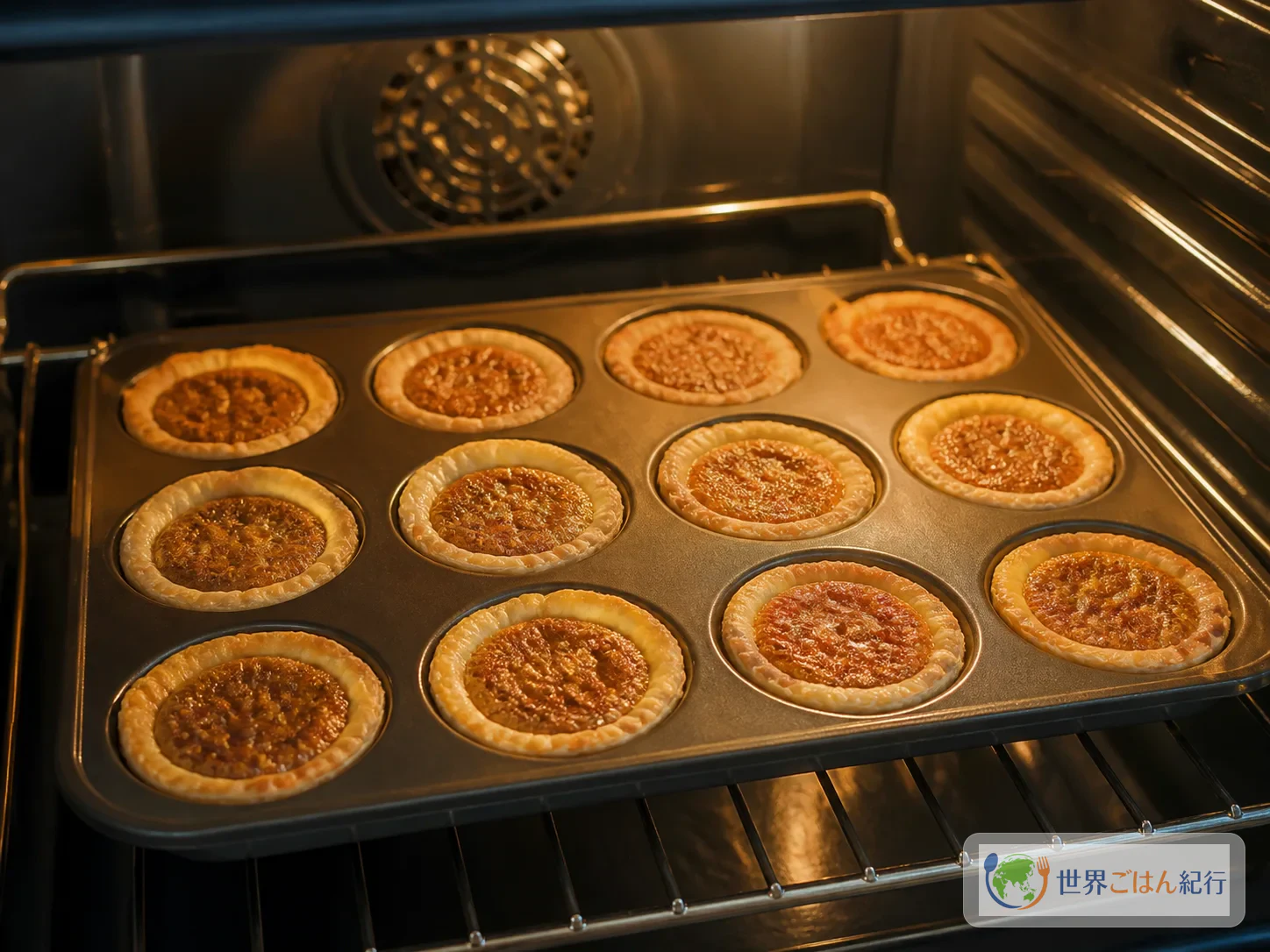
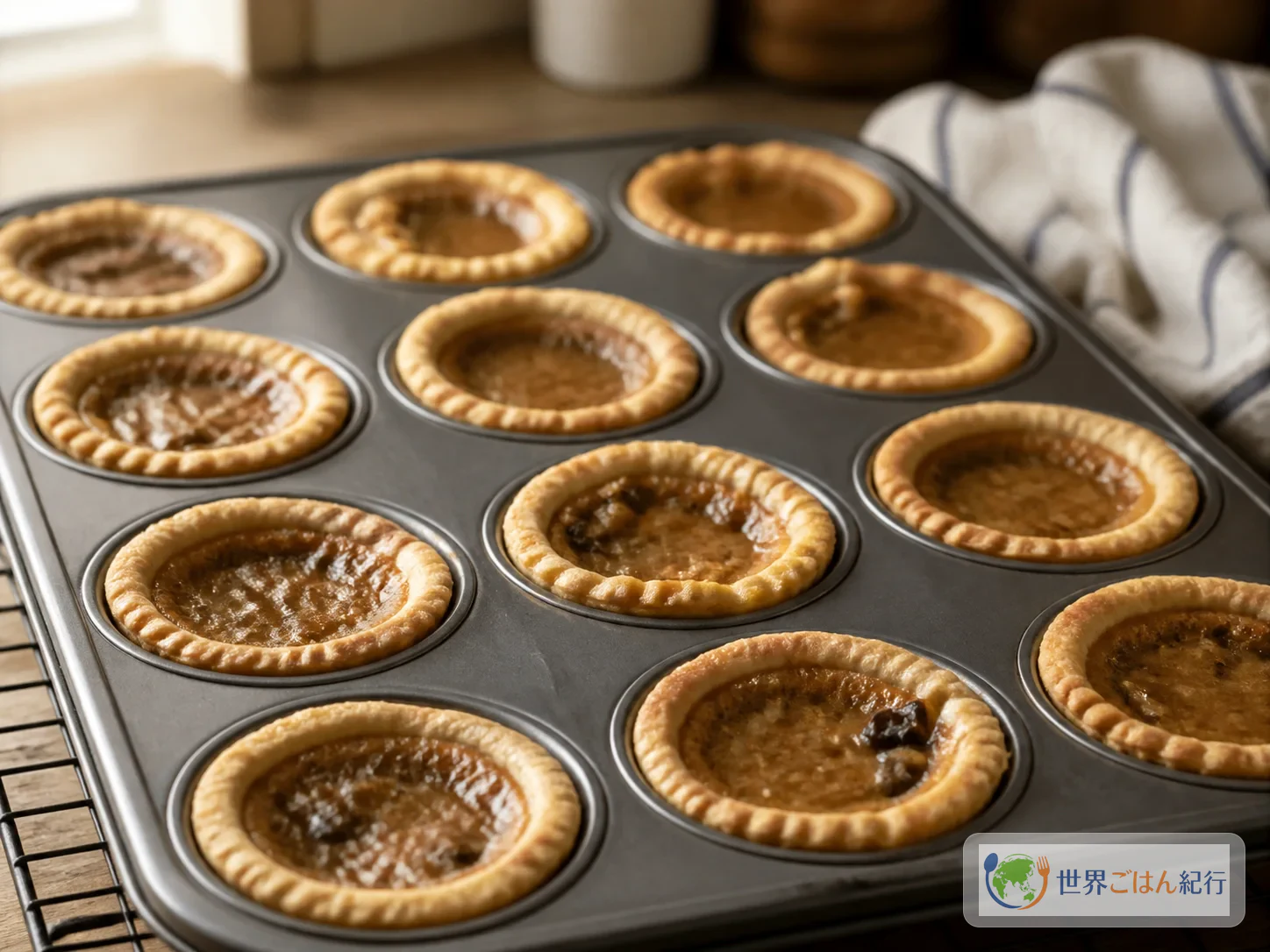
A butter tart fresh from the oven still trembles in the center. Leave it alone in the pan for 20 minutes, even if it looks liquid. As the egg-and-butter filling settles, the edge turns crumbly and the center becomes a thick, custard-like cream. This small Canadian sweet is butter, eggs, sugar and syrup poured into a pastry shell and baked, and it is rich and sticky with a soft, barely set heart.
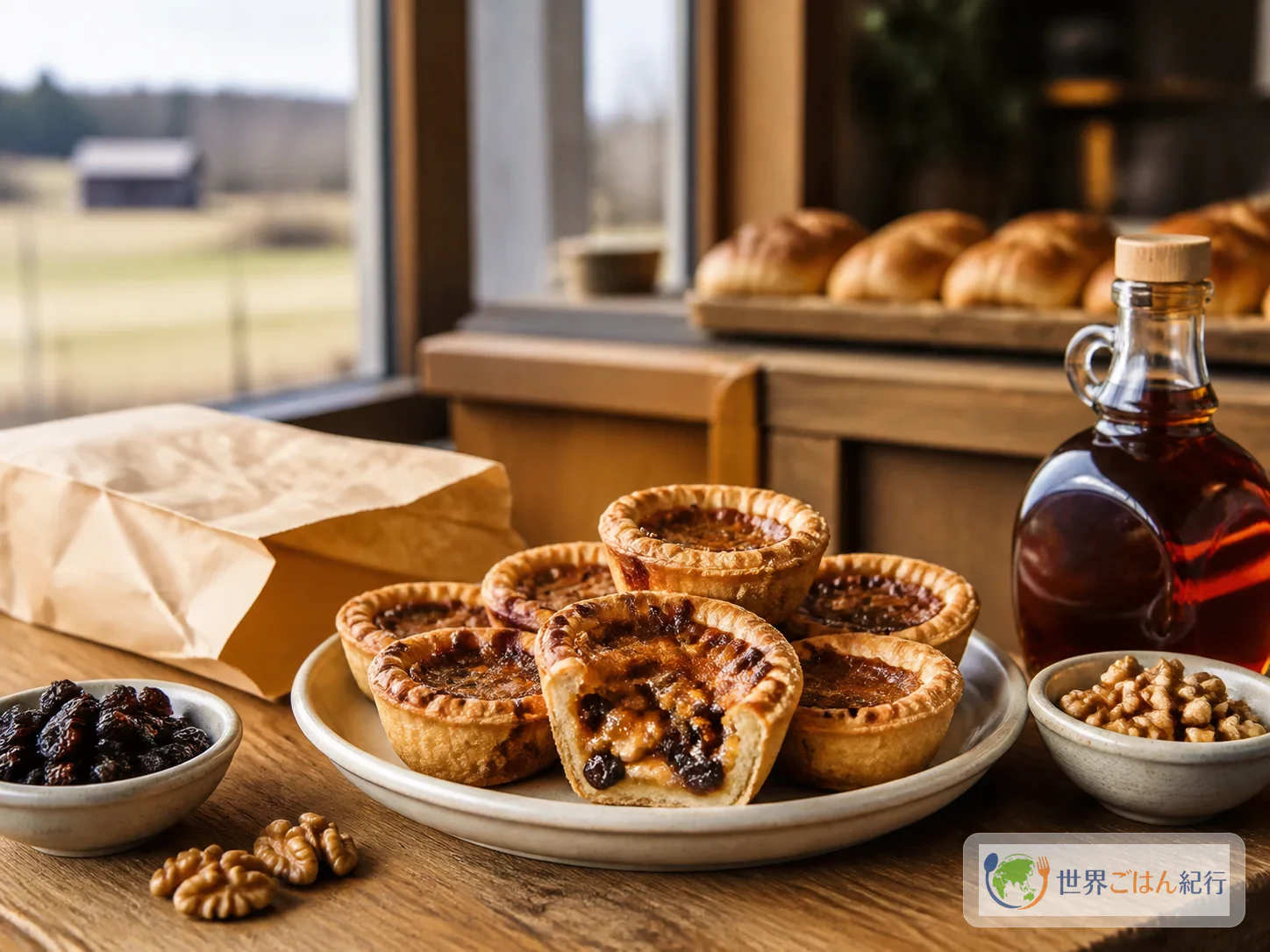
About Butter Tarts
The best-known butter tart has raisins or currants and walnuts in the filling. Whether to add fruit or nuts, and how runny to leave the center, is up to you. This version is baked in a 12-cup muffin pan, with an all-butter pastry and a filling of maple syrup, raisins, currants and walnuts.
The butter tart is a small sweet for coffee or tea, not a festive savory pie like tourtière. Each one is a single serving, so everyone gets their own sweet center.
Butter tart history
No single inventor is behind the butter tart. A 1900 cookbook from Barrie, Ontario, has a "Filling for Tarts" made with sugar, butter, eggs and currants. Families passed down recipes by hand, possibly before anything was printed, so the cookbook records the tart's early history in Canada but does not prove where it began.
A 1908 filling used sugar, butter, eggs, currants and salt. In 1911, several recipes were collected from farm households around Ontario. Farm kitchens already had everything the tart needed: butter, eggs, sugar, flour and lard for the pastry. That is one reason the recipe varied from house to house.
Where butter tarts are eaten
The name is used across Canada, including Manitoba, Nova Scotia and the Yukon, but it is most closely tied to Ontario. The tart is related to the French-Canadian tarte au sucre. That tart usually has no eggs, though, so the two are different sweets.
Regional differences show up more at the bakery counter than on the map. Ontario bakeries sell classic, raisin, pecan and maple walnut versions. In Kawarthas Northumberland, a butter tart tour has run since 2011 and visits more than 50 bakeries, cafés and restaurants. The tour has made the tart a reason to visit small-town bakeries.
Raisins, nuts or plain
People argue over raisins versus nuts, but it is more useful to choose by texture. Raisins and currants add a soft sweet-sourness, and walnuts bring a little bitterness and some bite to the liquid center. Pecans give a toastier aroma, and a plain filling lets the smoothness of egg and syrup come forward. The butter tart is a sweet in which even whether it has a filling becomes a household's memory.
Ingredients: 12 to take up the liquid's sweetness
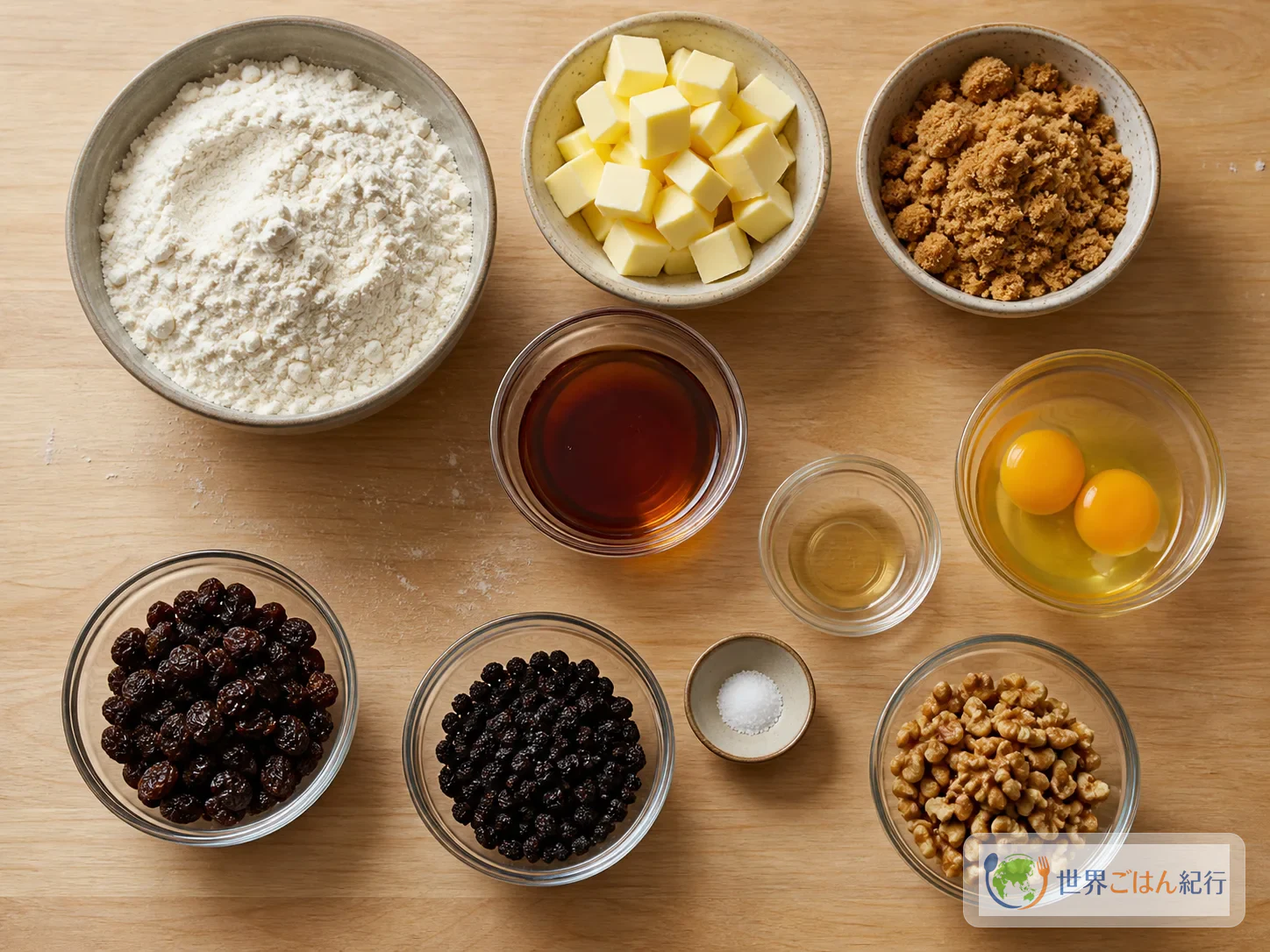
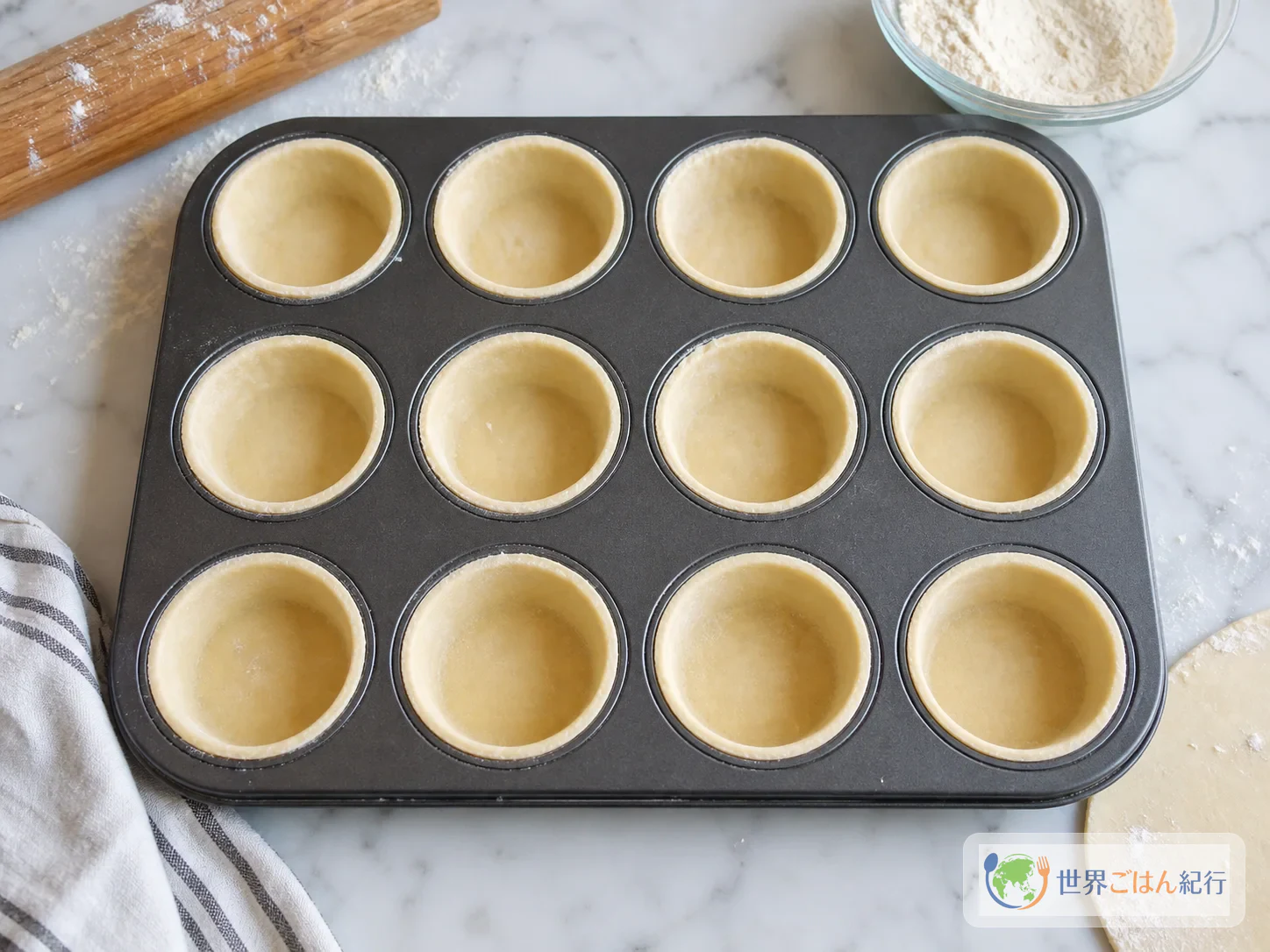
Use a 12-cup muffin pan with 7.5 to 8 cm cups. If the pan is shallow, some filling will be left over, so don't force it all in, and don't bake it in an empty ovenproof dish. If egg-containing liquid spills outside the pan, it scorches easily before the bottom of the pastry sets.
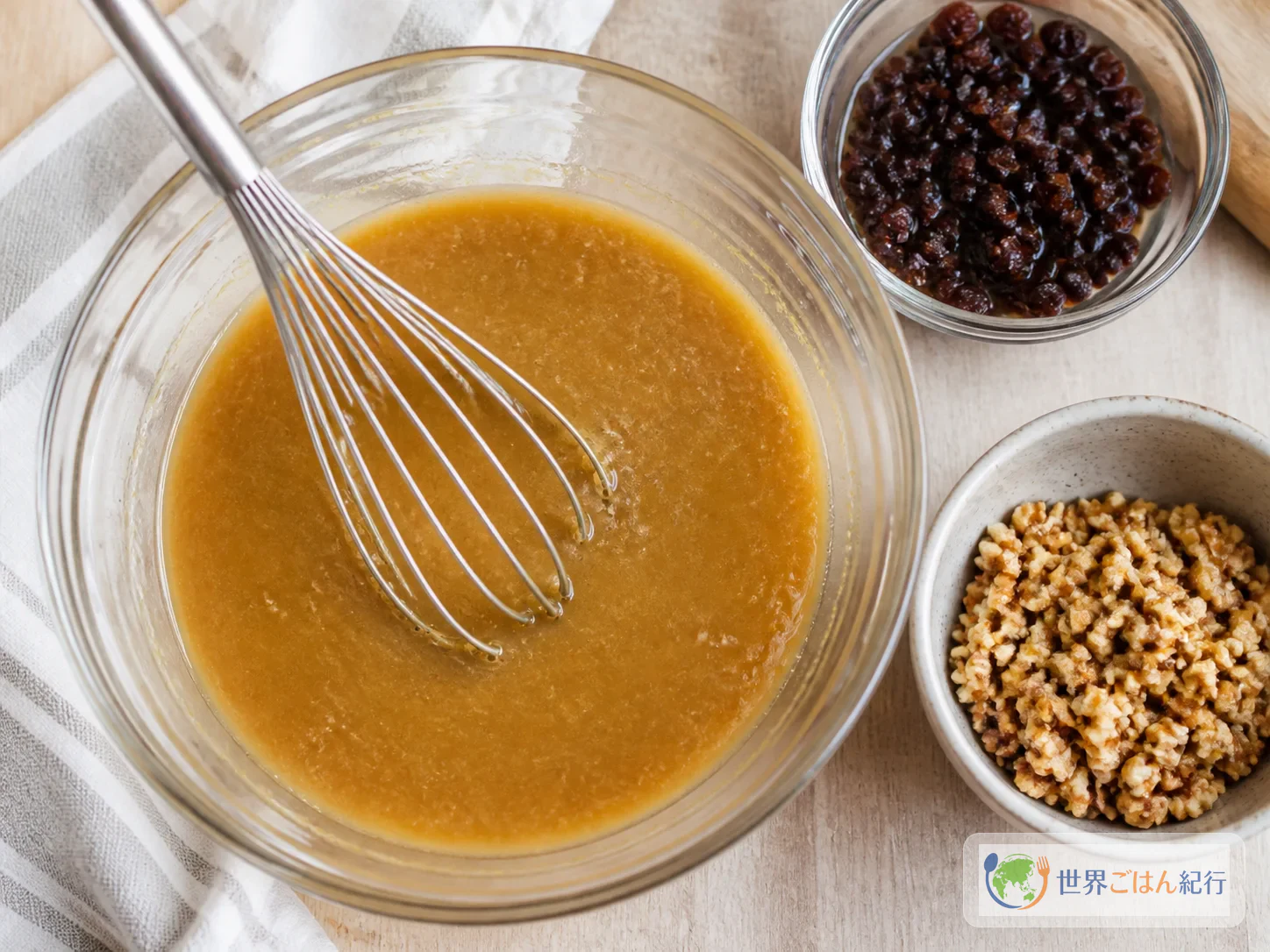
Putting 3.5 oz (100 g) of raisins and currants in total scatters the fruit's sourness through the sweet liquid. Combine currants, golden raisins and walnuts, or raisins with walnuts or pecans. If currants are hard to find, use raisins instead; it is still a butter tart.
For maple syrup, don't use flavored pancake syrup; choose one that lists maple syrup as the main ingredient. To keep the aroma, use pure maple syrup. For a steadier sweetness and stickiness, use golden syrup or corn syrup, which gives a milder syrup taste.
It uses wheat, milk, egg and walnuts. Even if you swap walnuts for pecans or seeds, watch for contamination from shared equipment if anyone has a nut allergy. Check the ingredient labels on store-bought syrup and dried fruit for milk or wheat.
Whether to buy extra walnuts
For a raisin-only butter tart, it works without walnuts. When making a walnut version, choose unsalted ones with no old-oil smell when opened as your basis. If you need only 2 oz (60 g), buying a small bag nearby wastes less, and if you will also use them in other baked sweets or salads, choosing about 7 oz (200 g) online makes sense. On the product page, check for an "unsalted" label and the quantity.
If you bake the plain version without walnuts, or want to finish buying with just these 12, you can make it with what you have on hand.
Choosing Ingredients and Substitutes for Butter Tarts
The pastry uses butter alone, with no lard, so it is easy to shop for. The syrup and add-ins are where you can make changes. Maple gives the most aroma. Golden syrup or corn syrup gives a plainer, lighter sweetness.
| Change | Result | Judgment |
|---|---|---|
| Maple syrup | A woody aroma with a slight bitterness | Choose it when you want the aroma to be the star |
| Golden syrup or corn syrup | Rounder sweetness and a milder syrup aroma | Replace in the same amount if you don't keep maple on hand |
| Raisins only | Soft fruitiness with no walnut bitterness | Use for nut allergies or adjusting for children |
| Walnuts only | Toastiness and bite come forward | Choose when you don't want fruity sweet-sourness |
| Change to pecans | A stronger aroma and more of the richness of baked sweets | Same amount as walnuts |
| No filling added | The smoothness of egg and butter is the center | Good when you first want to check how the filling sets |
Honey changes the direction of the aroma, not only the sweetness. It often has a strong floral note, so golden syrup stays closer to the Canadian butter tart.
Method: 6 steps that leave the wobble in the center
Do not boil the filling. Don't whip the eggs too much, keep the pastry cold, and let the liquid set slowly in a 350°F (180°C) oven. Judging by browning alone can leave the center runny though the edges are done, so look at the state at each step.
Fixing Common Butter Tart Problems
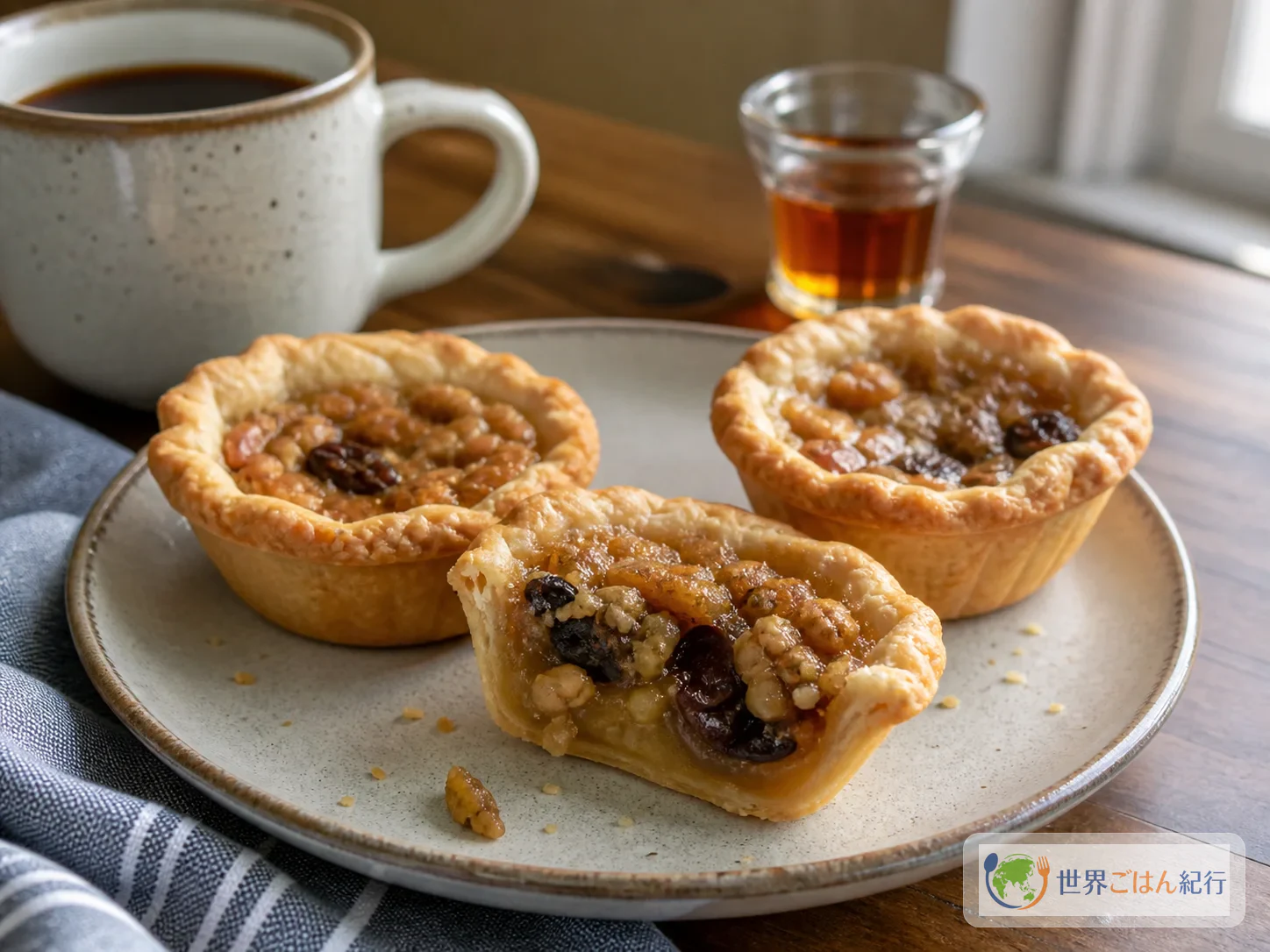
The hardest call at home is how long to bake the filling. If you overbake it, the egg turns firm. If you take it out too early, the tart won't come out of the pan. Roll the pastry thin, don't overfill, and stop when the center wobbles like jelly.
When the filling runs
If the center runs onto the plate after the tart seems cool, it probably hasn't cooled enough. Wait 30 minutes at room temperature. If it is still liquid, return the tarts to the pan and bake 5 to 8 minutes more at 325°F (160°C), and cover with foil if the top is already brown enough. If the egg is still weak after that, pour 1.5 oz (40 g) per tart next time, and judge doneness by how the center moves instead of stopping at 20 minutes.
When the filling gets hard
If you bake until the center no longer moves, the egg firms up even more as it cools. The tart is still good to eat, but it loses its thick, custardy quality. Next time, don't go by color. Stop when only the central 2 inches (5 cm) trembles as you shake the pan.
When the pastry shrinks or the bottom is damp
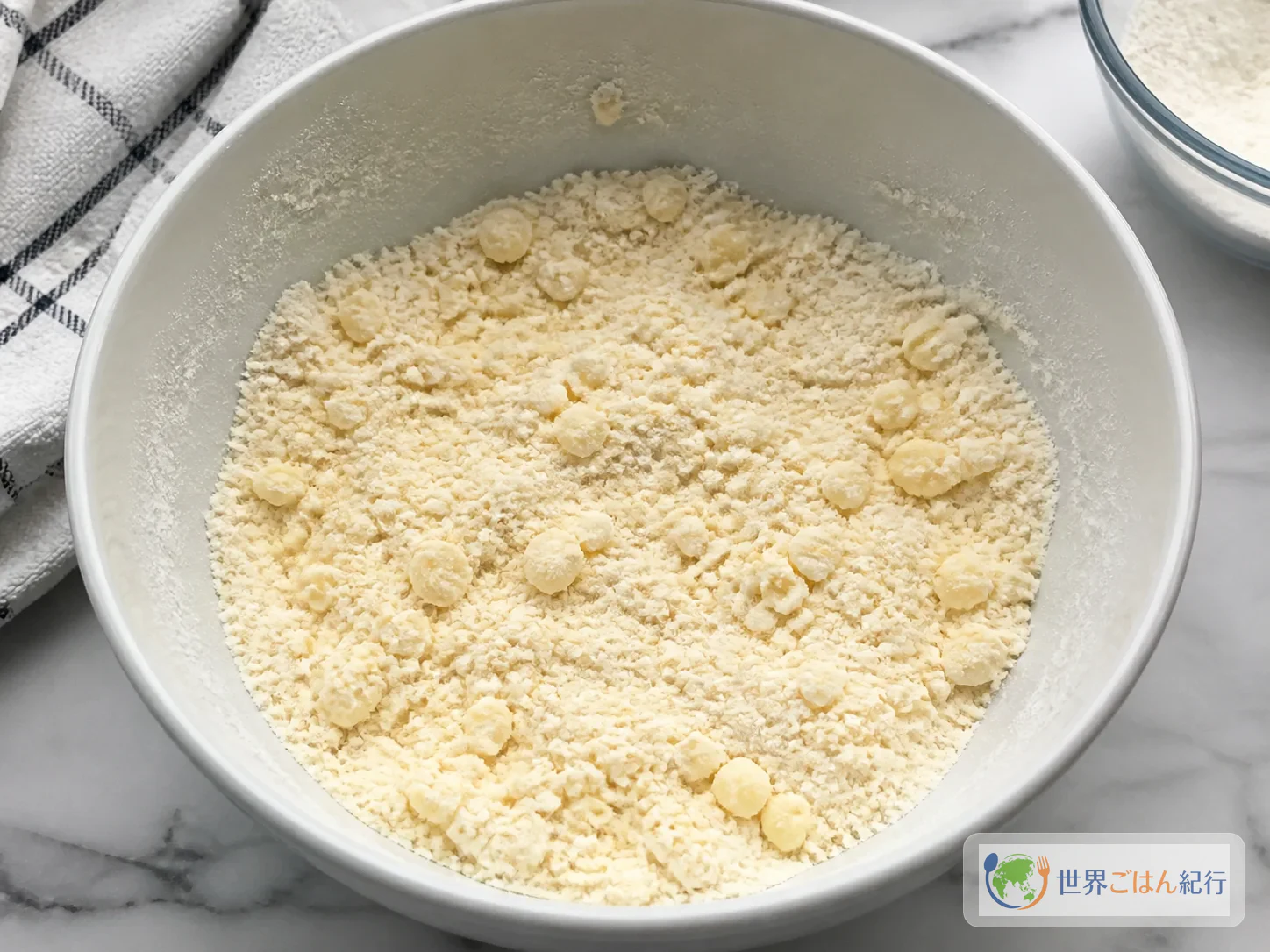
There are four common causes. You stretched the dough as you pressed it into the pan, you skipped the chilling time, you used too much filling, or you didn't dry the soaked fruit. Keep the pastry cold and about 0.125 inch (3 mm) thick. Use extra dough to build up the sides instead of rolling it out again. Pat the fruit dry and divide it among the shells before pouring, so liquid doesn't pool at the bottom.
Serving, Storing and Varying Butter Tarts
To make a meal of it, serve a chicken-and-potato soup from eastern Canada, such as fricot, and finish with the tarts. Modern versions add chocolate or coconut. For a first batch, though, focus on getting the sugar, egg and syrup to set.
Store baked tarts in a single layer in an airtight container at room temperature for up to 24 hours. Let them cool completely before you cover them. Refrigerate them instead if your room is hot or you are taking them on a long trip. Before eating, leave refrigerated tarts out for 15 to 20 minutes to bring back the butter aroma and the soft center.
To freeze leftovers, cool them completely, wrap each one, and put them in the freezer. Thaw them in the refrigerator, then bring them to room temperature, still sealed so the surface doesn't dry out. The filling has egg and dairy, so eat refrigerated or frozen tarts soon.
FAQ
Can't I make it without maple syrup?
Yes. Use golden syrup or corn syrup in the same amount. The sweetness and thickness come close, but the woody aroma is weaker. Sugar alone changes the amount and thickness of the liquid, and the tart won't bake the same, so use a syrup.
Is it still a butter tart without raisins?
Yes. Raisins, currants and nuts are common, but the name doesn't require them. Some homes make it with no add-ins, and some shops use only nuts. Without add-ins, the liquid fills each shell evenly, so pour about 1.5 oz (40 g) per tart.
May I remove them right after baking?
No. If the filling hasn't set, the thin pastry tears and the center runs. Leave them about 20 minutes in the pan, then 10 more on a rack. The cooling time is part of the cooking.
What if I have only tart pans, not a muffin pan?
Use twelve shallow tart pans of about 10 cm, or make one large tart in a shallow 20 cm pan. One large tart has a thicker center, so the baking time and the wobble will change. With a 12-cup pan, you can use these amounts and the 20 to 25 minute time as written.
What can I use in place of walnuts?
Pecans, almonds or pumpkin seeds work in the same amount. Nuts and seeds differ in aroma, oiliness and allergen labeling, so the tart will taste different. If you avoid nuts, leave out the add-ins or use seeds whose allergen labels you have checked, and wash your equipment again.
Note: the nutrition values are an estimate converted to the whole batch from the per-tart values in Canadian Living's 12-tart formula. They vary with the products used for sugar, butter, syrup, dried fruit and nuts.