Lift the lid on a cold night and the smell of chicken broth and dried herbs comes up first. The potatoes have gone a little soft at the corners, the carrots are sweet, and white dumplings float quietly on the broth. Your first spoonful gets soft dough and clear broth before it reaches the meat. Fricot is the chicken stew of the Acadian region of eastern Canada: a few ingredients added in order to one pot. The chicken makes the stock and is also the main event, the potatoes make it filling, savory gives the aroma, and the dumplings soak up the broth. Home cooks tend to run into three problems: dried savory is hard to find, bone-in chicken cooks differently depending on its thickness, and the dumplings puff up in the steam, not in the boiling broth. Here we use bone-in thighs and drumettes, and you watch for four signs: the bubbles on the surface, the firmness of the potatoes, the inside of a dumpling and the core temperature of the chicken.

In English it is written chicken fricot, and in French fricot au poulet or fricot à la poule.
Fricot and Acadian Food Culture

Acadia covers part of eastern Canada: today's Nova Scotia, New Brunswick, Prince Edward Island and more. It's where French settlement and later displacement overlap. The Acadians descend from French settlers who came to North America from 1604 on, and in the mid-18th century they were forcibly removed and scattered. They kept cooking fricot after they lost their land, holding on to the name and making it with whatever they had at home.
In mid-18th-century French, fricot meant a "feast" or "treat," and "au fricot" was an invitation to eat together as well as the name of a dish. That's why it stays fricot even when the chicken or vegetables change. People gather, the pot gets bigger, everyone eats with spoons. That's what the dish is about.
Fricot au poulet (chicken fricot) is one of the best-known kinds. In the old days it was made with hens that had stopped laying, cooked in a big pot for guests, holidays, communal work and evening get-togethers. The method is simple: brown the chicken, sauté the onion, simmer it all with savory and water, and add the potatoes at the end. Locally the dumplings go by names like pâtes and grand-pères. Some versions use pork, fish, rabbit or salted meat in place of chicken, and rabbit was the choice at Christmas and Easter.
Go west and the food changes a lot. For the immigrant food culture of the Pacific coast, try the B.C. roll, which wraps grilled salmon skin.
Ingredients and amounts: make a pot for 6

This makes about 6 servings in a pot about 9.5 inches (24 cm) across, with a capacity of 4.25 quarts (4 L) or more. Plan about 350 g to 14 oz (400 g) per serving, counting broth, ingredients and dumplings. Leave the chicken skin on for richness, or remove it for a lighter broth.
This uses wheat, dairy and chicken. Even if you replace the butter with oil, the wheat in the dumplings remains. If you avoid wheat, omit the dumplings and increase the potatoes to 1.75 lb (750 g). Use separate cutting boards and knives for the chicken and the vegetables, or wash them right after use. When using commercial stock or herb blends, also check the ingredient labels.
Choosing Ingredients and Equipment for Fricot

Savory and substitutes
Dried savory (summer savory, sarriette in French) has a thyme-like greenness and a slight peppery warmth, and it smells a bit like marjoram, thyme and mint. It doesn't crowd out the chicken fat or the sweetness of the potatoes. It just leaves a faint outline at the back of your tongue after the last bite. If you find it, start with 1 tbsp for about 6 servings. More won't make it taste more like the local version; it only pushes the dried-herb greenness forward.
If you can't get savory, mix 2 tsp dried thyme with 1/4 tsp oregano. That gets you close, though it isn't the same thing. Rosemary is too strong and basil leans sweet, so skip both for a first try. When you buy the substitute herbs, check whether they're whole or ground, how much is in the package and what's in it. They're worth buying if you'll use them up in chicken or bean stews. If you already have oregano with plenty of aroma and are only making one pot, use what you have.
Everyday groceries
Chicken, potatoes, onions, carrots and flour all come from an ordinary grocery store, and you don't need special brands. If you're only making fricot once, use the thyme you have and the pot you already own. Before buying anything, ask whether you'll use it in other dishes too.
Thermometer and pot
With bone-in chicken, doneness depends on how thick the meat is and how hot the pot runs, so a thermometer is worth having if you make stews, roasts or thick burger patties a few times a month. If you mostly cook thin cuts quickly and your method works, you can skip it. Look at the measuring range, probe length and how easy it is to wash.
A pot of about 4.25 quarts (4 L) with a tight-fitting lid is all you need. A pressure cooker makes sense if you often cook beans or large cuts and want to spend less time watching the stove. Otherwise, about 1 hour over low heat is fine. If you do use one, use it only to simmer the chicken and broth, then release the pressure and steam the dumplings in an ordinary pot. Check capacity, compatible heat sources, safety valves and replacement parts.
How to make it: watch the quiet bubbles and the dumplings' steam, rather than the browning
Use a pot of 4.25 quarts (4 L) or more that won't overflow at the rim with the chicken and 2.5 quarts (2.4 L) of water. Heat varies by stove, so watch the change in the water's surface as well as the numbers. If large bubbles come continuously, it is too strong; if small bubbles rise from the sides of the pot now and then, you can go on to the next step.
Common Fricot Problems and Fixes

Thin or salty broth
If the broth is thin and the dumplings aren't in yet, take the lid off and simmer for 5 minutes over medium-low heat. Once the dumplings are in, reducing the broth makes them hard, so instead mash a piece of potato against the side of your bowl and stir it in for body. If it's too salty, add 3.5 tbsp (50 ml) boiling water at a time, then bring the flavor back at the end with black pepper and parsley. If you're using store-bought chicken stock, cut the first addition of salt to 4 g so it's easier to correct later.
Heavy or collapsing dumplings
Dumplings turn out heavy when the flour is overworked, the dough is too dry, or the lid comes off and the steam escapes. They fall apart when the broth boils too hard, the dough is too loose, or you stir right after dropping them in. You can't really save a batch that has collapsed, but it will thicken the broth. Next time, drop pieces smaller than 20 g and keep the lid on.
Tough chicken or broken potatoes
When chicken comes out tough, the cut matters as much as the simmering time. Boneless breast cooks fast but dries out with long simmering, so use thighs your first time. If the potatoes break up, cut them evenly into 1 inches (3 cm) cubes and turn down the boil. Floury potatoes thicken the broth, and waxy ones hold their shape.
Fricot Variations and Storage

Variations
Make your first pot with chicken, since it's the easiest version to judge for both taste and doneness. To skip the dumplings, increase the potatoes to 1.75 lb (750 g) and leave a bit more broth so it serves like a soup with bread. For white fish, add it after the vegetables are soft and stop just before the flesh turns opaque and flakes. Salt cod needs to be desalted first. Rabbit cooks differently depending on the cut and how much bone there is, so the chicken times won't work for it.
Storage and reheating
Don't leave the pot sitting out. Refrigerate or freeze perishable food within 2 hours of cooking, and eat or freeze leftovers within 4 days. Keep your refrigerator below 39°F (4°C), reheat until steaming, and check that the center of the chicken and leftovers reaches 165°F (74°C). For more, see these general food-safety tips.
Store the chicken and vegetables and the broth in shallow containers, and keep the dumplings in a separate one, because they soak up liquid overnight and go soft. If texture matters most to you, eat the dumplings the same day. Leftovers chilled without dumplings reheat better the next day, and that version also freezes better.
To reheat, put only what you'll eat in a small pot with 1 to 2 tbsp water or broth and warm it over low heat. When the chicken and vegetables are hot all the way through, add the dumplings and warm them for just 1 to 2 minutes. Boiling it again and again breaks up the potatoes, and the dumplings keep soaking up broth.
Fricot FAQ

Is savory essential?
You can make a stew with just chicken, onion, potatoes and salt, but savory is the main aroma of fricot. Use thyme and oregano the first time. When you find dried savory, make the same pot with it and compare. Think of the substitute version as a different good pot, not as a copy.
Can I make it with a whole chicken or chicken breast?
A whole chicken works if you cut it up, but you'll need a different pot size and cooking times. With breast, take it out once the center reaches 165°F (74°C), simmer the vegetables, and put the chicken back at the end. Breast simmered the whole time ends up tougher than thigh.
What if the center of a dumpling is floury?
Put the lid back on and cook over low heat, 2 minutes at a time. High heat only hardens the outside, so keep the surface from rolling in big waves. Next time, make each dumpling smaller than 20 g and add cold water a little at a time starting from ½ cup (110 ml), until the dough holds a mound when you drop it.
Where do I measure the 165°F (74°C) in the chicken?
Push the probe in from the side to the center of the thickest piece, without touching bone. Hot broth or chicken that looks white on the outside doesn't tell you the center is safe.
What if I avoid dairy or wheat?
Use rice bran oil in place of the butter and leave out the dumplings, and the dish has no dairy or wheat. You can add rice in place of the dumplings, though the texture will be quite different. If you avoid wheat, also check the labels on store-bought stock and seasonings, and keep bread and noodles off your cutting board.
Is it a soup or a stew in Acadia?
It can be either. With more water and no dumplings it's closer to a soup, and with more potatoes and dumplings it's more of a stew. Every household uses its own mix of meat or seafood, potatoes and dumplings. The name matters less than sharing one pot and eating it with spoons.
Sources used
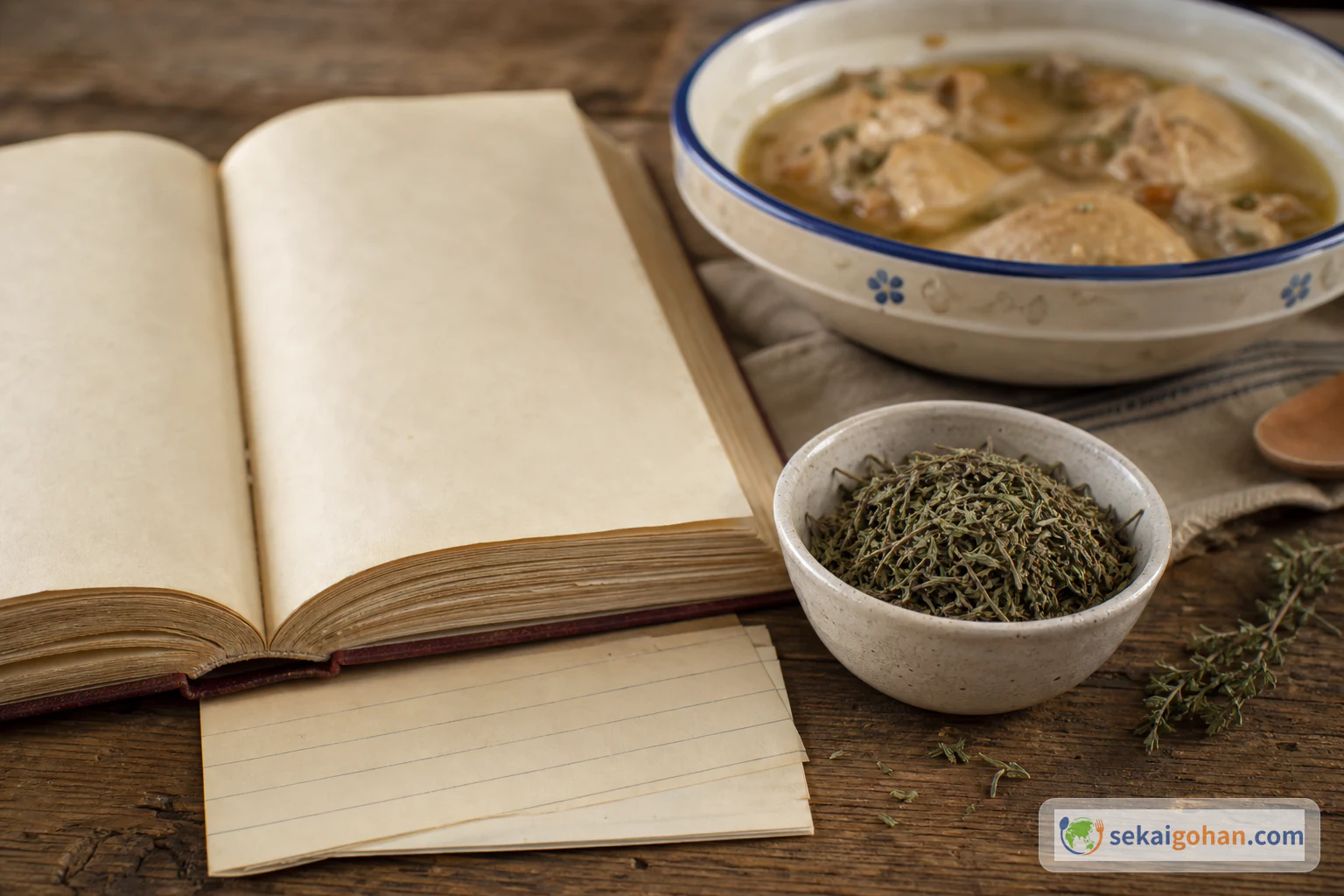
For this article, local recipes and cultural sources were compared and recomposed into amounts and heat suited to home cooking. The 3 L of water and 1 tbsp of savory in the local recipes and the flow of steaming covered dumplings for about 7 minutes are a skeleton common to several sources. For the core temperature of chicken and storage, public food-safety guidance takes priority.
- Tourism New Brunswick, "Acadian Chicken Fricot"
- Musée Acadien de l'ÎPE, "Questions fréquentes"
- Acadian Genealogy, "Chicken Fricot"
- Canada's History, "Flexible Feast"
- Connecting Albert County, "Fricot recipe"
- Government of Canada, "General Food Safety Tips"
- FoodSafety.gov, "Cook to a Safe Minimum Internal Temperature"
After making fricot, if you want to try a pot where clear broth and ingredients are finished separately, go on to Germany's Hochzeitssuppe. To compare the feel of serving meat and vegetables from one pot, the Gaisburger Marsch is also a useful reference. And to go from the simplicity of chicken and dumplings to a slightly toastier North American pot, try the pasty.