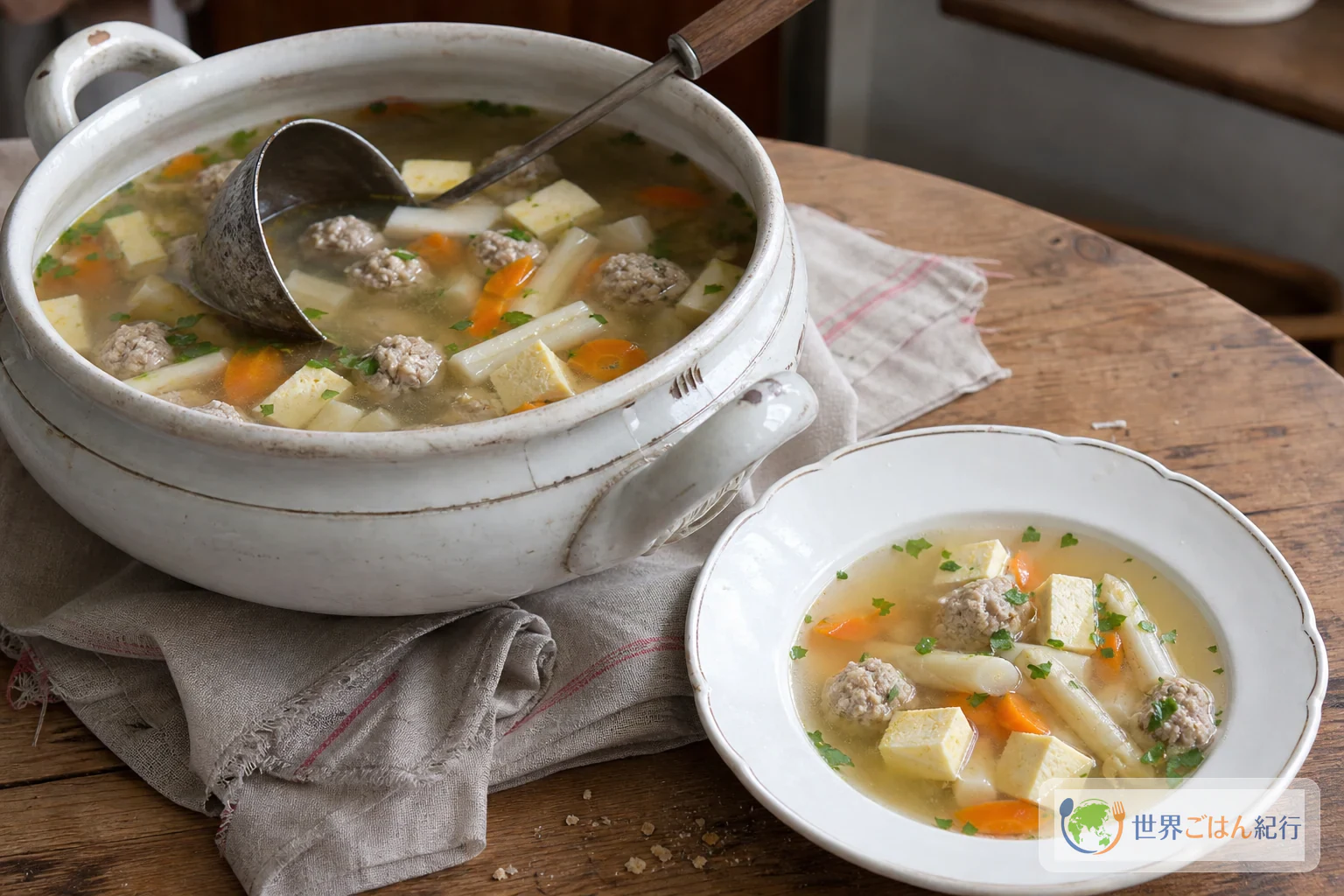
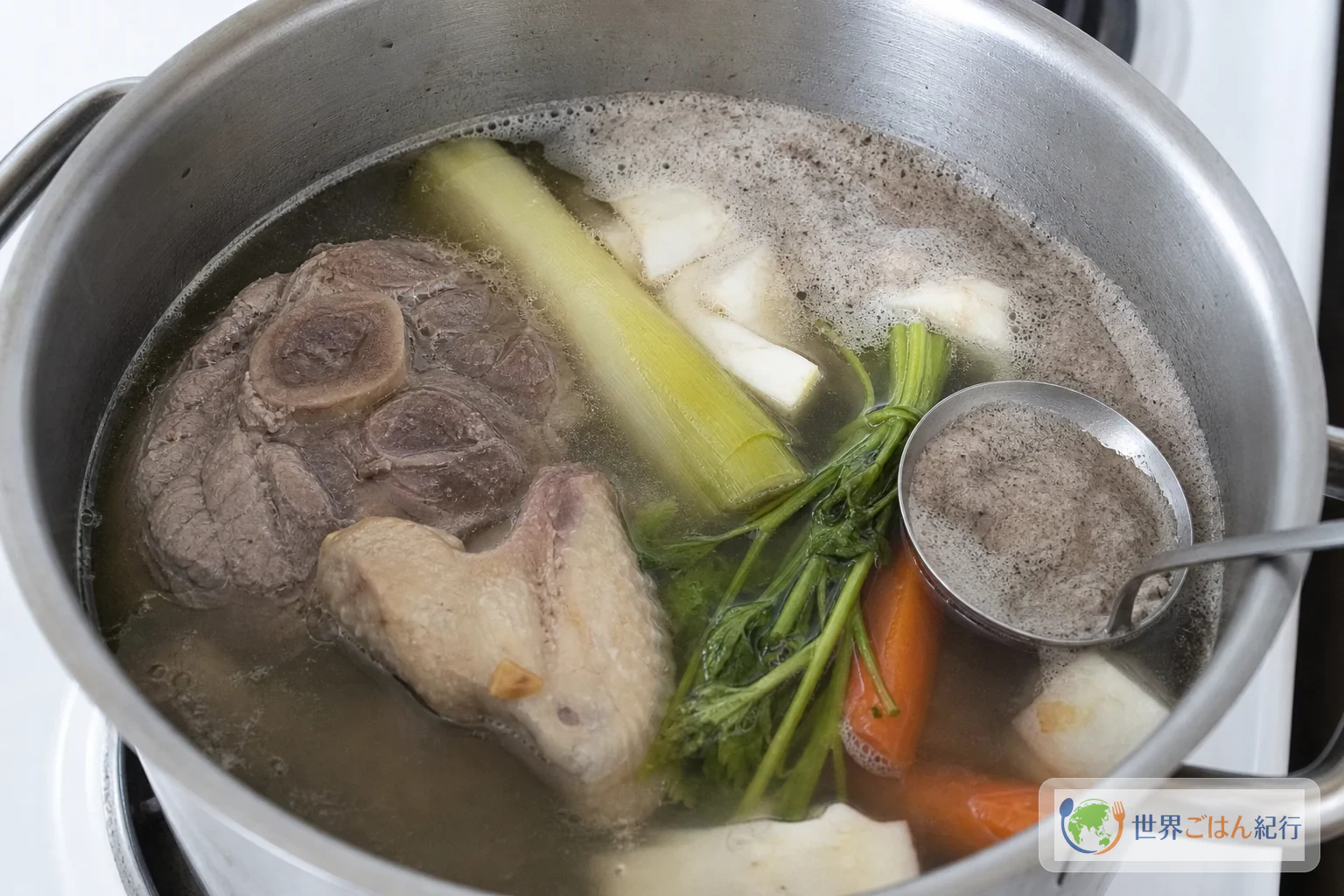
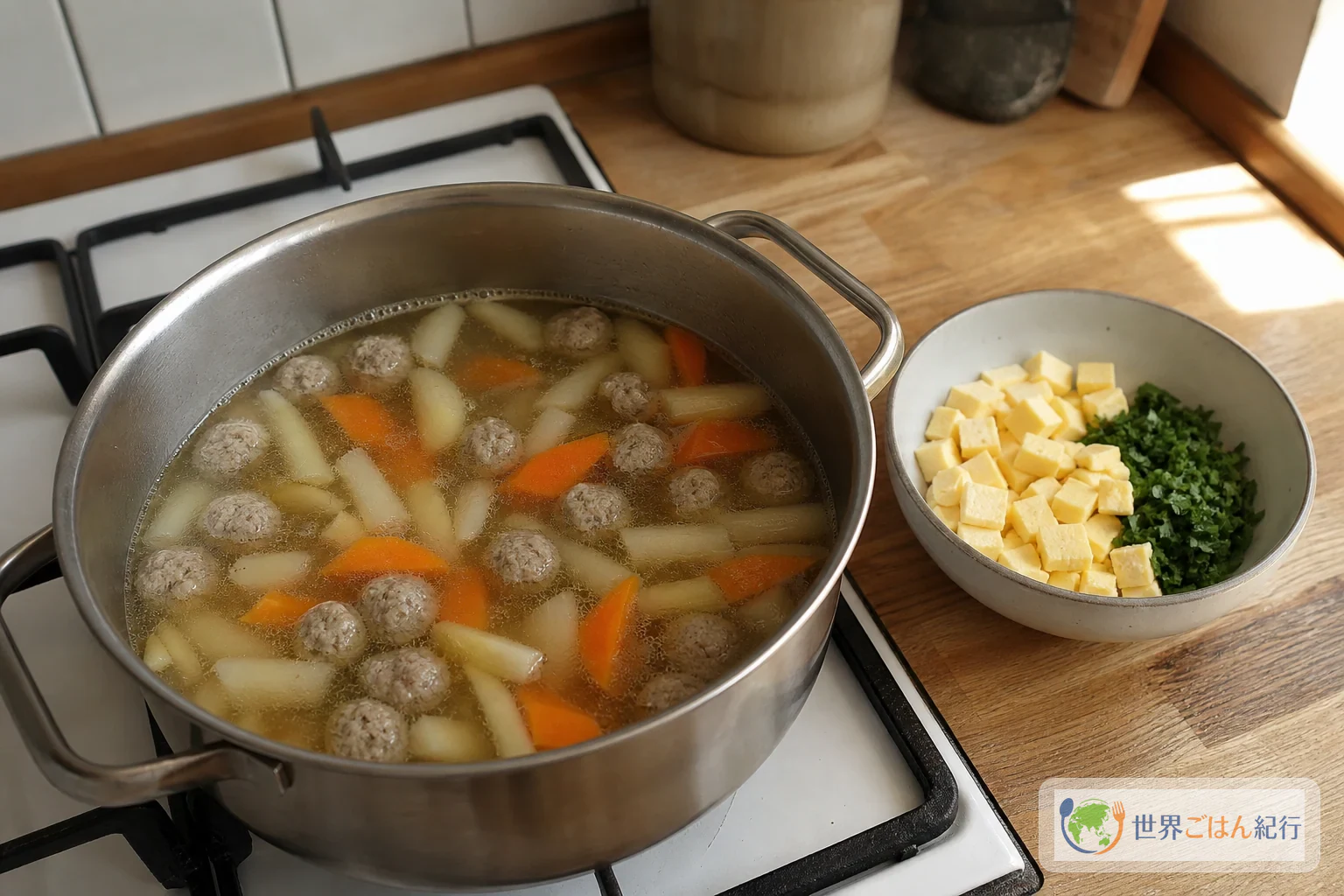
Lift the lid of a big white soup tureen and the first thing to rise is a round aroma of beef and chicken, quietly simmered. Each time the ladle reaches the bottom, small meatballs, pale yellow egg and white asparagus come up together.
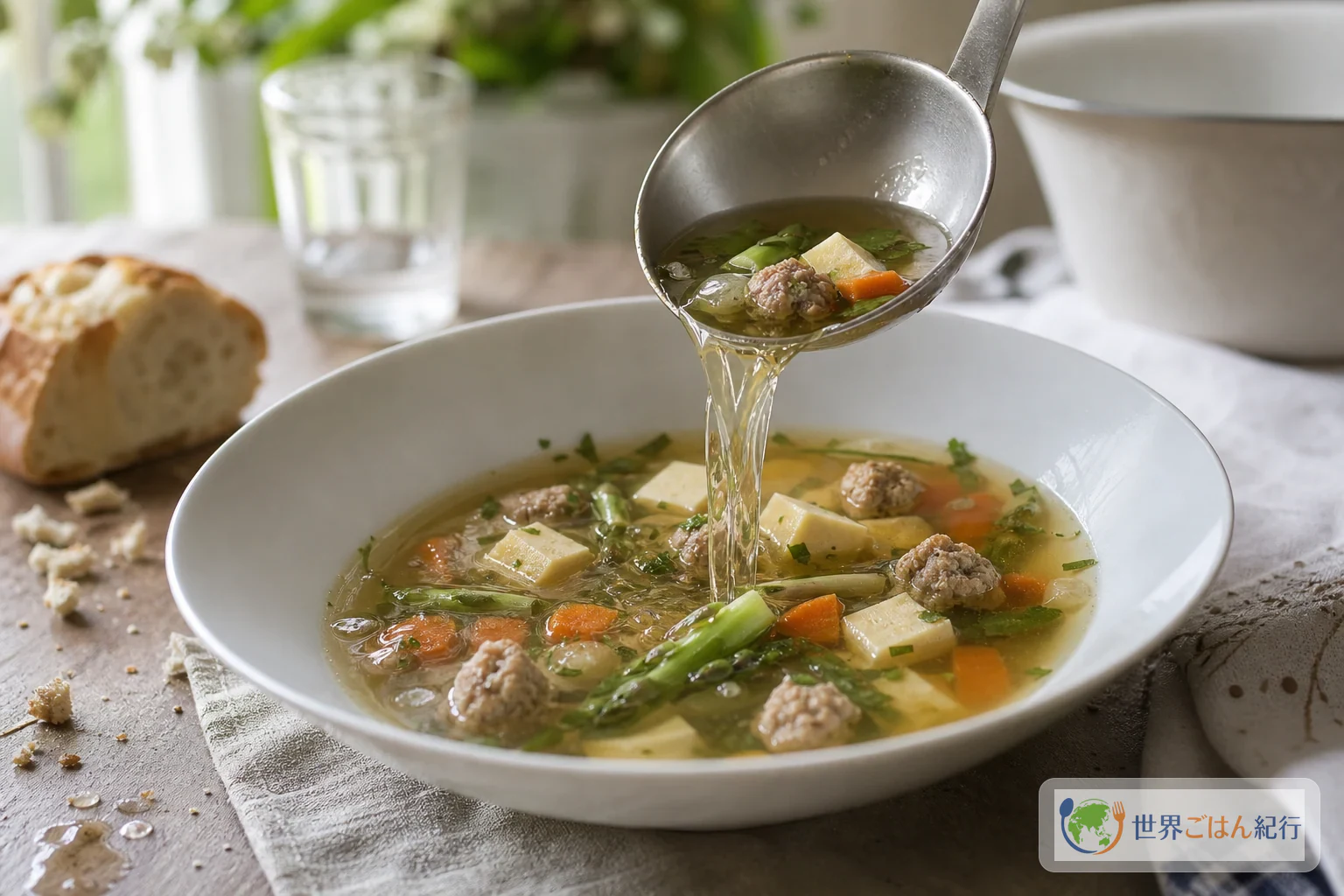
Hochzeitssuppe, German for "wedding soup," is the modest first bowl that settles the table for a long day of celebration. Every version is a clear meat broth with festive additions: meatballs, a set egg custard, seasonal vegetables, noodles or rice. It takes effort, but none of the steps is hard on its own. You finish the broth, meatballs, egg and vegetables separately and combine them in one pot just before eating, which keeps the soup clear and every piece intact.
Hochzeitssuppe and the North German wedding table
Hochzeit means "wedding" and Suppe means "soup." The regional name Wendländische Hochzeitssuppe means "wedding soup of the Wendland region."
The Wendland version
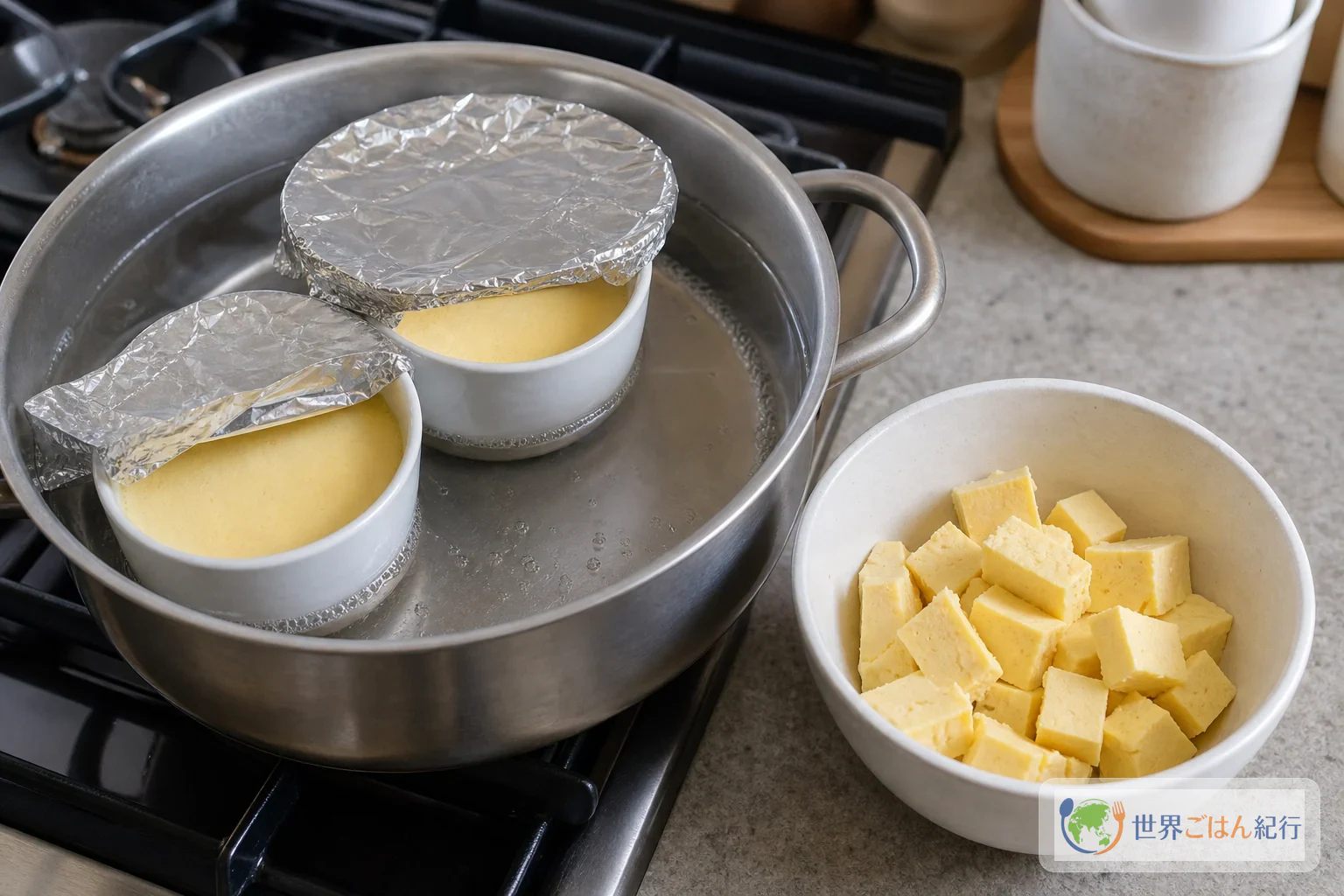
This recipe is the Wendland version from Lower Saxony. A broth of beef shank and chicken wings is combined with small meatballs called Fleischklößchen, an egg custard called Eierstich, and white asparagus. Eierstich may look like Japanese chawanmushi, but here it plays a supporting role, cut into yellow cubes and floated in the clear soup. Slowly drawing a beef broth in a home pot also connects this soup to the Gaisburger Marsch of Swabia.
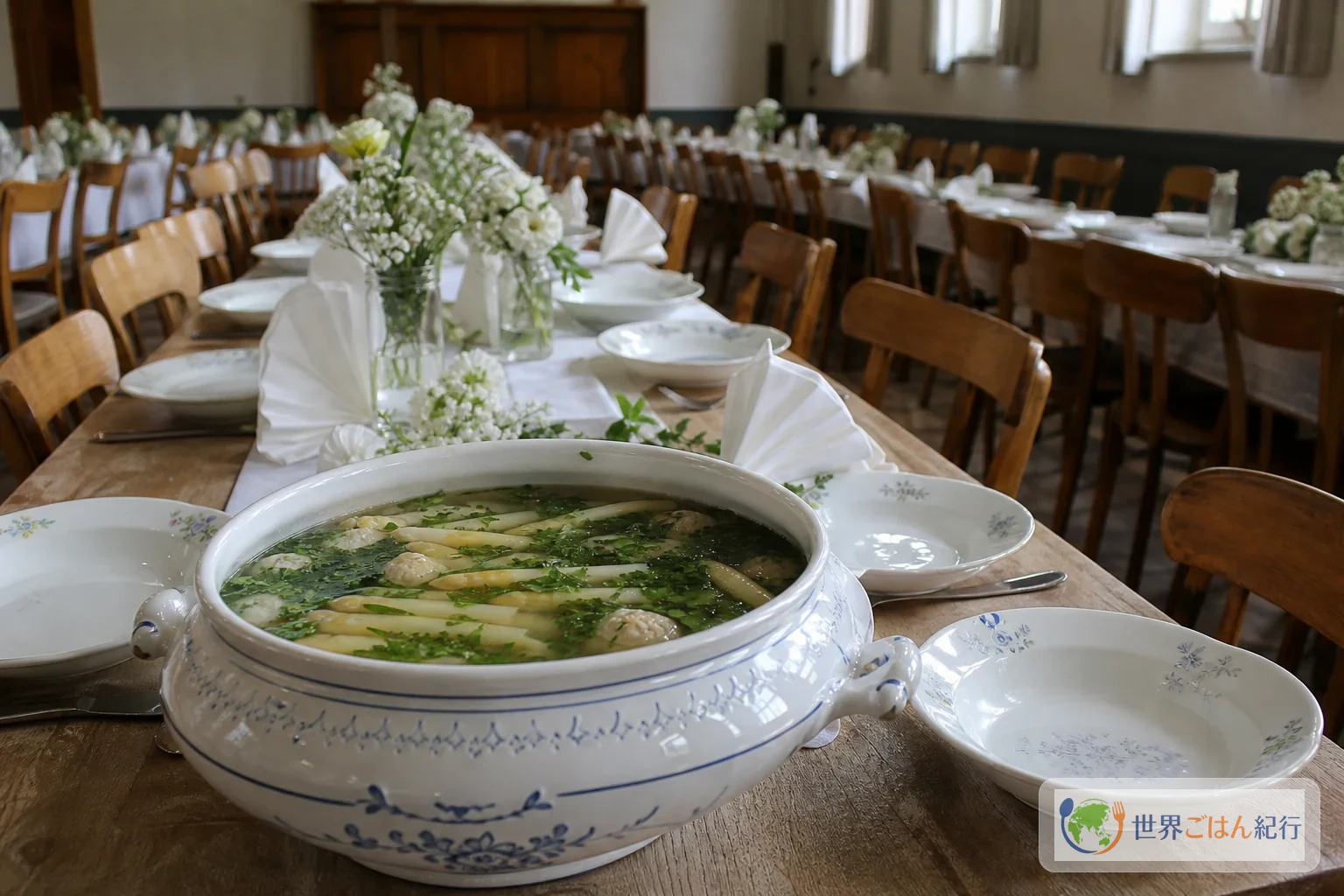
The amounts are for a pot to welcome guests, not a family dinner, and no single expensive ingredient dominates. Broth, meatballs, egg and asparagus, each prepared differently, all fit into one ladle. One person can roll the meatballs while another cuts the Eierstich and a third trims the asparagus, so the work splits easily even in a banquet kitchen. That practical abundance suits a festive day.
Whether the bride or the groom takes the first spoonful is a small piece of table lore that has lasted. After the ceremony, everyone sits in front of the same steam. At home you can skip the decoration: serve the clear soup from a large bowl and you'll see where the name comes from.
Regional versions of wedding soup
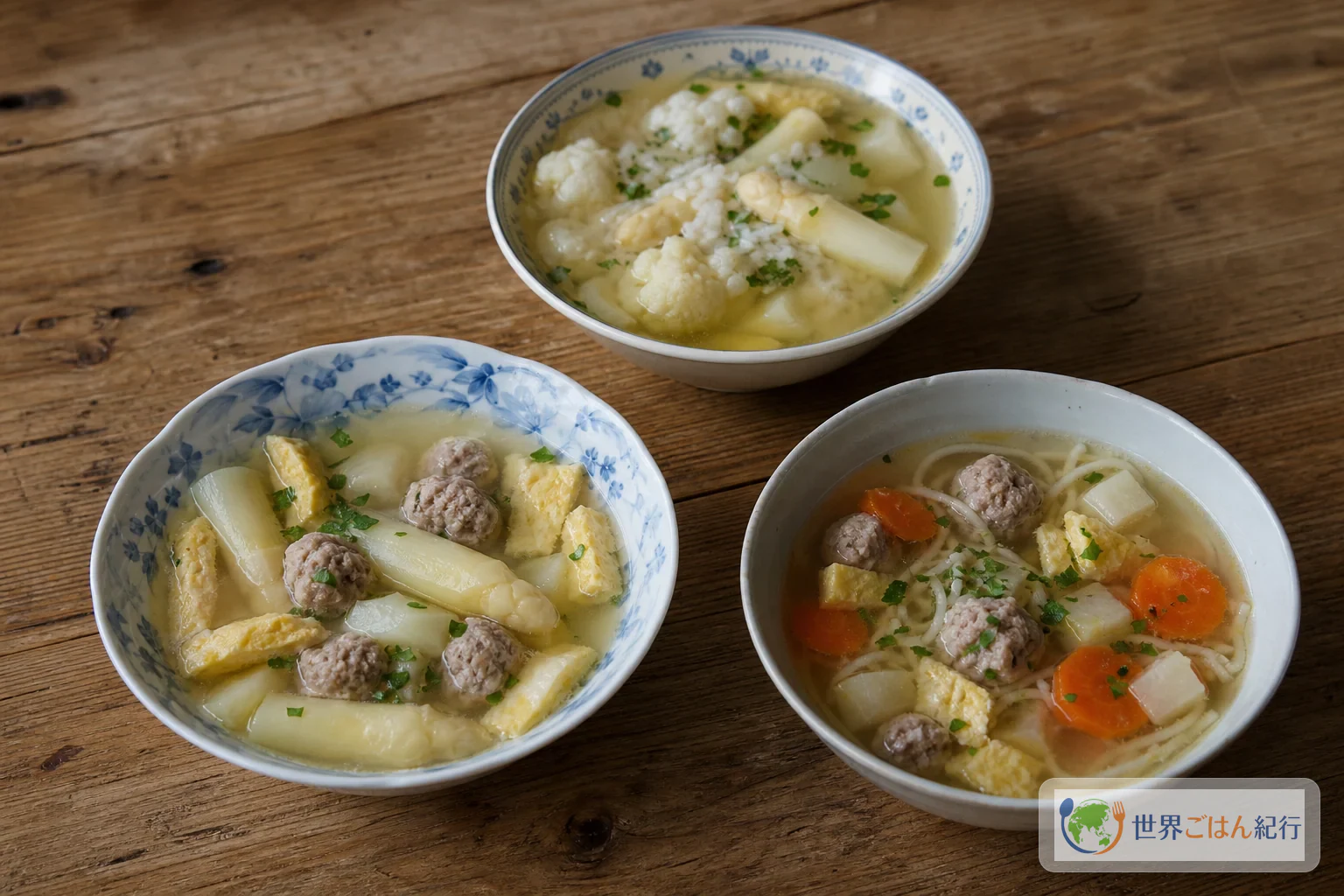
The name spreads from northern to southern Germany and on to the region where the Sorbs live, but what goes in the pot changes. The wedding comes first, and the local meat, vegetables, noodles and rice gather around it. Even the meatball differs: in the Sorbian region, liver dumplings are also used traditionally.
| Region or name | Main ingredients | Character at the table |
|---|---|---|
| Wendland, Lower Saxony | Beef and chicken broth, meatballs, Eierstich, white asparagus | For large feasts. Parts made separately and combined in a big pot |
| Land Hadeln, Hadler Hochzeitssuppe | Beef broth, meatballs, rice, cauliflower, white asparagus | With rice, a slightly more filling bowl |
| Sorbian region, kwasna poliwka | Beef and vegetable broth, meatballs or liver dumplings, noodles, root vegetables, Eierstich | Served from a large tureen, home-style |
| Southern German versions | Flädle, Grießnockerl, Brätspätzle and so on | More starchy ingredients, putting local noodle culture forward |
Land Hadeln lies between the Elbe and Weser rivers, and white asparagus turns up there just as it does in Wendland. That ties both soups to the northern German calendar: in Lower Saxony, white asparagus season runs from April to the end of June, so at a spring or early summer wedding the fields go straight into the celebration pot.
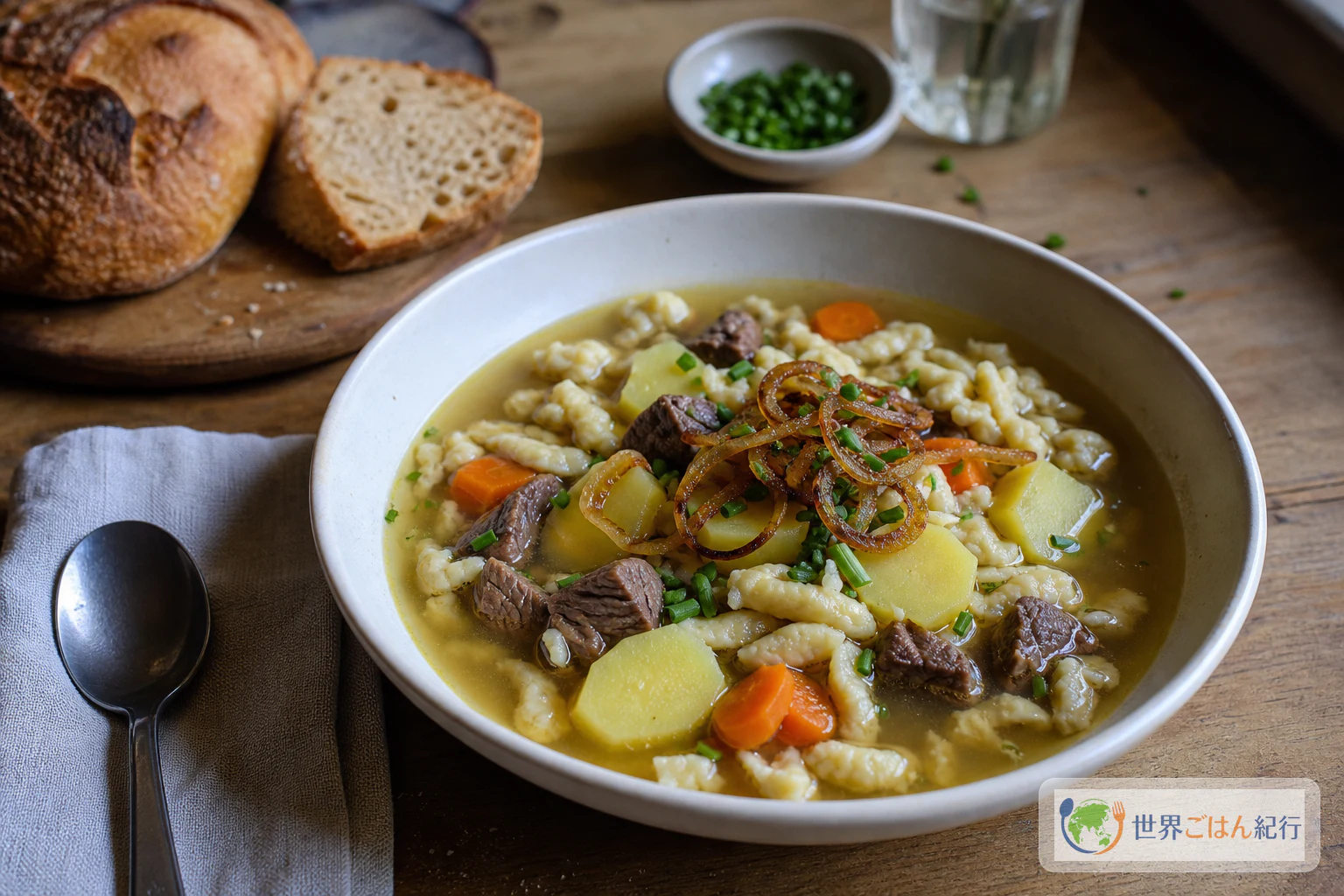
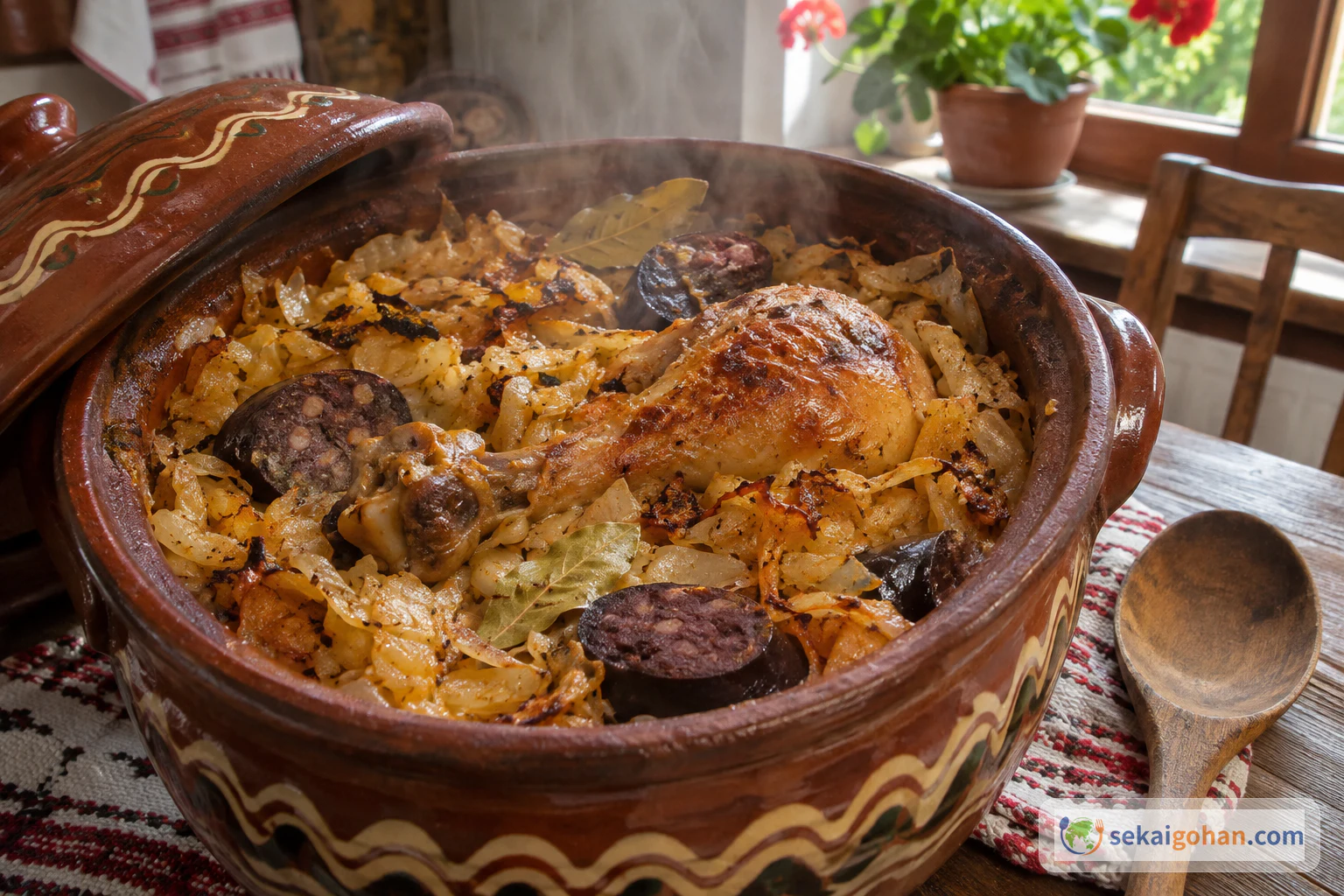
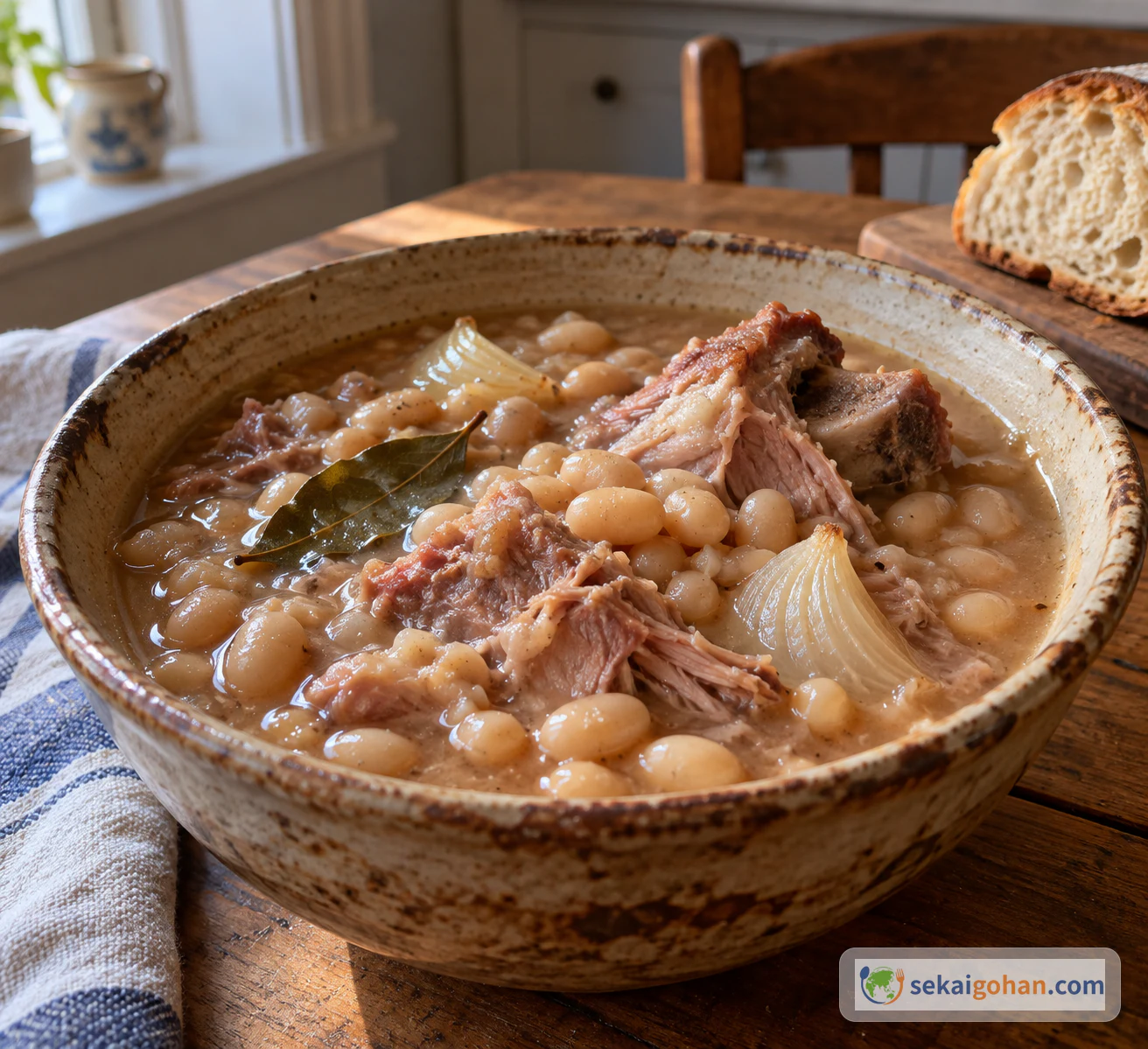
Compared with France's garbure, where ingredients and beans pile up into a one-dish main course, or Finland's lohikeitto, finished white with salmon and dairy, wedding soup is a clear entrance. Even with many ingredients, it makes room for the next plate.
Ingredients: building a pot for six
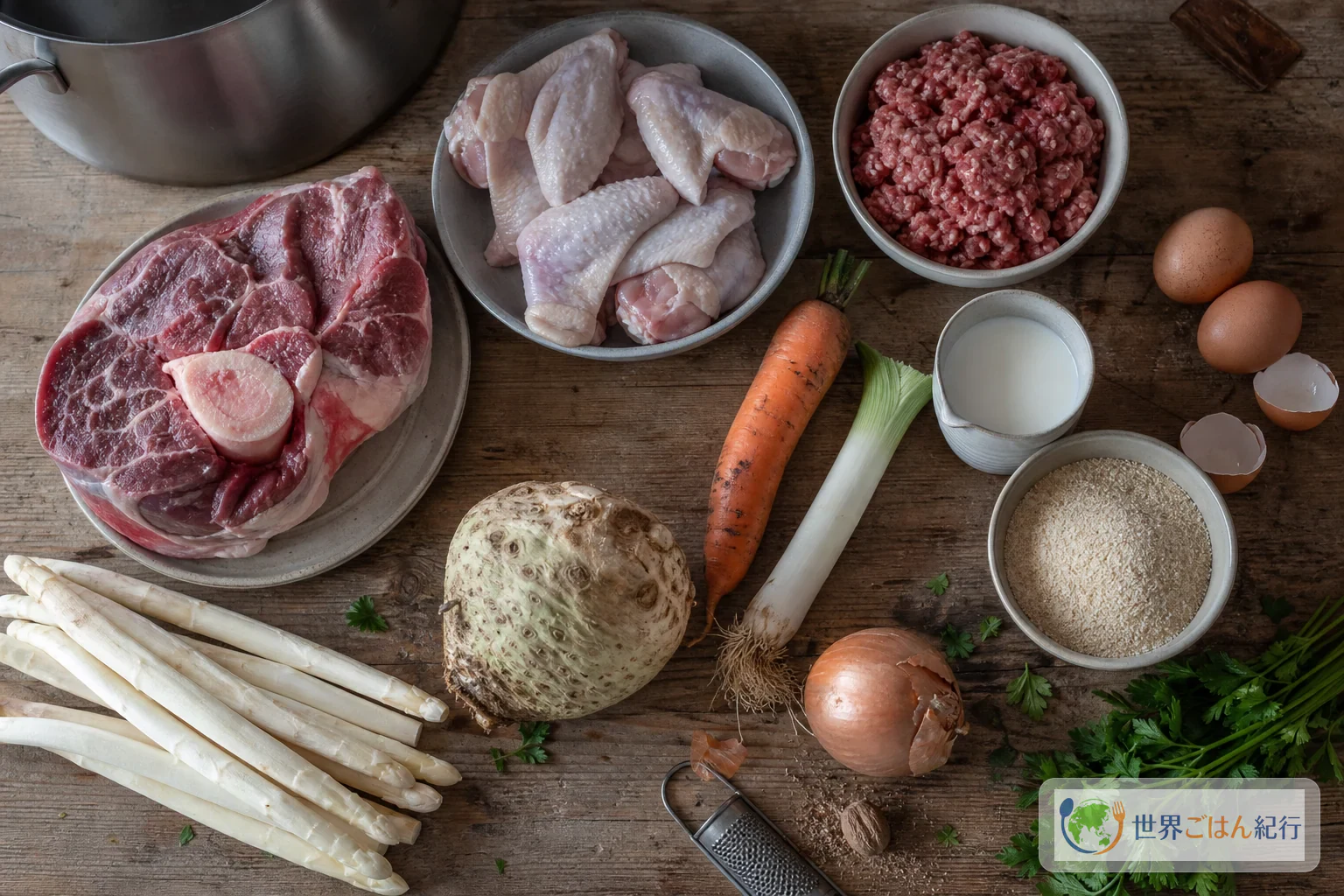
The finished amount is about 2.25 quarts (2.1 L). As a starter it serves 6, as a light lunch about 4. White asparagus can be used fresh or from a jar. If you use jarred, it is salty, so go easy on the broth's salt until the end.
Clear broth
Eierstich (egg custard)
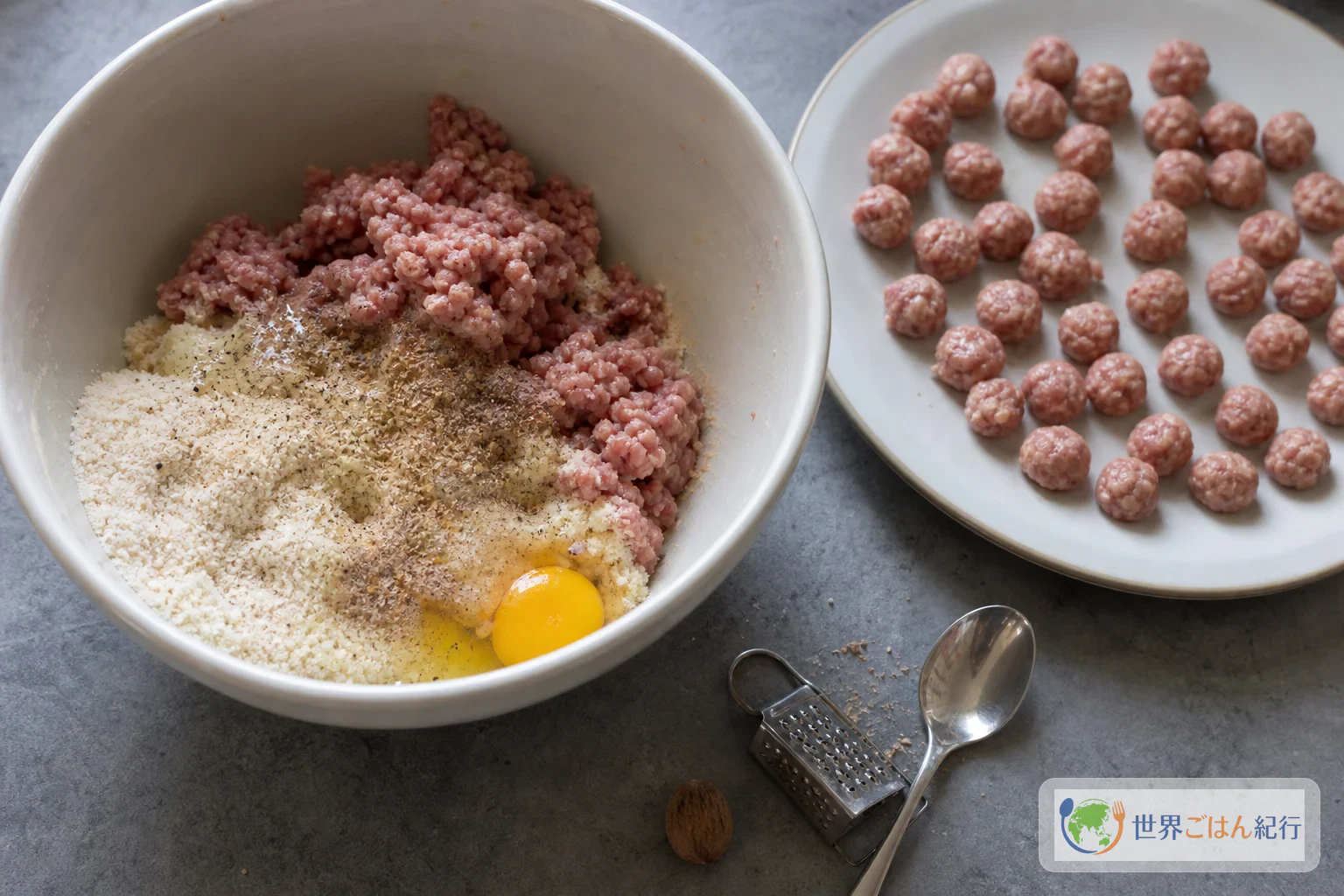
Fleischklößchen (small meatballs)
Finishing ingredients
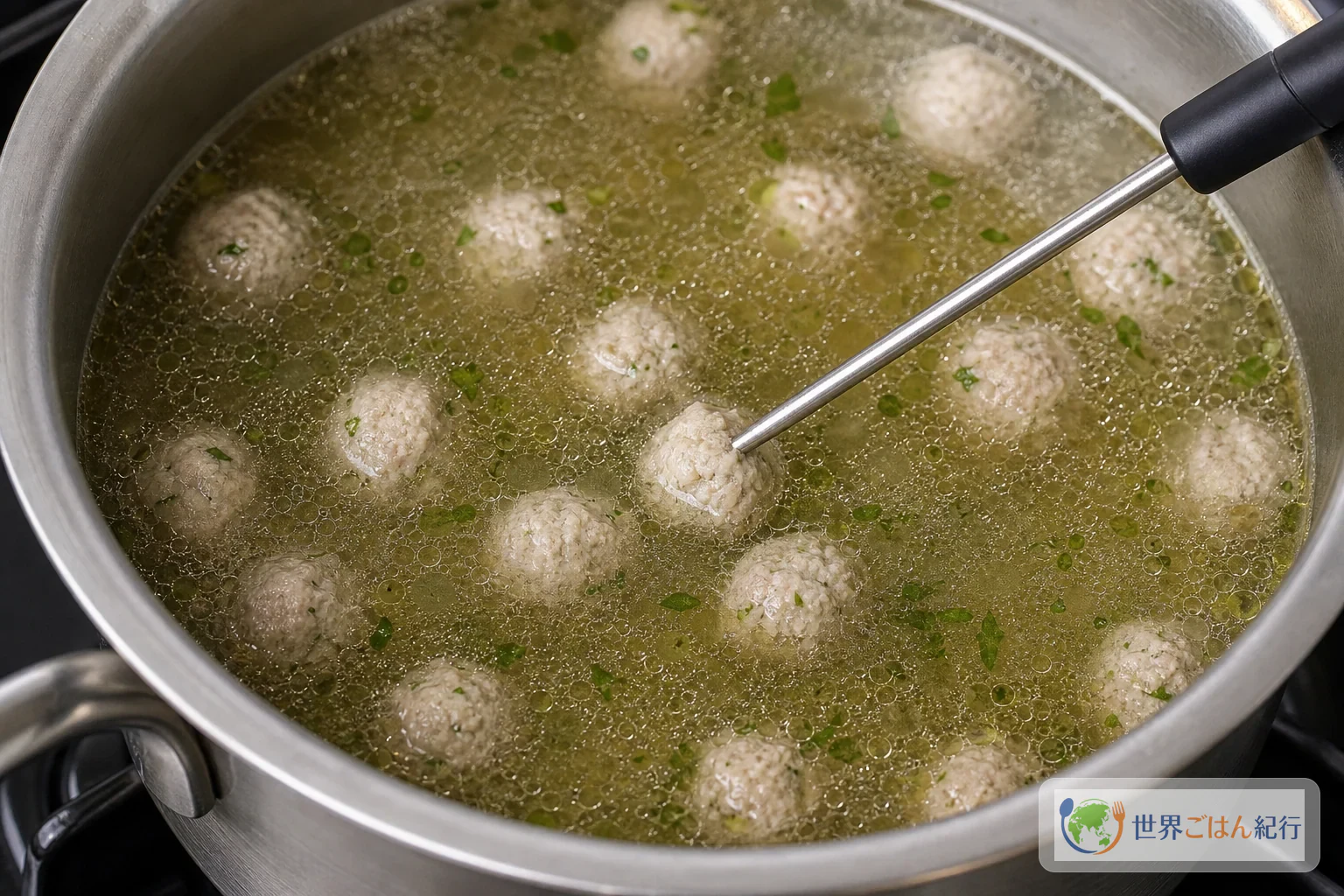
This uses beef, chicken, pork, eggs, dairy and wheat. Also check the allergen labeling on each product. Cook the meatballs and the Eierstich until the center of each reaches 160°F (71°C); for the meatballs, check the largest one. Ground meat and egg dishes both need 160°F (71°C). Don't judge doneness by color or by whether they float; check with a thermometer.
Choosing ingredients and substitutes for Hochzeitssuppe
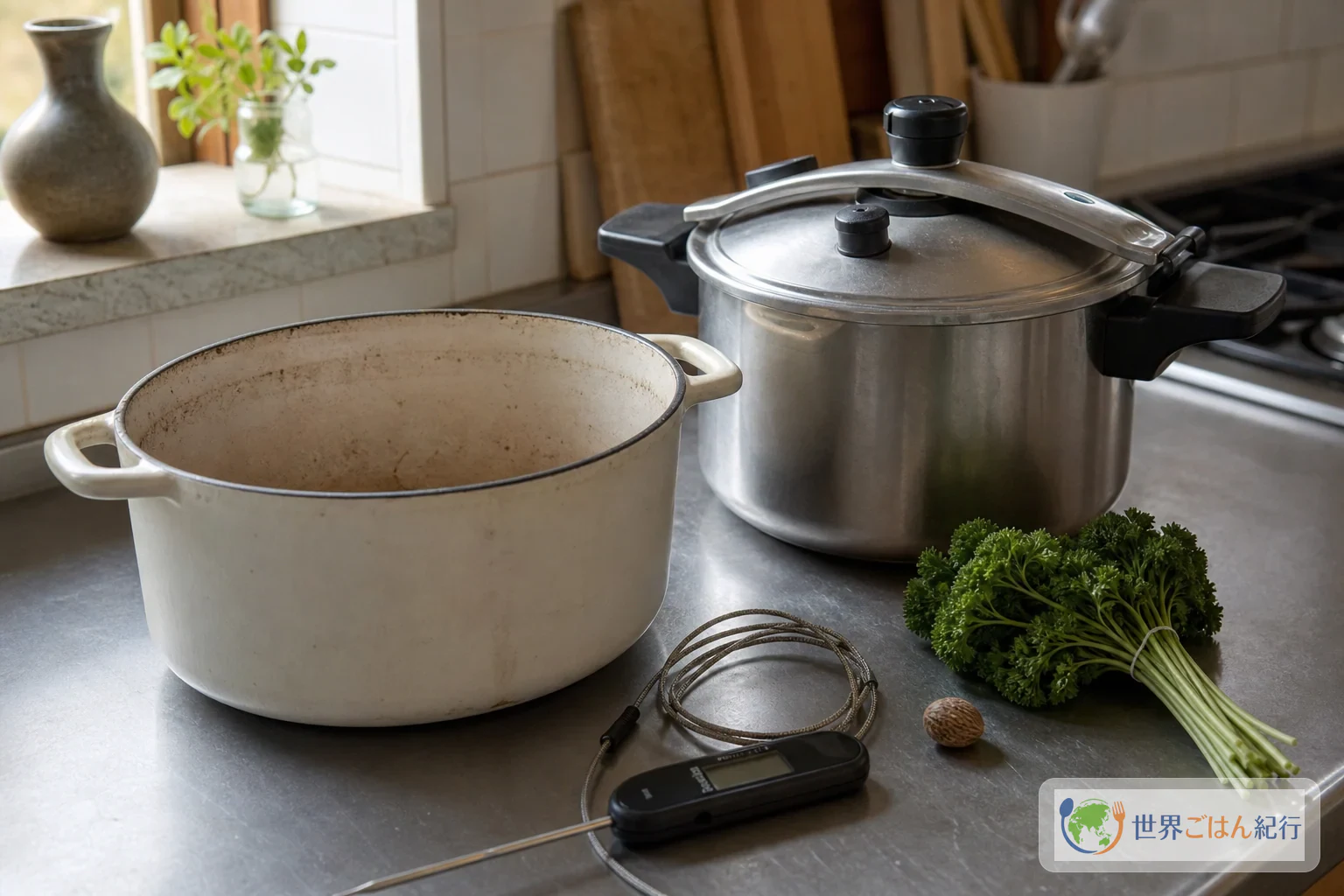
Beef shank, chicken wings, ground meat, eggs and root vegetables are all ordinary supermarket buys. What makes the difference is equipment: a heavy pot that keeps 2 quarts (2 L) or more of broth quiet, a thermometer to check the center of the meatballs, and, if you want to shorten the long broth-making, a pressure cooker. A pot of 4.25 quarts (4 L) or more with a thick bottom keeps the surface calm; in a thin pot, even on low heat, the bottom boils hard and scatters scum through the soup.
The usual obstacles at the market are beef bones, celeriac and white asparagus. Keep the core of the dish, a layered beef and chicken broth, meatballs and Eierstich, each finished separately, and the soup will still taste close to the original.
| Ingredient or step that gives pause | Why keep it | Realistic answer |
|---|---|---|
| Bone-in beef shank | Beef aroma and gelatin | Use 14 oz (400 g) boneless beef shank and 1 lb (450 g) chicken wings |
| Celeriac | Sweetness and earthy aroma of root vegetables | Combine 1 celery stalk and 3.5 oz (100 g) small turnip |
| White asparagus | A spring ingredient of northern Germany | Drain jarred asparagus and warm it at the end |
| Green asparagus | Stronger color and green aroma | If substituting, cut into 1.5 inches (4 cm) lengths and simmer only the last 3 minutes |
| Eierstich | Yellow cubes and a soft mouthfeel | Set with milk and eggs only, no dashi as for chawanmushi |
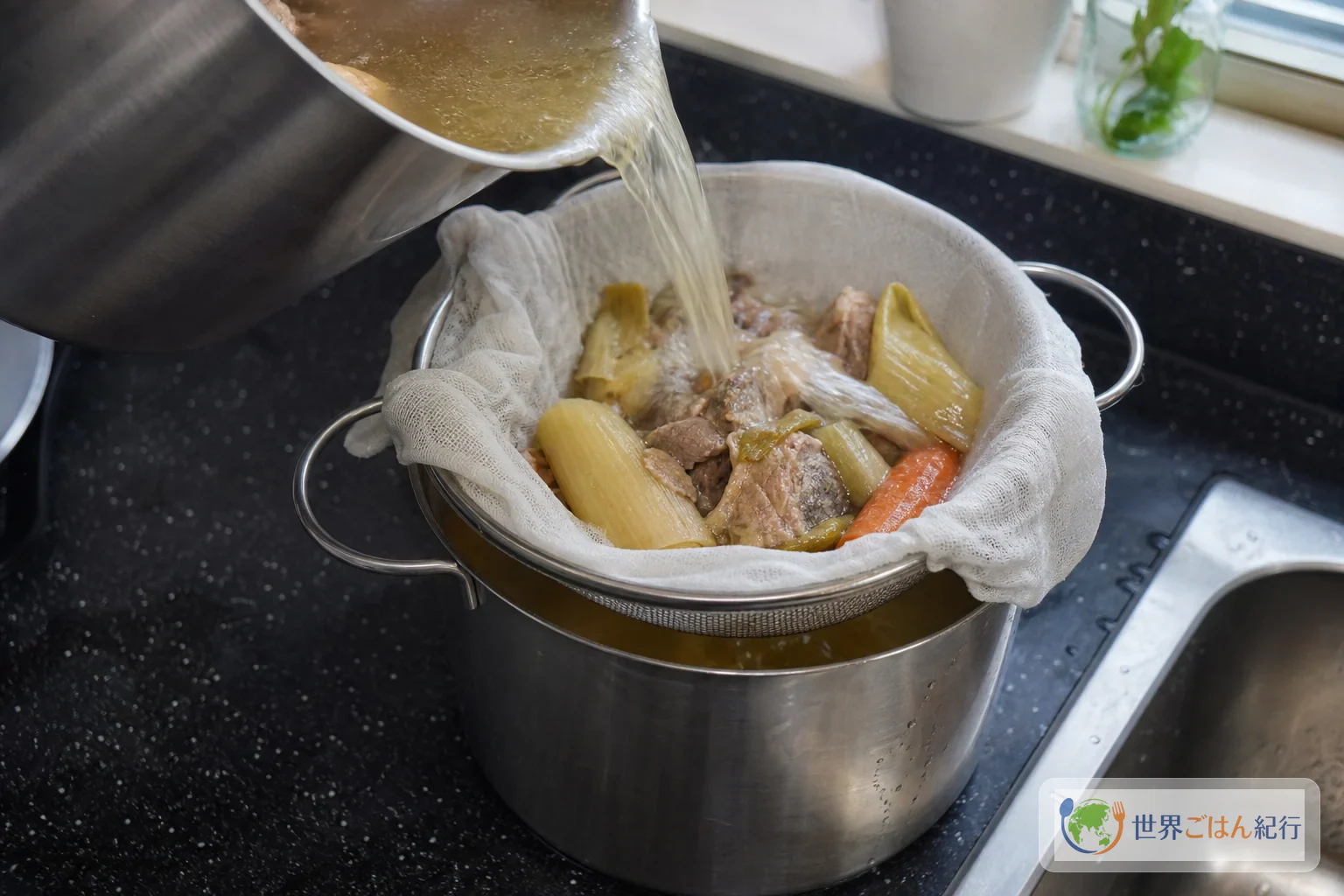
| Clear broth | The lightness of a celebration's first plate | Keep it below a boil, and strain without pressing the solids |
Fresh white asparagus can be expensive, so buy it only when it is in season and reasonably priced. The rest of the year, jarred asparagus keeps the white color and lets you make the same dish.
Method: finish the parts separately and bring them together at the end
Not boiling the broth too hard, and finishing the meatballs, egg and asparagus separately: these two points change the look a great deal. Cooking everything in one pot looks quicker, but the corners of the egg break down, the fat of the meatballs floats and the asparagus gets too soft.
Common problems with Hochzeitssuppe
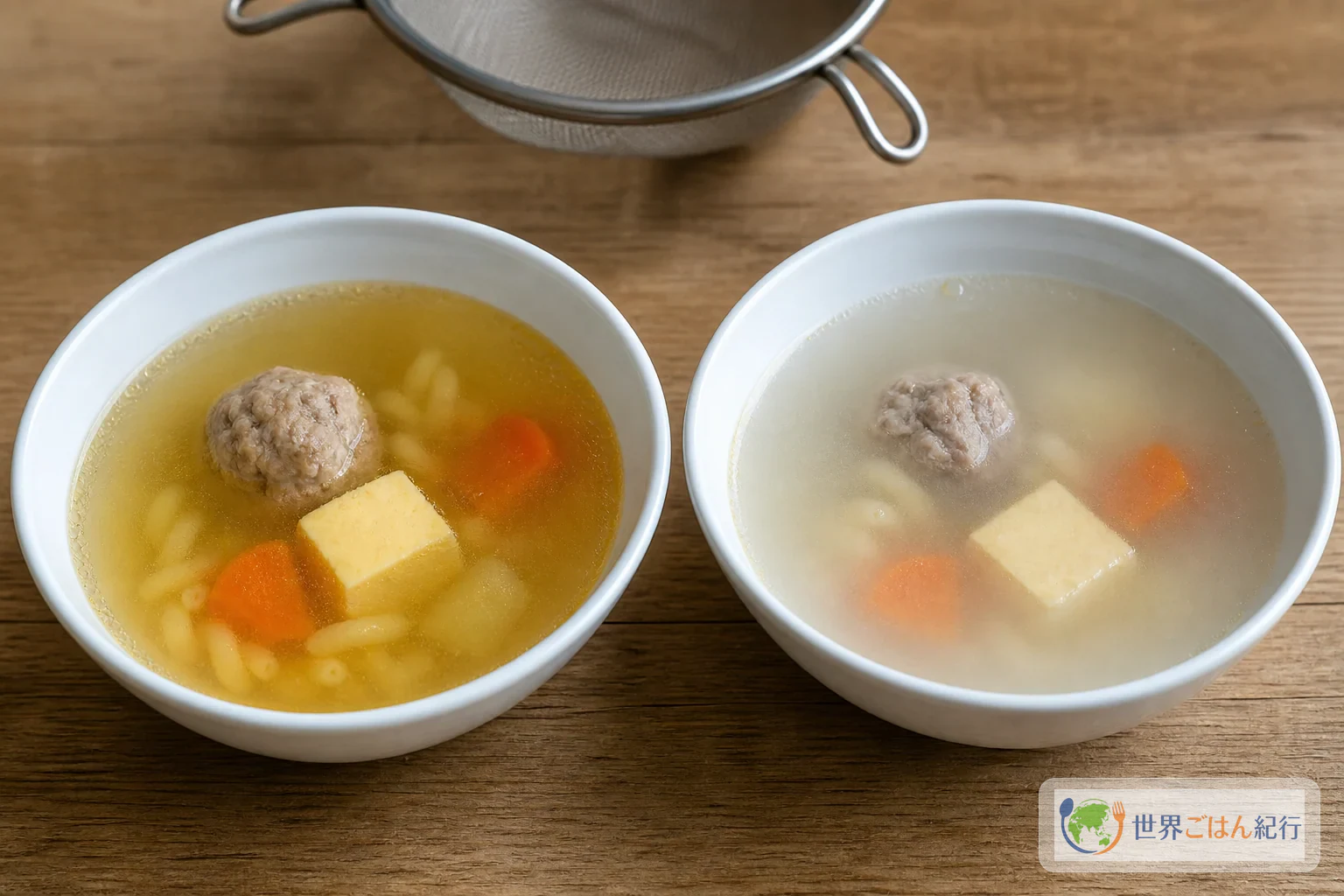
A cloudy broth is still perfectly good to eat. Clarifying it with egg white adds work and often thins the flavor at home, so strain it once through a cloth and put your effort into the salt and meat aroma instead. Next time, remember "stop the boil" before "skim the foam."
The meatballs floating is the sign that they have started to cook. Simmered quietly in a heavy pot, they hold their surface better and the soup stays clearer. If you make this often in the cold season, warm a small amount of broth in a saucepan to adjust the seasoning separately, so you can finish without breaking up the ingredients in the big pot.
Serving, storage and variations
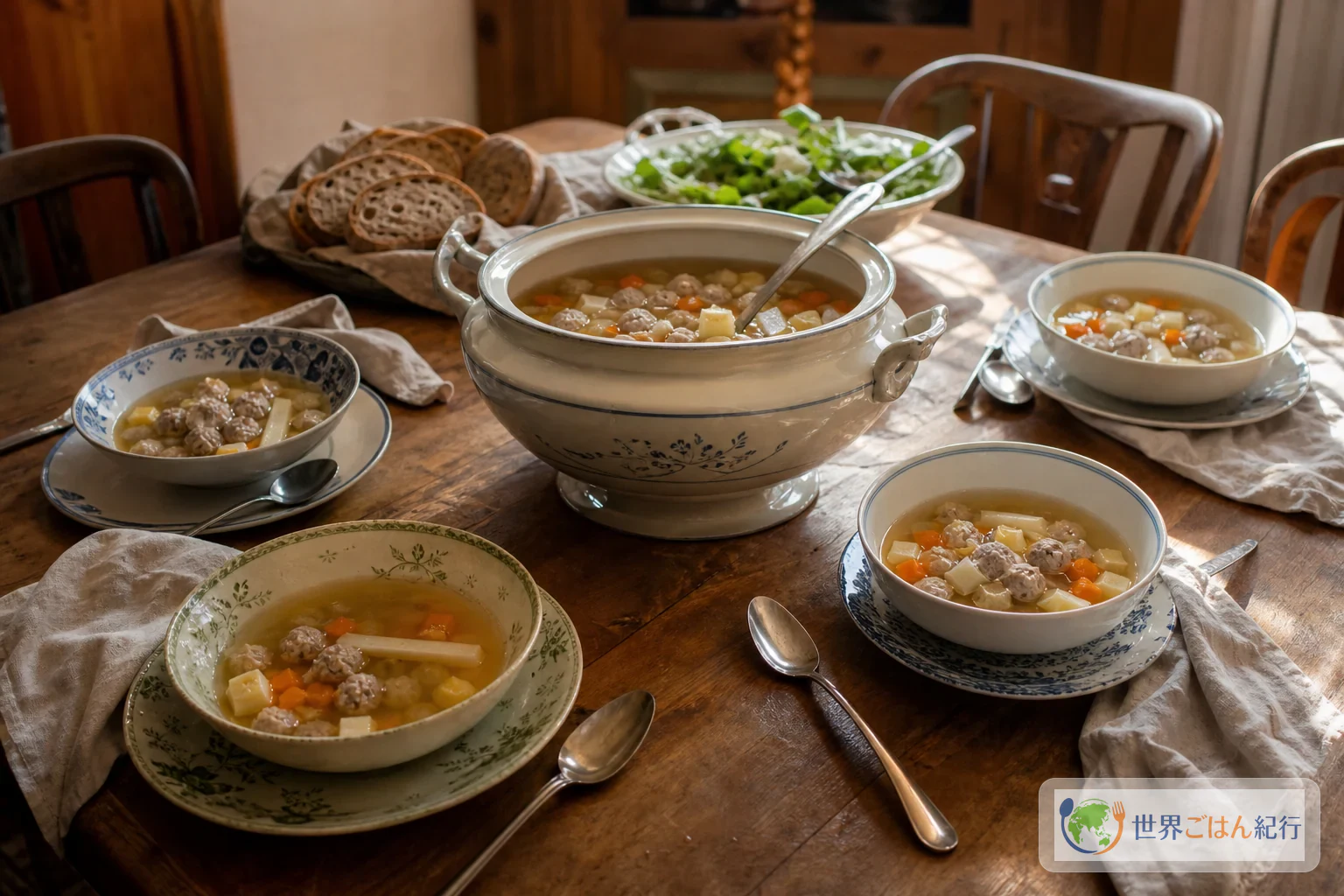
Serving Hochzeitssuppe
To serve it like a wedding menu, pour 1 cup (250 ml) to 1¼ cups (300 ml) per person into a deep plate, with 5 to 6 meatballs and about 4 pieces of Eierstich. Get greedy and it starts to look like a stew. From a large tureen, each serving comes out a little different, one plate with more meatballs, another with more asparagus, and that variety is part of cooking in one big pot.
Keep what follows light. For a German table, serve sweet-and-sour Bavarian-style red cabbage on the side and a small portion of Käsespätzle in place of a main. After a meat soup, acidity or starch makes the meal easier to finish than another large meat dish.
Storing and reheating
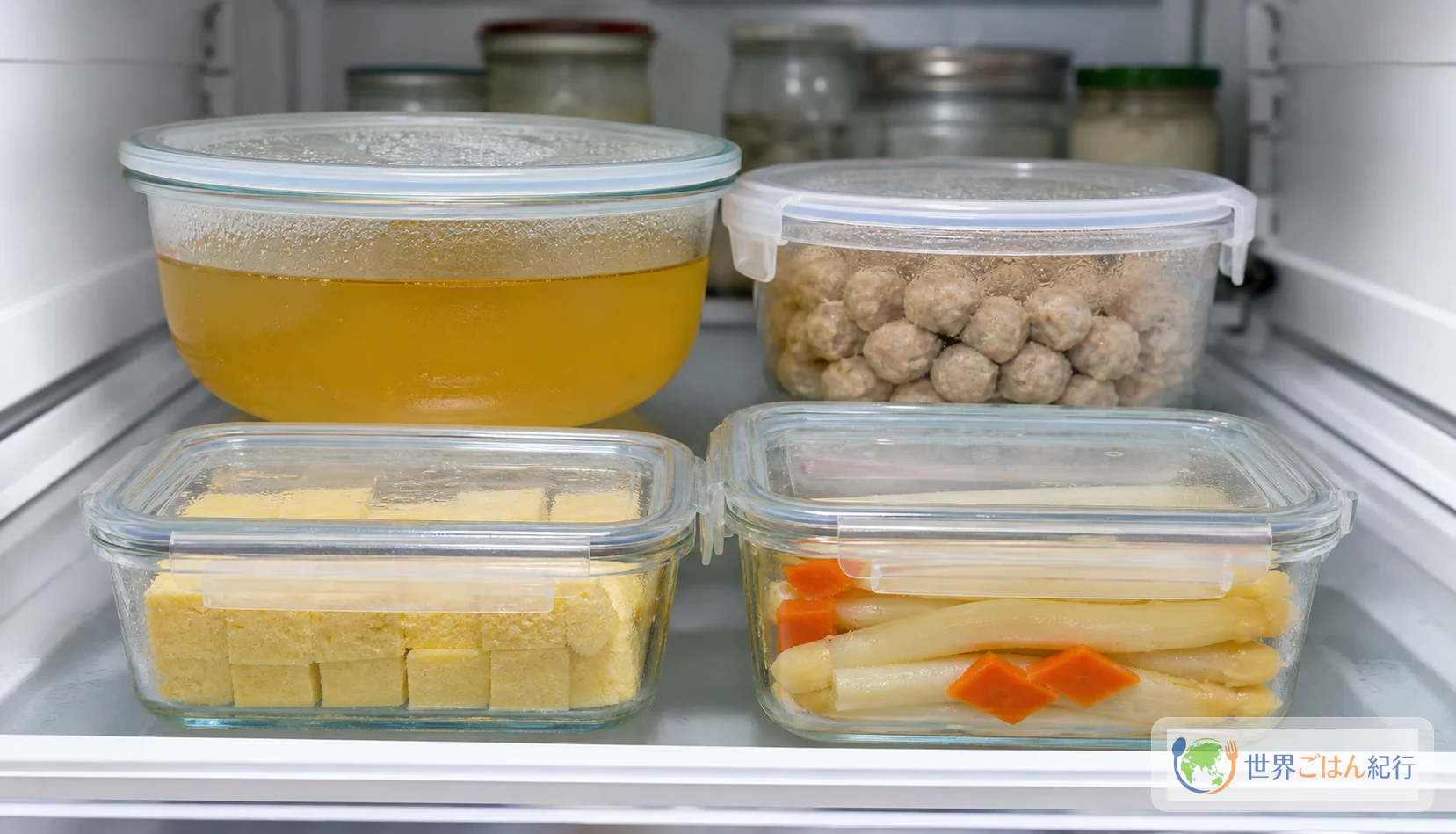
Store the broth, meatballs, Eierstich and asparagus separately. Move them to shallow containers, cover once the steam settles, and refrigerate quickly. Cooked leftovers keep 3 to 4 days in the refrigerator; for the best texture, eat the broth and meatballs within 3 days and the Eierstich and asparagus within 2 days. To reheat, warm the broth and meatballs first to 165°F (74°C), and add the Eierstich and asparagus only for the last 2 minutes.
Only the broth and meatballs freeze well, separately, for 1 month. Eierstich turns watery and pocked, and asparagus goes soft in the fibers. Thaw overnight in the refrigerator, or warm the frozen broth directly in a pot over low heat without letting it boil; once it has completely melted, add the meatballs and reheat everything to 165°F (74°C).
Variations
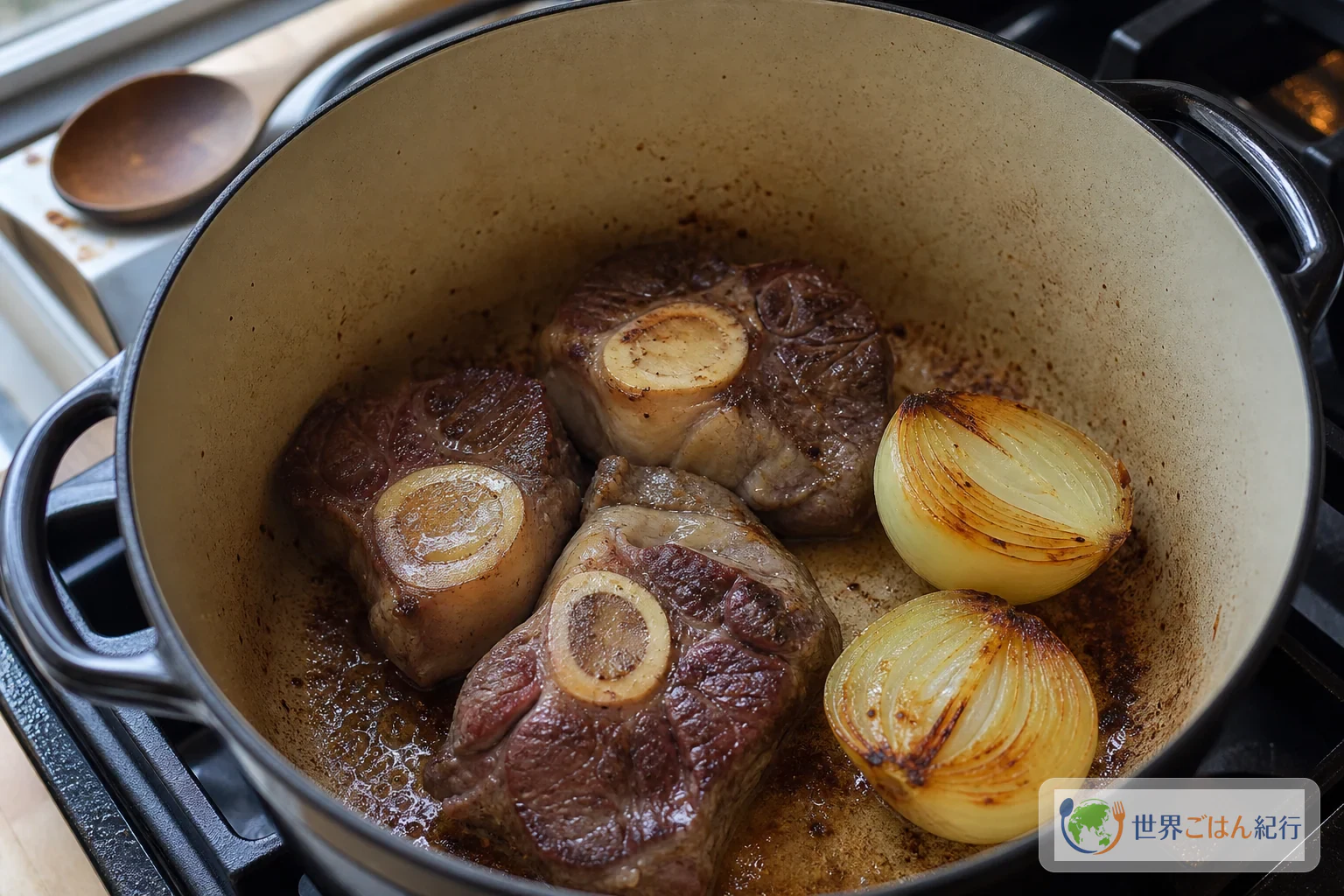
For a pressure cooker version, put in the seared beef shank, chicken wings, aromatics and 2.75 quarts (2.5 L) water, cook at high pressure 25 minutes and release the pressure naturally for 20 minutes. After straining, move to an ordinary pot and finish the meatballs, Eierstich and asparagus separately as usual. The pressure cooker is for speed; anything that must keep its shape belongs in the ordinary pot.
The Wendland version is the easiest place to start, since without rice or noodles you can concentrate on a clear broth and the four main ingredients. The second time, try adding 20 g of cooked rice per person in the Hadeln style, or a small amount of thin egg noodles in the Sorbian style. And for another dish that refuses to rush the heat, try Sweden's tjälknöl, frozen meat cooked in a low oven. It looks nothing like this soup, but the patience is the same.
Frequently asked questions
How far ahead can I make it the day before?
You can make the broth, meatballs and Eierstich, chilled in separate shallow containers in the refrigerator. On the day, warm the broth and meatballs first, cook the asparagus and carrot, and return the Eierstich last. If you combine everything the day before, the egg breaks down from the corners and the asparagus goes soft.
What if I can't find white asparagus?
Jarred is easiest and keeps the white look. Drain it, cut it into 1.5 inches (4 cm) lengths and warm it only for the last 2 minutes. Green asparagus works too, though its aroma is stronger and the color changes the look of the bowl; keep it from getting too soft.
My Eierstich has holes. Can I fix it?
They do no harm to the eating. Large holes tend to come from whipping the egg mixture or boiling the water bath, so next time strain the mixture through a tea strainer and set it in 80–85°C water. For this batch, cut it a little smaller than 0.5 inches (1.5 cm) and the holes will be less noticeable.
Will it have flavor if I can't get beef bones?
Yes. Use boneless beef shank and chicken wings and simmer quietly for the same time; the bones and skin of the wings make up the gelatin. Commercial bouillon added at the start makes the salt and aroma too strong, so use up to 1/2 tsp only if the flavor is weak after straining.
Can I make the meatballs with beef only?
Yes. Switch to 10.5 oz (300 g) ground beef and increase the cold water to 2.5 tbsp (40 ml). Without the pork the fat drops and they firm up a little, so keep the mixing to within 1 minute and the cooking on low heat. The center still needs to reach 160°F (71°C).
Finally, shake the pot gently, and turn off the heat when the corners of the egg haven't broken and golden broth shows between the meatballs. Carry the large bowl to the table and ladle meatballs and egg up together. Handing out that bowl is the finish of Hochzeitssuppe.