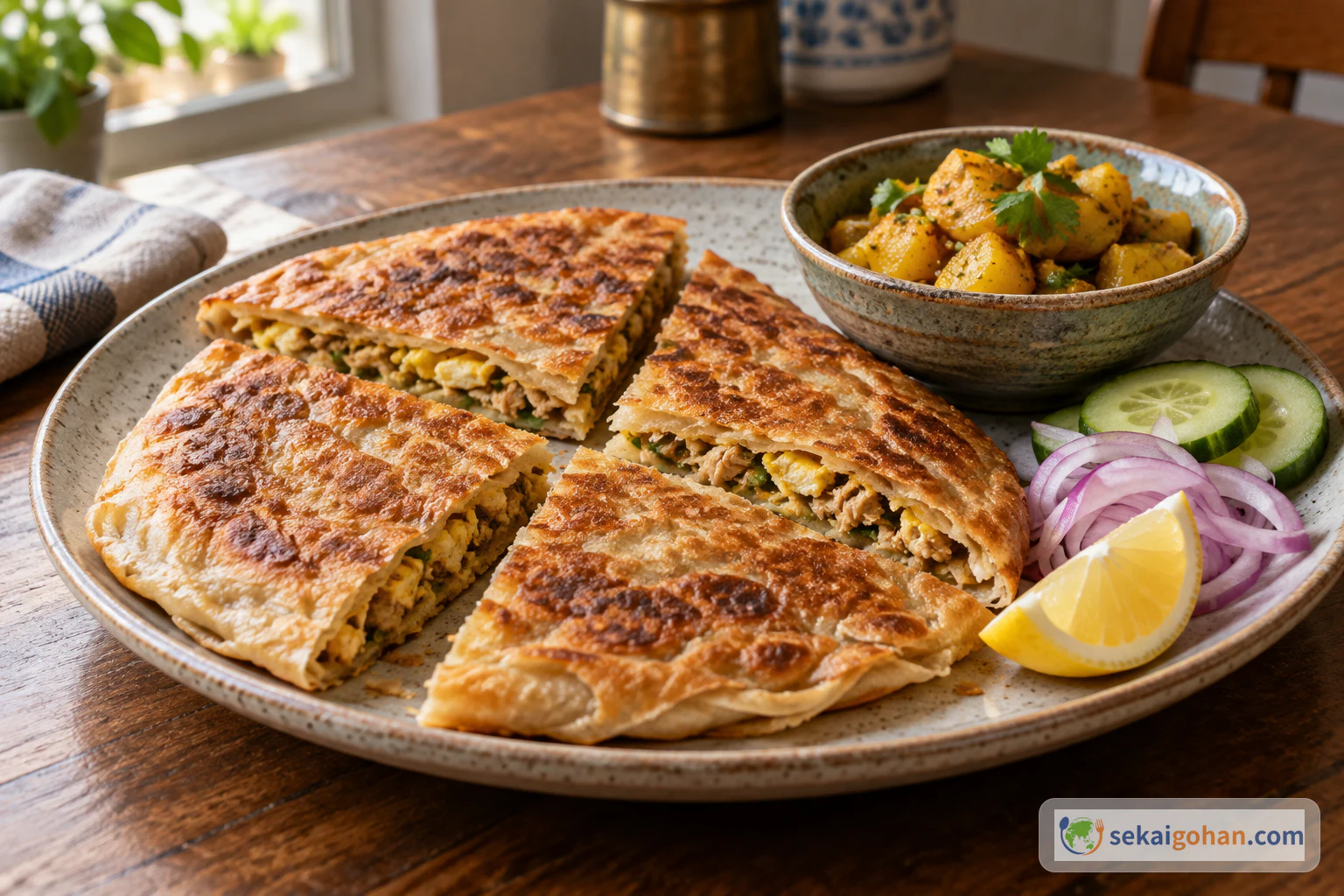
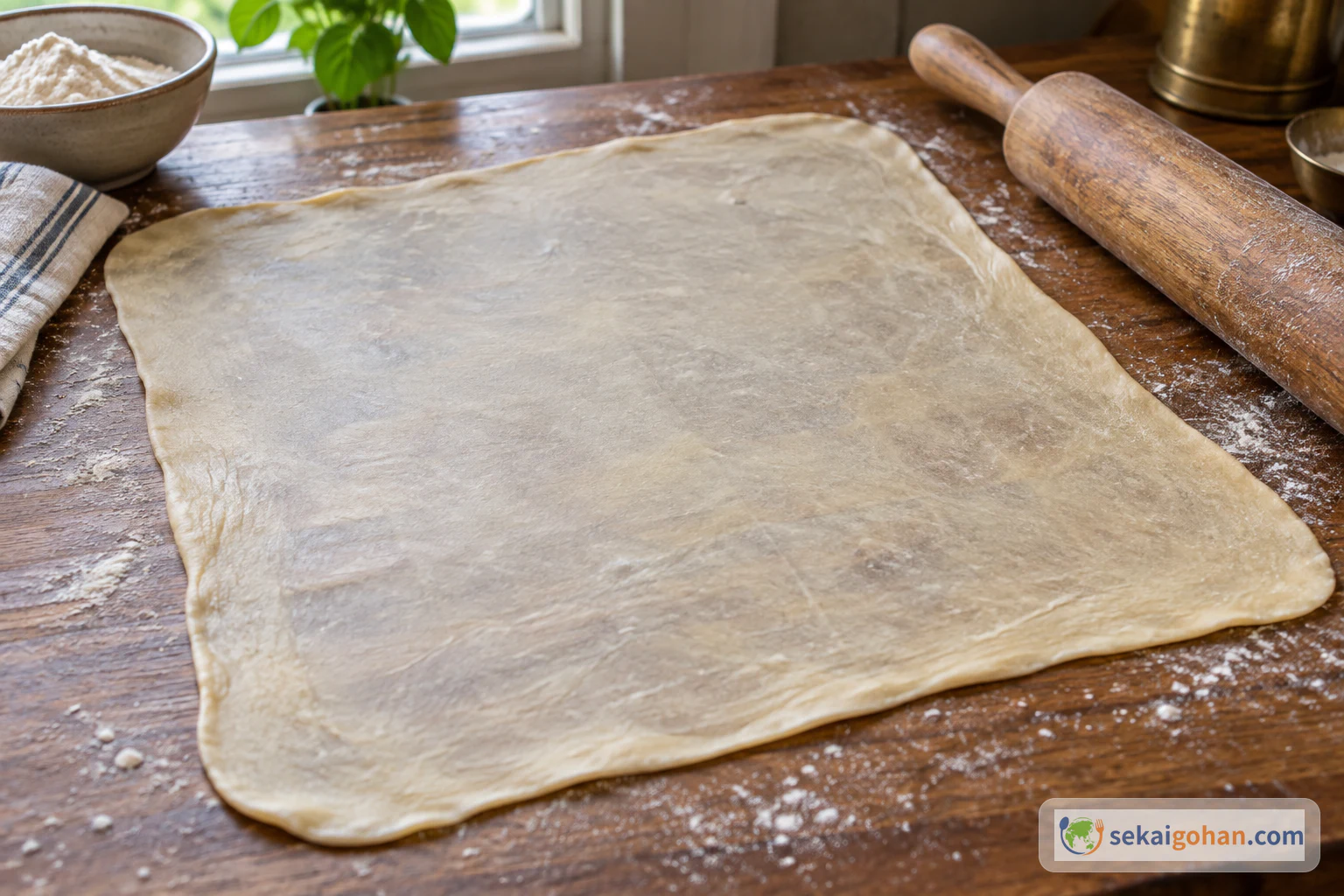
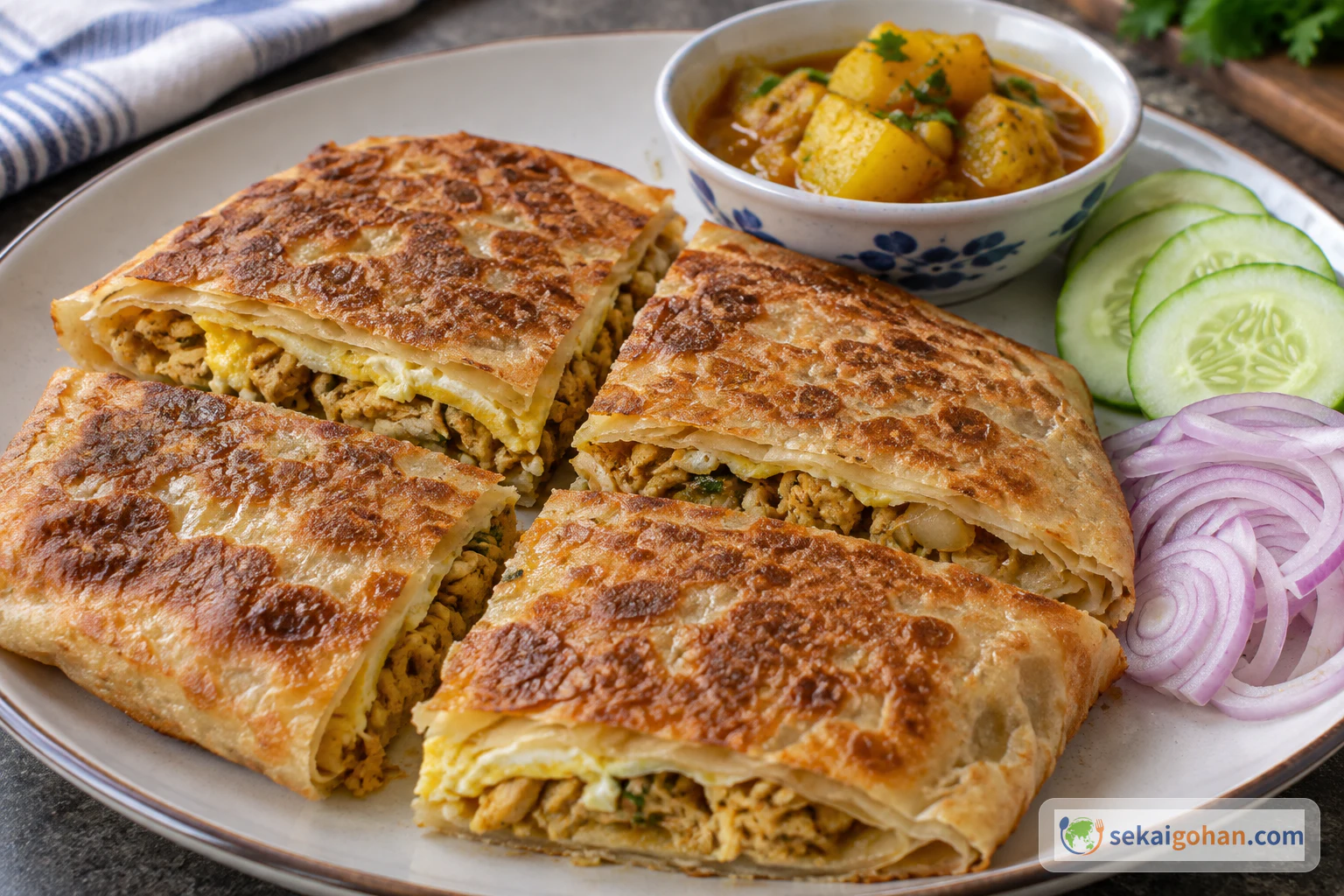
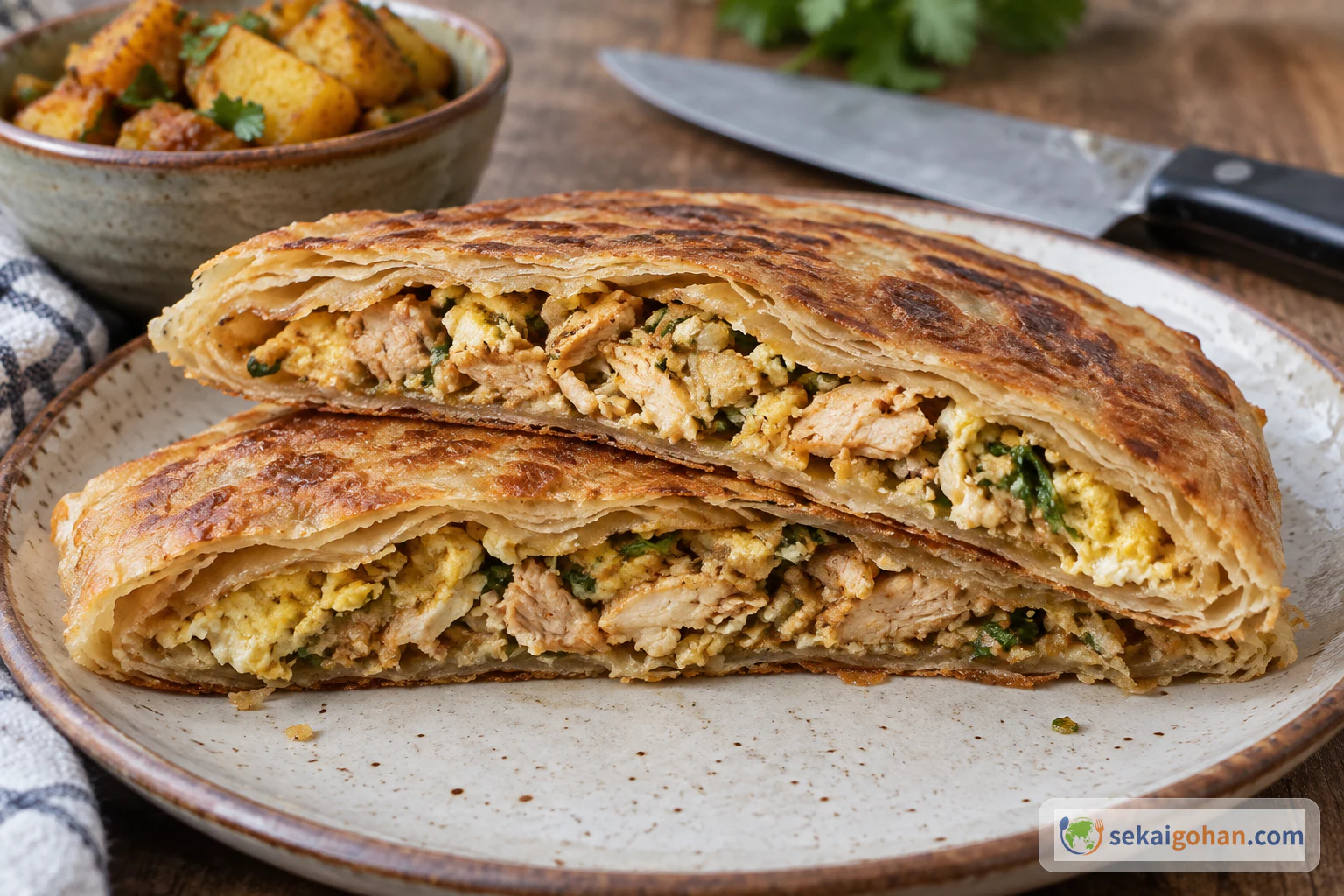
Set a squared-off parcel of dough gently into an oiled pan and fine bubbles rise around the seam. Cut it once the surface is golden, and inside the thin layers you find the egg and chicken filling, crisp dough and soft filling fused into one piece. Mughlai paratha is the Bengali paratha made as a full meal: wheat dough wrapped around egg or meat and fried. At home, the trick isn't more filling. Roll the dough nearly translucent, spread the filling thin and then wrap, and you get a crisp outside with an egg inside that isn't overcooked.
Mughlai Paratha in Bengal
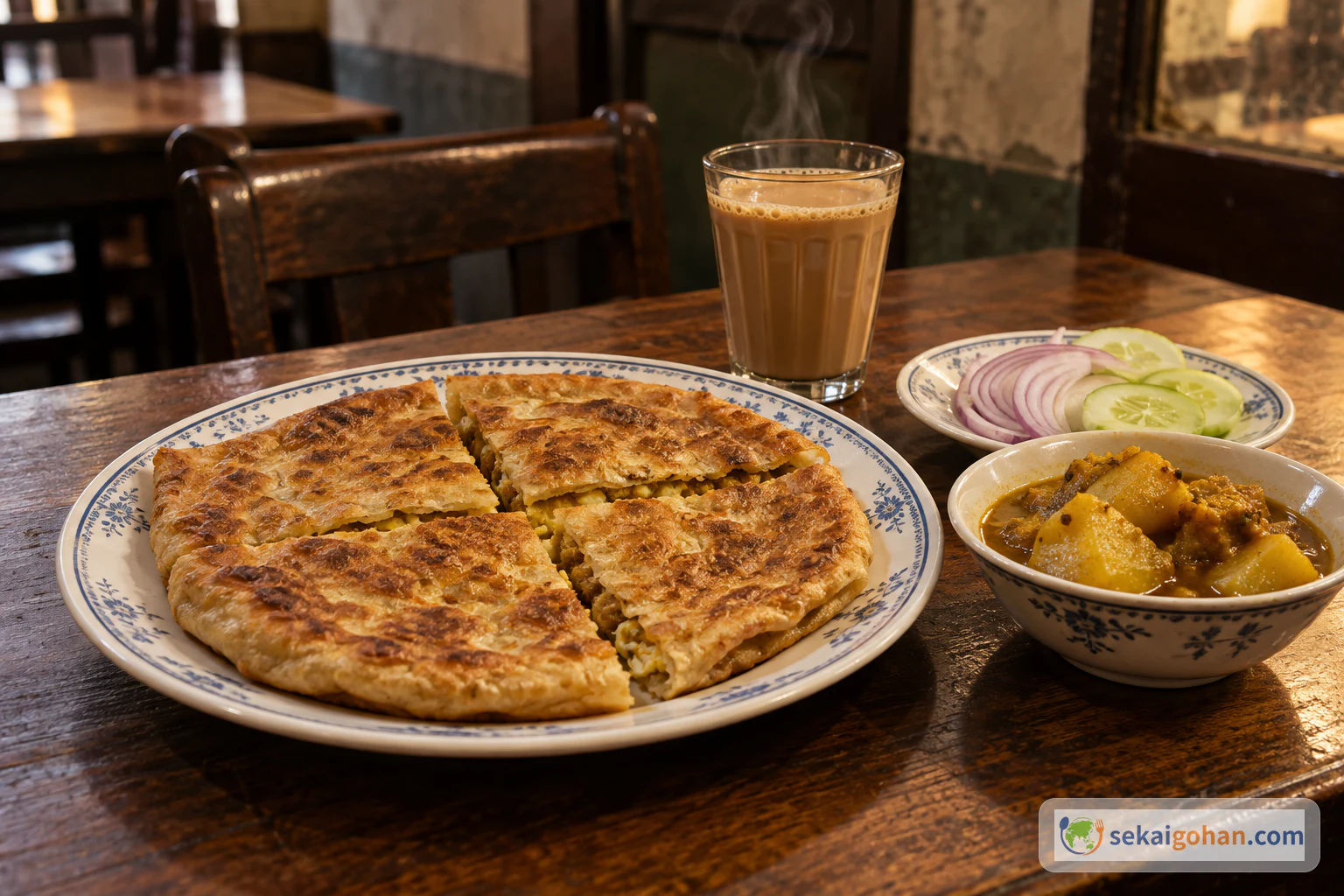
Bangladeshi recipes include a version that combines minced chicken and egg, and in Kolkata, West Bengal, it is eaten at small eateries called cabins and at shops around the city. "Mughlai" here points to Mughal cuisine, a group of dishes built on the aromas of whole and ground spices. Bengal was influenced during the Mughal period, that influence remains in present-day Bangladesh, and this paratha is one dish shaped by it.
In Kolkata, parathas stuffed with egg or keema were eaten at cabins, restaurants and small city shops, served with hot chai and a lightly seasoned potato stew. A cabin wasn't a place for grand banquets. It was somewhere you could stop on the way home from school or after a film, and one piece with egg and meat sealed in thin dough made a quick meal, with the line between staple and side dish very thin.
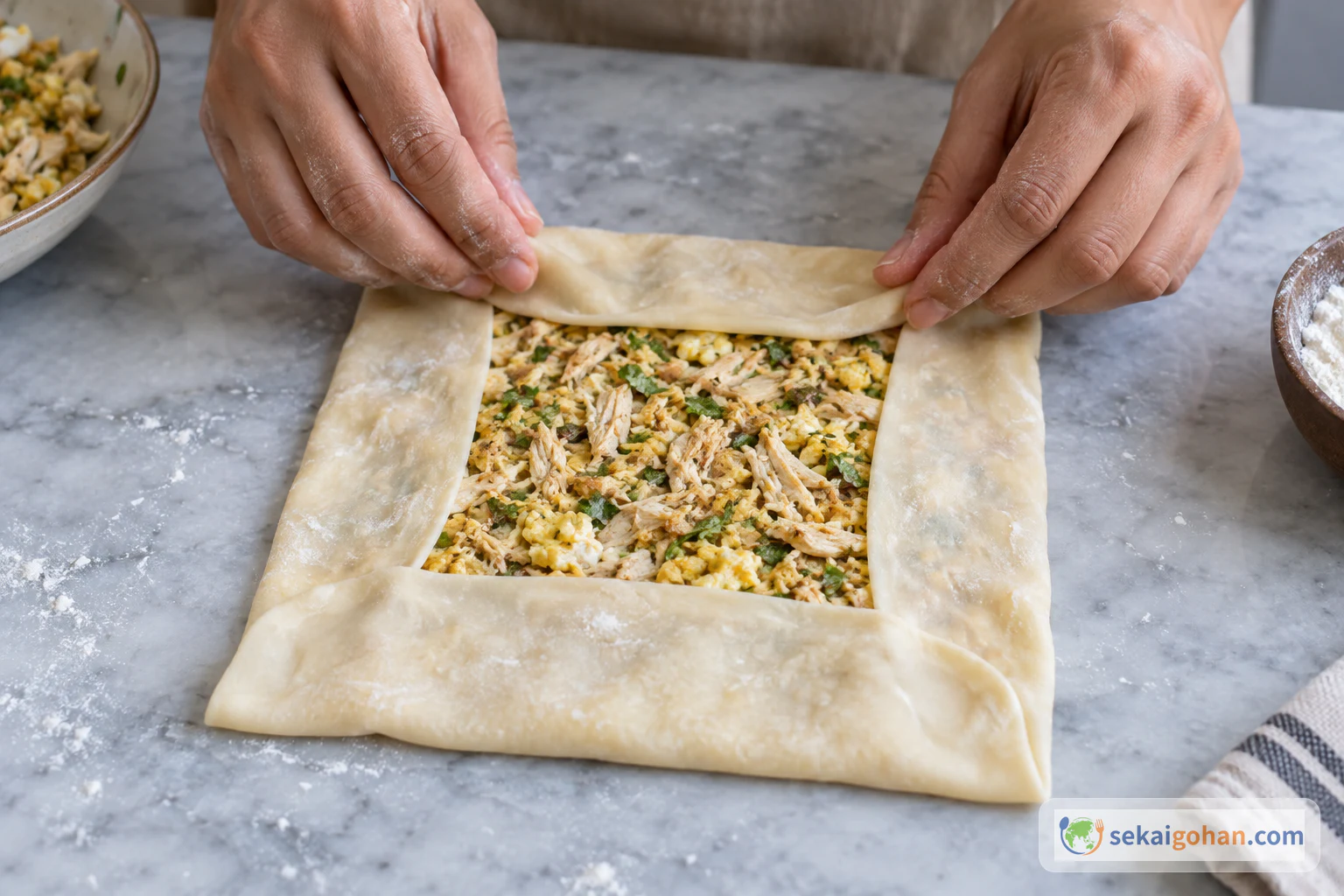
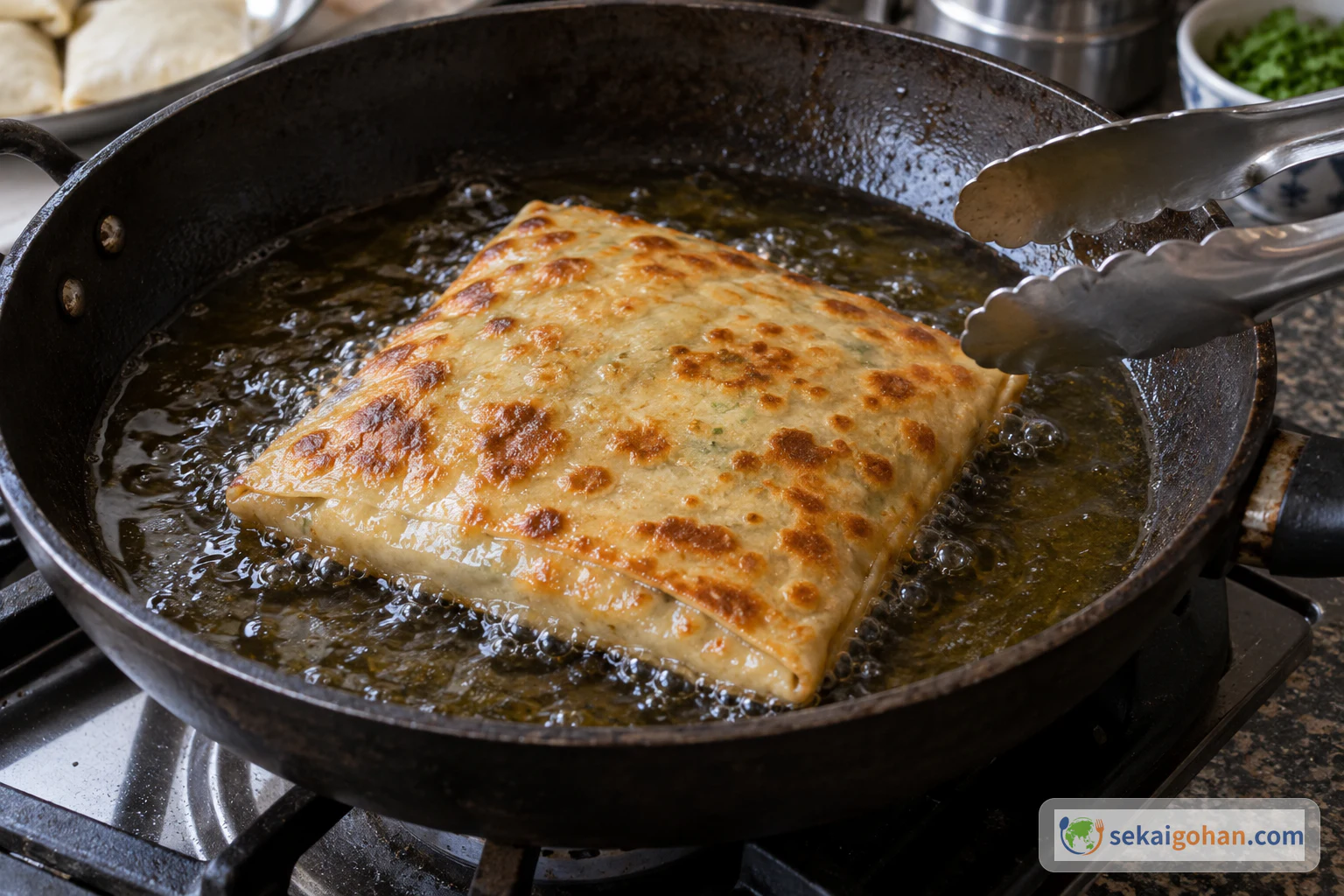
That way of eating shows in how it's made. Instead of cooking a thick round, you fold a thin sheet in from four sides and wrap the filling like an envelope, then fry it slowly over medium-low heat, ladling oil over it rather than scorching it over high heat. The outside keeps a light texture of layers that shatter, and the egg and meat inside hold together. The potato on the side matters too: something soft with a little liquid next to a paratha rich with oil and spices balances each bite.
One story says the Mughal emperor Jahangir had it made, but there is no contemporary evidence for that. It's better understood as Mughal cooking blended with Bengali ingredients and urban eatery culture, settling into several forms: egg, keema, chicken. Bangladeshi home cooking and the Kolkata shop style share a thin dough, folds that close in the filling, and slow cooking in oil.
It's worth comparing with aloo paratha, which wraps a potato filling in whole-wheat dough. Both are stuffed parathas, but because Mughlai paratha centers on egg and meat, the thinness and frying differ.
In Bangladesh it is also written "Mughlai porota," and this site uses "Mughlai paratha."
Ingredients (serves 4, 8 parathas)
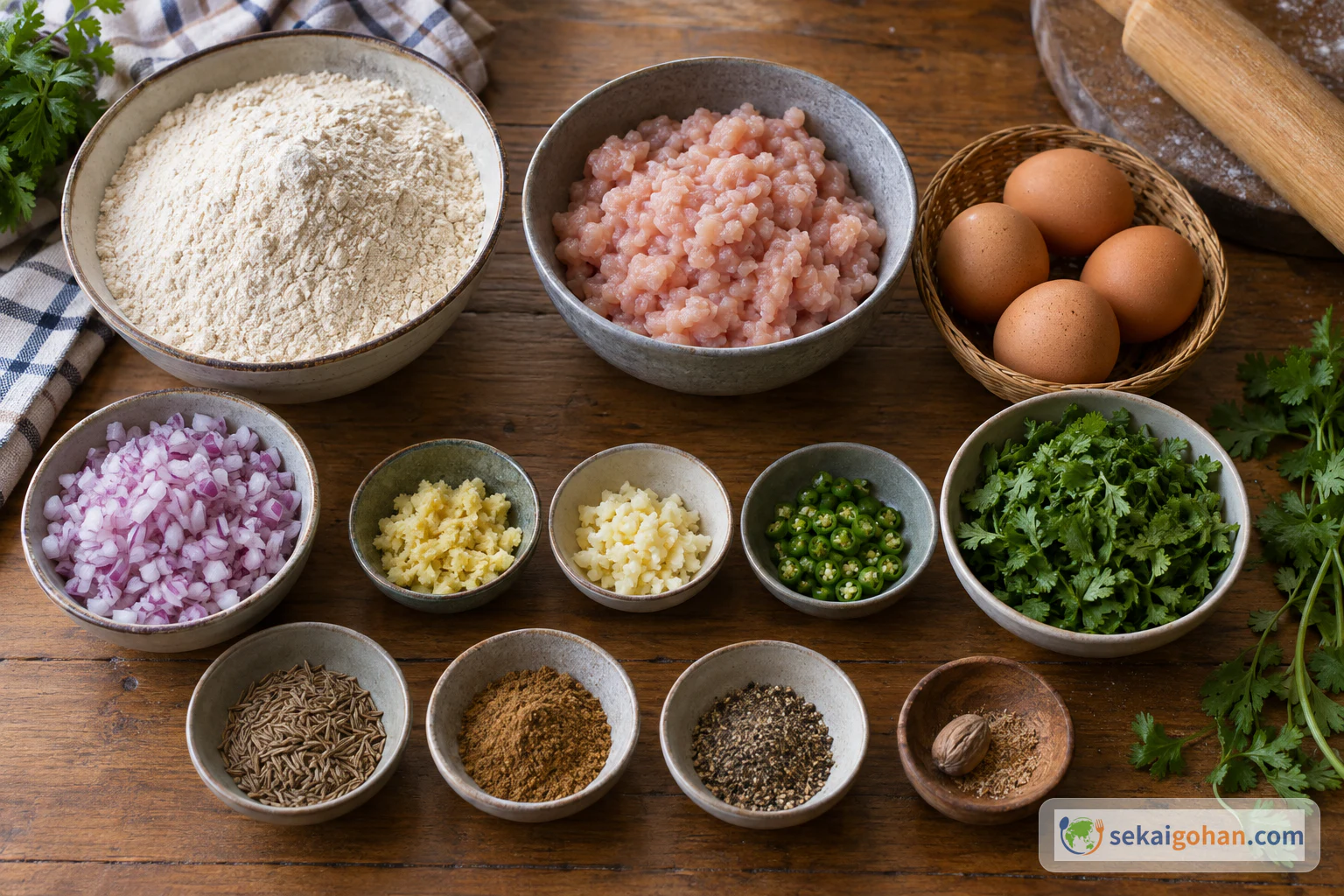
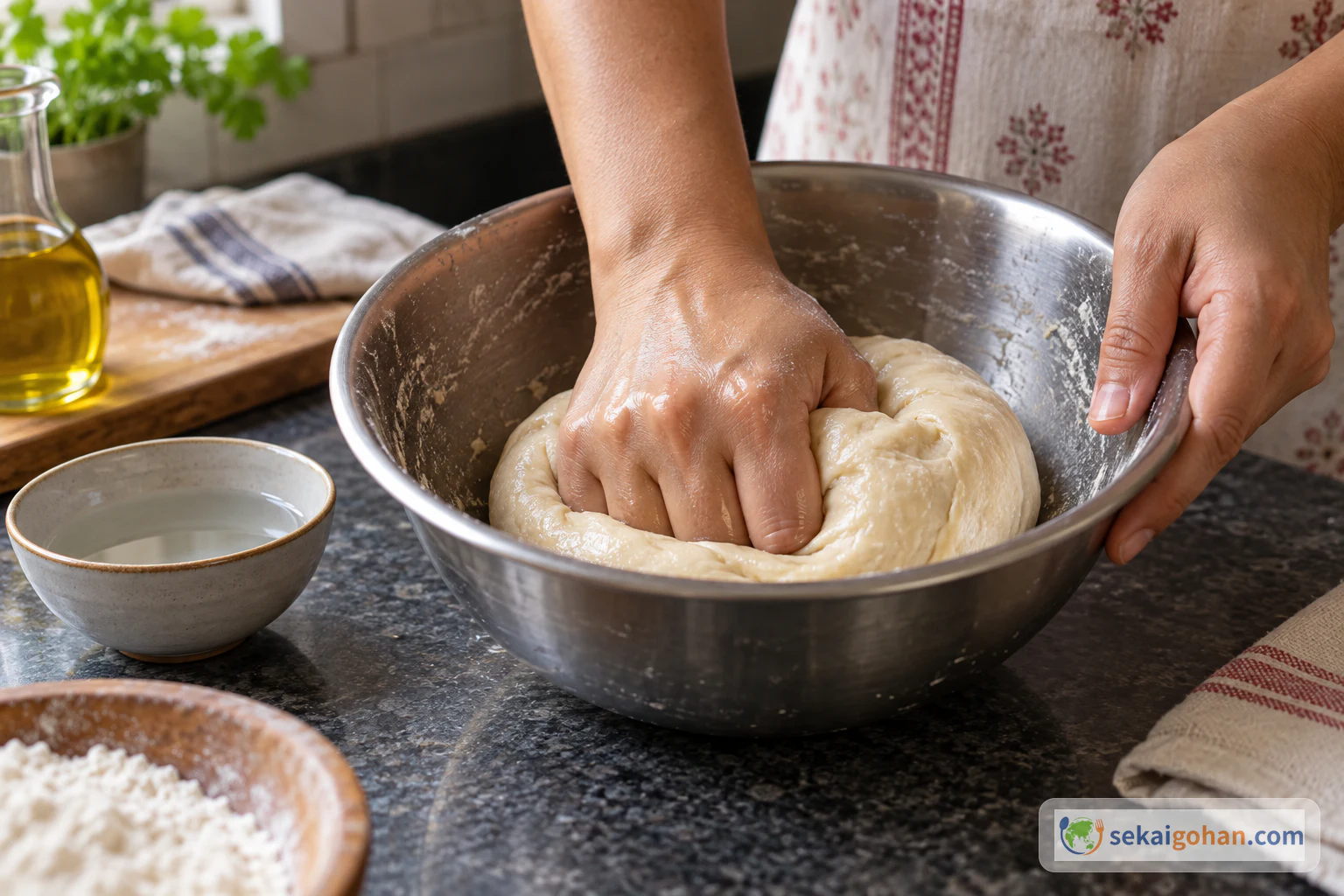
This makes 8 small Mughlai parathas. If one is a staple for each person, that is for 4; if you serve plenty of salad or potato stew, plan on 1–2 per person. The dough needs to rest, so knead it first, then make the filling.
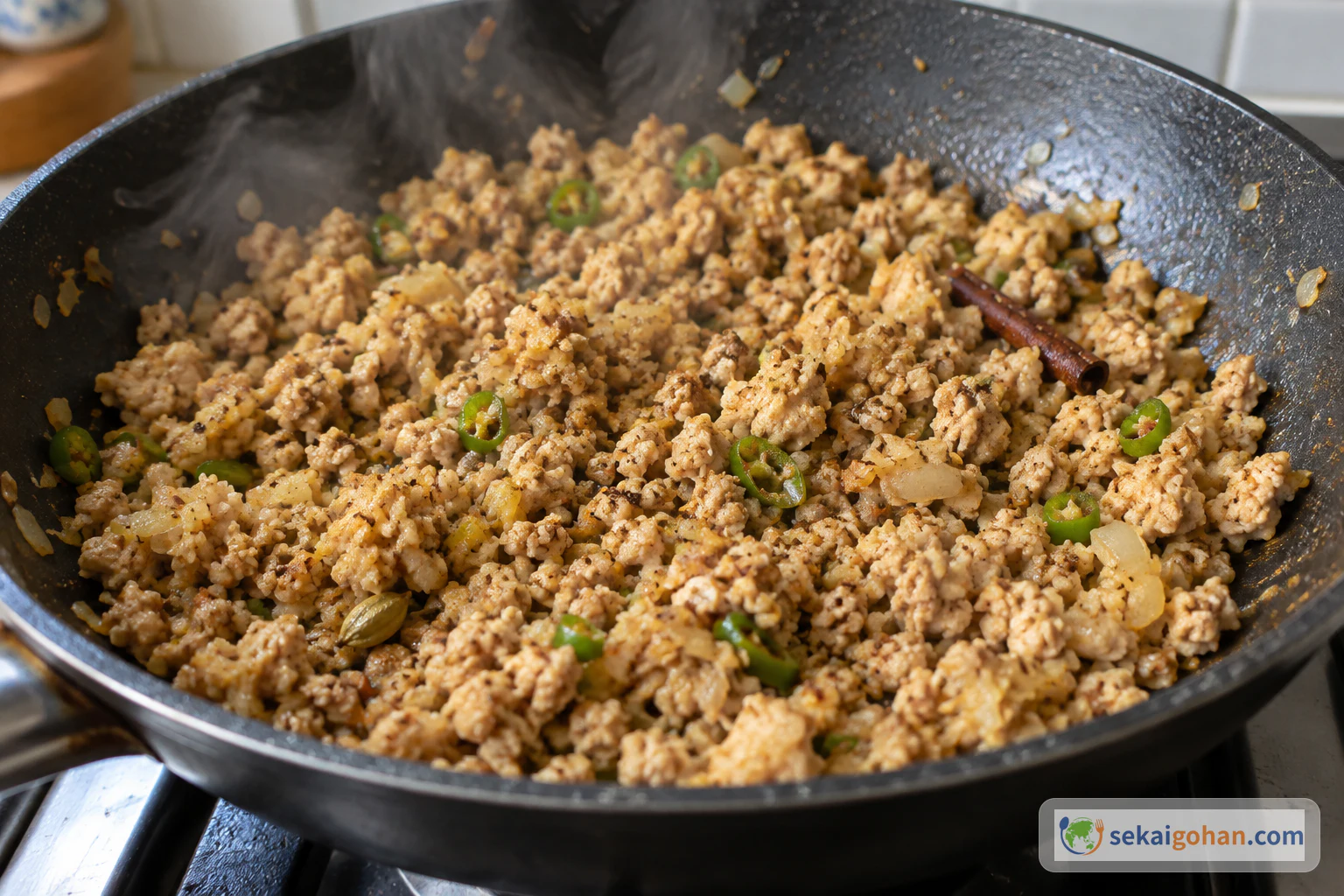
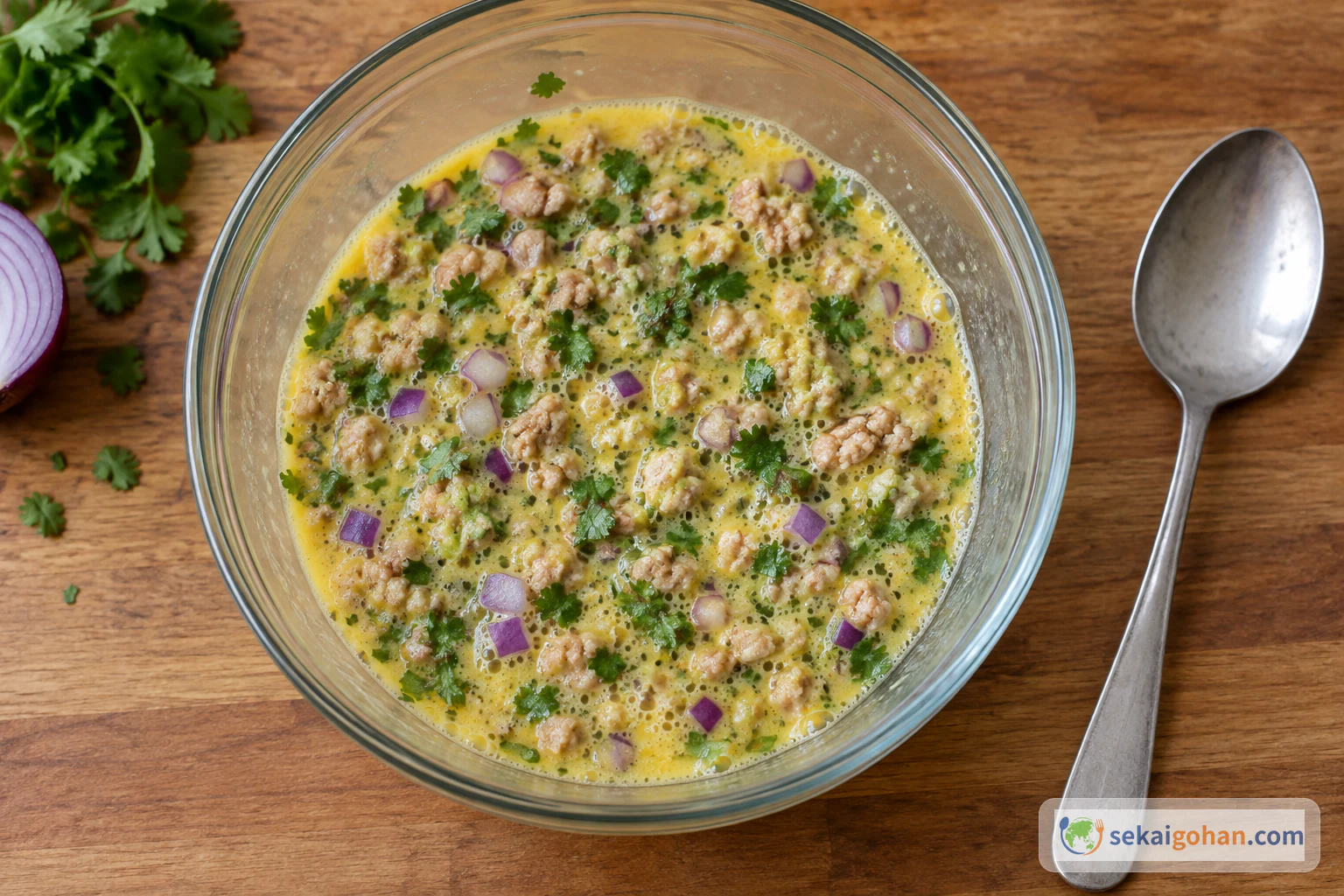
Before wrapping, check the state of the chicken and the egg separately. Cook the chicken until the moisture is gone, and beat the egg with red onion and cilantro. If you make the filling in one bowl, liquid seeps out when you set it on the dough, so cool the meat filling before combining it with the egg.
A note on the spices and chopping
You use a little under 1 tsp of garam masala, but it adds the rounded aroma that cumin and black pepper alone can't. If you already have some with its aroma intact after opening, there's no need for more. A knife is enough for chopping the onion, ginger, garlic and green chili for 8 parathas; a small food processor only saves time.
For how the dough and potato filling differ, see the ingredient table of aloo paratha. It shows why that filling dries out.
This uses wheat, eggs and chicken. Check the allergen labels on commercial garam masala, curry powder and oils. You can omit cilantro or green chili if you dislike them, but if you replace the egg and chicken with other ingredients, the cooking time and seasoning change.
Choosing Ingredients and Substitutes for Mughlai Paratha
Green chili can become shishito or a little red chili, and cilantro can become scallion. The outline of the aroma shifts, but the heart of the dish (wheat dough, egg, meat, the folds and the oil temperature) stays the same. Replacing the egg with tofu makes it a different dish, so say so when you name it.
Method: cool the filling, fold the dough thin, then fry
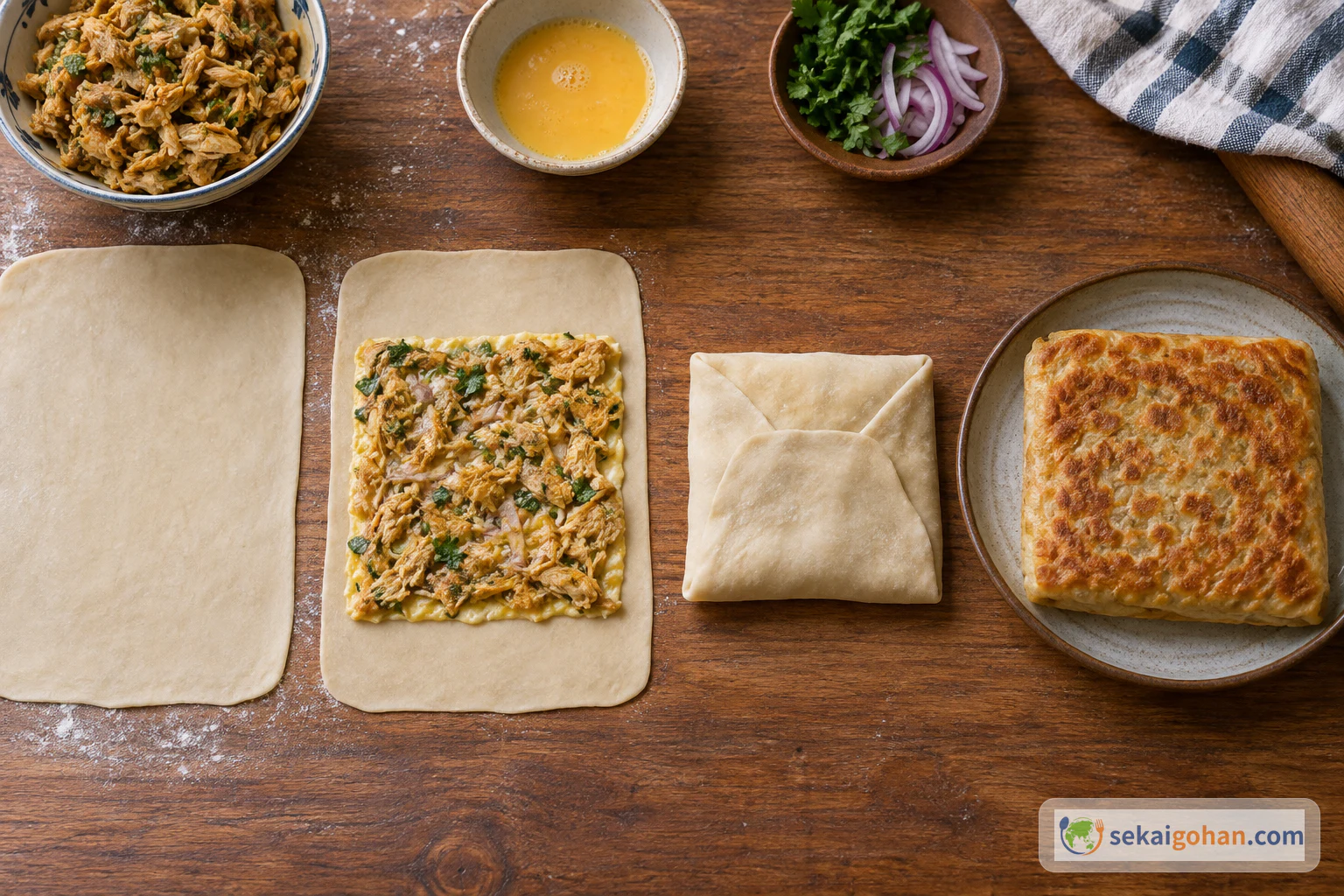
While the dough rests, make the meat filling and combine it with the egg after the heat has gone. When you wrap, don't mound the filling at the center; spread it flat in a thin square to prevent tearing. If the oil is too cool the result is greasy, and if it is too hot only the surface browns first, so fry one at a time, watching the heat.
Mughlai Paratha Failures and Fixes
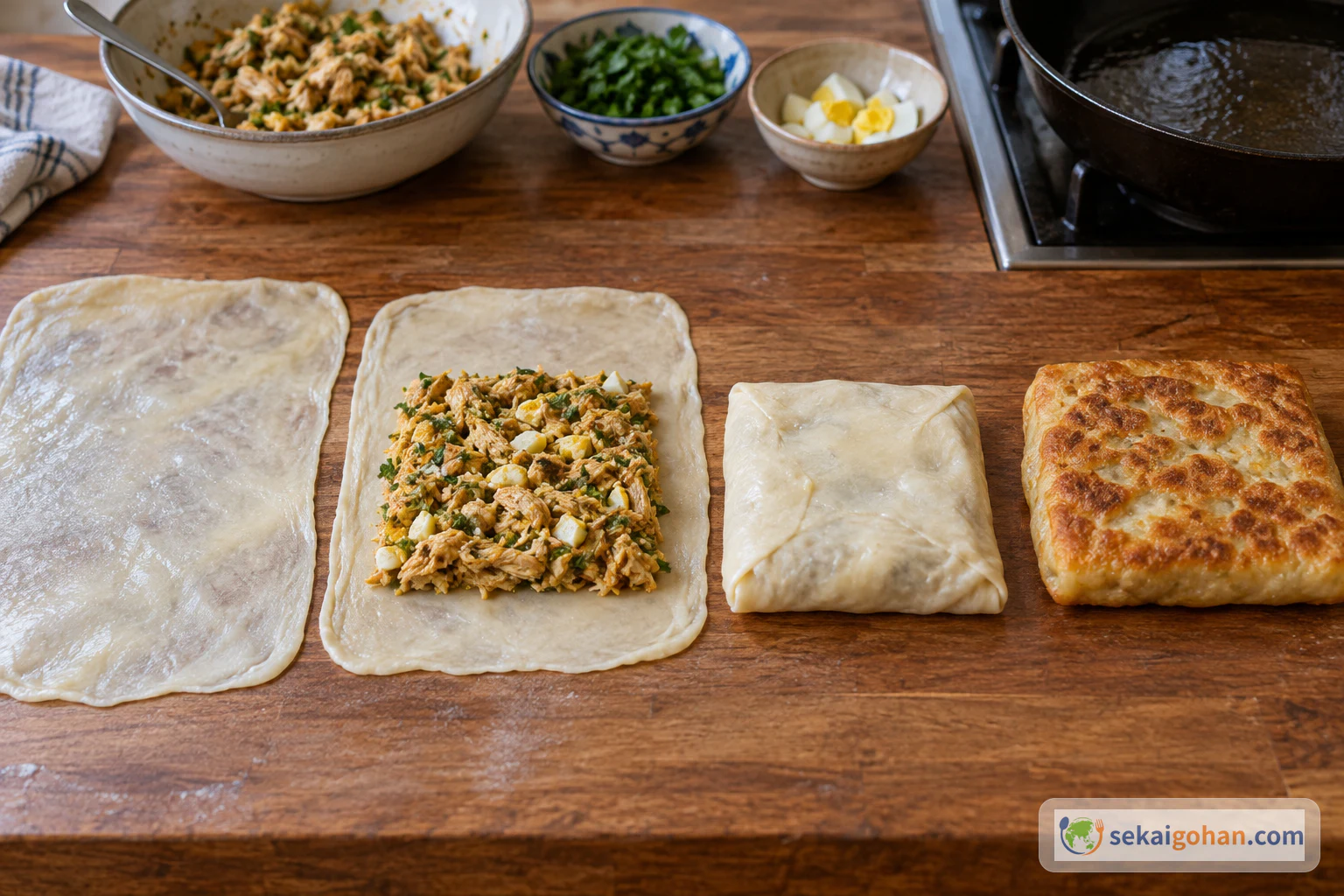
Most problems start before the paratha ever goes into the oil.
The dough springs back and won't stretch
Just-kneaded dough has tight gluten and fights the rolling pin; forced out, it ends up thick in the center and thin only at the edges. Rest it, rounded, another 10 minutes, brush it with a little oil and then roll. More dusting flour won't relax it.
The filling runs out
Either moisture is left in the meat filling or the egg was spread right to the edge of the dough. Spread the meat filling on a tray to cool and use 1 tsp less filling per piece. If egg drips when you lift a wrapped square, pinch the folds closed again and fry it right away, seam side down. If raw egg touched the counter, wash the counter and tools before you continue.
Only the surface burns and the center is raw
The oil is too hot or the filling is too thick. A burnt one can't be rescued, so for the next piece lower the oil to 165–170°C (330–340°F) and make the filling thinner. You can't judge the safety of minced chicken by the color of the crust: check the thickest center with a food thermometer, and if it hasn't reached 73.9°C (165°F), cook both sides further over low heat.
The outside is greasy
This happens when the dough goes into oil that's too cool. If almost no bubbles come up right after it goes in, take it out and wait until the oil is back to 170–175°C (340–350°F). Lean finished ones on a rack for 1 minute instead of stacking them, so oil doesn't pool underneath.
Cook chicken, including ground chicken, to 165°F (73.9°C), and dishes containing eggs to 160°F (71.1°C), as measured with a food thermometer. Because these parathas are thick at the center, insert the thermometer in the thickest part and eat only once it reaches temperature.
Serving, Storing and Varying Mughlai Paratha
Fillings by region
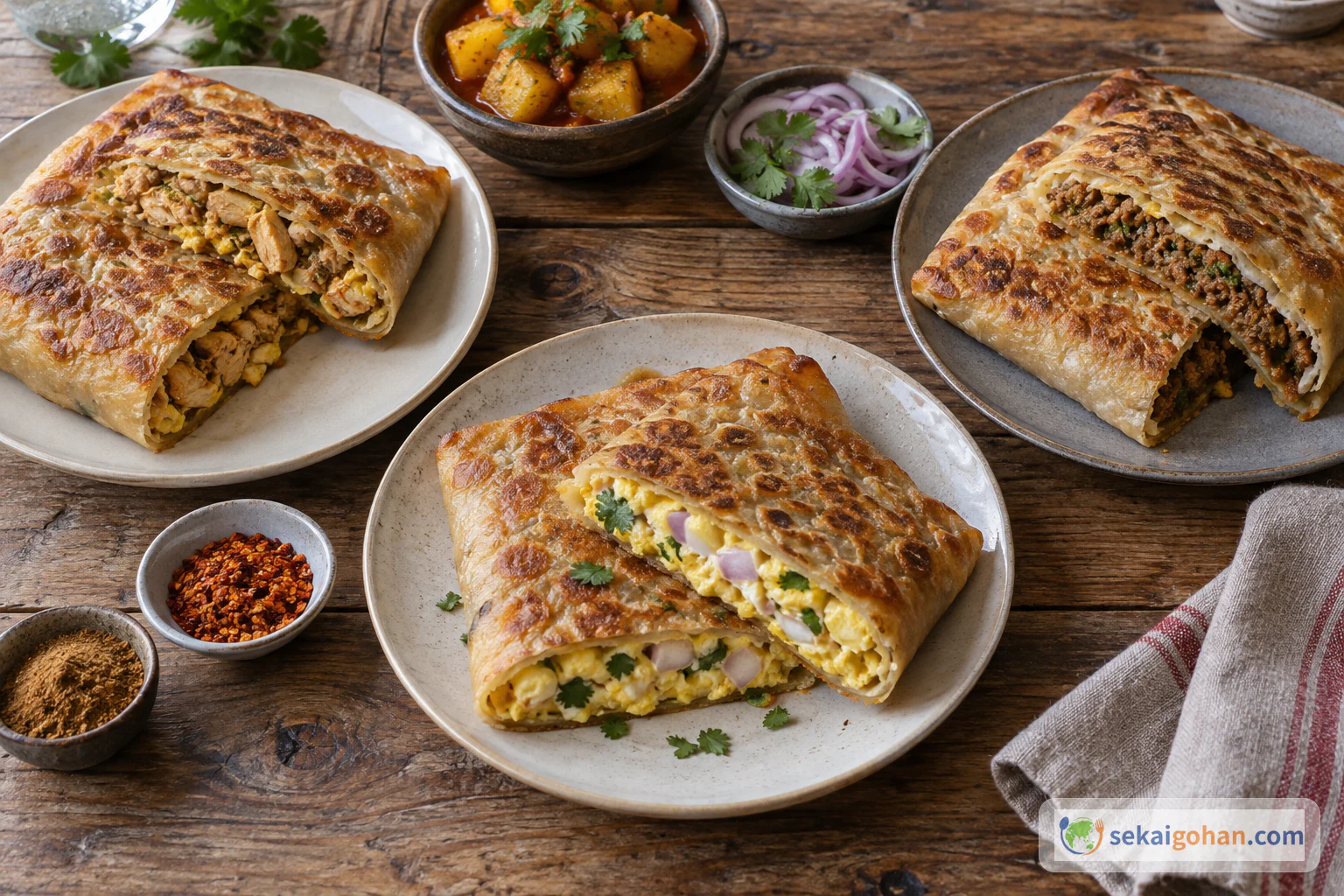
There's no single fixed filling. Kolkata's style is built on egg, and some shops switch to keema. The Bangladeshi version combines egg and minced chicken, flavored with ginger, garlic, cumin and garam masala. None of these is the "correct" one; they're simply different choices for the same staple.
| Filling type | Texture and flavor axis | Choosing it at home |
|---|---|---|
| Egg + minced chicken | Soft egg, savory meat, a rounded spice aroma | The base of this recipe. Easy to check internal temperature |
| Egg + keema | Meat fat and texture come forward | If using beef or lamb, spread a fatty filling thin and extend the cooking time |
| Egg only | Layers of dough and the aroma of egg are the center | For days you want to avoid meat. Increase onion and green chili |
| With potato | Less moisture in the filling, gently filling | Compare with aloo paratha to see the difference |
For egg only, mix 4 eggs with red onion, cilantro and green chili and use about 1/2 egg per piece. Without meat there's more liquid, so close the folds quickly once the egg is on and set it seam side down in the oil right away. If you add potato, drain it well after boiling and mash it finely before salting. Lots of raw onion or tomato will make water seep out of the folds.
Potato stew and a weeknight plate
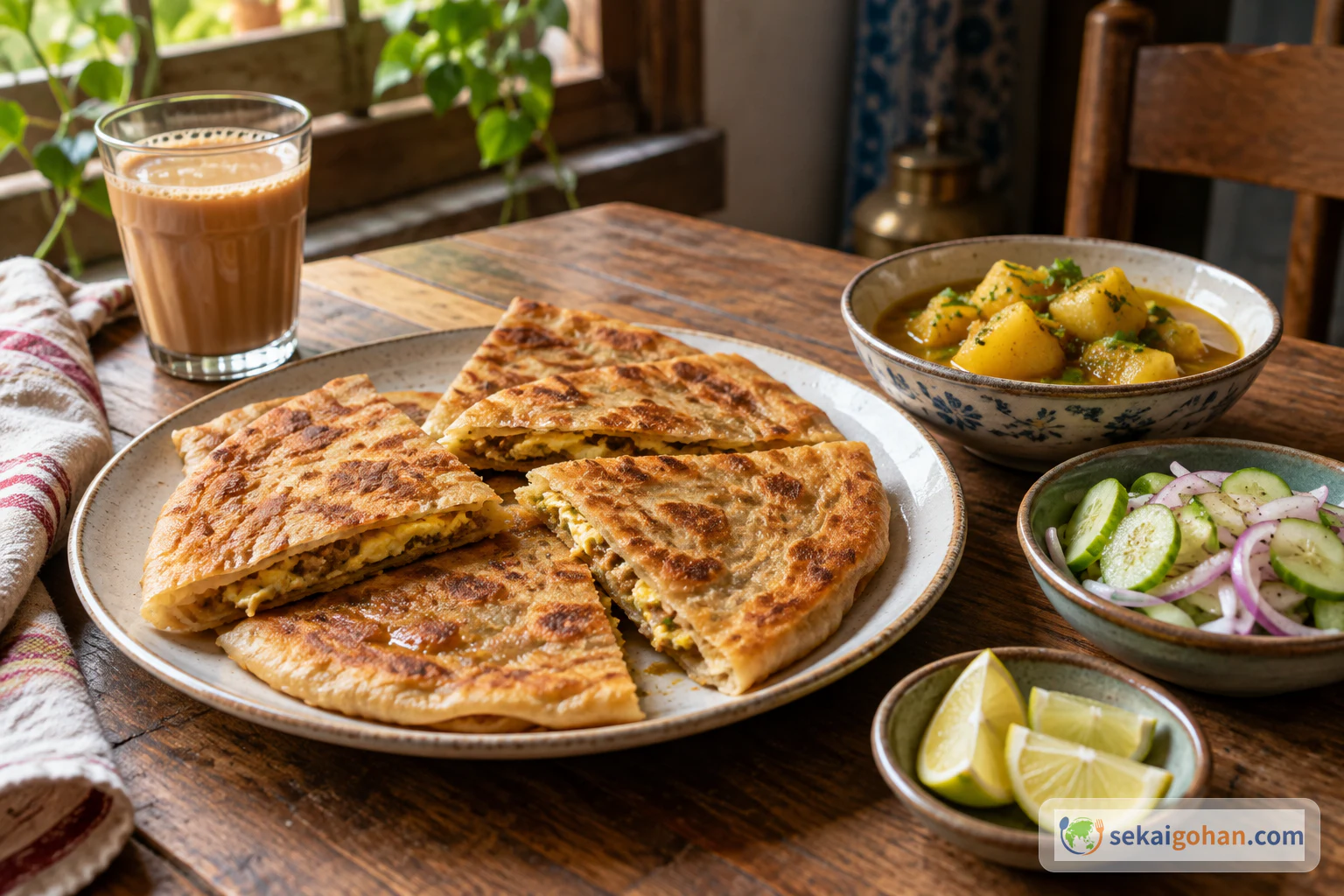
The potato stew served alongside in Kolkata doesn't compete on heat. Boiled potatoes are warmed with a little oil, salt, turmeric, green chili and water, leaving some liquid. Break off a corner of paratha, top it with potato, and the potato, which has soaked up the aroma of the oil, falls apart in your mouth while raw cucumber and onion lighten the finish.
To make it, cut 2 potatoes into bite-size pieces, put them in a small pot with a pinch of salt, a little turmeric and ½ cup (100 ml) of water, and simmer over medium-low heat for 8 minutes. Turn off the heat before the liquid is gone and reheat just before serving. Some people add ketchup; a little, when you want acidity, won't hide the garam masala.
Two parathas with potato and raw vegetables make a filling meal, and adding rice or curry tips it into heavy. If you want to move on to Bengali seafood, serve it as a separate plate, such as chingri malai curry.
Storing and reheating
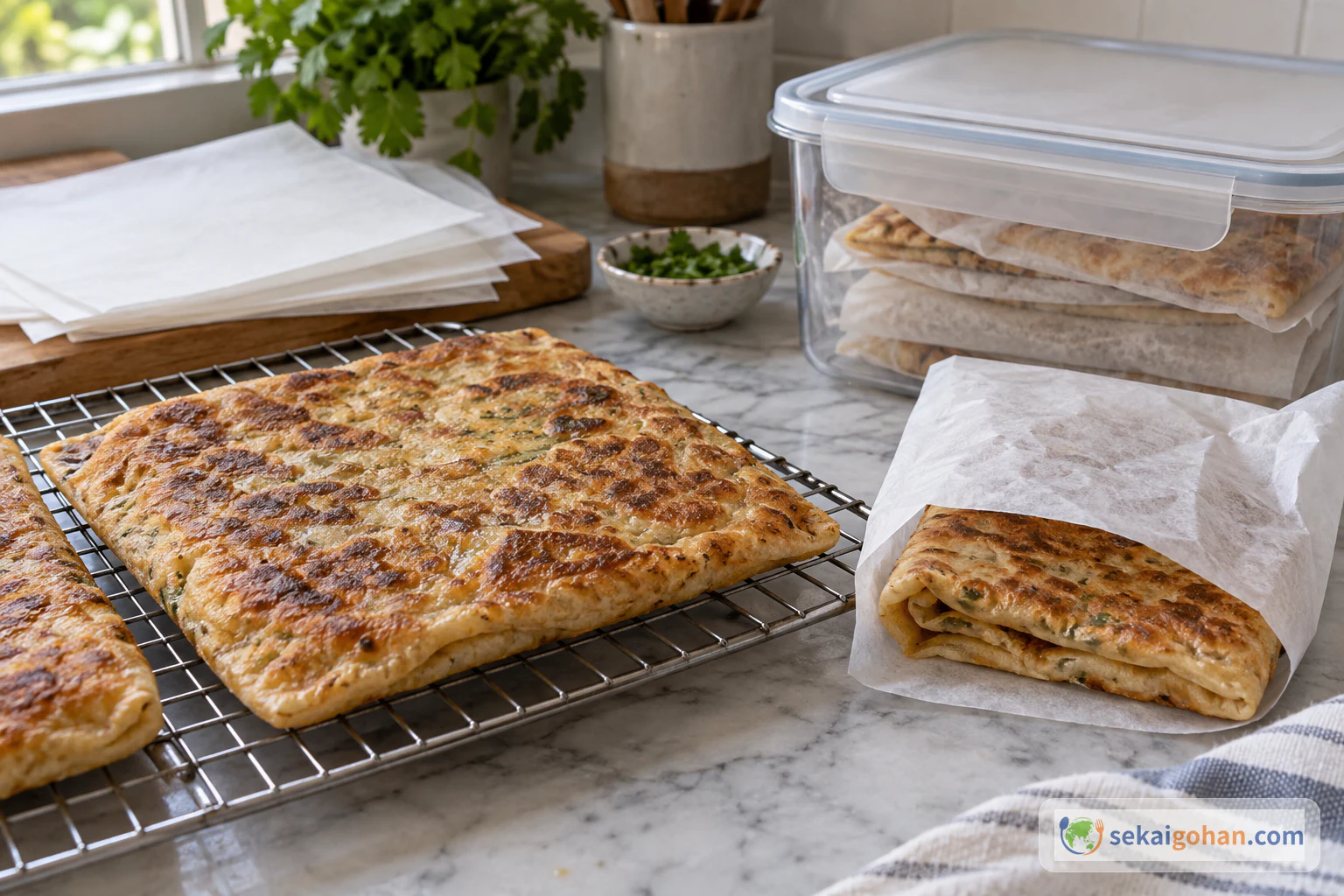
Cool freshly cooked parathas fully on a rack, wrap each in parchment or plastic wrap, and refrigerate; at this small size, aim to eat them the next day. For longer storage, seal each one individually on the day, once the heat is gone, and freeze.
Reheat a refrigerated paratha in a frying pan over low heat without oil, 2–3 minutes per side. If the surface is too dry, drop just 1 tsp of water at the edge of the pan and cover immediately to steam for 30 seconds; water poured directly on the dough weighs down the layers, so keep that as a last resort. Thaw frozen ones in the refrigerator and reheat in the oven or the same way in the pan, breaking one open to check the center isn't still cold.
If you prepare the raw egg and chicken filling in advance, keep it in the refrigerator, never at room temperature, and only for a short time. Reheat cooked parathas until the center is hot, and don't eat one that has sat out at room temperature for long.
FAQ
Is Mughlai paratha an Indian dish or a Bangladeshi dish?
It's easiest to see it as a dish of the whole Bengal region. It appears in Bangladeshi recipes and in the eatery culture of Kolkata in West Bengal, India. Rather than settling it by national borders, enjoy the differences in name, filling and where it's eaten as regional variation.
What if rolling the dough out to translucent is difficult?
Don't try to roll it to 8 × 5.5 inches (20 × 14 cm) in one go: press it with your palm, rest it 5 minutes, and roll gradually from the center outward. If it springs back, give it more rest rather than more flour. Pinch a small hole closed before the filling goes on; if the hole is large, turn just that piece into a smaller folded-in-half size.
Can I switch to ground beef or lamb?
Yes, but the safe temperature and cooking times here are based on chicken. Beef and lamb mince differ in fat and grain size, so cook the moisture off well and spread the filling thin. Check the safe center temperature for the meat you use, and don't judge doneness by color alone.
Can I make it with less oil?
You can, but as it moves toward a plain pan-fried flatbread, the layers at the folded edges dry out and turn hard. Start with about 0.25 inch (5 mm) of oil, cook one side at a time, and use the lid briefly to carry heat to the center. If you want the light fried finish of the Kolkata style, 0.5 inches (1 cm)–0.5 inches (1.5 cm) of oil is more reliable.
I don't like cilantro or green chili.
Swap the cilantro for scallion and leave out the green chili. The ginger, garlic, cumin and garam masala carry the aroma on their own. If you want more heat, put a little chili sauce on the table instead of adding moisture to the filling.
Can I wrap the filling the next day?
It works best to cool only the cooked chicken, seal it and refrigerate, then combine it with the egg and wrap the next day. Egg left mixed in for long releases moisture, and the dough tears more easily. Cook any filling you reuse thoroughly to the center, and don't use it if the smell or condition seems off.
Sources
These are the sources actually opened to check the cultural background, the cooking steps and the safety notes in the text. All access and check dates are 22 September 2026 (JST). They were not used as evidence for product prices or stock.
- Why Mughlai Paratha is slowly disappearing from Kolkata's food culture (Telegraph India / My Kolkata) — Published 4 August 2026, accessed and checked 22 September 2026 (JST).
- Mughlai Paratha Recipe (King Arthur Baking) — Accessed and checked 22 September 2026 (JST). Checked the Bangladeshi-style ingredients and steps.
- Mughlai cuisine: How 16th century empire food found its way to our tables (The Business Standard) — Published 27 August 2021, accessed and checked 22 September 2026 (JST).
- Safe Food Handling (U.S. Food and Drug Administration) — Accessed and checked 22 September 2026 (JST). Checked cooking temperatures for chicken and egg dishes and the handling of fresh foods.