Take the leftover rice out of the refrigerator and loosen it with your fingers. Garlic, chili and sweet soy sauce hit the hot pan, the smell rises, and at the end you break the yolk of a fried egg over the top. Nasi goreng is Indonesia's fried rice, and its flavor is built in layers: sweetness, saltiness and heat. The dish depends less on extra ingredients than on getting the rice and seasonings right, one step at a time.
The cold rice it starts from is rice that has been cooled safely in the refrigerator, never rice left out at room temperature. Rice handled that way goes into the pan as dry, separate grains. Start there, and even a home stove can bring sweet, salty, hot and toasty together on one plate.
Nasi Goreng in Indonesia
The name simply means "fried rice" in Indonesian. Cooks make it from leftover lunch or dinner rice and serve it for breakfast or dinner, everywhere from hotels to street stalls. It might be a plate stir-fried to order at a late-night stall or a quick breakfast at home, and being made from leftovers takes nothing away from its standing.

The add-ins change freely. Use chicken, fish or vegetables, and the sweet soy sauce and aromatics still make it recognizably nasi goreng. Nobody can pin its origin to a single date. Chinese immigrants brought the stir-frying technique, and over generations local seasonings and local tables turned it into something different from Chinese fried rice.
Regional Styles of Nasi Goreng
Indonesia has "at least 104 kinds" of nasi goreng, which tells you how far the dish has spread and how much it changes from one place and one home to the next. Ingredients, heat, aroma and even the time of day it's eaten all shift the impression. Here is how a few styles translate to a home kitchen.
| Direction | How the flavor shows | How to approach it at home |
|---|---|---|
| Nasi goreng kampung | Plain, built on aromatics and chili | Use less kecap manis and fry garlic and onion first |
| Javanese sweet-spicy flavor | The color and gloss of sweet soy sauce come forward | The base of this recipe. Add heat afterward with sambal |
| Nasi goreng kambing | A strongly aromatic street food using lamb or ghee | Make it with chicken and add more black pepper for aroma |
| Surabaya's red fried rice | Bold in color and heat | Add more chili and keep the red by not overdoing the kecap manis |
Every shop and household has its own version. For your first plate, let the sweet soy sauce lead and adjust the heat afterward. If you like comparing, try mie goreng, which takes the same idea to noodles, and nasi liwet, where the rice is cooked with coconut and chicken broth. Side by side, the dry grains and glossy seasoning of nasi goreng stand out.
Ingredients (serves 2)

Seasonings
| Seasoning | Amount | Role |
|---|---|---|
| Kecap manis | 2 tbsp | Sweetness, color, gloss |
| Dark soy sauce | 1 tbsp | Saltiness and toasty aroma |
| Terasi | 1/2 tsp | Umami of fermented small shrimp. Omit if you dislike it |
| Sambal oelek | from 1 tsp at the table | Heat. Do not mix in the full amount at the start |
| Black pepper | a little | Outlines the meat and aromatics |
| Lime | 1/4 | Sourness for the finish. Optional |
Terasi is a seasoning made by fermenting small shrimp with salt, and its aroma is strong. If you have a shrimp or seafood allergy, do not use it, and check the ingredient labels. Fish sauce is optional. If you use it, keep it to about 1/2 tsp so the Thai fish sauce aroma does not come forward too far.
Think about rice safety on its own, apart from fluffy, separate grains. Divide cooked rice into wide, shallow containers and refrigerate it as soon as you can. Do not leave rice or leftovers at room temperature for long. Keep cold food at 39°F (4°C) or below. Rice left out overnight at room temperature cannot be made safe by frying it.
Choosing Ingredients for Nasi Goreng
Kecap Manis
Kecap manis is an Indonesian sweet soy sauce, thicker, sweeter and more syrupy than ordinary soy sauce. It sets the color and flavor of nasi goreng in one step, so if you plan to make the dish again, buy this first. When you shop, make sure the bottle is sweet soy sauce and not tomato ketchup, and note the contents, the country of origin and how to store it after opening.
If you're cooking it once, or want less sweetness, a homemade version is fine. Put 2 tbsp soy sauce, 1 1/2 tbsp brown sugar or raw cane sugar and 1 tbsp water in a small pot and reduce over low heat for 2–3 minutes, until the sugar dissolves and the syrup falls from a spoon in a thin thread. It thickens as it cools and scorches easily, so take it off the heat before it gets as thick as the bottled kind. Make one batch only, keep any leftovers in a clean container in the refrigerator, and use them up soon.
Sambal Oelek
Sambal oelek is an Indonesian chili sauce made mostly from red chilies. Put a lot in the pan at the start and you can't take the heat back out. Serve it in a separate dish and add it bite by bite, and the sweet rice keeps its aroma.
A jar is worth buying if you cook spicy food several times a month and would also use it in stir-fries and with grilled meat. If you dislike heat or are cooking a single portion, use a little fresh red chili or leave it out. Check the contents, country of origin and storage instructions when buying.
Substitutes
| Local element | Choice elsewhere | What changes |
|---|---|---|
| Kecap manis | Store-bought, or soy sauce + brown sugar | Store-bought gives color and body quickly. Homemade lets you adjust sweetness |
| Terasi | Fermented shrimp paste, a little anchovy, or omit | Leaving it out reduces seafood depth, but it still works as sweet-savory fried rice |
| Bird's eye chili | Red chili, sliced chili | Heat builds more gently |
| Krupuk | Prawn crackers, fried rice crackers, or omit | Adds a light texture outside the rice |
| Short-grain rice | Chill well and loosen the grains | It does not become as dry-grained as long-grain rice, but with less seasoning it is less likely to get heavy |
These swaps aren't meant to copy the original taste exactly. Their job is to remove the usual causes of failure in a home kitchen. Terasi and krupuk can wait until the second time you make the dish.
The Pan
An ordinary frying pan works for two servings. If you stir-fry often over a gas flame and want room to spread the rice and drive off moisture, a 13 inches (33 cm) carbon-steel wok is worth considering. On induction, if you'd rather skip extra pan upkeep, or if you're cooking this once, stick with the pan you have. Some iron woks don't work on induction. There, use a flat-bottomed, induction-compatible pan and keep it flat rather than tilting it to heat one spot.
Method: Raise the Aroma, Then Add the Rice
STEP 1: Prepare the rice and ingredients (10 min)
Move the refrigerated rice to a bowl and loosen only the big clumps with a rice paddle. Cold rice is fine to use, but don't leave it at room temperature for long. Cut the chicken into 0.5 inches (1 cm) dice, the onion into 0.25 inch (5 mm) dice, finely chop the garlic and slice the chili thinly on the diagonal. Measure the seasonings into small dishes.

If you have no cold rice, spread freshly cooked rice thin to let steam escape and, when it has cooled down, refrigerate it in a shallow container. A freezer only dries the surface and does not cool hot rice safely. Do not confuse cooling rice with leaving it at room temperature.
STEP 2: Stir-fry the aromatics and chicken (4 min)
Preheat a wok or a frying pan of 10 inches (26 cm) or larger over medium to high heat. Heat an iron pan until it shimmers slightly when oil goes in; do not heat a coated pan empty. Add 1 tbsp oil and stir-fry the garlic, onion and chili for 30 seconds. When the corners of the onion turn a little translucent and the garlic smells fragrant, add the chicken.
Stir-fry the chicken for 2–3 minutes, turning, and cook it through to the center, not just the surface. If the meat releases moisture that collects on the bottom, raise the heat one notch, push the ingredients to one side of the pan and drive off the moisture. If you use terasi, add it here and fry for 20–30 seconds to round out its aroma.

STEP 3: Stir-fry the rice and seasonings (5 min)
Push the chicken and aromatics to one side of the pan and put the rice in the space. Do not press it with the spatula; turn it in a cutting motion to loosen the clumps. When the grains are loosened and the moisture on the bottom of the pan is gone, pour the kecap manis and soy sauce around the edge of the pan.
Stir-fry for 1–2 minutes, until the seasoning is evenly coated on the rice. Spread it out for about 30 seconds to brown, then turn it once the grains on the bottom are dry and toasty. Kecap manis contains sugar and scorches easily, so keep everything moving before it turns black and hard.

It is done when the rice is dark brown and no liquid pools on the surface. Press it with the paddle: the grains should spring back. Bite one: the outside should be toasty and the center not too firm. If the saltiness is lacking after tasting, add soy sauce 1/2 tsp at a time. Do not mix in a lot of sambal at this point.
STEP 4: Fry the eggs (3–4 min)
Put the remaining oil in another frying pan and crack in 2 eggs over medium heat. When the edges bubble and the white sets to the center, lower the heat. For a runny yolk, do not cover, and turn off the heat once the white has set. For a yolk set through the center, cover and cook 1–2 minutes longer.

People who want to avoid raw or runny eggs, and anyone who needs to be careful about food poisoning risk such as children and older adults, should cook the yolk through. If you used the pan for raw meat, wash it before using it for plating.
STEP 5: Plate (2 min)
Divide the nasi goreng between 2 plates and top with the fried eggs. Put the cucumber and tomato on one side and add the krupuk. Plate within 2 minutes of turning off the heat. On the plate, the grains should look dry on the surface with an even gloss. Put the sambal in a separate dish starting at 1 tsp, and squeeze the lime, if using, just before eating.

Fixing Sticky, Scorched or Flat Nasi Goreng
| What happened | First place to look | Next move |
|---|---|---|
| Rice is sticky | Insufficient cooling, moisture in the pan, too much sauce | Spread the rice to drive off moisture and stop adding seasoning. Do not try to fix rice left at room temperature by frying it |
| Flavor is sweet and heavy | Added too much kecap manis first | Add a little unsalted rice or fried ingredients and add lime a drop at a time |
| Weak aroma | Garlic under-cooked, terasi omitted | Add sambal at the table, and next time use 1/2 tsp terasi |
| Too hot | Increased the chili and sambal at the same time | Serve with a fried egg, cucumber and unsalted rice to divide the heat bite by bite |
| Bottom of the pan goes black and hard | Did not keep the kecap manis moving | Do not stir the burnt part in; finish the rest in another pan. Do not use fully charred parts |
You can't tell whether rice is safe from its smell or look, and reheating won't make rice that sat at room temperature for a long time safe again. If you're unsure how it was stored, throw it out rather than trying to rescue the flavor.
Serving Nasi Goreng
Add a fried egg with a runny yolk, cool cucumber and crisp krupuk, and the same fried rice starts to feel like a plate from a street stall. Keep the sambal on the table, not in the pan.
First build sweetness and color with kecap manis, then add just a little terasi for the depth of fermented shrimp. Do not fry the sambal in; serve it at the table. In this order, you can make a mild plate for children and a hot plate for adults from the same pan.

When you're ready for more, see how the same sweet soy sauce works on noodles in mie goreng.
Sambal Terasi for the Table
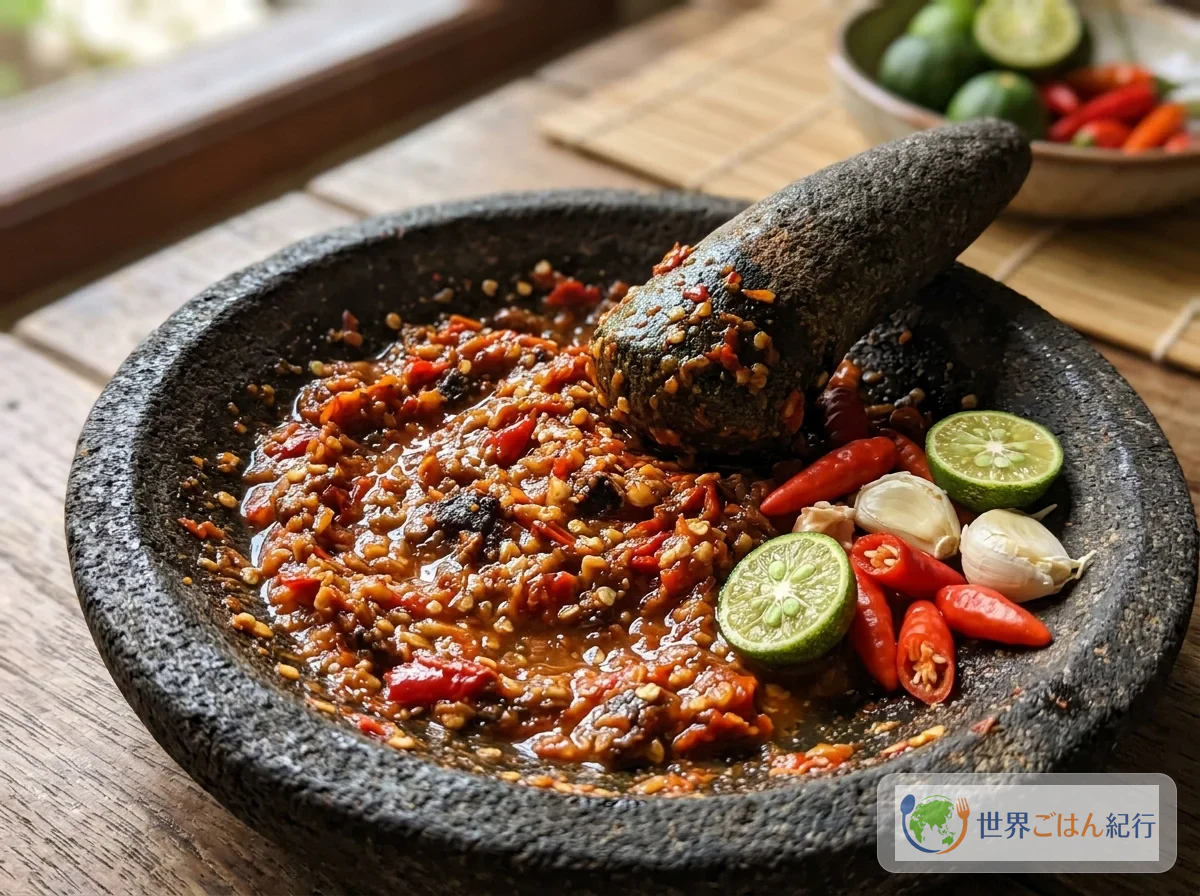
Store-bought sambal oelek gives you heat with no work. When you want the deeper aroma of terasi, fry a small batch of sambal terasi and serve it on the side. Sambal is a whole family of chili sauces and every kitchen makes its own, but here its job is to be a strong partner for nasi goreng.
Ingredients (serves 2–3)
| Ingredient | Amount |
|---|---|
| Red chili | 3 |
| Garlic | 1 clove |
| Onion | 1/4 |
| Terasi | 1/2 tsp |
| Sugar | 1 tsp |
| Lime juice | 1 tsp |
| Salt | a pinch |
| Oil | 1 tbsp |
Method
- Coarsely chop the chilies, garlic and onion.
- Heat the oil in a frying pan over medium heat and fry the terasi for 20–30 seconds.
- Add the chopped ingredients and stir-fry over medium-low heat for 5–7 minutes.
- Turn off the heat and mix in the sugar, lime juice and salt. When it has cooled a little, taste and adjust.
Make only what you need for 2 servings of nasi goreng and use it up soon. Once it has cooled, put it in a clean container in the refrigerator rather than leaving it at room temperature. Terasi contains shrimp, so check the labels for shrimp and seafood allergens.
Frequently Asked Questions
I only have freshly cooked rice
Spread it thin to let the steam escape, and once it has cooled down, refrigerate it in a shallow container. Don't leave it sitting at room temperature to cool. If you can't wait for the grains to firm up in the refrigerator, cut back on the add-ins, use less sauce and fry one serving at a time.
I'm worried about the smell of terasi
Even 1/2 tsp is enough for aroma, and frying it in oil for 20–30 seconds before it meets the rice softens the sharp smell. If you need to avoid seafood, leave it out and adjust with a little soy sauce and sambal at a time.
Do I mix in all the sambal oelek?
Start with 1 tsp in a separate dish. Take a few bites of the sweet rice first, then add more, and you'll notice how the heat and aroma change. If your family members handle heat differently, keep the sambal out of the pan so everyone can add their own.
Can I store leftover nasi goreng?
Divide it while it's still hot, cool it in shallow containers and refrigerate it soon. Anything that has sat at room temperature for a long time shouldn't be stored. When reheating, heat it all the way through and warm only as much as you'll eat.