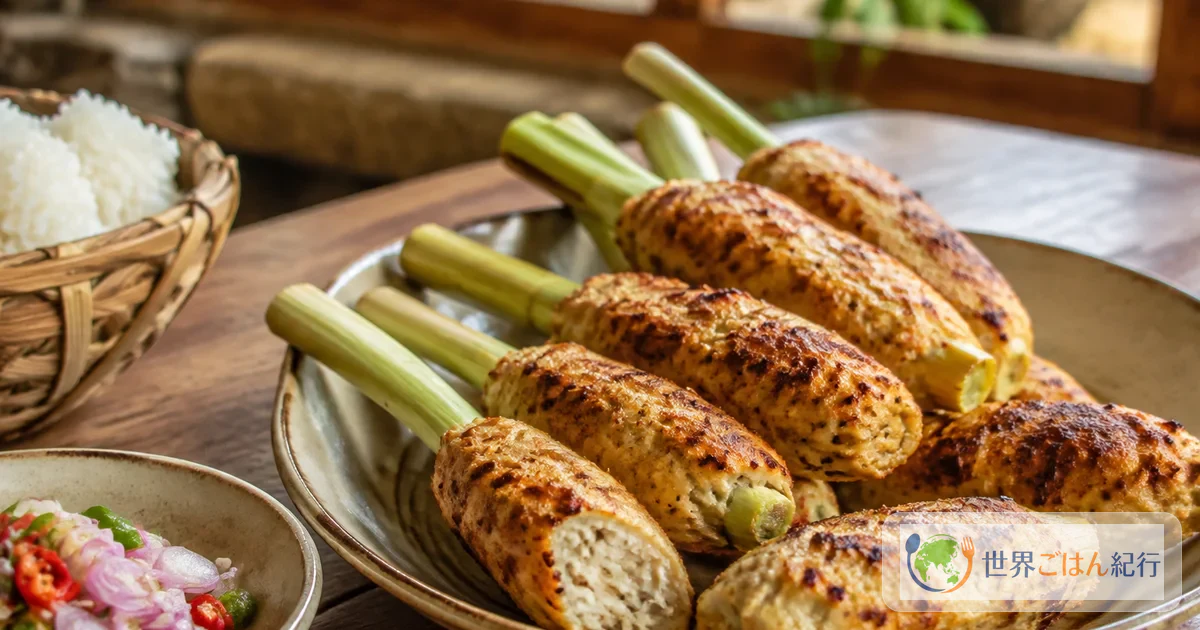
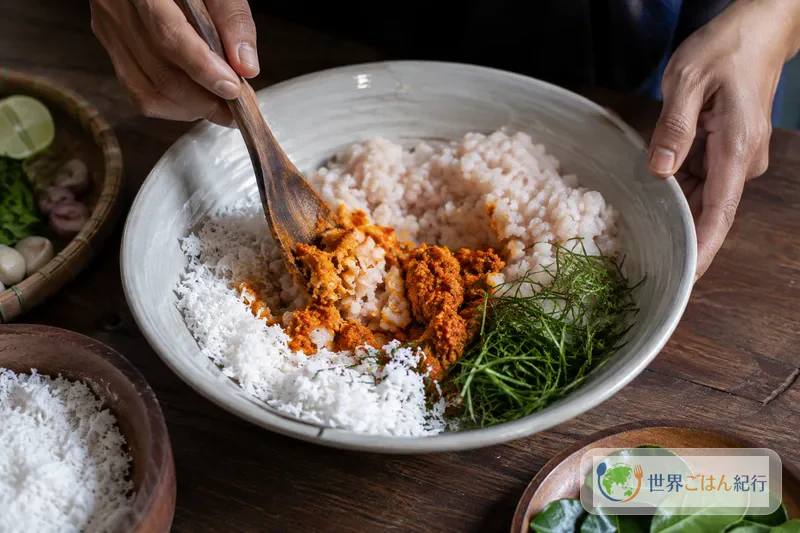
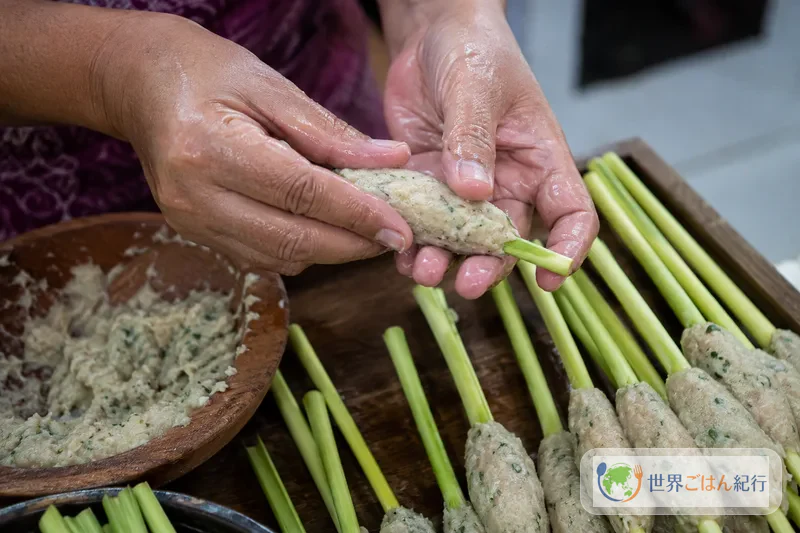
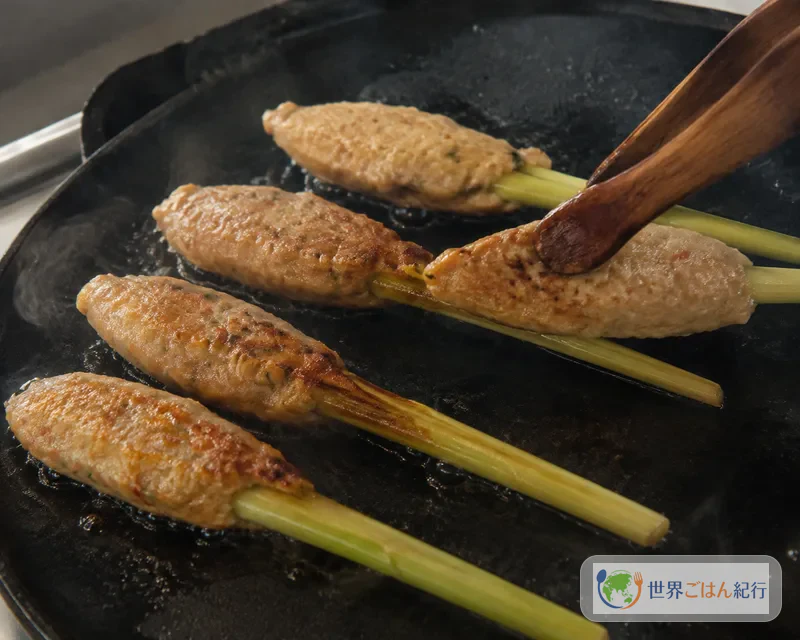
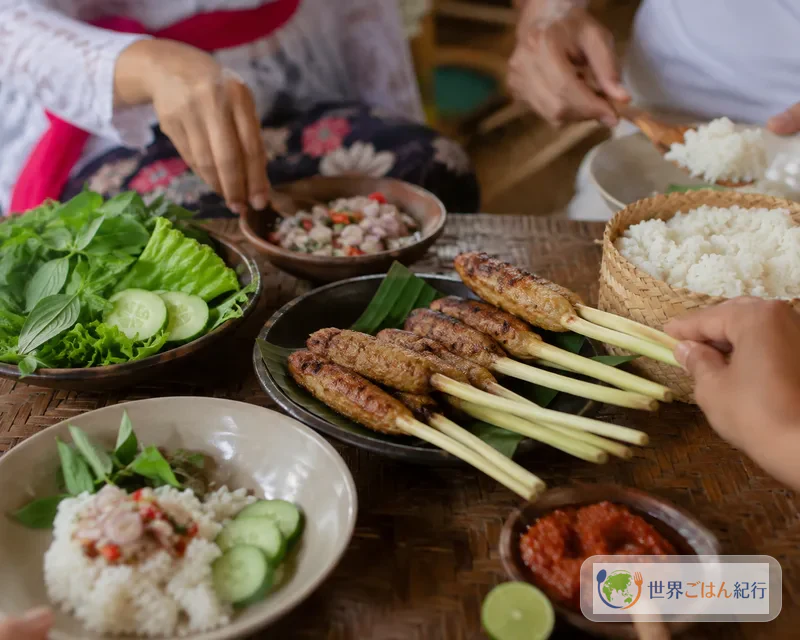
The moment the sticks touch the grill, the scent of chopped lemongrass and makrut lime leaf rises. The fish on the surface turns white and firm, bits of oily coconut pick up color here and there, and the mixture wrapped around each slender stalk slowly tightens. Sate lilit is a Balinese home dish of white fish, aromatics, coconut and chile, wound around a thick lemongrass stalk that doubles as the handle. Eaten hot off the grill with white rice and raw sambal, it brings together green citrus fragrance, chile heat and the soft roundness of coconut.
Sate lilit on the Balinese table
Many people hear the word "sate" and picture small pieces of meat lined up on thin bamboo skewers. Sate lilit departs a little from that image. The Indonesian and Balinese word "lilit" refers to the motion of winding or wrapping: instead of threading cut meat onto a skewer, you spread seasoned minced fish or meat by hand and wind it around a stick. The stalk becomes the handle, and because the mixture has more surface, the aromatic paste and the grill marks come together in one bite.
Traditionally, the mixture is set on bamboo, lemongrass or coconut leaf stalks and grilled over charcoal. At traditional events and religious ceremonies in Klungkung Regency, Bali, sate lilit of chicken, pork and sea fish is served, and it also appears at weddings and temple festivals. The main ingredient changes with what is on hand, but the shape wrapped around a stick, the aromatics ground together from roots and leaves, and the habit of eating it hot with white rice and raw sambal are what keep it Balinese. Because the dish adapts so easily to local ingredients and sticks, it moved into home kitchens too.
Shared chopping before a festival
In Bali, sate lilit is made for every festival and feast as a communal task: neighbors chop the meat and prepare the aromatic paste the day before. Rather than one person making a huge amount of fish or meat smooth alone, the hand work of chopping, mixing and winding onto sticks is divided up. By the time the grill cook starts, mixture of the same thickness is already lined up, so less time is spent shaping it by the fire.
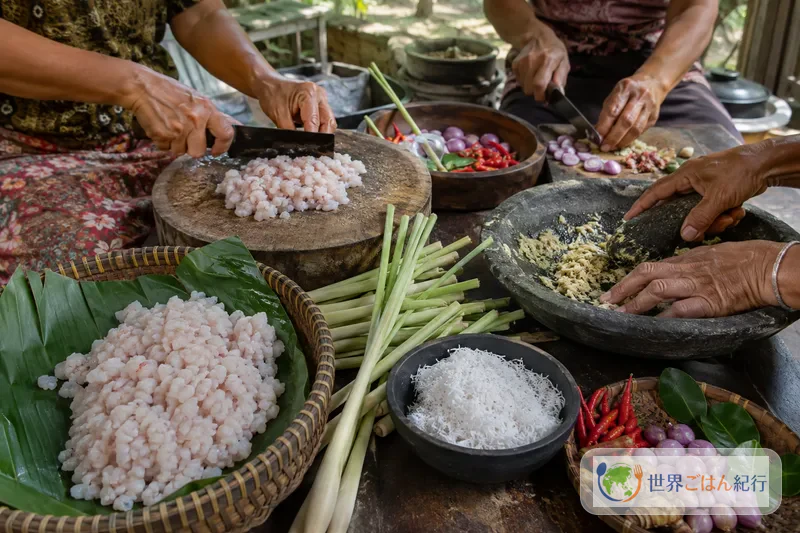
A home kitchen can borrow a small version of this. Divide the mixture into 8 beforehand, wrap the sticks together as a family, and put the hot sticks in the center of the table.
Coconut-husk fire and the home grill pan
In Bali there is a method of grilling over a fire of coconut husks, where the smoke adds to the aroma. A heavy grill pan, flat griddle or nonstick pan can stand in for charcoal, though the aroma will not be the same. Rather than chasing smoke, you get closer to the dish by thinning the mixture, drying the surface slowly and keeping the lemongrass from scorching. Burning husks or wood chips indoors to add a charcoal-like smoke is dangerous.
Ingredients: white fish and spiced coconut for 8 sticks
Buy fresh fillets at the fish counter and chill them right after you get home. Firm-fleshed fish such as sea bass or sea bream are easy to handle, and fresh cod also works well. Oilier fish bind more easily, but they make the aromatic outline heavier. Start with a mild white fish so you can taste the lemongrass and lime leaf more clearly.
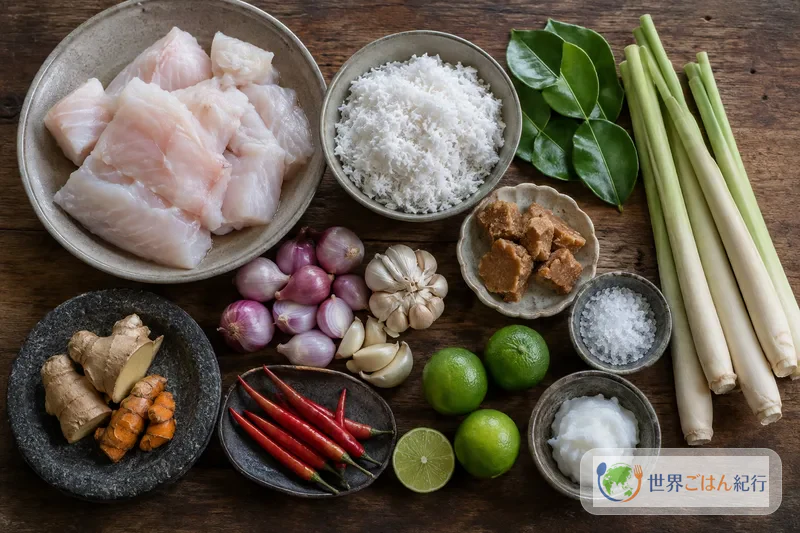
Makrut lime leaves layer a green citrus note over the fat of the fish that lemongrass alone cannot provide. For this dish, frozen leaves divided into small portions are more practical than waiting for fresh ones. Dried leaves smell rounder, so rather than crushing them fine, rehydrate them in water and then chop them to keep the leaf aroma.
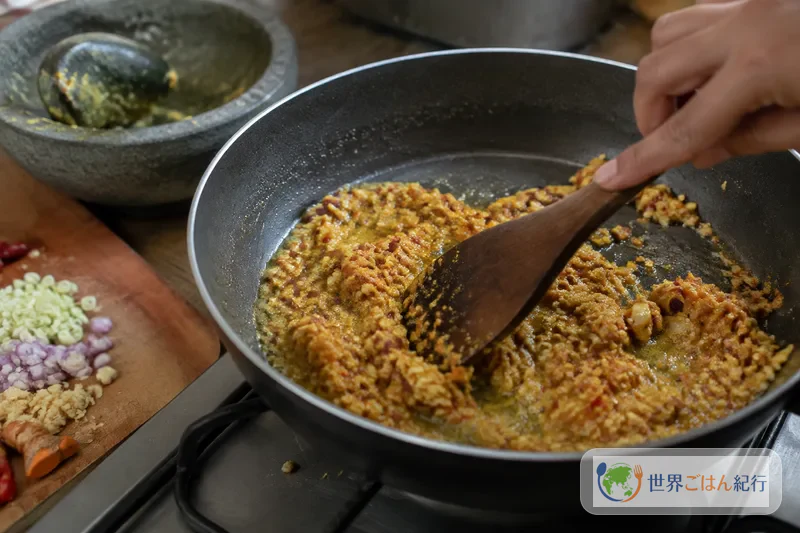
The aromatic paste can be chopped finely with a knife and then ground in a mortar. If you want to develop only stickiness without making the fish smooth, a food processor that can pulse in several bursts is handy with cold fish. For just 8 sticks, though, a knife is enough. If you are thinking of buying a machine, first ask whether you will often chop aromatics, meat and nuts for other dishes too. There is no need to keep a large machine for one plate, and if you have no storage space, a knife and mortar are the more reasonable choice.
Choosing fish and aromatics for sate lilit
White fish
White fish whose skin and bones can be removed, such as fresh cod, sea bass or sea bream, is easiest to handle. Coastal Balinese fish sate lets delicate aromatics support the scent of the flesh, and lean white fish holds the coconut while still flaking softly when you bite. If the flesh is very soft, dry it thoroughly, cut it into 1 inches (2 cm) cubes and chop it while still cold.
Salmon works too, but its fat and aroma are stronger. Reduce the coconut oil to 2 tsp so it won't turn heavy, and add lime just before eating.
Chicken and pork
With minced chicken thigh, the mixture is springier than fish and stands up strongly to the aromatic paste. With minced pork, the sweetness of the fat comes forward, so use 1.75 oz (50 g) of coconut and a little more chile to keep the outline from blurring.
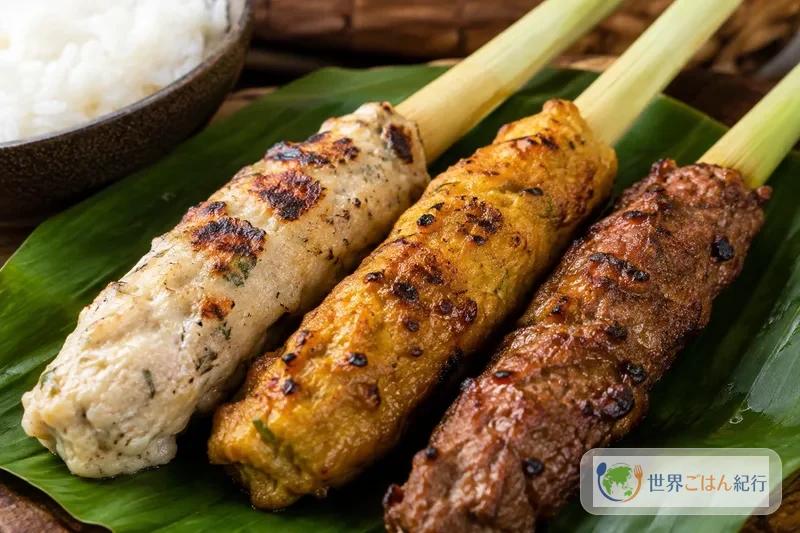
Both must be cooked through to the center. Aim for about 74°C at the center for chicken and about 160°F (71°C) for pork as ground meat, and don't make the sticks thicker than the fish version.
Base genep and a simplified paste
Base genep, the foundation of Balinese cooking, is an aromatic paste ground from shallots, garlic and chile along with galangal, ginger, kencur, turmeric, candlenuts, shrimp paste, lemongrass and more, and it is used for meat, fish and vegetables alike. A full batch makes around 14 oz (400 g), though, far more than 8 sticks need. Galangal and kencur give depth of aroma, but outside Southeast Asia they are easily left over after one shopping trip, so ginger and makrut lime leaves carry the paste here.
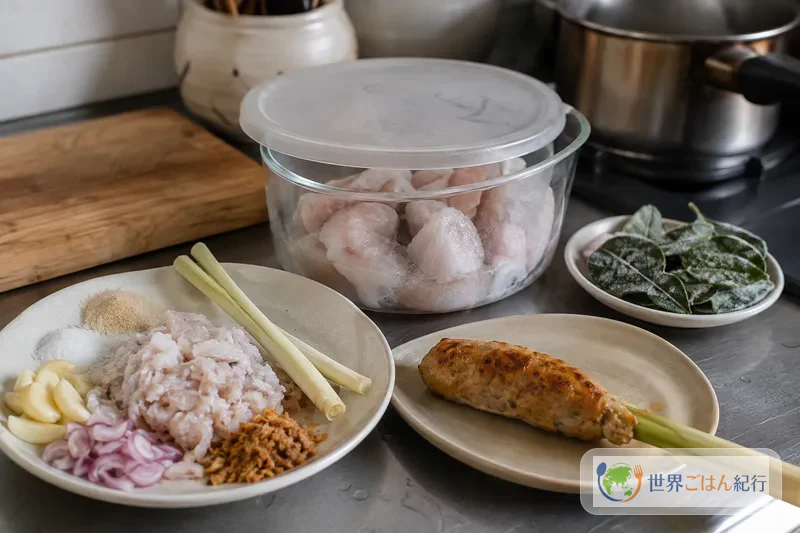
If you want the richness of candlenuts, add 10 g of unsalted macadamia nuts to the aromatic paste. If you add shrimp paste, start with 1/2 tsp, and leave it out for anyone with a shrimp allergy or anyone who prefers the clear aroma of fish alone. Keep the fish pieces, the roundness of the coconut, the lemongrass handle and the green scent of makrut lime leaf, and the dish comes across without any more root vegetables. If the fragrant leaves are hard to find locally, they are the one thing worth ordering.
Method: cool the aromatics, wrap thin, and grill
What decides how easy the shaping is: do not combine the fish with the fried aromatic paste while it is still hot. Cook off the moisture from the paste and let it cool, and chop the fish while cold. Before you put the sticks on the grill, cook one small bite as a test, so you can adjust the saltiness and heat and mix the whole batch again.
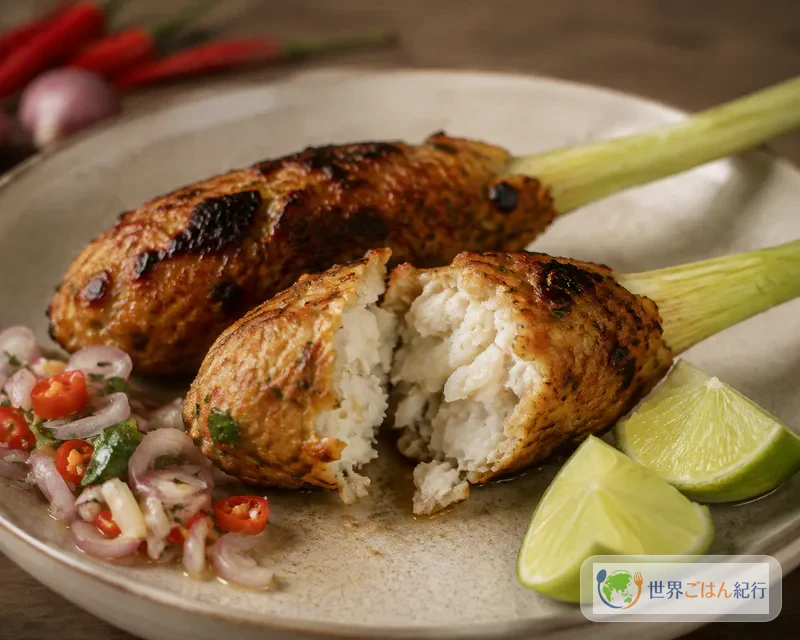
Move the cooked sate to a plate and let it rest 2–3 minutes before serving. While it rests, the surface oil settles, and the mixture is less likely to slide off the stalk when you pick it up. For the sambal matah on the side, combine the shallot, lemongrass, chile, makrut lime leaf and salt, and add the warmed coconut oil and lime juice just before eating.
Fixing common sate lilit problems
With sate lilit, success depends less on seasoning than on the moisture and thickness of the mixture. A small test fry before wrapping makes corrections much easier.
The mixture cracks or slides off
If the mixture cracks, either the fish is too dry or you shaped it before it had chilled enough to turn sticky. Return the whole bowl to the refrigerator for 15 minutes, then press the surface again with wet hands. If it still crumbles, knead in just 1 teaspoon of coconut milk for 30 seconds and test-fry another teaspoon; adding it by the tablespoon makes it too soft.
If the mixture slides off your hand or the stalk instead, the fish was not dried well enough or the aromatic paste went in while hot. Chill for 20 minutes, thin out the mixture and wrap again. Potato starch or flour would firm it up, but it pushes the texture toward fish cake and away from the springiness of the fish, so skip them.
Charred outside, raw center
The usual causes are a pan preheated too hard or a layer thicker than 1 inches (2 cm). Pushing the heat for early browning turns the turmeric color and the fish fat black before the center cooks. Lower the heat to medium-low, keep the turns to a minimum and use the lid to carry heat to the center.
Don't scrape off the burnt part and eat the rest. Move still-raw sticks to medium-low, cover, and cook 1–2 minutes at a time. Break the thickest part open and check that it has turned white and opaque or flakes with a fork; if the center is still translucent, don't eat it. When the center is white and the surface lightly browned, take the sticks off the heat and let them settle for 2–3 minutes on residual heat. Wash the cutting board and utensils that touched raw fish separately from the ones for serving.
A strong fishy smell
Before adding more aromatics, look at the fish itself. Choose raw fish with a mild, fresh smell, not a fishy, sour or ammonia smell, and refrigerate it right after buying rather than leaving it at room temperature. With fresh cod, press the surface dry with paper towels, and remove the veins of the lime leaves before slicing them thin; that layers aroma on top rather than just masking the smell.
Dry, crumbly sticks
Cooking too long over high heat, or processing the fish until too much water is squeezed out, dries out the mixture. Next time chop the fish coarsely while cold, don't cut the coconut below 2 oz (60 g), and leave the sticks alone for only the first 3 minutes of grilling. Dry sticks are easier to eat next to warm rice with a little lime squeezed over. Save the lime for serving time, though, since sourness mixed in early loosens the mixture.
Serving sate lilit
Served only as skewers, sate lilit is a strongly flavored fish dish. With white rice or rice crackers, sambal matah and a dressed leafy green beside it, the rice receives the fish fat and the sambal and greens add heat and crunch. On the Balinese table, sambal is so familiar that people eat it with rice alone when in a hurry. It places heat and sourness to the side, so each person can choose the strength of each bite.
Sambal matah and stand-ins
Balinese sambal matah is a raw accompaniment of purple shallot, lemongrass, chile and makrut lime leaf combined with warmed oil and lime, eaten for its crunch and fragrance. Place it at the edge of the plate rather than spooning it over the sate; the sate is flavorful enough to need no sauce. If you can't find fresh green or red chiles, a small dish of sambal oelek is a quick way to add chile heat. It is a red chile paste and not the same thing, so taste it first, serve it in 1/2 teaspoon increments and keep it out of the mixture and the raw vegetables. For people who avoid spicy food or dislike the smell of raw onion, lime alone is perfectly good.
Eating and pairing
Hold the lemongrass stalk and bite from the top a little at a time. The stalk itself is tough and not eaten, but it carries the fragrance and makes the sticks easy to handle at a table where people reach in with chopsticks or forks. For children or people using chopsticks, it is safer to slide the cooked mixture off onto a plate or rice and flake it. To use up spare lemongrass and lime leaves, pair it with urap as the vegetable plate, and make ayam betutu, a chicken dish with slowly infused spices, as the main on another day.
FAQ
Can I use frozen white fish?
Yes, but the water released on thawing loosens the mixture and changes the flavor, so it can bind less well than fresh fish. Thaw slowly in the refrigerator, never at room temperature, press the surface and cut faces dry with paper towels, and cook right after thawing. For a stable shape on your first try, fresh fillets are easier.
My lemongrass stalks are too thin to wrap.
Peel one tough outer layer first. If the stalk is still thin, press the mixture on thin and long instead of piling it on. If that still doesn't give you a handle, wrap the mixture around bamboo skewers, grill on a flat grill pan and pull out the skewer after grilling. An even layer on a bamboo skewer fails less often than forcing mixture onto a thin stalk and ending up with a thick center.
Does the flavor change without makrut lime leaves?
Yes. Lemongrass has a bright lemony scent, while makrut lime leaf smells green and citrusy, like a freshly folded leaf, so one can't replace the other. You can make the dish without the 5 leaves in the main mixture, but the aroma is one level shallower. Frozen leaves work: thaw, pat dry, remove the veins and cut into thin strips. Grated lime zest can make up some of the aroma; use only the green surface to avoid bitterness.
Can I store the finished sate lilit?
Keep the fish mixture refrigerated both before and after shaping, and grill it the same day if you can. After grilling, move it to a shallow container and cool it quickly. Don't leave grilled fish on the table at room temperature for more than 2 hours, or 1 hour on a hot day. Refrigerated at 40°F (about 4.4°C) or below, it keeps for 2 days. Reheat it until hot to the center, and discard it if there is any odor, sliminess or sour off-smell.
What if someone has a shrimp allergy?
The basic recipe has no shrimp paste, but Balinese aromatic pastes and sambals may contain it. Check product labels and manufacturing-facility labels, and leave it out if there is any doubt. The dish is made with fish, so it is not for people with a fish allergy. Keep a cutting board, knife and bowl just for raw fish, and wash the utensils before portioning if the people eating differ.