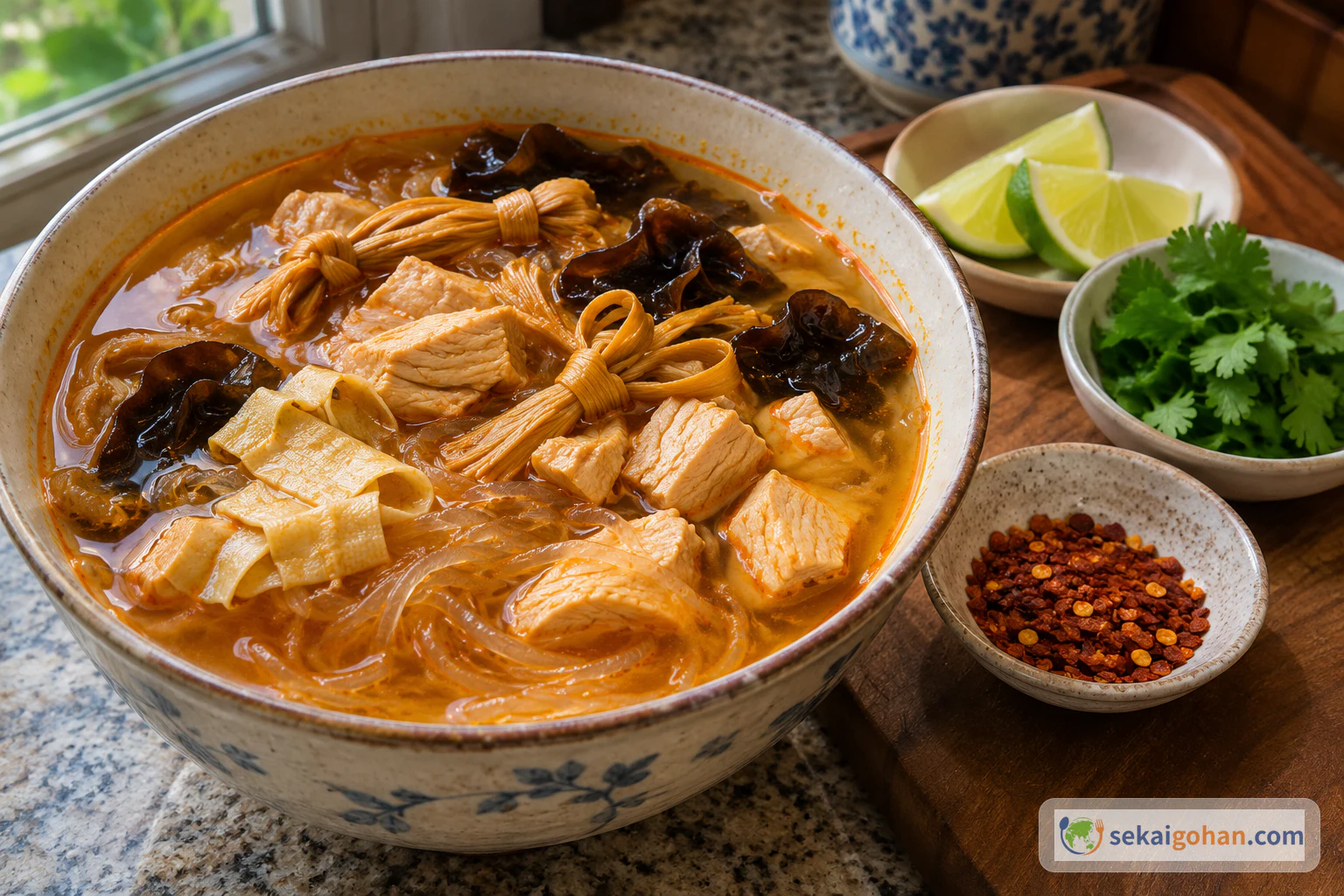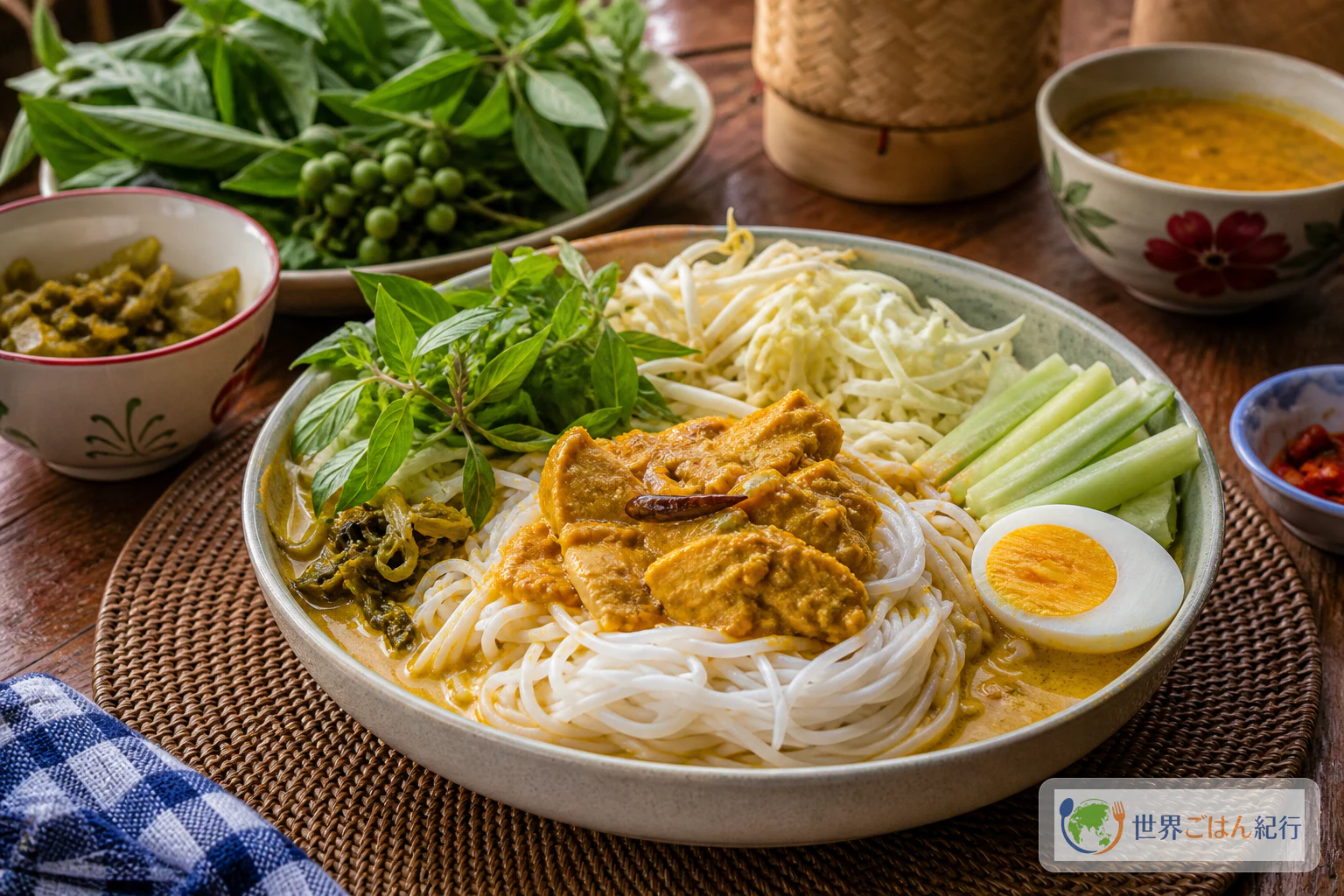
In the pot, coconut milk slowly turns yellow and the fish breaks into fine fibers that melt into the broth. On a separate plate, cucumber, bean sprouts, shredded cabbage, and herbs sit in small mounds, because a pot of steaming curry on its own only half sets a khanom chin nam ya table. Khanom chin nam ya (ขนมจีนน้ำยา) is fermented Thai rice noodles served under a fish curry sauce. The sauce is thick, the noodles are soft, and the raw vegetables stay crisp. The pale tang of the noodles and the water in the vegetables soak up the heat and salt of the sauce.
Khanom Chin Nam Ya and Its Regional Broths
Where the name and the noodles come from
Read literally, the Thai ขนมจีน suggests "sweets" and "China," but the dish is neither. The name comes from Mon, where words for something "kneaded and shaped" or "cooked" passed into Thai. It still carries the memory of an old process: rice kneaded into a dough and pushed out as noodles.
That process is very different from rice vermicelli, which is just rice flour mixed with water. In the traditional method, high-amylose rice is soaked for 4–5 hours and fermented for 3 days in contact with air. It is then wet-milled and fermented for another 3 days in salt water, then filtered, kneaded, heated, extruded, and boiled. An overnight soak at home won't give you the same noodle.
Fermentation is where the aroma comes from. Researchers have identified 43 volatile compounds in khanom chin, and many aroma compounds increase during the first 24–48 hours of fermentation. Behind the smooth softness of fresh noodles there is a slight sourness, and it tastes nothing like lemon squeezed into a sauce.
How it is eaten in Thailand
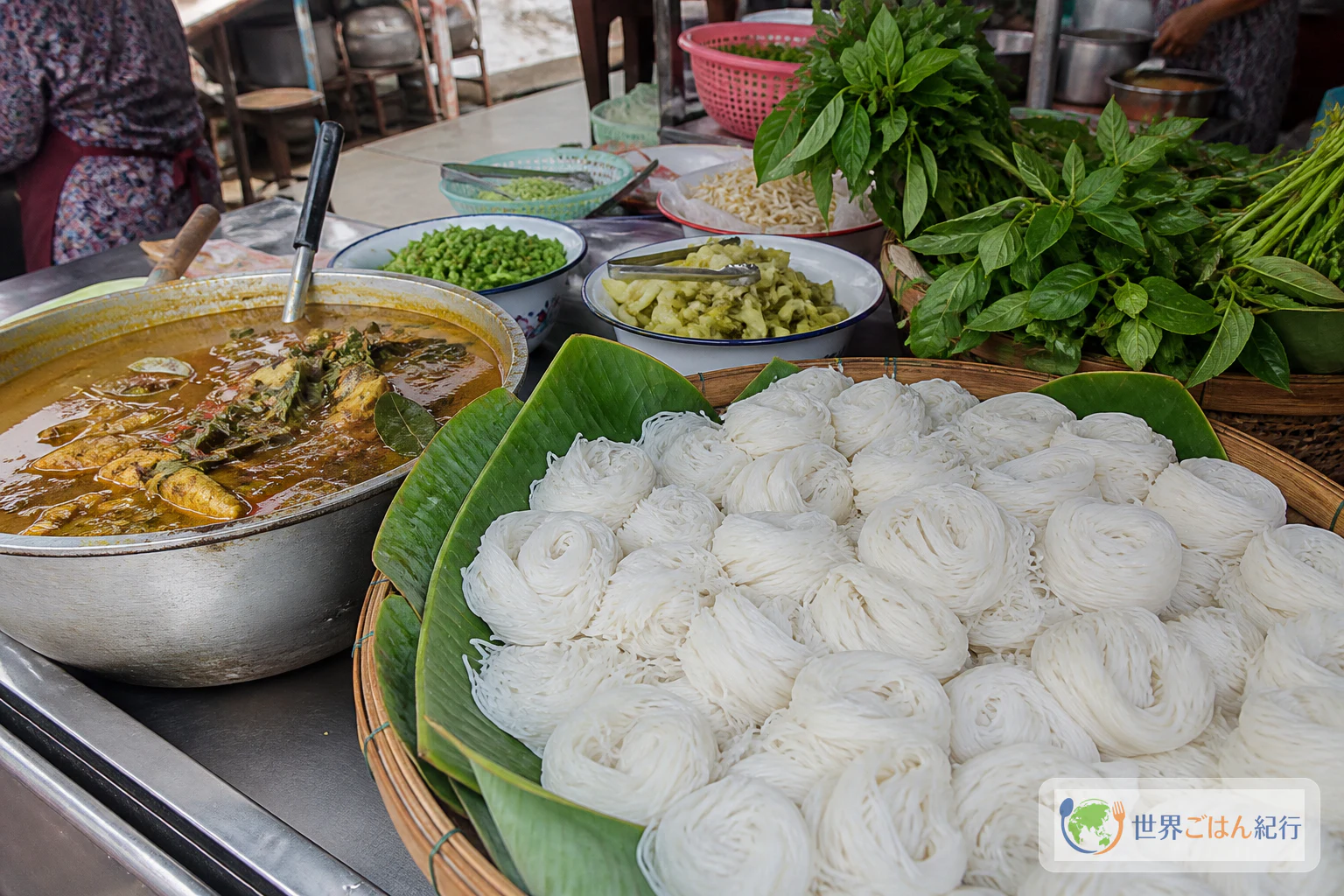
In Thailand, khanom chin spread as a staple that carries regional broths and curries rather than as a noodle dish of its own. You find it in markets and eateries, at family gatherings, and at temple offerings and community meals, and the broth and side dishes change with local ingredients. So a full plate is more than nam ya poured over noodles. It comes with raw vegetables, pickles, herbs, and boiled egg on the side.
Regional broths
Nam ya has no single fixed recipe. Regional broths served with khanom chin include fish-based nam ya, the spicy chili sauce nam prik, and northern nam ngiao with pork and tomato. The noodles stay the same, but fish, pork, tomato, fermented seasonings, or coconut shift the center of gravity of the dish.
| Region / name | How the broth is built | Accompaniments and impression | How to approximate it |
|---|---|---|---|
| Central, nam ya kati | Fish, coconut milk, lemongrass, makrut lime, turmeric | Mellow heat and fish savor. Raw vegetables lighten the sauce | This recipe, made with white fish and canned coconut milk |
| South, nam ya pak tai | Turmeric, lemongrass, garlic, shallot, strong chili | Hotter than central, with a sharper aroma. Plenty of vegetables and boiled egg | Increase the chili and reduce the coconut. Do not start out hot |
| South, nam ya pu | Crab instead of fish, or crab meat layered over fish | Sweet seaside meat in a spiced broth | Add canned crab at the end and do not overcook |
| North, nam ngiao | Pork, tomato, dried chili, dok ngiao and others | A tangy red broth with strong pork and herb presence | A separate dish from nam ya: serve the northern broth over the noodles |
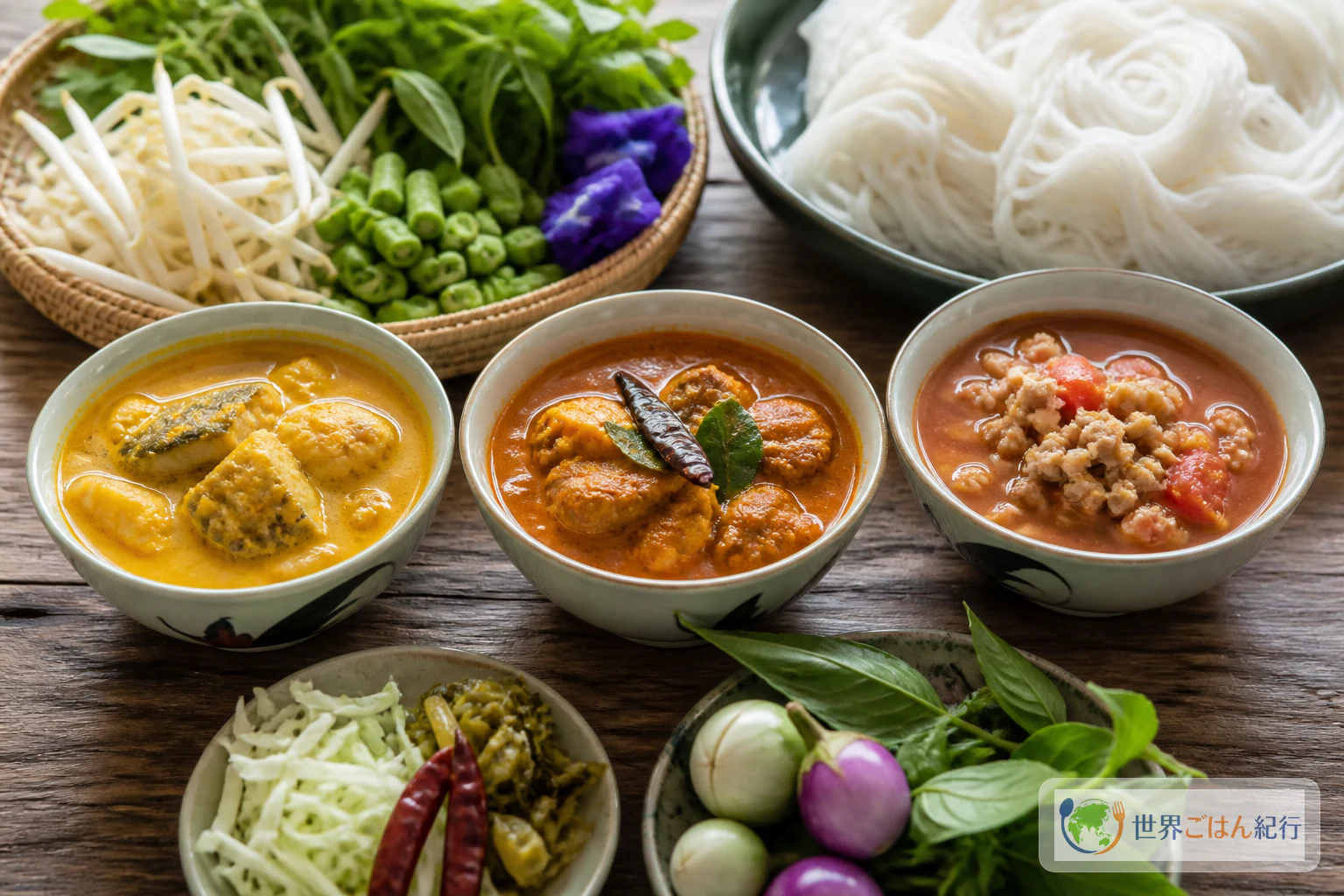
Southern cooks lean hard on chili heat, sourness, lemongrass, and makrut lime leaves, so southern nam ya is noticeably hotter and sharper than the central version. The difference comes from the aromatics and the local food culture.
Ingredients (serves 4)
This makes a rich sauce meant to be eaten with noodles and vegetables, not sipped on its own. Plan on about 200–250 ml of nam ya per serving of noodles.
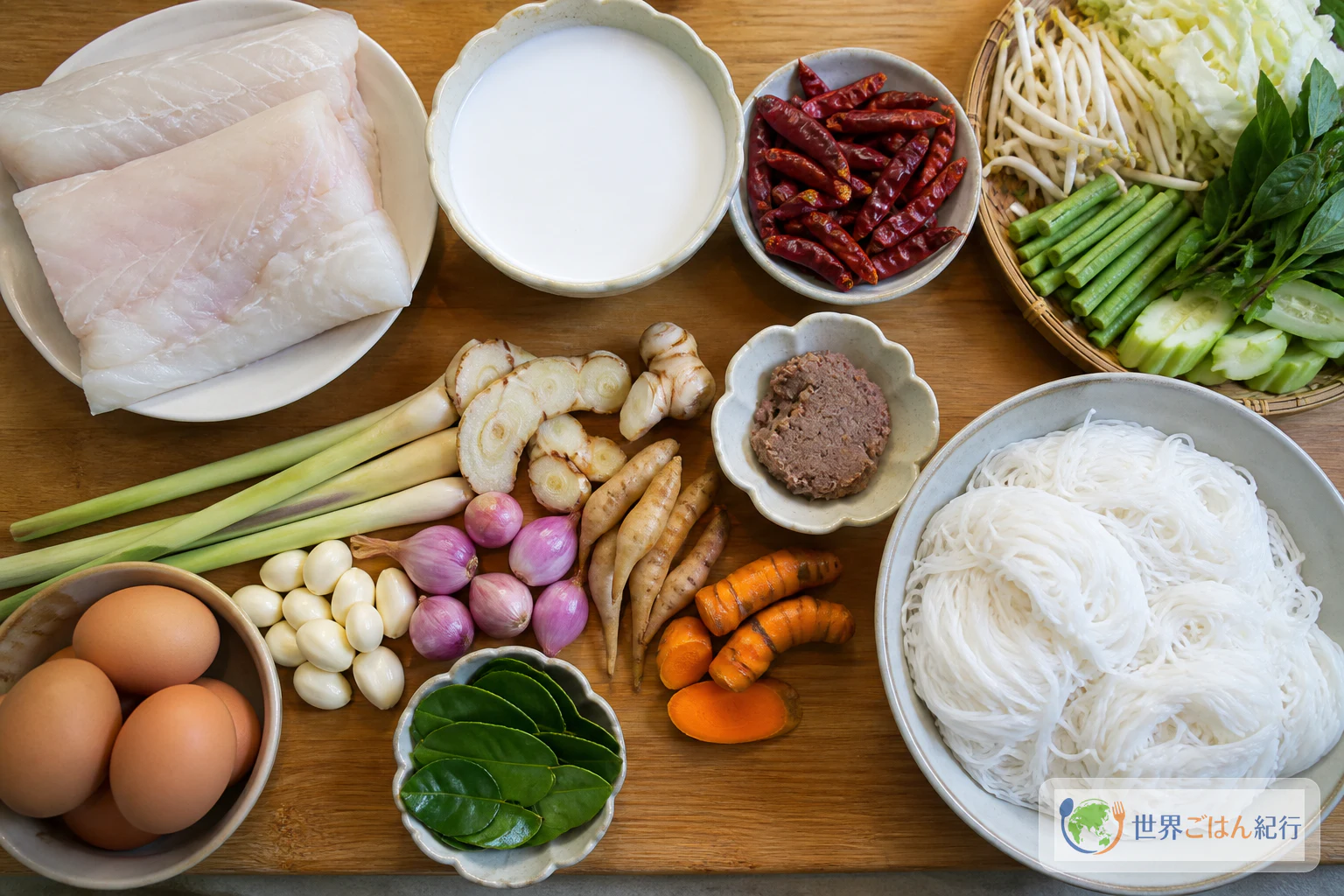
This dish uses kapi, fish sauce, fish, fish balls, coconut, and eggs. If you have a shellfish, fish, or egg allergy, check the ingredient labels and replace kapi and fish sauce with seasonings that contain neither. Bean sprouts and herbs are served raw, so wash them well under running water, drain them, and handle them with separate utensils.
Choosing Ingredients for Khanom Chin Nam Ya
The curry itself isn't the hard part of making this at home. Three decisions matter more: what to use in place of fresh noodles, how to get the bones out of the fish, and how far you can go without kapi or galangal. Settle those first and the long ingredient list gets much easier to handle.
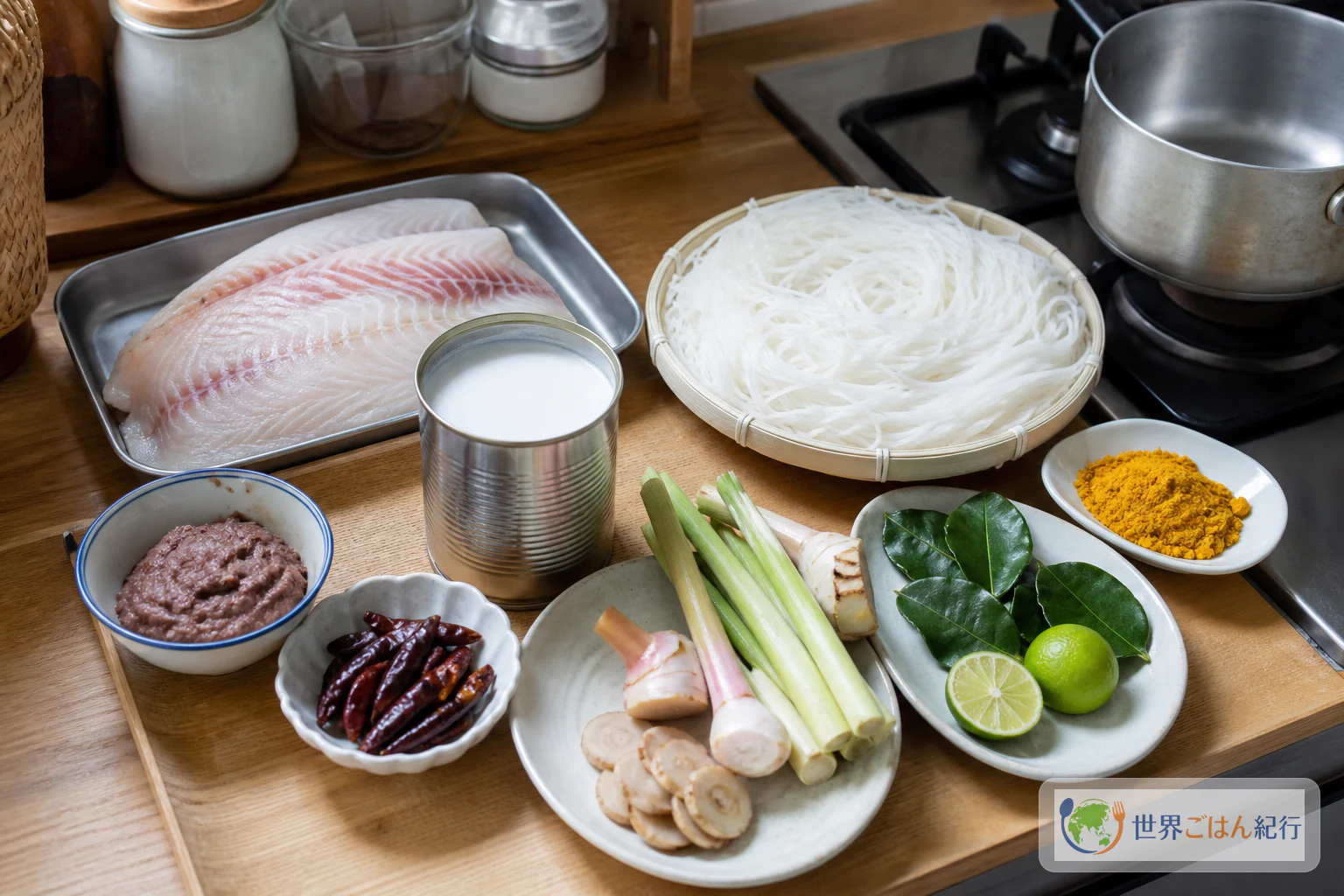
Noodles and substitutes
If you can get frozen or chilled khanom chin, follow the package directions. Fresh noodles are often already cooked, so a long soak in boiling water makes them fall apart. Loosen them under water and, if needed, warm them for only 10–20 seconds just before eating.
The easiest substitutes to find are thin rice vermicelli or sen lek. Soften the dried noodles for the time on the package, rinse off the surface starch under cold water, and drain them well in a colander. You lose the fermented aroma and softness of khanom chin, but you still get sauce clinging to noodles, eaten with vegetables. Udon and other wheat noodles hold too much sauce and lose the pale rice flavor, so they make poor substitutes.
Fish
Thai recipes use fish such as snakehead (pla chon) and barracuda. For a first attempt, skinless, boneless cod fillet is easy to work with, and its mild flavor makes it easier to taste what the kapi, fish sauce, and aromatics are doing. Mackerel brings fat and a stronger fish aroma for a more powerful broth, though it pushes the dish toward a southern profile.
Boil the fillets first, then remove the bones, flake the fish finely, and return it to the sauce. If you simmer raw fish in the sauce from the start, you end up hunting for bones as you stir, and the texture turns uneven. Cook the fish to an internal temperature of 63°C (145°F), or until the flesh is opaque and flakes easily with a fork. Check that the center has turned white before you take off the skin and bones.
Kapi and galangal
Kapi (กะปิ) is fermented shrimp paste. Besides salt, it lays a fermented savor and a sea aroma over the fish broth. Fish sauce alone can supply the salt, but the base aroma comes out lighter. If you have a shellfish allergy, leave out the kapi, add fish sauce gradually, and think of the result as a different dish.
Kapi is cheaper per gram in large containers, but this recipe uses only 15 g. It keeps in the refrigerator, so a large container makes sense if you'll use it for other Thai or Malay fermented seasonings too. Check the ingredients and the size. If you're making the dish just once, or can't eat shrimp, use fish sauce and aromatics instead.
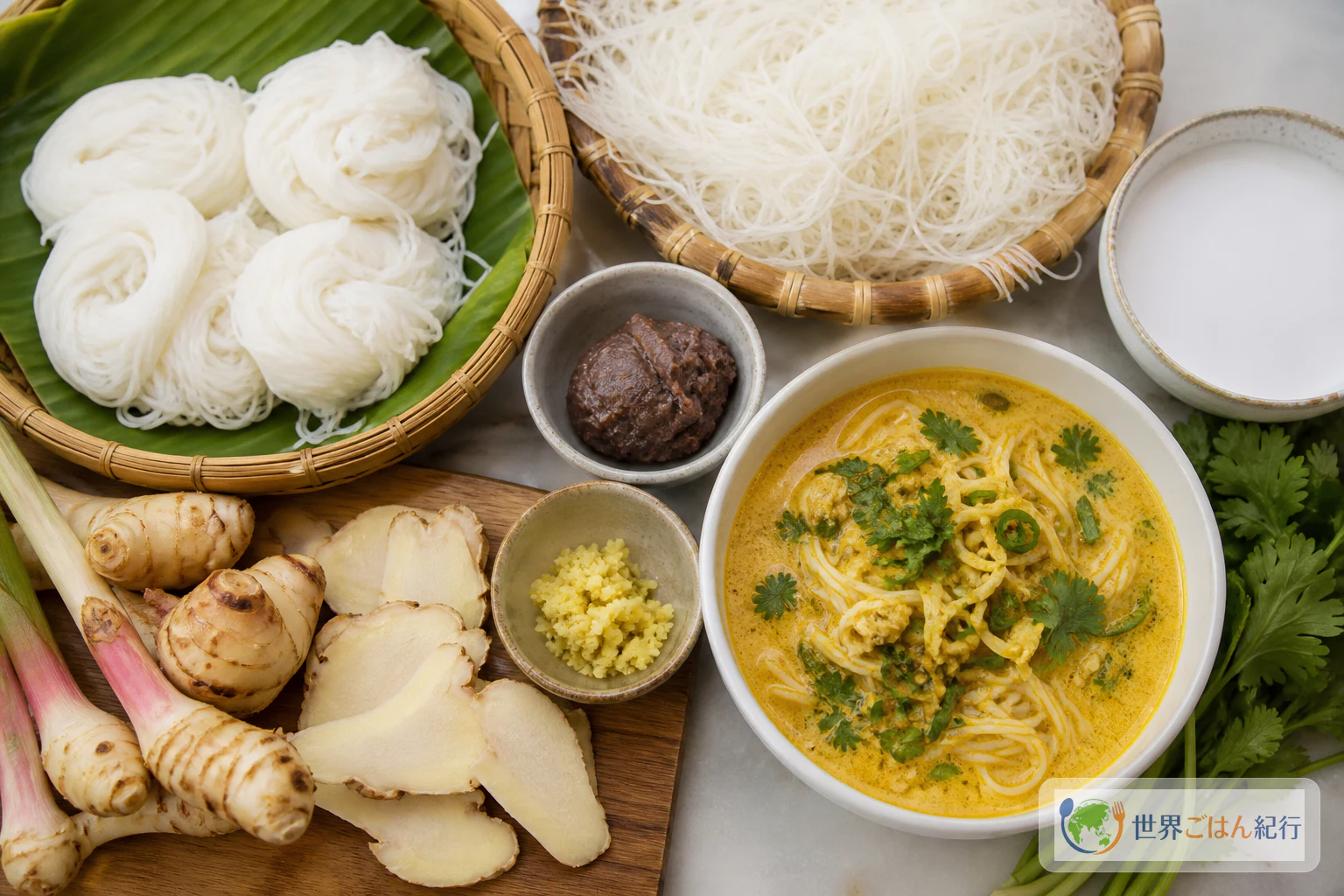
Galangal (kha) smells drier, cooler, and woodier than ginger. Frozen works if you can't find fresh. As a last resort, use the same amount of ginger and expect a different flavor. Ginger alone makes the broth smell round and sweet, so keep the lemongrass and makrut lime leaves.
A mortar and pestle for the paste
A mortar and pestle lets you crush lemongrass and chilies a little at a time, so the paste keeps some rough texture and aroma. Pound the dried chilies first, add the aromatics in order, and mix in the shrimp paste last. Pounding for nearly 30 minutes is a lot of work if you're only cooking this once, and if you already own a food processor you can build the flavor with that. A hand-pounding tool is not for "authenticity" but for people who want to control coarseness and aroma themselves.
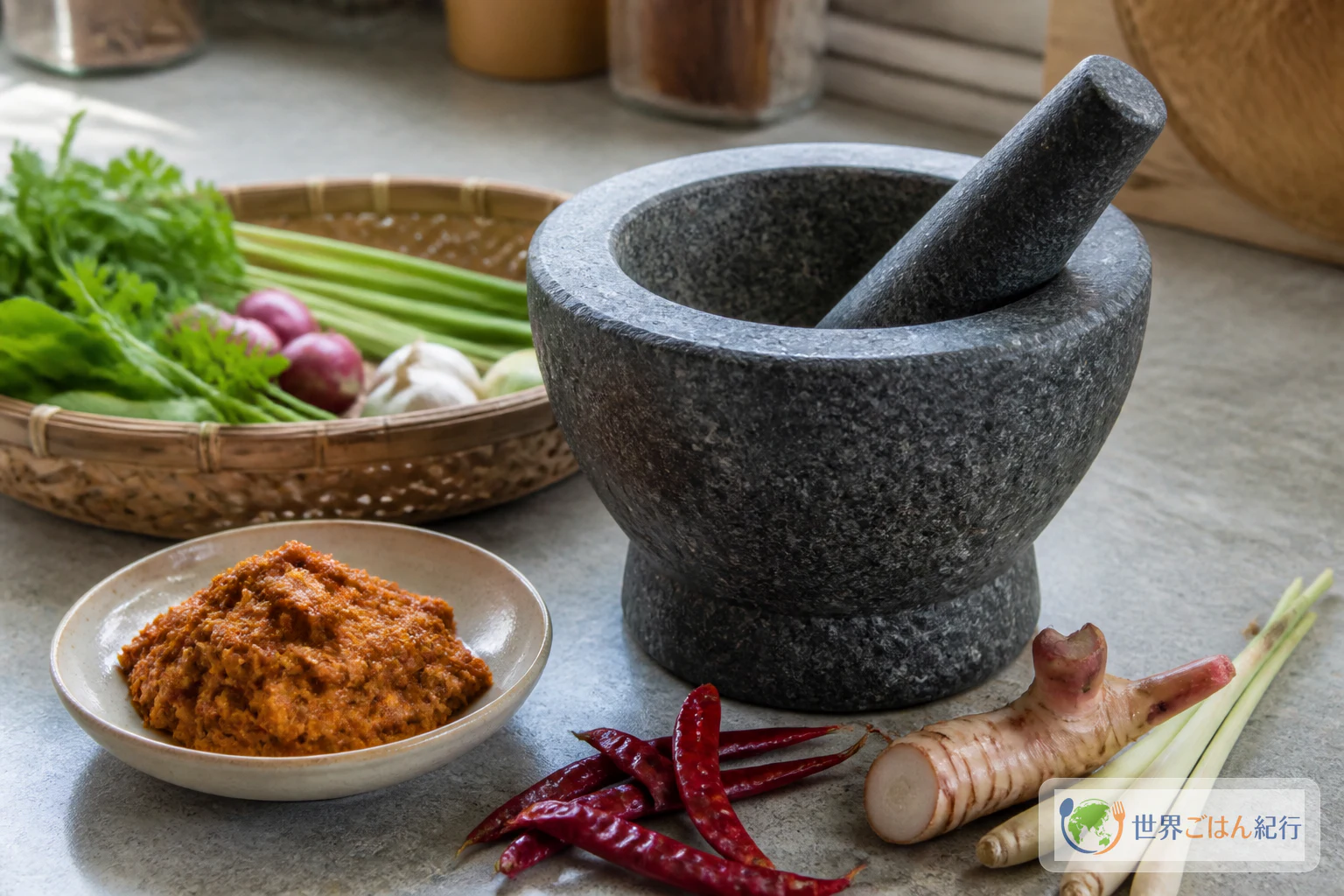
If you buy one, choose a deep stone mortar that won't slip over a light suribachi-style bowl. It pays off if you make curry paste, salsa, or aromatic salad dressings several times a month. On the product page, check the inner diameter of the bowl, the length of the pestle, the weight, and whether there's a non-slip base. A bowl that's too small sends chilies flying, and one that's too big is a chore to wash and store. Product photos won't tell you the stone type or weight, so read the listing and what comes in the set.
Directions (Khanom Chin Nam Ya)
1. Boil the fish and aromatics to make the broth
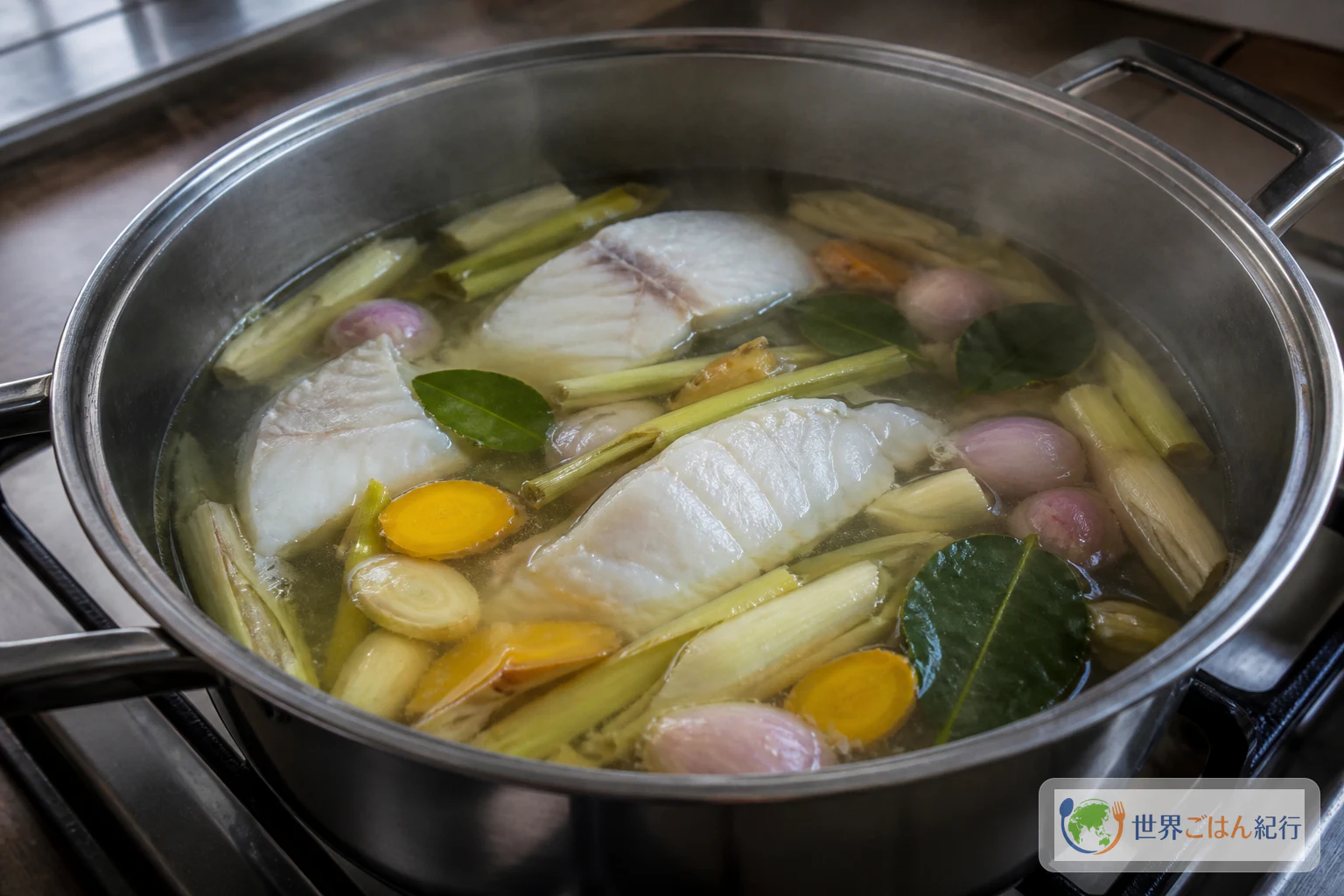
In a pot, combine 2 cups (500 ml) water, the white fish, 1 thick piece of lemongrass, 10 g sliced galangal, 2 shallots, 2 garlic cloves, half the turmeric, and the krachai, and set over medium heat. When it boils, lower to medium-low and simmer for 8–10 minutes, until the fish is opaque to the center and breaks apart easily with chopsticks.
Take the fish out onto a plate, and once it has cooled a little, remove the skin and bones one by one and flake it finely with your fingers. Strain the cooking liquid with the aromatics and keep 1¾ cups (400 ml). Press the fish with your fingertips to check that no bones remain. Keep the rest of the broth to restore thickness later.
2. Make the paste from the dried chilies
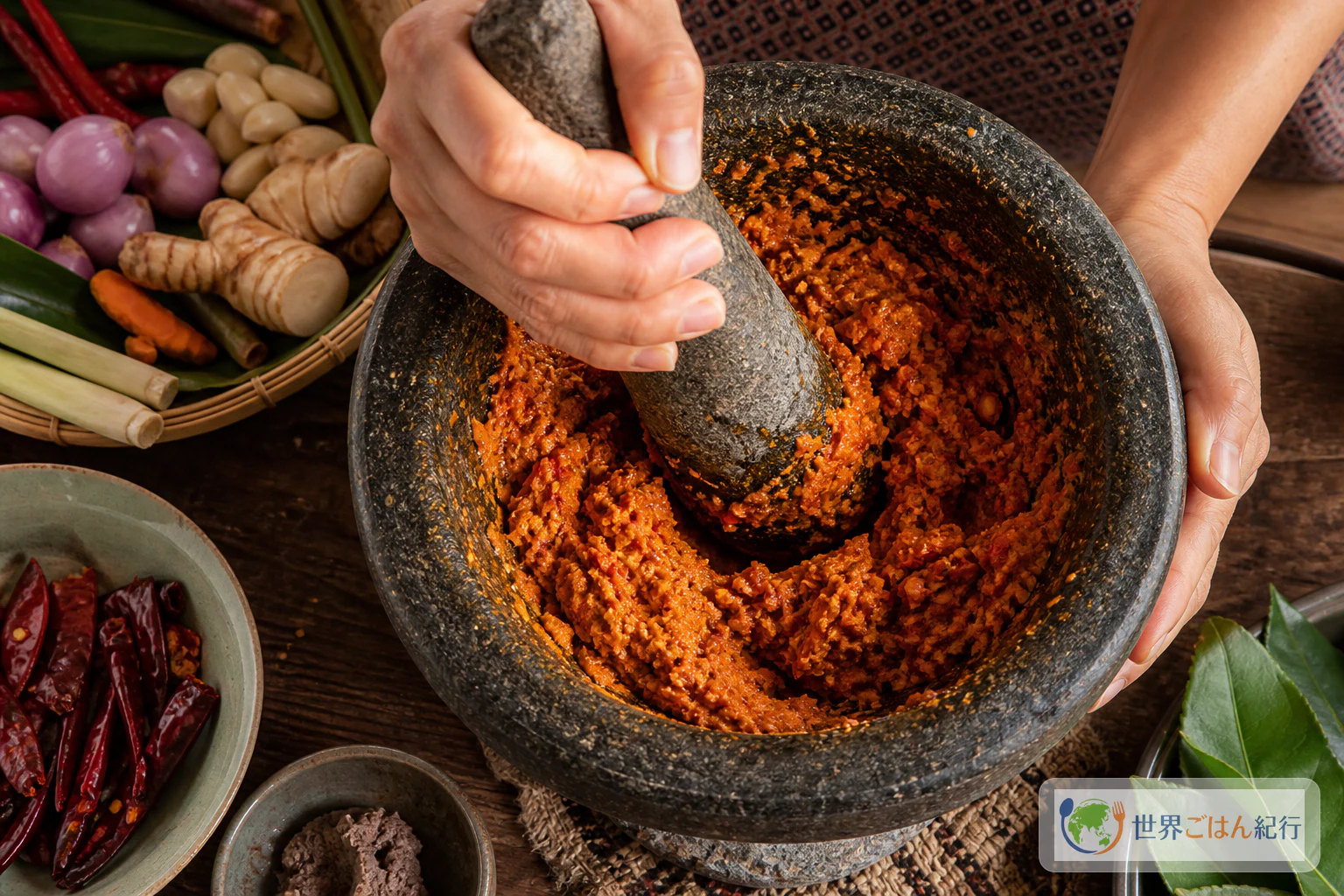
Soak the dried chilies in boiling water for 10 minutes and squeeze out the water. Wear disposable gloves when handling them, and do not touch your eyes or face. Put a pinch of salt and the chilies in a mortar and pound for about 5 minutes. Then add the remaining lemongrass, galangal, krachai, shallots, garlic, turmeric, and makrut lime leaves a little at a time, and pound for another 15–20 minutes.
It does not need to become a complete paste. If you slice the lemongrass into 0.125 inch (2–3 mm) widths beforehand, it gets to the stage where it is red-orange, the fibers are short, and the mass holds together when pressed with a spoon. An even color and a rising aroma are enough. Finally add 15 g kapi and mix for 2 minutes. With a food processor, cut everything small, add water 1 tsp at a time, and pulse briefly. Too much water makes it harder to fry the aromatics in the next step.
3. Fry the paste in the thick part of the coconut milk
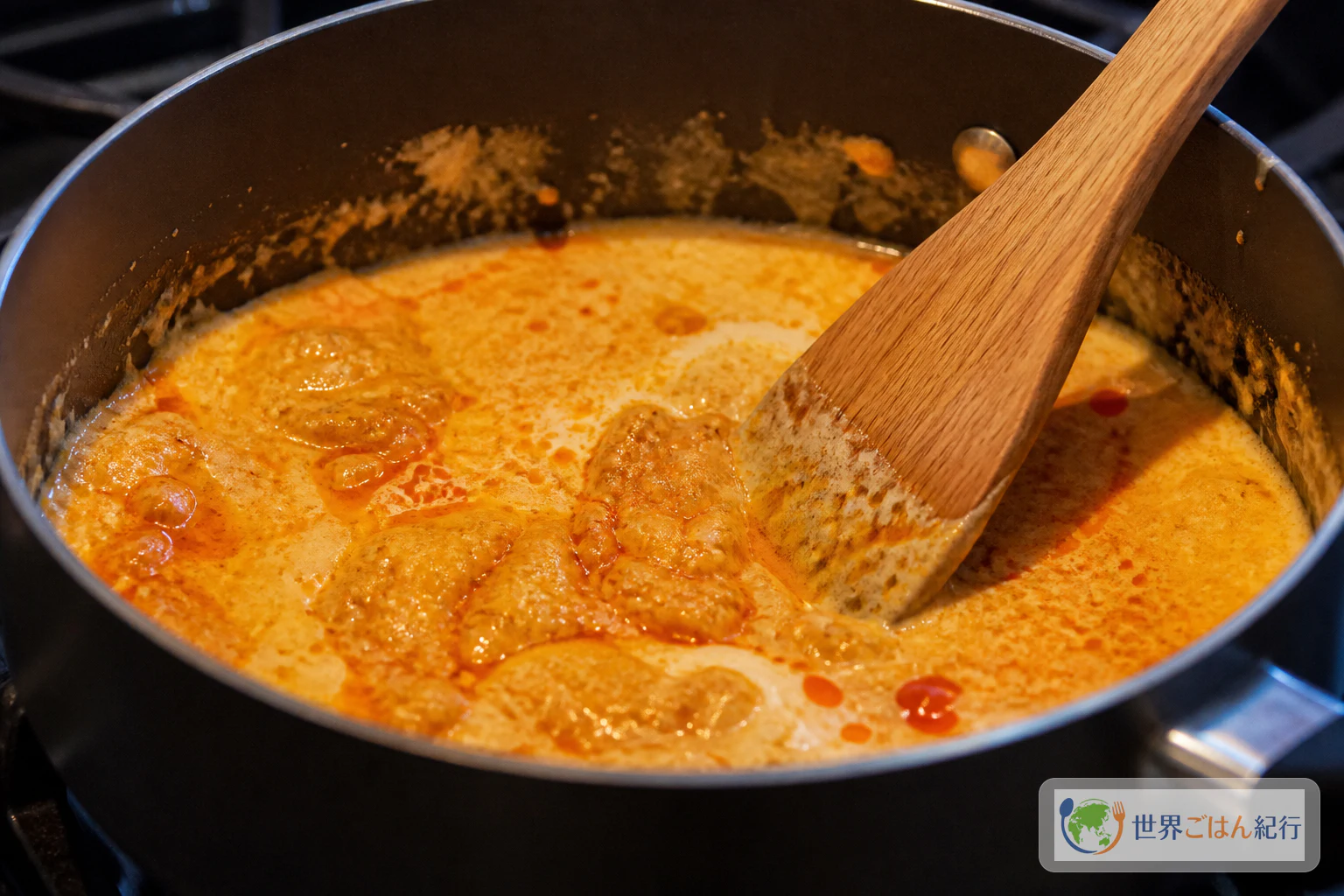
Open the can of coconut milk without shaking it, and if a thick portion has separated on top, put that in the pot first. If not, put ½ cup (150 ml) of the total in the pot and warm it over medium heat. Add the paste and fry for 5–7 minutes, stirring slowly in one direction with a wooden spatula.
Move on when a little red-orange oil rises from the bottom, the paste spreads smoothly, and the raw sting of the chili has mellowed. You do not need to fry it to dark brown. It turns bitter if it sticks to the bottom, so lower the heat and, if needed, add only 1 tbsp water to loosen it. Strong boiling makes coconut milk separate easily, so keep the surface at a gentle bubble.
4. Add the fish, broth, and coconut, and simmer
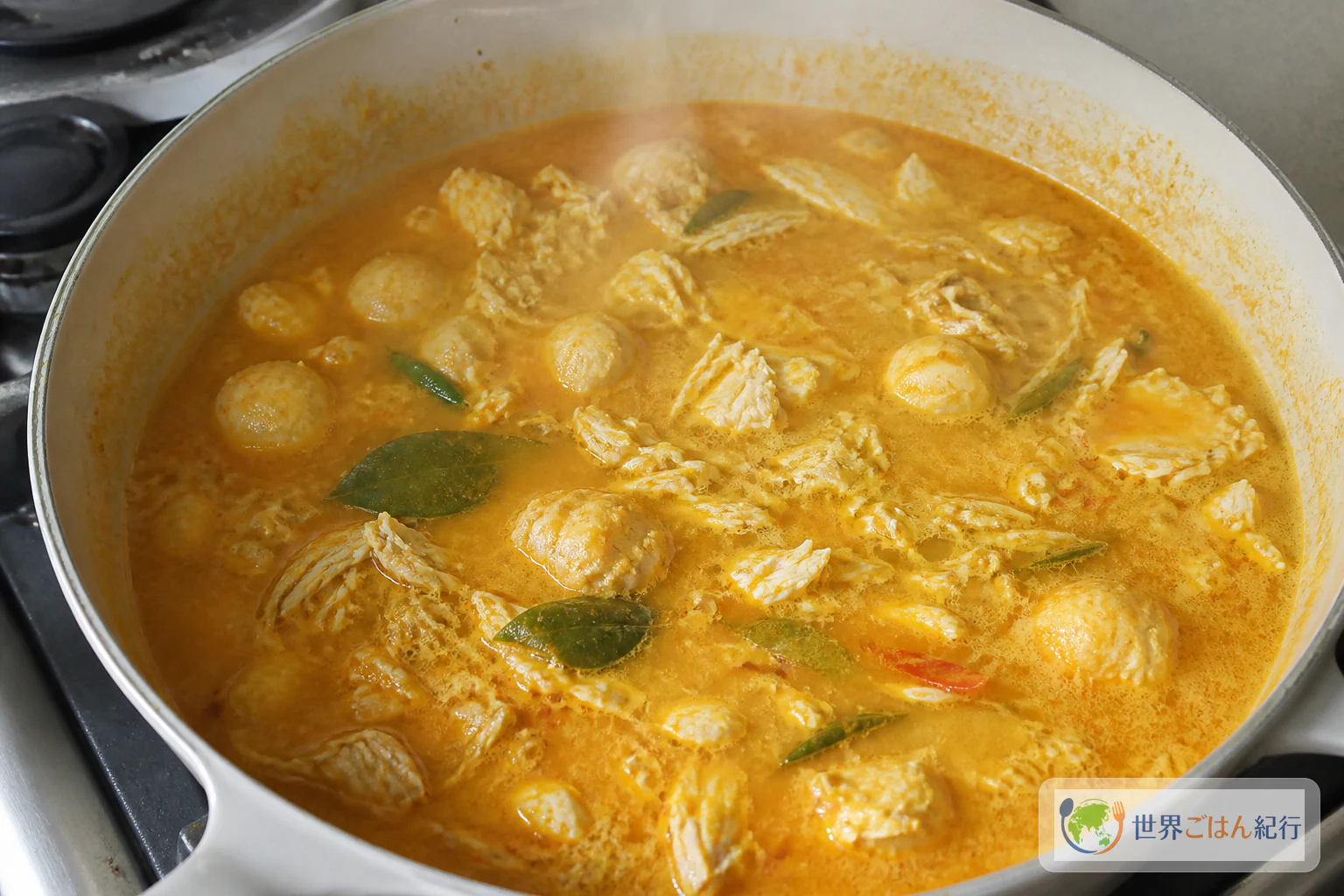
Add 1¾ cups (400 ml) of the strained fish broth, the remaining 1 cup (250 ml) coconut milk, the flaked fish, the fish sauce, and the palm sugar to the pot. Raise the heat to medium, and when the edge boils, lower it to low. Simmer for 8–10 minutes without a strong boil, tracing the bottom with a wooden spatula.
When the sauce leaves a thin film on the back of a spoon and the fish fibers are finely distributed throughout, add the fish balls. Warm for another 3–4 minutes, and taste once they are hot in the center. Adjust saltiness with fish sauce, sweetness with sugar, and thickness with the reserved fish broth. Make the sauce slightly too strong to eat on its own before it goes over the noodles, and it keeps its outline when combined with pale rice noodles and vegetables.
5. Prepare noodles, eggs, and vegetables separately
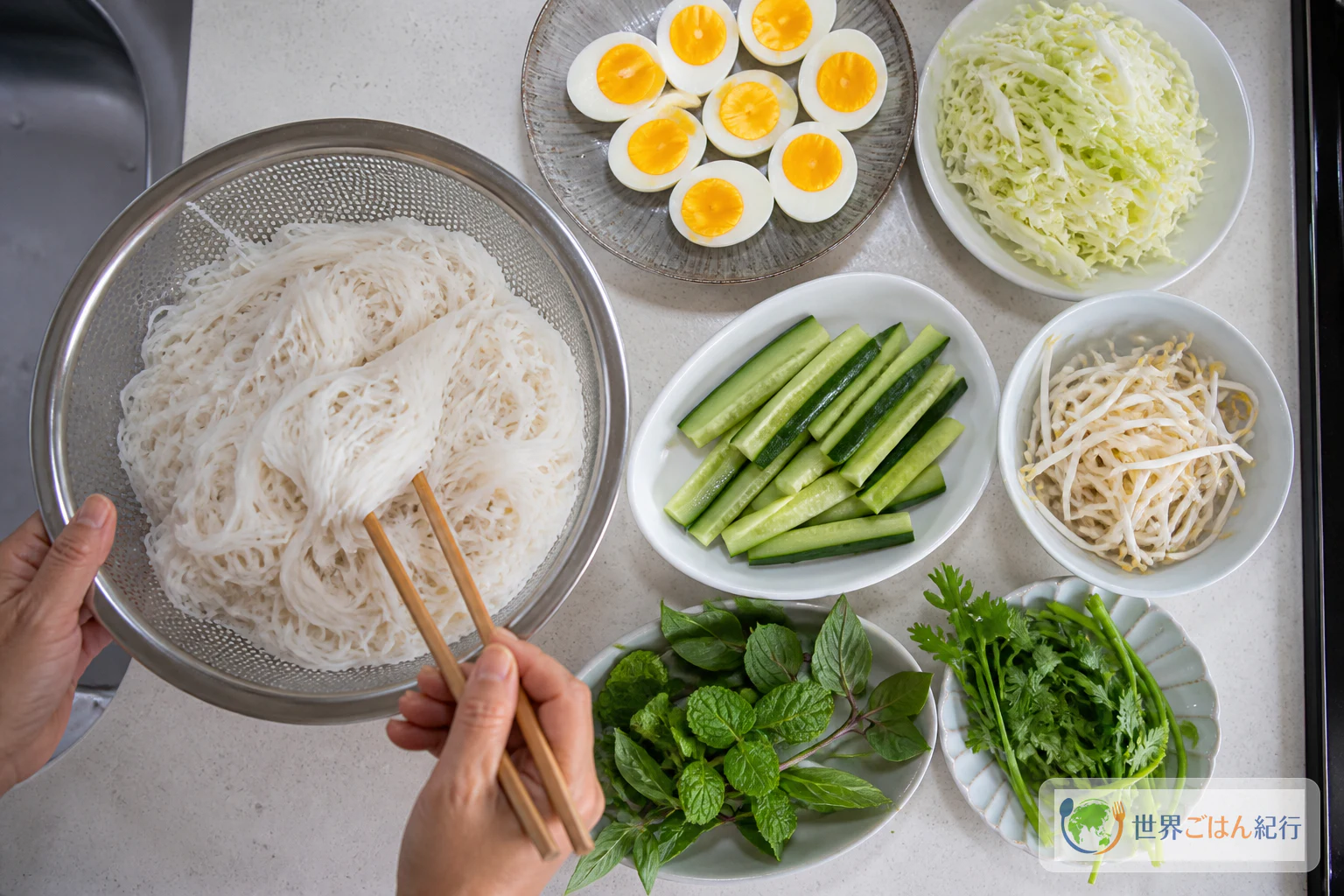
Start the eggs in cold water in a separate pot and boil for 9 minutes after it boils. Transfer to cold water, peel, and halve. Loosen fresh khanom chin under water, and if the package says to heat it, warm it in boiling water for only 10–20 seconds. For dried rice noodles, taste one strand 30 seconds before the package time and drain in a colander when the core is gone.
Rinse rice noodles quickly in cold water to remove surface slime and drain without squeezing hard. Leftover water thins the nam ya, and over-draining dries the noodles so they soak up too much sauce. Slice the cucumber thin on the diagonal, shred the cabbage, rinse and drain the bean sprouts, and pick the herb leaves. Plate the vegetables first and hold them in a separate bowl from the noodles.
6. Nest the noodles and pour on the hot sauce
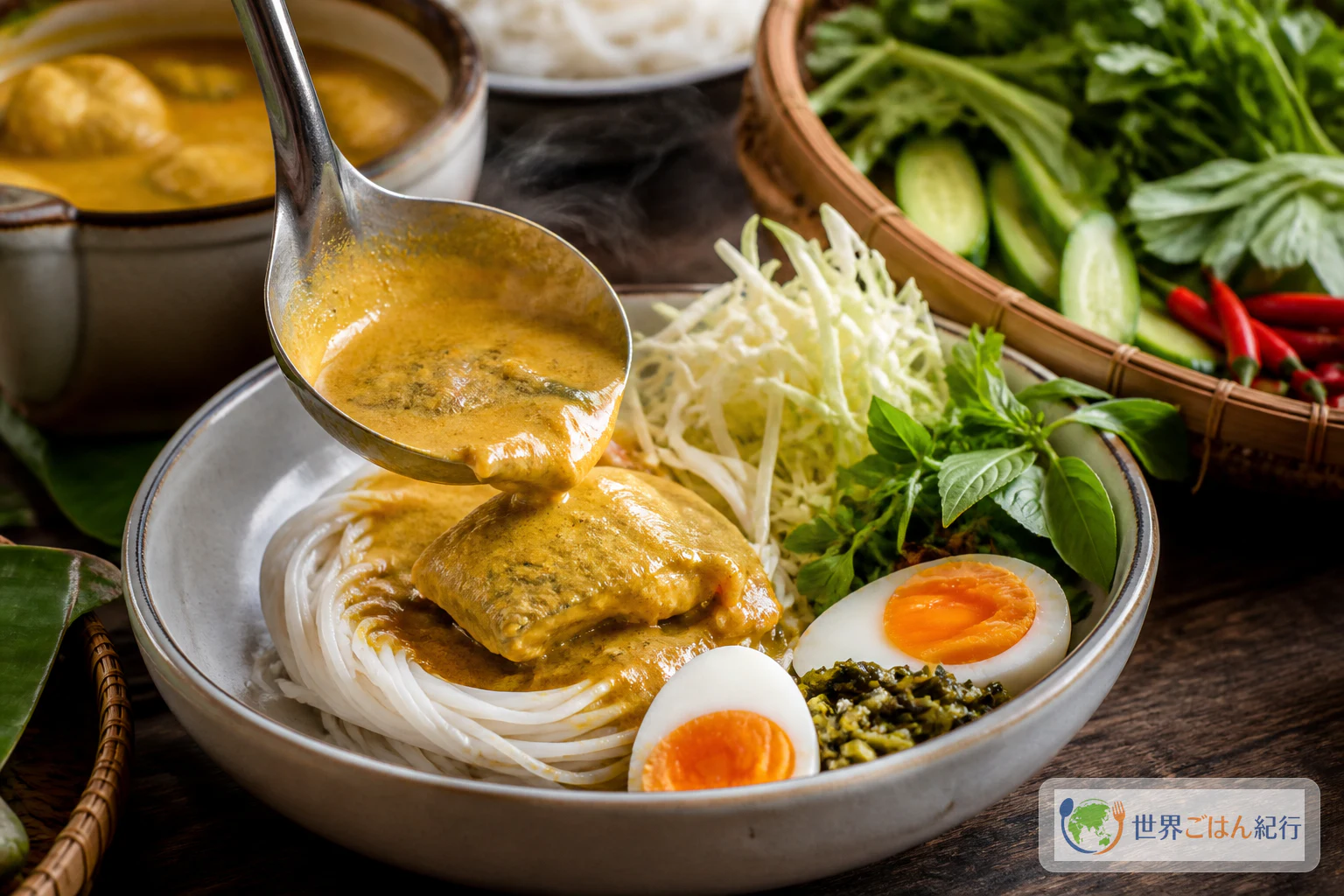
Loosely coil the noodles by hand, one serving at a time, and place them in the center of a shallow bowl. Pour on 200–250 ml nam ya, and arrange the egg half, cucumber, cabbage, bean sprouts, herbs, and pickles around them. When the steaming sauce runs into the gaps in the noodles and the nest holds together without collapsing, it is time to serve. Do not simmer the noodles in the pot of sauce; combining warm sauce and near-room-temperature noodles in the bowl is the assembly that preserves their texture.
Take the first bite of sauce and noodles alone, then mix in a little of the vegetables and herbs. For anyone who wants more heat, adding dried chili with its seeds to the paste is easier to control than frying it in oil. Frying chilies indoors makes irritating smoke, so skip it if you cannot ventilate.
Fixing Nam Ya When the Flavor Drifts
When the sauce goes wrong, you can usually bring it back, so there's no need to throw it out.
| What happened | How to fix it | What to look for |
|---|---|---|
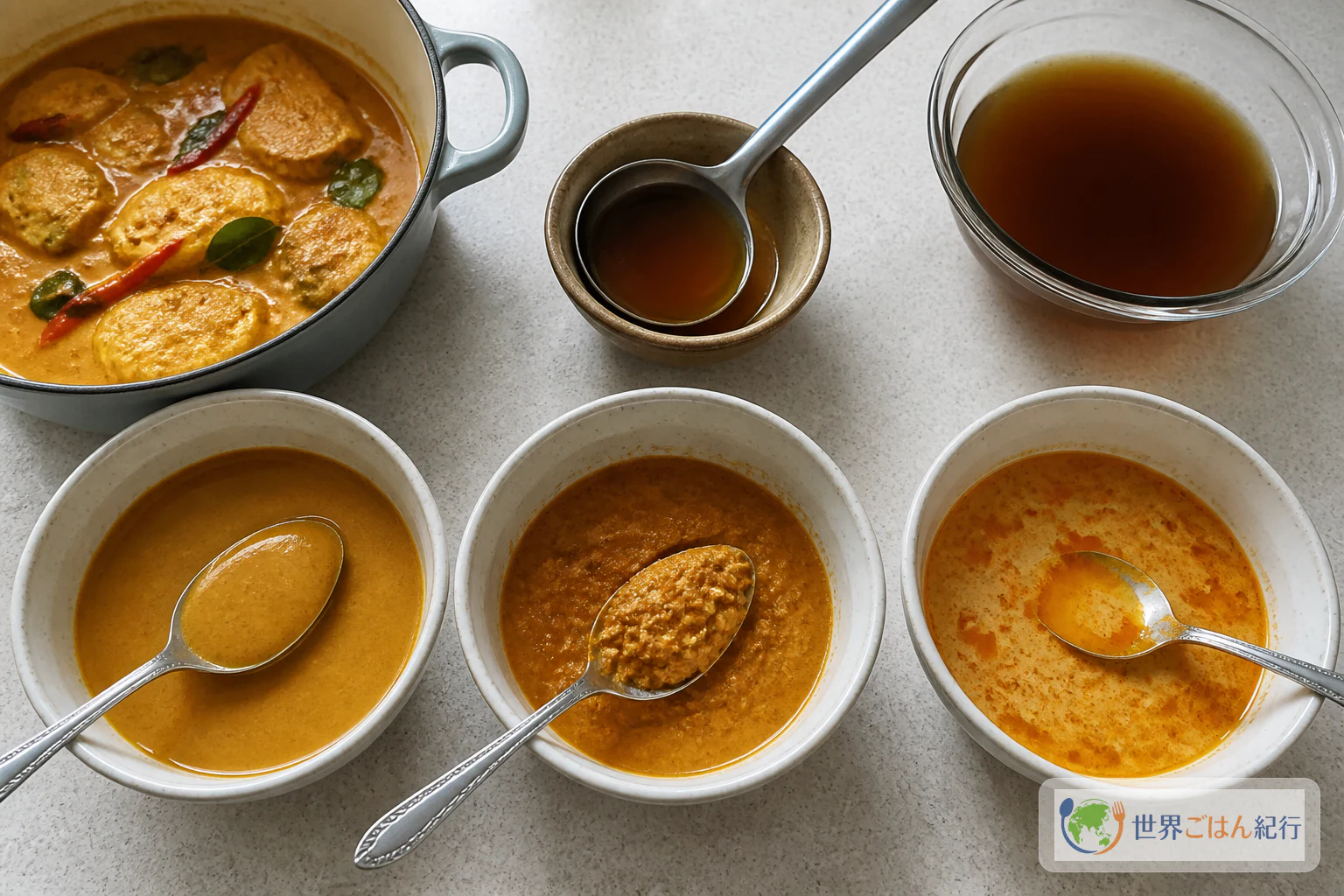
| The sauce is thick and heavy at the bottom | Add the reserved fish broth 3.5 tbsp (50 ml) at a time and warm on low heat for 2 minutes | Leaves a thin film on the back of a spoon |
| The sauce is thin | Simmer uncovered on low heat for 3–5 minutes. Do not add salt first | The aroma rises and the fish scatters in the sauce |
| The coconut milk separated | Take it off the high heat, add warm fish broth 2 tbsp at a time and stir in one direction | Even if oil floats, it is edible once the graininess is reduced |
| It is too hot | Add 3.5 tbsp (50 ml) coconut milk and 3.5 tbsp (50 ml) fish broth. Add more vegetables and egg | The saltiness also thins as well as the heat, so readjust |
| The fish aroma is too forward | Do not add more fish sauce; add a little lemongrass and a pinch of sugar | The aroma rounds out and a little oil floats on the surface |
| The paste is coarse and the fibers are long | Add 2 tbsp sauce and pound again, or run it briefly in a food processor | Lemongrass is cut to about 1 mm to 0.125 inch (1–2 mm) |
If the coconut milk has only separated and oil is floating on top, the sauce is fine to eat. If it smells scorched or sour, or has turned grainy, start over. Next time, don't let it keep boiling, and keep the heat at medium or below from the moment you fry the paste.
Fish is one problem seasoning can't fix. If raw fish smells sour, rotten, or like ammonia, don't use it. Color alone won't tell you about freshness: look for a mild smell, firm flesh, and edges that aren't dry or discolored.
Serving, Variations, and Storage
At the table
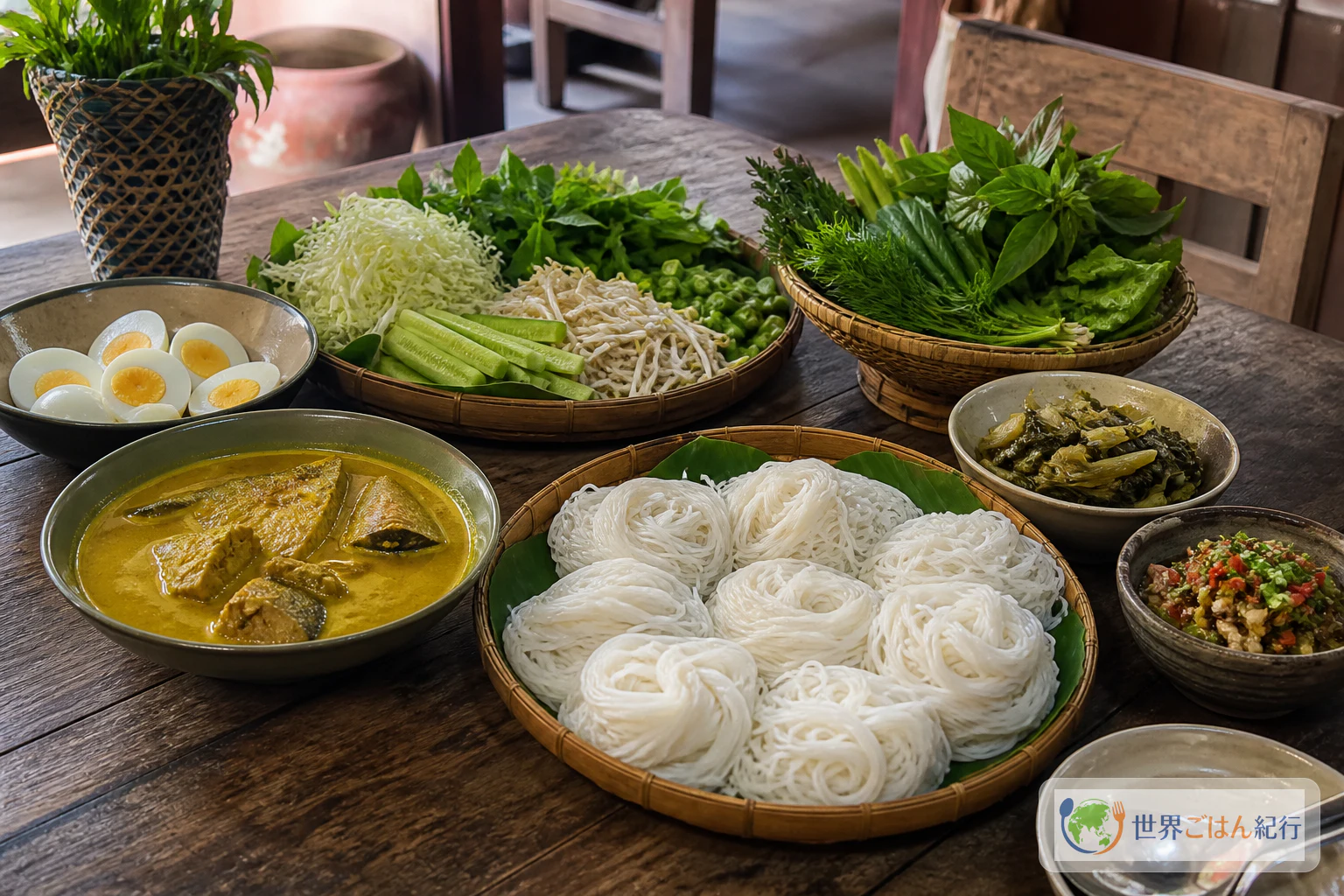
In Thailand, raw vegetables and herbs go on the side so each person can change the combination from bite to bite. Cucumber, bean sprouts, pickled mustard greens, long beans, and herbs pair well with cabbage, cilantro, mint, and a quick pickle. The vegetables take the edge off the hot sauce and cut through the oil and salt as you eat.
To plate, gather the noodles into a small nest and spoon the sauce over them. Keep the vegetables out of the pot, because heat kills the crunch of the bean sprouts and the aroma of the herbs. Set the egg beside the sauce, break the yolk, and work it into the noodles a little at a time. If people at the table like different levels of heat, cut back the chili in the paste and serve fried chili in oil or chili flakes on the side.
Variations
- Move toward southern heat. Increase the dried chilies to 20 g and make the turmeric slightly stronger. To leave room for more heat later, cook with 15 g first, seeds removed, and serve extra on the side. Heat alone won't make it southern: the turmeric, lemongrass, and garlic aromas shift along with it.
- Make southern nam ya pu. Replace 3.5 oz (100 g) of the 10.5 oz (300 g) fish with crab meat and add it in the last 3 minutes. Simmered too long, the crab disappears into the sauce, so don't break it up much.
- Serve it over rice. This is a realistic option when you have no khanom chin. The aroma and texture change, but nam ya made on the strong side goes well with white rice, and rice suits the weight of the sauce better than udon would.
- Make a dish without fish or kapi. Combine grilled mushrooms, thick fried tofu, and chickpeas, leave out the kapi, and season with a little miso and salt. This plant-based version borrows the structure of the sauce and sides, though it's a different dish from Thai nam ya.
- Explore northern broths. Nam ngiao, made with pork, tomato, and dried chilies, turns the same khanom chin into something quite different from fish curry. To see how northern cooks layer aromatics, compare it with gaeng hung lay, simmered with ginger and tamarind.
Storage and the next day
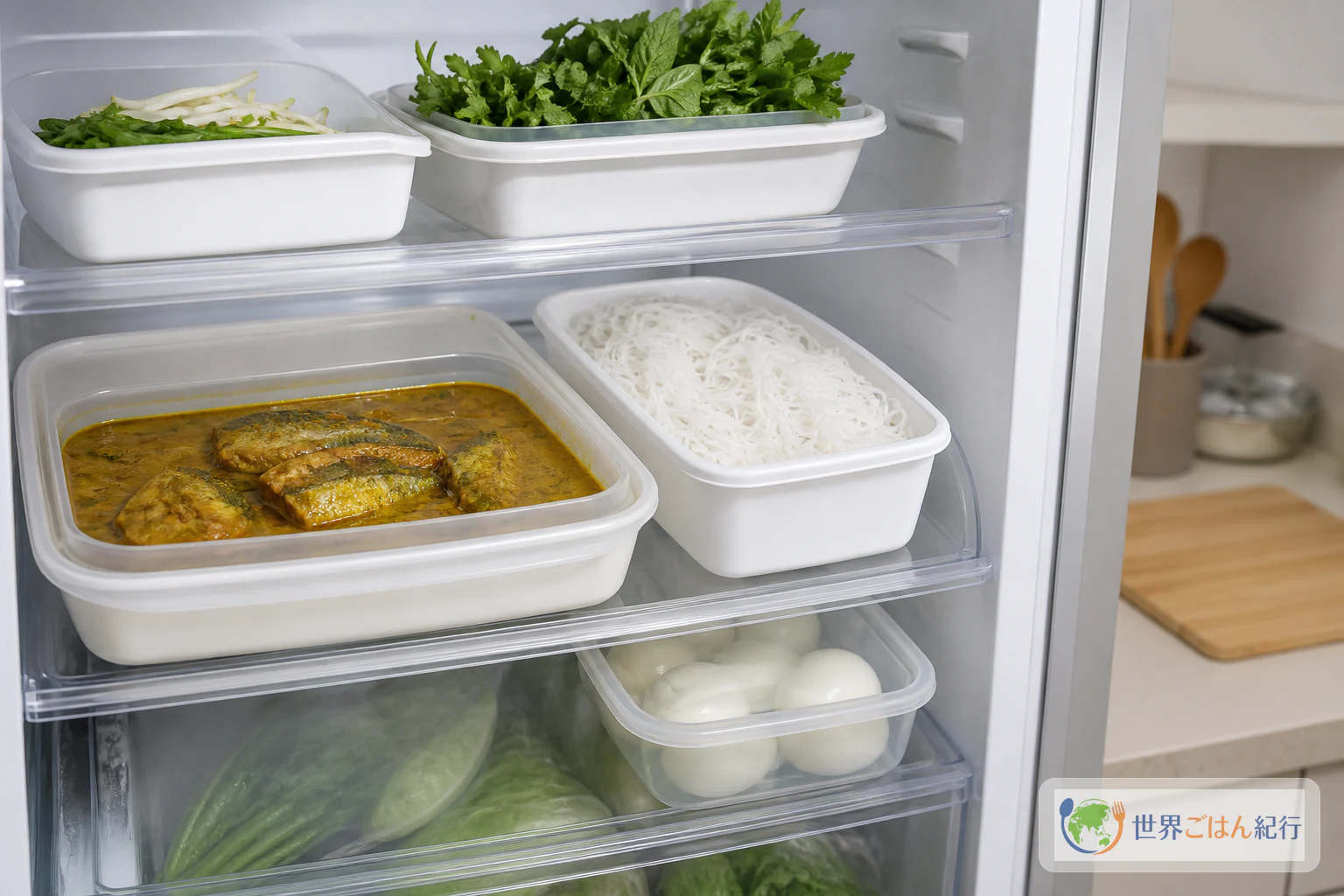
Store only the nam ya sauce, and keep the noodles, eggs, vegetables, and herbs separate. Move the sauce to a shallow container so it cools quickly, and refrigerate it. Don't leave perishable food at room temperature for more than 2 hours, and less in hot weather. Use cooked leftovers within 4 days, and reheat them to 74°C (165°F).
The sauce is best by the next day, while you can still easily judge its aroma and the state of the fat. Even within 4 days, it changes with refrigerator temperature, container cleanliness, and the utensils used for serving. Throw it out if it smells sour, feels unusually sticky on the surface, or the container is bulging. To freeze, seal the sauce alone in single portions and warm it once after thawing. Noodles lose their texture in the freezer, so soften them on the day you eat.
To reheat, add a little fish broth to the sauce, warm it on low heat, and stir the separated coconut back in one direction. Fresh vegetables and a boiled egg keep the second day's plate from feeling like a repeat. Prep bean sprouts, herbs, and sliced cucumber fresh each time, which is better for both texture and hygiene. If you're serving the sauce over rice, don't reduce it too far, and go easy on the salt since the rice adds moisture.
Frequently Asked Questions
I have no krachai. Is ginger alone all right?
You can make it with ginger alone, but the aroma becomes rounder. Keep 20 g galangal, 2 stalks lemongrass, and 2 makrut lime leaves, and start with 10 g ginger. If you replace all the rhizomes with ginger, it gets closer to a ginger-flavored fish curry than to nam ya.
Will leaving out kapi make it taste thin?
You'll lose the savor of fermented shrimp, so it won't taste the same. Add fish sauce 1 tsp at a time, tasting for salt as you go. If you have a shrimp allergy, check the labels on commercial curry pastes too, since some contain kapi. A plant-based version with a little miso or dried mushrooms works, but it tastes different from Thai nam ya.
How hot should it be to taste authentic?
For mellow central nam ya, start with 15 g dried chilies and remove half the seeds. When moving toward southern heat, add more on the side for each person; it balances better with the vegetables and egg that way.
Can I use mackerel in place of the fish?
Yes. Mackerel has more fat and aroma, so the fish comes through more than it does with cod. Start with fillets that are easy to skin and bone, and reduce the kapi to 10 g, checking the saltiness as you go.