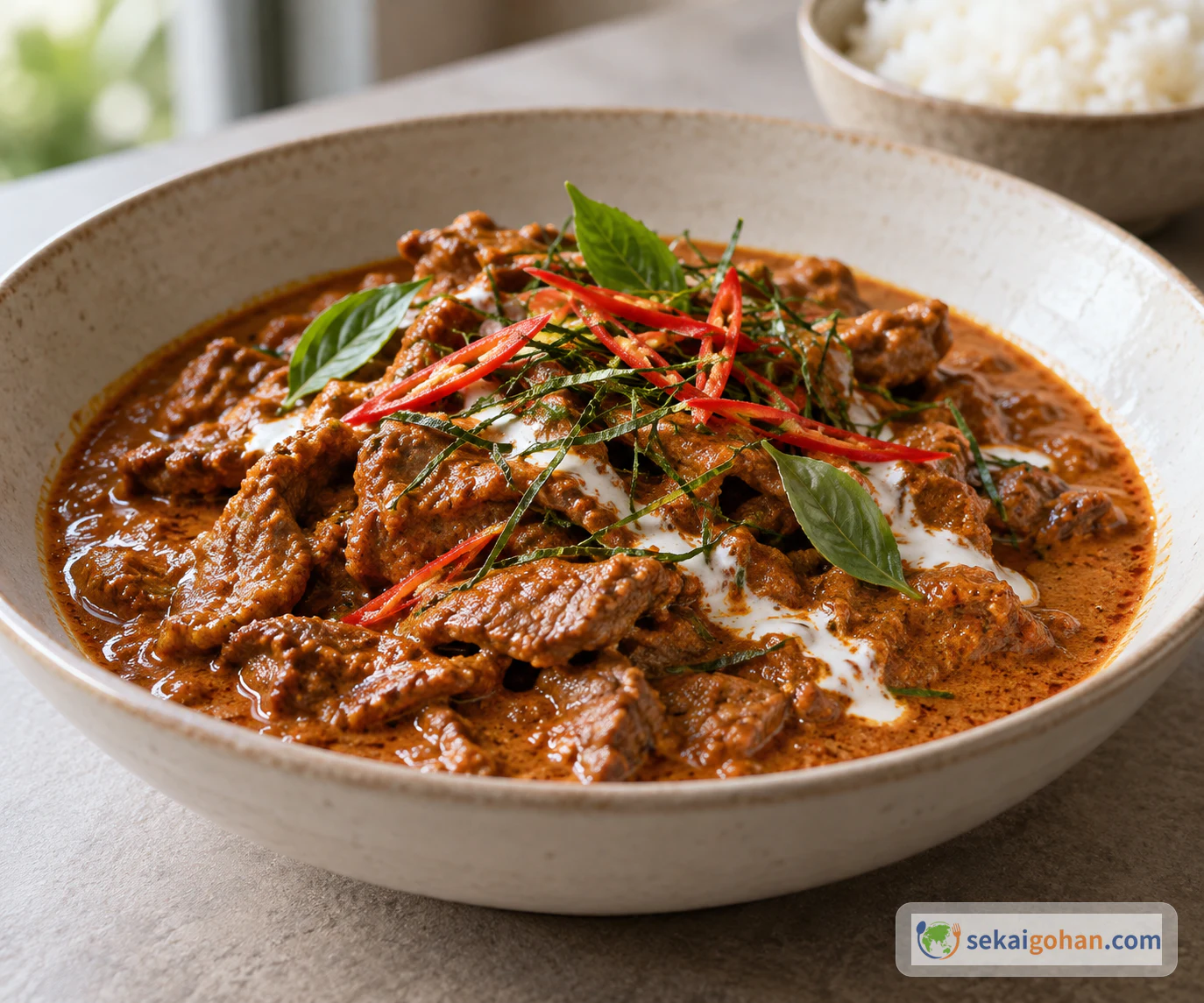
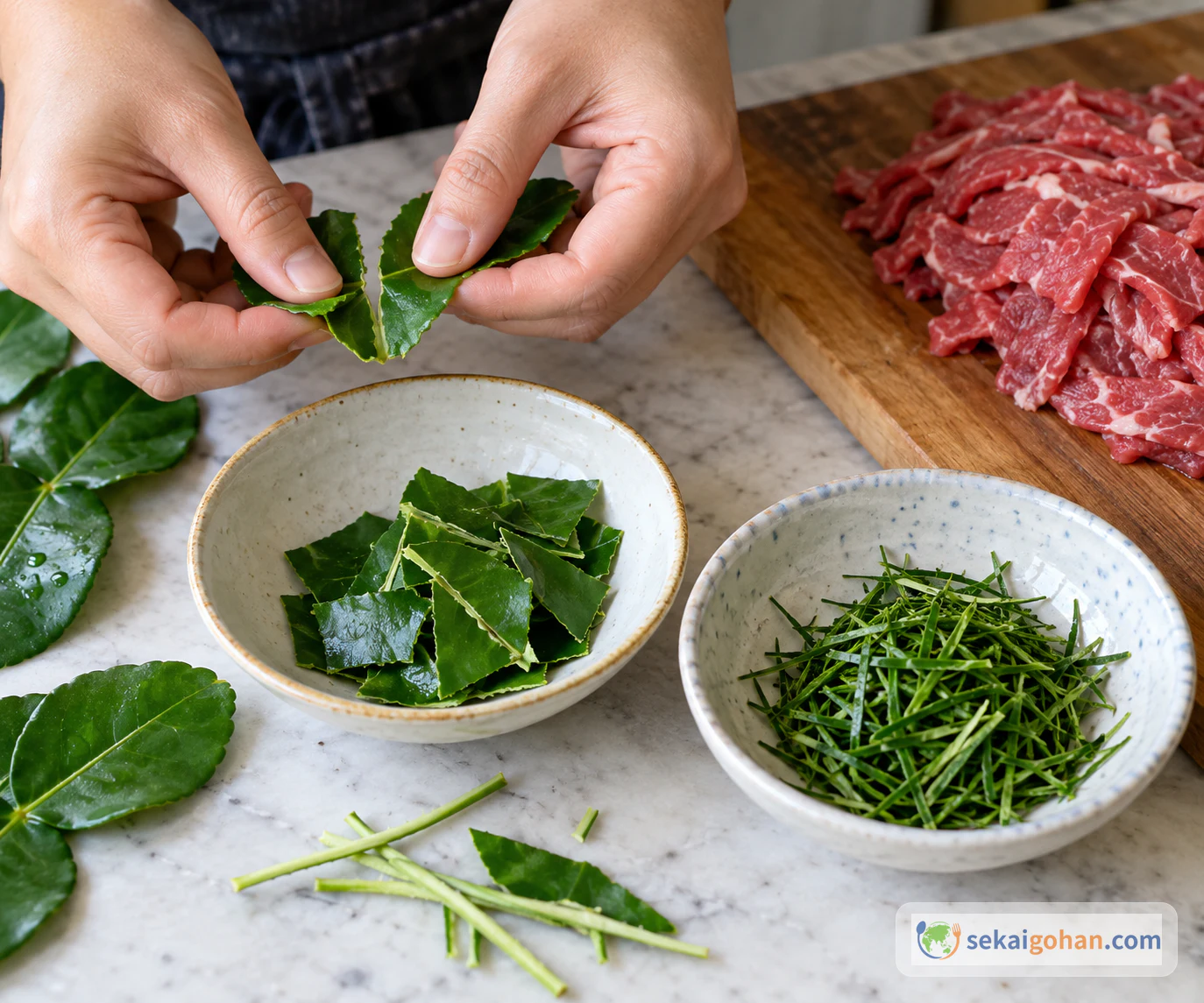
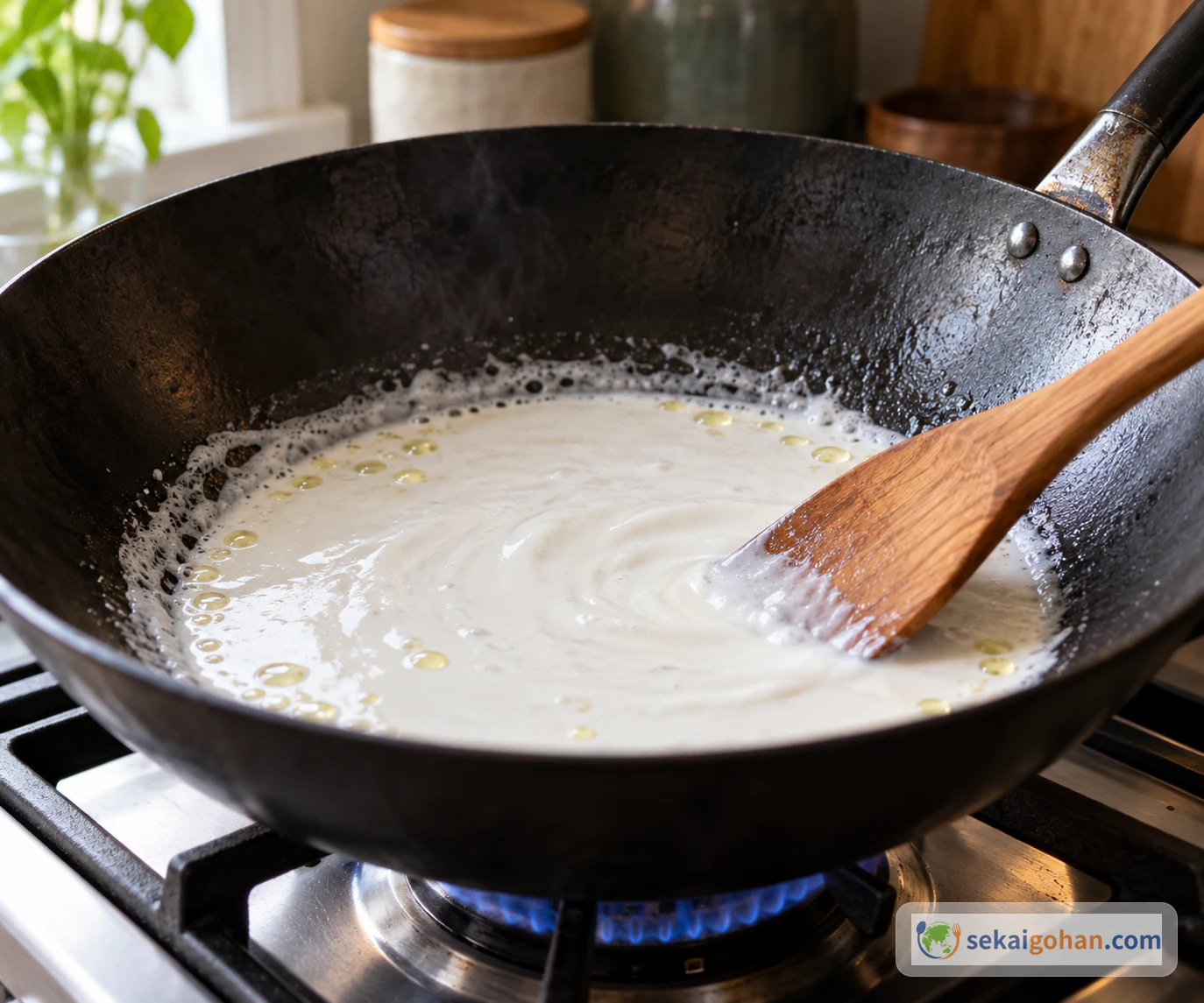
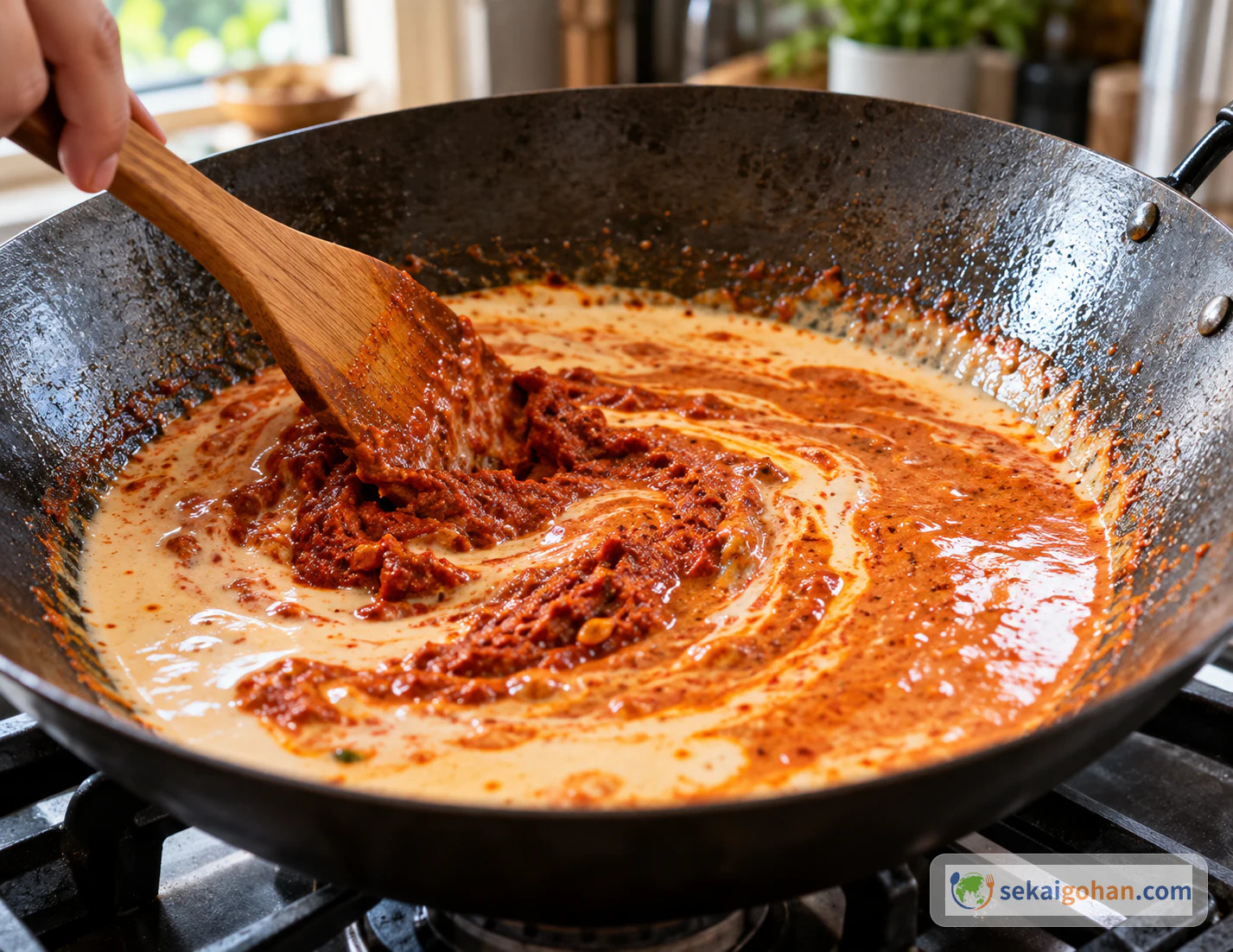
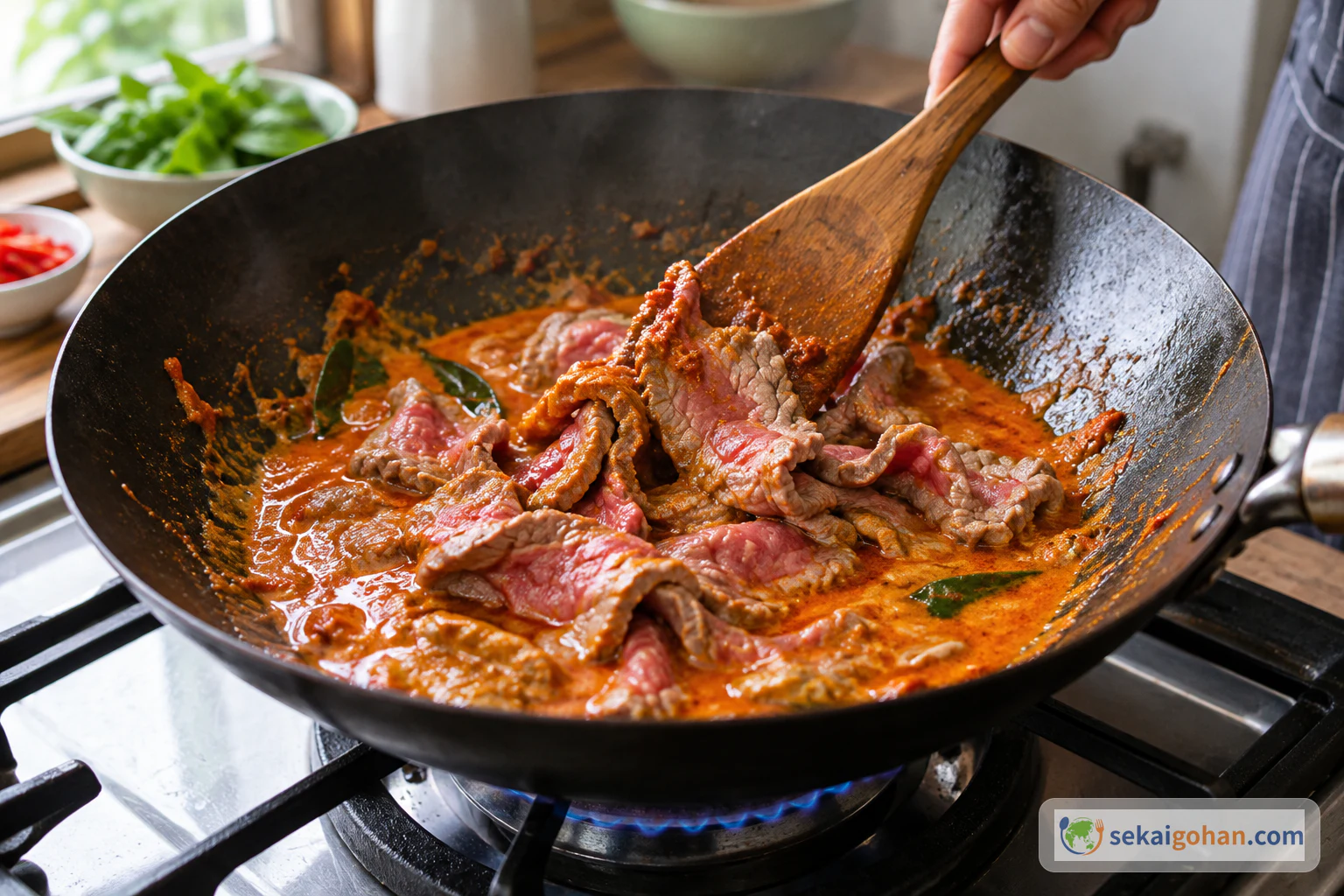
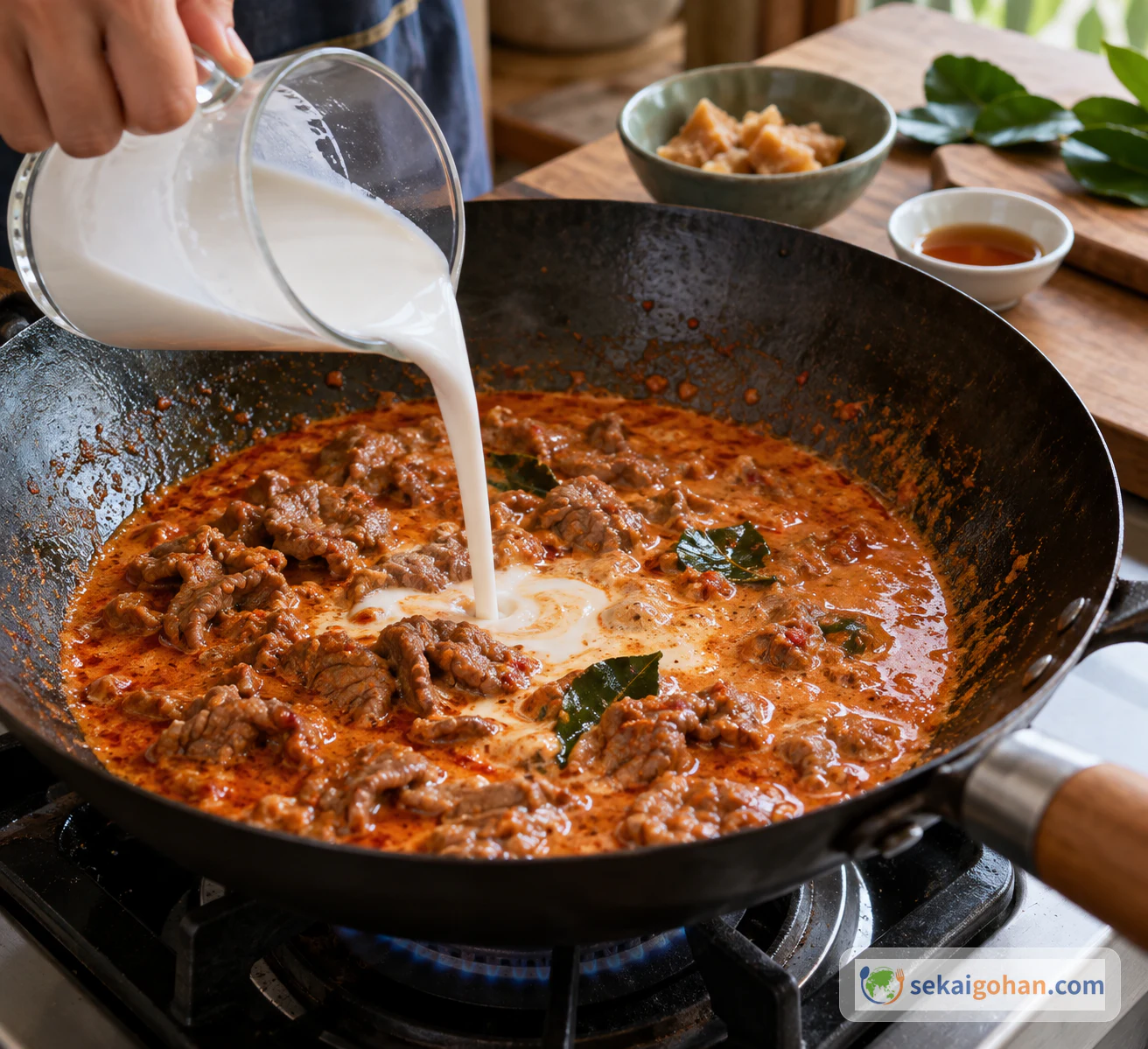
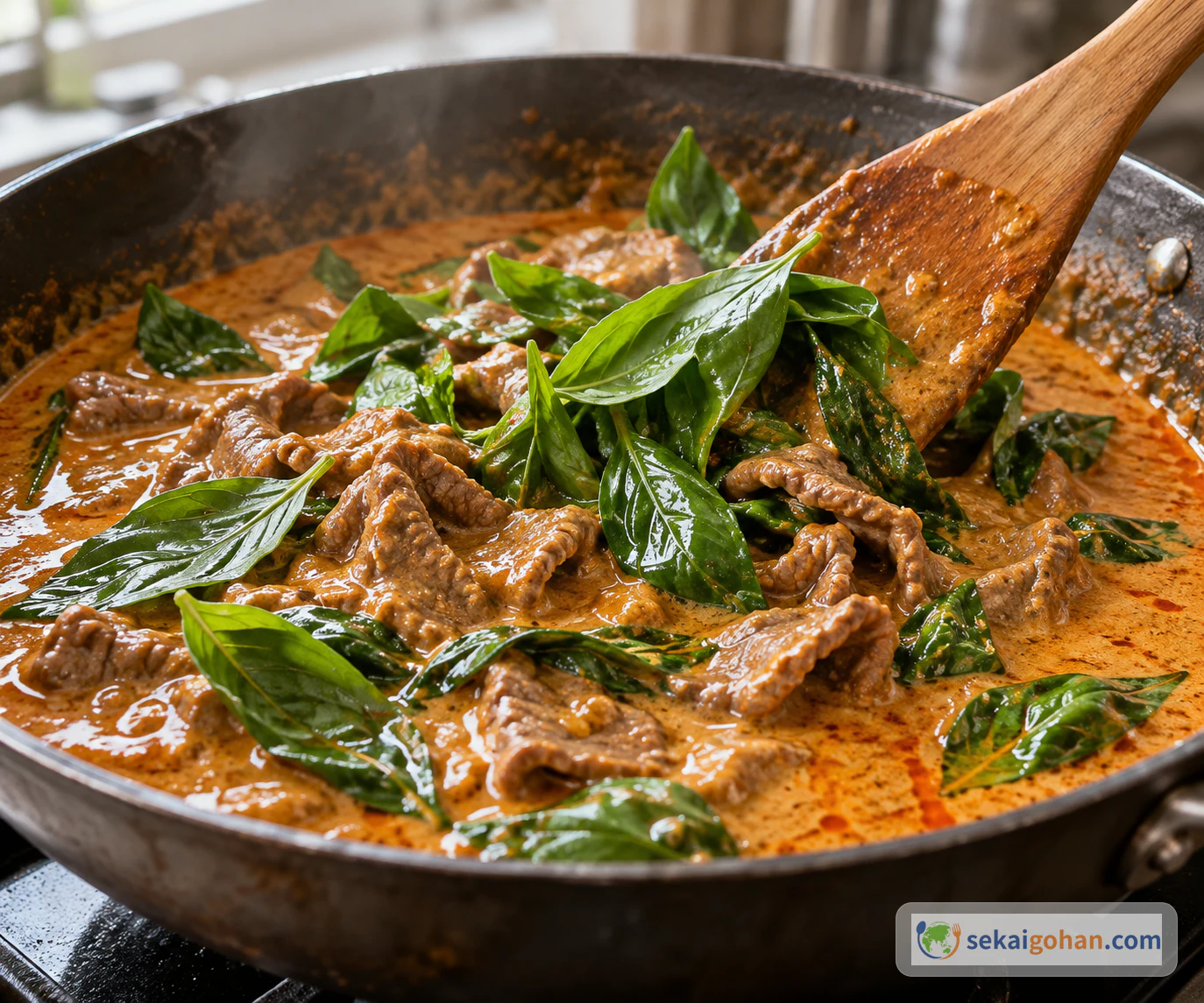
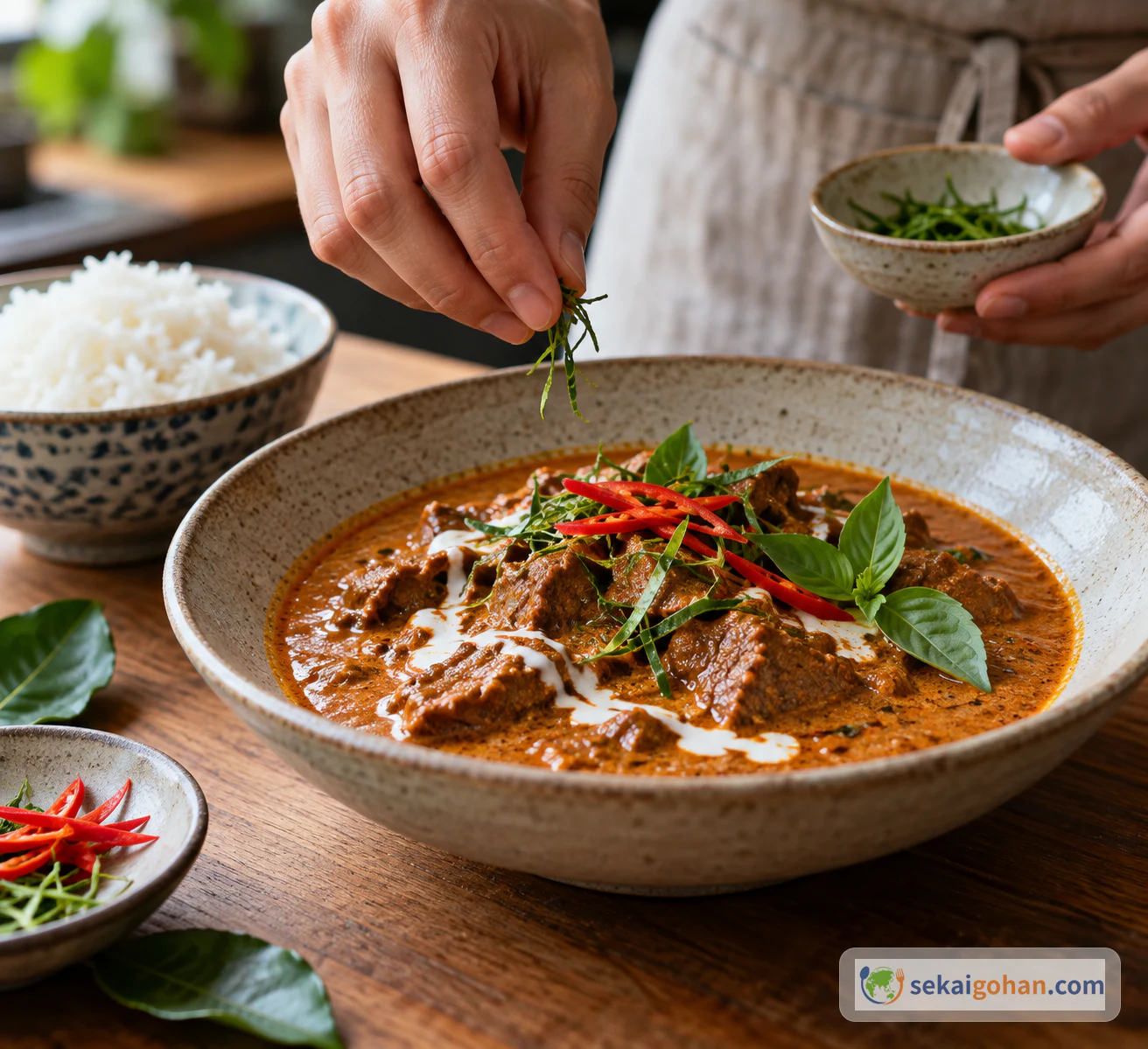
Warm thick coconut milk in a wok and stir until the surface turns glossy, then fry deep red panang curry paste in it. The liquid stops acting like a soup and turns into a sauce that clings to whatever goes in next: here, thinly sliced beef, finished with a little reserved coconut milk, fine shreds of makrut lime leaf and slices of red chili. Panang curry is a Thai dish of meat in a thick sauce of coconut milk, chili and makrut lime leaves. It tastes both sweet and salty. What makes it work is the contrast between that dense sauce and the sharp, fresh scent of the leaves.
About Panang Curry
In Thai the dish is written พะแนง, and in English you'll see it as Panang, Phanaeng or Phanang. All three spellings mean the same curry, so try each one when you're hunting for paste or reading up on it. Thai cooks make phanaeng with many meats, including beef, chicken, pork and duck, and it doesn't belong to the home cooking of any one province. You'll find more about the country's food on the Thailand page.
Origins of the Name
An 1890 cookbook already included a chicken dish written as 'Panang'. One theory connects the name to Penang (Pulau Pinang), and another to the Malay word panggang, meaning to roast or grill. One food writer thinks Muslim cooking influenced the dish. Nobody has settled where the dish or its name came from.
A 2018 qualitative study of curry pastes in central Thailand, based on interviews and observation, shows how paste ingredients and aromas changed with place, trade and time. It also describes how traditional pastes use lemongrass and makrut lime leaves. The study covers Thai pastes in general rather than panang itself, but it helps explain why the paste and the leaves carry so much of the flavor.
Panang, Massaman and Green Curry
Thai curries often get ranked by heat. These three differ more in what they're built around.
| Curry | What it centers on | What to keep in mind |
|---|---|---|
| Panang (this recipe) | Thin slices of beef, panang curry paste, thick coconut milk, makrut lime leaves | The sauce is reduced around the meat; leaves and chili finish it |
| Massaman | Warm spices and sweetness come to the front | A different paste and a different character; not interchangeable with panang |
| Green curry | Green paste and the aroma of green herbs, with vegetables | Same family of paste-based curries, but a lighter, herb-led result |
Ingredients: Serves 4
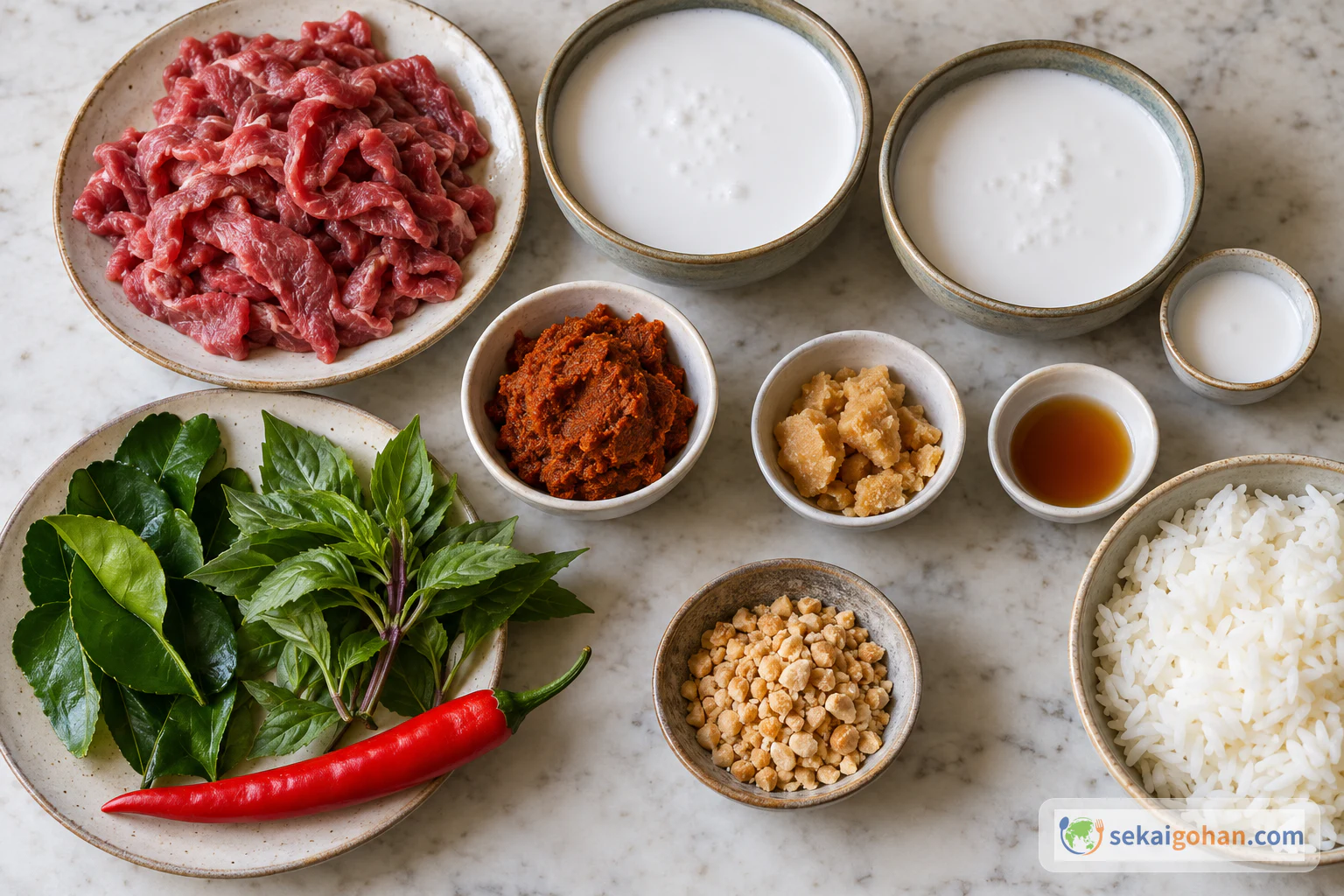
Use 2 cups (500 ml) of coconut milk in total. Set 2 tbsp (30 ml) aside for garnish, and divide the remaining 2 cups (470 ml) into two portions of 1 cup (235 ml). Do not add more coconut milk.
No oil, salt, water or extra vegetables are added. The paste is fried in the coconut milk itself.
Fish sauce is a fish product, and many panang pastes contain shrimp paste or other seafood. Check the label of what you buy. Peanuts are optional in this recipe, but some commercial pastes contain them, so read the ingredients even if you skip the topping. Coconut milk is not dairy milk, but check the labels of canned coconut milk and paste for milk and other allergens, along with any shared-facility statements.
Equipment
- A wok or a pot with a wide base
- A wooden spatula
- A knife and cutting board for raw beef, kept separate from those used for garnishes and serving
- A small container for the reserved 2 tbsp (30 ml) of coconut milk, and one for the second 1 cup (235 ml) portion
- A food thermometer, if you have one, to check the center of the beef
Ordinary kitchen tools are enough; there is no need to buy anything special for this dish.
Choosing Ingredients for Panang Curry
The beef and basil are easy to find. Spend your shopping effort on panang curry paste, makrut lime leaves, Thai fish sauce and thick coconut milk, because those give the dish its shape. Asian grocers and online shops sell them under their general names. Salt, heat and ingredients vary from one brand of paste to the next, so read the label before you buy.
- Panang paste vs. red curry paste: Red curry paste will make a curry, but it isn't panang paste. See the FAQ below.
- Coconut milk: Try not to shake the can. If a thicker layer has settled on top, use it in the first portion you heat.
- Palm sugar: If you can't find it, use a less-refined cane sugar and add it a little at a time. It sweetens the sauce, but the aroma and depth are different.
- Makrut lime leaves: Also sold as bai makrut. Fresh leaves are best.
- Sweet basil vs. Thai basil: Thai basil works, though it changes the aroma of the finish.
- Red chili: Pick a large red chili. Removing the seeds is one way to keep the heat down.
- Peanuts: Ground fine, they melt into the sauce. Ground coarser, they add crunch. Either way, they're an allergen.
- Beef shank: Shank needs long cooking and a recipe of its own, with its own amounts and method. This recipe is built around thin slices that cook quickly.
Method: Splitting the Coconut Milk and Frying It in Stages
Cook the first coconut milk for 3–5 minutes and the paste for 1–2 minutes. Judge heat by what you see and smell, since stoves vary.
Before you turn on the heat, have every ingredient measured and close at hand. Once the paste is in the pan, things move quickly.
When you finish, check three things in order: the sauce should coat the beef rather than run off it, the beef should be cooked through, and the seasoning should taste balanced. Do not simmer the beef for long.
Fixing Panang Curry Problems
Where the recipe leaves things to your judgment, such as heat level, go by what you see and smell rather than a set number. Patience with the paste matters more than high heat. One Bangkok restaurant kitchen fries the paste over low heat, adding coconut cream a little at a time until the oil starts to separate.
| Problem | Likely cause | What to do |
|---|---|---|
| The paste sticks to the bottom of the pan | Heat too high for the amount of liquid | Lower the heat and drizzle in a little of the second coconut milk portion. Avoid water, which dilutes the flavor |
| The oil does not separate | Coconut products differ in processing and fat content | Separation isn't the only sign of success. If nothing is scorching and the paste smells fragrant, move on |
| Too salty | Fish sauce added all at once; salty paste | Start fish sauce at 2 tbsp (30 ml) and taste. Check the paste's own salt before going up to the full 3 tbsp (45 ml) |
| The beef is tough | A cut meant for stewing, or cooking stretched out without reason | Use thin slices of a tender cut. If the center isn't fully cooked, keep heating: safety comes before speed |
Use separate tools for raw beef and for anything served without further cooking. Cook the beef until the center reaches 167°F (75°C) for at least 1 minute. This recipe is for sliced beef, not ground meat.
Serving, Storing and Varying Panang Curry
Jasmine rice is the base, but panang is also eaten with roti or salted egg. Each one takes up the sauce differently, so soft flatbread and plain rice make two slightly different meals.
Divide leftovers into shallow containers so they cool quickly, and don't leave them at room temperature for long. Reheat thoroughly, to 167°F (75°C) or above.
- Milder: Less paste lowers the heat, but it also cuts the aroma and salt and makes the whole sauce thinner.
- Pork: Pork can replace the beef. Expect to readjust the paste and the salt.
- Chicken: Treat chicken as a separate dish that needs its own cooking.
Frequently Asked Questions
Are peanuts required?
No. In this recipe, roasted ground peanuts are an optional topping that adds toastiness and texture. Some commercial panang pastes contain peanuts, so check the label if you need to avoid them.
Can I use red curry paste instead?
You can make a curry with it, but the aroma, salt and heat will be different, and the result won't quite be panang. If you can, use a homemade or ready-made panang paste.
What if I can't find makrut lime leaves?
Their citrus aroma is central to the dish, so leaving them out or using another citrus won't give the same flavor. Dried leaves will do, but their aroma is weaker and their texture is different.