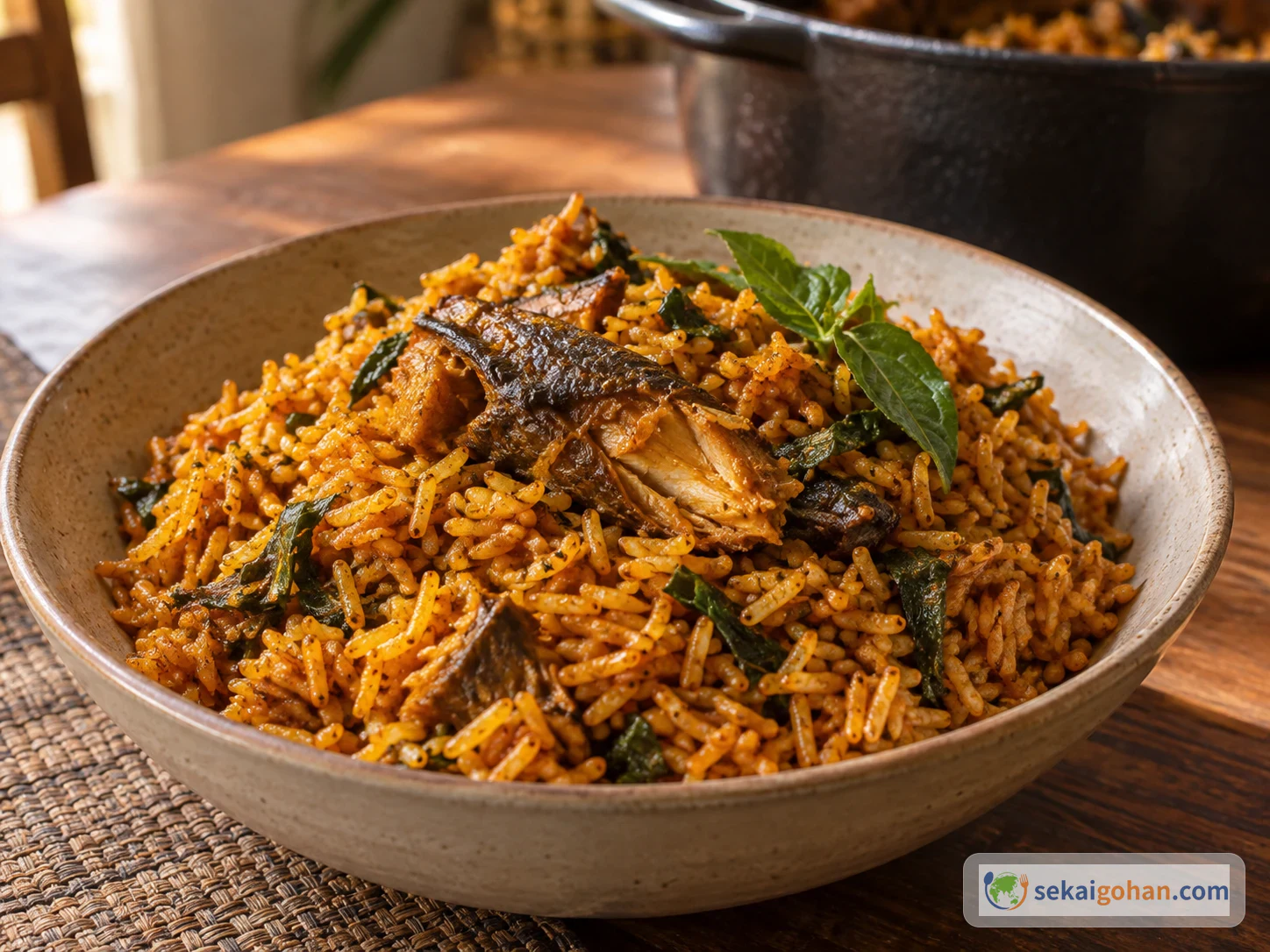
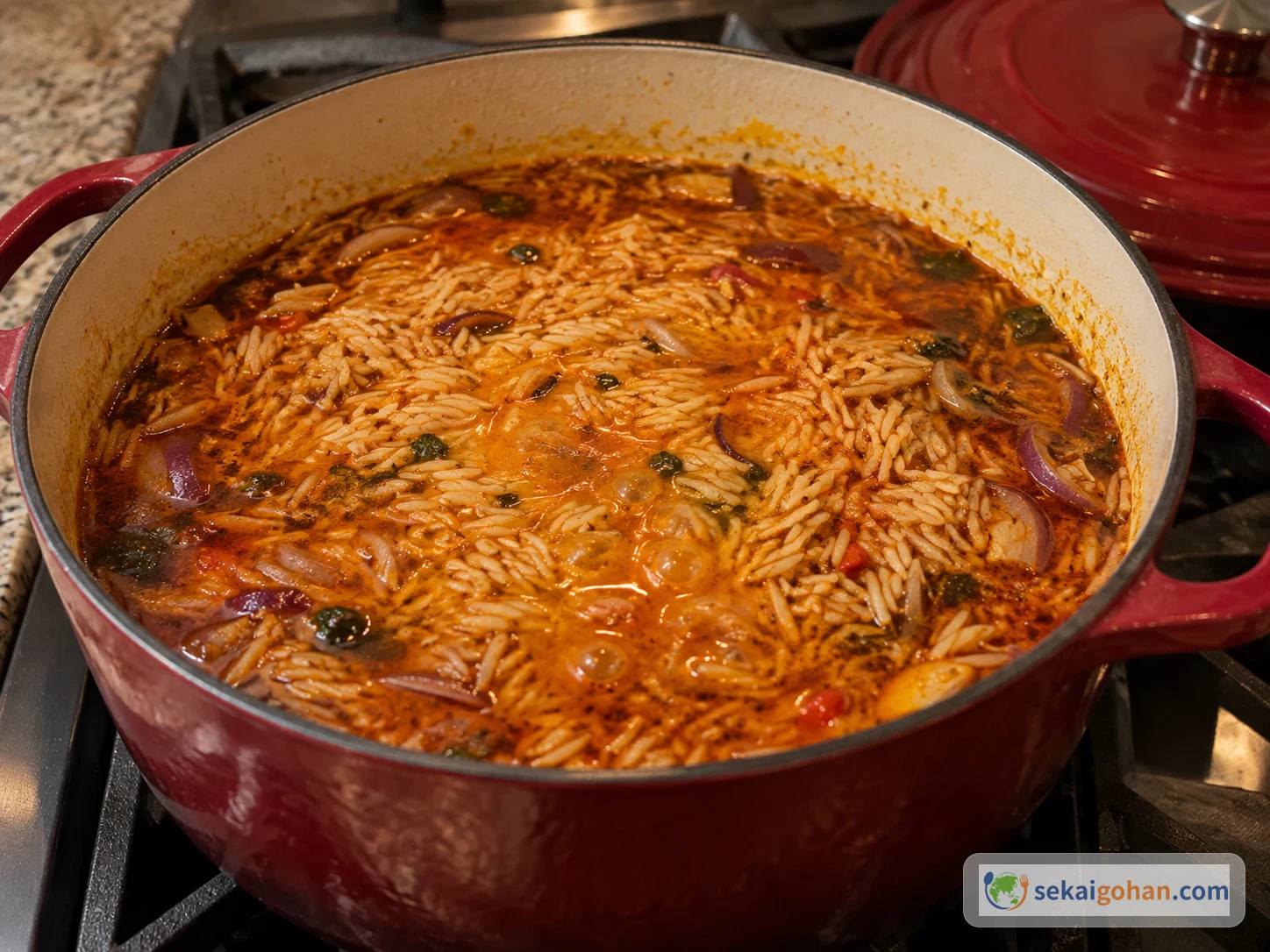
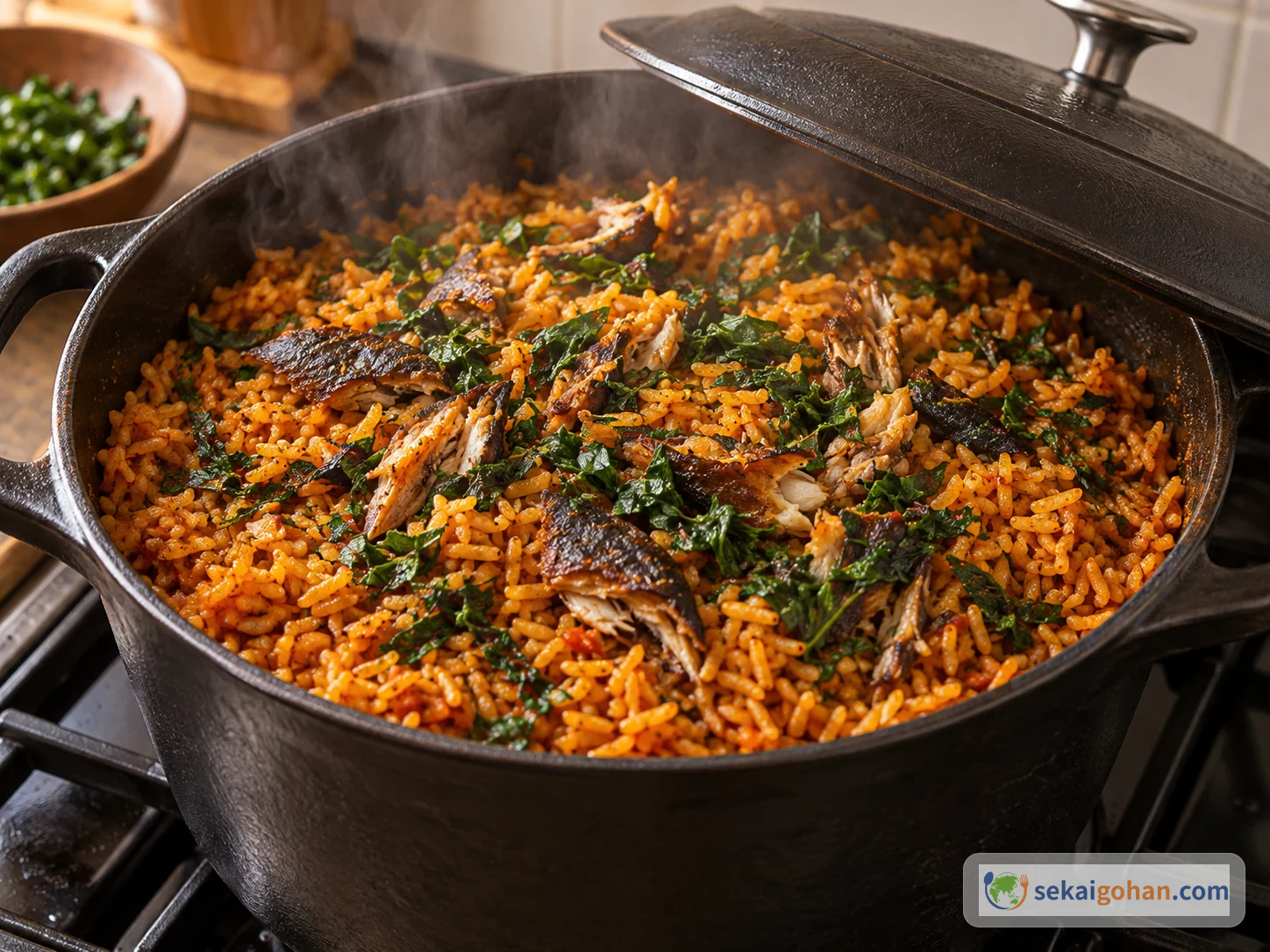
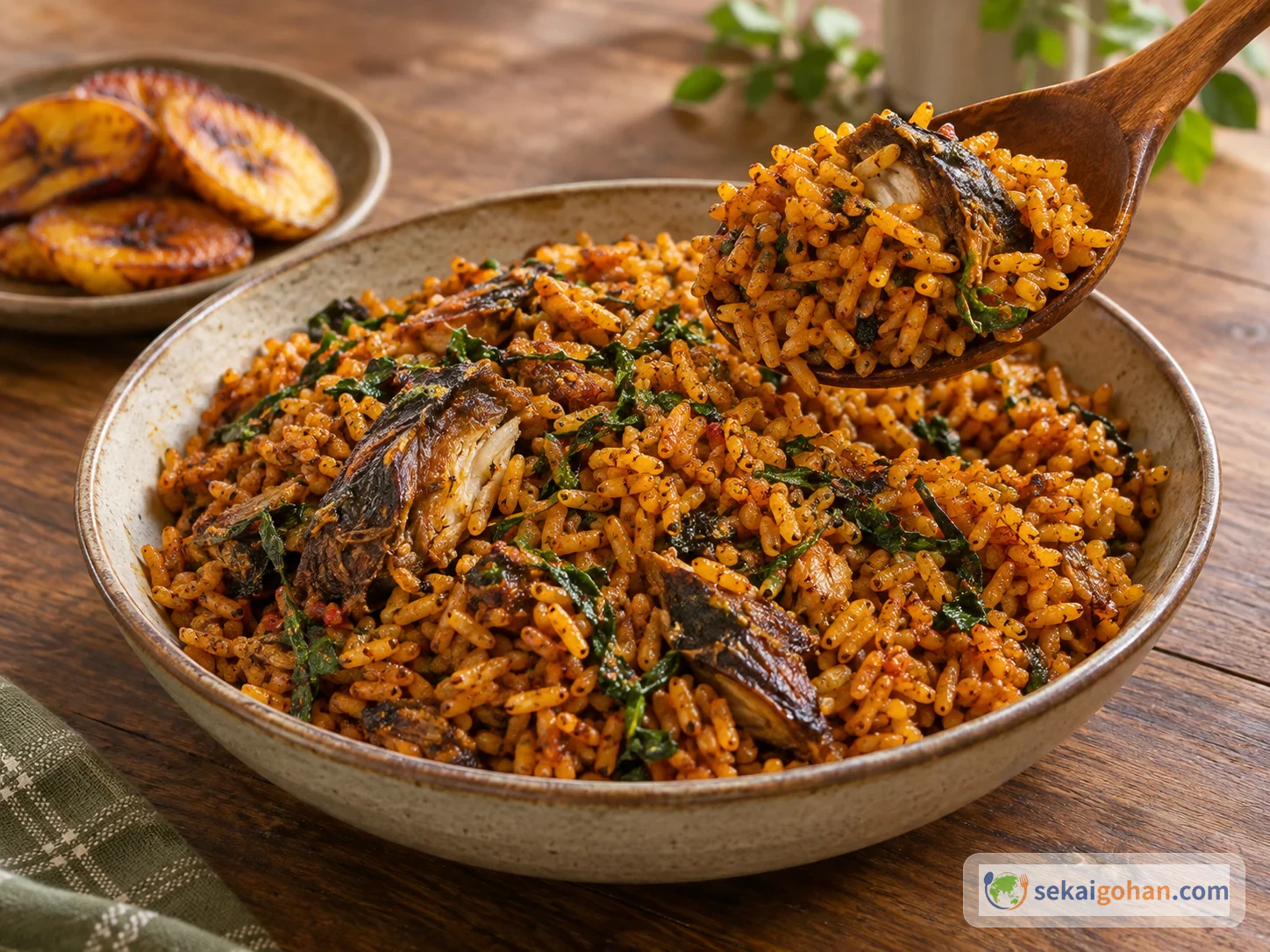
On the way home from school in Delta State, you could buy banga rice from the local mamaput, a street-corner eatery that serves hot meals. What stays with you is the steam that rises each time the pot lid lifts, and the warmth of the parcel in your hands. Banga rice is cooked in an extract of palm fruit with seafood, chile, and herbs. The palm nut extract decides the color and aroma of the rice. The red-orange liquid soaks into every grain, and dried seafood and banga spice perfume the whole pot.
Banga Rice in Delta State
Origin and the Urhobo Table
Banga rice belongs to Southern Nigeria, especially the Urhobo people of Delta State, and it often goes by the name Urhobo Banga Rice. A state-by-state list of Nigerian dishes places Hot Banga Rice next to Banga Soup under Delta State, which tells you how firmly it is rooted there as a local staple. In Delta life, it's an everyday plate, the kind of hot rice you pick up without a second thought.
Traditionally, the liquid starts with fresh palm nuts. They are boiled for about 30 minutes, then lightly crushed or worked by hand, gently enough that the nuts stay whole. Warm water loosens the pulp, the liquid is strained, and the extraction is repeated. It takes a pot, a colander, and a strainer, and it runs on a much longer timeline than opening a can, which is why this recipe uses commercial palm nut concentrate.
Banga Rice, Banga Soup, and Ofe Akwu
The same palm nut extract also becomes Banga soup, a seafood soup. Delta State memories of banga soup gather around starch (usi), earthen pots, catfish, and periwinkle. Banga rice has the rice as the lead; banga soup is a dish served with a staple.
A neighboring palm fruit dish is ofe akwu, a stew tied to the Igbo and southeastern Nigeria. Like banga dishes, it uses palm fruit cream or concentrate, seafood or meat, and herbs and spices. The difference is how it reaches the plate: banga rice is a one-pot dish with the rice cooked right in the palm liquid, while ofe akwu is served alongside rice and other staples.
Ingredients (serves 4)
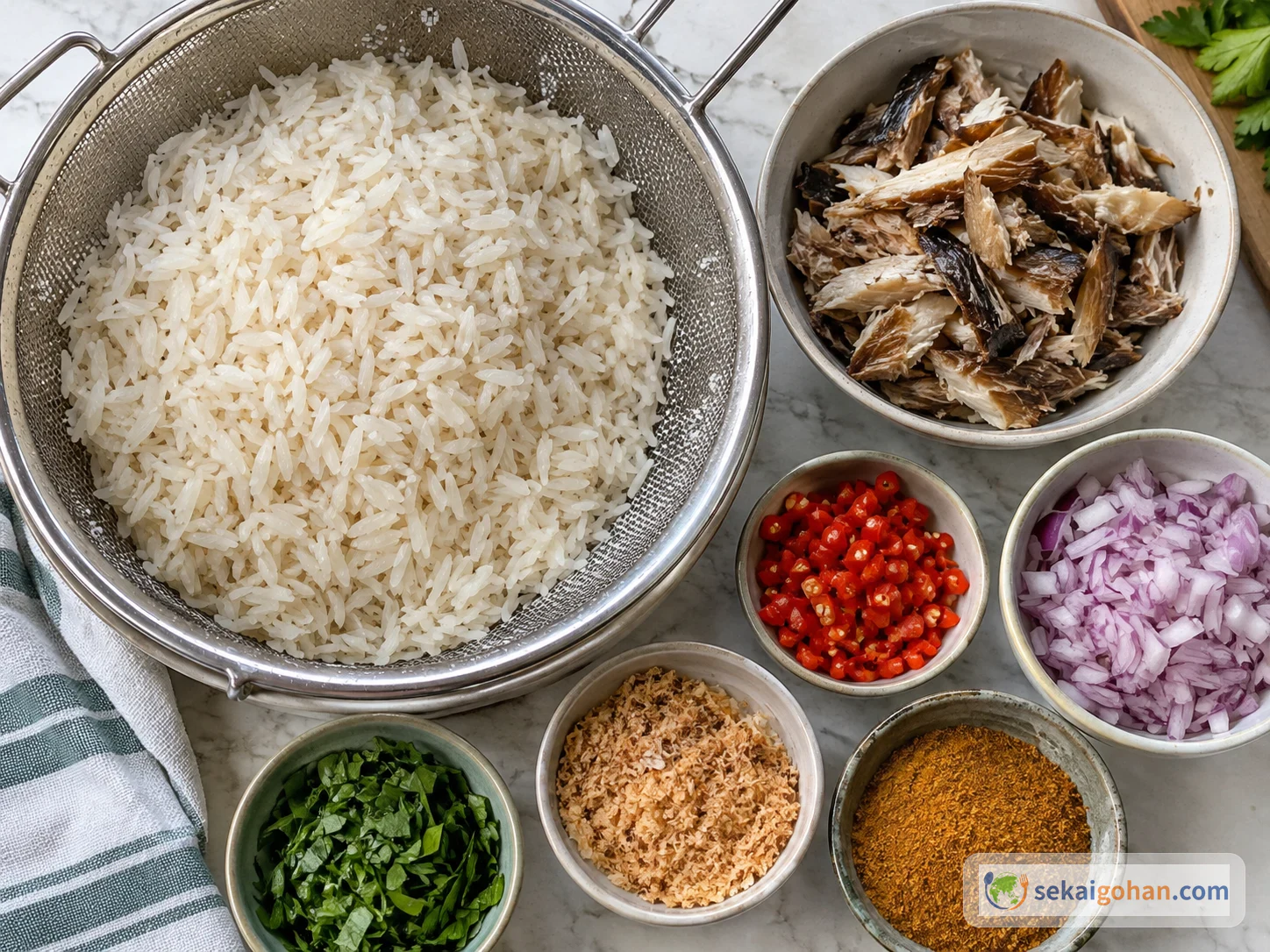
The leads are long-grain rice and palm nut concentrate. Dried seafood and banga spice are layered on in small amounts. The liquid is built around 14 oz (400 g) palm nut concentrate, and 15 g crayfish powder or ground dried shrimp builds the depth of the seafood.
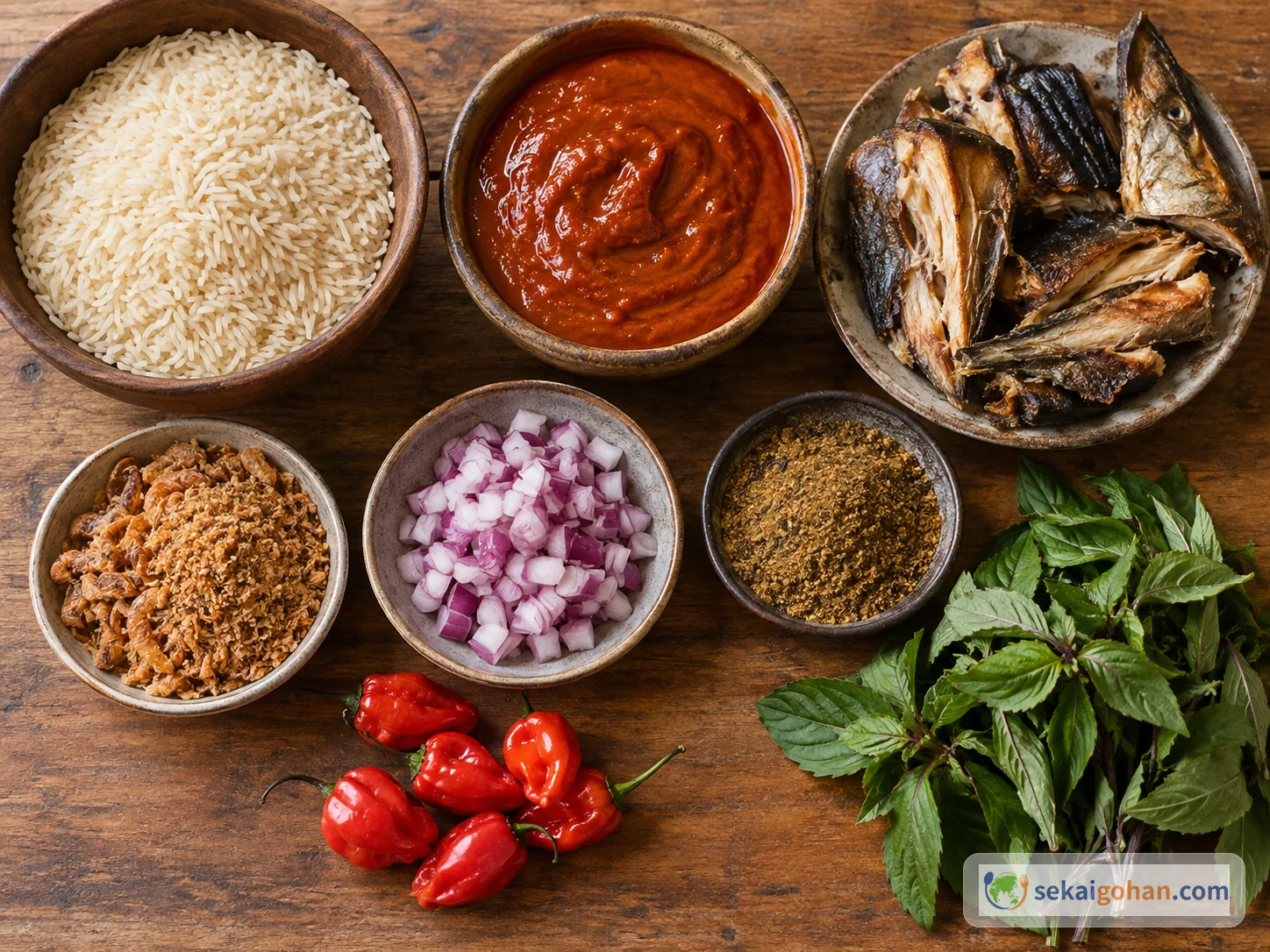
The fresh palm nut extraction described earlier is not an alternative amount for the 14 oz (400 g) of concentrate in this table. The 14 oz (400 g) is the fixed amount for the main recipe. The first time, make the main recipe. If you switch to a different prep, adjust while watching the amount and thickness of the liquid.
Choosing Ingredients and Substitutes for Banga Rice
Palm Nut Concentrate
Ready-made palm nut extract replaces extracting from fresh nuts. Look for a true palm fruit concentrate, not just red oil: coconut milk or red palm oil on its own can't supply the liquid of palm fruit that soaks into the rice. Concentrates vary in thickness and saltiness from brand to brand, so add water in 3.5 tbsp (50 ml) increments, watching the liquid level in the pot and the firmness of the rice. The signal to add the rice is that fine droplets of oil return to the palm liquid.
Banga Spice, Crayfish, and Leaves
Banga spice is a ready-made local spice blend. Without it the rice still cooks, but the banga character of the aroma is weaker. Crayfish powder carries the aroma of dried crustaceans, and ground dried shrimp is an easier-to-find substitute. Use scent leaves if you can get them; otherwise a small amount of sweet basil points the aroma in a similar direction, though it isn't the same as the local leaf. Choose substitutes to keep the role of the aroma, not to match the taste exactly.
Allergy Notes
Crayfish powder and ground dried shrimp are both made from crustaceans, so leave them out if you have a crustacean allergy. Swapping in another seafood such as dried bonito flakes isn't automatically safe either; check the ingredients and cook only what the person eating can safely have. Without the dried seafood the aroma is lighter, and the smoked fish and herbs balance it better than extra salt or banga spice would. Decide whether to omit before looking for a substitute.
This uses smoked fish, crayfish powder, and ground dried shrimp. If you have a seafood or crustacean allergy, check the labels and do not eat it. Dried goods are labeled differently by product. You need only one of crayfish powder or ground dried shrimp. The main recipe does not use raw seafood. If you add it, cook it thoroughly to the center.
Look first for the palm nut concentrate. Next the banga spice, then crayfish powder or ground dried shrimp. Rice, onion, chile, smoked fish, basil, and a pot and colander can be gathered in an ordinary shop.
Method
The overall flow is about 10 minutes of prep, about 10 minutes for the palm nut base, and about 15 minutes of cooking the rice. After that come 5 minutes on low heat, a 10-minute rest, and about 5 minutes to serve. Add the rice after the oil of the palm liquid separates, steam on low heat, then turn off the heat and leave for 10 minutes. Do not rely on the clock alone. Look at three things: the oil on the surface of the liquid, the firmness of the center of the rice, and whether there is any scorch on the bottom of the pot. Do not add the rice before the oil separates; that is the first rule of this dish.
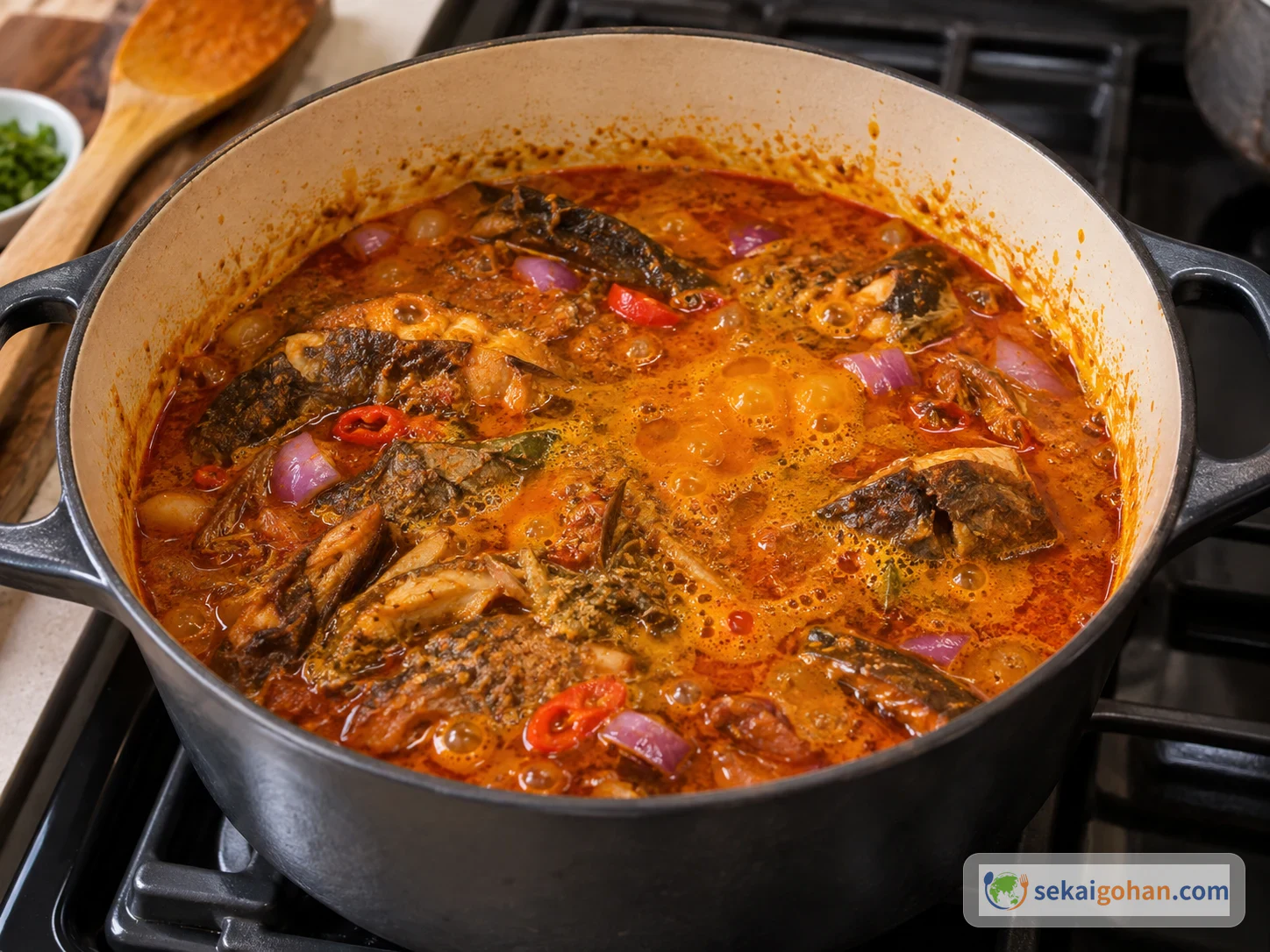
When you boil palm nut liquid, at first large bubbles with a lot of water form. Before long they turn into fine bubbles and red-orange droplets of oil. If you add the rice before the oil separates, the liquid is thin and the aroma of the seafood does not get into the rice. But just because the oil has risen does not mean you can scorch the bottom. Keep the heat at medium and stroke the bottom with a wooden spoon.
If the center of the rice is hard and the liquid is gone, add 3.5 tbsp (50 ml) boiling water, not cold water, down the side of the pot. Cover, cook on low for 5 minutes, steam off the heat for 5 minutes, and check again. If liquid remains but there is still a core, keep the heat low with the lid on without stirring.
Banga Rice Doneness and Fixes
Reading the Pot
Rather than relying on the minutes alone, look at three points in the pot. The grains should have absorbed the red-orange liquid, with no puddles on the surface and no white core in the center. Turned once with a wooden spoon, the bottom should show only a thin film and smell clean, not burnt. The seafood should be heated through, the smoked fish warm, and the leaves still fragrant rather than boiled black. No puddles, no white core, no burnt smell: when all three line up, it's done.
| Condition | What is happening | How to bring it back |
|---|---|---|
| Center of the rice is hard, no liquid | Parboiling or steam was insufficient | 3.5 tbsp (50 ml) boiling water, 5 minutes low heat, 5 minutes steaming |
| Rice is not hard but there is a lot of liquid | The concentrate or stock had a lot of water | Take off the lid without breaking up the fish and cook on low for 3–5 minutes |
| Only the bottom is about to scorch | The heat is high, or solids settled on the bottom | Turn the heat to the minimum and shake the pot without stirring. Leave the burnt bottom where it is |
| The aroma is flat | The aroma of the banga spice or dried goods is weak | Adding more at the end won't fix it; next time weigh the dried goods and wait until the oil floats |
Adjusting the Taste
Make small adjustments you can build on. Salt content in seafood and banga spice varies by product, so use unsalted stock and add the 4 g of salt gradually, tasting as you go. Set the heat at the start with the amount of chile and its seeds; thinning the finished rice with water only breaks the grains. If the palm nut aroma seems strong, balance it with more smoked fish and leaves rather than lemon or vinegar, which would turn it into another dish.
Serving and Storing Banga Rice
Serve banga rice with grilled chicken, smoked fish, and plantain. Away from Nigeria, make the smoked fish the lead, keep it in large pieces, and scatter green leaves over the top at the end. No grilled plantain? A small amount of unsweetened grilled banana or some warm vegetables on the side works well.
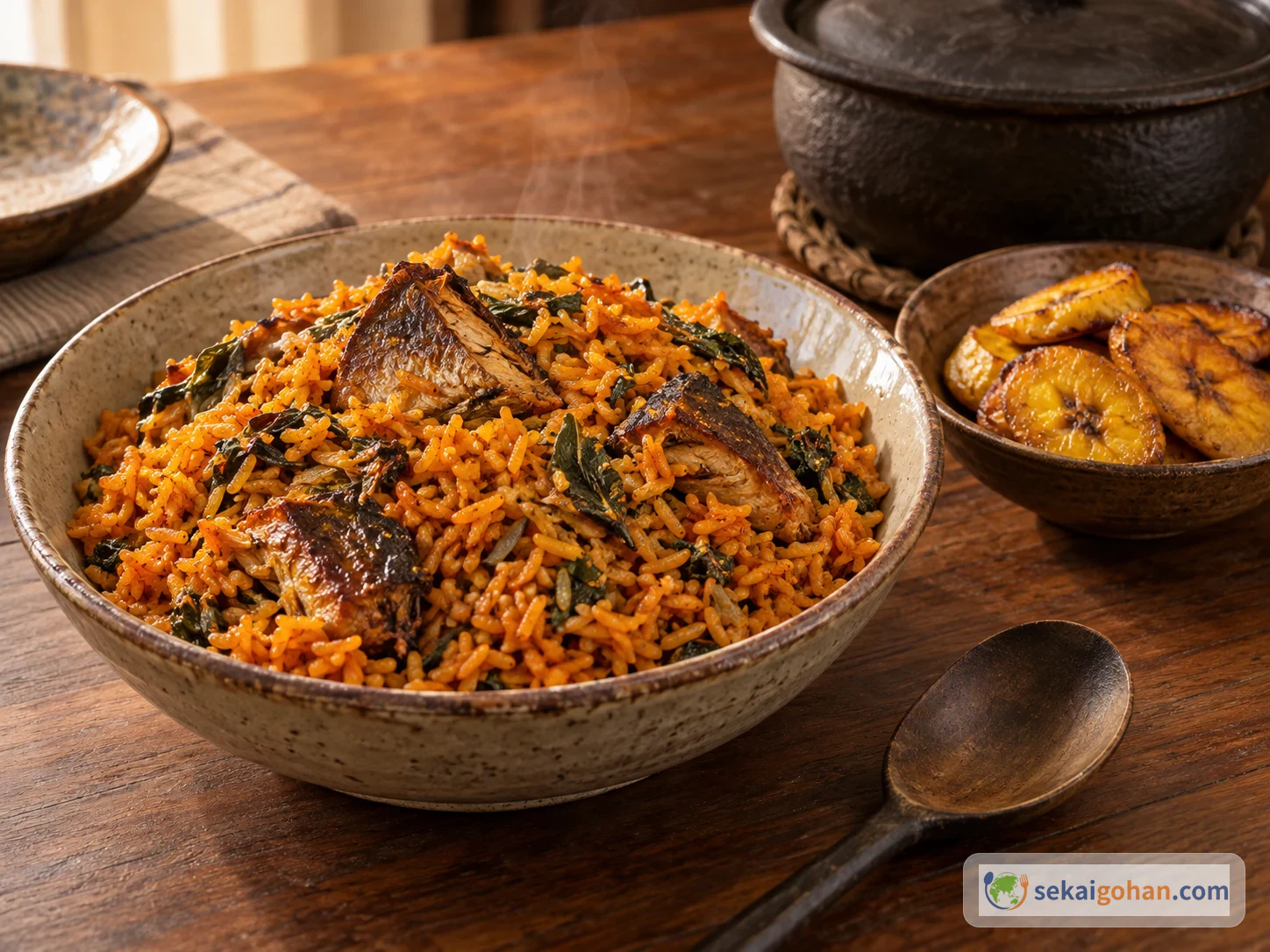
To enjoy the same palm nut as a soup with a staple on the side, try banga soup. For another Nigerian dish built on seafood and dried goods, there's abacha, though it's put together quite differently from rice cooked in palm liquid.
Cool leftovers quickly with clean utensils. Do not leave cooked food at room temperature for long. Divide into shallow containers and avoid leaving it at room temperature. When eating, reheat the whole thing thoroughly, to 167°F (75°C) at the center for at least 1 minute. Do not eat anything that has been stored too long or whose smell or condition seems off. If you add raw fish, also heat the center to 167°F (75°C) for at least 1 minute. Wash the knife and cutting board used on raw fish, and pour boiling water over them, before using them on cooked food.
Frequently Asked Questions
What if I cannot get palm nut concentrate?
Use fresh palm nuts. That adds about 30 minutes of boiling, plus gentle crushing, extracting with warm water, and straining. For a first attempt, concentrate is the easier choice. Coconut milk alone changes both the palm fruit aroma and the red-orange base, so it won't make the same dish.
Can I substitute red palm oil?
Not on its own. The palm fruit extract is the liquid the rice cooks in, and red palm oil can't supply that water or the body of the pulp. The color it adds isn't worth the trade.
Do I need both crayfish powder and ground dried shrimp?
Either one at 15 g is enough. Crayfish powder gives the local aroma of dried crustaceans, and ground dried shrimp is easier to find. If you have a crustacean allergy, leave out both.
Can I cook the rice raw?
You can, by adding more liquid and cooking it directly, but the thickness of the palm nut liquid makes the rice's absorption hard to predict. The main recipe parboils the rice for 5 minutes in boiling water and drains it, which makes it easier to read how much liquid the rice will take up in a thick liquid. If you try raw rice, keep the liquid about 0.25 inch (5 mm) above the rice, check the firmness of the center, and if needed bring it back with 3.5 tbsp (50 ml) boiling water.