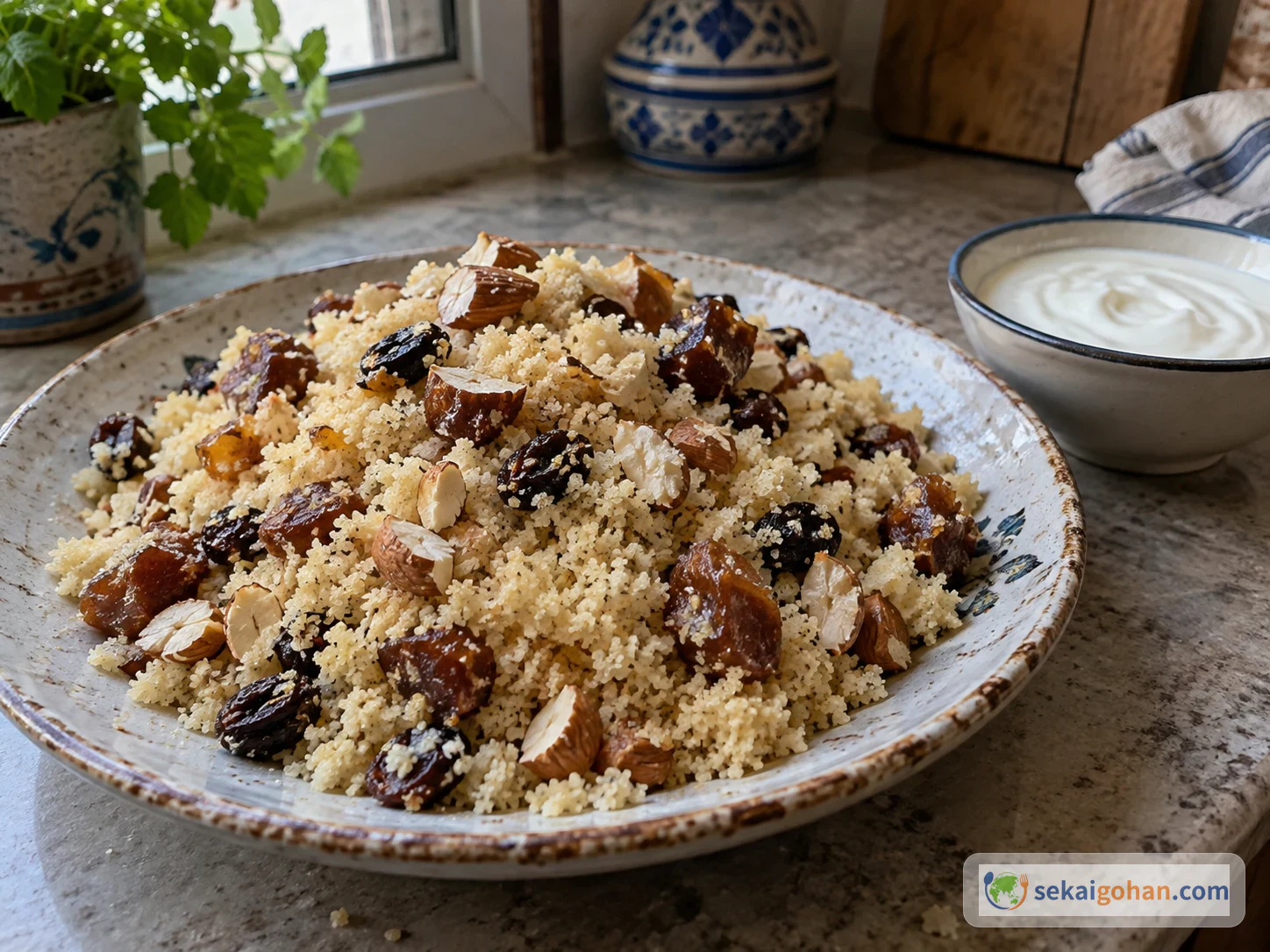
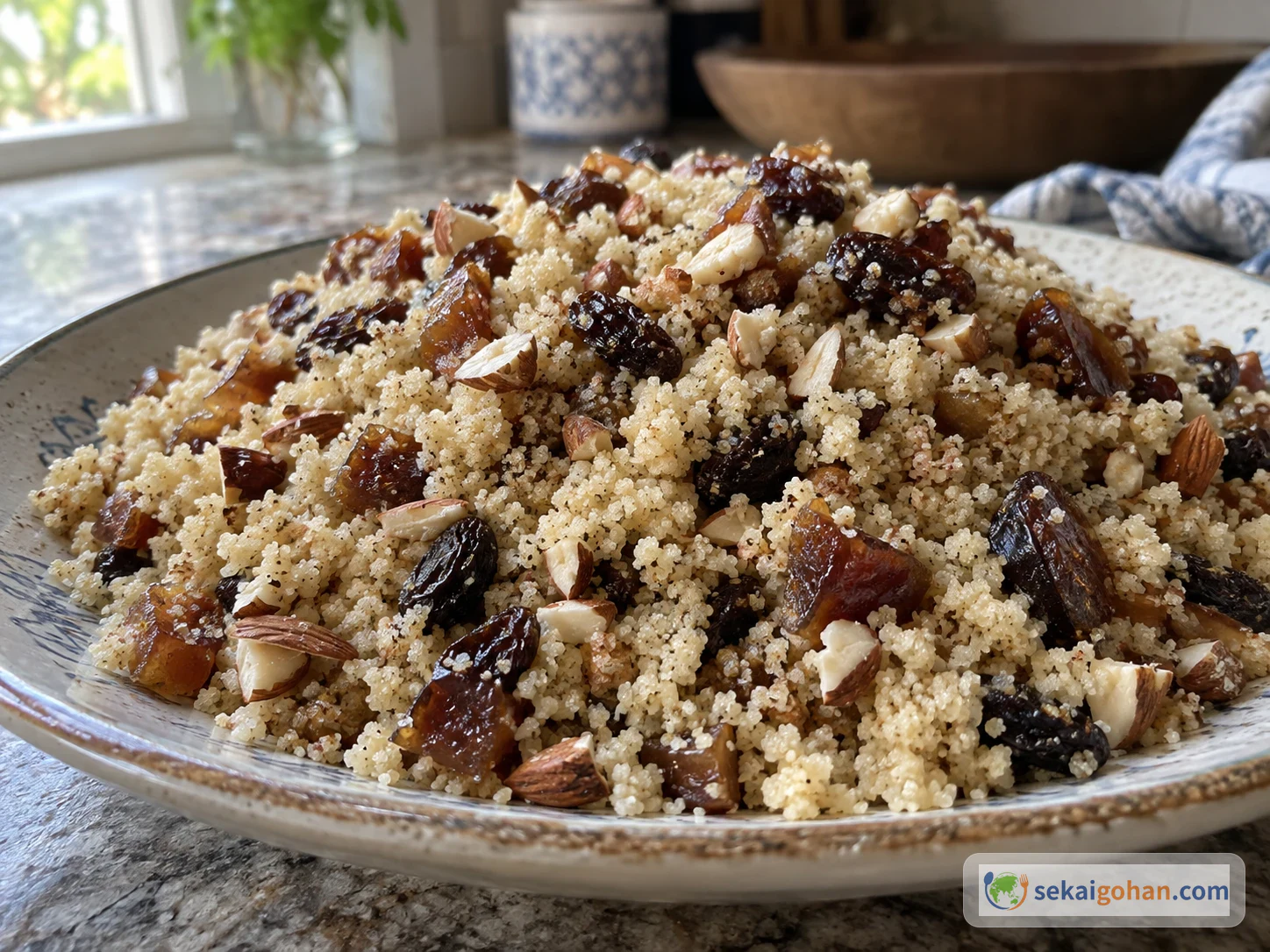
Steam rises off a big platter of couscous in the middle of the table on a Ramadan night. Someone slips in a fork and loosens the moist grains, and the smell of the sweetness of dates and raisins comes up with the steam. Chopped fruit is scattered over the top, and a small bowl of fermented milk, lben, waits at the side. This is mesfouf (also spelled Masfouf), Tunisia's sweet fine-grain couscous. The grains stay separate and fluffy, with soft dried fruit and crunchy nuts layered over them, and there's no spicy sauce anywhere in sight. It comes together in about 20 minutes, and the one thing that matters most is loosening the grains one by one.
Mesfouf on the Tunisian table
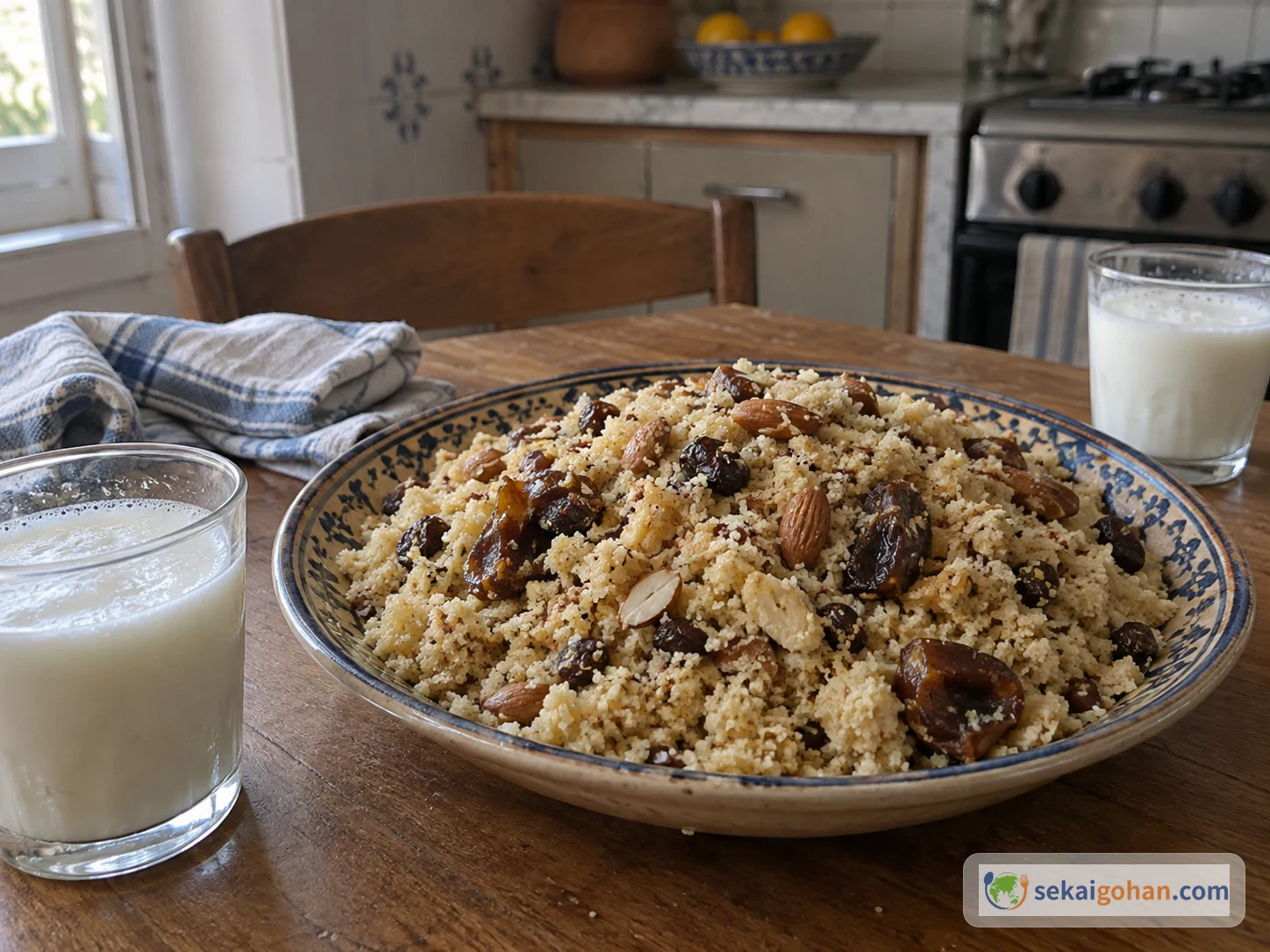
In Tunisia, mesfouf is the couscous of Ramadan nights, served with raisins and dates and often with a bowl of lben. Sweet couscous and fermented milk show a different side of the same wheat grains that elsewhere carry a spicy tomato sauce or meat. It turns up at the evening table, but it suits the pre-dawn meal just as well, either as a light meal or as something sweet.
The name stretches further than you might expect. In Sousse, the sweet version is mesfouf sucré, also called Hajouja, while in Zarzis, Mesfouf salé is savory, made with fillings and preserved meat. The same name covers sweet and savory, and what you'll make here is the sweet one with dried fruit.
The handwork of loosening the grains
Every version shares the same handwork. Traditionally, the grains are steamed, spread out, broken up, moistened, and steamed again, round after round. A quick couscous that needs only one soak in hot water won't taste or feel quite like steamed couscous, but it still needs to be separated with a fork, and it lets you skip the steamer entirely.
In 2020, the knowledge, skills, and practices of couscous were recognized as heritage. Four countries, Algeria, Mauritania, Morocco, and Tunisia, applied jointly. The recognition covers the techniques and tools for handling grain and the custom of gathering around the table. The hand movement that loosens the grains of this sweet dish comes from that same inherited handwork.
There are modern takes too, such as one that alternates layers of grains perfumed with flower water and cream, finished with nuts and dates. The version here skips the cream and serves unsweetened yogurt on the side.
Ingredients (serves 4)
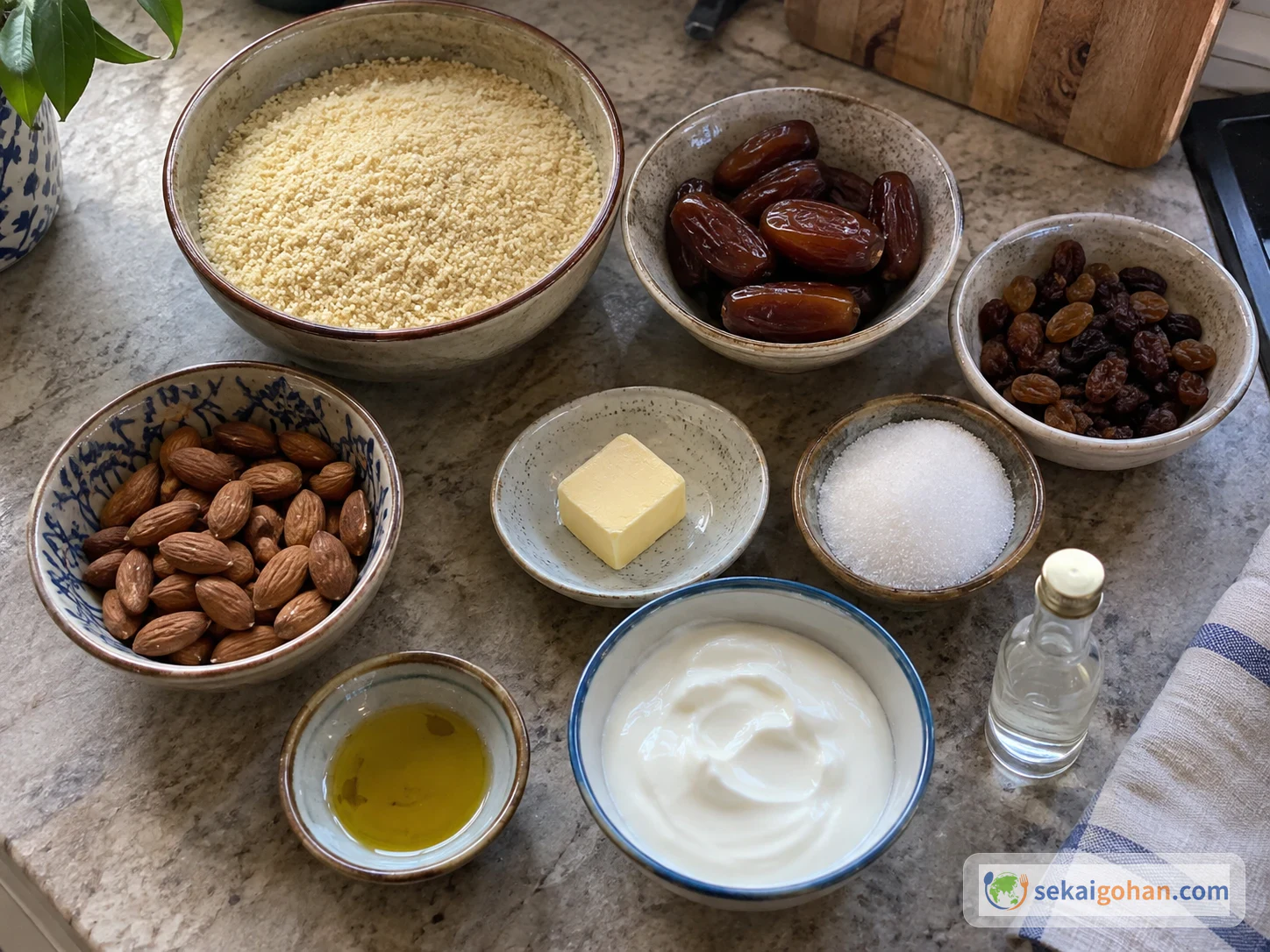
Four servings is the amount for a light meal or dessert. It does not guarantee a quantity that fills you as a staple. The sweetness comes from the dates and raisins, and the 20 g of sugar is there to help the grain blend in. The most important thing when shopping is plain dry couscous, to be distinguished from seasoned products. The unsweetened yogurt is not mixed into the grains; the yogurt is served on the side.
For orange blossom water, choose food-grade flower water. Cosmetic waters, aroma oils, and essential oils are not used in cooking. A small amount gives aroma, so starting from 0.5 tsp (2.5 ml) is enough. Orange juice adds sourness and moisture and is not a one-to-one replacement. Even without flower water, you can make it from the basic combination of fruit, grain, and fat. Only the floral aroma is left out.
Soak the raisins in warm water for 10 minutes and drain them well. If the dates are hard, soak them separately in warm water for 5 minutes, drain, and then chop. Soft dates soaked with the raisins become hard to chop, so just pit and cut them as they are. Do not add the soaking water to the 1 cups (250 ml) for absorption.
Watch for the wheat in couscous, the dairy in butter and yogurt, and the nuts in almonds. For dried fruit, also check the label for additives such as sulfites. Removing only the nuts does not remove the other allergens, and be careful about cross-contact through bowls, cutting boards, and forks. If avoiding dairy, replace the butter with 20 g of oil and omit the yogurt. The oil then totals 1 oz (30 g) with the basic 10 g. Check the product's ingredients.
Choosing couscous for mesfouf
Couscous is semolina formed into grains, so pouring hot water over raw semolina flour won't give you this dish. Fineness alone isn't the test: check that the package gives directions for hydrating with hot water, and follow its soaking time. Pearl couscous is a large-grain product cooked a different way. Look for plain "couscous" in the import section or online, and check the ingredients and whether it's seasoned.
How to make it
The total is about 20 minutes: about 10 minutes of prep, then about 10 minutes for boiling water, hydrating, and finishing. While the raisins soak, prepare the nuts and dates. In step 2, follow the package for the soaking time. The 4 to 5 minutes here is for couscous that hydrates in hot water. It is not the steaming time for raw couscous.
1. Prepare the fruit and almonds
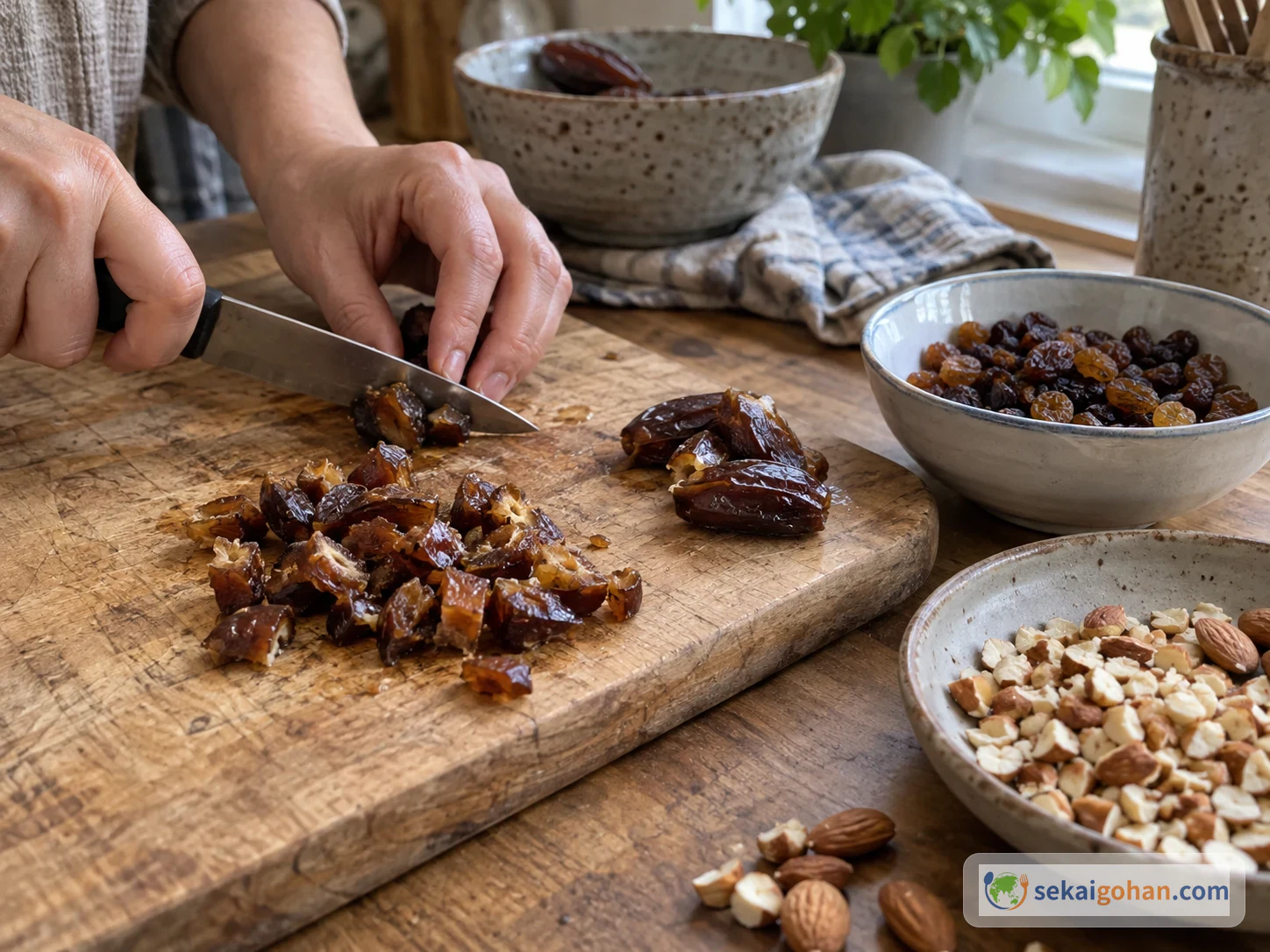
This takes about 10 minutes. Soak 2 oz (60 g) of raisins in ½ cup (150 ml) of warm water at about 104°F (40°C) for 10 minutes, drain in a strainer, and pat with paper towels. Pit the dates, weigh out 2.75 oz (80 g), and cut them in 0.25–0.375 inch (5–8 mm) pieces. While cutting, check that no pits remain.
Chop 1 oz (30 g) of unsalted almonds to 3–5 mm. If raw, toast them in a dry skillet over low heat for 2 to 3 minutes, shaking occasionally. When the aroma rises and they are a pale golden brown, move them to a plate. Once the color starts to deepen, residual heat carries it further, so do not leave them in the pan. If already roasted, skip the reheating.
2. Pour hot water over the couscous
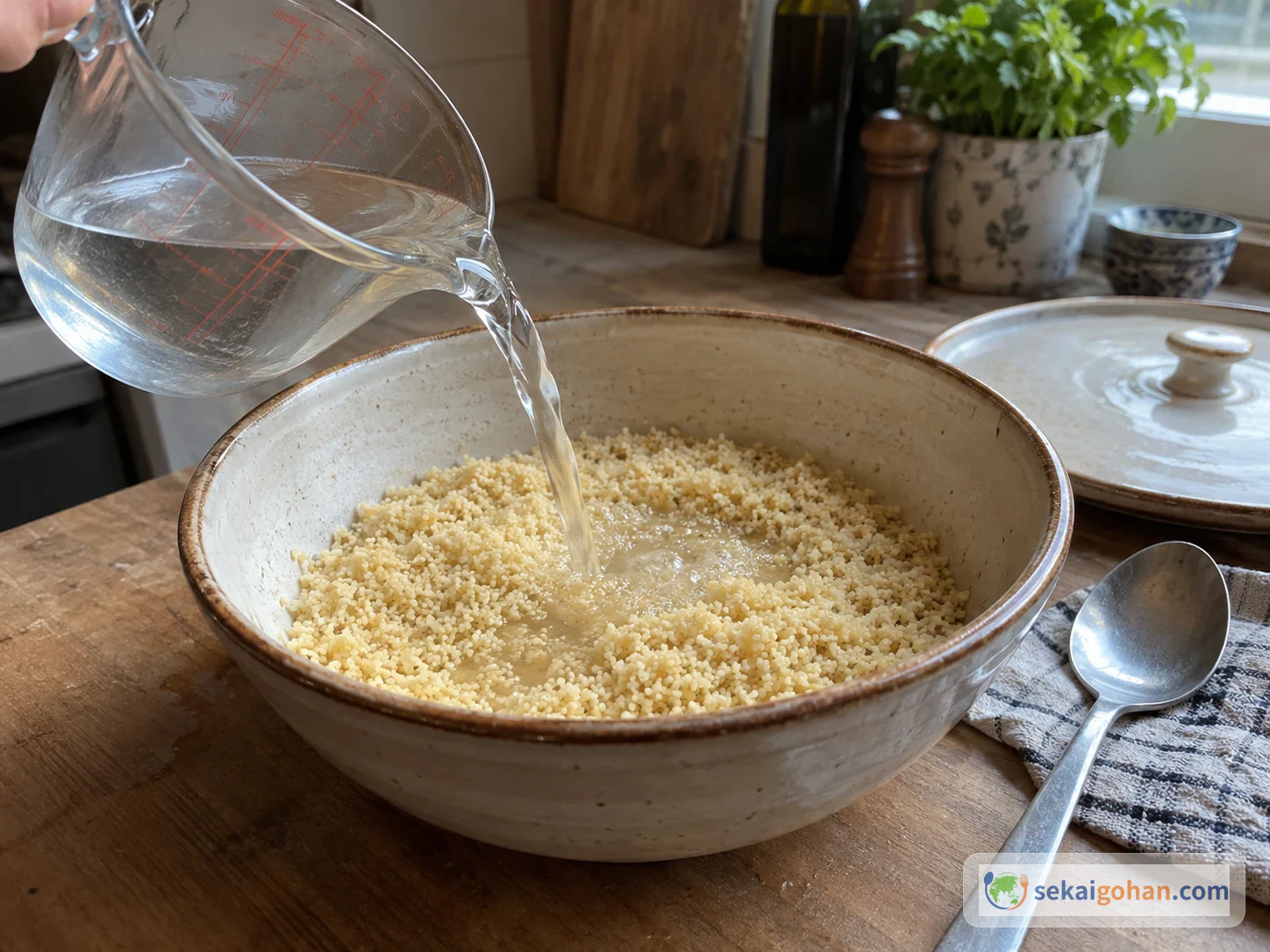
Boiling the water takes about 2 to 3 minutes and hydrating takes 4 to 5 minutes. Put 7 oz (200 g) of couscous and 10 g of oil in a heatproof bowl and mix with a fork for about 30 seconds so the grains are coated with oil on the surface.
For the water, use about 1 cups (250 ml), the same volume as the dry couscous. If the product specifies an amount, use that. Dissolve 1 g of salt, bring to a boil over high heat, and as soon as you turn off the heat, pour it so it reaches everything. Stir lightly, cover with a lid or plate, and leave 4 to 5 minutes according to the product's directions. The grains are hydrated when there is no pool of water at the bottom and the grains have swollen. Do not hold a hot bowl in your hands. This step does not apply to powdered ingredients or large-grain types.
"The same volume" means the volume of grains and water measured in the same container. It does not mean ¾ cup (200 ml) of water for 7 oz (200 g) of grains. If the product specifies an amount, pour that. For coarser grains or a different product, follow the package for the amount.
3. Mix in the butter and fluff the grains
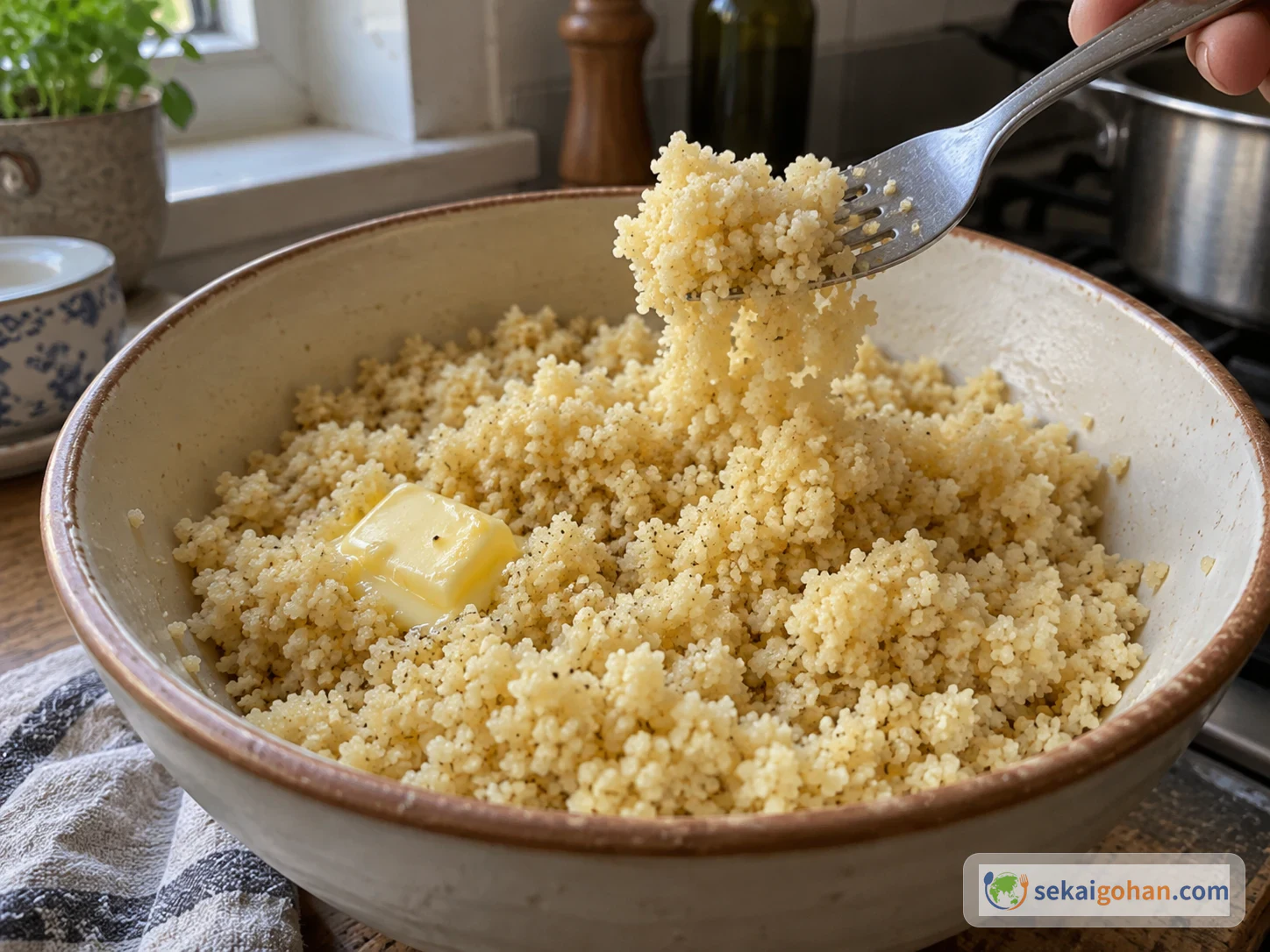
No heat; about 2 minutes. Open the lid and add 25 g of butter and 20 g of sugar. Insert the fork shallowly and loosen the whole by lifting with the fork. If the butter melts in the warm grains and clumped grains separate, you are on track. Do not press them down or keep stirring in circles.
Take a small amount with a clean spoon and taste; only if a hard core remains, add 1 tbsp (15 ml) of hot water at a time. Cover, wait 2 minutes, and check again. Do not add a large amount at once.
If water remains at the bottom, don't add more. Spread the couscous on a shallow heatproof dish for 2 to 3 minutes and loosen it gently. Grains that have already been crushed into porridge cannot be returned to their original texture. Next time, check the package's amount of water and your measuring. Hard grains mean too little water, and soft, clumped grains mean too much.
4. Combine the fruit and aroma and serve
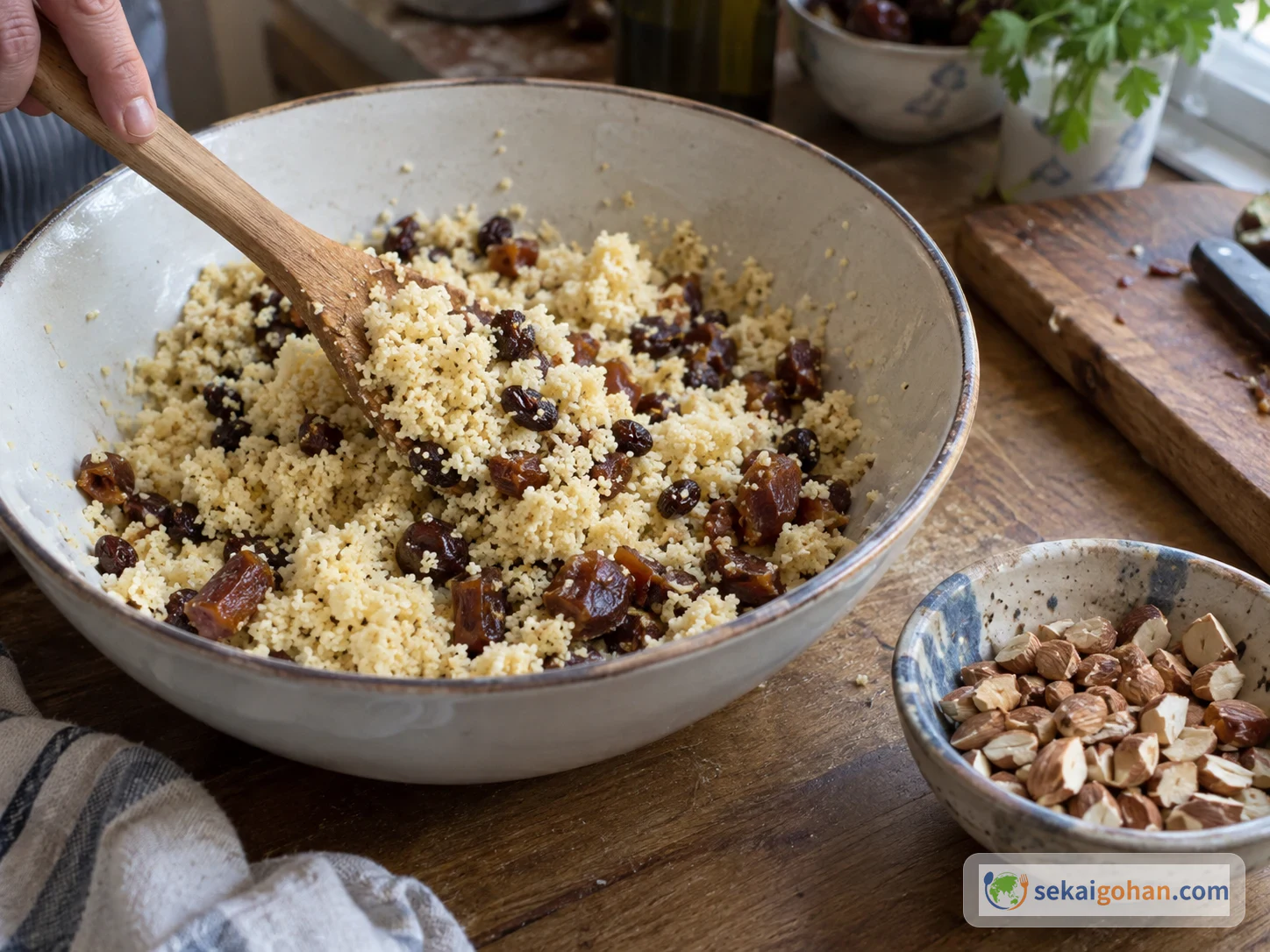
No heat; about 2 minutes. Mix the drained raisins and the dates cut in 0.25–0.375 inch (5–8 mm) pieces in step 1 into the grains. Scatter 0.5 tsp (2.5 ml) of food-grade orange blossom water in small amounts and turn lightly. With a strongly scented product, follow the recommended amount and use less. An excess cannot be hidden by adding sugar, so add a little at first.
Mound it softly on plates and scatter 1 oz (30 g) of almonds. Divide into 4 plates and serve the yogurt on the side, 1.75 oz (50 g) per person, in small bowls. You can eat the warm grains and cold dairy separately, or mix them a little on your plate.
Pour boiling water into a stable heatproof bowl, and open the lid away from your face. Use a cloth or oven mitts and do not hold the bowl bare-handed. Do not leave the pouring to children, and do it where no one else's hands reach.
Fixing hard or sticky mesfouf
If the grains are hard inside but sticky on the surface, the hot water probably reached only part of them, or the soak was shorter than the package specifies. Loosen everything with a fork, then add a little water to only the hard grains and go back to step 3 with the lid on. If the grains are already soft, leave the water out. Raw semolina and large-grain products won't work with this short method at all, so check the package directions first.
Serving and variations for mesfouf
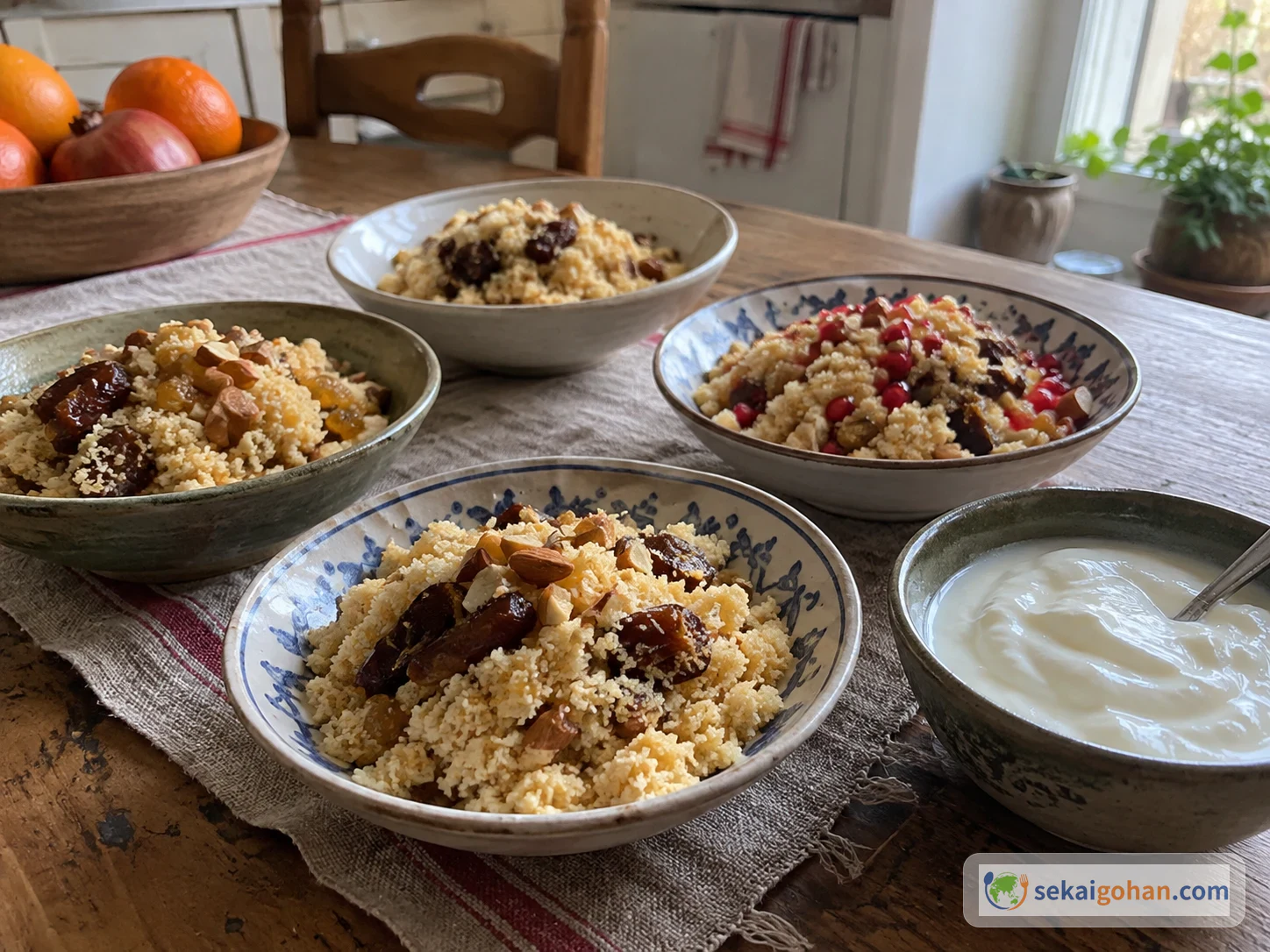
Yogurt isn't the same food as Tunisian lben, but it makes a good stand-in that adds sourness a little at a time. Keep it on the side: soaking all the grains in dairy from the start changes how they absorb and how they feel in the mouth. Served warm, the butter's aroma comes through; served cold, the grains firm up. If you go the cold route, follow the storage advice below.
Adjusting sweetness and adding fruit
How sweet the finished plate tastes also depends on how soft and sweet your dates are. To pull the sweetness back, use 10 g of sugar and keep the dates and raisins as they are. A small plate works as a light breakfast; a smaller one as dessert.
| Variation | Change for 4 servings | Difference in texture and aroma |
|---|---|---|
| Less sweet | Reduce the 20 g of sugar to 10 g | The sweetness of the dried fruit comes forward |
| Add pomegranate | Scatter 2 oz (60 g) of pomegranate seeds just before serving | Sour juice and popping texture. Do not add the juice to the basic amount of water |
| Add orange | 3.5 oz (100 g) of orange segments with the membrane removed, on the side | The fruit sourness, separate from the flower water |
| Switch to pistachios | Replace the 1 oz (30 g) of almonds with 1 oz (30 g) of unsalted pistachios | Nut aroma and green color. The nut allergy remains |
| Serve with milk | Replace the 7 oz (200 g) of yogurt with ¾ cup (200 ml) of milk, on the side | No sourness, and the grains absorb the milk. The basic hydrating water does not change |
| Leave out the floral aroma | Omit the 0.5 tsp (2.5 ml) of flower water | Fruit and butter aromas become central |
Add fruits such as pomegranate and orange just before serving, so their moisture doesn't turn the grains soggy. These changes are home suggestions; pick one or two rather than piling them all on.
What to cook next
Got dates left over? Try makroud, a pastry with a date filling, shaped and cooked quite differently from mesfouf. And if you'd like a main course after the sweet plate, Tunisia's fish couscous brings spice, fish, and broth.
Nutrition
The basic mix for all 4 servings comes to 1810 kcal, 1.5 oz (43 g) protein, 1.75 oz (53 g) fat, and 10.5 oz (296 g) carbohydrates, or about 450 kcal per serving. That includes the 7 oz (200 g) of unsweetened yogurt and 1 oz (30 g) of almonds, but not the extra fruit or swaps from the table.
Frequently asked questions and storage
Can I make it without dates or flower water?
Flower water can simply be left out; don't swap in the same amount of orange juice or essential oil. Without dates, you can replace the 2.75 oz (80 g) of dates with 2.75 oz (80 g) of raisins. You'll lose the soft sweetness of the dates, and the plate gets more sour and chewy, so it won't taste quite the same.
What about making ahead and freezing?
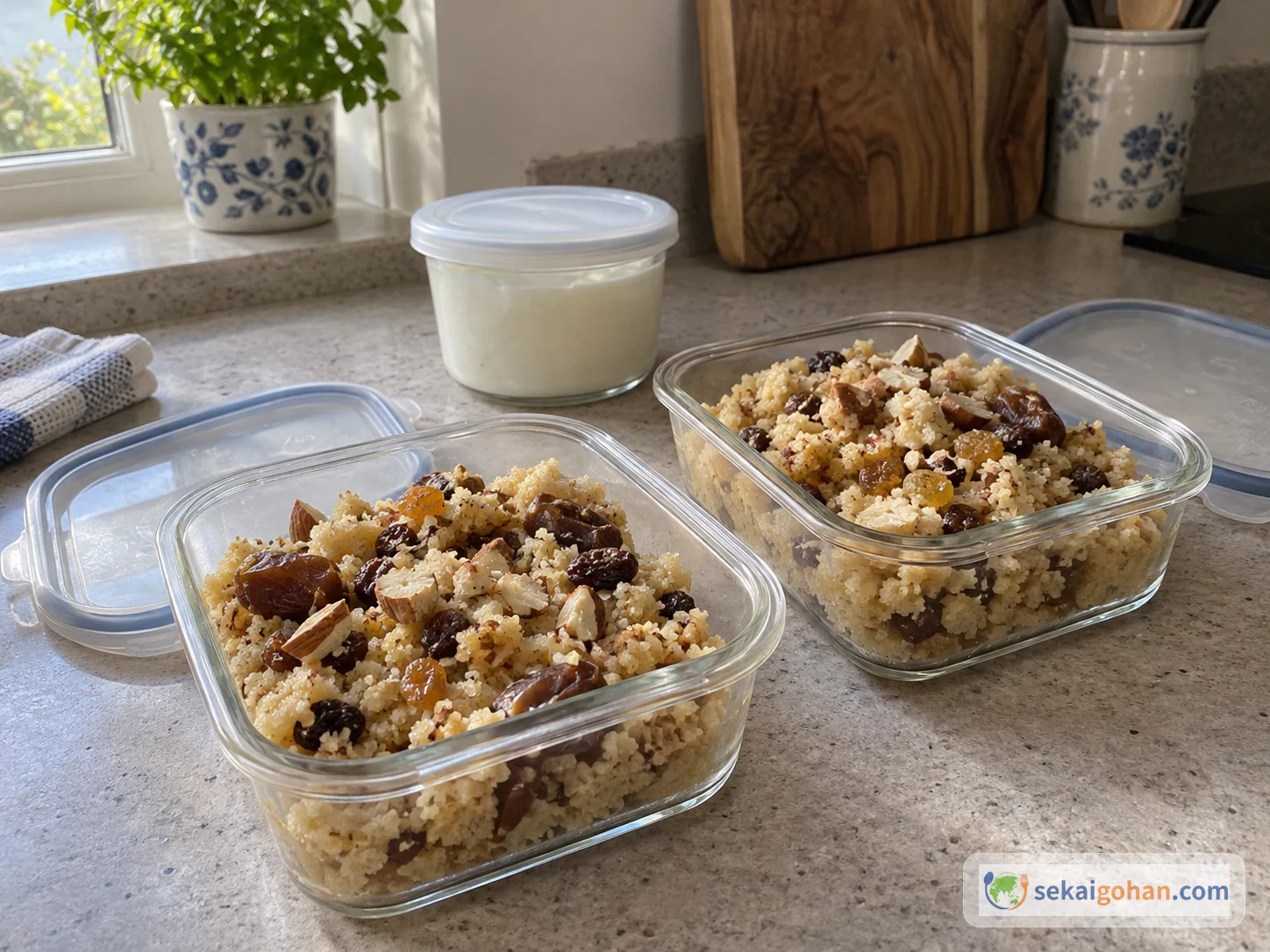
Cool it in shallow containers, and refrigerate within 2 hours in portions. Keep the refrigerator at 41°F (5°C) or colder and finish within 48 hours. Don't leave a hot platter standing out for long, and store the yogurt and fresh fruit separately, adding them right before eating.
To freeze, seal the grains in small portions before any dairy or fresh fruit goes on, and write the date. Thaw in the refrigerator.
Even with dried fruit, hydrated couscous does not keep like a dry good. Do not leave it at room temperature overnight. Follow the label and date for yogurt after opening. Finish refrigerated leftovers within 48 hours.
Will the grains loosen again when reheated?
The butter sets in the fridge, so the grains tend to clump. If you're eating it cold, loosen them lightly with a clean fork. To warm, put the portion you'll eat in a heatproof container, sprinkle 1 tsp (5 ml) of water, set the lid slightly ajar, and heat in 600 W microwave bursts of 30 seconds, adjusting the total time to the amount and your appliance. Stir partway, and once steam rises through the center, loosen it gently and add the dairy and fresh fruit. Reheat only once.
Sources
- Voyage Tunisie — Recette masfouf, Tunisie — sweet fine-grain couscous, Ramadan nights, lben and dried fruit, steaming. Accessed and checked: 13 October 2026 (JST).
- Diari — Mesfouf Express — hydrating a dedicated quick product with milk, fruit and flower water. The unnatural oil quantity was not adopted. Accessed and checked: 13 October 2026 (JST).
- Alain Ducasse / Académie du Goût — Mesfouf tunisien — public introduction and ingredient list only; presented as a pre-dawn meal. Members-only steps not consulted. Accessed and checked: 13 October 2026 (JST).
- La Presse de Tunisie — Le Couscous tunisien en fête — 19 August 2025. The sweet version of Sousse and the savory version of Zarzis. Accessed and checked: 13 October 2026 (JST).
- UNESCO — Inscription of couscous traditions — 16 December 2020. Joint application of four countries, handwork and food culture. Accessed and checked: 13 October 2026 (JST).
- Rim Beji / La Presse Magazine no. 23 — 27 April 2025, magazine page 17. Ingredients, steaming, and presentation of Masfouf à la crème. Accessed and checked: 13 October 2026 (JST).
- Tipiak — Couscous moyen — the manufacturer's water of the same volume as the grains, covered hydration, and fluffing. Follow the package of the product you use. Accessed and checked: 13 October 2026 (JST).
- Food Standards Agency — How to chill, freeze and defrost food safely — cooling, portioning, refrigerator temperature, leftovers within 48 hours, thawing in the refrigerator. Accessed and checked: 13 October 2026 (JST).
- Food Standards Agency — Allergen guidance for food businesses — wheat, dairy, nuts, sulfites, cross-contact via utensils. Accessed and checked: 13 October 2026 (JST).
- Food Standards Agency — Cooking your food — reheat only once, heat thoroughly to the center, and stir in the microwave. Accessed and checked: 13 October 2026 (JST).
- NutritionDataHub — Couscous, dry — reposted USDA composition. Used for the rough calculation of 100 g of dry couscous. Accessed and checked: 13 October 2026 (JST).
- NutritionDataHub — Olive oil — reposted USDA composition. Used for the rough calculation of 100 g of oil. Accessed and checked: 13 October 2026 (JST).
- MyFoodData — Dates (Deglet Noor) — reposted USDA composition. Weight conversion from the labeled value for 71 g of pitted dates. Accessed and checked: 13 October 2026 (JST).
- Sun-Maid — California Sun-Dried Raisins — the manufacturer's composition for 28 g of raisins. An example for the rough calculation, not a brand recommendation. Accessed and checked: 13 October 2026 (JST).
- MyFoodData — Butter Stick Unsalted — reposted USDA composition. Weight conversion from the labeled value for 227 g of unsalted butter. Accessed and checked: 13 October 2026 (JST).
- MyFoodData — Sugar — reposted USDA composition. Weight conversion from the labeled value for 3 g of sugar. Accessed and checked: 13 October 2026 (JST).
- MyFoodData — Almonds — reposted USDA composition. Used for the rough calculation of 100 g of almonds. Accessed and checked: 13 October 2026 (JST).
- MyFoodData — Plain Yogurt, whole milk — reposted USDA composition. Used for the rough calculation of 100 g of unsweetened whole-milk yogurt. Accessed and checked: 13 October 2026 (JST).