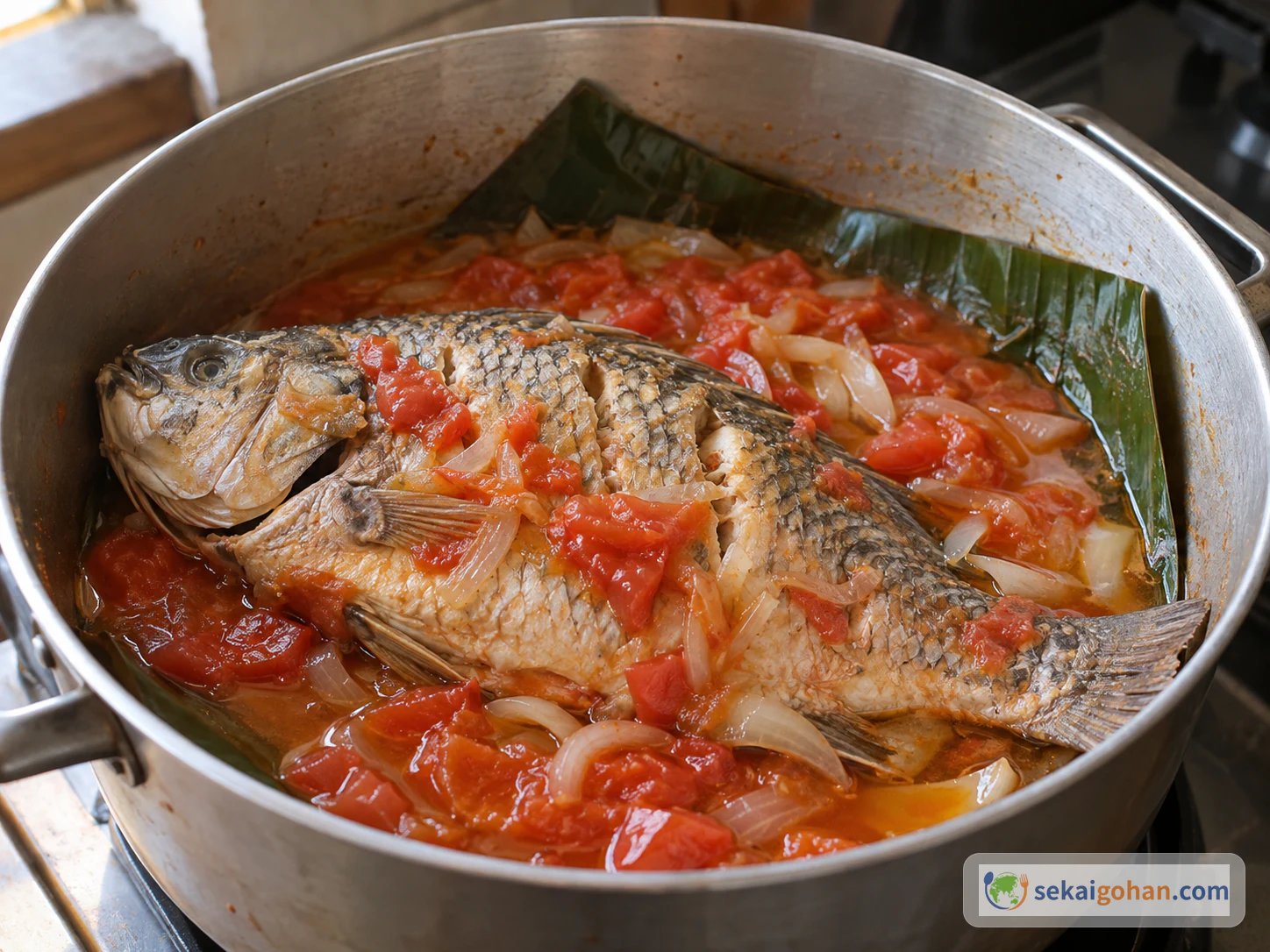
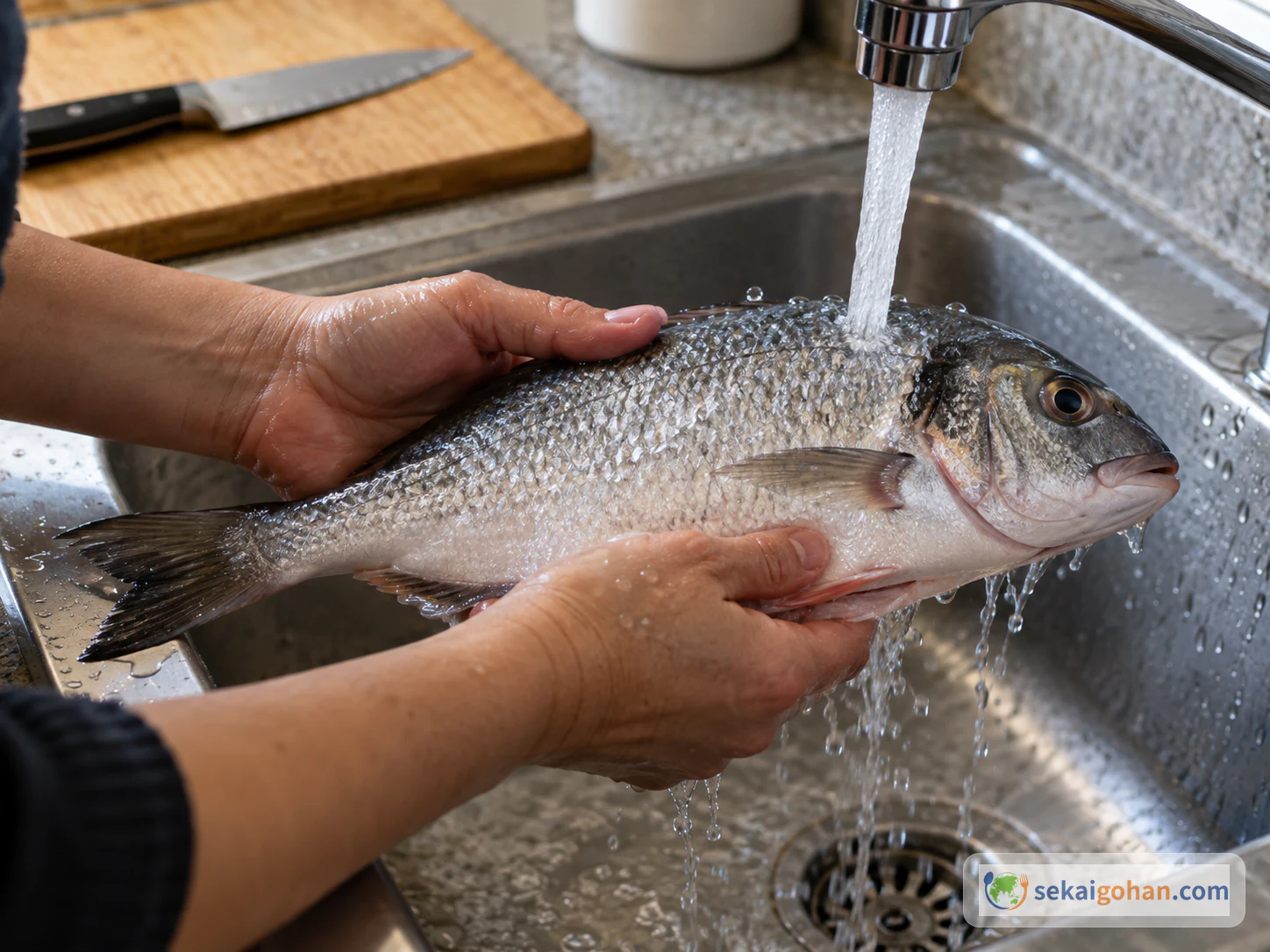
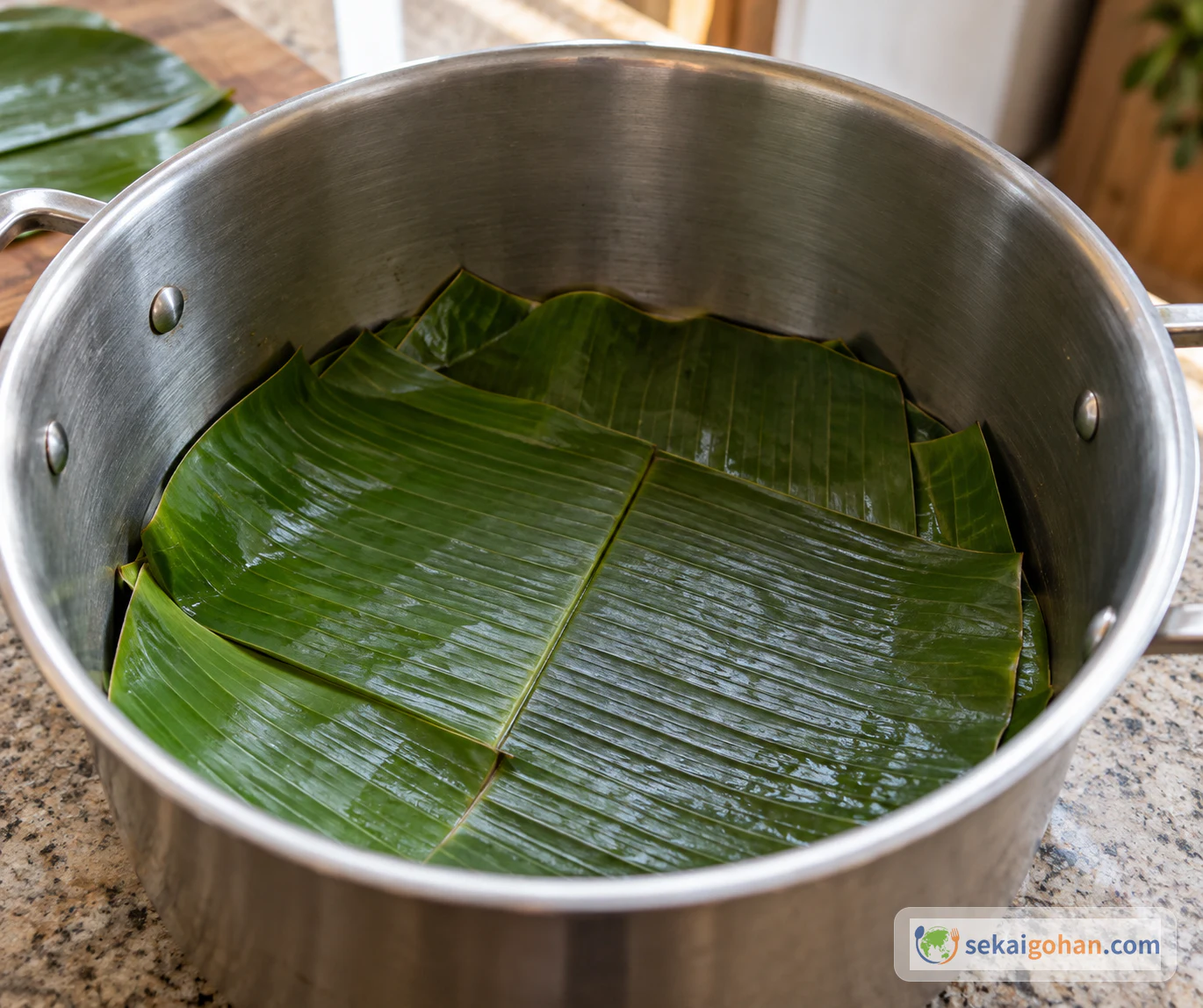
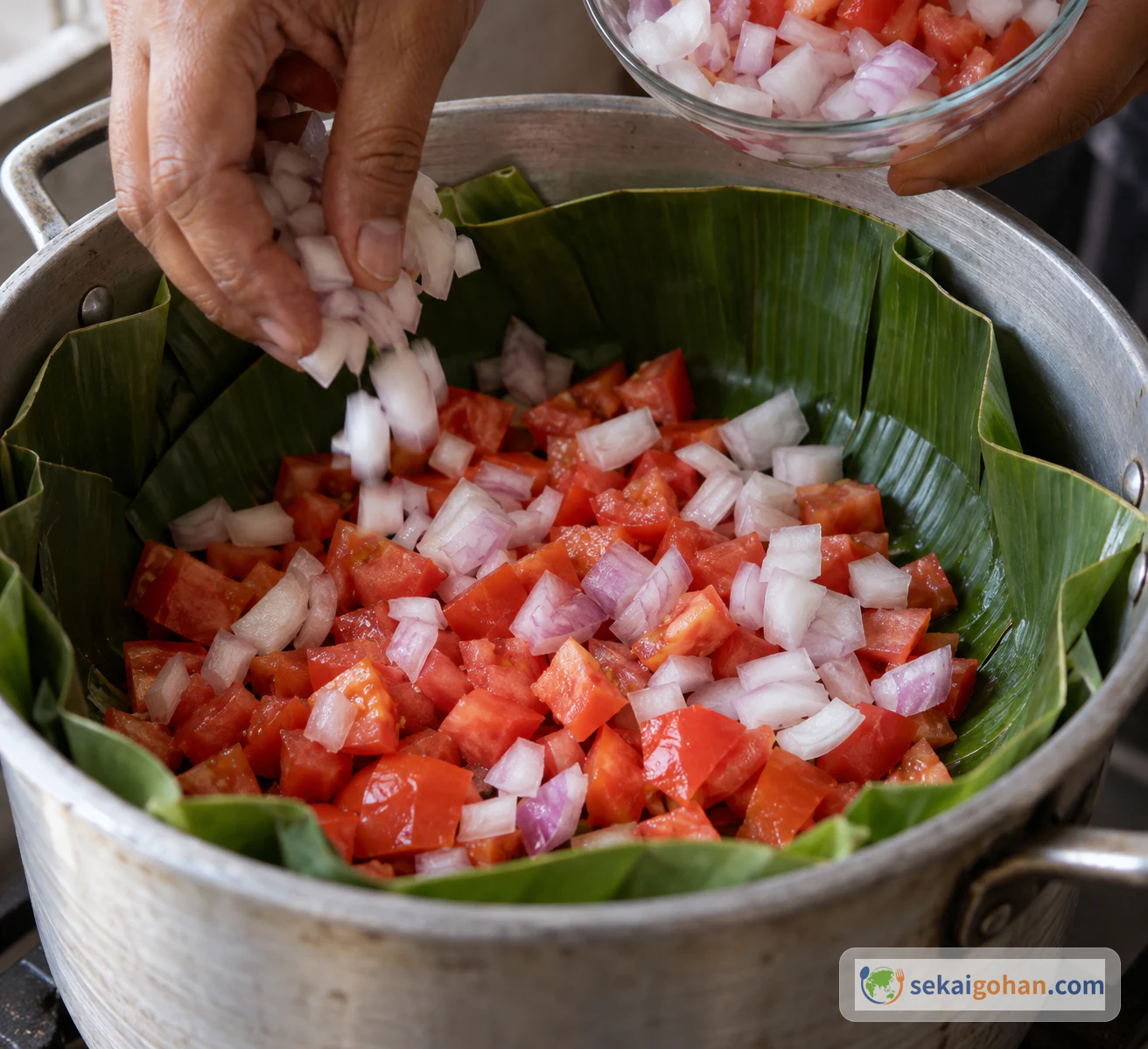
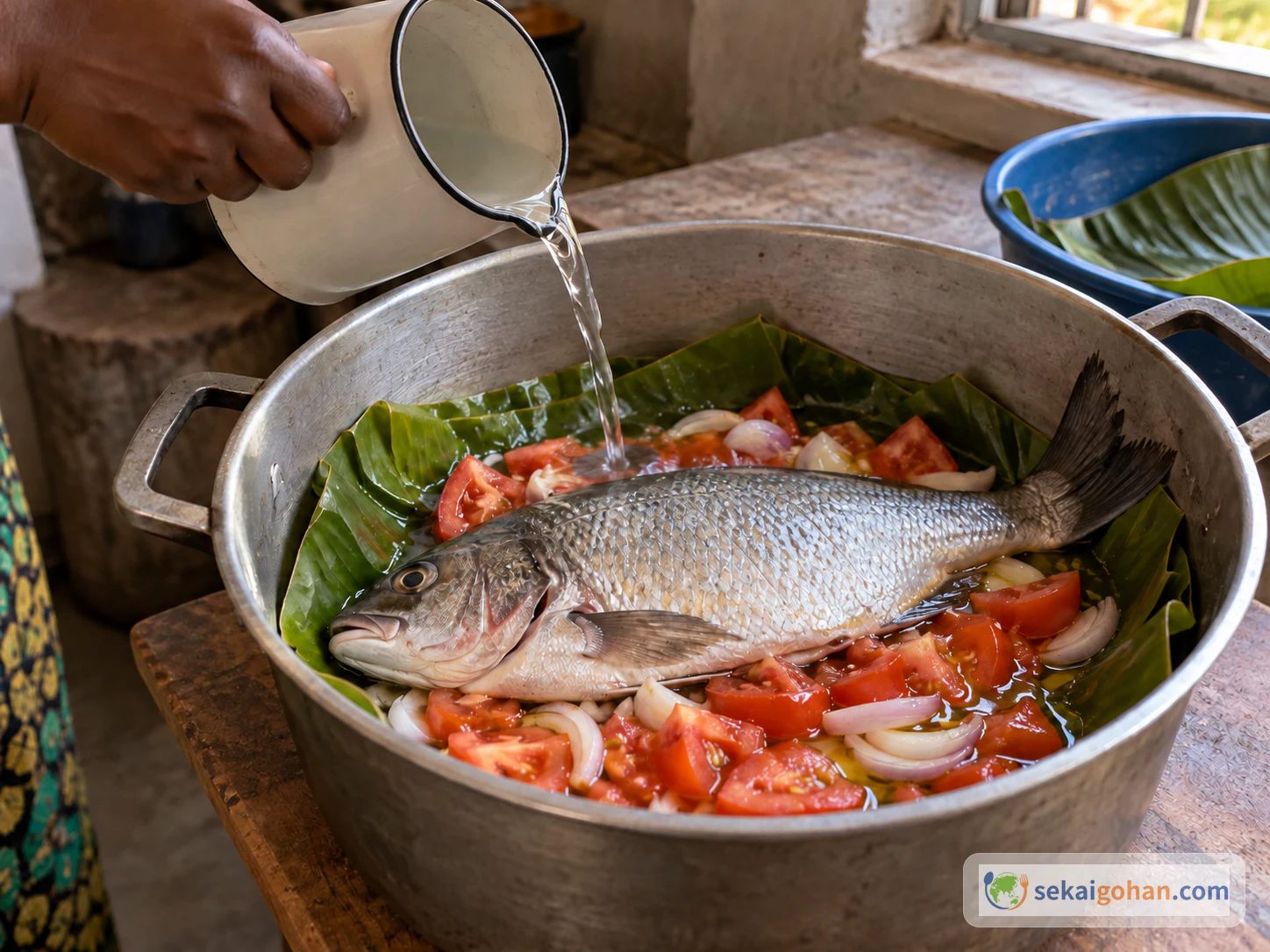
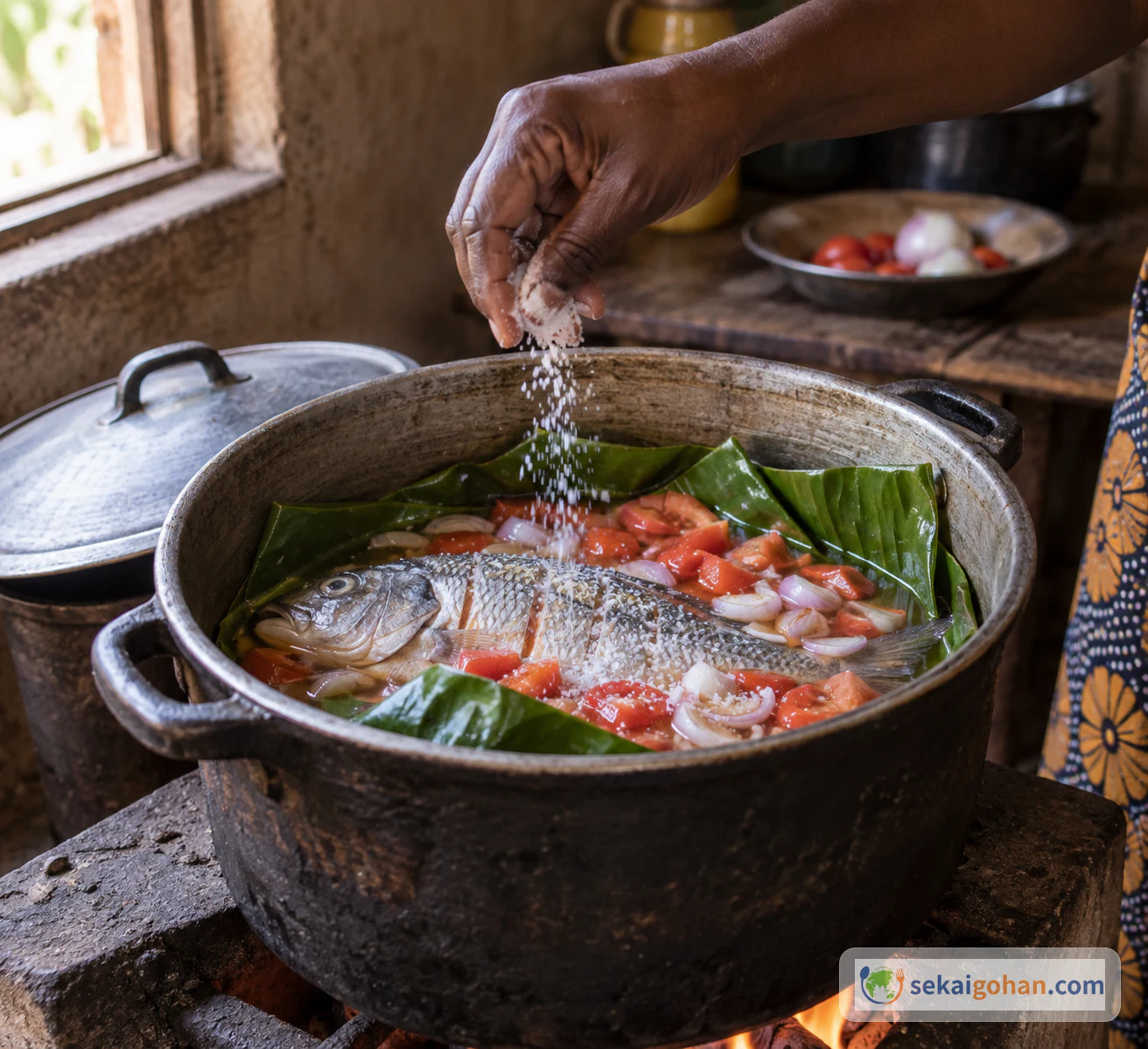
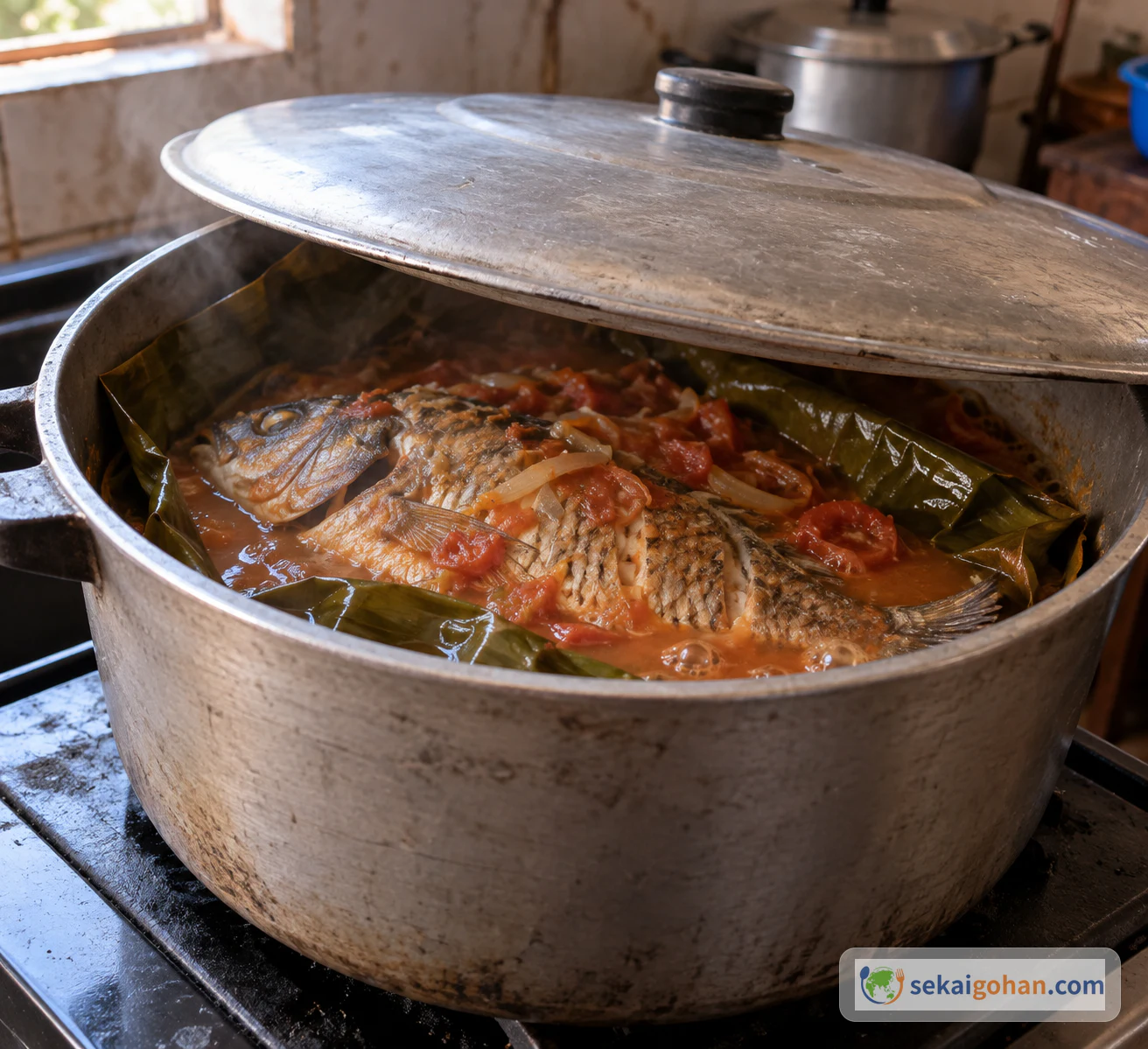
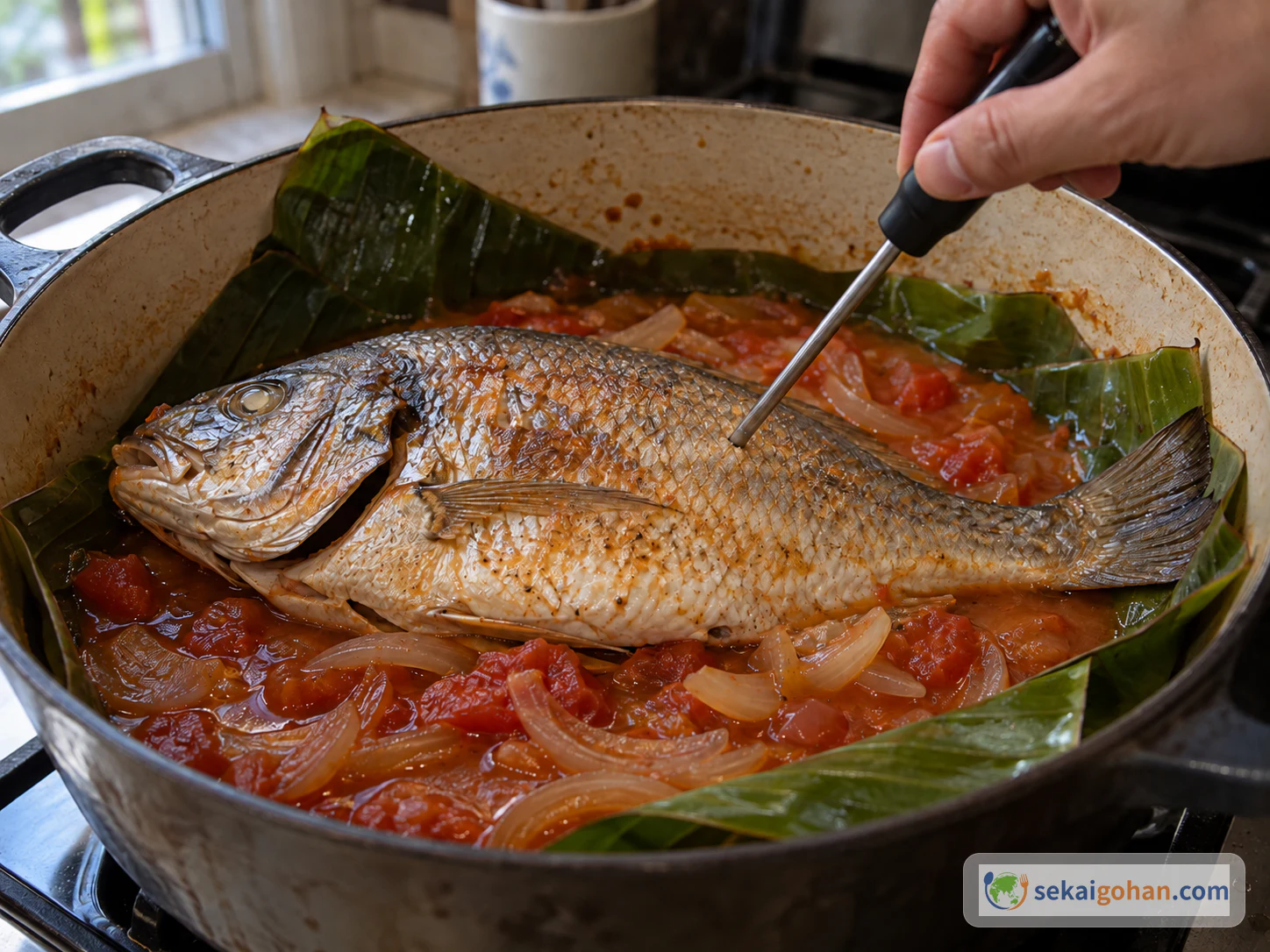
The bottom of a heavy pot is lined with washed banana leaves. Finely chopped onion and ripe tomato go on top, a whole cleaned bream is laid over the vegetables, and then come the sunflower oil, a litre of water and the salt. The lid goes on, and the pot boils for 10 minutes before the heat drops for another 20. That is all there is to "Boiled bream fish – Zambian style": seven ingredients, five steps, no spices and no frying, just a whole fish simmered gently in a light broth of tomato and onion.
Boiled Bream in a Zambian Meal
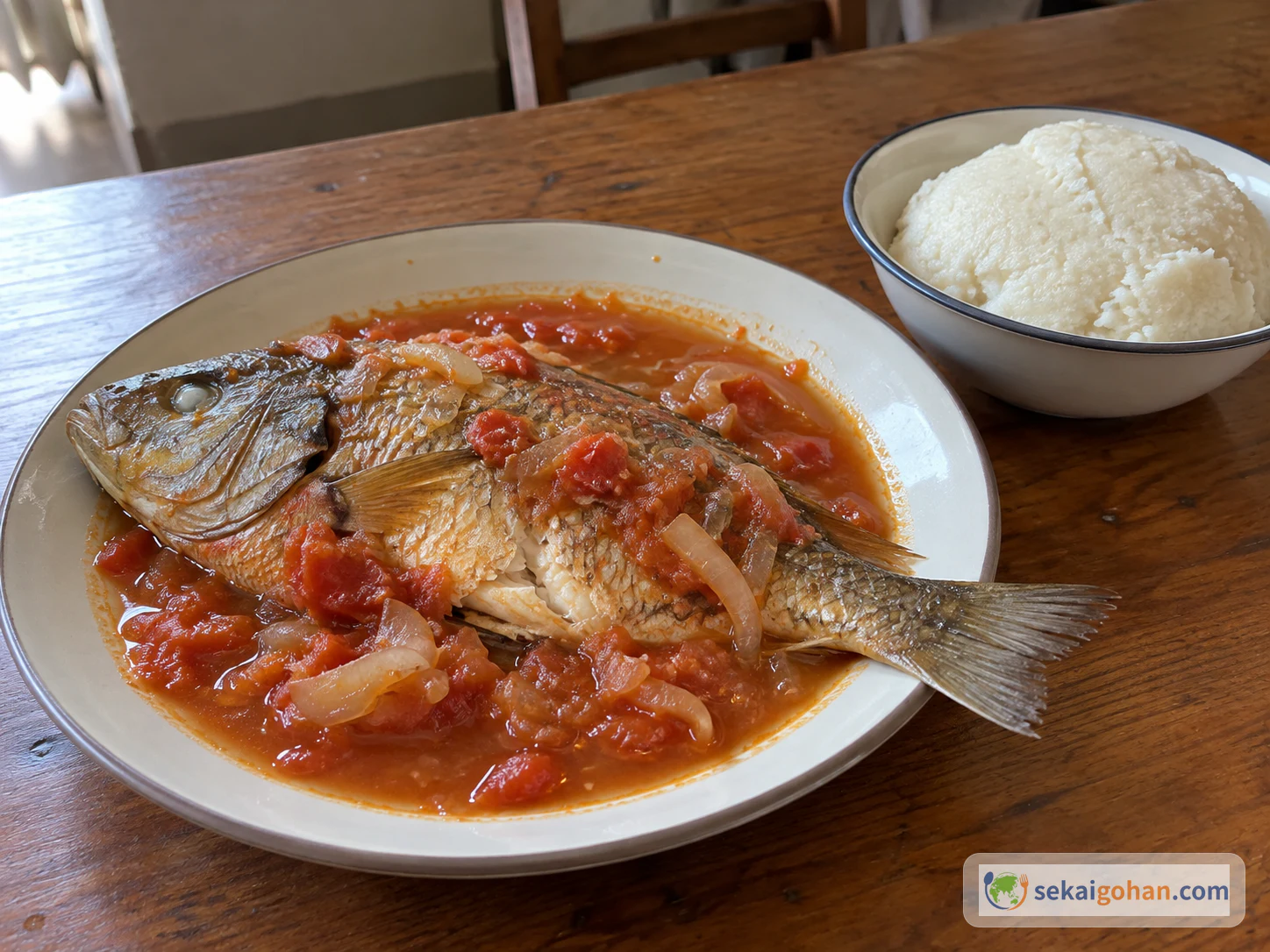
Zambian meals are built around nshima (also written nsima), a stiff staple, eaten with ndiwo, a relish of fish, meat or vegetables. Fresh fish or meat is boiled in water until tender and salted, with onion, tomato and oil added when available. Boiled bream fits that pattern exactly, and a plate of plain nshima alongside is the natural partner for the fish and its broth.
The leaves aren't wrapped around the fish as a parcel. They simply line the pot, and the fish rests on the vegetables above them. For more dishes and food culture from the same country, see our Zambia page.
Ingredients for One Whole Bream
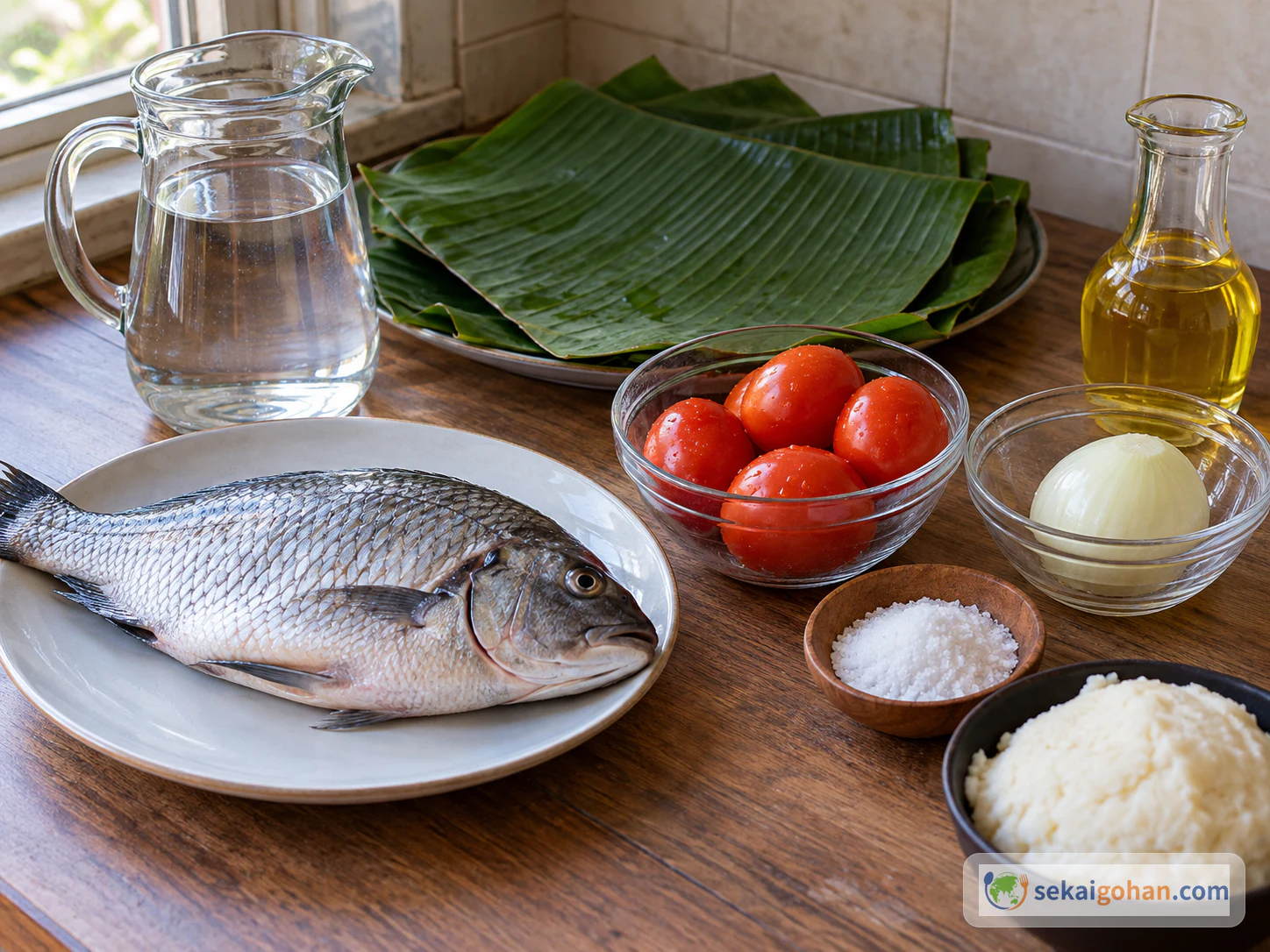
Use these amounts in full.
Use 1½ tablespoons of iodized salt, added in step 5. A tablespoon here is 1 tbsp (15 ml). The amount may look large, but don't reduce it.
Equipment
- A heavy-bottomed pot with a lid, large enough to hold the whole fish and all the liquid with room to spare when it boils
- A sharp knife for cleaning the fish
- A cutting board kept for raw fish, separate from the one for vegetables
- A clean instant-read food thermometer
- A wide spatula or similar for lifting the cooked fish
Choose a heavy-bottomed pot where the whole fish lies flat, the 1 quarts (1 L) of water and ½ cup (150 ml) of oil fit with the vegetables, and the lid still closes with space above the liquid.
Choosing the Fish and Leaves for Boiled Bream
Bream is an English common name shared by several different fish, and it is a different fish from what is sold as sea bream or Japanese tai. If your fishmonger has a fish labeled bream, ask what species it is and buy it whole, within the 500 g–1.25 lb (600 g) range.
When bream isn't available, a whole tilapia or another whole white fish on the bone is a good stand-in. The flavor and texture will be a little different, and so may the cooking time, so check doneness with a thermometer as in step 6.
Banana leaves should be ones sold for food or cooking use. Wash them well before lining the pot. Sunflower oil can be swapped for rapeseed (canola) or rice bran oil, though the aroma shifts slightly.
This dish contains fish. Check for fish allergies before serving, and be aware that some people react individually to onion. Refrigerate fresh fish quickly after buying it; the two-hour limit in general food-safety guidance is a maximum, not a waiting period. Use separate cutting boards and utensils for raw fish and for vegetables or cooked food, and do not return cooked fish to a plate that held it raw.
Method: Building the Pot in Layers
Step 6 is an added safety check with a thermometer.
Troubleshooting Boiled Bream
| Situation | Likely reason | What to do |
|---|---|---|
| The thickest part is below 145°F (63°C) after the 10 + 20 minutes | A thicker fish, a different pot or a weaker burner | Cover again, keep simmering and recheck with the thermometer |
| The fish and liquid barely fit in the pot | Pot too small for a whole fish plus 1 quarts (1 L) of water and ½ cup (150 ml) oil | Next time choose a wider, deeper pot with room above the liquid for boiling |
| The fish breaks apart when moved | Cooked fish is fragile | Lift it with a wide spatula, supporting the whole body |
| You used fillets or a different fish | The recipe is written for one whole bream | Rely on the thermometer rather than the times |
| You see cabbage leaves mentioned for step 3 | Cabbage is not in the ingredient list | Use banana leaves only, as in step 2 |
Serving, Storage and Variations
Serve the fish whole from the pot with its broth spooned over, and plain nshima on the side. The seasoning is salt alone, which keeps the taste of the fish, tomato and onion at the front, so hold back on spices, chili or extra acidity.
Refrigerate cooked fish quickly, within 2 hours of cooking, or within 1 hour if the surrounding temperature is above 32°C (90°F). Keep the refrigerator at 4°C or below, and reheat leftovers until they are hot throughout.
Use separate utensils for raw and cooked fish from start to finish.
A few changes for when you can't follow the recipe exactly:
- Ask the fishmonger to clean the fish. Having it gutted at the counter saves work at home.
- Fillets. They fall apart more easily in the pot, and the broth will be lighter than one made with a whole fish on the bone. Expect different cooking times.
- No banana leaves. It works, but the dish loses what the leaves contribute.
Frequently Asked Questions
Do I need to scale the fish or remove the gills?
The method calls only for removing the intestines and washing the fish. Check how it was prepared when you bought it, and ask the fishmonger if you'd like it cleaned further.
Can I make it without banana leaves?
You can, but the leaves are part of the dish, and leaving them out changes it.
Is 10 minutes at a boil plus 20 minutes of simmering enough?
Check the thickest part with a thermometer; it should read 63°C (145°F). If it doesn't, keep simmering.
Can I make it ahead?
Refrigerate leftovers quickly, within 2 hours of cooking (1 hour above 32°C/90°F), and reheat until hot throughout.