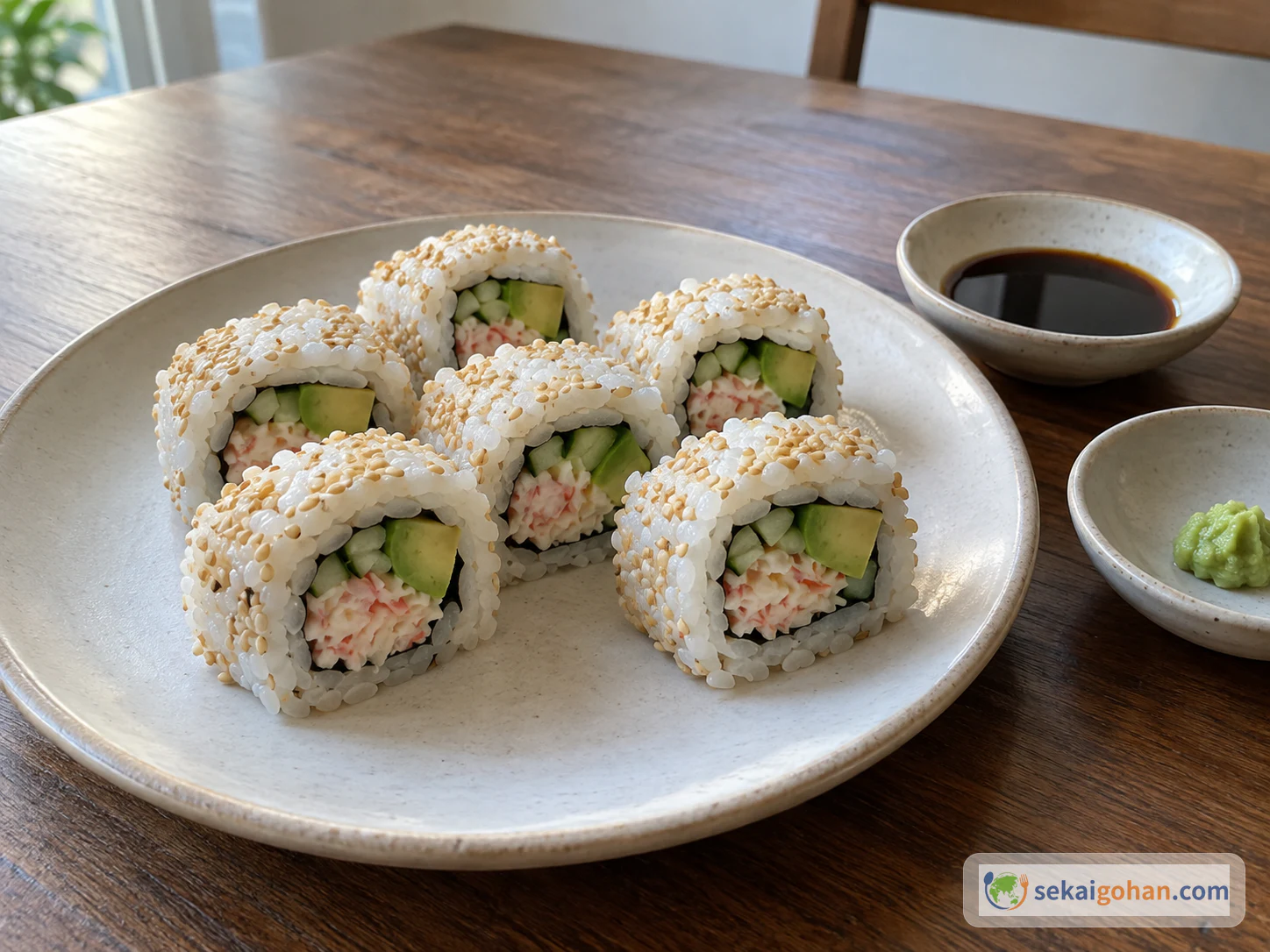
California Roll: How to Make an Inside-Out Sushi Roll, and Why Its Origin Is Still Debated

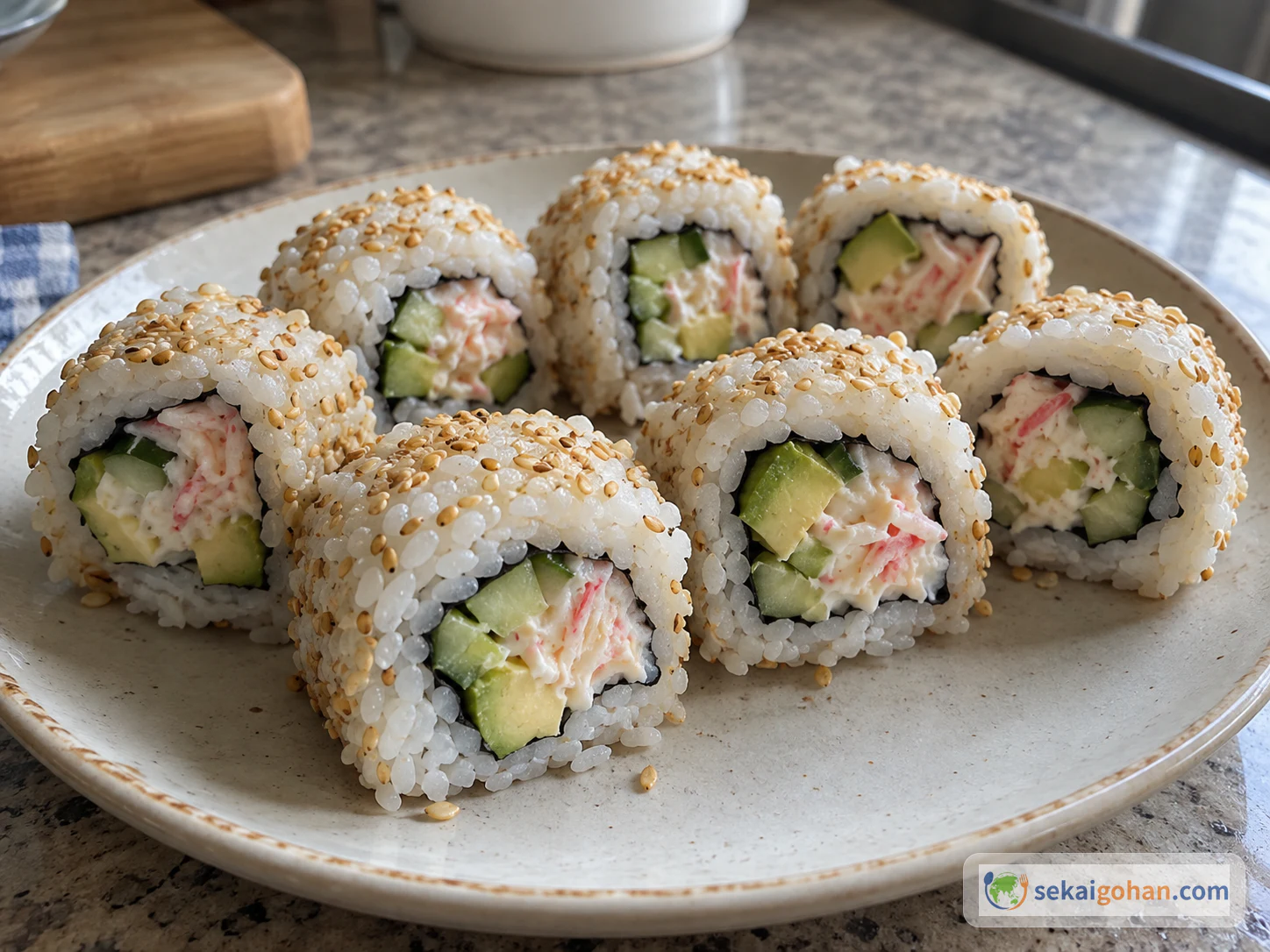
Sliced California roll coated with white sesame seeds, arranged on a plate
Serves
8 rolls (8 pieces each)
Cuisine
North American sushi (uramaki)

How to make California rolls with the rice on the outside, filled with precooked imitation crab and Japanese mayonnaise, cucumber and avocado. This recipe makes 8 rolls cut into 8 pieces each, uses no raw fish, and shows where to place the nori and filling on the mat. It also covers safe holding of sushi rice and the competing origin stories from Los Angeles and Vancouver.

Cooking flow

Cooking steps

STEP11 / 9

Rinse, soak and cook the rice

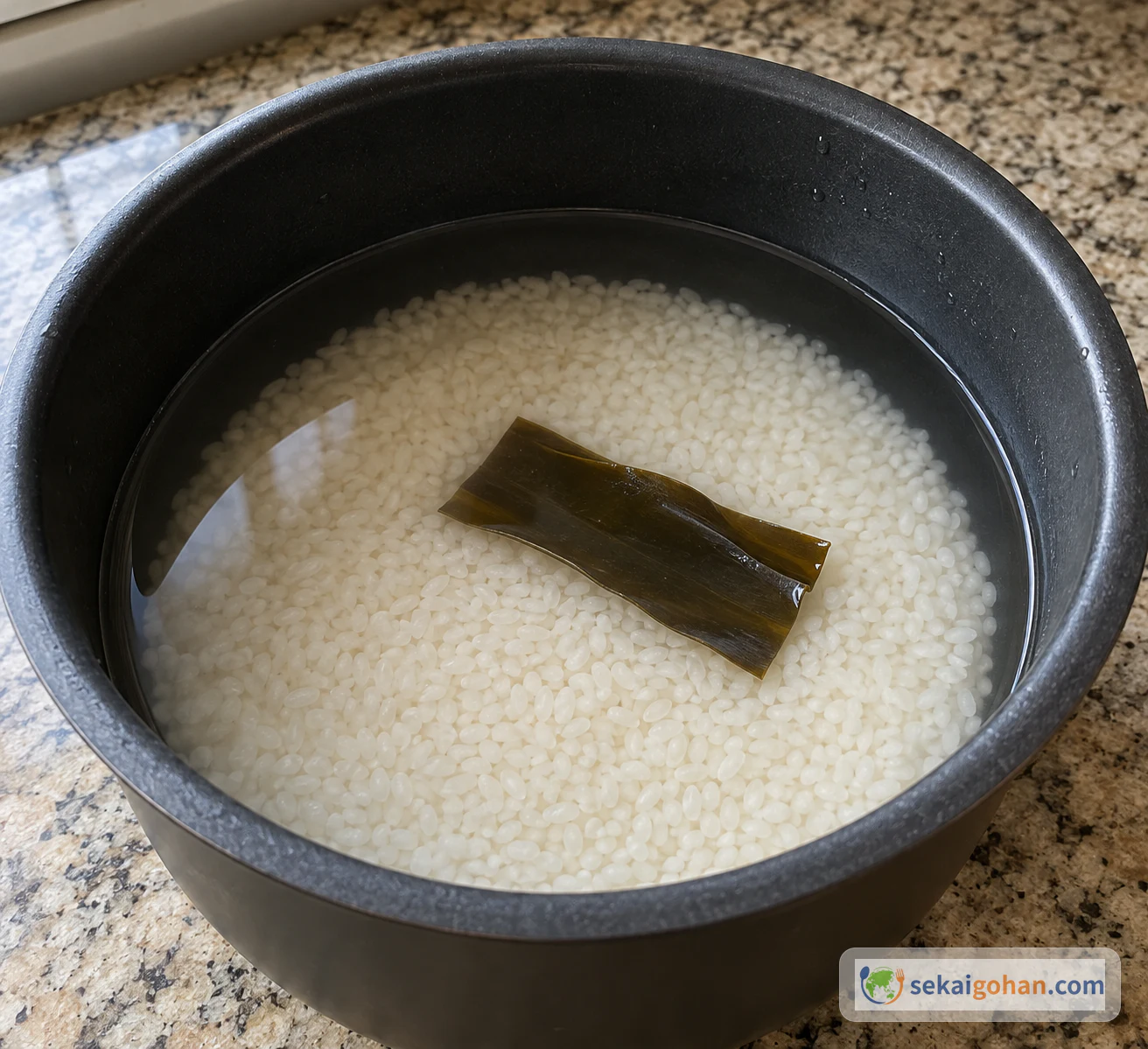
Rinsed short-grain rice soaking in water with a piece of kombu in a rice-cooker pot
Soak the rinsed rice with the kombu resting on top before cooking

Put 2¼ cups uncooked rice in a large bowl, pour in cold water to wet the grains, and drain right away. Gently move the rice with your fingertips for 10–15 seconds, then pour off the cloudy water. Repeat twice more, until the water is nearly clear, and drain well.

Put the rice and 2¼ cups water in the inner pot of the rice cooker, level the surface, and lay the piece of kombu on top. Soak for 20–30 minutes, then cook in the rice cooker.

STEP22 / 9

Season the rice and fan it cool

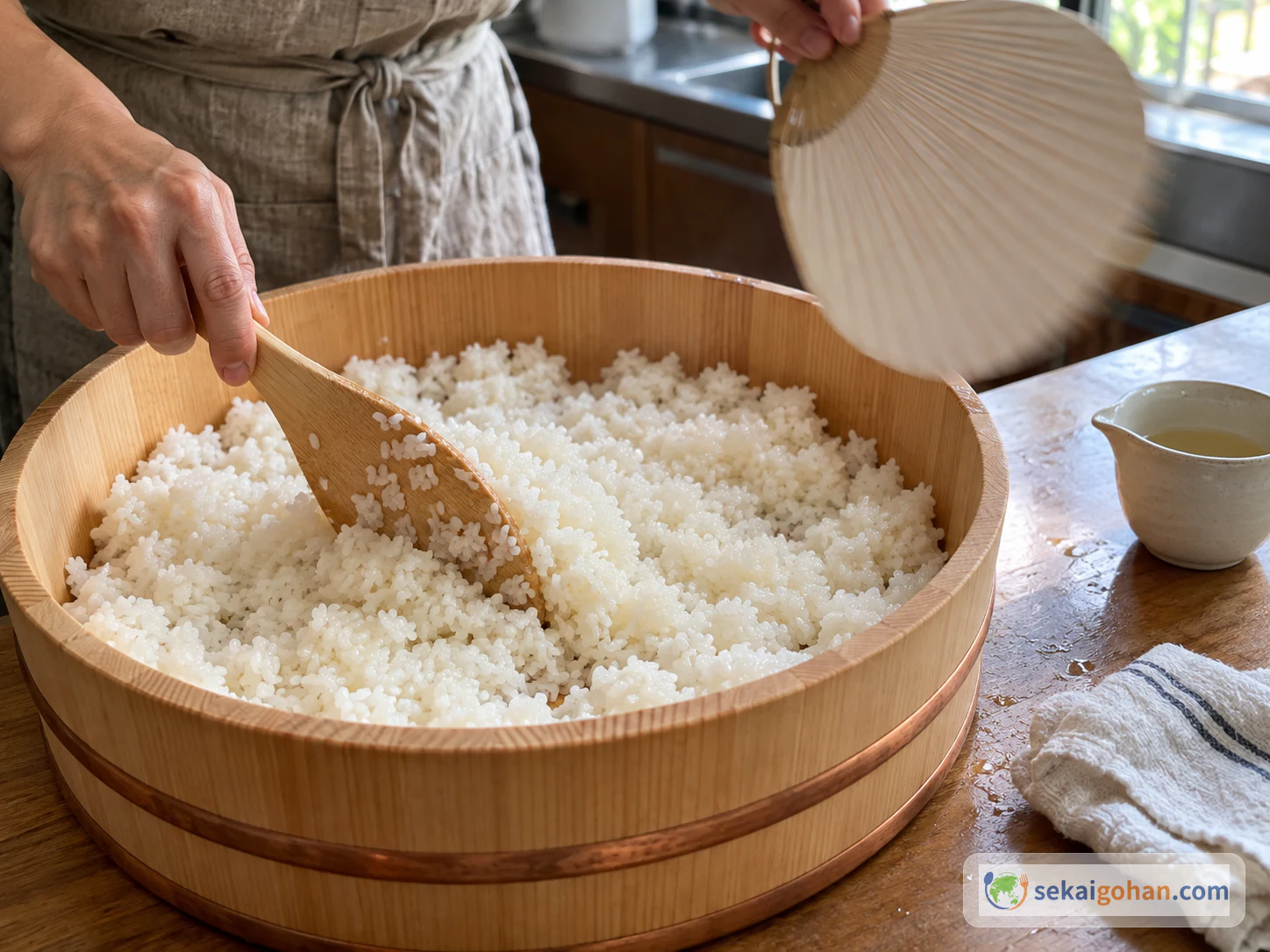
Hot rice being folded with seasoned vinegar using a slicing motion while being fanned
Slice the paddle through the rice at an angle and fan it so the grains stay intact

When the rice is cooked, remove and discard the kombu. Spread the hot rice in a sushi tub, a large bowl, or a tray lined with parchment paper. Right away, drizzle ⅓ cup seasoned rice vinegar over the rice.

Hold the rice paddle at about a 45-degree angle and mix with a slicing motion rather than stirring, so the grains stay whole. Fan the rice as you work, turning it over every few strokes, until it cools to about skin temperature.

While you prepare the fillings, cover the rice with a damp cloth to keep it from drying out. This is only for the short time you are working. The vinegar is there for flavor; it does not make the rice safe to keep at room temperature.

STEP33 / 9

Shred the imitation crab and mix with mayonnaise

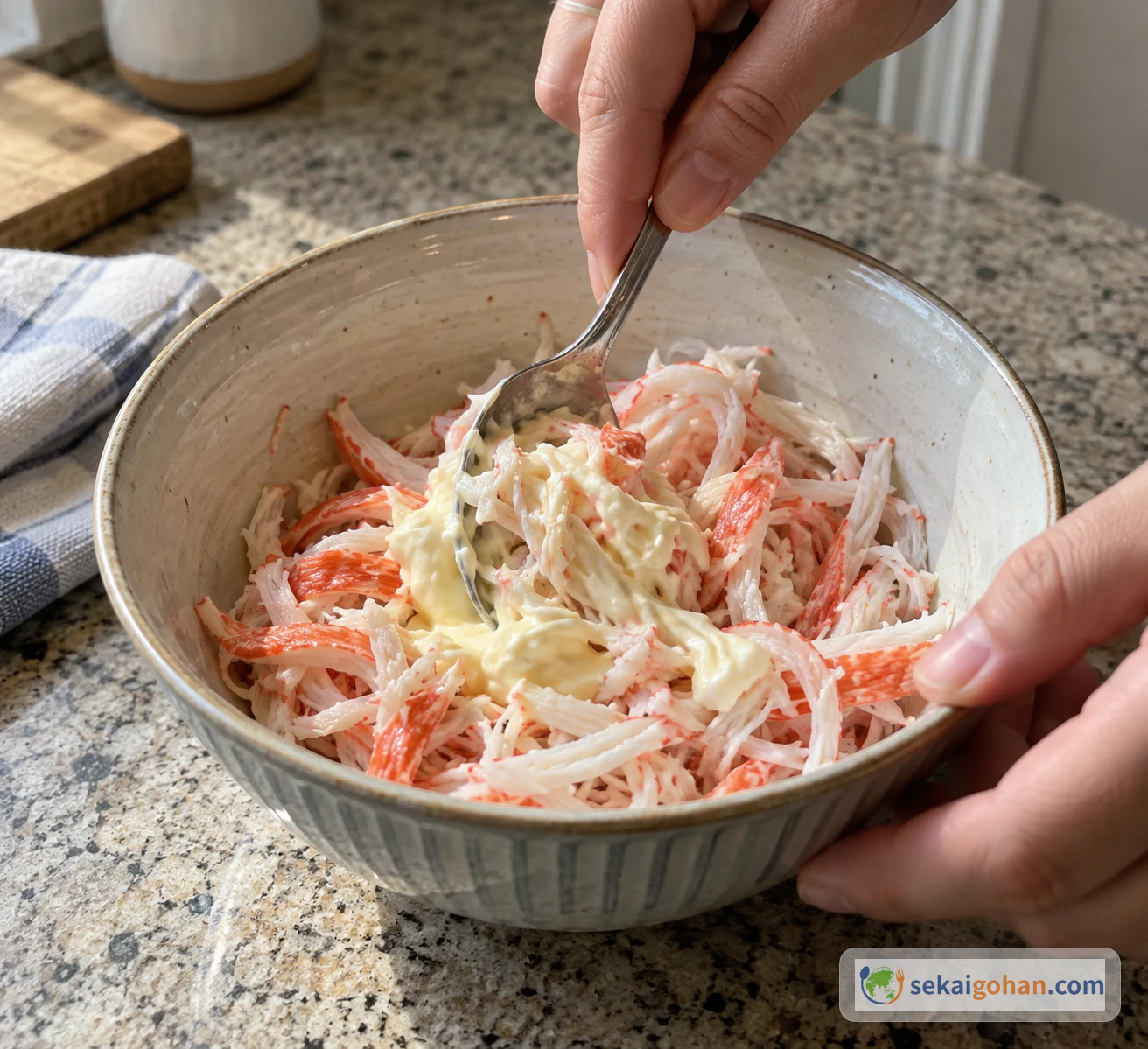
Shredded imitation crab being mixed with Japanese mayonnaise in a bowl
Keep the crab in distinct shreds as you fold in the mayonnaise

Cut 5 oz precooked imitation crab into pieces about 1 inch (2.5 cm) wide, then pull them apart with your fingers into fine shreds. Add 1 Tbsp Japanese mayonnaise and fold it in, keeping visible strands rather than a smooth paste. Add nothing else.

STEP44 / 9

Cut the cucumbers and avocado

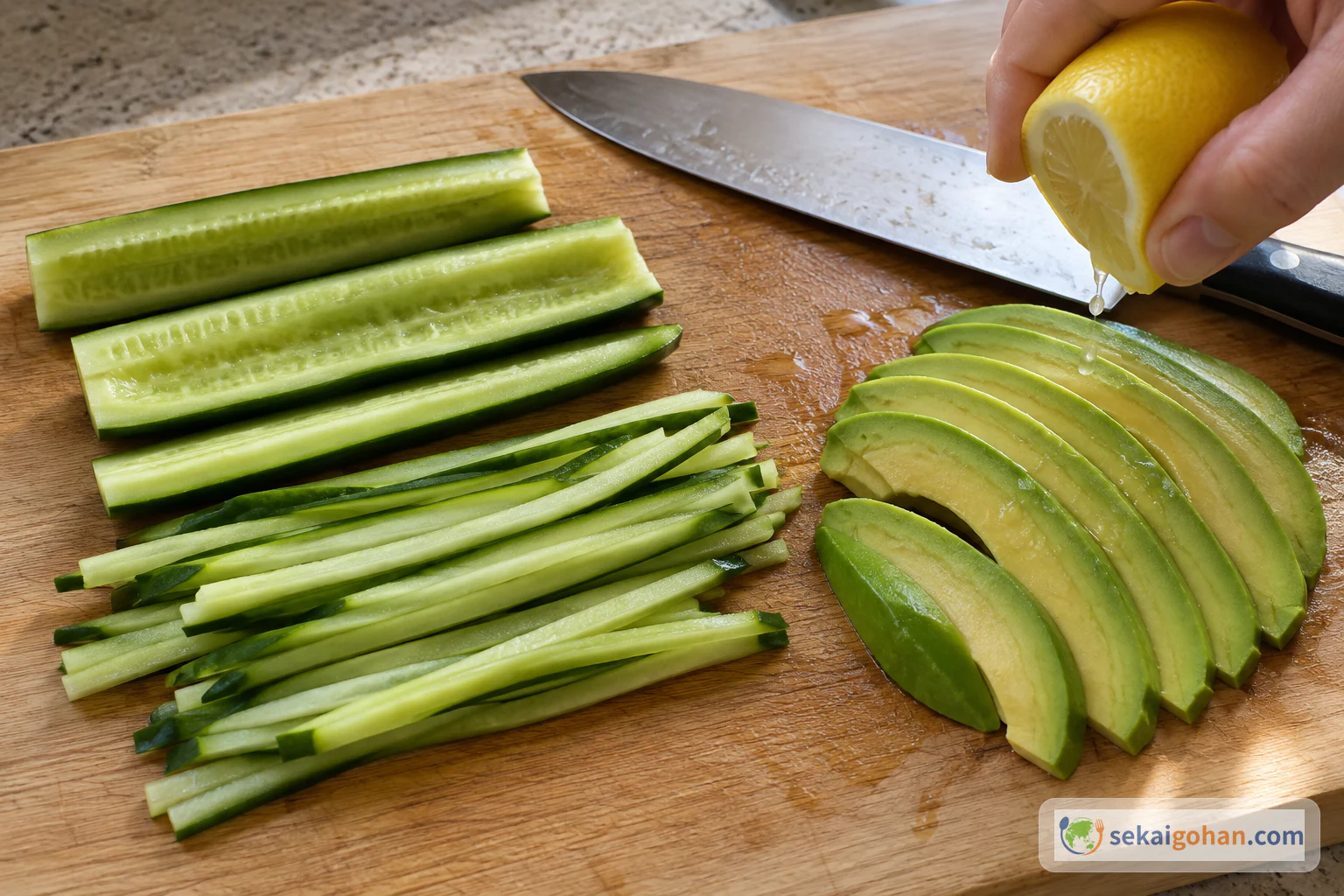
Cucumber partway through being cut into strips, with lemon squeezed over sliced avocado
Prep in progress: every cucumber piece still needs its seeds removed before it goes into a roll

Quarter each cucumber lengthwise and cut away the seed core from every quarter. Then cut the seeded quarters into long, thin strips. Finish all the cucumber this way before you start rolling.

Cut the avocado lengthwise around the pit, twist the halves apart and remove the pit. Cut each half into quarters lengthwise, then slice lengthwise about ¼ inch (6 mm) thick. Squeeze ½ lemon over the cut surfaces. Remove the skin from the slices before rolling.

STEP55 / 9

Cut the nori and spread the rice

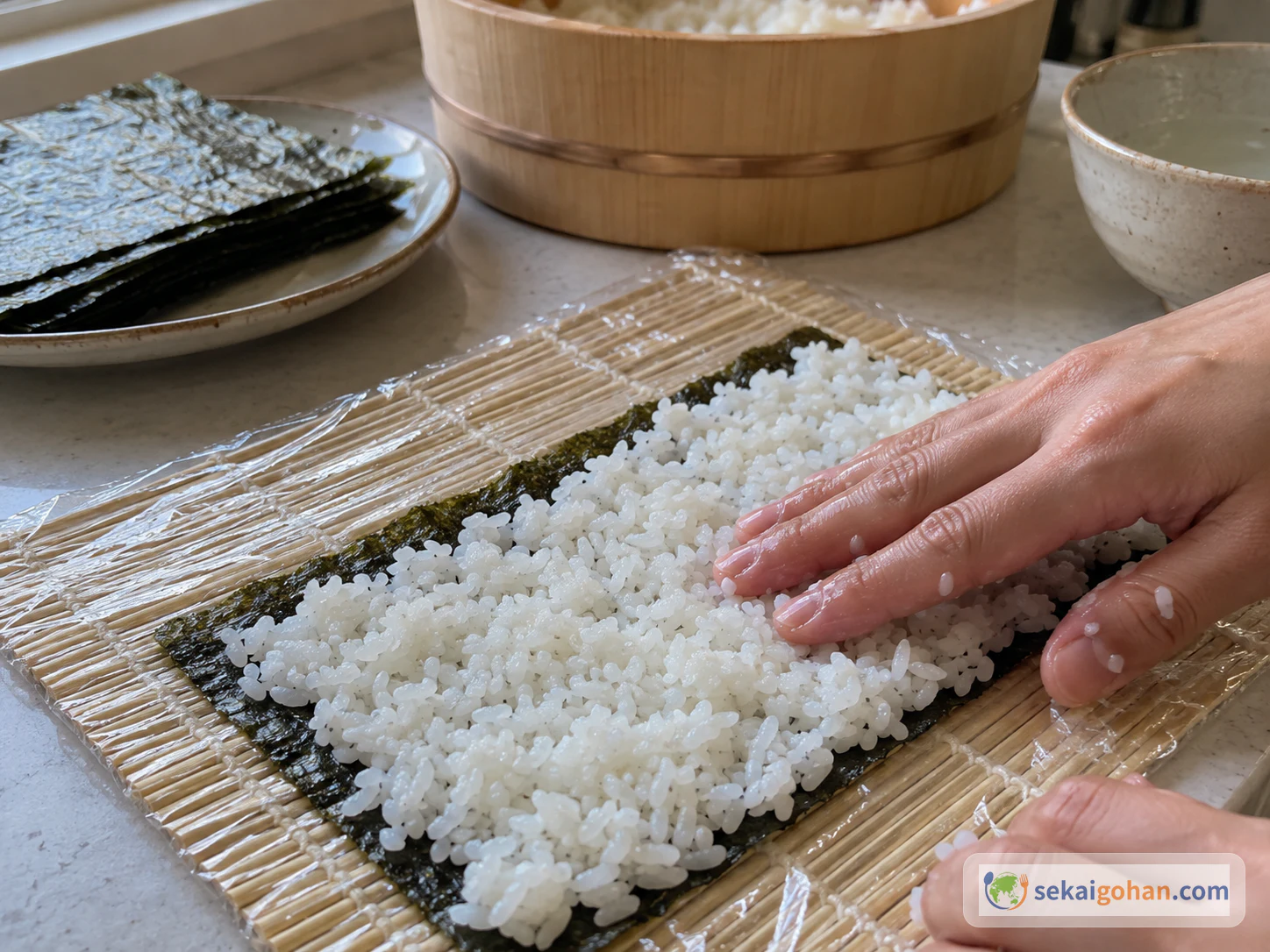
Sushi rice being spread thinly over a half sheet of nori on a plastic-wrapped mat
Spread the rice thin and even with wet hands, without crushing the grains

Cut the 4 nori sheets in half crosswise to make 8 half sheets. Cover the front and back of the bamboo mat with plastic wrap, leaving the two sides uncovered so air does not get trapped.

Lay one half sheet of nori on the mat, shiny side down. Wet your hands and spread ¾ cup (110 g) seasoned sushi rice over the nori in an even, thin layer, without pressing the grains flat. Sprinkle about ½ Tbsp sesame seeds over the rice.

STEP66 / 9

Flip and lay the fillings

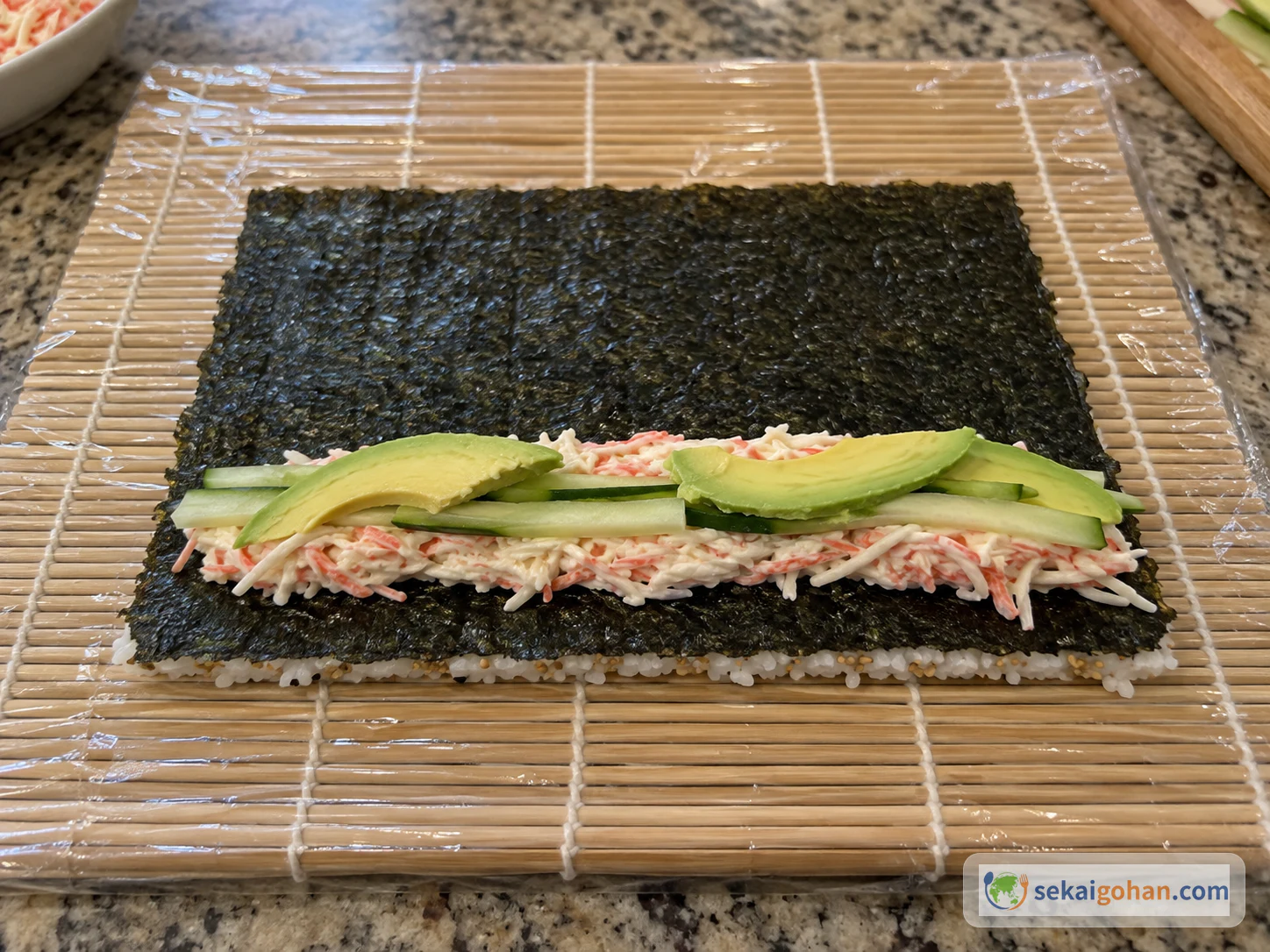
Imitation crab, cucumber and avocado lined up on nori, with the rice facing down
Rice side down, fillings in one neat line near the lower edge of the nori

Turn the nori over so the rice is facing down on the mat. Position it so the bottom edge of the nori is 1 inch (2.5 cm) above the bottom edge of the mat.

Starting ½ inch (1.3 cm) above the bottom edge of the nori, lay the crab mixture, cucumber strips and peeled avocado in a single line across the sheet. Divide the fillings so each of the 8 rolls gets a share it can close around easily, and don't overfill.

STEP77 / 9

Roll and tighten

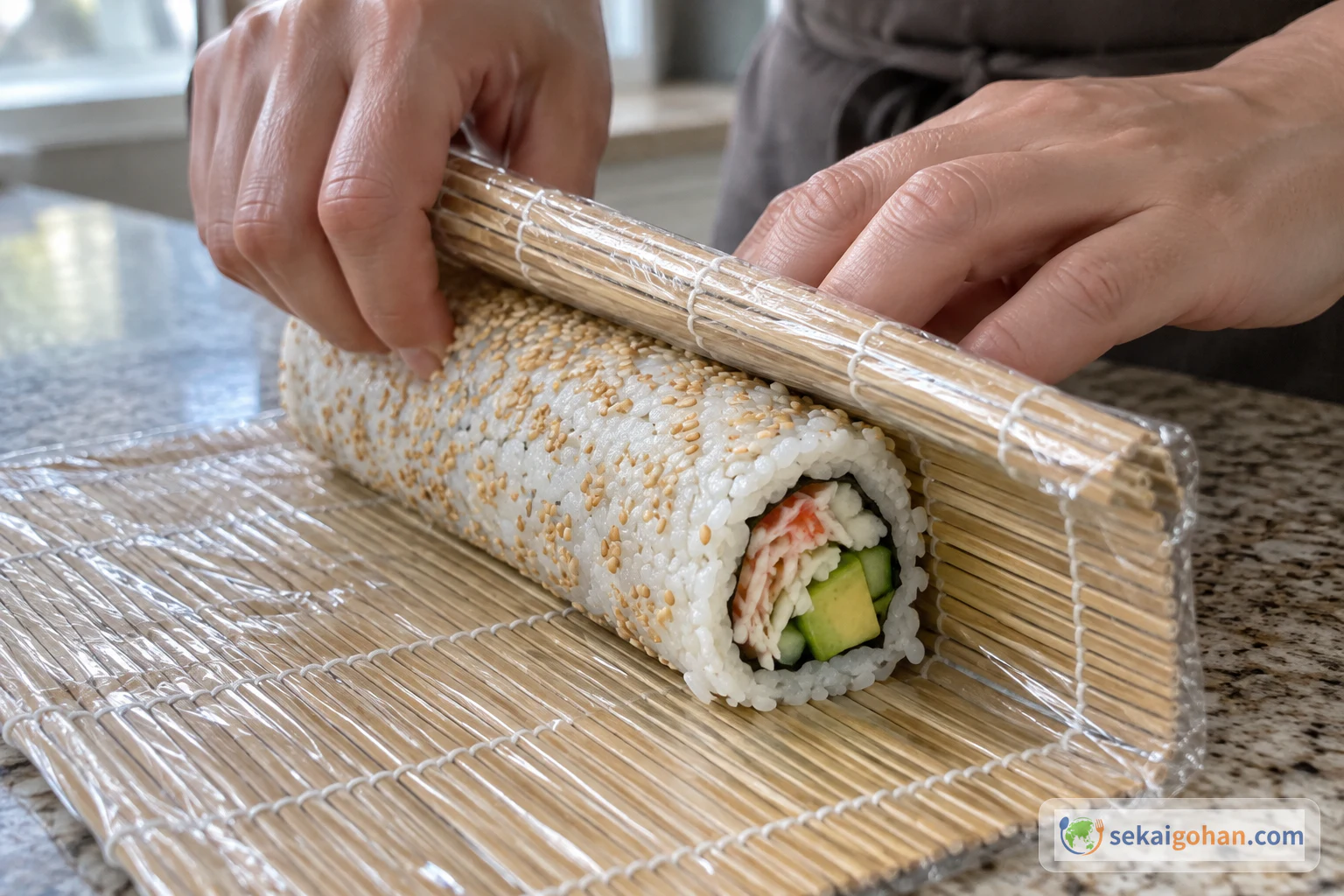
Hands rolling an inside-out roll in a plastic-wrapped bamboo mat
Pull the mat against your gentle squeeze to form a compact cylinder

Hold the near edge of the mat with your thumbs and index fingers, and use your other fingers to keep the fillings in place. Bring the mat up and over the fillings, rolling until the edge of the rice nearest you meets the nori on the far side. Lift the edge of the mat and roll forward to close.

With one hand, squeeze the roll gently through the mat while pulling the mat in the opposite direction with the other hand, so the roll tightens into a firm cylinder. Press the ends in with your fingers to neaten them. If you set finished rolls aside while making the rest, cover them with a damp cloth, only for the short time you are working.

STEP88 / 9

Cut into 8 pieces

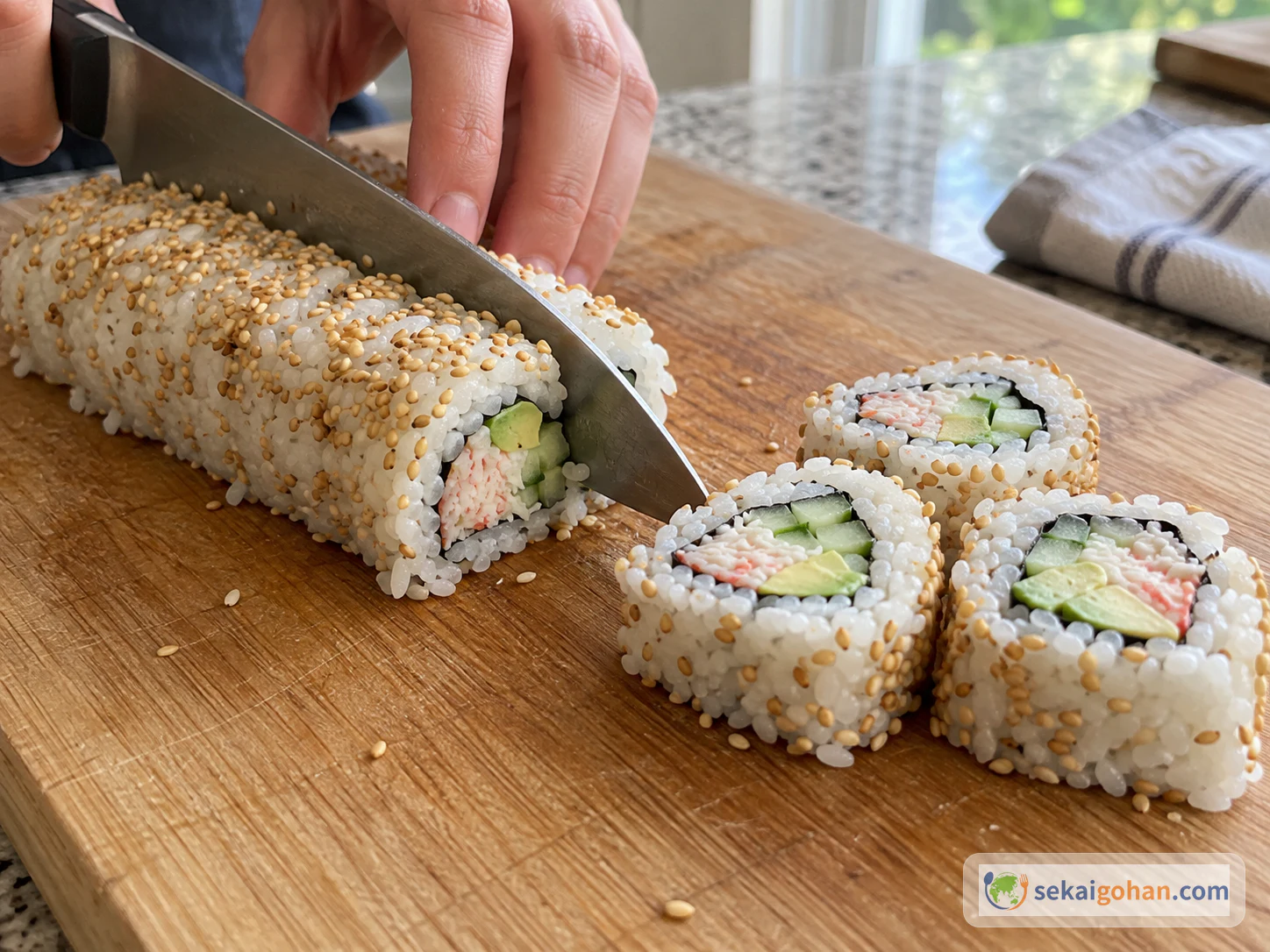
A sharp knife cutting a finished roll crosswise on a board
Wipe the blade every few cuts for clean slices

With a sharp knife, cut each roll in half crosswise, then cut each half into 4 pieces. Wipe the knife with a damp cloth every few cuts. Each roll gives 8 pieces, 64 pieces for all 8 rolls.

STEP99 / 9

Serve with soy sauce and wasabi

California roll pieces served with soy sauce and wasabi in separate small dishes
Soy sauce and wasabi only: no roe, ginger or garnish in this version

Arrange the pieces on a plate and serve with soy sauce in a small dish and wasabi on the side. Make only as much as will be eaten at the table, and don't leave the rice or the finished rolls at room temperature for long.

Refrigerate any leftovers within 2 hours, or within 1 hour when the air temperature is above 90°F (32°C). Store them in a wide, shallow container and refrigerate as soon as possible, keeping them at 40°F (4°C) or below.

0 / 0
Ingredients

Ingredients

1 / 1

Ingredients

Ingredient Amount Role
Uncooked Japanese short-grain white rice 2¼ cups (3 rice-cooker cups / 540 ml) The base of the sushi rice; rinsed three times before soaking
Water 2¼ cups For soaking and cooking the rice
Kombu (昆布) 1 piece (5 g; 2 x 2 inches) Rests on the rice while it soaks and cooks; removed after cooking
Store-bought seasoned rice vinegar (合わせ酢) ⅓ cup Seasons the hot rice; for flavor only
Seasoned sushi rice, per roll ¾ cup (110 g) The outer layer of each roll
Precooked imitation crab (kanikama / surimi, カニ風味かまぼこ) 5 oz Main filling, shredded by hand
Japanese Kewpie mayonnaise 1 Tbsp Binds the shredded crab
Japanese or Persian cucumbers 2 Crisp long strips, seeds removed
Large avocado 1 Thin slices, peeled before rolling
Lemon ½ Squeezed over the cut avocado
Nori (海苔) 4 sheets Cut crosswise into 8 half sheets
Toasted white sesame seeds 4 Tbsp About ½ Tbsp per roll, on the outside rice
Soy sauce as needed For dipping, in a small dish
Wasabi as needed Served on the side

This recipe uses no raw fish, roe or pickled ginger. The vinegar is ready-made seasoned rice vinegar, with nothing added.

0 / 0

Cut a California roll crosswise and you can read it from the outside in: a ring of white short-grain sushi rice dotted with toasted sesame seeds, a thin dark line of nori, then a center of shredded crab-flavored surimi in mayonnaise, crisp cucumber strips and soft green avocado. Because the rice sits on the outside and the nori is tucked inside, this style is called uramaki, or inside-out roll. The filling is precooked imitation crab, so there's no raw fish anywhere in it. The name says "California," but as the history below shows, nobody can say for sure where the first one was made. If you'd like to explore Japan's own home cooking, start from the Japan country page.

California Roll History in North America

The California roll is an example of how sushi adapted outside Japan, not a traditional Japanese standard. Today it's among the most widespread forms of American sushi, turning up in restaurants, supermarkets and university cafeterias alike.

Its origin is still debated. Claims range from 1962 to 1971, and the earliest newspaper mention dates from 1979. Scholars trace the roll to Los Angeles's Little Tokyo, where one account credits a chef at Tokyo Kaikan who used avocado when tuna supply was seasonal. Another account links it to a chef in Vancouver. No single inventor or birthplace has been confirmed, so treat any confident origin story as one account among several.

The roll also belongs to a longer story. Japanese American households in Los Angeles were already making sushi such as inari and futomaki before the restaurant sushi boom. The California roll is best understood as one of many routes through which immigrant cooks and restaurants reshaped sushi.

Ingredients for 8 Rolls (64 Pieces)
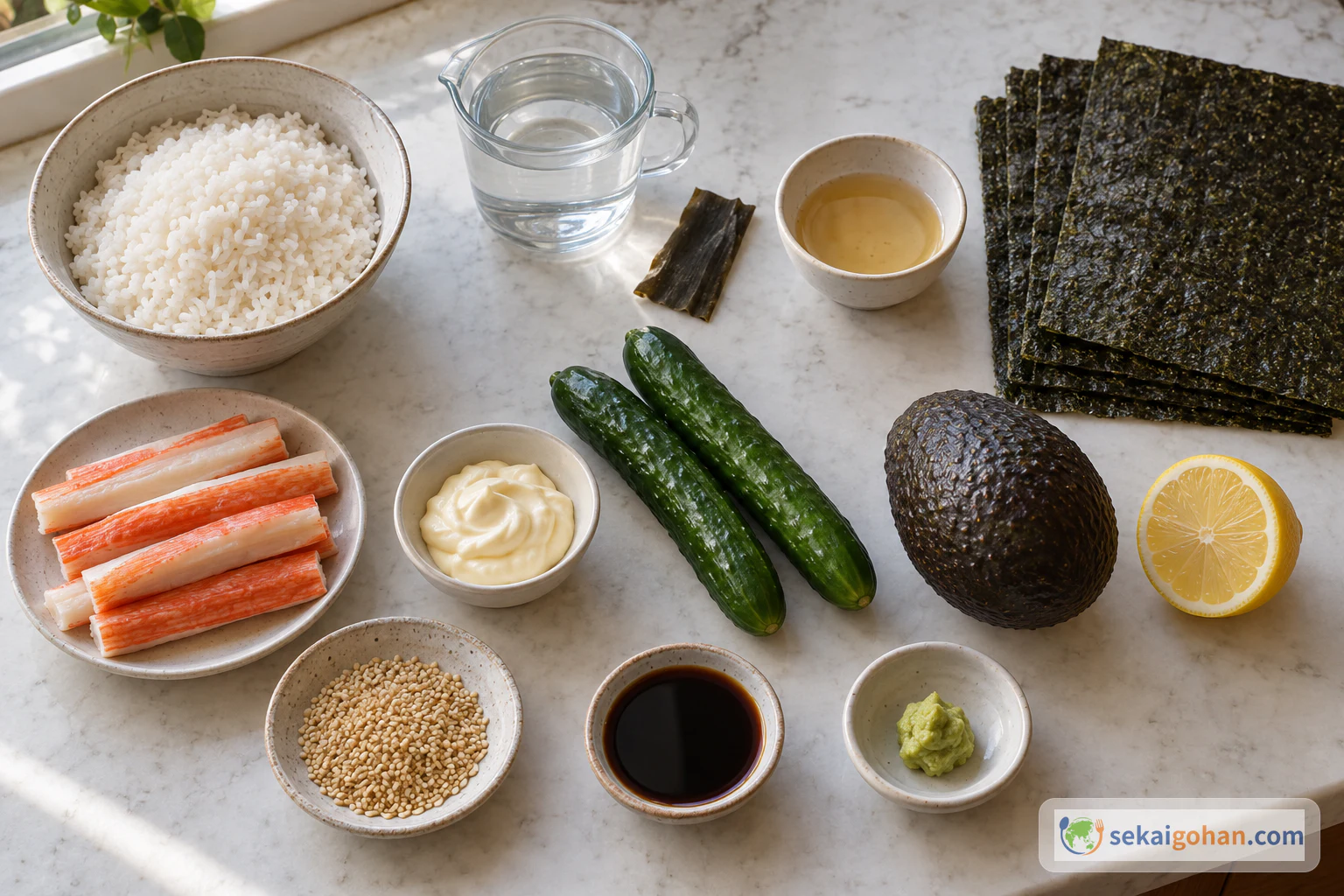
Short-grain rice, kombu, seasoned rice vinegar, imitation crab, cucumbers, avocado, nori and sesame laid out on a counter
Only what this version uses: no homemade vinegar blend, roe, ginger or raw fish
Allergies

Imitation crab is made from fish, and mayonnaise contains egg. Ingredients differ by product, so check the labels on the imitation crab, mayonnaise, seasoned vinegar and soy sauce you buy.

Equipment

  • Rice cooker
  • Large bowl and a strainer for rinsing rice
  • Sushi tub, or a large bowl, or a tray lined with parchment paper
  • Rice paddle
  • Fan (a hand fan or a piece of stiff card works)
  • Bamboo sushi mat (makisu)
  • Plastic wrap
  • Cutting board and a sharp knife
  • Clean damp cloths
  • Small dishes for soy sauce and wasabi

Choosing Ingredients for California Rolls

Imitation crab is not crab. Kanikama is surimi: finely pureed white fish combined with starch, flavoring and other ingredients. It's precooked, so it can go into a roll straight from the package. Look for it in the refrigerated section of Asian and Japanese grocery stores, and follow the storage and handling instructions on the package you buy.

Seasoned rice vinegar already contains its seasoning. Use a store-bought bottle as is. Plain, unseasoned rice vinegar is a different product and won't season the rice the same way.

For the cucumbers, choose Japanese or Persian ones, and remove the seed core from every quarter before cutting strips.

Method: From Rinsed Rice to Eight Even Pieces

Two distances to measure in step 6

The nori sits 1 inch (2.5 cm) above the bottom edge of the mat, and the filling starts ½ inch (1.3 cm) above the bottom edge of the nori. Keep these two measurements separate.

California Roll Problems and Fixes

A good California roll has the rice outside in a thin, even layer, grains intact and sesame clinging to it. Inside, a modest line of crab-mayonnaise, cucumber and avocado sits snugly in the nori. When a roll falls short of that, the cause is usually one of the ones below.

What to check first

Before changing anything, check that the rice is spread thin and even and that the two distances in step 6 are measured. Most rolling problems start there.

Problem Likely cause What to do
The rice won't hold together or the roll is loose Rice spread unevenly, grains crushed, or too much filling Spread the rice in a thin, even layer without pressing it flat, use less filling, and pull the mat firmly against your squeeze to tighten the cylinder
Filling squeezes out of the ends or seam Filling line too wide or started in the wrong place Keep the filling in a single narrow line and start it ½ inch (1.3 cm) above the bottom edge of the nori
The avocado turns brown Cut surfaces exposed to air Squeeze the ½ lemon over the cut avocado as soon as it is sliced
Rice grains are mushy or pasty Stirred instead of sliced while seasoning Mix with a slicing motion with the paddle at an angle, and fan while turning the rice
Pieces are ragged Knife dragging through rice Use a sharp knife and wipe it with a damp cloth every few cuts
Watery spots in the roll Cucumber seeds left in Remove the seed core from every cucumber quarter before cutting strips

Serving, Storing and Varying California Rolls

Serve the rolls with soy sauce and wasabi at the table. They have the best texture the same day they're made, though that's a matter of texture, and the safety rules below come first.

Keeping sushi rice and rolls safe

Vinegar is seasoning, not preservation

The seasoned vinegar in this recipe is a flavor amount. It does not make cooked rice safe at room temperature.

Cooked rice held too long at room temperature is linked to Bacillus cereus, so it needs time and temperature control. Vinegar added for flavor doesn't acidify the rice; that would require a verified equilibrium pH below 4.2. Even properly acidified rice needs that control again once it's combined with sushi fillings. With no raw fish in this recipe, how you hold the cooked rice and finished rolls is what matters.

Make only as many rolls as will be eaten, and refrigerate leftovers within 2 hours (within 1 hour above 90°F / 32°C). Store cooked food in a wide, shallow container, get it into the refrigerator as soon as possible, and keep it at 40°F (4°C) or below. The imitation crab follows its own package instructions for storage and handling.

Variations

Other versions of the roll use real crabmeat, make their own sushi vinegar, top the rolls with roe, or serve pickled ginger alongside.

Frequently Asked Questions

Why does the rice have two different cooked amounts?

They measure different things. The uncooked rice yields about 6⅔ cups (990 g) of cooked rice, while each roll uses ¾ cup (110 g) of seasoned sushi rice, which is 6 cups (880 g) for eight rolls. Use ¾ cup (110 g) per roll, and store any leftover rice the same way as the rolls.

My package of imitation crab isn't 5 oz. What should I use?

Use 5 oz. A 154 g package is a different amount, not a conversion of it.

Where exactly do the nori and filling go?

Place the nori 1 inch from the bottom of the mat, and start the filling ½ inch from the bottom of the nori.

How is a California roll different from a B.C. roll?

The B.C. roll is a separate dish built around grilled salmon skin. It shares neither the filling nor the origin accounts of the California roll.

Does "8 rolls" mean 8 servings?

No. It means 8 rolls, each cut into 8 pieces, for 64 pieces. How many people that feeds depends on what else you serve.
Sources

  • Namiko Hirasawa Chen, Just One Cookbook, "California Roll カリフォルニアロール." The recipe this article follows: the uramaki description and no raw fish, the 8-roll yield cut into 8 pieces each, the rice, store-bought seasoned vinegar, filling, nori and sesame amounts, the per-roll rice allocation and cooked-rice estimate, the rinsing, soaking, seasoning, cutting, placement and rolling method, and the author's same-day texture recommendation. https://www.justonecookbook.com/california-roll/
  • Namiko Hirasawa Chen, Just One Cookbook, "Imitation Crab Sticks." Kanikama as surimi made from pureed white fish with starch and flavorings, precooked and ready to use in sushi rolls, sold refrigerated in Asian and Japanese grocery stores. https://www.justonecookbook.com/imitation-crab-sticks/
  • U.S. Food and Drug Administration, "Supplement to the 2022 Food Code — December 2024 Version." Cooked rice as a time/temperature-control food associated with Bacillus cereus; flavoring vinegar without verified pH below 4.2 is not a validated acidification process; finished sushi requires time/temperature control. https://www.fda.gov/media/183271/download
  • FoodSafety.gov, U.S. Department of Health and Human Services, "Bacteria and Viruses." Rice and leftovers held too long at room temperature associated with Bacillus cereus; keeping cold foods at 40°F (4°C) or below, storing cooked food in wide, shallow containers and refrigerating it as soon as possible. https://www.foodsafety.gov/food-poisoning/bacteria-and-viruses
  • Eric C. Rath, "Known Unknowns in Japanese Food History," Asia Pacific Perspectives, University of San Francisco, 2020. The uncertain origins of the California roll, accounts tracing it to Los Angeles's Little Tokyo with dates from 1962 to 1971, the earliest newspaper mention found in 1979, the likely unknown inventor, and its wide circulation in American restaurants, supermarkets and cafeterias. https://jayna.usfca.edu/asia-pacific-perspectives/pdfs/asia-pacific_perspectives_v16n2_final.pdf
  • Los Angeles Times, "The history of sushi in L.A.: How two friends sparked a revolution," 2023. Japanese American home sushi such as inari and futomaki before the restaurant boom, the account linking the roll to Tokyo Kaikan chef Ichiro Mashita and avocado, and the existence of competing accounts. https://www.latimes.com/business/story/2023-05-03/history-of-sushi-in-la?src=longreads
  • Kibun Foods (U.S.A.), Inc., "Kanikama Crab Flavored Surimi Seafood." Imitation crab commonly used in sushi rolls, with consumer products identified as steamed surimi seafood. https://www.kibunusa.com/homes_category/kanikama-crab-flavored-surimi-seafood/