Gyoza (餃子): Japanese Pan-Fried Pork and Cabbage Dumplings

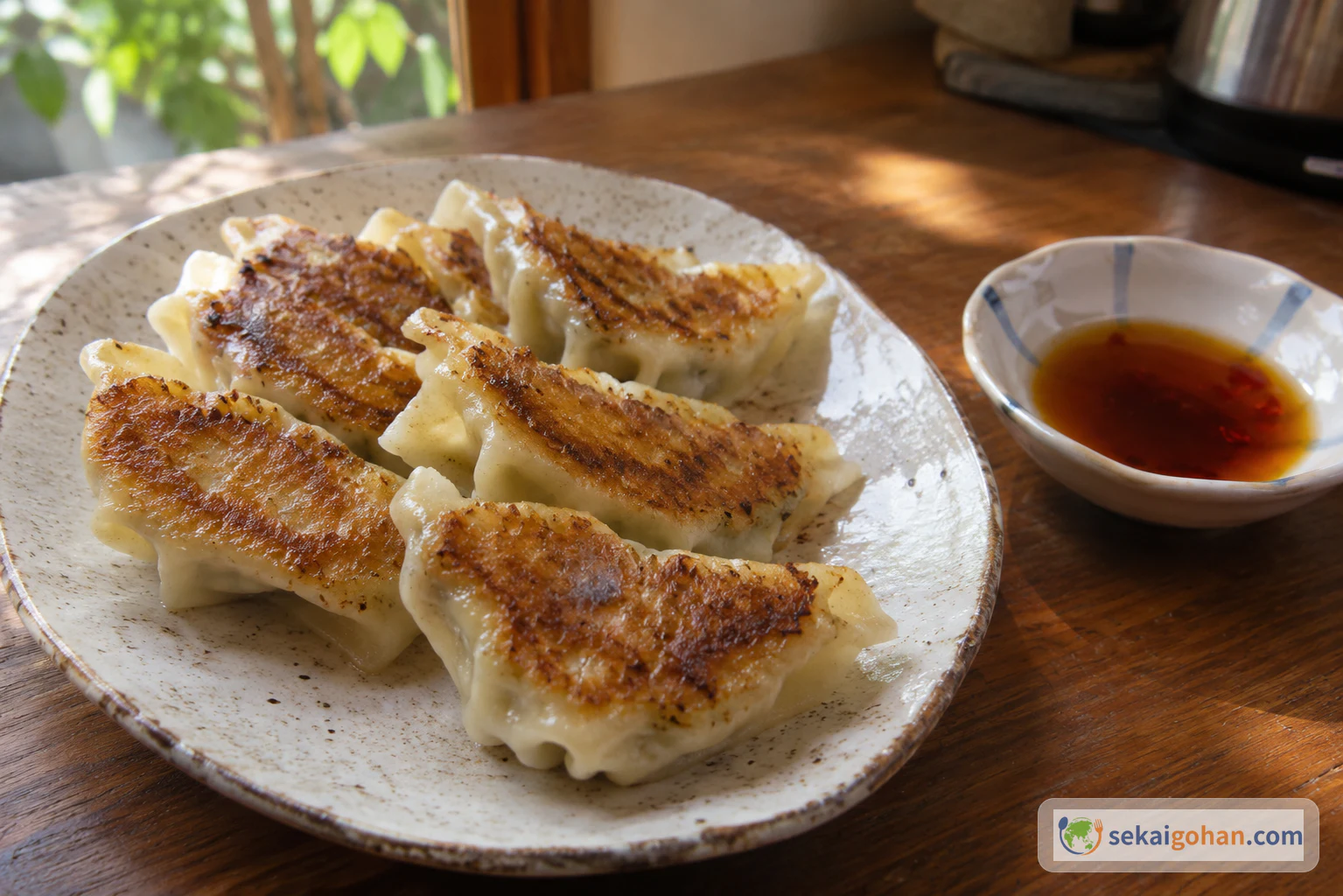
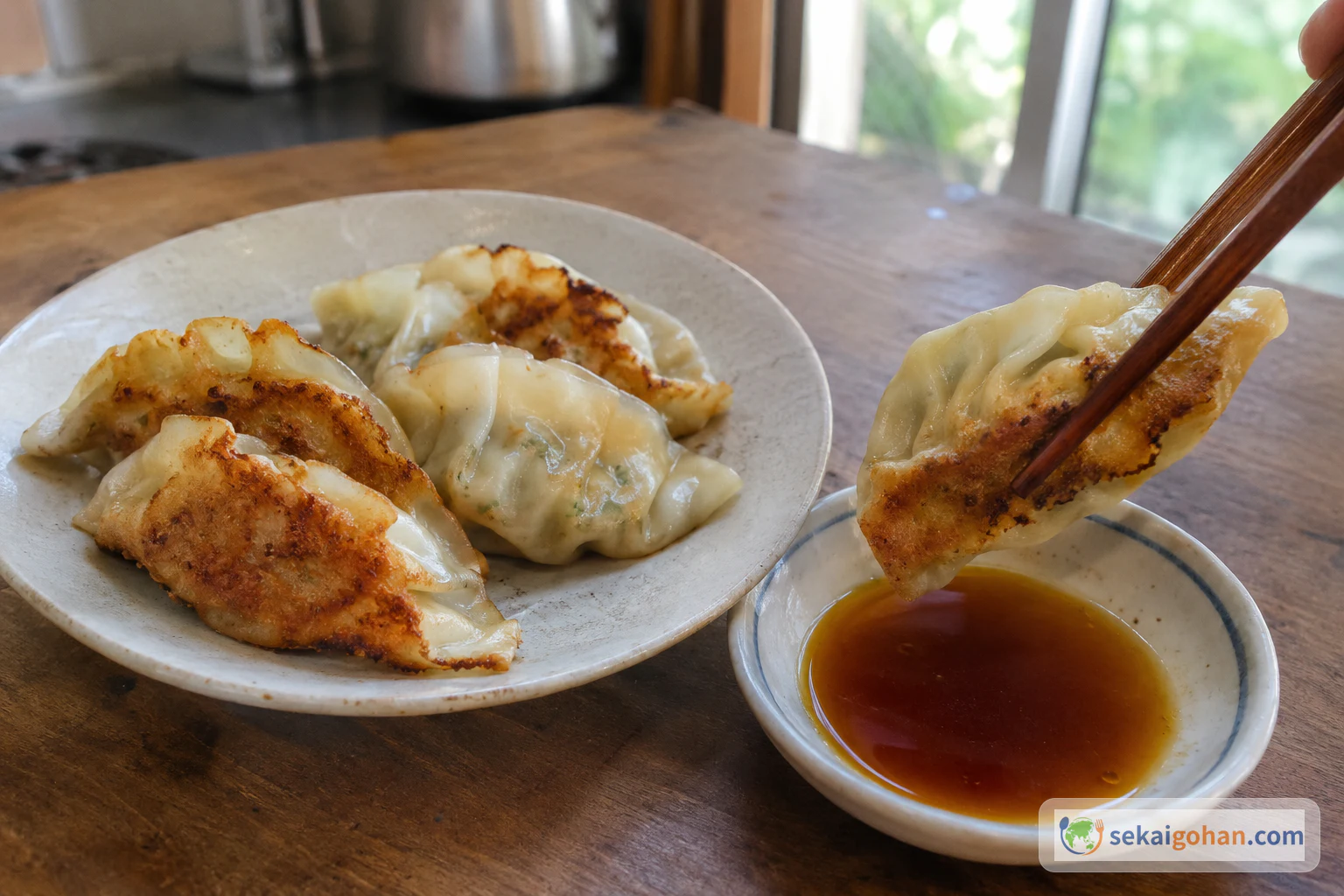
Golden-browned gyoza on a plate with a dish of soy sauce and vinegar dipping sauce
Serves
52 pieces
Cuisine
Japanese

How to make Japanese yaki-gyoza with a pork, green cabbage and shiitake filling: salting and squeezing the cabbage, kneading the filling, pleating store-bought wrappers, then browning, steaming and crisping in one pan. Includes per-batch and per-serving amounts, a soy and rice vinegar dipping sauce, storage, troubleshooting and the separate center-temperature safety target.

Cooking flow

Cooking steps

STEP11 / 12

Cut the cabbage finely

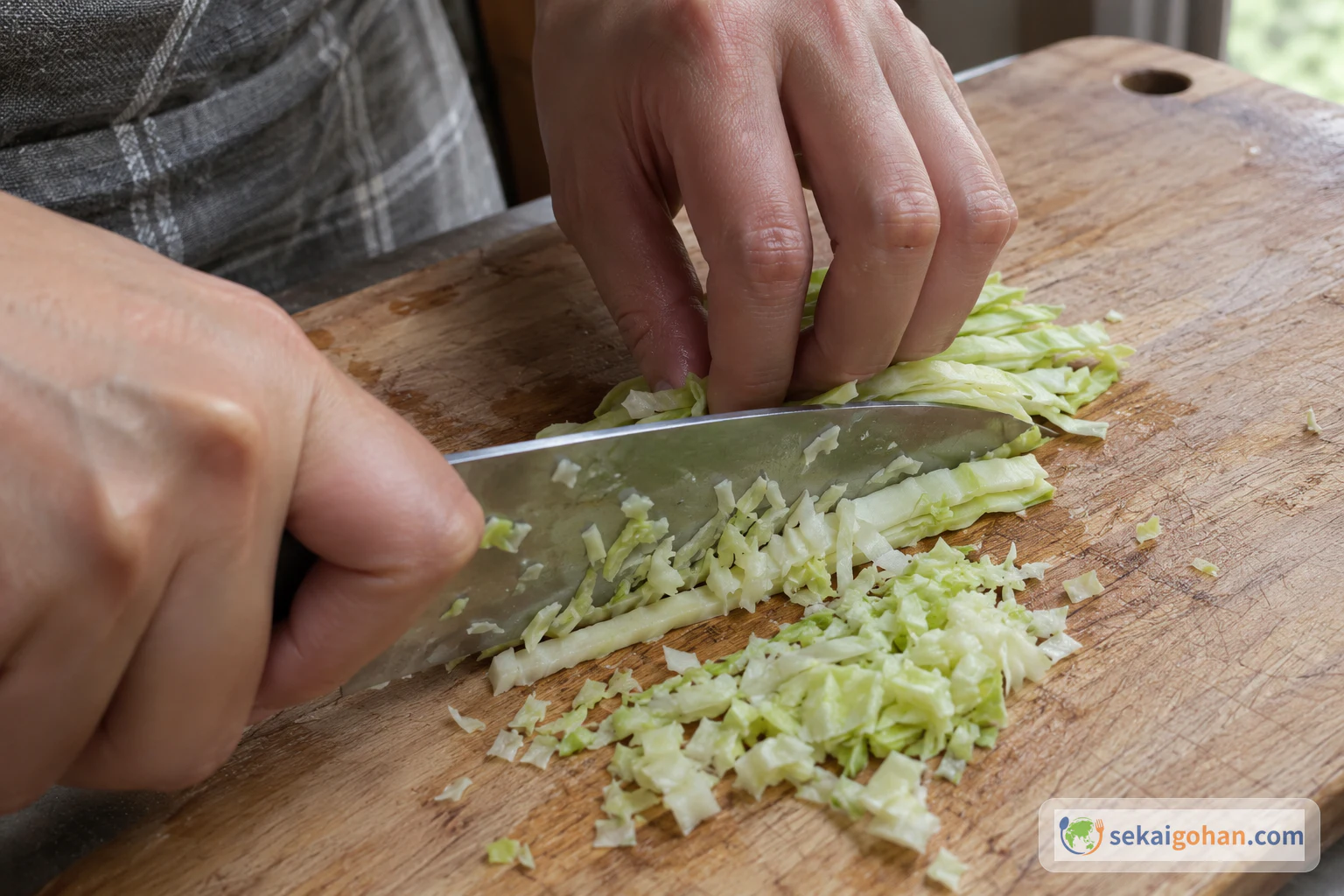
Cutting the cabbage into strips and mincing it finely after removing the core
Mince the strips crosswise, especially through the pale ribs

Remove the thick core from the green cabbage. Cut the leaves into 1/3-inch (1-cm) strips, then mince them finely crosswise, paying particular attention to the white ribs.

STEP22 / 12

Salt the cabbage and let it wilt

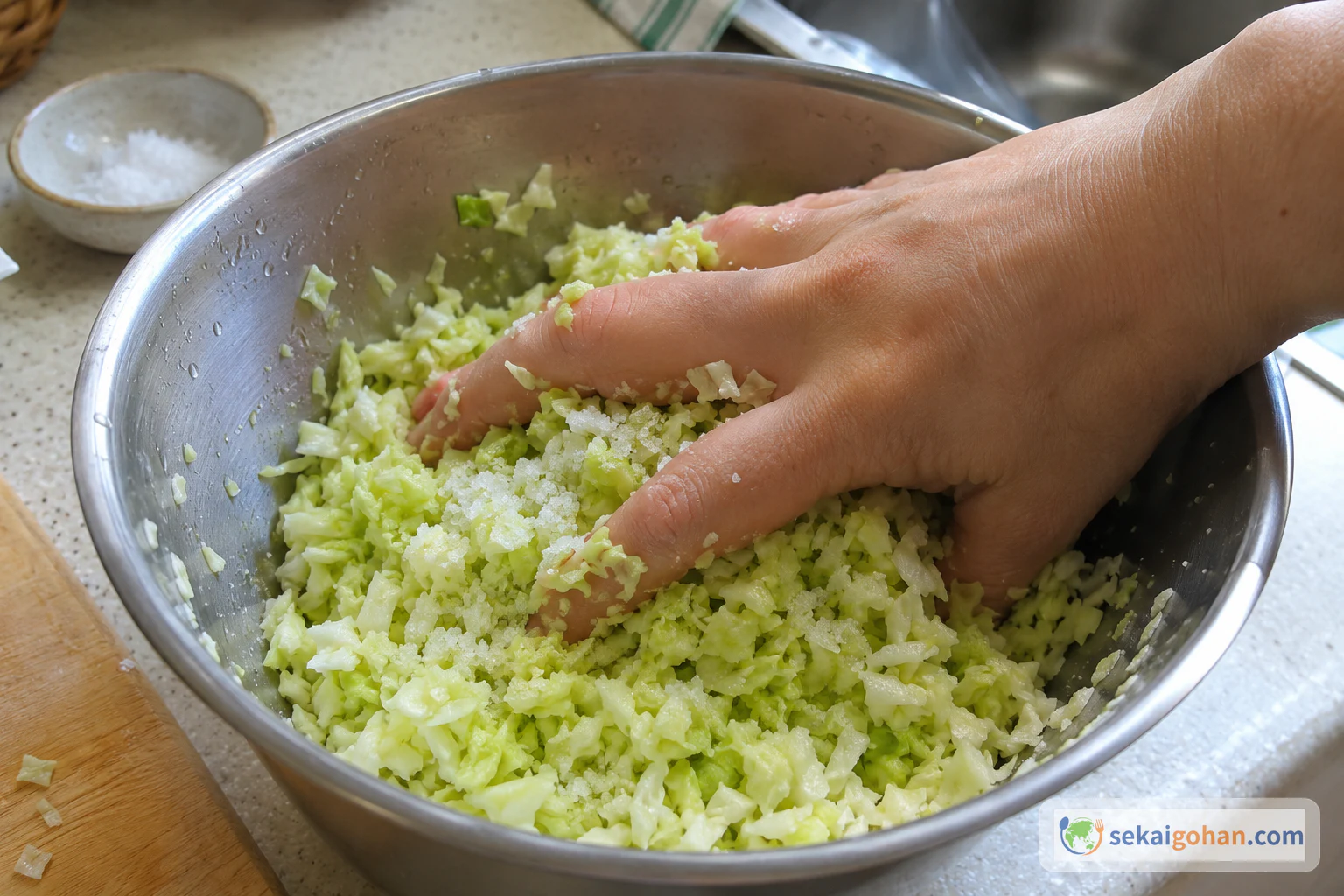
Rubbing salt into the minced cabbage until it softens
Only cabbage and salt go into this bowl

Put the minced cabbage in a bowl, sprinkle with 1 tsp kosher salt and rub it in with your hand. Set aside until the cabbage is wilted, and move on to the next steps while it rests.

STEP33 / 12

Prepare the aromatics

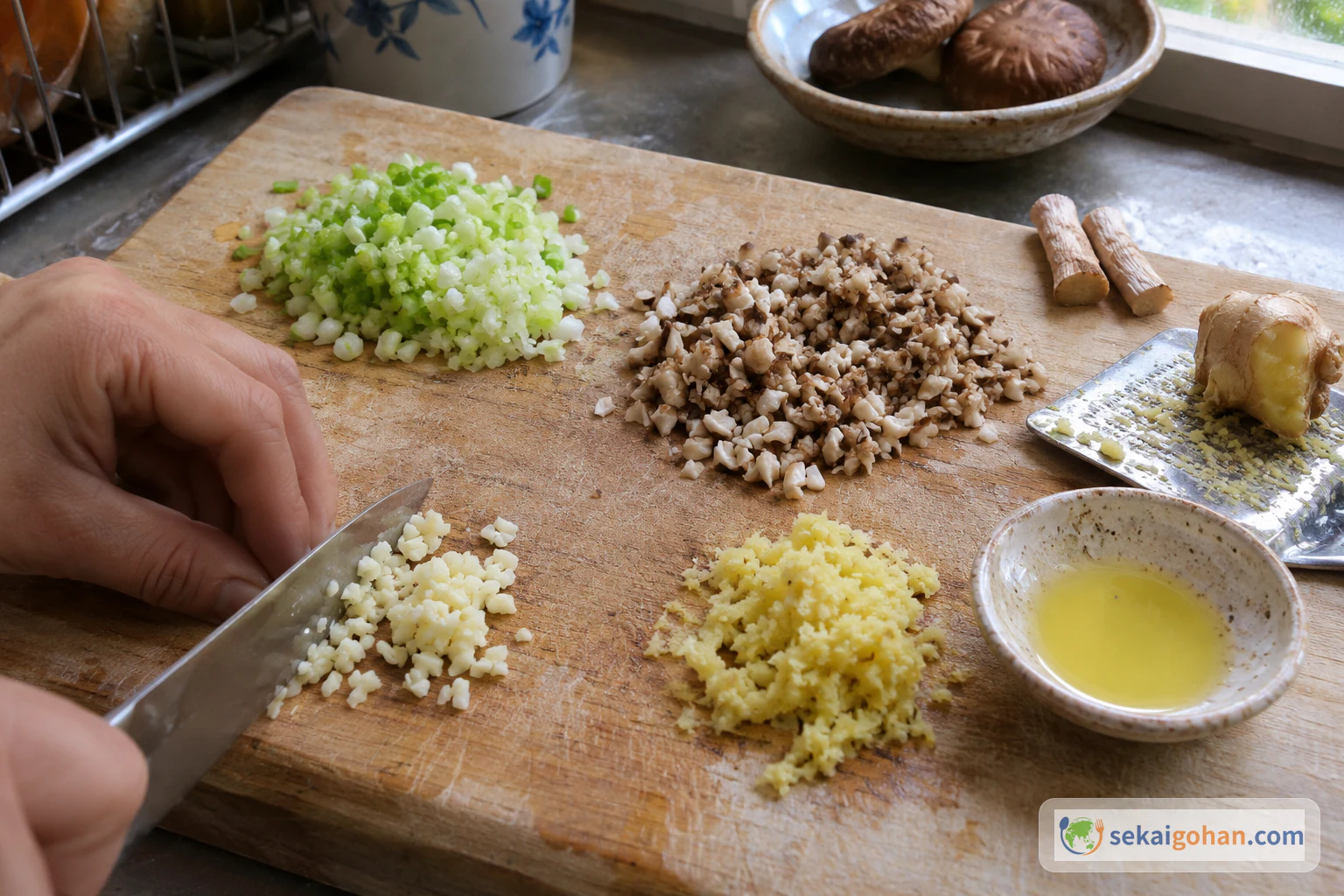
Minced scallions and shiitake, ginger grated with its juice, and garlic ready to use
Keep the ginger juice with the grated ginger

Mince the scallions. Remove the shiitake stems, thinly slice the caps, then mince them. Grate the ginger together with its juice to get 1 tsp. Mince or press the garlic.

STEP44 / 12

Knead the pork with the seasonings

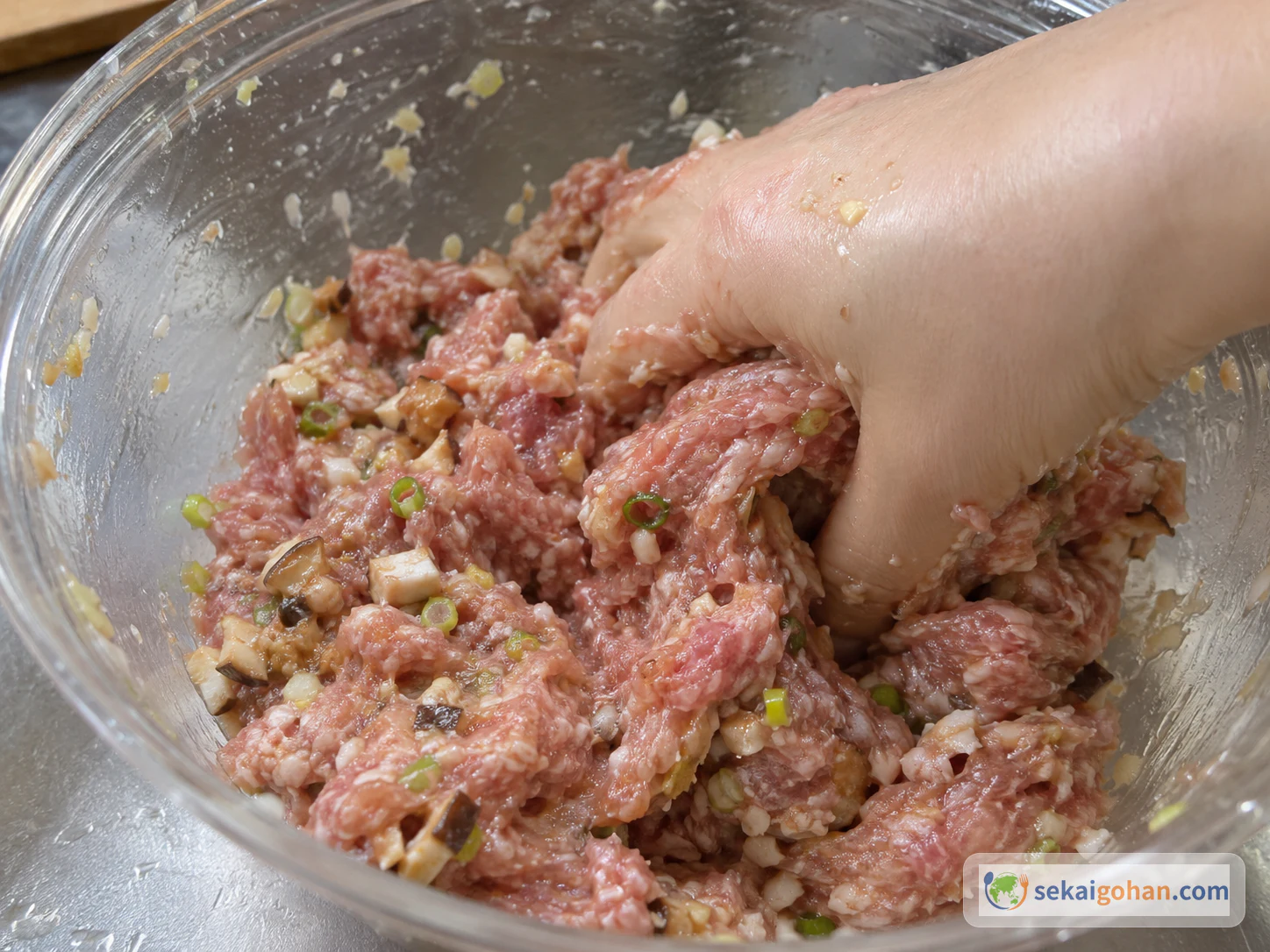
Kneading ground pork with scallions, shiitake, seasonings and aromatics until sticky
The cabbage is not in the bowl yet

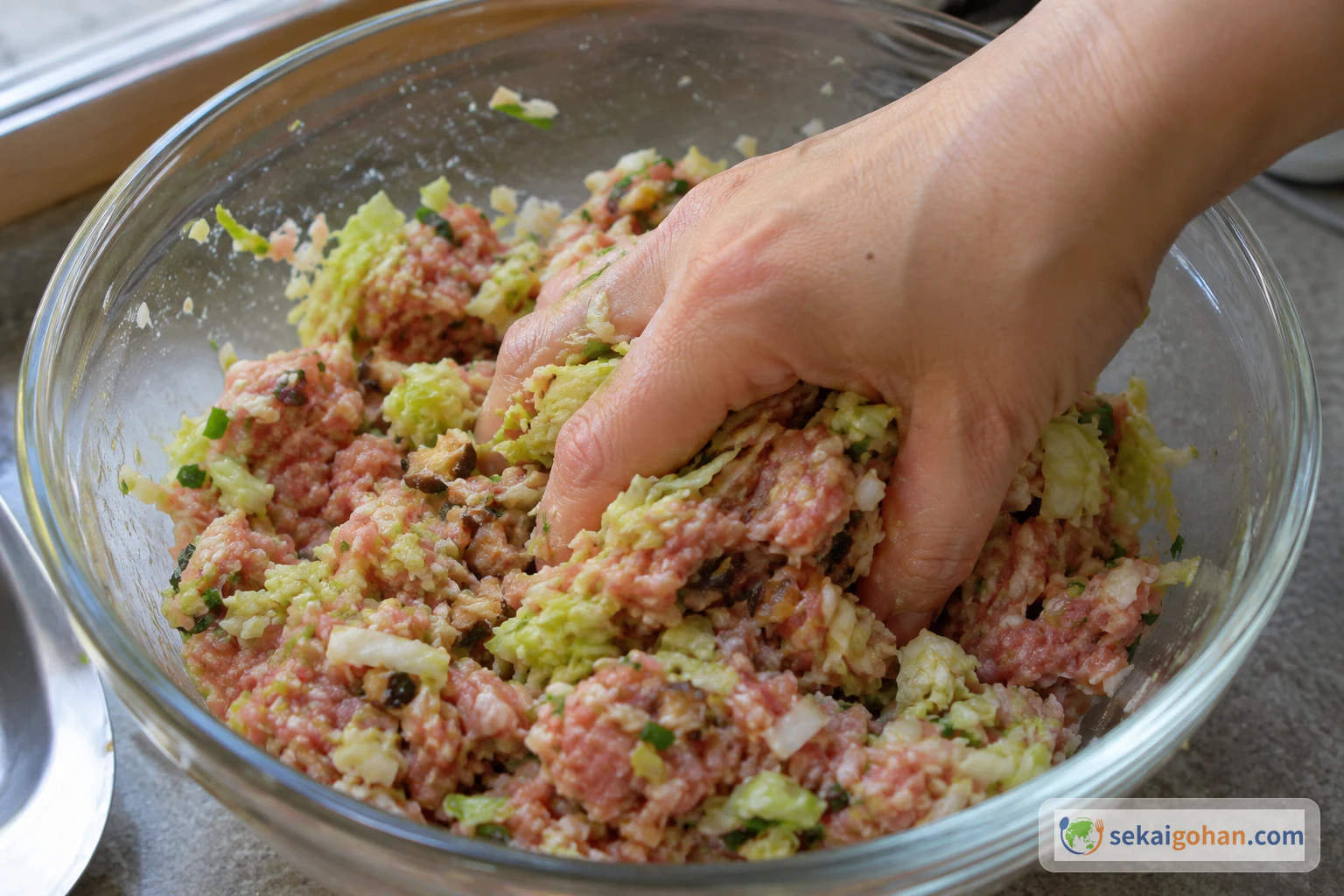
In a large bowl, combine the ground pork, scallions, shiitake, ginger, garlic, 2 tsp soy sauce, 2 tsp toasted sesame oil, 1/8 tsp black pepper and, if using, 2 tsp sake. Knead by hand until the mixture becomes sticky and pale.

STEP55 / 12

Squeeze the water out of the cabbage

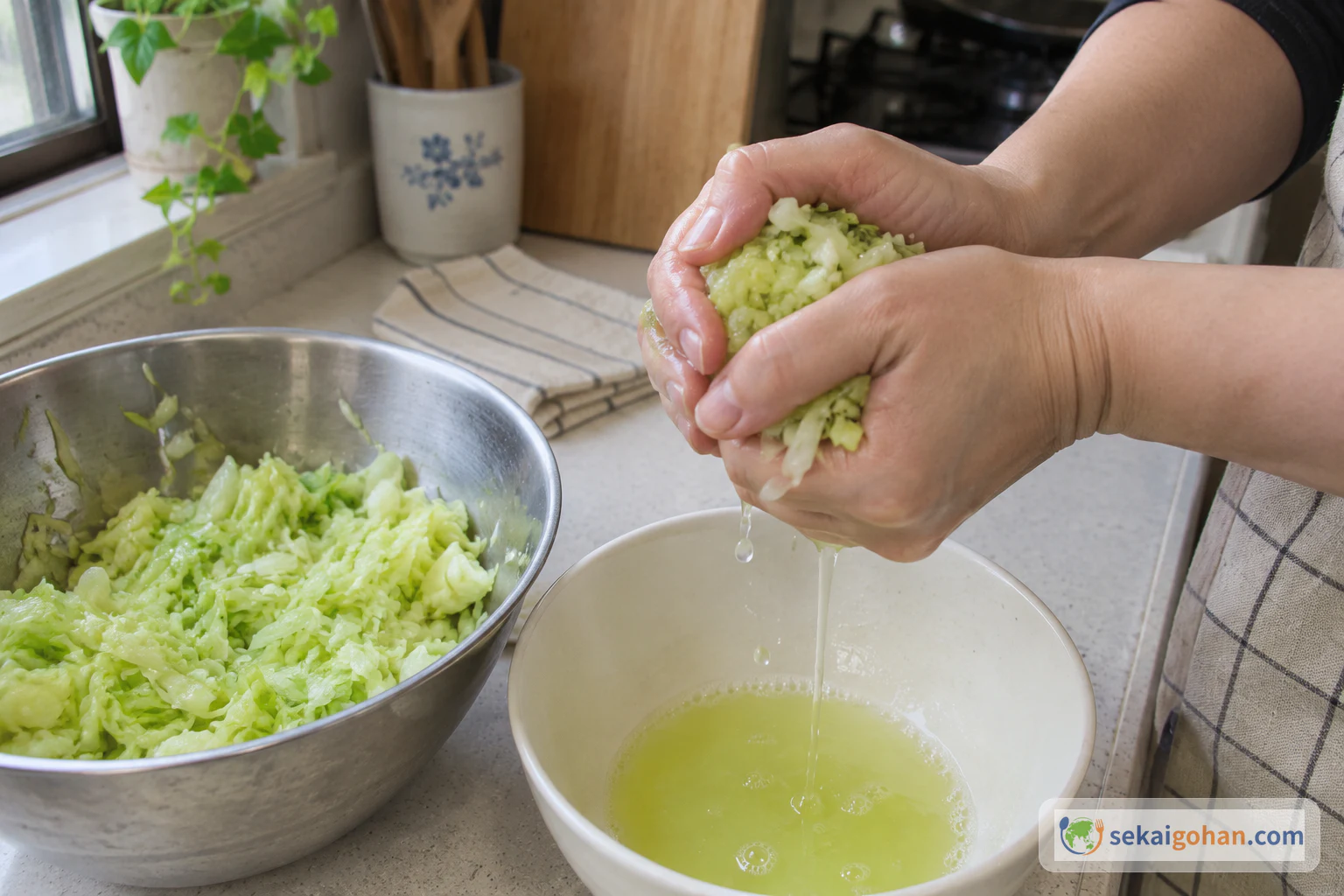
Squeezing the salt-wilted cabbage by hand to remove its water
Let the squeezed-out liquid fall away from the cabbage

Take the wilted cabbage in your hands and squeeze out the water. Discard the liquid; do not add it to the filling.

STEP66 / 12

Work the cabbage into the pork

Mixing the squeezed cabbage into the sticky pork filling until even
Mix until the cabbage is spread evenly through the filling

Add the squeezed cabbage to the pork mixture and knead until it is evenly incorporated and the filling looks uniform.

STEP77 / 12

Fill the wrappers

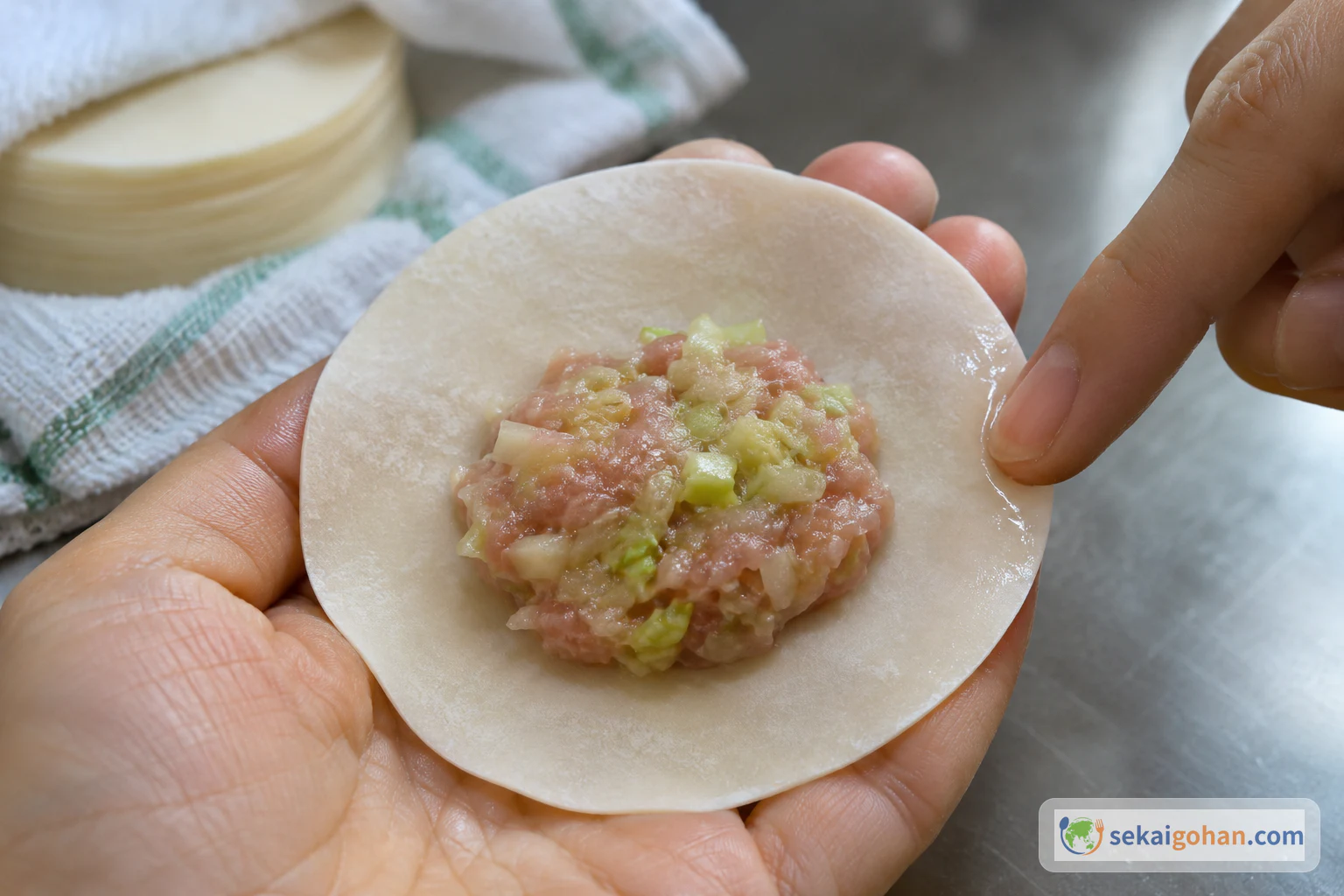
Filling placed in the center of a gyoza wrapper with the edge moistened with water
Keep the edge free of filling so it can seal

Set out a small bowl of water and a parchment-lined baking sheet. Keep the wrappers covered with a damp towel or plastic wrap while you work. Place 1 level Tbsp of filling in the center of a wrapper, or a scant 3/4 Tbsp if you are new to folding. Flatten the filling to press out trapped air. Dip a finger in the water and moisten the outer 1/4 inch (6 mm) of the wrapper.

STEP88 / 12

Fold, pleat and seal

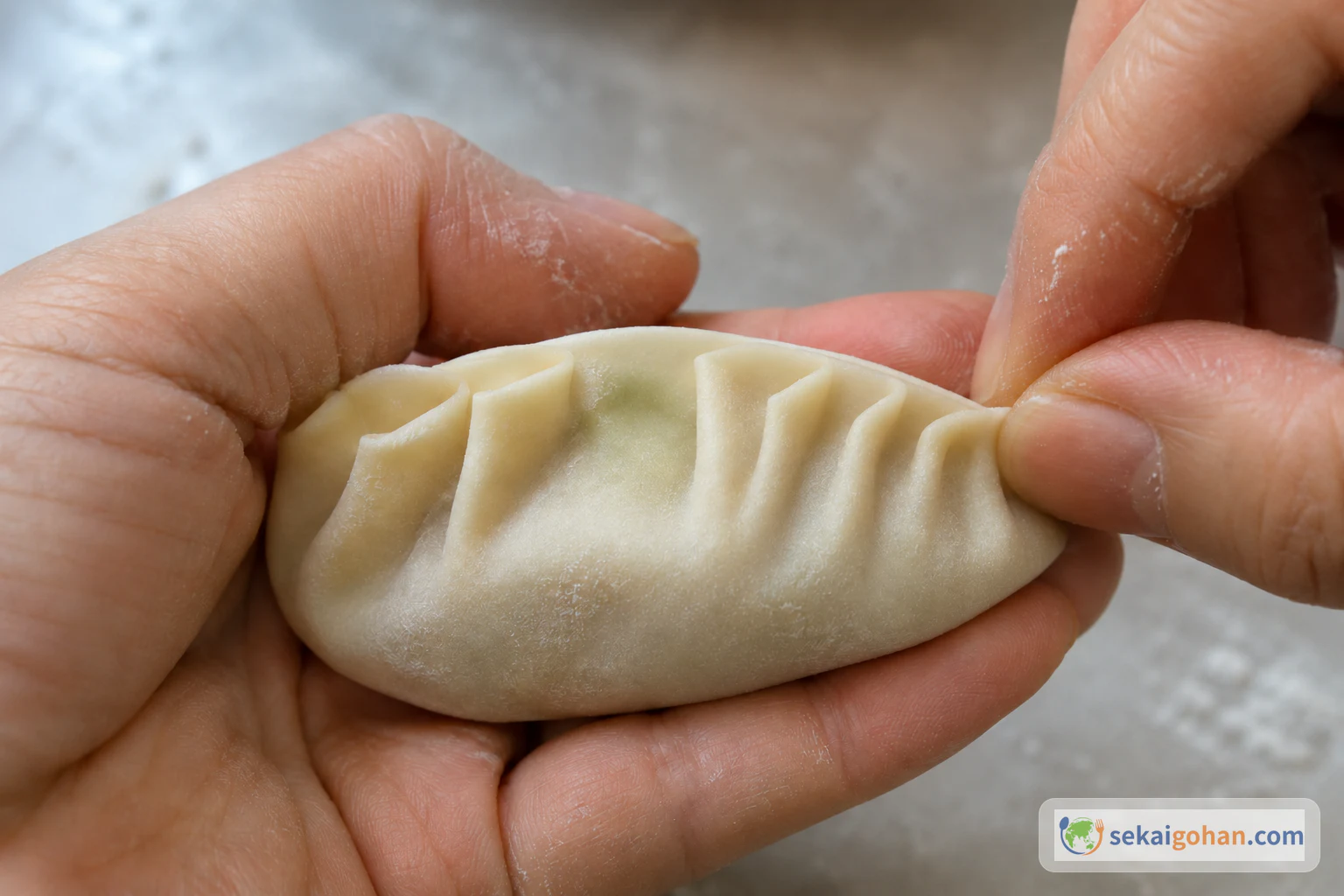
Folding the wrapper in half, pleating one side at a time and pressing the seam closed
Press each pleat against the smooth back half and flatten the base

Fold the wrapper in half and pinch it at the top center, without sealing all the way across yet. On one side, make an initial pleat, then 2–3 more pleats about 1/4 inch (6 mm) apart, pressing each pleat against the smooth back half. Repeat on the other side, so each side has 3–4 pleats. Press along the seam once more to close any gaps, spread the filling evenly inside, and flatten the bottom so the dumpling can stand upright. Set it on the tray and keep the formed gyoza covered. Cook or freeze them without delay, so moisture from the filling does not soften the wrappers.

STEP99 / 12

Brown the flat side

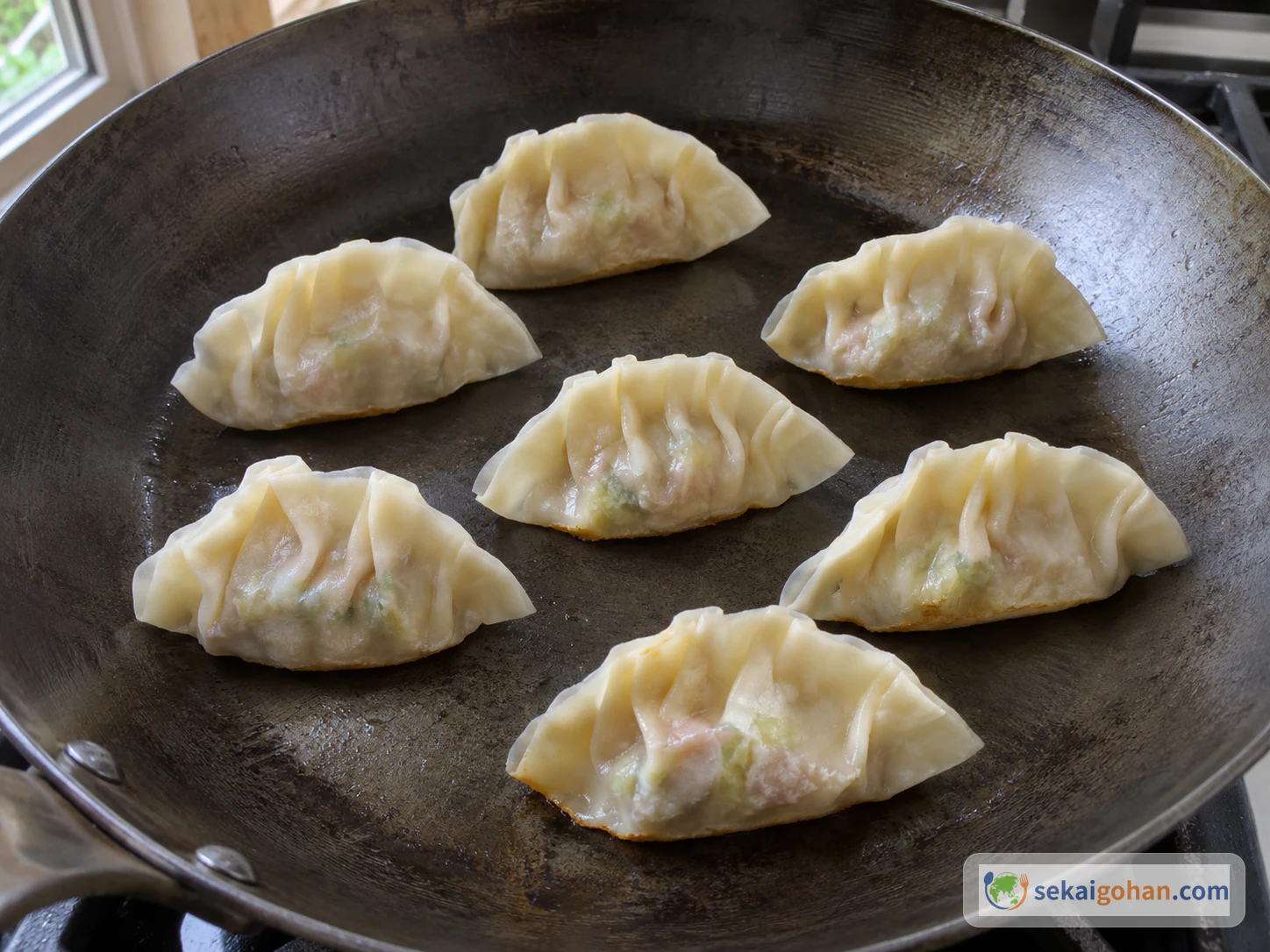
Gyoza arranged with space between them in a frying pan, browning on their flat sides
One layer, with room between each dumpling

Heat a large nonstick or carbon-steel pan over medium heat and add 1 Tbsp neutral oil. Arrange the gyoza flat side down in a single layer with space between them. Cook for about 3 minutes, until the bottoms are golden and release cleanly from the pan. Cook in as many batches as your pan needs, using the oil, water and sesame oil amounts for each batch.

STEP1010 / 12

Add water, cover and steam

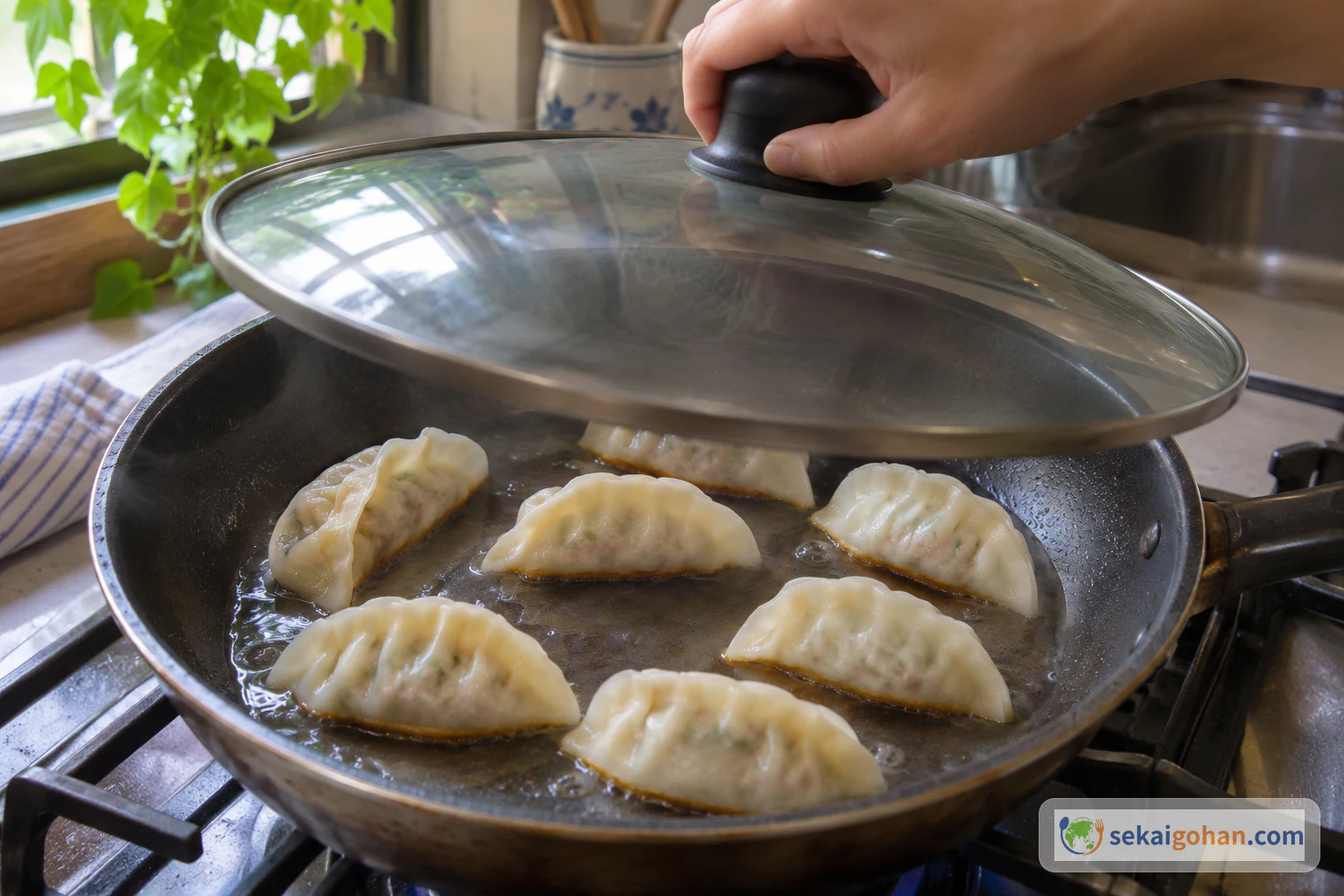
Water added to the pan and the lid lowered right away to steam the gyoza
Cover as soon as the water goes in

Add 4 Tbsp water to the pan and cover immediately. Steam for about 3 minutes, until most of the water has evaporated. For gyoza cooked from frozen, steam 1–2 minutes longer.

STEP1111 / 12

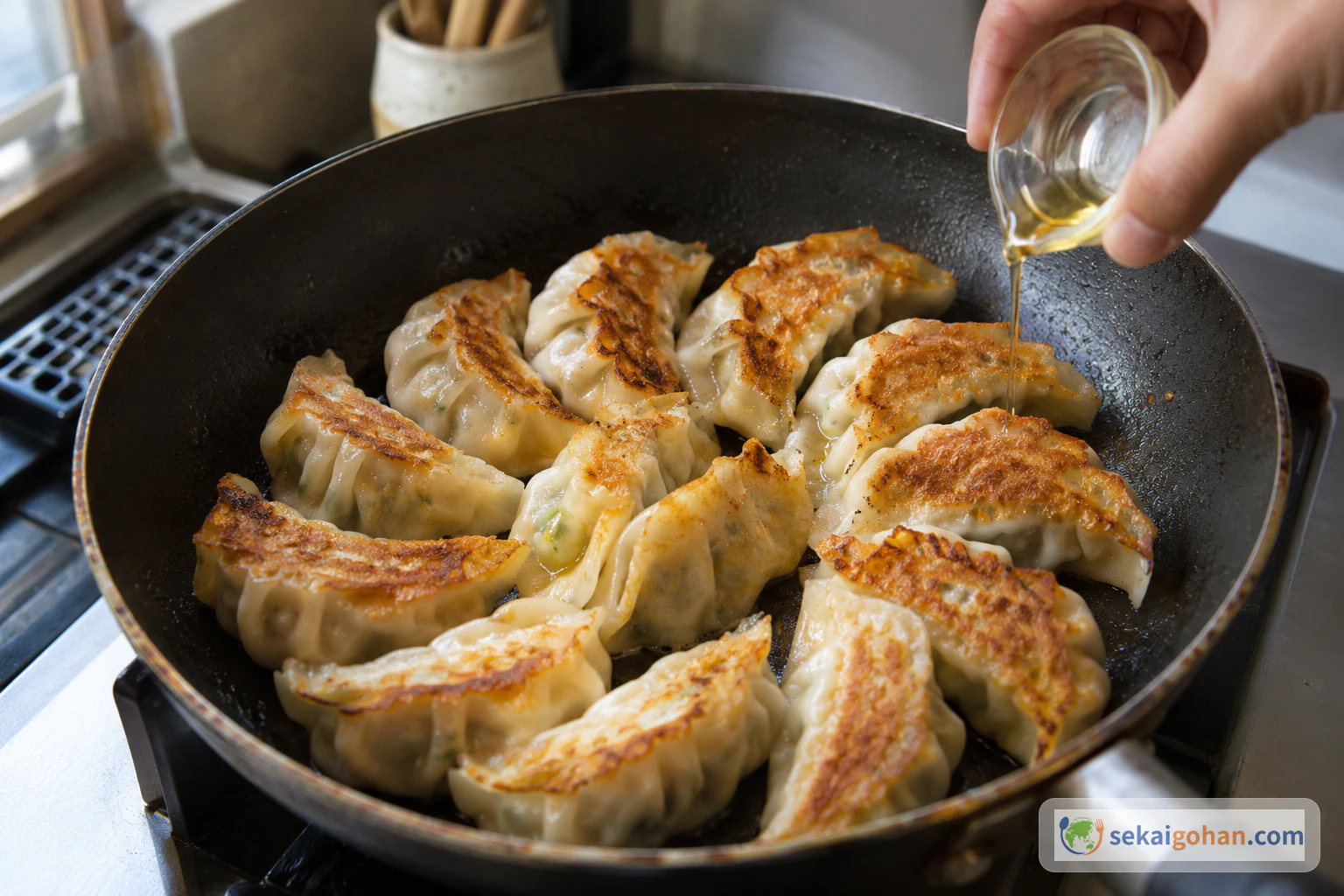
Uncover and crisp with sesame oil

Lid removed, water cooked off and sesame oil drizzled around the gyoza to crisp the bottoms
No water should remain in the pan when the sesame oil goes in

Remove the lid and cook until the water has fully evaporated, about 1 minute. Drizzle 1 tsp toasted sesame oil around the gyoza and keep cooking, uncovered, until the bottoms are deep golden and crisp. Check that the center of the filling reaches 167°F (75°C) and stays there for at least 1 minute. Cooking time and a golden bottom don't confirm this.

STEP1212 / 12

Serve with the dipping sauce

Yaki-gyoza served with a soy sauce and vinegar dipping sauce, one lifted toward the dish
One small dipping dish per person

For each person, mix 1 Tbsp soy sauce and 1 Tbsp unseasoned rice vinegar in a small dish, and add 1/8 tsp la-yu if you like. Serve the gyoza with the sauce for dipping.

0 / 0
Ingredients

Ingredients

1 / 1

Ingredients

Ingredient Amount Role
Ground pork 1/2 lb The base of the filling
Green cabbage 3/4 lb (1/4 large head) Thick core removed, finely minced, salted and squeezed. Green cabbage, not napa
Diamond Crystal kosher salt 1 tsp For salting the cabbage only. If using table salt, use half the volume or the same weight
Shiitake mushrooms 2 Stems removed, caps minced
Green onions / scallions 2 Minced
Fresh ginger 1 tsp, grated with its juice (from a 1-inch / 2.5-cm knob) Aroma for the filling
Garlic 2 cloves Minced or pressed
Sake (optional) 2 tsp Softens the gamey taste of the pork
Toasted sesame oil 2 tsp Mixed into the filling
Soy sauce 2 tsp Mixed into the filling
Freshly ground black pepper 1/8 tsp Mixed into the filling
Gyoza wrappers 1 package (52 sheets, 10 oz / 284 g) Store-bought round wrappers
Water as needed For moistening the wrapper edges
Neutral oil 1 Tbsp per pan batch For browning
Water 4 Tbsp per pan batch Added before covering, to steam
Toasted sesame oil 1 tsp per pan batch Drizzled around the gyoza at the end to crisp the bottoms
Soy sauce 1 Tbsp per serving Dipping sauce
Unseasoned rice vinegar 1 Tbsp per serving Dipping sauce
La-yu (Japanese chili oil, optional) 1/8 tsp per serving Dipping sauce

Salt goes only on the cabbage. The 2 tsp of toasted sesame oil in the filling and the 1 tsp drizzled into the pan are separate. The same is true of the soy sauce in the filling and the soy sauce in the dipping dish.

0 / 0

The dumplings go into the hot pan flat side down and sit until their bottoms turn golden. Then a little water goes in, the lid comes down right away, and steam softens the pale pleated tops. When the lid comes off, the last of the water cooks away, a thin ring of toasted sesame oil goes around the pan, and the bottoms fry crisp again. That is yaki-gyoza, the pan-fried gyoza most people picture when they think of Japanese gyoza. This version fills store-bought wrappers with ground pork, finely minced green cabbage, shiitake mushrooms, scallions, ginger and garlic, so you get a juicy center under a crisp, deep golden base.

Gyoza in Japan

In Japan, gyoza generally means pan-fried yaki-gyoza, though the country also has steamed gyoza (mushi-gyoza) and boiled gyoza (sui-gyoza). The dumpling traces back to Chinese jiaozi, and Japanese gyoza developed their own character to suit local tastes. The usual method is to pan-fry in oil, then lightly steam. They're served with soy sauce and vinegar, with rayu (chili oil) if you like, and ready-made wrappers are sold in supermarkets.

A classic filling uses pork, cabbage or Chinese cabbage, long onion, Chinese chives, soy sauce, garlic and sesame oil. This recipe stays within that range but uses green cabbage rather than napa, scallions and shiitake rather than chives, and Japanese seasonings.

Gyoza and northern Chinese boiled jiaozi are related, but they make different plates. Boiled jiaozi built on handmade flour-and-water wrappers, napa cabbage and a black-vinegar sauce cook quite differently from these browned, steamed and re-crisped dumplings. For more dishes from the same country, see Japan.

Ingredients for 52 Pieces
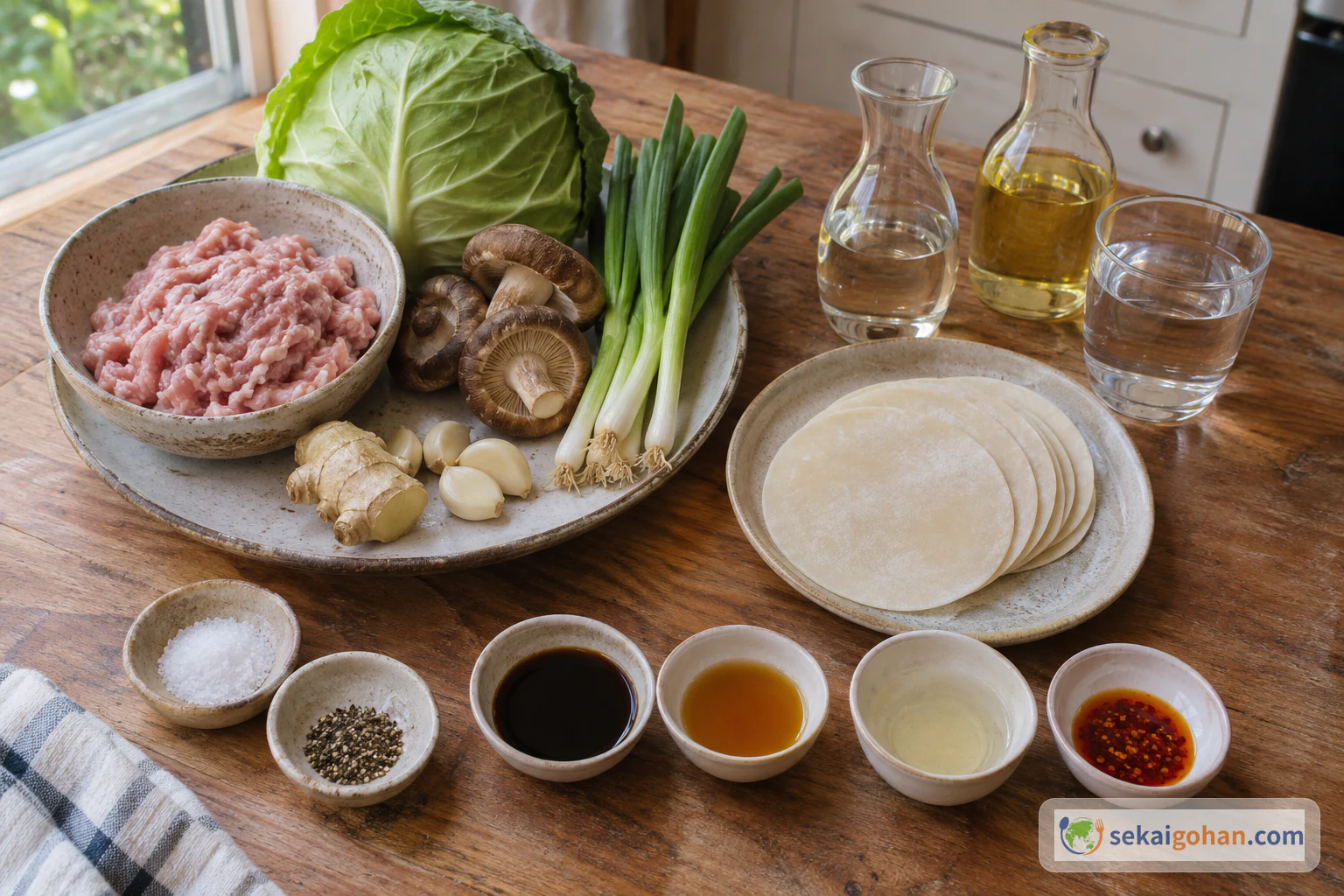
Ground pork, green cabbage, shiitake, scallions, gyoza wrappers and the dipping sauce ingredients
Filling, wrappers, pan items and sauce, grouped by where they are used

Equipment

  • Knife and cutting board
  • Large mixing bowl
  • Grater for the ginger, and a garlic press if you like
  • Small bowl of water for sealing
  • Baking sheet lined with parchment paper
  • Damp kitchen towel or plastic wrap to cover the wrappers and formed gyoza
  • Large nonstick or carbon-steel frying pan with a lid
  • Kitchen thermometer for checking the center temperature
  • Small individual dipping dishes

Gyoza Ingredients and Substitutes

Cabbage. Use ordinary round green cabbage rather than napa.

Salt. Kosher salt brands differ in how much a spoonful weighs. If you have no Diamond Crystal kosher salt, use table salt at half the volume or at the same weight. Other kosher or Japanese salts won't swap in spoon for spoon.

Wrappers. Thin Japanese-style gyoza wrappers suit this recipe. The 52-piece yield assumes a 52-sheet pack, so a pack with a different count or weight may give you a different number of gyoza.

Sauce. Use unseasoned rice vinegar, not seasoned sushi vinegar. Black vinegar or a miso-based sauce makes a different table from the plain soy and vinegar dip here.

Oil. Brown the gyoza in a neutral oil and save the toasted sesame oil for the finishing drizzle at the end of each batch.

Sake and la-yu. Both are optional. Leave them out if you don't have them or prefer not to use them.

Method: Salt the Cabbage, Knead the Pork, Then Wrap and Pan-Cook

The order that matters

Salt the cabbage first and let it wilt while you prepare the aromatics and knead the pork. Squeeze the cabbage only when the pork mixture is already sticky, then work it in.

Cooking ground meat through to the center

Heat ground meat until the center reaches 167°F (75°C) and stays there for at least 1 minute. Pathogens can sit inside minced meat, so the center has to get hot, not just the outside. The minutes in this recipe are technique cues, and your pan, burner and dumpling size change them. Golden bottoms, evaporated water and a finished look don't tell you the center is done. Use a kitchen thermometer. Keep meat chilled, and keep raw meat juices away from other foods and utensils.

Gyoza Troubleshooting

The habit that matters most comes before any wrapping: salt the cabbage until it wilts, and meanwhile knead the pork with its seasonings until sticky and pale. Only then work in the squeezed cabbage. A dry filling is easier to wrap and won't soak the wrappers before they reach the pan. How many batches you cook depends on how many gyoza fit in your pan in one spaced layer.

Problem Likely cause What to do
The filling is wet and the wrappers turn soggy The cabbage was not minced finely, not salted long enough or not squeezed well Mince finely, rub in the salt, wait until fully wilted, then squeeze hard and discard the liquid before mixing
Wrappers dry out and crack while folding The wrappers were left uncovered Keep the stack under a damp towel or plastic wrap, and take out one at a time
Formed gyoza go soft before cooking They sat too long after wrapping Cover them on the tray and cook or freeze them without delay
Filling squeezes out or the wrapper won't close Too much filling, or filling on the edge Use 1 level Tbsp (or a scant 3/4 Tbsp), keep the edge clean, moisten the outer 1/4 inch (6 mm) and pinch any gaps shut
Gyoza stick together or brown unevenly The pan was crowded Cook in a single layer with space between dumplings, with the full oil amount for each batch
The bottoms are not crisp Water was still in the pan when finishing, or the sesame oil went in too early After uncovering, cook until all the water is gone, then add the 1 tsp sesame oil and cook uncovered until deep golden
Unsure whether the center is cooked Times and color can't tell you Check the center with a thermometer for 75°C held for at least 1 minute

Storing Gyoza and Variations

Making ahead and storage

Uncooked gyoza: Freeze them in a single layer until solid, or at least frozen on the outside, then transfer them to an airtight freezer bag. Keep them frozen for up to 1 month. Cook them straight from frozen with the same brown, steam and crisp sequence, adding 1–2 minutes to the steaming.

Cooked gyoza: Let them cool completely, then store them in an airtight container. Refrigerate for up to 3 days, or freeze for up to 1 month.

Variations

  • Add garlic chives (nira) to the filling.
  • Use ground beef, turkey, chicken or lamb instead of pork.
  • Make a meatless filling with firm tofu, mushrooms and vegetables.
  • Change the dipping sauce with miso and sugar.
  • Use a different fold instead of the pleated half-moon.

Frequently Asked Questions

Is 52 pieces enough for 52 people?

No. 52 is the number of dumplings, not the number of servings, and how many people that feeds depends on your table. The dipping sauce is measured per serving, so mix one dish for each person rather than scaling it to the 52 pieces.

Why salt the cabbage instead of adding it raw?

Salting draws water out of the minced cabbage, so you can squeeze it away before it meets the pork. That keeps the filling from going watery and soaking the wrappers.

Do the 3-minute browning and 3-minute steaming times guarantee the filling is done?

No. The times are technique cues. Ground meat needs to reach 167°F (75°C) at the center and stay there for at least 1 minute, whatever the recipe time or the color of the bottoms, so check with a thermometer.

Is gyoza related to gujiya?

Only in that both are filled doughs. Gujiya is a sweet, deep-fried half-moon pastry whose flour-and-ghee shell holds khoya, sugar and nuts, and it can be finished in syrup. That's a long way from the pork filling and pan-fry–steam–crisp method here.
Sources

  • Namiko Hirasawa Chen, "Gyoza Recipe 餃子," Just One Cookbook, written recipe card republished May 10, 2026. The recipe followed here: yield of 52 pieces, all ingredient amounts and their scopes, the salt note, the salting, kneading, filling and pleating steps, the brown–steam–crisp sequence, the dipping sauce, the time estimates, storage guidance and listed variations. https://www.justonecookbook.com/gyoza/
  • Kikkoman Corporation, "Gyoza Pot Stickers," Close-Up Japan Vol. 32 No. 2, July 2018. Background on yaki-gyoza as the common Japanese form, steamed and boiled Japanese styles, the relationship to Chinese jiaozi, the pan-fry-then-steam pattern, soy-vinegar and rayu serving, and a typical filling pattern. https://www.kikkoman.com/en/culture/foodforum/close-up-japan/32-2.html
  • Ministry of Health, Labour and Welfare (Japan), "食中毒予防:お肉はよく加熱して食べよう ~お肉の生食はとても危険です!~" (Preventing food poisoning: cook meat thoroughly). The 75°C for at least 1 minute center-temperature target, the note on pathogens inside minced-meat dishes, cold storage and avoiding cross-contamination. https://www.mhlw.go.jp/stf/web_magazine/closeup/08.html
  • Embassy of India, Luanda / Indian Council for Cultural Relations, "Bharat Darshan," March 2021, Gujiya recipe by Mrs Pallavi Redkar. Used only to describe gujiya as a separate sweet, deep-fried pastry. https://www.indembangola.gov.in/pdf/menu/Bharat-Darshan-March-2021-English.pdf