Kiritanpo Nabe: Akita's Grilled Rice Cylinders in Chicken Broth (きりたんぽ鍋)

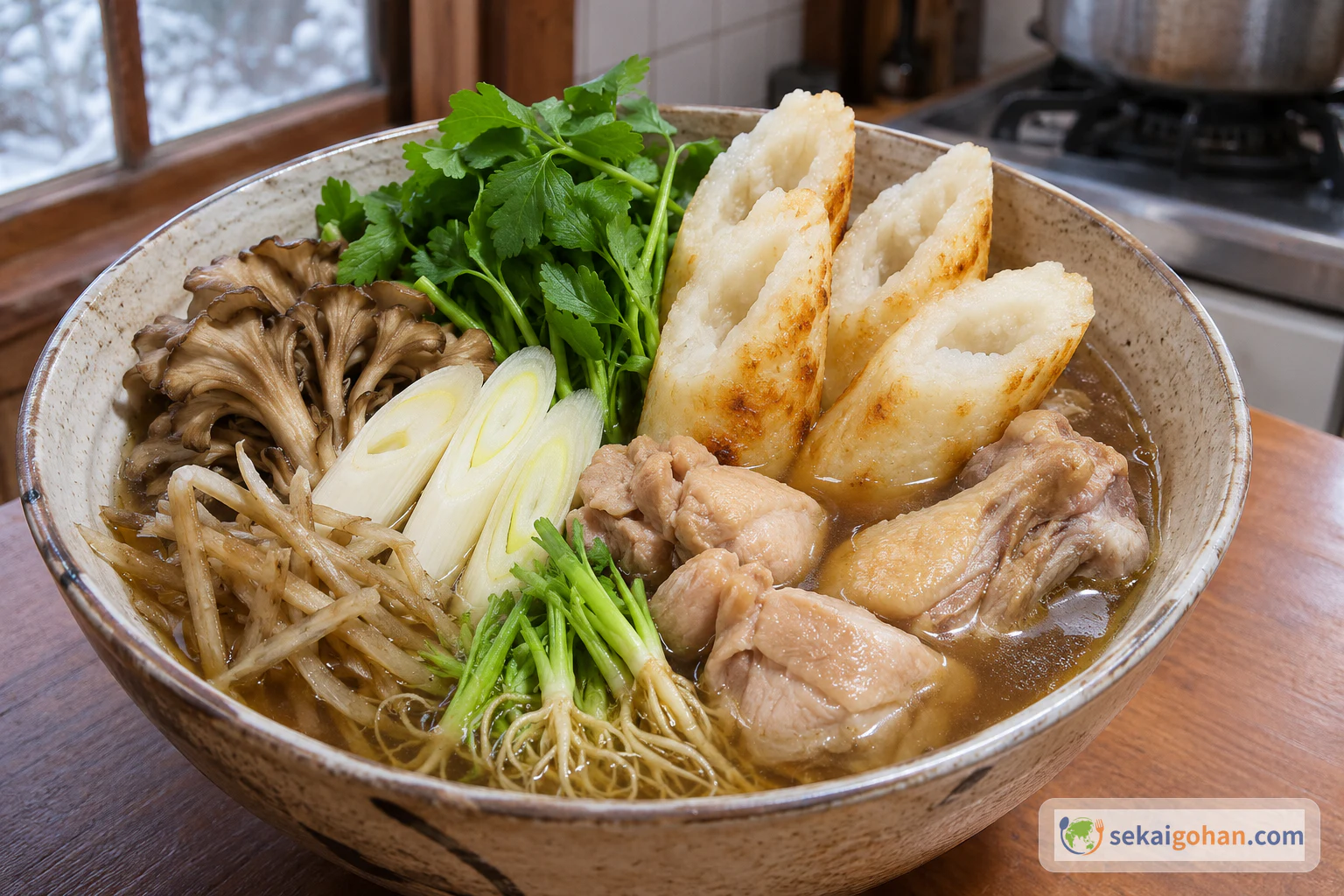
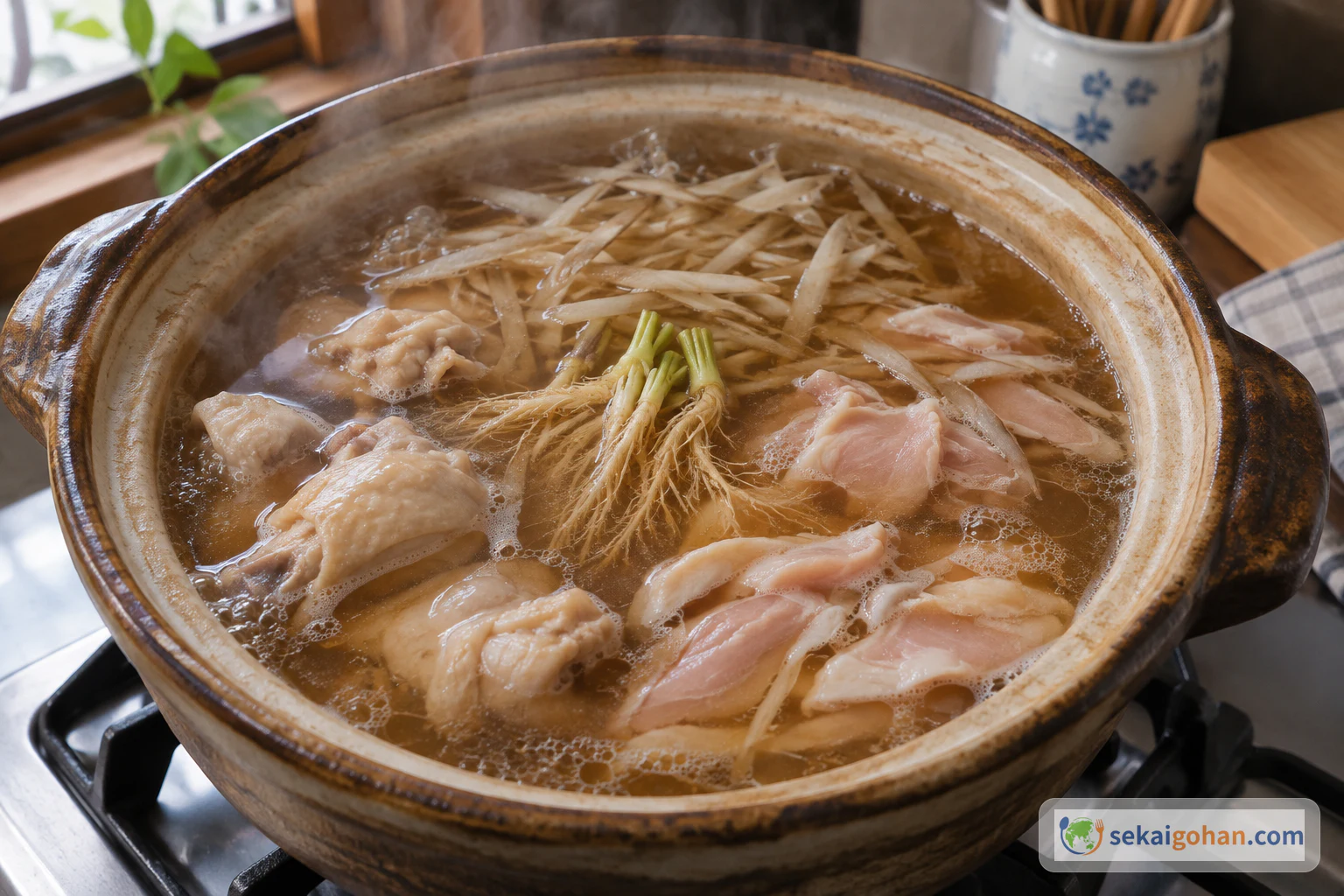
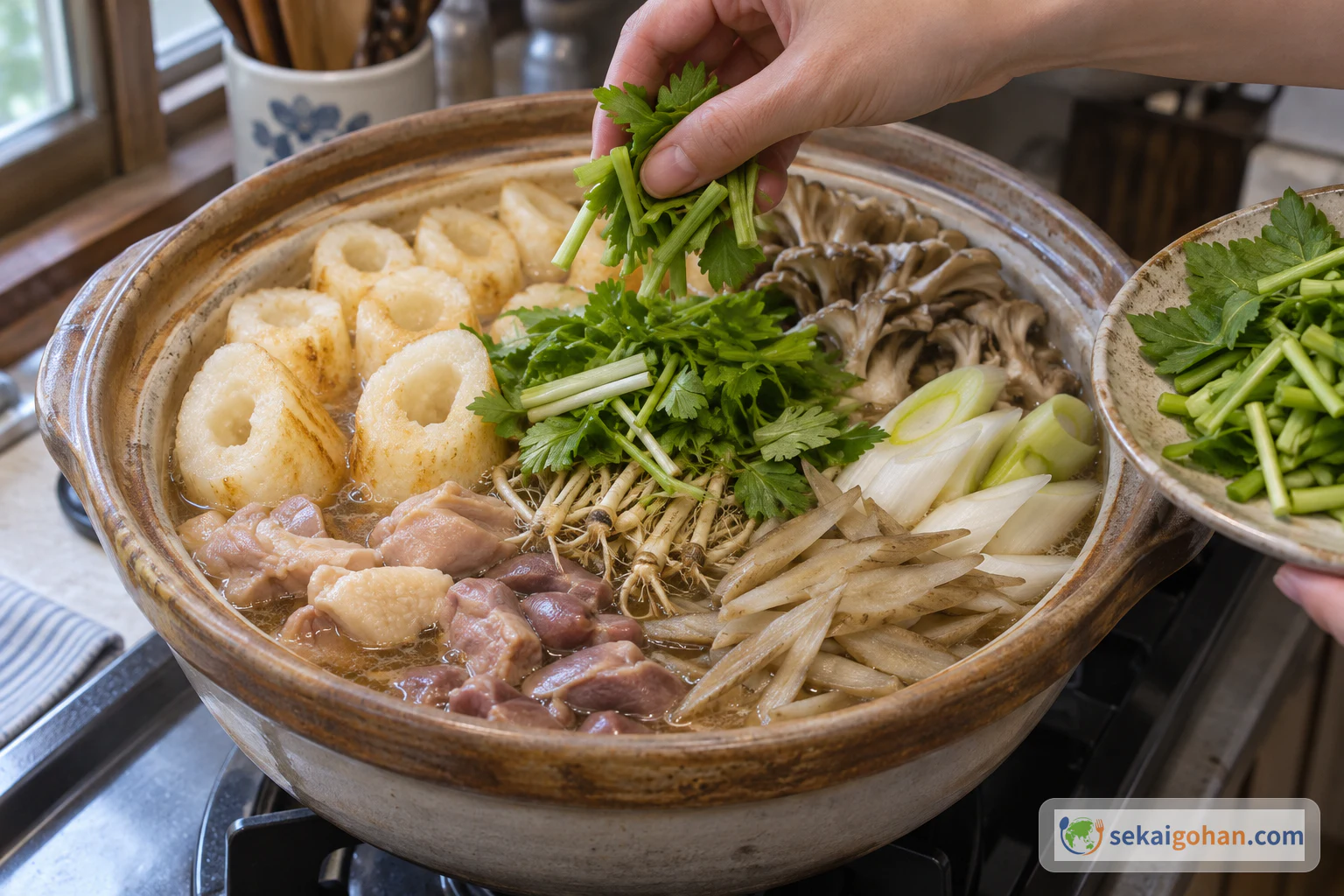
Akita kiritanpo nabe with grilled kiritanpo, chicken, burdock, maitake, long leek and seri
Serves
2–3 servings
Cuisine
Japanese

How to make kiritanpo nabe, the Akita hot pot of grilled rice cylinders, bone-in and boneless chicken, burdock, maitake, leek and seri, with clear steps for shaping the rice, checking your grill's manual before using foil, building the stock, and handling chicken and seri safely.

Cooking flow

Cooking steps

STEP11 / 14

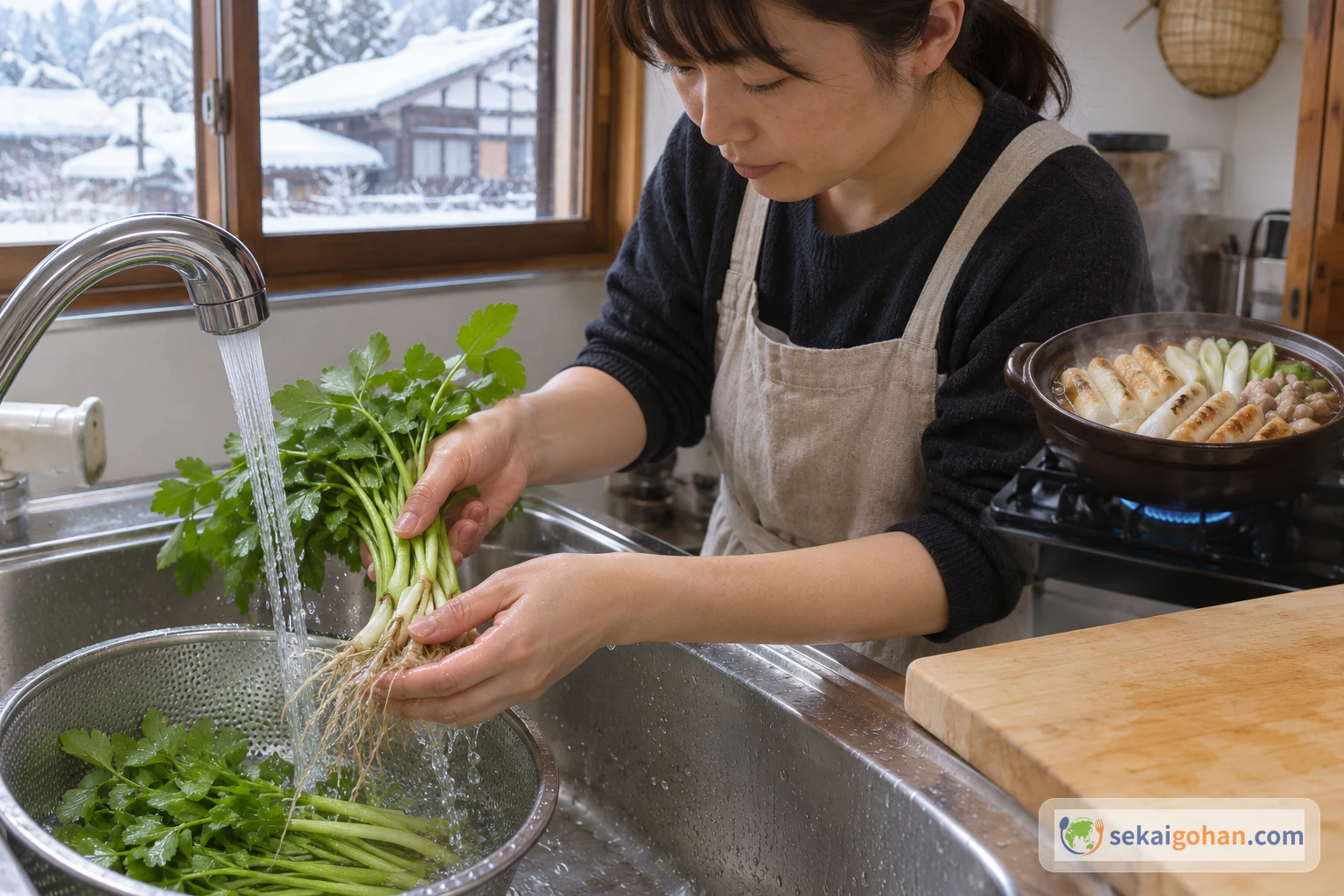
Wash the leek, seri and burdock

Rinsing a bunch of food-market seri, roots and leaves, under water
Clean the roots and the leaves

Wash the leek well under running water, without soap or detergent. Rub the soil off the seri roots by hand and loosen them gently, then rinse well under running water, reaching between the roots, and rinse the stems and leaves too. If the soil won't come off, soak the roots in water for a few minutes and rinse again. Wash the burdock under running water. Don't use soap, detergent or produce wash on any of them. Everything is ready when no soil is left.

STEP22 / 14

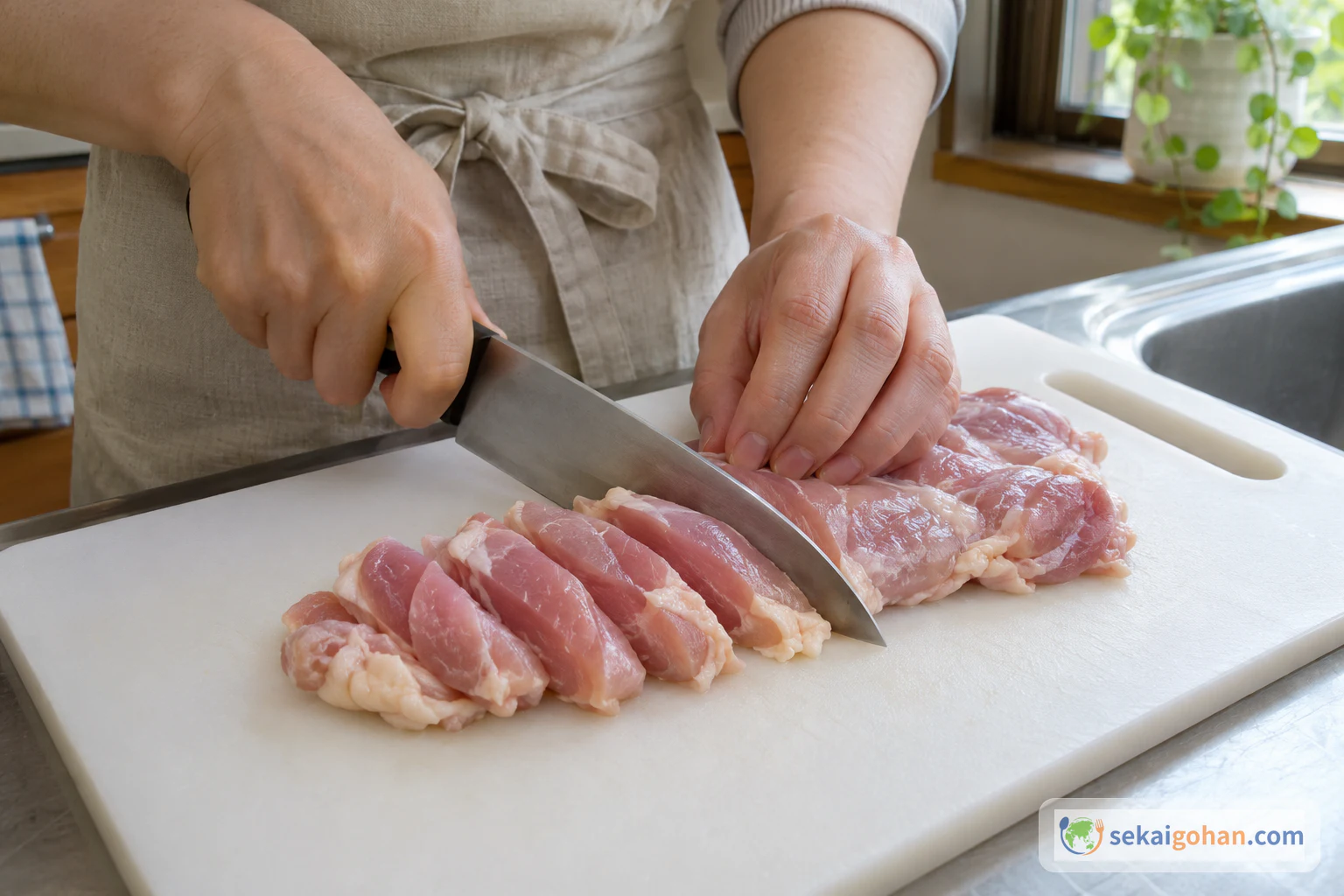
Slice the boneless chicken

Slicing raw boneless chicken thigh on an angle, about 1cm thick
Use a board kept for raw meat

Don't wash the chicken. On a board kept for raw meat, slice the boneless thigh on an angle, about 0.5 inches (1cm) thick. Wash your hands, and keep the raw chicken and its tools away from other food. The slices should be even, about 0.5 inches (1cm) thick.

STEP33 / 14

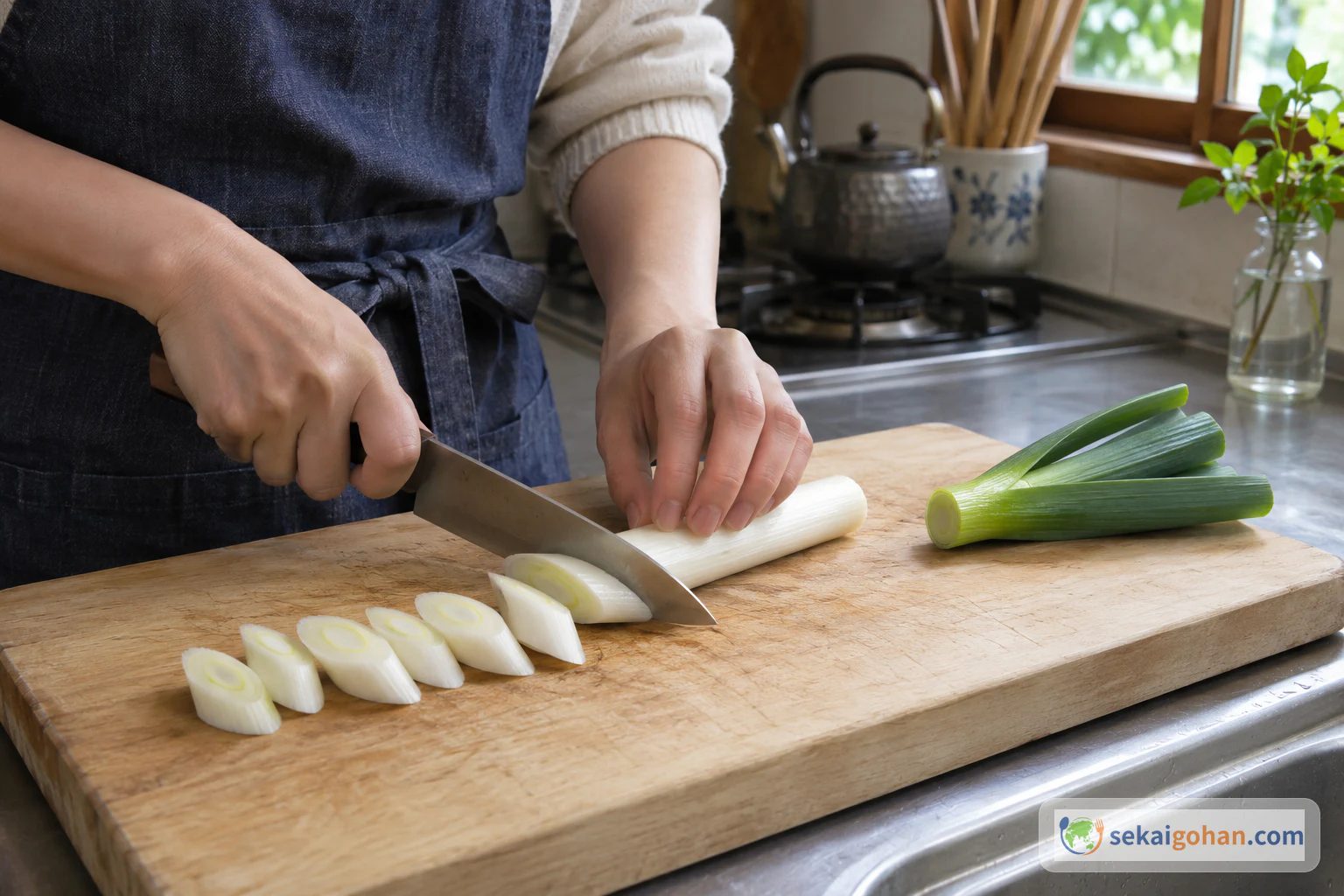
Cut the leek and seri

Slicing the white part of the leek on the diagonal, about 1cm wide
The green top stays whole

Cut the leek into the green top and the white part. Slice the white part on the diagonal, about 0.5 inches (1cm) wide, and leave the green top whole for the stock. Separate the seri into roots and leafy stems, then cut the leafy stems into 1.5 inches (4cm) lengths. Leave the roots whole and apart from the leaves, since they go in at different times.

STEP44 / 14

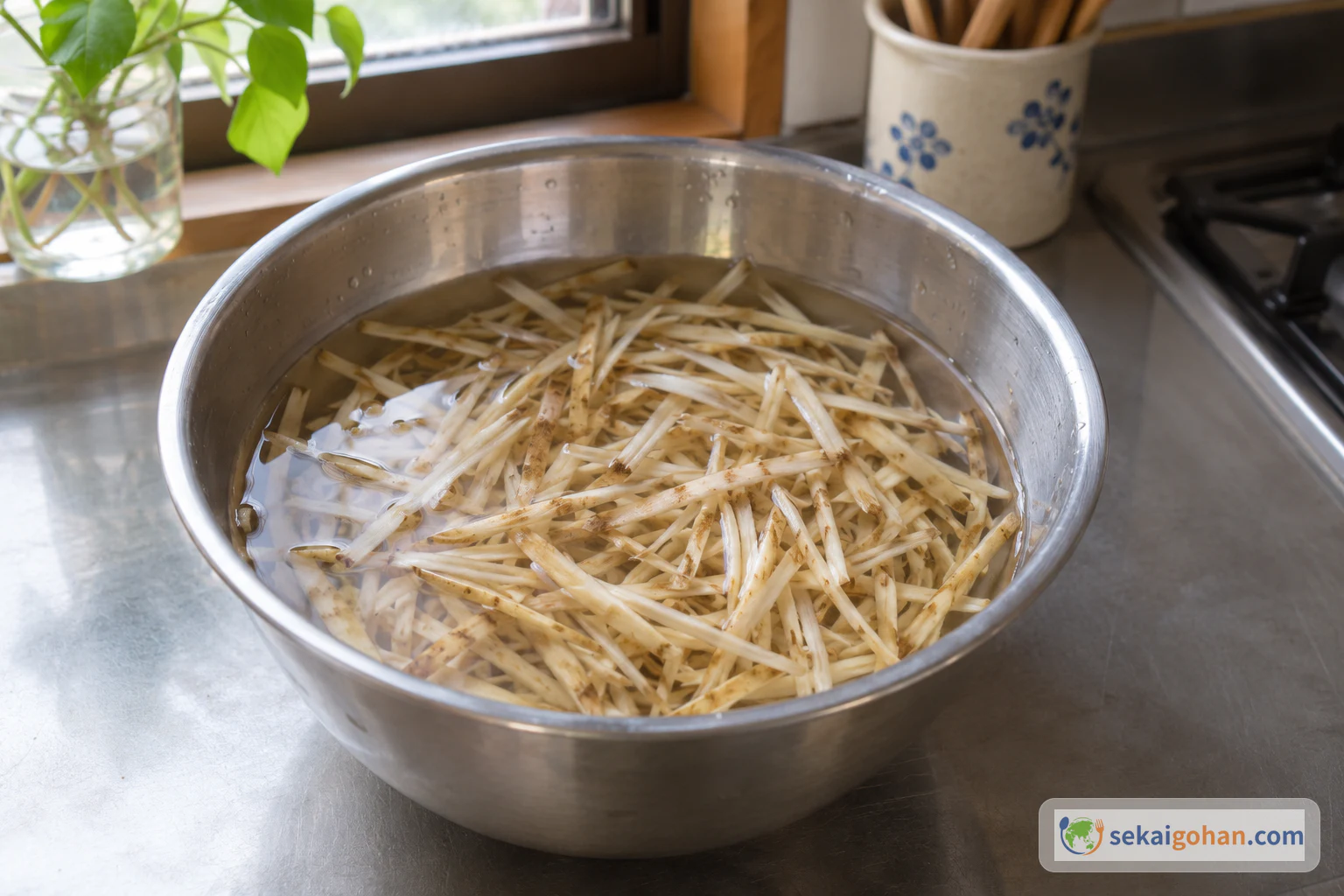
Shave, soak and drain the burdock

Shaved burdock soaking in a bowl of water
A plain water soak

Shave the burdock into thin, irregular strips. Soak the shaved burdock in plain water for 5 minutes. Drain it well before it goes in the pot, until no water drips.

STEP55 / 14

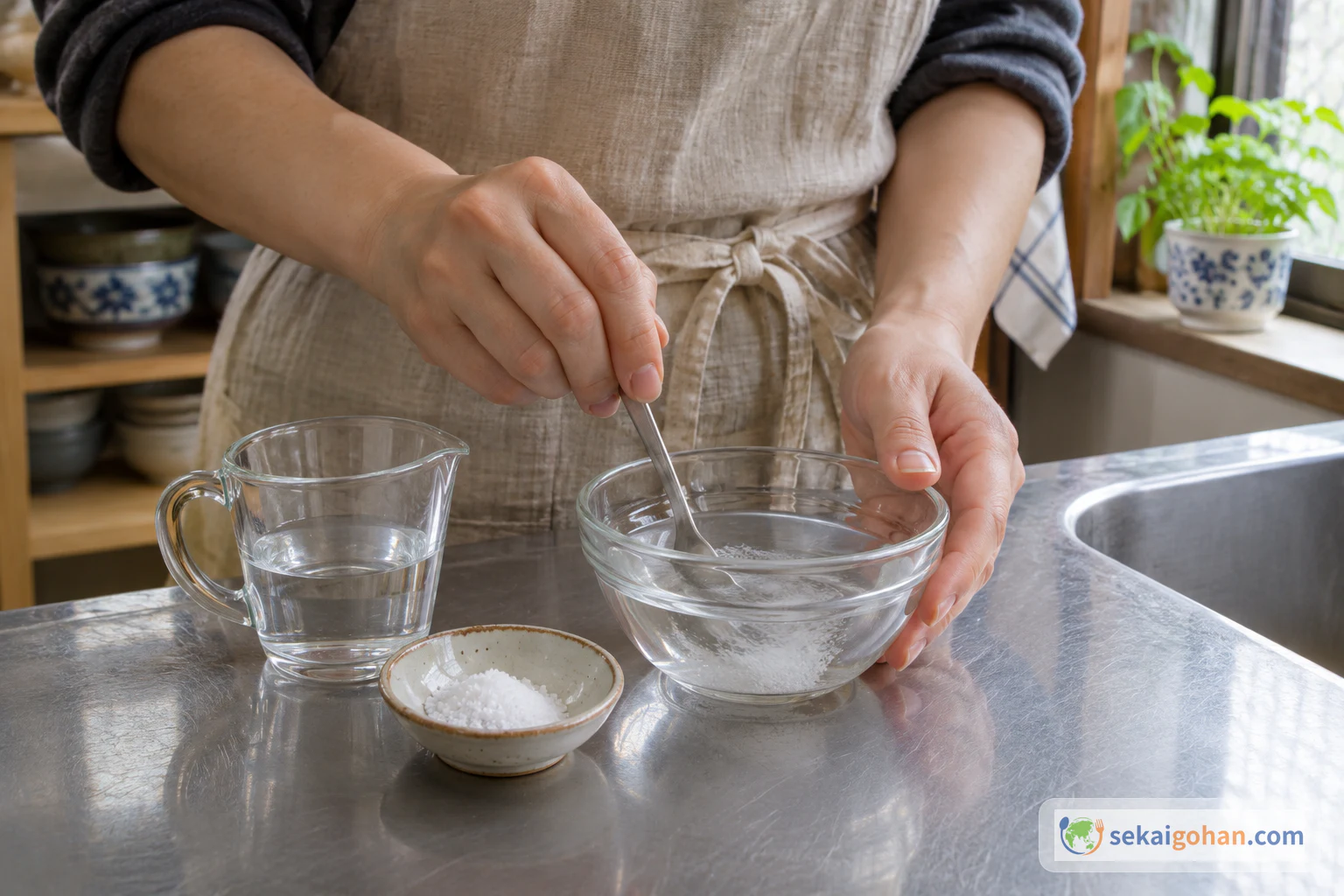
Prepare the maitake and the saltwater

Stirring water and salt together in a small bowl
Saltwater ready for shaping

Cut off the tough base of the maitake, trimming the base only, then tear the maitake into bite-size pieces. Pour the 1/2 cup of A water into a small bowl, away from the stock ingredients, and add the 2 tsp of A salt. Stir until mixed, then set aside until you shape the rice. This saltwater is for shaping only and never goes in the pot.

STEP66 / 14

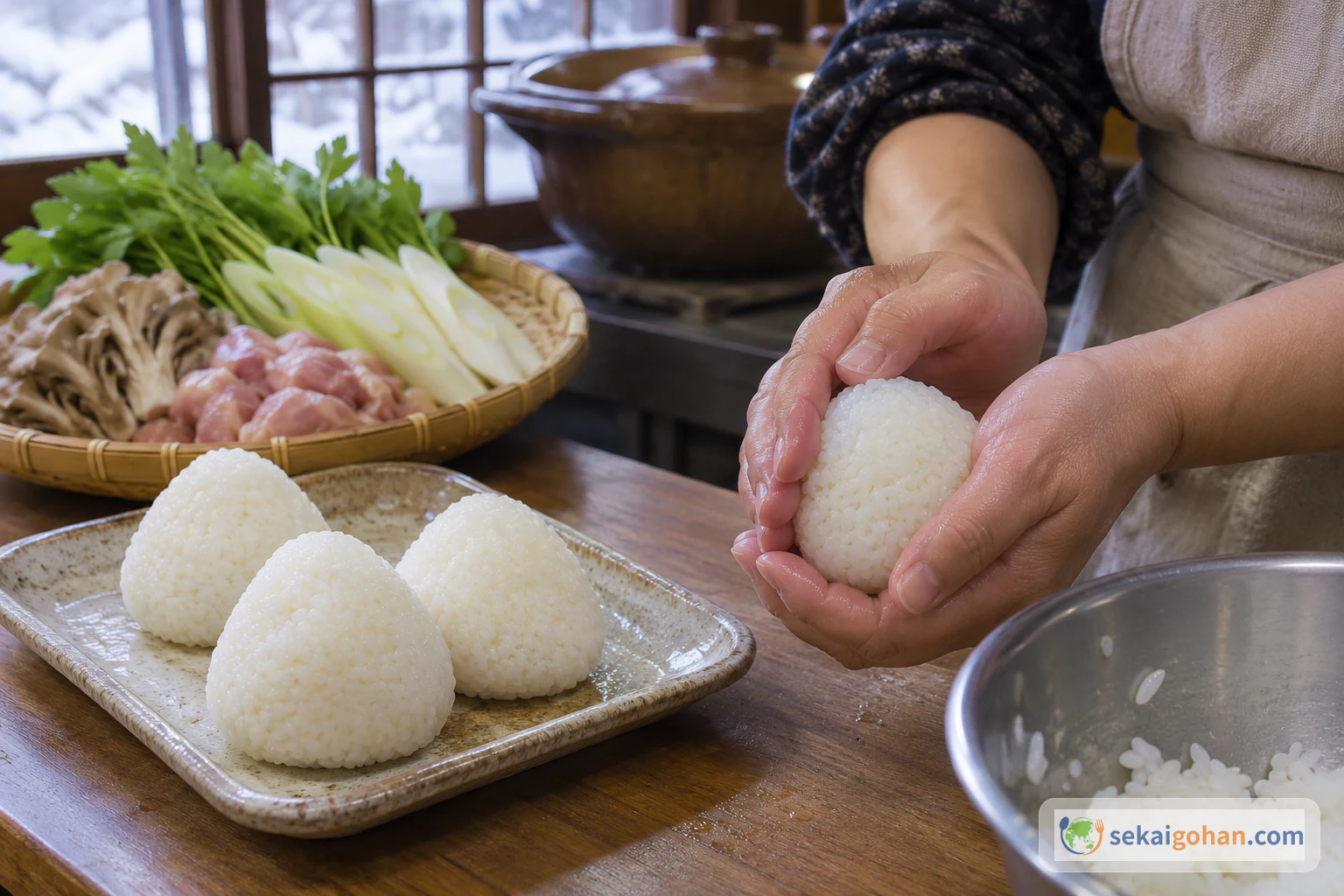
Mash and shape the rice

Shaping the four rice portions into firm balls
Firm balls, with no filling

Put the 14 oz (400g) of freshly cooked rice into a clean mortar. Mash with the pestle until about 30 percent of the grains remain. Divide the mashed rice into 4 equal portions and press each firmly into a ball, like an onigiri, with no filling. You should end up with four firm balls.

STEP77 / 14

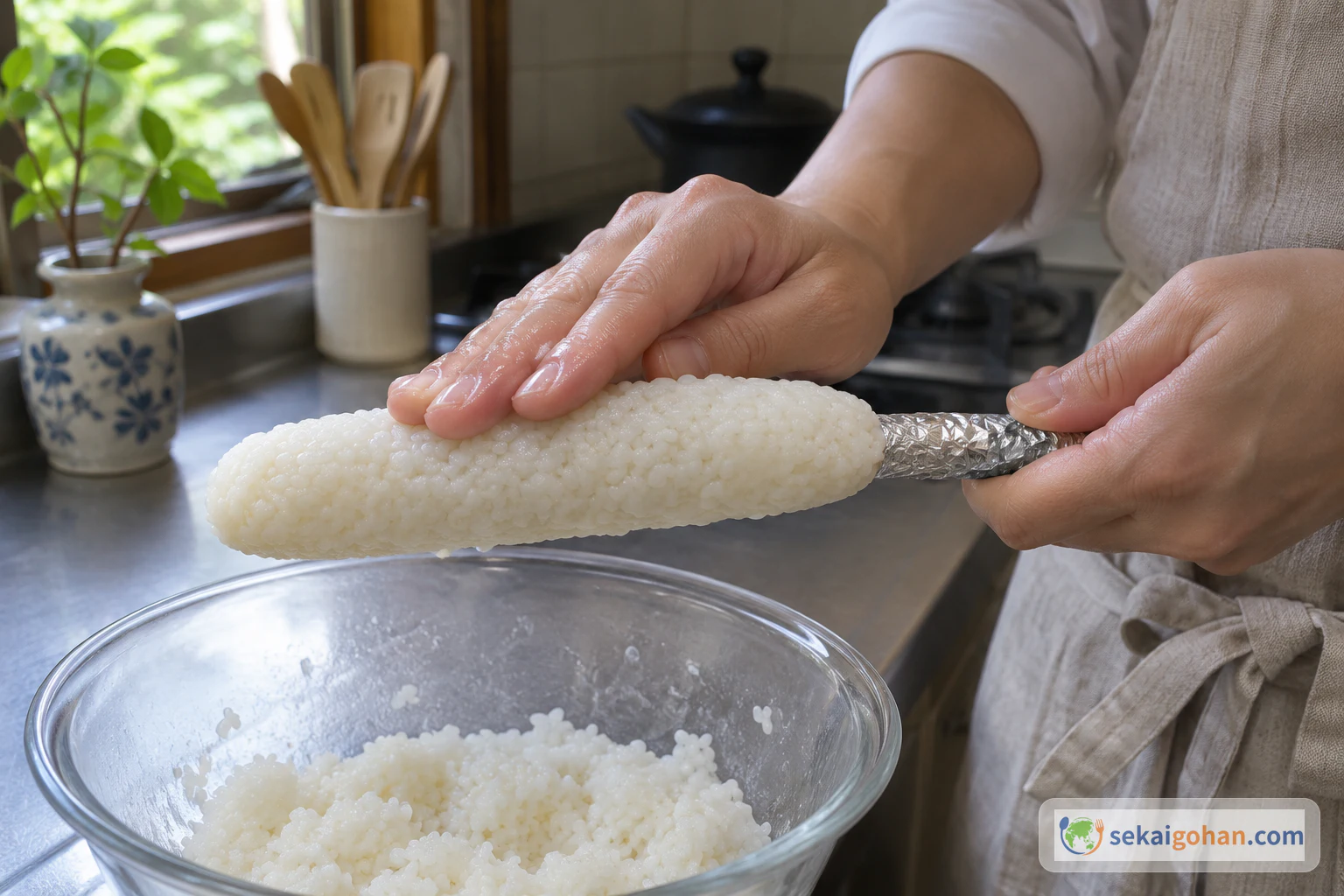
Form the kiritanpo on chopsticks

Pressing and rotating rice along the chopsticks until the wood is fully covered
No bare wood showing

Stack 2 chopsticks together and wrap about one-third of their length in foil to hold them and form a handle. Make 4 sets. Press a rice ball onto the tip of a chopstick set, then press and rotate the rice, stretching it into a cylinder until all the bare wood is covered and only the foil handle shows. Roll the cylinder on a clean cutting board to even its shape, then coat the surface lightly with the saltwater, a thin coat only. Repeat for all four.

STEP88 / 14

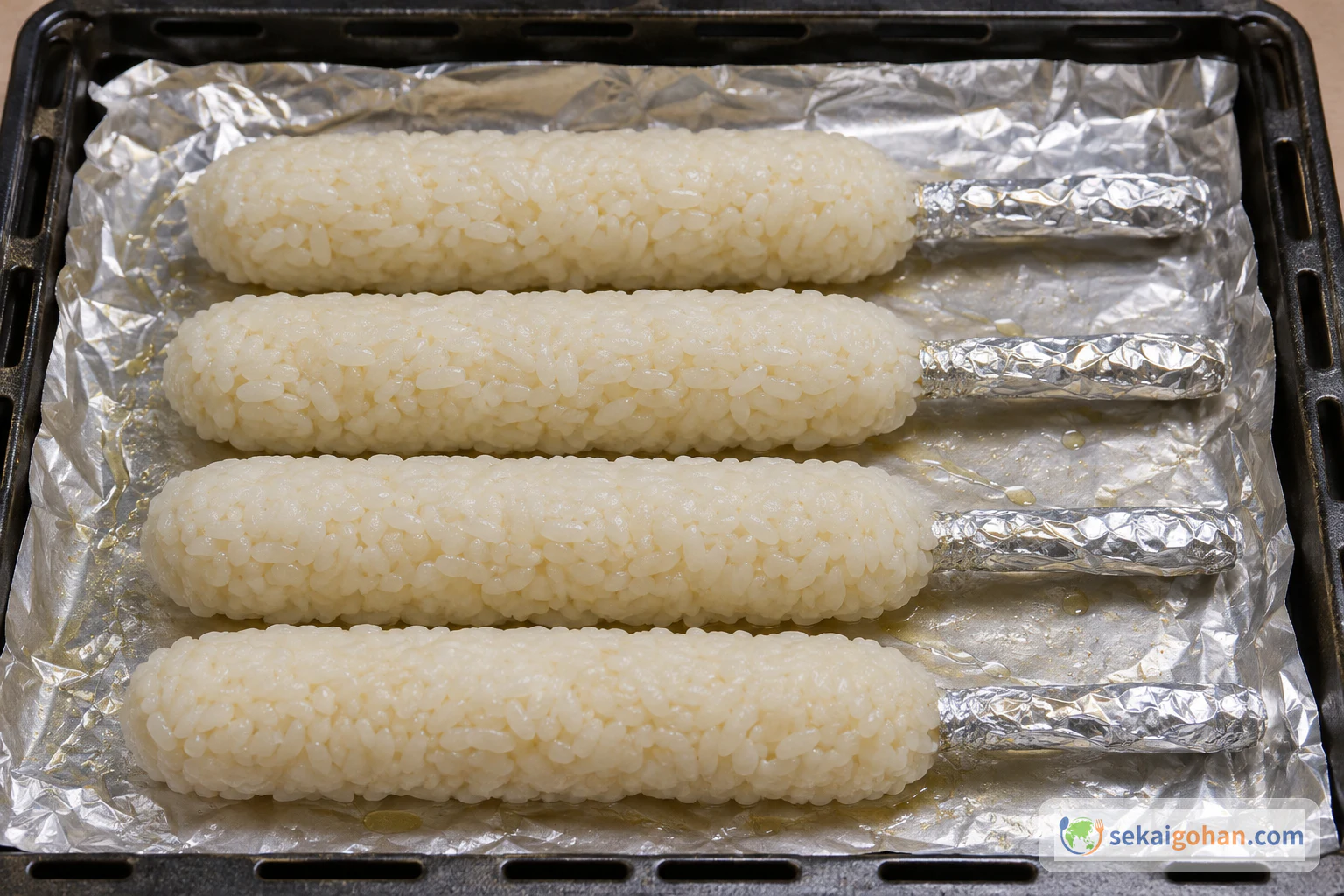
Set the kiritanpo on oiled foil

Four shaped cylinders with foil handles arranged on oiled foil
All four keep their handles

Brush a thin layer of salad oil onto a sheet of aluminum foil. This oil is for the foil only. Place the oiled foil in your fish grill only where the grill's manual allows it. If the manual doesn't allow foil, or you can't tell, don't do the grilling step. Don't guess at a position, and don't line the drip tray or cover burners or vents on an assumption. Lay the 4 cylinders on the oiled foil, still on their chopsticks.

STEP99 / 14

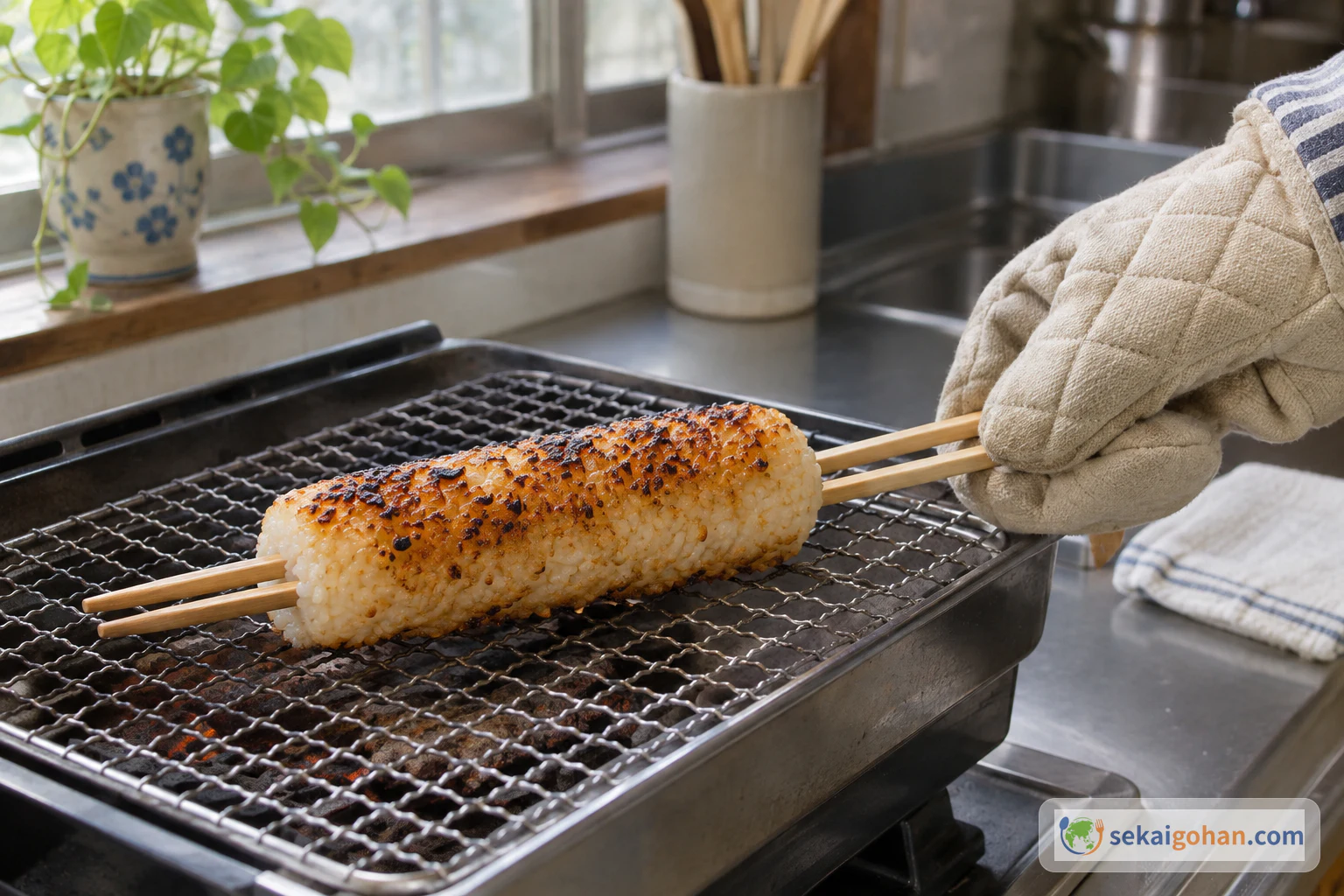
Grill, unmold and cut the kiritanpo

Pulling chopsticks from a hot grilled kiritanpo with an oven mitt
Protect your hands from the hot handle

Grill on high for 5 minutes. While the kiritanpo are hot, pull out the chopsticks using an oven mitt or long cooking chopsticks. The handles are hot too, so don't use bare hands. Let the kiritanpo cool slightly, then cut each diagonally into 3 equal pieces.

STEP1010 / 14

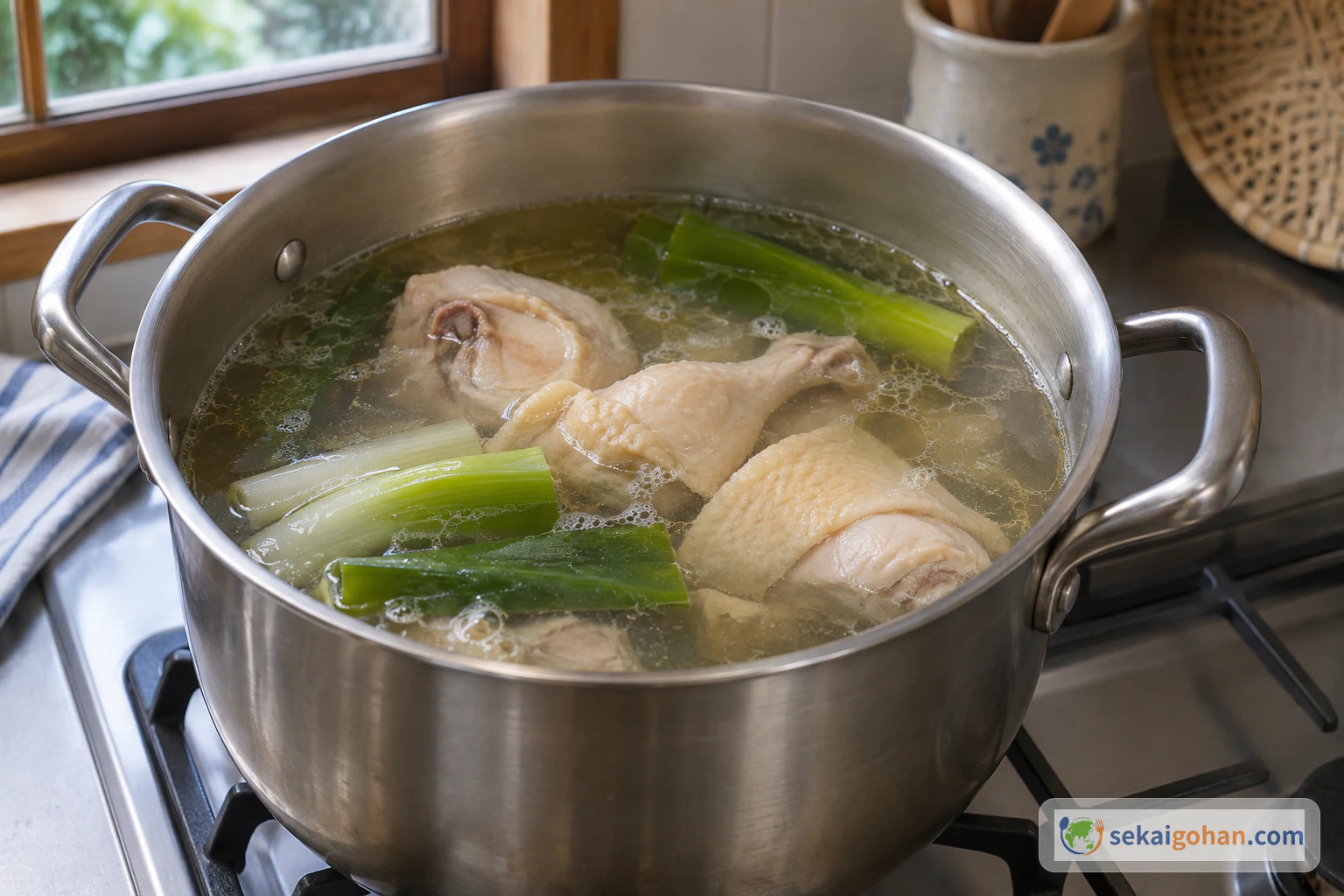
Simmer the bone-in chicken stock

Bone-in chicken and green leek simmering gently in the stock
About 1 hour on low

Pour the 6 cups of B water into the pot and add the 1/4 cup of B sake. Add the 7 oz (200g) of bone-in chicken, wash your hands, then add the green top of the leek whole. Bring to a boil over high heat and skim off the foam. Turn the heat down to low and simmer for about 1 hour, until the chicken and leek are simmering gently in the stock.

STEP1111 / 14

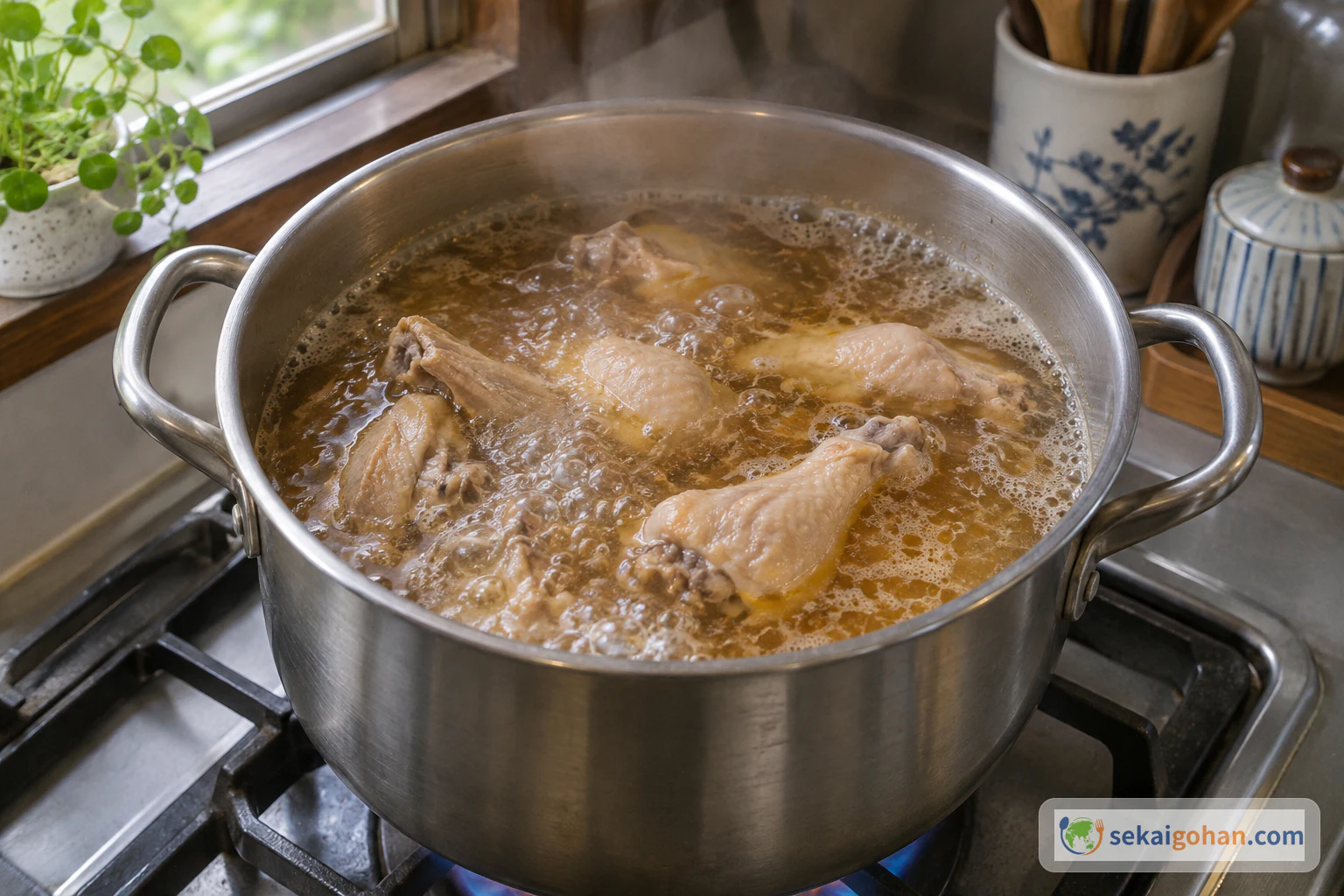
Season the stock

Seasoned stock with bone-in chicken returning to a boil
Wait for the boil before adding more

Lift out the green leek and leave the bone-in chicken in the pot. Add the 1 tbsp of soy sauce, the 1 tbsp of mirin and the 1/4 tsp of C salt, the only salt for the pot. Turn the heat to medium and bring the seasoned stock back to a boil. Wait for the boil before adding more.

STEP1212 / 14

Simmer the chicken, burdock and seri roots

The pot simmering with chicken, burdock and seri roots
A stage still in progress, not ready to eat

Add the sliced boneless chicken to the boiling stock, then wash your hands. Add the drained burdock and the washed seri roots. Simmer for about 5 minutes. The chicken, burdock and seri roots belong to one stage, and the pot is still in progress, not ready to eat.

STEP1313 / 14

Add the kiritanpo, vegetables and seri leaves

Adding seri leaves to the pot as the last ingredient
The leaves go in last

Add the diagonally cut kiritanpo, the sliced white leek and the maitake, which all belong to one stage. Simmer for about 4 minutes. Add the washed seri leaves last, into the bubbling broth.

STEP1414 / 14

Check the chicken and serve

Inserting a clean thermometer into the center of a thick piece of chicken, away from the bone
Check the center of the thickest piece

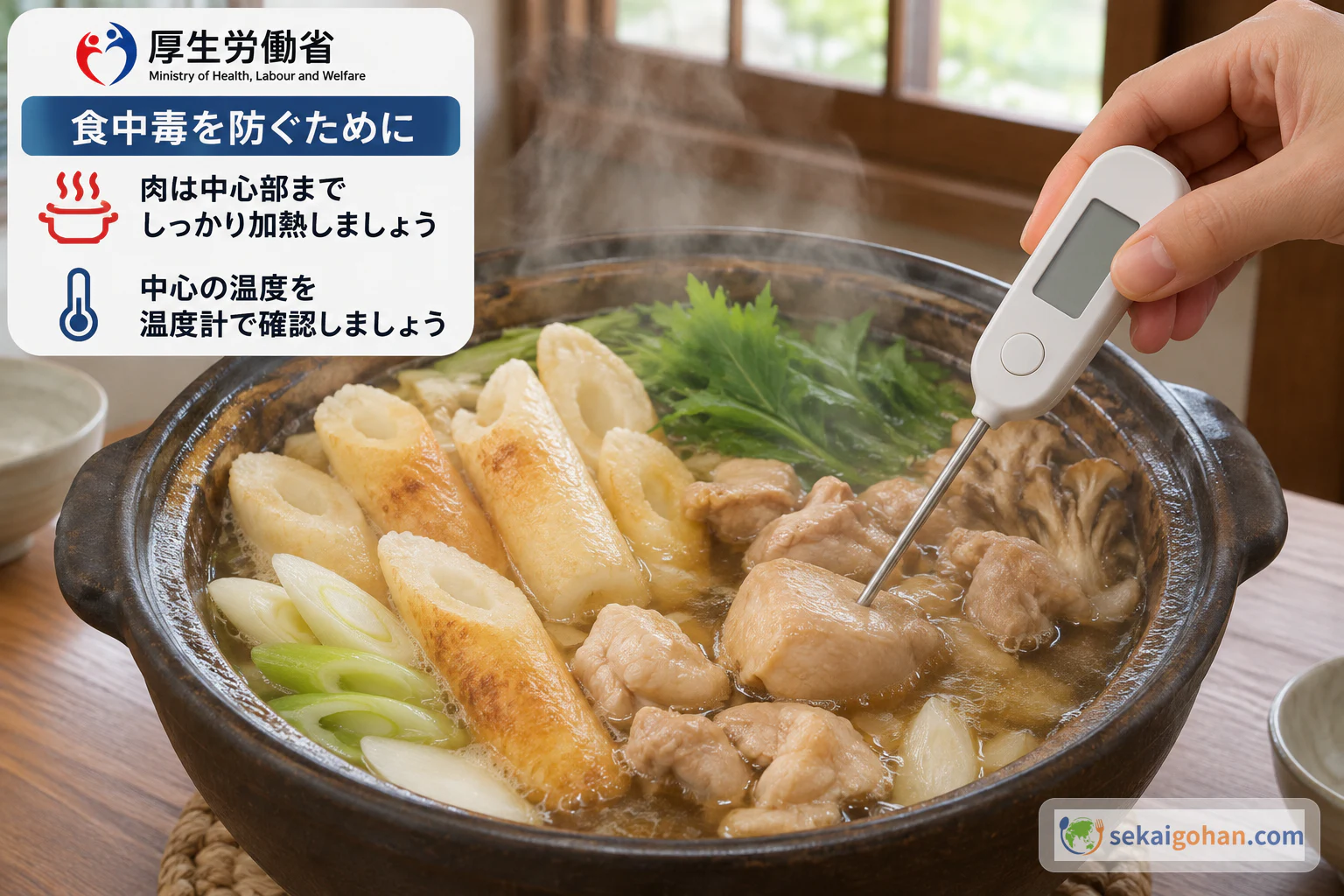
Insert a clean cooking thermometer into the center of the thickest piece of chicken, without touching bone or the pot. The center should be 167°F (75°C) or above for at least 1 minute. If it isn't, keep heating and check again. Don't go by the times or the look of the pot. Ladle into bowls with the chicken, seri and kiritanpo.

0 / 0
Ingredients

Ingredients

1 / 1

Ingredients

Ingredient Amount Role
Freshly cooked rice (ご飯) 400g Mashed and shaped into four kiritanpo
A: Water 1/2 cup Shaping saltwater only; never goes in the pot
A: Salt 2 tsp Shaping saltwater only; never goes in the pot
Salad oil a little Thin coat on the foil only; never goes in the pot
Boneless chicken thigh (鶏もも肉) 1 piece (200g) Sliced and added after the stock is seasoned
Bone-in chicken thigh, chopped (骨つきぶつ切り肉) 200g Simmered in the stock and stays in the pot
Long leek (ねぎ) 1 Green top flavors the stock and is removed; white part goes in near the end
Seri, Japanese parsley (せり) 1 bunch (50g) Roots simmer with the chicken; leaves go in last
Burdock (ごぼう) 1/2 root (70g) Shaved, soaked and drained
Water for soaking the burdock as needed Preparation only
Maitake (まいたけ) 1 pack (100g) Torn into bite-size pieces
B: Sake 1/4 cup Stock liquid
B: Water 6 cups Stock liquid
C: Soy sauce 1 tbsp Seasons the stock
C: Mirin 1 tbsp Seasons the stock
C: Salt 1/4 tsp Seasons the stock
0 / 0

Freshly cooked rice is mashed until only about 30 percent of the grains remain, then pressed around paired wooden chopsticks into four cylinders. They're grilled, slipped off the chopsticks while still hot, and cut on the diagonal. Those pieces go into a pot of stock built from sake, water, bone-in chicken and green leek, joined by boneless chicken, burdock, white leek, maitake and, at the very end, seri. This is kiritanpo nabe, a hot pot from Akita Prefecture in northern Japan.

Kiritanpo Nabe in Akita

Kiritanpo nabe is listed as a regional dish of Akita Prefecture, handed down mainly in Odate and Kazuno. There, as here, the seri goes in last.

Other regional versions of the nabe build the stock from chicken carcass and balance the ingredients differently, with items such as Hinai chicken and shirataki-style konjac noodles. Kiritanpo doesn't have to go in a pot at all: for sweet miso-grilled kiritanpo, the shaped rice is spread with sweet miso and grilled. Each of these has its own amounts and method, so make them from their own recipes rather than mixing them into this one.

For more from the same country, see Japanese dishes on Sekai Gohan.

Food Safety for Kiritanpo Nabe

Read this before you shape the rice

The kiritanpo are grilled on oiled foil in a fish grill. Do this only if your grill's manual allows foil and the way you plan to place it. If the manual doesn't allow it, or you can't tell, don't do the grilling step.

The times in the method tell you when to move to the next stage. They don't tell you the chicken is cooked, and neither do the photos.

Chicken. Heat meat until the center reaches 167°F (75°C) or above for at least 1 minute. Keep tools and containers for raw meat separate, wash your hands after handling meat, and wash and sanitize your tools. Don't wash raw chicken. Step 14 shows where to take the temperature.

Produce. Wash fresh produce well under running water, without soap, detergent or commercial produce wash. If a board or tool has touched raw meat, wash it with soap and hot water before using it on produce, or use a separate board if you can. Wash your hands for at least 20 seconds. Washing reduces bacteria but doesn't remove them all.

Foil. The method grills the rice on foil in a fish grill, and there's no alternative given. Use foil only if your own grill's manual allows it; permission for another brand or model doesn't carry over to yours. If yours doesn't allow it, skip the grilling step.

Ingredients (2–3 Servings)
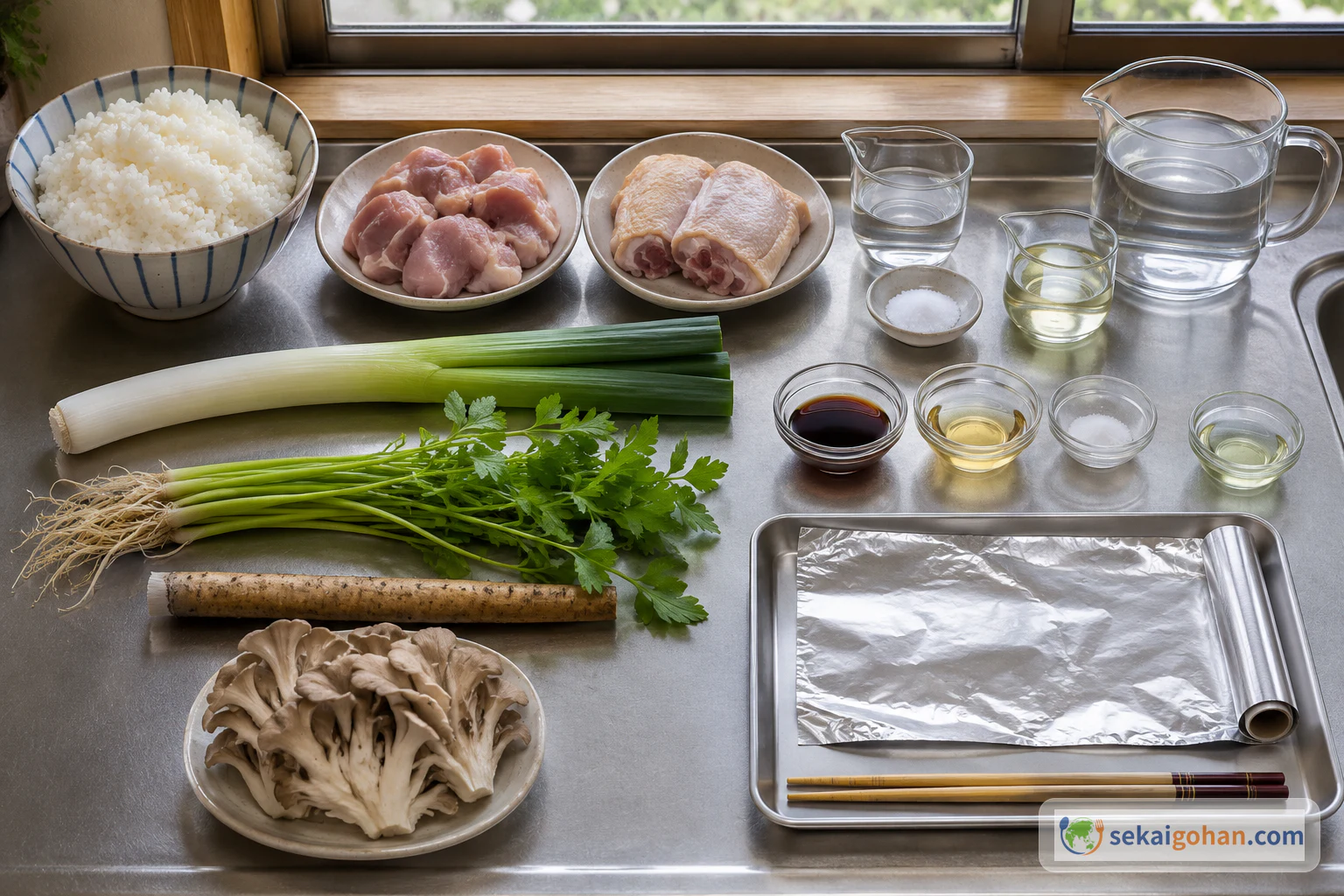
The rice, boneless and bone-in chicken, leek, seri, burdock and maitake laid out with the seasonings
Everything for the rice cylinders and the pot

The letters A, B and C mark three separate groups. A is for shaping the rice, B makes the stock, and C seasons it.

Equipment

  • Separate cutting boards and knives for raw chicken and for other foods, if you have them
  • Mortar and pestle
  • Small bowls and a colander
  • Measuring cup and measuring spoons
  • 4 pairs of disposable wooden chopsticks
  • Aluminum foil
  • Brush for the oil and saltwater (fingertips also work for the saltwater)
  • Fish grill, if its manual allows the foil use described here
  • Oven mitt or long cooking chopsticks
  • Large pot, skimmer or ladle, and tongs
  • Clean cooking thermometer

Choosing Seri, Chicken and Cups for Kiritanpo Nabe

Seri: Buy seri sold as food. Don't eat any wild plant you haven't identified.

Chicken: The two cuts do different jobs. The bone-in pieces simmer in the stock for about 1 hour, while the boneless slices go in much later. Use one cut for both and you'll end up with a different pot.

Cups: Measure the A and B liquids with the same cup.

Additions: Stick to what's in the table. Extra stock or a spoonful of miso changes the pot.

Method: Prepare, Shape, Grill, Then Build the Pot

Each step is one action, so the list is long but each step is short. Steps 10–13 each split one stage into separate additions.

Kiritanpo Nabe Troubleshooting

What you notice What to do
Bare wood shows between the rice and the foil handle Before rolling, press and rotate the rice again until the wood is covered
You rolled the cylinder after adding saltwater, or lost track of the order For the next cylinder, roll on the board first and add saltwater after
Your grill's manual doesn't mention foil Treat it as unclear and don't do the grilling step
The handles are still hot when you pull the chopsticks Keep using a mitt or cooking chopsticks, not bare hands
Saltwater is left over Keep it out of the pot; it is for shaping only
Soil is still clinging to the seri roots Soak in water for a few minutes, loosen, and rinse again under running water
A board or tool touched raw chicken and you need it for produce Wash it with soap and hot water first, or switch to a separate board
The thermometer touched bone or the pot Reposition it in the center of the thickest meat and read it again
The chicken is below 167°F (75°C), or you aren't sure Keep heating and check again; don't go by the color or the clock

Frequently Asked Questions

How long should the seri leaves cook?

Wash the leaves under running water first, then add them last, into the bubbling broth, with no extra cooking time.

Does the order inside each group of additions matter?

No. The stock ingredients, the C seasonings, the chicken with burdock and seri roots, and the kiritanpo with white leek and maitake each go in as a group. The steps split each group up only to show each action.

Why are the amounts in cups, with no milliliters?

The recipe gives 1/2 cup, 1/4 cup and 6 cups without stating a cup size, so there's no milliliter conversion. Just use the same cup throughout.

Do I need Hinai chicken?

No. Hinai chicken belongs to the regional nabe version, not this one.
Sources