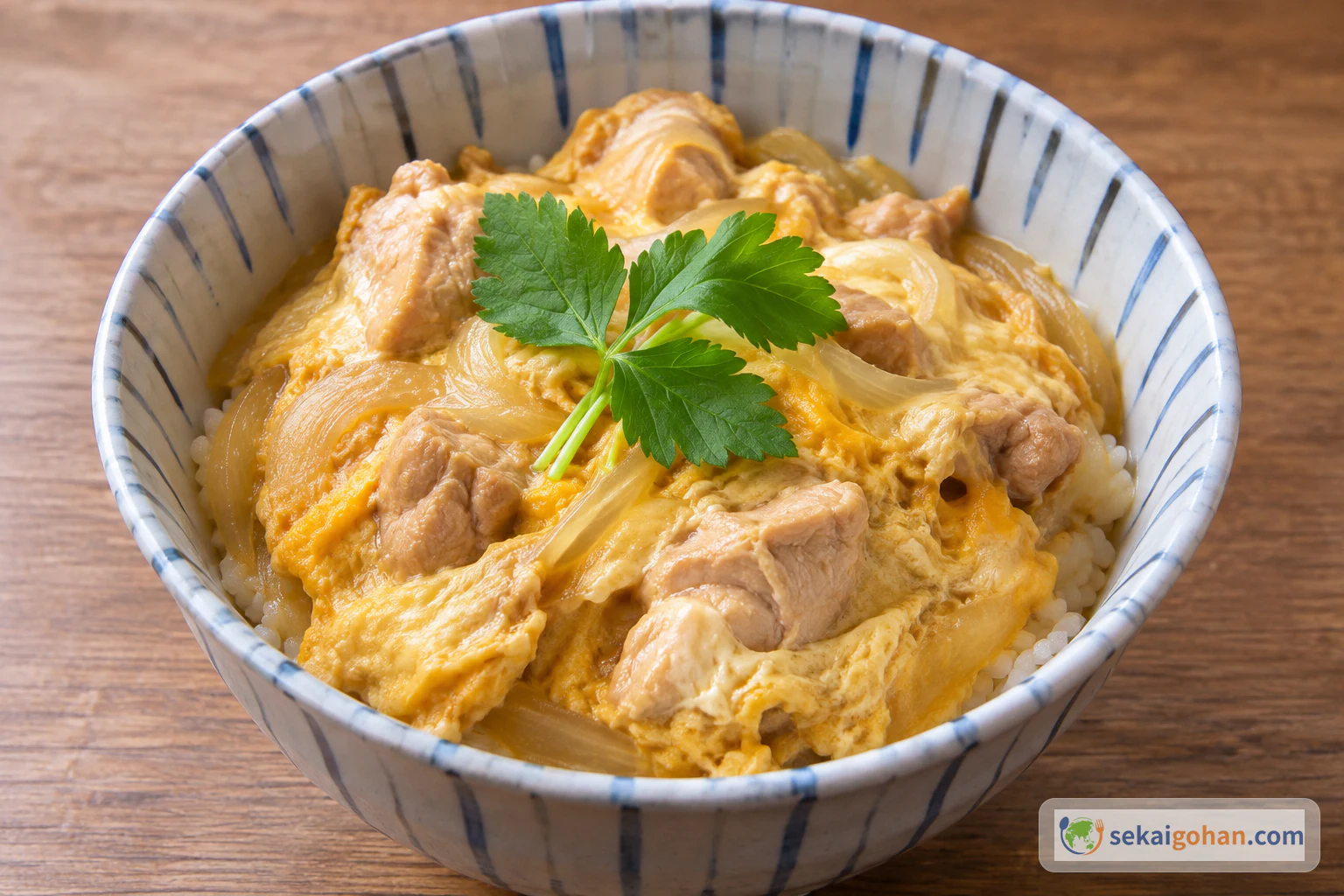
Oyako-donburi: Japanese Chicken and Egg Rice Bowl (親子丼), Fully Cooked

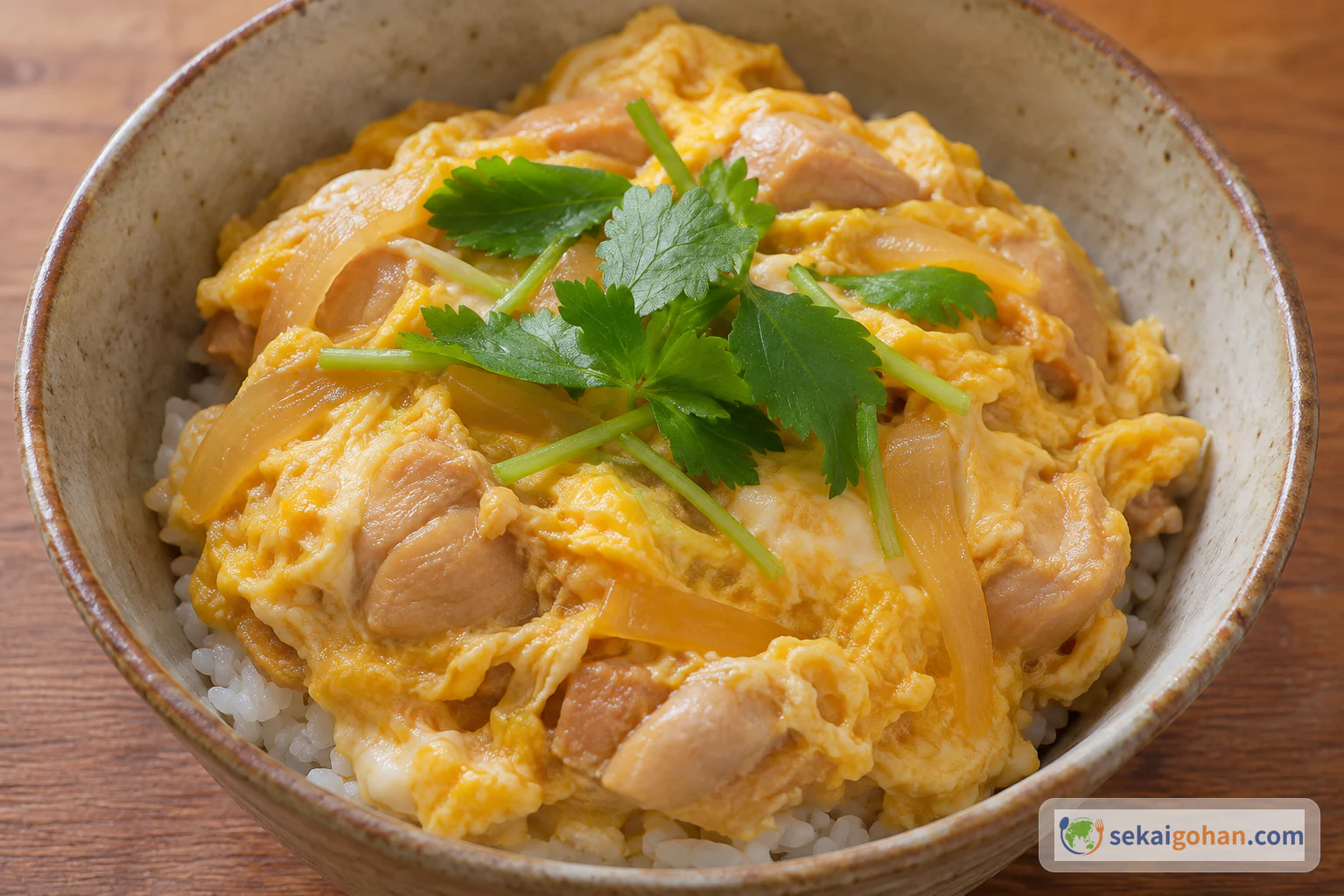
Oyako-donburi topped with fully cooked egg and chicken
Serves
2 servings
Cuisine
Japanese (Tokyo home cooking)

How to make oyako-donburi (親子丼), the Japanese rice bowl of chicken and egg, for 2 servings. Based on a home recipe published by Japan's agriculture ministry, this version checks the chicken with a thermometer and fully sets the egg, and it explains the origin story the ministry presents.

Cooking flow

Cooking steps

STEP11 / 6

Cut and season the chicken

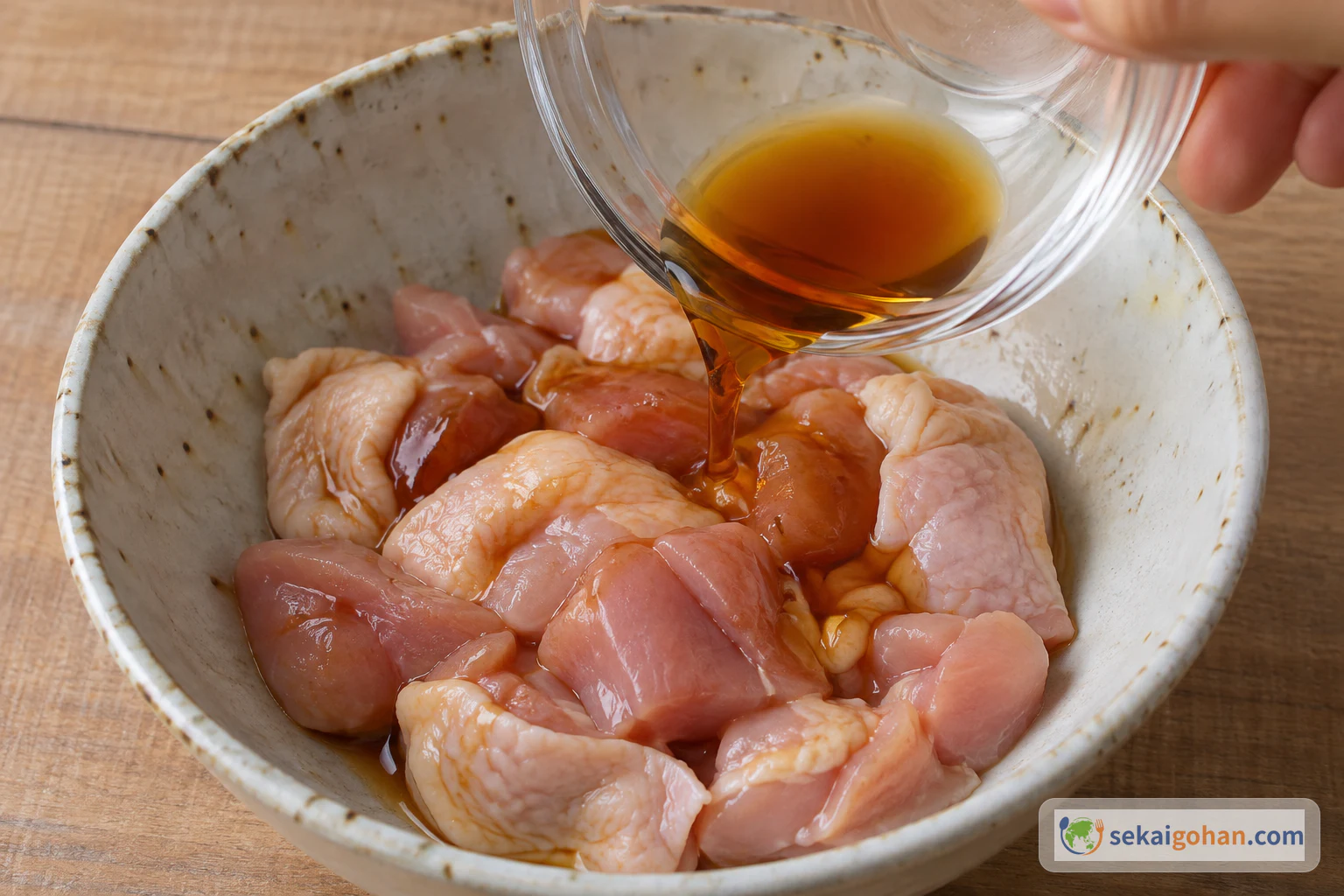
Seasoning being coated over the chicken
Only the small chicken portion of soy sauce and sake goes on here

Slice the 5.5 oz (150g) chicken thigh at an angle into bite-size pieces on the board you're using for raw chicken. Larger pieces won't cook through evenly. Wash your hands, the board and the knife afterward. Put the chicken in a bowl and coat it with 1/2 tsp soy sauce and 1/2 tsp sake until every piece is lightly coated, then wash your hands again after touching the raw chicken.

STEP22 / 6

Prepare the onion and mitsuba

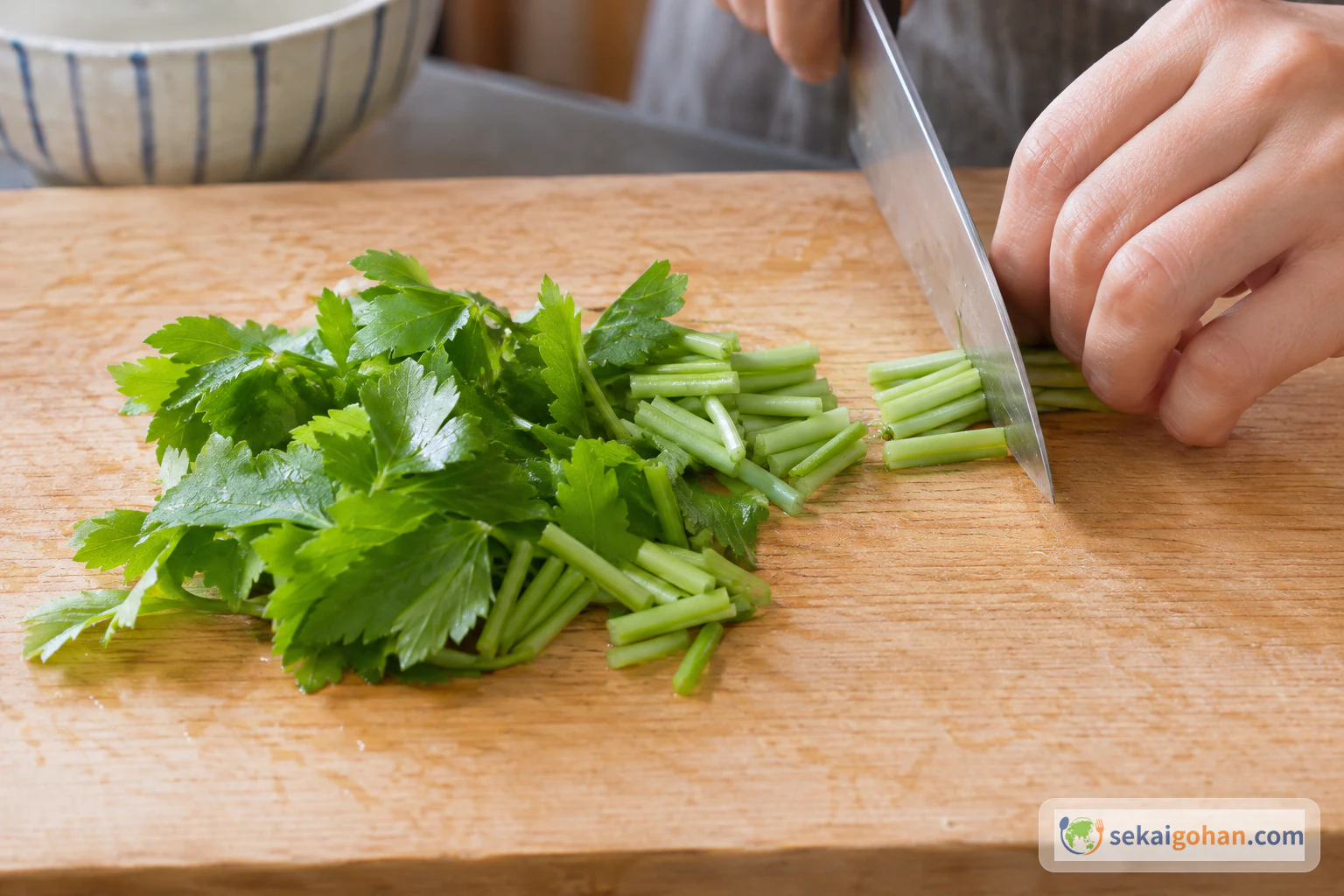
Mitsuba being cut to 2cm lengths
Wash the mitsuba before cutting it, and keep it away from raw chicken

Cut the onion in half lengthwise, then slice 1/2 onion (3.5 oz / 100g) thinly on a clean board. Wash the 4–5 stems of mitsuba well under running water, then cut them to 1 inches (2cm). Use a board and knife kept apart from raw chicken, or wash them thoroughly first if they touched it. Set the mitsuba aside for the finish.

STEP33 / 6

Boil the liquid and add the chicken and onion

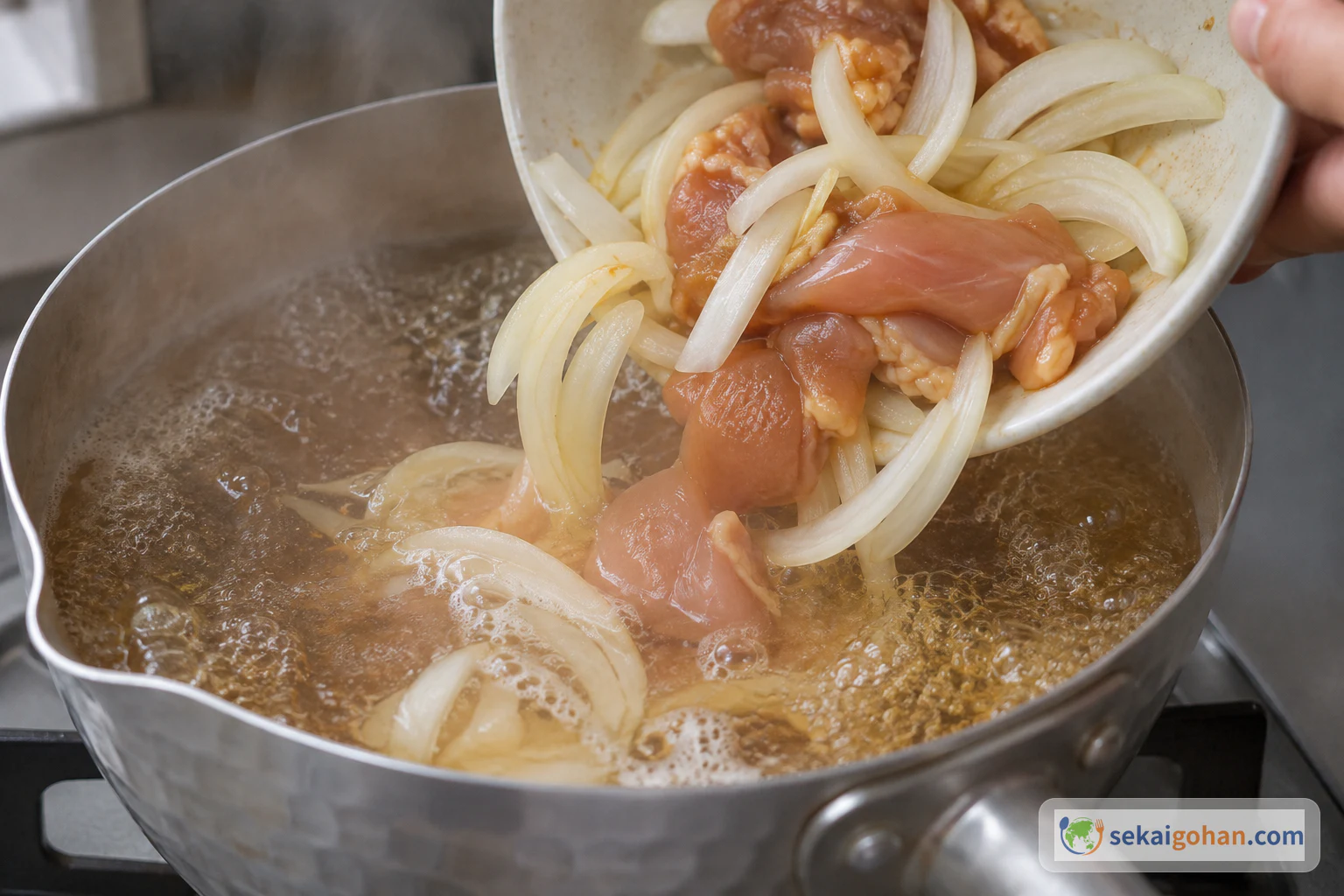
Onion and seasoned chicken being added together to the boiling liquid
Onion and chicken go in together

Put ½ cup (100ml) dashi, 1 tbsp soy sauce, 1/2 tbsp sugar and 1/2 tbsp mirin in the pot and stir. Set the pot over medium heat and bring the liquid to a boil. Once it is boiling, add the sliced onion and seasoned chicken at the same time, without cooking the onion first. Put the lid on the pot, then wash your hands and wash the bowl that held the raw chicken before using it again.

STEP44 / 6

Simmer and check the chicken

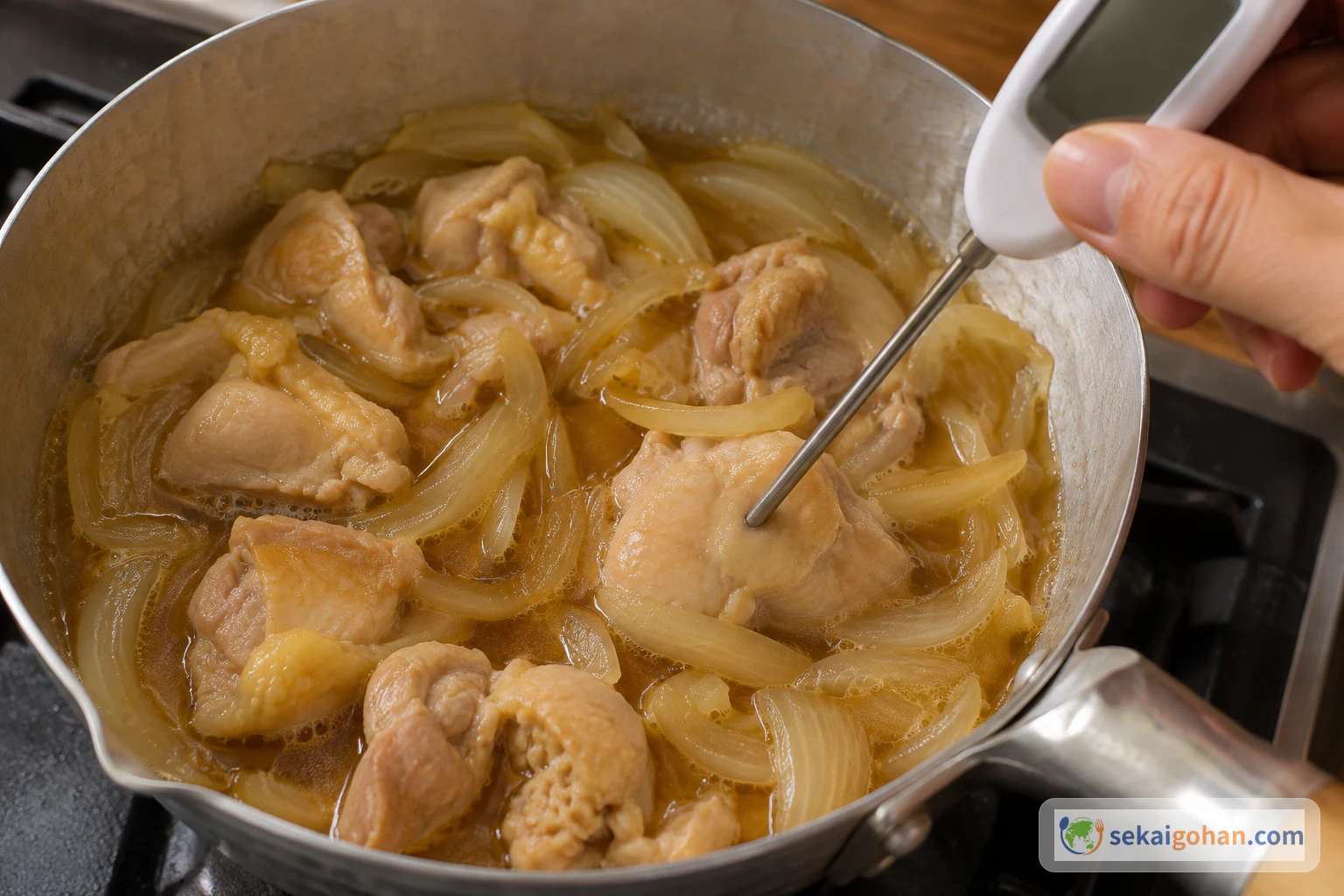
A thermometer checking the center of a thick piece of chicken
Measure the thickest piece and rely on your own reading

Simmer the chicken and onion, covered, for 2–3 minutes. That time alone doesn't confirm the chicken is cooked, so insert a clean thermometer probe into the center of the thickest piece. It should stay at 167°F (75°C) for at least 1 minute. If it falls short, cover the pot, keep cooking and measure again, cleaning the probe before each new reading. Move on to the eggs only after this check.

STEP55 / 6

Cook the eggs until fully set

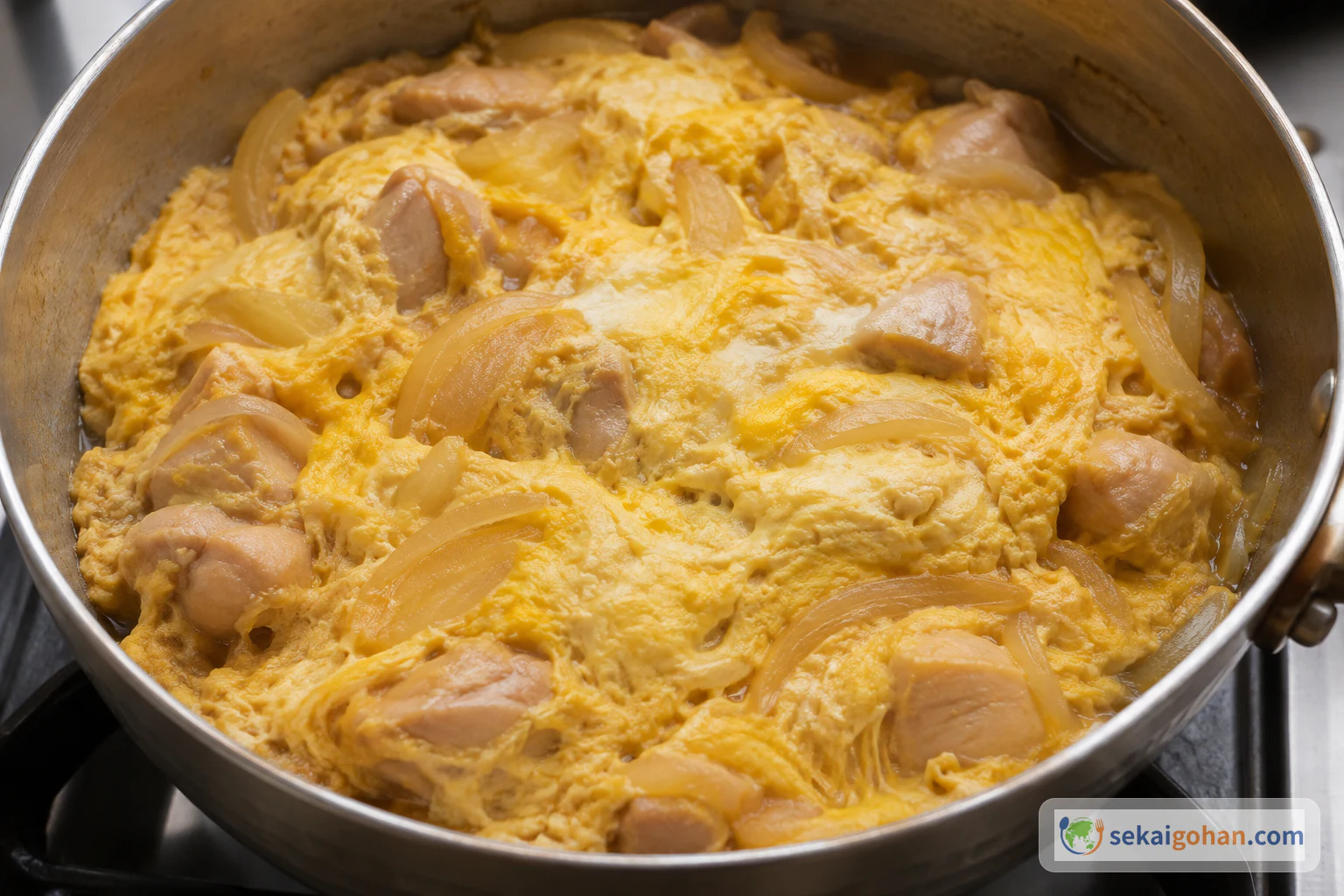
Fully cooked egg set over the chicken and onion
Opaque egg with no liquid left, and no mitsuba yet

Crack the 2 eggs into a clean bowl, beat them lightly, then wash your hands after handling the raw eggs. Pour the beaten egg into the pot in a circle, starting at the center and moving outward. Keep cooking until the whole egg is set and no liquid egg remains. Don't stop when only the edges have set, and don't let a set appearance replace the chicken check.

STEP66 / 6

Finish with the mitsuba and serve over rice

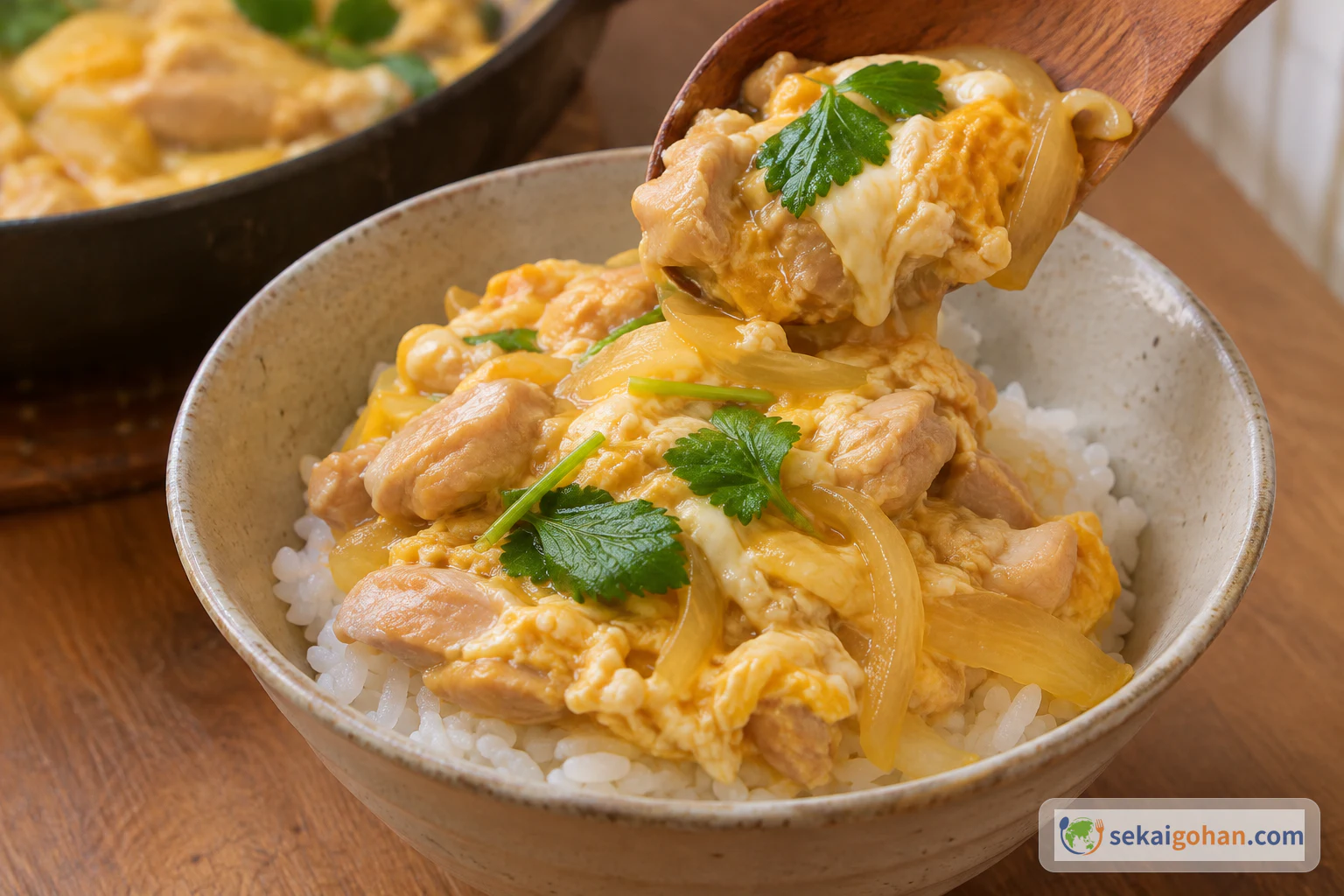
Oyako-donburi topping being spooned over rice
Use a clean spoon that hasn't touched raw chicken

Once the egg is fully set, turn off the heat. Scatter the washed, cut mitsuba over the cooked chicken, onion and egg, so it goes on fresh as a finishing herb. Divide the 2 servings of cooked rice between 2 bowls. Using a clean spoon, divide the topping and its liquid between the bowls.

0 / 0
Ingredients

Ingredients

1 / 1

Ingredients

Ingredient Amount Role
Boneless chicken thigh (鶏もも肉) 5.5 oz (150g) The "parent"; cut into bite-size angled slices
Soy sauce, for the chicken (しょうゆ) 1/2 tsp Seasons the chicken before cooking
Sake, for the chicken (酒) 1/2 tsp Seasons the chicken before cooking
Onion (玉ねぎ) 1/2 (3.5 oz / 100g) Halved lengthwise, then thinly sliced
Eggs (卵) 2 The "child"; lightly beaten
Mitsuba (三つ葉) 4–5 stems Fresh finishing herb; washed well under running water, then cut to 1 inches (2cm)
Dashi (だし) ½ cup (100ml) Base of the simmering liquid
Soy sauce, for the simmering liquid (しょうゆ) 1 tbsp Seasons the simmering liquid
Sugar (砂糖) 1/2 tbsp Seasons the simmering liquid
Mirin (みりん) 1/2 tbsp Seasons the simmering liquid
Cooked rice (ご飯) 2 servings The base of the bowl
0 / 0

Dashi, soy sauce, sugar and mirin come to a boil in a small pot, and sliced onion and seasoned chicken thigh go in together. Beaten egg follows in a circle from the center outward, and then everything slides over white rice, where the simmering liquid soaks in. This is oyako-donburi (親子丼), Japan's chicken and egg rice bowl, named for the "parent" and "child" it brings together. The ingredient list is short, so the order you add things matters. This home version makes 2 servings with onion and mitsuba, and it cooks both the chicken and the egg all the way through.

Oyako-donburi and Its Origins

The dish is traced to Tamahide. Around the 20th year of the Meiji era, chicken and warishita sauce bound with egg were eaten there to finish a chicken sukiyaki meal, and this was called oyako-ni. In the 24th year of Meiji, Toku, the wife of the fifth-generation head, put it over rice and made it a dish of its own. That is where oyako-donburi began.

Today it's a home dish as much as a restaurant one, and no single standard exists. Households differ in whether they use onion or Japanese long onion, and in how firm they make the egg. If you'd like to keep reading about the country's food, see more dishes from Japan.

Cooking the Chicken and Egg Through

What this bowl should keep

Season the chicken separately, bring the simmering liquid to a boil before anything goes in, and add the onion and chicken together. Confirm the chicken with a thermometer, cook the egg until no liquid remains, and finish with fresh mitsuba.

The ingredients, amounts and order stay the same as the usual method. What changes is the doneness: the chicken is checked with a thermometer, and the egg cooks until no liquid remains.

Stage Standard method This recipe
Chicken Simmer covered for 2–3 minutes, until cooked through Start with 2–3 minutes, then measure the center of the thickest piece: 167°F (75°C) for at least 1 minute. If it falls short, keep cooking
Egg Finish half-set: turn off the heat as the edges begin to set Keep cooking until the whole egg is set, with no liquid left
Finish Scatter mitsuba, cover and steam for 30 seconds Turn off the heat, scatter mitsuba and serve over rice. Skip the 30-second rest

The egg will set firmer than the soft, half-set finish many people know, and that's the point here.

Go by your thermometer, not the clock

Heat level, the size of the chicken pieces, the pot and the starting temperature of the food all change how long it takes.

Ingredients (2 Servings)
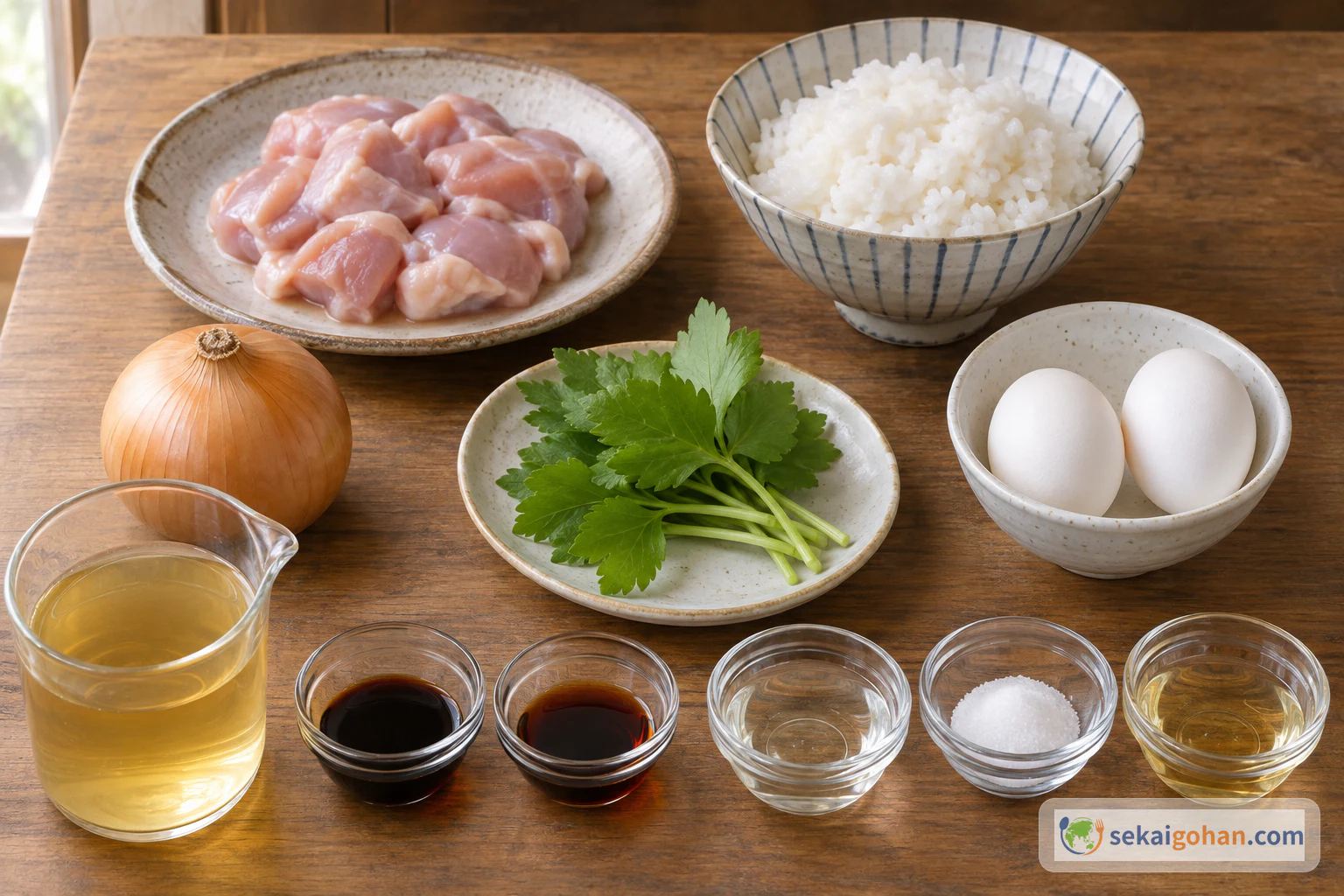
Oyako-donburi ingredients, with the chicken seasoning and simmering-liquid seasoning kept separate
Raw chicken stays on its own plate, away from the cooked rice

Measure the two portions of soy sauce separately. The 1/2 tsp goes on the chicken and the 1 tbsp goes in the pot.

Equipment

  • Small pot with a lid
  • Food thermometer with a probe
  • Cutting board and knife for raw chicken
  • Separate cutting board and knife for the onion and mitsuba, or the same ones washed thoroughly first
  • Bowl for seasoning the chicken
  • Clean bowl for the eggs
  • Clean spoon for serving
  • 2 rice bowls

Choosing Dashi and Chicken

Use the dashi you normally cook with. The chicken has no substitute; the dish is built on it.

Allergies: Labels on soy sauce and dashi products vary, so check the ones you buy.

Method: Season, Boil, Measure, Set

Keeping raw chicken away from everything else

Wash your hands after handling raw chicken or raw egg. Wash any tool that touched raw chicken before using it for other food. If you have to stop partway through cooking, refrigerate the food rather than leaving it at room temperature, and heat it thoroughly when you resume.

Troubleshooting Oyako-donburi

What you notice Possible reason What to do
The chicken is below 167°F (75°C) after 2–3 minutes Heat level, piece size or the pot Keep cooking and measure again. The thermometer takes priority over the time
Some pieces cook faster than others Pieces are large or uneven Keep cooking until the thickest piece passes, and cut bite-size angled slices next time
The seasoning seems off The 1/2 tsp and 1 tbsp portions of soy sauce were mixed up or combined Keep the two measures separate next time
Some egg is still liquid The heat went off too early Turn the heat back on and cook until no liquid remains, before adding the mitsuba if you can
The egg is firmer than you expected This recipe cooks the egg fully That's expected here. Give it the full cooking time
You have to stop partway through Anything that interrupts the cooking Refrigerate the food instead of leaving it out, and heat it thoroughly when you resume

Serving Oyako-donburi

Oyako-donburi with set egg
Fully set egg, chicken and onion over rice, finished with mitsuba

Serve the bowls hot, while the egg is just set and the rice has drunk up the liquid. Cooked food shouldn't sit out at room temperature, so eat it right away.

Some cooks finish oyako-donburi in a one-portion pan, half the mixture at a time. That method uses 150g chicken thigh, 100g onion, 3/4 cup water, 1 1/2 tbsp each of mirin and soy sauce, 1/3 tsp dashi seasoning, 2 eggs and 440g rice. Its balance is different, so keep its amounts separate from the ones above.

Frequently Asked Questions

Can I leave the egg half-set?

Not in this recipe. For food safety at home, cook the egg until no liquid remains.

Why wash the mitsuba if the rest is cooked?

The mitsuba goes on fresh after the heat is off, so it never gets cooked. Wash it under running water, and keep it away from raw-chicken tools.
Sources

  • Ministry of Agriculture, Forestry and Fisheries of Japan, "親子丼 東京都|うちの郷土料理" (Oyako-don, Tokyo, Our Regional Cuisines). Used for the 2-serving ingredients and order of cooking, the household differences and the origin account it presents. The half-set egg finish isn't adopted here. https://www.maff.go.jp/j/keikaku/syokubunka/k_ryouri/search_menu/menu/34_12_tokyo.html
  • Ajinomoto Co., Inc. (Ajinomoto Park), "親子丼(薄いそぎぎり肉)の作り方" (How to make oyako-don with thin angled-cut chicken). Used only as a comparison: a different home balance of ingredients and finishing half at a time in a one-portion pan. https://www.ajinomoto.co.jp/recipe/card/710003/
  • Ministry of Health, Labour and Welfare of Japan, "家庭でできる食中毒予防6つのポイント" (Six points for preventing food poisoning at home). Used for the general guideline of 75°C at the center for at least 1 minute, handwashing, washing tools, preventing cross-contamination from raw meat, refrigerating when cooking is interrupted and not leaving cooked food at room temperature. It isn't a source for this dish's recipe. https://www.mhlw.go.jp/stf/seisakunitsuite/bunya/kenkou_iryou/shokuhin/syokuchu/01_00006.html